Skip to content

The Business of Social Games and Casino

How to succeed in the mobile game space by Lloyd Melnick

Tag: Feedback

How to build a Leaderboard that actually works and drives KPIs

Leaderboards are a common feature in games but developers are often surprised because they are ineffectual or quickly lose impact. The problem is not in the underlying value of leaderboards but in how they are often designed. A recent blog post by Omar Ganai and Steven Ledbetter, How to Motivate with Leaderboards, does a great job of presenting the underlying psychology driving leaderboards and best practices.

What makes leaderboards work

The key principle behind leaderboards is that people want to win and winning improves status. What is often neglected, however, is that some players do not want to win, they want to avoid losing. The latter is important as players who want to avoid losing perform worse when competing. Competition is good for motivation and achievement only when it helps users feel competent. You need to design your leaderboards so it does not make your players feel incompetent.

Ganai and Ledbetter point out that self-determination theory shows people seek and engage in undertakings that fulfill three basic needs. Thus, a well designed leaderboard is consistent with these three needs:

  1. Competence. The emotion a player feels when they successfully complete a challenging goal. The opposite feeling is ineffective or helpless.
  2. Relatedness. The feeling a player has when they are understood and liked by other players. The opposite feeling is rejection and disconnection.
  3. Autonomy. The satisfaction a player gets resulting from a personal commitment and choice. The opposite here is coercion and manipulation.

An effective leaderboard will combine competence, relatedness and autonomy while not making the player feel helpless, disconnected or manipulated.

Best practices in designing leaderboards

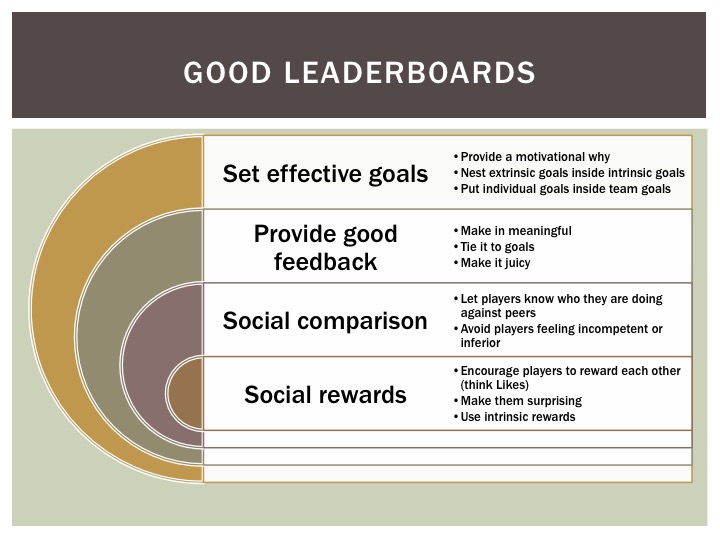
To design a leaderboard that drives behavior and incorporates the three needs above, the authors point to four “ingredients”:
Slide1

  • Goal-setting.Goal-setting involves giving or guiding a user toward a goal, and has become recommended as an effective building block for behavior change. The goal of most leaderboards implicitly is to be number one. You need to go beyond this implicit goal and guide your player toward a goal. Effective goals include having fun, learning and showing autonomy. They also recommend nesting intrinsic goals with the extrinsic goals, like making yourself a better poker player by competing on the leaderboard. Finally, an effective technique nests individual goals inside team goals, so the leaderboard is more about playing with others than being number one.

    There are also some goals you should avoid as they will prove demotivating. These goals include meaningless rewards (get more worthless points by finishing number one), emphasizing outcomes players cannot control and focusing on pride (i.e. you should win because only the smartest win).

  • Feedback. A strong feedback mechanic can promote feelings of mastery and competence. You should provide feedback for players on how they are progressing tied to the above goals they have set. The authors also suggest proving juicy feedback, “juicy feedback is varied, unexpectedly excessive sensual positive feedback on small user actions and achievements.”
  • Social comparison. Social comparison helps players understand how they are doing compared to others. Rankings are inherently a form of social comparison. The trick is doing it right because social comparison can make people feel ineffective and unrelated. People tend to compare themselves with people above them so it is easy for them to then feel incompetent.

    There are some techniques to mitigate the risks in social comparison. First, you can tell players they have achieved a standard, even if they did not finish first. Second, explain why players got the score they did and explain how they can do better. Third, give players a choice of playing more or stopping (putting them in control). Finally, acknowledge losing is not fun. If you keep players focused on improving and playing well, they are likely to stay engaged. Also, if they lose as part of a team, the impact of the loss will not be as great, thus it is critical to emphasize connections and relationships.

  • Social rewards. Just as Facebook uses the Like button, let other players reward a player for their activity. You can achieve this impact by letting them follow the player or just sending a virtual high-five. It also helps to make the rewards surprising, as predictable rewards undermine intrinsic motivation.

What to do

Rather than avoiding leaderboards, build them but build them correctly. If you employ a lazy approach and just rank players 1 to one million, the leaderboard will not work well and impact will diminish over time. If you take the time, however, to set up effective goal setting, provide good feedback, employ social comparison and have strong social rewards, you will have a winning feature and move up the AppStore leaderboard.

Key takeaways

  1. While leaderboards are a central feature in many games, for them to be effective you must build them properly or else they will be ineffective.
  2. A key to good design is keeping players from feeling incompetent or inferior.
  3. The other critical components of powerful leaderboards are clear goals, a strong feedback loop, social comparison and rewards that are social.
Share this:

  • Click to share on Facebook (Opens in new window) Facebook
  • Click to share on LinkedIn (Opens in new window) LinkedIn
Like Loading...
Unknown's avatarAuthor Lloyd MelnickPosted on June 19, 2018June 18, 2018Categories General Social Games Business, General Tech Business, Social CasinoTags Feedback, game design, goals, leaderboards3 Comments on How to build a Leaderboard that actually works and drives KPIs

How to encourage your team to speak freely

While almost every company professes and often tries to get its employees to speak freely, most are unsuccessful. Employees either feel retribution for speaking openly or believe their efforts will be fruitless. An article in the Harvard Business Review, Can Your Employees Really Speak Freely by James Detert and Ethan Burris, shows the value of getting employees to speak up and how to do it.

Many leaders believe that by professing to have an open door policy, employees will come to them to raise issues or suggest improvements. It could be a project is going to miss its schedule or one of your manager’s is putting in a lackluster effort, Detert and Burris’ research shows your team is more likely to keep quiet than to question initiatives or suggest new ideas. When employees freely express their concerns, companies experience higher retention and better performance.

As Detert and Burris write, “leaders use a variety of tools to get people to speak up, like “climate” surveys and all-staff feedback sessions. Many of these efforts focus on improving communication up and down the hierarchy. But they usually fall short, regardless of good intentions, for two key reasons: a fear of consequences (embarrassment, isolation, low performance ratings, lost promotions, and even firing) and a sense of futility (the belief that saying something won’t make a difference, so why bother?).“

Why your team keeps quiet

There are two key reasons why employees fail to express their concerns, fear and futility. While you may think you are encouraging your team to speak up, you actually may be doing the opposite and leaving them afraid to openly discuss issues.

Part of the problem comes from relying on anonymous feedback. This policy has multiple problems:

  1. Encouraging anonymous feedback implicitly says it is not safe to raise issues publicly. If you were truly an open organization, people would not have to comment anonymously.
  2. Rather than focus on the content of the anonymous comment, the focus often becomes a hunt for who made or could have made the comment.
  3. It can be difficult to address issues while protecting the identify of the people who raised them.

Another element that contributes to the fear factor is sending signals that you are in charge. While you may be encouraging open conversation, forcing someone to sit in a small chair in your large office or set up an appointment can create a power situation. In this atmosphere, people may not be willing to tell you the unvarnished truth.

The other enemy of open conversation is futility, people feel it just will not make a difference to raise issues. This is referred to as the why-bother attitude. One contributor to this attitude is when leaders fail to convey issues to their superiors. If your team members raise concerns but you fail to address them with your superior, they feel they have wasted their time.

Another contributor to this problem is leaders who are unclear about the input they want. They may encourage “all” feedback but you have your own priorities and will only act on input that can help you advance these priorities (it could be improving efficiency, making marketing more user driven, etc.). By telling your team to bring you all issues but then not acting on all issues, and we all need to prioritize, they will feel their input is fruitless.

The most frustrating area to me that leads to people suppressing comments is a lack of resources to address the issues raised. You may spend excessive time getting ideas for new products or software that could improve efficiency, but you then do not have the resources to create the product or license the software. Devoting resources to collecting ideas without making commitments, financial and otherwise, to see some of them to fruition can lead your team to feel their input will have no impact.

Slide1

How to create a more vocal culture

While saying be open and not always closing your door probably will not generate open conversation, there are ways to get strong feedback from your team.

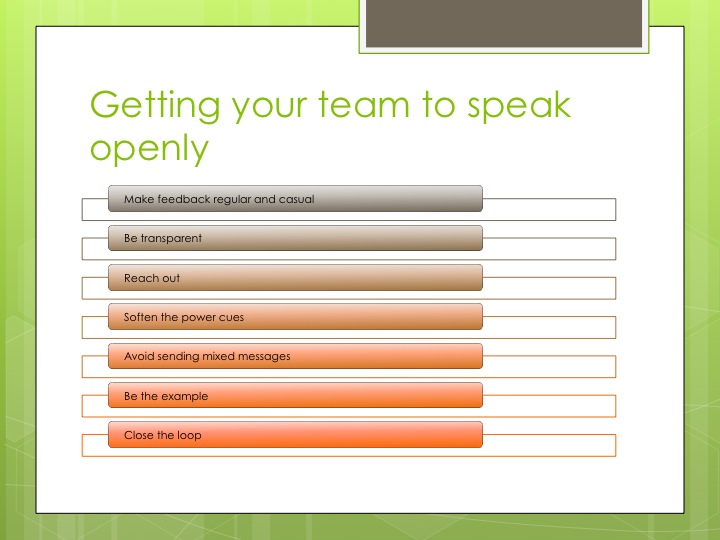
  • Make feedback a regular and casual exchange. Try to schedule regular one-to-one meetings with your team, this will make it less of a special even when they have something to share. The meetings also should not be with only your direct reports, but try to reach out to all the units you oversee, the ideas are not limited to your direct reports. Even when there is nothing to discuss, still hold the meeting and see what comes out. Often, if there is not a set agenda, the true issues will rise to the top.
  • Be transparent. As Detert and Burris write, “transparency about feedback processes can reduce anxiety and increase participation…. Spelling out guidelines and commitements up front made contributing feel less daunting and futile to employees.”
  • Reach out. When you want to understand what your team thinks of something, ask them. Call people in and ask them what are the company’s biggest problems or where they feel costs can be reduced or what is wrong with your product. Soliciting feedback proactively is more effective than just listening to it when someone brings an issue to you. First, it allows you to focus on your biggest problems. Second, since it is an issue you are already trying to address, there is a higher likelihood you will act on the employee’s feedback.
  • Soften the power cues. To get earnest feedback, play down the power relationship. Walk over to your employee to talk to them rather than asking them to your office. Sit with them at a table rather than having them sit across from your desk. Join your employees for lunch or a drink. The key is to interact with your team as peers rather than subordinates.
  • Avoid sending mixed messages. Do not encourage ideas and then cut them apart. Make sure not to focus the employee on process, it does not matter if their Powerpoint is awful, but instead pull the ideas out of the conversation and see which ideas will help the company.
  • Be the example. Employees feel inspired when they see you advocating for them. It is important to help move the ideas along. Unless you feel they will hurt the company, and provide visibility to the team on your efforts in getting their ideas implemented. As Detert and Burris write, “Employees feel inspired when they see you advocating for them. While it’s great when your subordinates can see you speaking up, in many cases that’s not possible, because they aren’t present when you interact with your own boss. But you can tell them what happened and involve them directly in any follow-up steps.”
  • Close the loop.The most critical element in creating a culture where people are truly open with their feedback and suggestions is telling them what you did with their idea and what they can expect as a result. Even in cases where the idea was not implemented, tell them why it was not moved forward so that they both see it was taken seriously and can adjust future suggestions to the reality of the business. Also, where possible, tell the entire team about the feedback you received and how it was acted upon.

While it is much easier to say you have an open door policy than follow through on the seven suggestions above, these suggestions will prompt your team to raise important issues to improve your company. You will find the effort is well worth it both in increased morale and a better business.

Key takeaways

  1. Open feedback and suggestions improve retention and the company’s performance, yet just having an “open door policy is not effective at soliciting feedback.
  2. Most people do not speak openly out of fear that there will be negative consequences or a belief that nothing will happen if they do.
  3. To counteract this reluctance, make feedback regular, be transparent, proactively reach out to employees, soften the power position, set an example by bringing ideas up the corporate chain and provide feedback on what action came from the suggestion or criticism.

Share this:

  • Click to share on Facebook (Opens in new window) Facebook
  • Click to share on LinkedIn (Opens in new window) LinkedIn
Like Loading...
Unknown's avatarAuthor Lloyd MelnickPosted on February 10, 2016February 9, 2016Categories General Social Games Business, General Tech BusinessTags communication, Feedback, leadership, management2 Comments on How to encourage your team to speak freely

Get my book on LTV

The definitive book on customer lifetime value, Understanding the Predictable, is now available in both print and Kindle formats on Amazon.

Understanding the Predictable delves into the world of Customer Lifetime Value (LTV), a metric that shows how much each customer is worth to your business. By understanding this metric, you can predict how changes to your product will impact the value of each customer. You will also learn how to apply this simple yet powerful method of predictive analytics to optimize your marketing and user acquisition.

For more information, click here

Follow The Business of Social Games and Casino on WordPress.com

Enter your email address to follow this blog and receive notifications of new posts by email.

Join 791 other subscribers

Most Recent Posts

  • Join me at PDMA Inspire for my talk on new product prioritization
  • Why keep studying?
  • The next three years of this blog
  • Interview with the CEO of Murka on the biggest growth opportunity in gaming, Barak David

Lloyd Melnick

This is Lloyd Melnick’s personal blog.  All views and opinions expressed on this website are mine alone and do not represent those of people, institutions or organizations that I may or may not be associated with in professional or personal capacity.

I am a serial builder of businesses (senior leadership on three exits worth over $700 million), successful in big (Disney, Stars Group/PokerStars, Zynga) and small companies (Merscom, Spooky Cool Labs) with over 20 years experience in the gaming and casino space.  Currently, I am the GM of VGW’s Chumba Casino and on the Board of Directors of Murka Games and Luckbox.

Topic Areas

  • Analytics (114)
  • Bayes' Theorem (8)
  • behavioral economics (8)
  • blue ocean strategy (14)
  • Crowdfunding (4)
  • DBA (2)
  • General Social Games Business (459)
  • General Tech Business (195)
  • Growth (88)
  • International Issues with Social Games (50)
  • Lloyd's favorite posts (101)
  • LTV (54)
  • Machine Learning (10)
  • Metaverse (1)
  • Mobile Platforms (37)
  • Prioritization (1)
  • Social Casino (52)
  • Social Games Marketing (105)
  • thinking fast and slow (5)
  • Uncategorized (33)

Social

  • View CasualGame’s profile on Facebook
  • View @lloydmelnick’s profile on Twitter
  • View lloydmelnick’s profile on LinkedIn

RSS

RSS Feed RSS - Posts

RSS Feed RSS - Comments

Categories

  • Analytics (114)
  • Bayes' Theorem (8)
  • behavioral economics (8)
  • blue ocean strategy (14)
  • Crowdfunding (4)
  • DBA (2)
  • General Social Games Business (459)
  • General Tech Business (195)
  • Growth (88)
  • International Issues with Social Games (50)
  • Lloyd's favorite posts (101)
  • LTV (54)
  • Machine Learning (10)
  • Metaverse (1)
  • Mobile Platforms (37)
  • Prioritization (1)
  • Social Casino (52)
  • Social Games Marketing (105)
  • thinking fast and slow (5)
  • Uncategorized (33)

Archives

  • September 2023
  • December 2021
  • July 2021
  • March 2021
  • February 2021
  • January 2021
  • December 2020
  • November 2020
  • October 2020
  • September 2020
  • August 2020
  • July 2020
  • June 2020
  • May 2020
  • April 2020
  • March 2020
  • February 2020
  • January 2020
  • November 2019
  • October 2019
  • September 2019
  • June 2019
  • May 2019
  • April 2019
  • March 2019
  • February 2019
  • January 2019
  • December 2018
  • June 2018
  • May 2018
  • April 2018
  • March 2018
  • February 2018
  • January 2018
  • December 2017
  • June 2017
  • May 2017
  • April 2017
  • March 2017
  • February 2017
  • January 2017
  • December 2016
  • November 2016
  • October 2016
  • September 2016
  • June 2016
  • May 2016
  • April 2016
  • March 2016
  • February 2016
  • January 2016
  • December 2015
  • November 2015
  • October 2015
  • September 2015
  • July 2015
  • June 2015
  • May 2015
  • April 2015
  • March 2015
  • February 2015
  • January 2015
  • December 2014
  • November 2014
  • October 2014
  • September 2014
  • August 2014
  • July 2014
  • June 2014
  • May 2014
  • April 2014
  • March 2014
  • February 2014
  • January 2014
  • December 2013
  • November 2013
  • October 2013
  • September 2013
  • August 2013
  • July 2013
  • June 2013
  • May 2013
  • April 2013
  • March 2013
  • February 2013
  • January 2013
  • December 2012
  • November 2012
  • October 2012
  • September 2012
  • August 2012
  • July 2012
  • June 2012
  • May 2012
  • April 2012
  • March 2012
  • February 2012
  • January 2012
  • December 2011
  • November 2011
  • October 2011
  • September 2011
  • August 2011
  • July 2011
  • June 2011
  • May 2011
  • December 2010
January 2026
S M T W T F S
 123
45678910
11121314151617
18192021222324
25262728293031
« Sep    

by Lloyd Melnick

All posts by Lloyd Melnick unless specified otherwise
Google+

Enter your email address to subscribe to this blog and receive notifications of new posts by email.

Join 791 other subscribers
Follow Lloyd Melnick on Quora

RSS HBR Blog

  • How to Handle a Difficult Board Member
  • When Being a Family Business Becomes a Competitive Advantage
  • How to Strengthen Your Focus When Demands Never Let Up
  • The Risks of Prioritizing Short-Term Revenue Over Customer Fit
  • When There’s Nowhere to Promote a Star Employee
  • Why AI Boosts Creativity for Some Employees but Not Others
  • Where McKinsey—and Consulting—Go From Here
  • How Equitable Confronted Its Inertia After 160 Years in Business
  • Our Favorite Management Tips on Creating Meaning and Happiness at Work
  • The Case for Sharpening Your Math Skills in the Age of AI

RSS Techcrunch

  • An error has occurred; the feed is probably down. Try again later.

RSS MIT Sloan Management Review Blog

  • Your People Are Not All Right
  • Five Trends in AI and Data Science for 2026
  • Stop Making Hollow Apologies at Work
  • Calm: The Underrated Capability Every Leader Needs Now
  • The Top Five MIT SMR Videos of 2025
  • Three Steps Toward Fairer Talent Management
  • From Crisis to Coopetition: What Leaders Can Learn From Anesthesiologists
  • AI Coding Tools: The Productivity Trap Most Companies Miss
  • How Procter & Gamble Uses AI to Unlock New Insights From Data
  • Rewire Organizational Knowledge With GenAI
The Business of Social Games and Casino Website Powered by WordPress.com.
  • Subscribe Subscribed
    • The Business of Social Games and Casino
    • Join 726 other subscribers
    • Already have a WordPress.com account? Log in now.
    • The Business of Social Games and Casino
    • Subscribe Subscribed
    • Sign up
    • Log in
    • Report this content
    • View site in Reader
    • Manage subscriptions
    • Collapse this bar
 

Loading Comments...
 

    %d