Skip to content

The Business of Social Games and Casino

How to succeed in the mobile game space by Lloyd Melnick

Tag: Netflix

How to avoid misleading data, aka Fake Analytics

Someone I respect recently posted an article from a news source that I also respect, but the article actually highlighted how data can mislead, either intentionally or not. An article on the Guardian.com, Amazon Prime Video’s growth outpaces Netflix in UK, tells the story of how Prime Video is growing at a faster rate than Netflix. The sub-title stresses that, “cross-promotion to Amazon shoppers and new on-demand series rank it top in 2017.”

The article goes on to point out several reasons why Amazon is top in 2017:

  • New series of the Grand Tour and Transparent are fueling growth
  • Hefty cross promotion of Prime Video to regular Amazon shoppers is also contributing
  • Prime Video increased its subscribers to 4.3 million in 2017, representing 41% year-on-year growth
  • Netflix only grew 25% in the same period.

If you stopped reading the article there, and who reads an article until the end these days, you would think Amazon is doing a great job in the video market and Netflix should be very worried. If you worked at Amazon and get a similar report from your analytics team, you might high-five the head of Amazon Prime in the UK. If you were at Netflix and got a similar report from your analytics team, you might panic a little and divert resources to the UK.

The problem is that although the data is accurate it is misleading. The key figure is that Netflix added 1.6 million new subscribers in 2017, while Amazon added 1.3 million new subscribers for Prime Video in the UK. Thus Netflix actually extended its lead over Amazon by 300,000 customers in 2017. Netflix is in 8.2 million UK households (at the end of 2017), versus 3 million for Amazon.

How different would the story have been if the headline was Netflix extends lead by another 300,000. How different would the reception be at Amazon and Netflix respective headquarters if their analytics team presented data in this way.
Slide1

The mistake

The mistake in this case (and I will be generous and assume the Guardian was not click-baiting) is comparing growth rates (or any other rates) while neglecting the size of the relative base. It would be the same in football if you looked at Messi’s goal scoring versus a second year player. The latter may be scoring twice as many goals as he did as a rookie while Messi may have been flat or added a few. Thus the young player is growing his goal scoring 100% while Messi is adding only a few percent to his lifetime numbers. That does not mean that the second year player is either having as good a season as Messi or closing the gap.

The same happens in the mobile game world. Your slot game may be growing 100% month on month while Slotomania is growing 10% (not real numbers), but because their base is so high they are adding millions in revenue while you are still not profitable.

The key is only comparing trends when you are comparing apples to apples. Trends mean something if you are looking at two products or companies of comparable size in the same stage of their lifecycle. Looking at two auto companies who launched an SUV the same year in the same market makes sense, comparing growth rates of two automakers, one who is new and has no dealer network with one that has been around 100 years is worthless.

The answer

You need to look deeper into the numbers. Look at the absolute numbers. Look at the pricing. Look at the target market. Look at percent usage (in the Amazon case, how engaged are Prime users who may have bought it just to get free shipping versus Netflix users). The key to using data effectively is look deeply at the data and understand what is driving the results. You also need to make sure your analytics team does the same. It is very easy to make conclusions based on obvious trends. Avoid superficial analysis and, more importantly, superficial conclusions.

Key takeaways

  1. A recent article implied Amazon Prime Video was doing better than Netflix in the UK as it grew 41% versus 25% by Netflix.
  2. The article is misleading as Netflix actually added 300,000 more customers than Amazon. This obfuscation shows how data can mislead if you focus on trends but are not comparing comparable companies or products.
  3. The key to using data effectively is look deeply at the data and understand what is driving the results.
Share this:

  • Click to share on Facebook (Opens in new window) Facebook
  • Click to share on LinkedIn (Opens in new window) LinkedIn
Like Loading...
Unknown's avatarAuthor Lloyd MelnickPosted on May 8, 2018May 8, 2018Categories General Social Games Business, General Tech Business, GrowthTags amazon, analytics, NetflixLeave a comment on How to avoid misleading data, aka Fake Analytics

Content cadence, where Netflix gets it wrong

Content cadence, where Netflix gets it wrong

I don’t very often disagree with Netflix strategy, but the way they drop content is probably sub-optimal and Netflix can learn much from the mobile game industry. One of the key drivers for success for a free-to-play game is the release of new content. To succeed in the space, game companies have to launch enough content to keep players engaged and returning regularly, while also making sure the high valued players never run out of content. It is a tricky balancing act because content is not free, and it is particularly difficult to create compelling content, so you need to release the content that will optimize value to your players.

Netflix also grasps the value of content. It has gone from a distribution platform (initially DVDs, then streaming) to a content company. Their focus now is on creating Netflix Original series (House of Cards, Narcos, Stranger Things, Daredevil, etc.), as content is what is driving people to subscribe and then stay with Netflix.

While I am very cautious whenever I criticize Netflix (it has a great understanding of its customers through very sophisticated analytics), their approach to releasing content is not as strategic as mobile game companies. Netflix largely pioneered binge watching, releasing a season of content at one time and encouraging customers to spend a day or so watching all of the episodes. The benefit of this approach is that it creates anticipation leading up to the new season and customer focus during the binge. Game companies, however, have learned it is best to release a stream of content regularly rather than in large bursts.

Why regular content releases are optimal

A steady stream of content creates habits for consumers where they come back regularly to see what is new. If a mobile game company launches a new slot every couple of weeks or a mid-core company releases a new military unit, the player will return regularly to see what the new content is. Even if the content is not what the customer is looking for, they will then return in the future to see if there is something closer to their desires.

What companies also find is that consumers and players, particularly the high valued ones, churn through content much faster than you expect. Thus, you might feel that the 50 new levels you have launched is enough content to keep players happy for months, but your biggest spenders are likely to consumer it in weeks or even days and then have no reason to return to your game or site. A steady stream of content, however, allows you to manage how quickly they consume the content and always ensure they have something new every few days or weeks.

Regular content releases also increases word of mouth marketing. People often will discuss with their friends and colleagues what happened in the previous episode and what they expect to happen next. Binge watching if anything is the opposite, since you see the entire story arc (at least for the season) in a short period, unless you share that short period with your friends you are encouraged not to discuss the show because you do not want to provide spoilers. While not as strong a force in games, new content is one of the more powerful drivers of social media engagement, and by providing it regularly you ensure strong engagement over time.

Content is also one of the strongest, if not the strongest, triggers for monetization. By releasing content regularly, you are also triggering monetization regularly. While a big drop of content may trigger a large spurt in monetization (or subscriptions if you are Netflix), a constant stream gets people purchasing weekly or every few weeks.

The biggest reason a stream of content is best

The strongest driver of value from regular content releases is that you become part of your customer’s consciousness, you get inside their head. Dan Ariely, the noted behavioral economist, was a Board of Advisor’s member of my first company, Merscom, and taught me perhaps my most valuable lesson in business, the key for an entertainment product to be successful is for the customer or player to be thinking about it when they are not playing. I remember the early days of Facebook games, when people would wake up in the middle of the night to tend their crops in Farmville or tend to their pets in Pet Society, both of those games made hundreds of millions of dollars for their creators. When 24 first hit television (before it turned into 48, 72, 96, etc.), it captured a huge audience share because viewers would spend the week thinking about and discussing what was going to happen to Jack next. These entertainment experiences truly got into the minds of fans even, and maybe more so, when they were not enjoying the product.

An anecdotal example

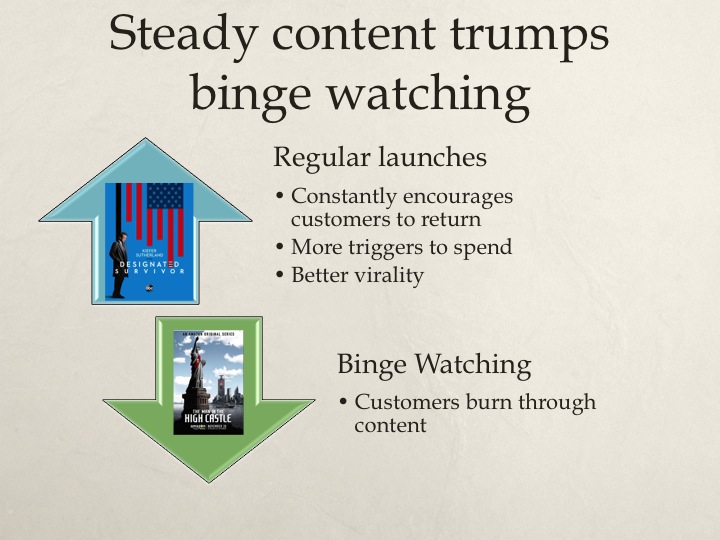
A recent experience drove home why a steady stream of content is better than bulk content drops. There are two series that I like about equally, Amazon’s Prime Man in the High Castle and Designated Survivor (on Netflix in Europe). The former follows the binge watch model, the first season was released a year ago and the new season was released in December. After watching the first season of Man in the High Castle, I probably did not watch anything else on Amazon Prime for about ten months. I also pretty much lost interest in the series and while I did watch the second season, it did not elicit the emotions the first season did (it could have been due to the actual content, though trying to look at it objectively the seasons seemed comparable). When I returned to watch season two, I noticed other Amazon Prime originals I was interested in and put on my watch list. With the binge watching strategy, Amazon lost a chance to have me more engaged (and thus potentially sell me other Amazon products) and made me less likely to watch season three.

slide1

Conversely, Netflix released new episodes of Designated Survivor on a weekly basis (I believe it is an ABC series and not a Netflix original so they did not control the content cadence). I found myself not only coming back every week, but coming back every few days as I was not sure when the new episode would appear. Moreover, I kept thinking about the plot twists and nuances in the series, which has made my enjoyment of the series increase significantly over time and prompted me to discuss it with friends. With the regular content cadence, Netflix has kept me more engaged while increasing the bond with the customer.

The consequences of getting it wrong

Many of you are probably thinking the same thing I was, well if Netflix is doing it wrong, sign me up. So if Netflix has the content cadence issue wrong, why are they so successful?

As I wrote in a previous post, industry leaders and not omniscient. They are often leaders because they are great companies and are providing great value to their customers or players, but they are not perfect. This underlying value can often cover many mistakes, or at least sub-optimal behavior.

That seems to be what is happening with Netflix. They have evolved into such a strong content creation machine, with the ability to create hit series regularly; they have replaced regular release of new episodes of popular shows with simply releasing new popular shows regularly. Thus, when you finish your season of Narcos, you keep coming back for Luke Cage and then Stranger Things. It is not optimal as it is expensive to create continually new series and at some point the creative juices may be as successful.

My money is on Ariely

When planning your content strategy, I would always put stock in the thoughts of Dan Ariely. Create a strategy that always keeps your content, and thus your company, in the mind of consumers. That way you will keep them engaged and ensure your best customers keep spending with you.

Key takeaways

  • The mobile games industry has discovered that release content regularly (weekly, fortnightly, etc) is optimal in creating player engagement and monetization.
  • The practice of releasing large quantities of content once or twice a year, the binge watching promoted by Netflix and Amazon Prime, is not as effective as regular content releases.
  • The greatest disadvantage of large content drops is that the content fails to integrate with the customer’s consciousness when they are not watching or playing, thus making customers less valuable.

Share this:

  • Click to share on Facebook (Opens in new window) Facebook
  • Click to share on LinkedIn (Opens in new window) LinkedIn
Like Loading...
Unknown's avatarAuthor Lloyd MelnickPosted on January 4, 2017January 10, 2017Categories General Social Games Business, General Tech Business, GrowthTags content, NetflixLeave a comment on Content cadence, where Netflix gets it wrong

Focusing on the core is the key to your company’s survival and success

There is no shortage of theories and articles on how to grow a business, but one I recently saw — What Netflix and House of Cards can teach us about why most companies fail by Harish Abbott — does a great job of showing the key to survival and success. Abbott starts with a statement that most experienced entrepreneurs know all too well but those who have gotten their business experience from television do not grasp, “most companies fail.” These failures, however, do not come from poor ideas or even lack of demand. The key cause of failure is not focusing on your core offering.

Focus on your core offering

To not only avoid failure but also sport significant growth, you need to identify what is your core offering and build off of that knowledge. Abbott uses the example of Netflix. Netflix, once it moved from sending DVDs to streaming, realized its key value and differentiator was content. Although it needed to deliver this content in a seamless manner, the quality of the content was what would be key to its success.

Conversely, customers did not care how they received the content, as long as it was a good experience that did not actually interfere with consuming the content. As Abbott wrote, Customers don’t care how House of Cards gets to them, so long as they can watch it anytime, anywhere. For Netflix, the realization was that the streaming technology itself was not Core to their business, but still Critical. Instead of enduring a costly and distracting build out of proprietary streaming infrastructure, Netlfix turned to Amazon Web Services (“AWS”). Netflix realized that AWS was already fast, stable, and secure.”

By outsourcing elements of its offering that were not core, they could then focus on the actual core offering. Initially, that meant securing more content than any of its competitors, the content its customers wanted. Then it meant creating new content that competitors could never access, from House of Cards to Orange is the New Black to Narcos to Stranger Things. By focusing on the core offering, Netflix now enjoys a valuation of over $40 billion.

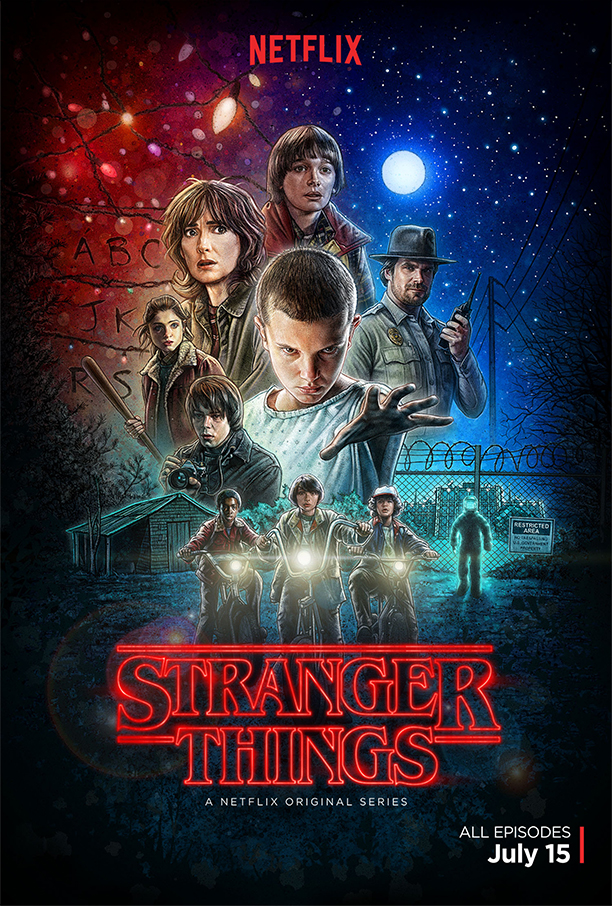
stranger-things-poster-netflix1

Outsource what is not primary

The corollary to focusing on your core offering is outsourcing what is not core. As I just mentioned, although streaming is critical to its users experience, Netflix did not try to build a superior streaming technology. Instead, it leveraged AWS to give its users an optimal streaming experience. Marketing is core to Coke’s business, so it focuses on doing marketing internally and using external companies for bottling even though bottling is critical in the user experience (nobody wants a flat glass of coke). Apple is great at design but let’s third parties do the bulk of manufacturing.

The key is that these great, huge companies know their core strength, build on that and use others to provide everything else. The companies that fail try to do everything themselves and then cannot leverage their true advantages.

The key to success

To succeed, you first need to identify what is the core value you are providing. You then need to figure out how to focus on leveraging this core offering while using partners and products to ensure the other parts of your product still create a great customer experience.

Key takeaways

  • The key to success, and survival, is understanding your business’s core offering, why your customers will consume your product.
  • Then focus your efforts on leveraging this core offering, making it better for your customers and more difficult for competitors to copy.
  • Find good third parties to provide the other key elements of your business, but not core elements, that are necessary for a great customer experience but are not your company’s strength.

Share this:

  • Click to share on Facebook (Opens in new window) Facebook
  • Click to share on LinkedIn (Opens in new window) LinkedIn
Like Loading...
Unknown's avatarAuthor Lloyd MelnickPosted on September 14, 2016September 10, 2016Categories General Social Games Business, General Tech Business, GrowthTags core, Netflix, outsourcing1 Comment on Focusing on the core is the key to your company’s survival and success

The right way to build, run and compensate your team

Netflix logoA recent article in Harvard Business Review by Netflix’s former Chief Talent Officer, Patty McCord, did a great job of explaining five core principles of building your team that could benefit any company. McCord, who was Chief Talent Officer at Netflix for 14 years, believes their policy towards HR is a key reason the company has been so successful. At its root, Netflix’s success is tied to hiring great people, and by hiring great people it creates a much better environment for the other great people (as everyone carries their weight). The other related foundation of Netflix’s success with its people was a willingness to let go of those who were not a good fit (or no longer a good fit). Netflix’s principles can help any company build a fantastic and high performing team. Overall, there are five core principles to Netflix’s success with its team.

Hire adults and treat them like adults

Rather than create long, complex and often bureaucratic policies on how employees should do everything, Netflix provides very high-level guidance and expects its employees to act in the company’s best interest. During the hiring process, it focuses on employees who can do this without strict guidance or careful observation. If they find they made a hiring mistake, they let the employee go. Continue reading “The right way to build, run and compensate your team”

Share this:

  • Click to share on Facebook (Opens in new window) Facebook
  • Click to share on LinkedIn (Opens in new window) LinkedIn
Like Loading...
Unknown's avatarAuthor Lloyd MelnickPosted on January 30, 2014February 6, 2014Categories General Social Games BusinessTags Compensation, HR, leadership, NetflixLeave a comment on The right way to build, run and compensate your team

Get my book on LTV

The definitive book on customer lifetime value, Understanding the Predictable, is now available in both print and Kindle formats on Amazon.

Understanding the Predictable delves into the world of Customer Lifetime Value (LTV), a metric that shows how much each customer is worth to your business. By understanding this metric, you can predict how changes to your product will impact the value of each customer. You will also learn how to apply this simple yet powerful method of predictive analytics to optimize your marketing and user acquisition.

For more information, click here

Follow The Business of Social Games and Casino on WordPress.com

Enter your email address to follow this blog and receive notifications of new posts by email.

Join 791 other subscribers

Most Recent Posts

  • Join me at PDMA Inspire for my talk on new product prioritization
  • Why keep studying?
  • The next three years of this blog
  • Interview with the CEO of Murka on the biggest growth opportunity in gaming, Barak David

Lloyd Melnick

This is Lloyd Melnick’s personal blog.  All views and opinions expressed on this website are mine alone and do not represent those of people, institutions or organizations that I may or may not be associated with in professional or personal capacity.

I am a serial builder of businesses (senior leadership on three exits worth over $700 million), successful in big (Disney, Stars Group/PokerStars, Zynga) and small companies (Merscom, Spooky Cool Labs) with over 20 years experience in the gaming and casino space.  Currently, I am the GM of VGW’s Chumba Casino and on the Board of Directors of Murka Games and Luckbox.

Topic Areas

  • Analytics (114)
  • Bayes' Theorem (8)
  • behavioral economics (8)
  • blue ocean strategy (14)
  • Crowdfunding (4)
  • DBA (2)
  • General Social Games Business (459)
  • General Tech Business (195)
  • Growth (88)
  • International Issues with Social Games (50)
  • Lloyd's favorite posts (101)
  • LTV (54)
  • Machine Learning (10)
  • Metaverse (1)
  • Mobile Platforms (37)
  • Prioritization (1)
  • Social Casino (52)
  • Social Games Marketing (105)
  • thinking fast and slow (5)
  • Uncategorized (33)

Social

  • View CasualGame’s profile on Facebook
  • View @lloydmelnick’s profile on Twitter
  • View lloydmelnick’s profile on LinkedIn

RSS

RSS Feed RSS - Posts

RSS Feed RSS - Comments

Categories

  • Analytics (114)
  • Bayes' Theorem (8)
  • behavioral economics (8)
  • blue ocean strategy (14)
  • Crowdfunding (4)
  • DBA (2)
  • General Social Games Business (459)
  • General Tech Business (195)
  • Growth (88)
  • International Issues with Social Games (50)
  • Lloyd's favorite posts (101)
  • LTV (54)
  • Machine Learning (10)
  • Metaverse (1)
  • Mobile Platforms (37)
  • Prioritization (1)
  • Social Casino (52)
  • Social Games Marketing (105)
  • thinking fast and slow (5)
  • Uncategorized (33)

Archives

  • September 2023
  • December 2021
  • July 2021
  • March 2021
  • February 2021
  • January 2021
  • December 2020
  • November 2020
  • October 2020
  • September 2020
  • August 2020
  • July 2020
  • June 2020
  • May 2020
  • April 2020
  • March 2020
  • February 2020
  • January 2020
  • November 2019
  • October 2019
  • September 2019
  • June 2019
  • May 2019
  • April 2019
  • March 2019
  • February 2019
  • January 2019
  • December 2018
  • June 2018
  • May 2018
  • April 2018
  • March 2018
  • February 2018
  • January 2018
  • December 2017
  • June 2017
  • May 2017
  • April 2017
  • March 2017
  • February 2017
  • January 2017
  • December 2016
  • November 2016
  • October 2016
  • September 2016
  • June 2016
  • May 2016
  • April 2016
  • March 2016
  • February 2016
  • January 2016
  • December 2015
  • November 2015
  • October 2015
  • September 2015
  • July 2015
  • June 2015
  • May 2015
  • April 2015
  • March 2015
  • February 2015
  • January 2015
  • December 2014
  • November 2014
  • October 2014
  • September 2014
  • August 2014
  • July 2014
  • June 2014
  • May 2014
  • April 2014
  • March 2014
  • February 2014
  • January 2014
  • December 2013
  • November 2013
  • October 2013
  • September 2013
  • August 2013
  • July 2013
  • June 2013
  • May 2013
  • April 2013
  • March 2013
  • February 2013
  • January 2013
  • December 2012
  • November 2012
  • October 2012
  • September 2012
  • August 2012
  • July 2012
  • June 2012
  • May 2012
  • April 2012
  • March 2012
  • February 2012
  • January 2012
  • December 2011
  • November 2011
  • October 2011
  • September 2011
  • August 2011
  • July 2011
  • June 2011
  • May 2011
  • December 2010
December 2025
S M T W T F S
 123456
78910111213
14151617181920
21222324252627
28293031  
« Sep    

by Lloyd Melnick

All posts by Lloyd Melnick unless specified otherwise
Google+

Enter your email address to subscribe to this blog and receive notifications of new posts by email.

Join 791 other subscribers
Follow Lloyd Melnick on Quora

RSS HBR Blog

  • How One Manufacturer Achieved Net Zero at Zero Cost
  • What Can U.S. Employers Do About Rising Healthcare Costs?
  • When You Have to Execute a Strategy You Disagree With
  • 4 Ways to Build Durable Relationships with Your Most Important Customers
  • What Jargon Says About Your Company Culture
  • Research: When Used Correctly, LLMs Can Unlock More Creative Ideas
  • Your New Role Requires Strategic Thinking…But You’re Stuck in the Weeds
  • For Circular Economy Innovation, Look to the Global South
  • Why Great Leaders Focus on the Details
  • Corporate Disclosure in the Age of AI

RSS Techcrunch

  • An error has occurred; the feed is probably down. Try again later.

RSS MIT Sloan Management Review Blog

  • AI Coding Tools: The Productivity Trap Most Companies Miss
  • How Procter & Gamble Uses AI to Unlock New Insights From Data
  • Rewire Organizational Knowledge With GenAI
  • Hungry for Learning: Wendy’s Will Croushorn
  • Beat Burnout: 10 Essential MIT SMR Reads
  • How Leaders Stay True to Themselves and Their Stakeholders
  • Our Guide to the Winter 2026 Issue
  • Broadening Future Perspectives at the Bank of England
  • A Faster Way to Build Future Scenarios
  • Assess What Is Certain in a Sea of Unknowns
The Business of Social Games and Casino Website Powered by WordPress.com.
  • Subscribe Subscribed
    • The Business of Social Games and Casino
    • Join 726 other subscribers
    • Already have a WordPress.com account? Log in now.
    • The Business of Social Games and Casino
    • Subscribe Subscribed
    • Sign up
    • Log in
    • Report this content
    • View site in Reader
    • Manage subscriptions
    • Collapse this bar
 

Loading Comments...
 

    %d