Skip to content

The Business of Social Games and Casino

How to succeed in the mobile game space by Lloyd Melnick

Month: January 2020

Beware of equating sector performance with that of a dominant company

Beware of equating sector performance with that of a dominant company

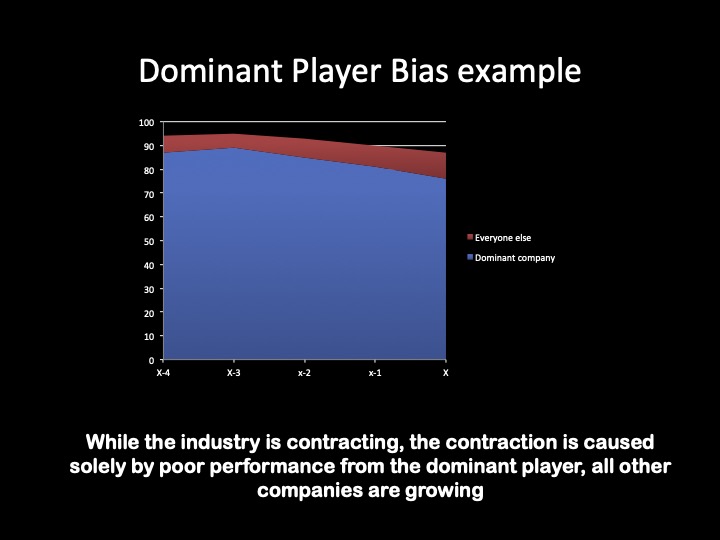
One cognitive bias that is often overlooked is equating the performance of an industry or sector with that of its dominant player. When one company represents 60, 70, 80+ percent of a market, its fortunes will drive the growth (or decline) rate of the industry. This growth, however, may be due to mistakes or issues with the dominant company rather than the underlying market and potential of the space. This bias, what I refer to as Dominant Player Bias, risks abstaining from good business opportunities and misallocating resources, missing Blue Oceans and accepting sub-optimal performance. The chart below shows how one company’s poor performance can imply the entire sector is contracting, though the problems are due to the dominant company rather than reduced interest:
Slide1

There are many examples where the fortunes of the dominant company are equated with the fortunes of the industry. Facebook has nearly 70 percent of the social media market and if people lose interest in Facebook, it drives a decline in social media usage. Roughly, a 20 percent drop by Facebook, would drive down overall social media numbers about percent 15 percent (I am not using real numbers for the purpose of this example). Thus, investors may invest less in social media or other companies may accept declining usage because they feel the industry is contracting significantly. The actual cause though may be Facebook’s customers’ dissatisfaction with privacy or advertising policies. Dominant player bias has caused these investors and competitors to equate Facebook’s performance with the social media landscape.

There are several actual examples of dominant player bias (the Facebook one above is for illustrative purposes only). When Zynga’s performance dropped significantly after its IPO in 2011, many heralded the end of social gaming. The success (and valuation) of companies like King.com, Epic, Supercell, etc., show that the underlying market remained healthy and Zynga was performing due to internal issues (shift to mobile, reliance on the Facebook feed, etc.).

Underestimating the market

The first problem caused by Dominant Player Bias is that it prompts companies to underestimate, and thus under-invest, in a market. To use the Facebook example, if Facebook is facing difficulties but people misinterpret its problems for shrinking demand for social media, they are underestimating the market and thus missing potential opportunities. These opportunities include:

  • The dominant player under-investing and seeking to diversify. If they do not realize that internal decisions have led to falling performance, they may seek to diversify or even exist a market with high potential because they believe the potential market is smaller than it actually is
  • Competitors may shy away from trying to build a business in the market because they feel it is not worth the investment. This bias can result in under-investment in new product development, marketing or other avenues that companies could challenge the dominant player. In this case, dominant player bias is actually compounding the problem because if the market is shrinking due to poor performance by the dominant player, it is actually a great opportunity for someone else to come in and try to break its hold on the market.
  • Investors are less likely to fund companies with ideas that can disrupt the market if they perceive the sector is not attractive. Investors might underestimate the potential of an opportunity if they think the market is shrinking, though the market may only be shrinking because of poor decisions by the dominant player.

While dominant player bias can be either positive or negative, it is not a significant problem when it exaggerates the market potential. If a great company is continually expanding the market, then the great company’s performance is a good proxy for the overall opportunity.

You may miss a Blue Ocean

Another issue generated by Dominant Player Bias is that it might blind companies or investors to Blue Ocean opportunities. I have written several times about Blue Ocean strategy, rather than competing directly find an adjacent market space where there is no competition, and how Blue Oceans over time generate a higher return than competing in red oceans. If you succumb to Dominant Player Bias, however, you may never find the Blue Ocean because you falsely decide it is not worth looking for. This problem is particularly salient in industries with a dominant player, because their dominance may have prevented them from appealing to anyone except their existing customers (who they feel represent the entire market).

A great example of Dominant Player Bias and how a Blue Ocean strategy proved it wrong is the circus industry. Years ago, Ringling Brothers dominated the market. However, they let their product get stale and did not react well to changing tastes. Most observers at the time, 1984, believed that the overall circus market was dying and not worthy of investment. The founders of Cirque de Soleil, however, saw past this bias and realized it was the Ringling Brothers offering, not the circus market, that was causing the decline and launched a reimagined product. Now Cirque de Soleil is orders of magnitude larger than Ringling Brothers ever was because the Cirque founders were not convinced the circus market was dying due to Ringling’s poor performance.

A convenient excuse

Whether you are the major company or one of the small players, dominant player bias can mask under-performance, and thus opportunities to improve your company. Rather than looking inwardly, either intentionally or unintentionally, poorly performing dominant companies will blame the market for poor results. This bias will lead to several problems:

  • Resources are under-allocated to the market where they have a dominant position. As mentioned earlier, dominant companies normally enjoy higher profit margins. Rather than trying to grow these businesses further (and thus increase a high margin business), internal investment is diverted to other efforts that have a lower ROI because the market potential of the core market is underestimated.
  • There is unnecessary diversification or divestment. If the company believes the market it dominates is declining due to existential issues, it may diversify or close its business in the sector while it could enjoy a higher return if it resolved the internal problems leading to declining results.
  • The dominant player misses opportunities to expand the market because they misinterpret declining results for a smaller market.
  • Allowing poorly performing leaders to remain in critical positions. Rather than realizing deficiencies in leaders, poor results are blamed on overall conditions. This mistake keeps weak leaders in place rather than in competitive markets where the strongest leaders rise to the top and help improve the company’s fortunes.

Concentration is often the cause of an industry’s decline

While most companies dream of dominating their market, the type of concentration that creates Dominant Player Bias also can negatively impact the dominant player. By not facing competition, the company is not forced to innovate or grow the market. Instead, it enjoys monopoly rents, and thus a high profit margin, but is not focused on creating additional value. Without a focus on improvement, these companies usually reach a peak where they consider their huge market share the ceiling.

They do not provide anything to people who might not like their product but would enjoy something somewhat different. They also suffer from the innovator’s dilemma, they are satisfying existing who they know very well but because of their focus on their customers they do not create offerings that appeal outside the existing market. Over time, because others experience Dominant Player Bias, nobody brings new products to market, and the perception that the market is saturated leads to the reality that there are no new customers. Additionally, when a company enjoys a dominant position, the cost to them of acquiring new customers is very high relative to the value (almost everyone knows the dominant player, the low- and mid-hanging fruit has already been picked, etc.) so resources are focused on increasing profitability, generally by cutting costs. Since there is no effective competition, in the short term the company sees higher profits but eventually people are driven to alternatives (there are always alternatives, just potentially not direct alternatives), which creates a declining market (though the market shrinking is not driven by a smaller addressable market but by the dominant player reducing the total net value it is providing). This decreasing market both negatively impacts the dominant player over the long-term and prompts other companies to avoid entering the space.

The antidote for dominant player bias

To counter Dominant Player Bias everyone (the dominant player, competitors, potential market entrants, investors, etc.) should focus on the underlying market dynamics and the value to the customer rather than the short or mid term trends in the market. Going back to the Zynga example, looking in the mirror it is clear how other companies avoided Dominant Player Bias. If rather than looking at Zynga’s troubles and extrapolating it to the social gaming market, you looked at the value they were giving game players with a product that appealed to an untapped market (non-core gamers) and a business model (free-to-play) that made it easy for consumer to test and enjoy products, you would have seen that there was still a tremendous opportunity. That is exactly what happened at King and Supercell and Scopely, who avoided Dominant Player Bias and built billion dollar companies. By focusing on how much value you can deliver, it is much easier to scope the market rather than relying on how much one company has already delivered.

Key takeways

  1. Dominant Player Bias is when you mistakenly think a sector is contracting because the dominant firm is performing poorly, while the underlying cause is mistakes by the dominant firm.
  2. Dominant Player Bias impacts both the dominant company and competitors (and potential competitors), as it prompts them to underinvest in the sector and not seek new, Blue Ocean, ways to expand the market.
  3. To combat Dominant Player Bias, you should look at the underlying value to customers and potential customers, rather than the performance of one company.

Share this:

  • Click to share on Facebook (Opens in new window) Facebook
  • Click to share on LinkedIn (Opens in new window) LinkedIn
Like Loading...
Unknown's avatarAuthor Lloyd MelnickPosted on January 28, 2020January 29, 2020Categories Analytics, General Social Games Business, General Tech BusinessTags blue ocean, competition, Dominant Player BiasLeave a comment on Beware of equating sector performance with that of a dominant company

The subscription KPIs that matter

The subscription KPIs that matter

I have written several times recently about building and running a successful subscription modelin gaming but I did not address how to measure whether it is successful. To grow any business you need to understand what to measure so you can then optimize against these KPIs. While subscriptions do share some common characteristics with the free-to-play business, driven by the in-app purchase model, there are certain KPIs unique to subscriptions that you should focus on when building your program. As Leandro Faria says in The Essential SaaS Metrics Guide, “data doesn’t do you any good unless you act on it.”

MRR

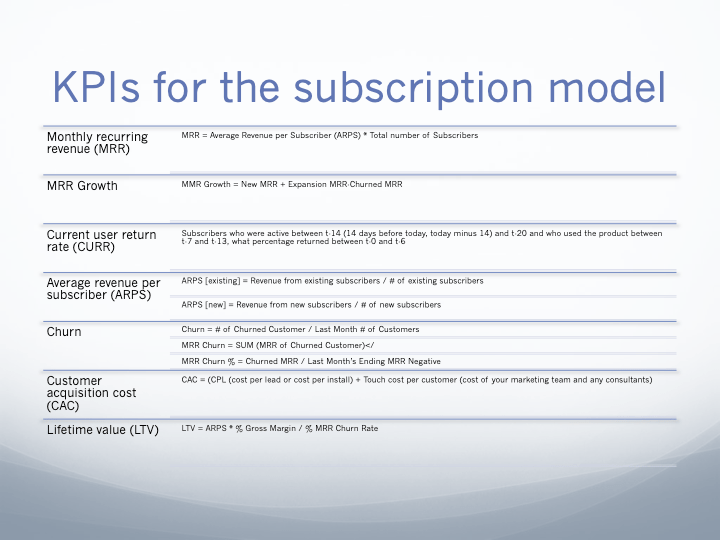
Monthly recurring revenue (MRR) is generally the first KPI that companies focus on when looking at the health of their subscription program. You calculate MRR by looking at the average revenue per subscriber by the number of subscribers. If you only have one subscription level, then it is simply the monthly subscription cost times the number of subscribers. If you have subscriptions for various terms (monthly, quarterly and annual, for example), you calculate the average monthly revenue from the different subscription (an annual subscription of $144 generates $12 per subscriber in MRR). The formula is

  • MRR = Average monthly revenue per subscriber (ARPS) * Total number of subscribers

The reason MRR is the first KPI that subscription businesses monitor is because it shows the value of the model. MRR effectively is how much revenue the business can count on every month. The company can then allocate this cash flow to marketing, operations, acquisitions, etc. By having a guaranteed amount of revenue (which you do not have with discrete sales or in-app purchases), you have a clear source of funds to operate your business. Most companies will extend MRR to create an Annual Run Rate (ARR), which is important both for business planning purposes and understanding the value of the subscription component of your business.

MRR Growth

In addition to looking at MRR, you should monitor MRR Growth. To analyze MRR growth, you need to break it into three components. The first is new MRR, revenue brought by newly acquired customers.

The second component of MRR growth is Expansion MRR. Expansion MRR is increases in subscription revenue from existing subscribers. This revenue is driven by up-selling and cross-selling your customers.

The third element of MRR Growth is churn. Churned MRR is the revenue that has been lost from customers cancelling or downgrading their plans.

Taking these three components into account, the overall formula for MRR Growth is:

  • MMR Growth = New MRR + Expansion MRR-Churned MRR

CURR

I have written before about CURR (current user return rate), and it is as valuable in subscription businesses as it is for other online models. CURR shows how loyal your existing customers are; you should consider CURR the inverse of churn. If your CURR increases, it means you have improved your product’s appeal to existing players or customers, if CURR declines you have made your game worse. CURR is also an excellent way of looking at how your game is performing among different segments, VIPs versus payers versus never-spenders.
To calculate CURR:

  • Subscribers who were active between t-14 (14 days before today, today minus 14) and t-20 and who used the product between t-7 and t-13, what percentage returned between t-0 and t-6.

Measuring CURR is critical to see how engaged your subscribers are. If CURR trends downward, you are likely to experience increasing customer churn.

.

ARPS

As mentioned above, Average Revenue Per Subscriber (ARPS) is central for calculating MRR, but it is also an important KPI itself. Increasing ARPS shows that customers are upgrading and most likely seeing high value in your offering, thus they are willing to pay more. Conversely, declining ARPS shows that customers are not experiencing sufficient value and are either down-grading or moving to free plans

You should also monitor ARPS separately for existing players versus new players. As Faria writes, “there is a good practice of measuring the Average Revenue per [subscriber] separately for new customers. So instead of having an [ARPS] metric for all your customers, you’d have two different metrics: Average Revenue per Existing [Subscriber] and Average Revenue per New [Subscriber].” To calculate:

  • ARPS [existing] = Revenue from existing subscribers / # of existing subscribers
  • ARPS [new] = Revenue from new subscribers / # of new subscribers

Churn

Churn is the enemy of any business, but is even more troubling for subscription businesses. You never want to lose customers, but with subscription businesses churn means you are losing not simply a sale but an entire revenue stream.

You need to monitor both Customer Churn and Revenue Churn.
Customer Churn is how many players have canceled their subscription while Revenue Churn is how much those lost customers represents in revenue. There are thus three churn KPIs you should closely monitor:

  1. Churn = # of Churned Customer / Last Month # of Customers
  2. MRR Churn = SUM (MRR of Churned Customer)
  3. MRR Churn % = Churned MRR / Last Month’s Ending MRR Negative

CAC

Customer Acquisition Cost (CAC) is the cost to acquire an additional customer, your marketing cost per customer. One way to calculate CAC is to consider the three variables that compose it. This method allows you to go into detail and might give you good insights about your sales process cost and conversions:

  • CAC = (CPL (cost per lead or cost per install) + Touch cost per customer (cost of your marketing team and any consultants)

I prefer to focus on cost per install (CPI) or cost per subscriber (CPS). As long as your lifetime value is higher than your CPS, you can continue to acquire subscribers and manage your overhead, including your marketing infrastructure.

LTV

Speaking of customer Lifetime Value (LTV), I have written repeatedly how it is the lifeblood of a successful business. LTV is a function that shows the present value of a new customer, how much that customer is worth to your company. While the equation is effectively the same for any business (the total expected value of your customer over their lifetime), it is somewhat simpler to calculate for subscription businesses. To calculate LTV for a subscription business, the following formula captures the core elements:

  • LTV = ARPS * % Gross Margin / % MRR Churn Rate

The hybrid model

While these KPIs show the health of a subscription business, you need to modify how you use them in most social games as well as iGaming. As subscriptions will only be one element of your revenue stream, in-app purchases will remain a major part of social gaming while gambling revenue will drive the casino industry. The above KPIs will help understand the health of the subscription element of your business, and whether you should invest in growing it, but they need to be incorporated into your other KPIs to understand both the impact on your business and your overall financial health. Subscription revenue will only be one part of your overall LTV calculation while you may want to look separately at CURR of players customers versus those making in-app purchases. There are many different combinations of models but the core subscription KPIs need to be incorporating into your daily review of the health of your business.

Slide1.png

Key takeaways

  • To run a successful business, you have to constantly monitor KPIs and optimize based on this data; the subscription model is no different but the KPIs are not the same as the ones you are used to reviewing
  • MRR (monthly recurring revenue) is the most important KPI for the subscription model, how much subscription revenue you generate (and can count on) each month.
  • Other critical metrics for the subscription model are MRR growth average revenue per subscriber (ARPS), current user return rate (CURR), cost to acquire a customer (CAC), customer lifetime value (LTV) and churn.

Share this:

  • Click to share on Facebook (Opens in new window) Facebook
  • Click to share on LinkedIn (Opens in new window) LinkedIn
Like Loading...
Unknown's avatarAuthor Lloyd MelnickPosted on January 21, 2020March 13, 2021Categories Analytics, General Social Games Business, General Tech Business, Social Games MarketingTags analytics, kpis, Subscriptions1 Comment on The subscription KPIs that matter

Creating an experience that retains players

Creating an experience that retains players

Slide2

One of the most useful book I read last year had nothing to do with tech or the gaming space but was Danny Meyer’s Setting The Table, about how he created an incredibly successful restaurant empire. Meyer, who is not a chef, has built arguably the most successful restaurant business in the hyper-competitive New York market and is one of the founders of Shake Shack. Meyer built his empire not on creative dishes but creating a fantastic customer experience, which resulted in very high customer retention.

setting the table.jpg

Given the importance of retention to game companies, creating a great customer experience is critical to retaining your players. While the product contributes to the experience, there are many other factors. When you go to a restaurant, the food is important but a key reason whether you return (are retained) is the overall experience. You might have great food, but if the waiter is surly, you have an issue paying the bill or even the cloakroom attendant is rude, you might not come back and will probably leave a bad Yelp or TripAdvisor review. Thus, the restaurant industry provides great lessons on how to create a superior customer experience, and Danny Meyer is probably the best restaurateur at delivering a fantastic experience. By extrapolating Meyer’s philosophy into a more general strategy, you can build a roadmap for improving almost any business.

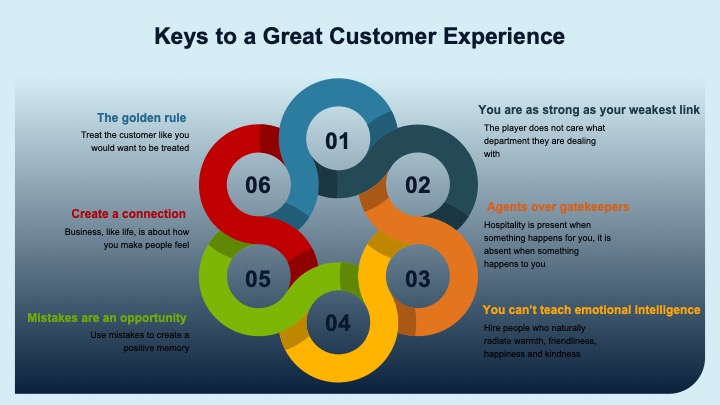
The Golden Rule

Creating a fantastic customer experience begins with the Golden Rule, “do as you would be done by.” In effect, you should treat your customers the way you would want to be treated (and spoken to). If you do not want to get a call at 5 AM, do not try to call your customers at 5 AM because they are more likely to answer. If you would not want to have to answer ten stupid questions to cash out from a casino, do not ask your customer ten stupid questions. In all situations, put yourself in your customer’s perspective and ask how you would want to be approached or treated.

You are as strong as your weakest link

While your core product offering may be fantastic, customers are going to remember the worst part of their experience. If you are in a hotel, you may have a beautiful room with a very comfortable bed but if when you check out you are charged for a bag of cashews from the minibar that you did not take, that is what you are likely to remember. If you go to the hotel restaurant and the food is bad, that is what you will write about on TripAdvisor. It also does not matter to the customer if the restaurant is owned by the hotel or licensed to a third party; the customer will probably be more irate if you try to blame someone else. The key lesson is if you are spending time and money creating a great game or product, do not neglect all the other ways you interact with your customer or player.

Create a connection

One of the strongest motivators for people is seeking connections. As I wrote last week, after satisfying physiological needs and safety, people focus on needs of belonging and esteem, so if the organization is focused on building connections with customers that focus creates tremendous value. Meyer writes, “business, like life, is about how you make people feel….Service without soul is quickly forgotten.” Creating this connection and sense of affiliation builds trust and leads to repeat business.

To create a connection, the first step is to make your players feel important. They should not feel like a number or one of many players (you are number 800 in the queue, please hold on). Every customer should feel like a VIP, they should feel important and loved by the company. According to Meyer, “everyone goes through life with an invisible sign hanging around his or her neck reading, ‘make me feel important.’” If everyone dealing with customers treats them (and considers them) VIPs, you will build a long-lasting connection that keeps the customer from churning and probably improves engagement.

Customer’s time is money

Many companies fail to realize that a customer’s time is more valuable to them than money. All game and gaming companies at their core are entertainment companies, people are choosing between playing your game online or watching the latest episode of the Witcher, land based casinos have learned the Bellagio is competing not only with the Wynn but also with a trip to Hawaii. Your customer facing team must realize it is as important to save customers’ time as how much money they are spending.

Withcher

Optimizing your customers’ time is also critical in ensuring their experience is better than their next best option. If you are using your customers’ time, you need to provide value (to them, not you) in exchange. Meyer writes, “what mattered most to me was trying to provide maximum value in exchange not just for the guests ’ money but also for their time. Anything that unnecessarily disrupts a guest’s time with his or her companions or disrupts the enjoyment of the meal undermines hospitality.”

If you have a great game, say an online casino, that they enjoy but have to spend half their time dealing with technical issues or trying to cash out, it effectively reduces their enjoyment 50 percent. Even if they get 10 percent more pleasure in your online casino then they would watching the Witcher, by forcing them to waste 50 percent of their time you make the Witcher, your competitor, a superior option.

Agents over gatekeepers

Creating a great customer experiences requires agents to act as advocates of the customers, not as gate-keepers. In every business, there are employees who are the first point of contact with the customers (attendants at airport gates, receptionists at doctors’ offices, bank tellers, executive assistants). Those people can come across either as agents or as gatekeepers. An agent makes things happen for others. A gatekeeper sets up barriers to keep people out. They need to represent the customer’s interest, fight for the customer and thus understand the customer’s concerns. As Meyer writes, “hospitality is present when something happens for you, it is absent when something happens to you.”

Mistakes are an opportunity

To me, mistakes are one of the best things that can happen in the customer experience world. Players remember the way mistakes are handled much more than the mistake and often more than the actual gaming experience. Mistakes provide an opportunity to create a great memory and a connection with your customer. Meyer writes, “The road to success is paved with mistakes well handled. Business is problem solving. As human beings, we are all fallible. You’ve got to welcome the inevitability of mistakes if you want to succeed in the restaurant business — or in any business. It’s critical for us to accept and embrace our ongoing mistakes as opportunities to learn, grow, and profit.”

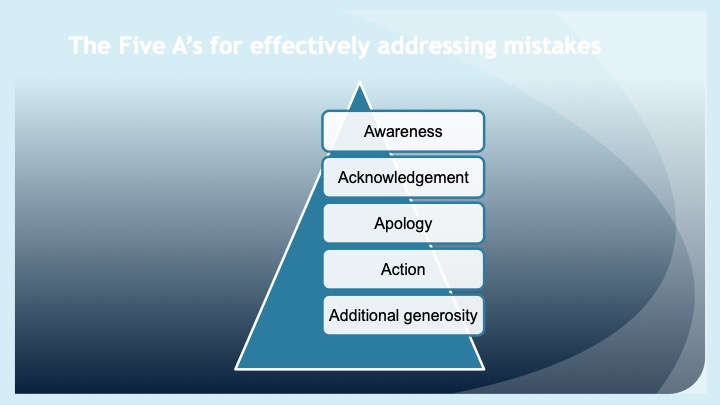
Meyer identifies five elements for effectively addressing mistakes, fortunately all start with the letter A:

Slide1

  • Awareness. Knowing that a mistake has been made.
  • Acknowledgment. Admitting that a mistake was made. It is incredibly frustrating having to argue with a company that they made a mistake. I remember a recent business trip to Sydney where the Internet in my room was not working. I had to argue with the front desk, then with a maintenance worker, both assumed that I did not know how to connect my phone to the Internet. Long story short is the wireless access point in the room was broken but their refusal to acknowledge the problem quickly ended up in my cancelling a stay the following month and not staying during visits every quarter. That is the cost of not acknowledging a mistake.
  • Apology. Saying you are sorry is an important step in turning a mistake into a good experience for your customer.
  • Action. Fix the mistake. Say what you are going to do to make amends then follow through. Make sure that the issue is resolved to the customer’s satisfaction and that you take care of it, do not put the resolution of the problem on the customer (remember to value their time).
  • Additional generosity. Do not simply make good for the mistake, provide more than you have to. Turn the bad experience into a great one. If a diner has a bad experience at one of Meyer’s restaurant, not only would they probably not be charged for the meal, but they might get a bottle of wine or champagne.

Another area to leverage mistakes is to turn a customer’s mistake into your mistake. Rather than fighting with a customer, accept responsibility even if it was not your fault. If you stress the customer made a mistake, either they will be mad at you or mad at themselves (if they do not believe you). Either way, they are not having a good experience. Instead, turn the mistake into your mistake and make them happy. That will drive additional engagement.

You need to align hiring with creating a great experience

To create a fantastic experience for your customer or player, the people responsible for dealing with them must have the right mentality. To have the right people, you need to hire the right people. As Meyer stresses, “you can’t teach emotional intelligence.”

You can have scripts and processes for dealing with customers but unless your team members can radiate warmth, friendliness, happiness and kindness, you will not be able to create great experience. Thus, you need to hire warm, empathetic people who have an excellence reflex. The excellence reflex is a natural reaction to fix something that is not right or to improve something that can be better. Not all hiring is perfect, so if you end up with some people who are not empathetic or have an excellence reflex, then you need to find them a new home. Otherwise, you will not be able to create great customer experiences.

You also need to ensure your people can control their moods. We all have bad days, but the customer does not care. You need people with personal mastery, team members aware of their moods and able to keep them in check.

Hiring is the key. As Meyer explained, “Over the years, the most consistent compliment we’ve received and the one I am always proudest to hear, is ‘I love your restaurants and the food is fantastic. But what I really love is how great your people are. ‘ The only way a company can grow, stay true to its soul, and remain consistently successful is to attract, hire, and keep great people.”

Customer experience is the key to success

While it is very challenging to build an organization with great customer experience, it is critical to engaging your players and preventing churn. Meyer’s success using customer experience as the key differentiator in building a restaurant empire in New York City, one of the most competitive and saturated markets, shows how this feature can help companies in other industries (like gaming) stand out and succeed.

Key takeaways

  • The key to strong retention is creating a great customer experience outside of the actual product, ensuring that customer contact is extraordinary.
  • To create a great experience for customers, everyone dealing with them needs to treat customers as they would want to be treated.
  • It is also critical to ensure you have no weak links in your interaction with customers, you create a connection with your player, your people act as agents for the customers and not gatekeepers, you treat mistakes as opportunities and you hire for emotional intelligence.

Share this:

  • Click to share on Facebook (Opens in new window) Facebook
  • Click to share on LinkedIn (Opens in new window) LinkedIn
Like Loading...
Unknown's avatarAuthor Lloyd MelnickPosted on January 14, 2020January 9, 2020Categories General Social Games Business, Lloyd's favorite posts, Social CasinoTags customer experience, customer service, Danny Meyer1 Comment on Creating an experience that retains players

Taking the subscription model to the next level

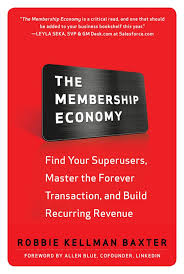
Last year, one of my most popular posts was about the subscription model and opportunities for social game companies. I recently read a book, The Membership Economy by Robbie Kellman Baxter, that provided another layer to building and launching a successful subscription model. Baxter’s work provides useful advice for creating a sustainable subscription business.
MemberShip Economy

Look at subscribers as members

Baxter’s book is not solely about subscriptions but about memberships, which can then be applied to the subscription model to make it more powerful. By looking at subscriptions as memberships, you not only generate an ongoing and stable revenue stream but also create value for your customers because membership provides recognition, stability, and convenience while connecting them. This connection is very powerful, as Maslow showed in his hierarchy of needs, after satisfying physiological needs and safety, people focus on needs of belonging and esteem before ultimately moving to self-actualization. Membership as part of a subscription helps people satisfy those needs.

Baxter writes that “membership is an attitude , an emotion. A subscription is a financial arrangement. It’s quite possible for something to be both a subscription and a membership organization…. Members love membership models because they fulfill powerful human drives — like needs for affiliation and prestige…. If you provide individuals with the infrastructure to enable them to connect and help them build behaviors that help themselves and others, there is tremendous potential to enable people to share ideas, content and physical products that otherwise might go underutilized.”

With membership, you are also less likely to churn customers. Members are committed until they cancel, the equivalent of breaking up or getting divorced. That break up is a much more emotional decision than deciding whether they want to make another purchase.

Subscriptions are about access

A key to success with subscriptions, as I discussed in my last post about the model, is to provide access as the core value rather than consumables. As Baxter writes, “too many loyalty programs are commodities, effectively just discounts for volume purchases, and don’t really create authentic loyalty or strengthen membership relationships. Don’t be that kind of loyalty program.” Subscriptions that are about discounts largely cannibalize your existing business and do not appeal to customers looking to build a long-term relationship with your product or game.

Access also takes you beyond the traditional discrete purchase model with customers, even in-app purchases (IAPs). Part of this access is access to a community of like-minded people, hopefully fans of your core offering. Access is so much bigger than ownership, and the subscription model ties customers to organizations in an ongoing relationship with an opportunity for benefits on both sides.

Given that access is probably a different value than you have focused on previously, the question becomes what do you offer subscribers. I cannot answer that question as it is different for different games and products. In the game space there are many types of access that appeals to customers, examples include:

  • Games or levels (i.e. Loyalty specific slots, hidden levels)
  • Community
  • Referral program
  • Additional bonus and side games
  • High roller features (i.e. higher MaxBet, higher limits)
  • Speeding up rewards
  • Battle Pass type features (avatars and other vanity items that show your expertise)
  • Online events (training, sneak peeks, webinars, etc)
  • Physical events for entire tiers (parties, casino visits, et al)
  • Individual physical events (personalized experiences for top tier players)
  • Additional customer service channels (phone, live chat, etc)
  • Charitable contributions

These are some examples but the key is not to offer subscribers a consumable item, you are not trying to replace an individual purchase but grant them access.

Building a strong subscription program

Programs should be tailored to your audience and product, ensuring you are creating something many of your players will enjoy. There are, however, several common steps to creating a successful program for subscribers:

  1. Member/benefit alignment. Start with research and analysis of your existing data so you understand your potential subscribers. If you are not certain a customer would love the offering if he or she knew about it, there is no point in investing in anything other than fixing the offer and figuring out whom to target.
  2. Remove frictionAnything that slows down a user’s ability to engage with the services offered, especially during the sign – up process.
  3. Provide benefits at every stage of the journey, especially immediately. Provide meaningful benefits from the moment a player enrolls (or is automatically enrolled).
  4. Make your trial period great.Rather than trying to limit what a customer gets with an initial or free trial, over deliver so they see all the benefits of subscribing. If you provide a minimal experience or create too many gates for the player, rather than convert they will get annoyed and churn.
  5. Do not overpromise Simplicity is always critical to success, including with subscriptions. If you promise too many things, customers get confused and might not be able to find the benefit that really matters to them Also, if you promise too many things, it is hard to deliver on all of them.
  6. Personalize.People value experiences differently so ensure that you provide a breadth of benefits to appeal to your addressable market. With data and machine learning, you can then surface the benefits specific subscribers would most enjoy so they get the best possible experience from the subscription. You want to personalize so your subscribers feel more connected than non-subscribers.

    Baxter writes about how Caesars Casino uses personalization with its loyalty program, “Caesars sees itself not just as a gaming company, but as an entertainment company . It segments users to provide each group with a differentiated set of benefits and offers. It uses data to determine member preferences for things like favorite wines, room locations, and hotel amenities. Management empowers frontline employees to become ‘local hosts’ who use the data to make members’ visits special. This element is critically important because too many loyalty programs don’t build relationships with members at all — they just provide discounts, thus encouraging people to join all programs across an industry just to collect the points.“

  7. Take risks As Howard Schultz, the founder of Starbucks once wrote, “whatever you do, don’t play it safe. Don’t do things the way they’ve always been done. Don’t try to fit the system. If you do what’s expected of you, you’ll never accomplish more than others expect.” Starbucks has made some major advances on traditional loyalty programs with loyalty cards that are great looking. The card is also tied to payments, reducing a major source of friction.
  8. Tie loyalty and payments together.As Starbucks shows, there is tremendous value to integrating loyalty and payment. By tying payments to the account, it eases the purchase process, thus increasing purchases.
  9. Continue to add value Players needs will evolve and your program will also need to evolve. You need to offer additional value to justify the ongoing costs of membership. As Baxter writes, “Amazon Prime is a paid membership program. Amazon’s approach has been to have members pay something so that they are more…. Amazon has systematically and thoughtfully continued to invest in layering benefits over the core offering of free two – day shipping.”

The first time subscriber experience

As discussed above, one of the critical elements in creating a loyalty program is the early user experience. According to Baxter, “onboarding done correctly dramatically reduces the number of people who sign up for trial or become full members and then cancel within the first month or two. It also increases the number of people who become long-term members. Members who participate heavily in the first few months of the membership are much ore likely to become long-term customers.”

To ease on-boarding, you need to keep the offering simple and easy to use. Provide a very straightforward experience and quickly reward your subscribers.

Also, try to turn the subscription into a two way street. In most membership organizations, the members have a responsibility to provide something — membership dues to an association or country club, content as with Snapchat or Twitter, or even just personal information as with Groupon — in exchange for access to the membership benefits. By having your customers contribute, they feel more invested in the offering and are less likely to churn. The contribution also should be very easy, let the subscriber contribute easily and quickly without having to jump through hoops. Then reward them for the contribution, to build a positive reinforcement cycle.

Determining pricing

Once you have designed your subscription program, you need to determine pricing. As with other elements of the program, remember the value of simplicity. While a program’s designer may feel multiple options allow players to find the optimal program, it actually confuses and overwhelms customers (just as retailers understand people buy more tomato sauce when there are 3-5 options rather than 30 options). In addition to simplicity, successful subscription programs are transparent. Customers need to understand clearly the value and benefits, the costs and how to cancel.

According to Baxter, the optimal number of subscription options is three, and this number is consistent with consumer behavior research. Baxter writes, “Most people prefer to have multiple options, that three is the right number of choices, and that the majority prefers the middle option.” You can then layer a la carte services on to these three options (as satellite TV companies frequently do).

These a la carte options allow customers to personalize their experience while not creating confusion (they also can be introduced once the subscriber is comfortable with the core offering). According to Baxter, “À la carte services are out-of-the-ordinary services members do not require on an ongoing basis — for example, a one-time indexing of your content, or an on-boarding fee, or a health audit at the gym. A mistake many organizations make is to put this type of one-time service into a higher-level, ongoing pricing tier.” Ancillary products can also be offered on an a la carte basis, such as headsets for Skype or exercise shorts sold by fitness centers.

Also look at offering different subscription terms. SurveyMonkey found that annual subscribers were more loyal customers than monthly payers. They were committed to the platform and used it in multiple ways. While you may have three tiers, you can also offer monthly and annual subscriptions or fewer tiers but vary the length. The key, though, is keep it simple and easy to understand for subscribers.

Change your thinking

Once your pricing is determined, you then need to change your company’s culture to support a successful subscription business. The subscription model relies on long-term customer retention and thus the entire organization needs to be focused on retention rather than discrete purchases.

This new attitude needs not only to be reflected in the product but also with your marketing and customer support (CS) teams. According to Baxter, “marketing is more than campaigns — it’s about focusing on the market. This is always true, but especially in the Membership Economy, where retention matters more than acquisition. Marketing should ensure that the offerings the organizations create meet the ongoing requirements of the target buyers and that those prospective buyers know about the benefits of the offering, sign up, and become loyal….Good marketing is honest. Sometimes people have the idea that good marketing is about tricking people into buying things they don’t need. Not only is this approach unethical, but in the Membership Economy, with the need for ongoing relationships, it simply doesn’t work.”

In addition to marketing, your customer support team needs to become agents for your subscribers. At its core, CS in a subscription model needs to focus on building loyalty, not reducing anger. Baxter writes, “In an ownership economy business, the support staff’s goal is to minimize customer anger. In the Membership Economy, the goal is to maximize loyalty …Their task is to help callers use the product — more effectively, more efficiently — so that they will be increasingly loyal.” Wwhen you launch your program, ensure all your customer facing teams are focused on retaining your customers.

KPIs, analysis and avoiding churn

The final key to a successful subscription program is measuring the right metrics and using them to prevent churn. There are several elements of churn to monitor:

  • Passive churn. Passive churn is the number of subscribers who churn by not updating their payment method. This churn is a good indicator of problems with your payment platform. To mitigate this situation, give good customers the benefit of the doubt when there is a payment problem (which requires knowing who your best customers are) and reach out to them (phone or their preferred communication platform) to update the information while not suspending service in the interim.
  • Active churn. Active churn is when a subscriber proactively decides to cancel. Minimizing active churn requires understanding the reasons someone might want to cancel and creating options and incentives for them to stay (while not forcing the to stay). Below are some areas that Baxter recommends you review to determine the root cause of active churn:
    1. Date cohorts. Measure elapsed time from the day they signed up to see if certain things happen after a certain fixed time.
    2. Utilization cohorts. Do people tend to cancel after a certain amount of time of low usage or engagement?
    3. Original lead source cohorts. Do certain ads or partnerships bring in subscribers who behave differently from established members

Once you measure and understand your churn, there are several ways to reduce it. You need to build a system that makes leaving a difficult decision to make. You do this by ensuring people are using your product regularly and are very engaged. People are more likely to perceive value in memberships that they use frequently and for extended durations, so many subscription companies devotedly track visits and lengths of visits of members.

Subscribers are also more reluctant to cancel memberships when they have achieved status, customized their experience, scheduled regular activities, or built personal spaces. Finally, Baxter points out that if “someone simply wants to stop paying , offering a free subscription — something that allows the member to remain part of the family — is a best practice.”

Key takeaways

  • Treat your subscription service as a membership service. By looking at subscriptions as memberships, you not only generate an ongoing and stable revenue stream but also create value for your customers because membership provides recognition, stability, and convenience for your players while connecting them.
  • The core value to subscribers from the subscription should be additional access, features or games or community not available to non-subscribers.
  • Focus on the early experience. Onboarding done correctly dramatically reduces the number of people who sign up for trial or become full members and then cancel within the first month or two.

Share this:

  • Click to share on Facebook (Opens in new window) Facebook
  • Click to share on LinkedIn (Opens in new window) LinkedIn
Like Loading...
Unknown's avatarAuthor Lloyd MelnickPosted on January 7, 2020April 5, 2021Categories Analytics, General Social Games BusinessTags Subscription3 Comments on Taking the subscription model to the next level

Get my book on LTV

The definitive book on customer lifetime value, Understanding the Predictable, is now available in both print and Kindle formats on Amazon.

Understanding the Predictable delves into the world of Customer Lifetime Value (LTV), a metric that shows how much each customer is worth to your business. By understanding this metric, you can predict how changes to your product will impact the value of each customer. You will also learn how to apply this simple yet powerful method of predictive analytics to optimize your marketing and user acquisition.

For more information, click here

Follow The Business of Social Games and Casino on WordPress.com

Enter your email address to follow this blog and receive notifications of new posts by email.

Join 791 other subscribers

Most Recent Posts

  • Join me at PDMA Inspire for my talk on new product prioritization
  • Why keep studying?
  • The next three years of this blog
  • Interview with the CEO of Murka on the biggest growth opportunity in gaming, Barak David

Lloyd Melnick

This is Lloyd Melnick’s personal blog.  All views and opinions expressed on this website are mine alone and do not represent those of people, institutions or organizations that I may or may not be associated with in professional or personal capacity.

I am a serial builder of businesses (senior leadership on three exits worth over $700 million), successful in big (Disney, Stars Group/PokerStars, Zynga) and small companies (Merscom, Spooky Cool Labs) with over 20 years experience in the gaming and casino space.  Currently, I am the GM of VGW’s Chumba Casino and on the Board of Directors of Murka Games and Luckbox.

Topic Areas

  • Analytics (114)
  • Bayes' Theorem (8)
  • behavioral economics (8)
  • blue ocean strategy (14)
  • Crowdfunding (4)
  • DBA (2)
  • General Social Games Business (459)
  • General Tech Business (195)
  • Growth (88)
  • International Issues with Social Games (50)
  • Lloyd's favorite posts (101)
  • LTV (54)
  • Machine Learning (10)
  • Metaverse (1)
  • Mobile Platforms (37)
  • Prioritization (1)
  • Social Casino (52)
  • Social Games Marketing (105)
  • thinking fast and slow (5)
  • Uncategorized (33)

Social

  • View CasualGame’s profile on Facebook
  • View @lloydmelnick’s profile on Twitter
  • View lloydmelnick’s profile on LinkedIn

RSS

RSS Feed RSS - Posts

RSS Feed RSS - Comments

Categories

  • Analytics (114)
  • Bayes' Theorem (8)
  • behavioral economics (8)
  • blue ocean strategy (14)
  • Crowdfunding (4)
  • DBA (2)
  • General Social Games Business (459)
  • General Tech Business (195)
  • Growth (88)
  • International Issues with Social Games (50)
  • Lloyd's favorite posts (101)
  • LTV (54)
  • Machine Learning (10)
  • Metaverse (1)
  • Mobile Platforms (37)
  • Prioritization (1)
  • Social Casino (52)
  • Social Games Marketing (105)
  • thinking fast and slow (5)
  • Uncategorized (33)

Archives

  • September 2023
  • December 2021
  • July 2021
  • March 2021
  • February 2021
  • January 2021
  • December 2020
  • November 2020
  • October 2020
  • September 2020
  • August 2020
  • July 2020
  • June 2020
  • May 2020
  • April 2020
  • March 2020
  • February 2020
  • January 2020
  • November 2019
  • October 2019
  • September 2019
  • June 2019
  • May 2019
  • April 2019
  • March 2019
  • February 2019
  • January 2019
  • December 2018
  • June 2018
  • May 2018
  • April 2018
  • March 2018
  • February 2018
  • January 2018
  • December 2017
  • June 2017
  • May 2017
  • April 2017
  • March 2017
  • February 2017
  • January 2017
  • December 2016
  • November 2016
  • October 2016
  • September 2016
  • June 2016
  • May 2016
  • April 2016
  • March 2016
  • February 2016
  • January 2016
  • December 2015
  • November 2015
  • October 2015
  • September 2015
  • July 2015
  • June 2015
  • May 2015
  • April 2015
  • March 2015
  • February 2015
  • January 2015
  • December 2014
  • November 2014
  • October 2014
  • September 2014
  • August 2014
  • July 2014
  • June 2014
  • May 2014
  • April 2014
  • March 2014
  • February 2014
  • January 2014
  • December 2013
  • November 2013
  • October 2013
  • September 2013
  • August 2013
  • July 2013
  • June 2013
  • May 2013
  • April 2013
  • March 2013
  • February 2013
  • January 2013
  • December 2012
  • November 2012
  • October 2012
  • September 2012
  • August 2012
  • July 2012
  • June 2012
  • May 2012
  • April 2012
  • March 2012
  • February 2012
  • January 2012
  • December 2011
  • November 2011
  • October 2011
  • September 2011
  • August 2011
  • July 2011
  • June 2011
  • May 2011
  • December 2010
January 2020
S M T W T F S
 1234
567891011
12131415161718
19202122232425
262728293031  
« Nov   Feb »

by Lloyd Melnick

All posts by Lloyd Melnick unless specified otherwise
Google+

Enter your email address to subscribe to this blog and receive notifications of new posts by email.

Join 791 other subscribers
Follow Lloyd Melnick on Quora

RSS HBR Blog

  • How One Manufacturer Achieved Net Zero at Zero Cost
  • What Can U.S. Employers Do About Rising Healthcare Costs?
  • When You Have to Execute a Strategy You Disagree With
  • 4 Ways to Build Durable Relationships with Your Most Important Customers
  • What Jargon Says About Your Company Culture
  • Research: When Used Correctly, LLMs Can Unlock More Creative Ideas
  • Your New Role Requires Strategic Thinking…But You’re Stuck in the Weeds
  • For Circular Economy Innovation, Look to the Global South
  • Why Great Leaders Focus on the Details
  • Corporate Disclosure in the Age of AI

RSS Techcrunch

  • An error has occurred; the feed is probably down. Try again later.

RSS MIT Sloan Management Review Blog

  • AI Coding Tools: The Productivity Trap Most Companies Miss
  • How Procter & Gamble Uses AI to Unlock New Insights From Data
  • Rewire Organizational Knowledge With GenAI
  • Hungry for Learning: Wendy’s Will Croushorn
  • Beat Burnout: 10 Essential MIT SMR Reads
  • How Leaders Stay True to Themselves and Their Stakeholders
  • Our Guide to the Winter 2026 Issue
  • Broadening Future Perspectives at the Bank of England
  • A Faster Way to Build Future Scenarios
  • Assess What Is Certain in a Sea of Unknowns
The Business of Social Games and Casino Website Powered by WordPress.com.
  • Subscribe Subscribed
    • The Business of Social Games and Casino
    • Join 726 other subscribers
    • Already have a WordPress.com account? Log in now.
    • The Business of Social Games and Casino
    • Subscribe Subscribed
    • Sign up
    • Log in
    • Report this content
    • View site in Reader
    • Manage subscriptions
    • Collapse this bar
 

Loading Comments...
 

    %d