Skip to content

The Business of Social Games and Casino

How to succeed in the mobile game space by Lloyd Melnick

Category: General Social Games Business

Optimizing failure

I am a big fan of failure. I not only encourage my team and people around me to fail, I consider it a problem if they do not. It means we are not trying enough new things.

Even if we have a 90 percent chance of success with everything you try, if you try 30 or 40 initiatives 3-4 will fail. I argue that only trying things with a 90 percent chance of working is too conservative; you need to look at the expected return and try any that have a positive expected value, even if they have less than a 50 percent chance (if the upside is high enough). The key is if you are not taking risks, you are not doing enough to increase value.

A great article in the Harvard Business Review, “Increase Your Return on Failure” by Julian Birkinshaw and Martine Haas, adds an important layer to the thesis of pursuing failures. Birkinshaw and Haas provide a framework to learn from your failures, so that even the initiatives that do not work create value.

The authors point out that while most companies acknowledge and support the need to fail occasionally, management processes actually work against this goal. Most budgeting, resource allocation and risk control systems are built on predictability and optimizing efficiency, giving bonuses and promotions to those executives “in control.” Thus, even if you are encouraged to fail, you are incentivized to do everything possible to avoid it. The solution is to extract value from failure so you an increase your return on it, boosting benefits while controlling costs. There are three steps to raise your return from failure.

Learn from every failure

The first step to generating additional value from failure is getting people to reflect on projects and initiatives that had disappointing results. While it sounds obvious, it often does not occur. Most people find reviewing failures quite painful and would prefer to invest their time in looking forward.

A failure provides the chance to revisit your core beliefs and adjust them where needed. The authors recommend asking the following questions to understand the benefits and costs of the failed initiative or project:

  1. What have we learned about our customers’ needs and preferences and our current markets? Should we change any of our assumptions?
  2. What insights have we gained into future trends? How shold we adjust our forecasts?
  3. What have we discovered about the way we work together? How effective are our organizational processes, structure and culture?
  4. How did we grow our skills individually and as a team? Did the project increase trust and goodwill? Were any developmental needs highlighted?
  5. What were the direct costs – for materials, labor, art and production or software development?
  6. What were the external costs? Did we hurt our reputation in the market or with customers, or weaken our competitive position?
  7. What were the internal costs? Did the project damage team morale or consume too much attention? Was there any organizational fallout?
  8. What are the key insights and takeaways for the business?

These questions will help you think of everything that you and your company have learned, how it might help you move forward and all the positive side effects from the experience.

Share the lessons

The big benefit from failures is spreading the lessons across the company. You can amplify the paybacks from failures by passing between business areas the information, ideas and opportunities for improvement gained from the above analysis.

Shared learnings also increases the proclivity to pursue future initiatives. By reflecting on the positives, you build trust and goodwill and clear the path for others to take action on risky initiatives.

Review your pattern of failure

The final step to gaining value from failure is “to take a bird’s-eye view of the organization and ask whether your overall approach to failure is working.” Do you have a process to learn from every failure? Are these lessons shared? Are you using these lessons to improve both your strategy and execution?

This analysis will help you see if you are failing too much (and unnecessarily), not enough (and thus not taking enough risks) or at the appropriate level. If you are failing too often, you probably need to make the green light process for initiatives more rigorous. If not enough, you need to generate and evaluate more initiatives.

The benefit

Failure is critical to generating the most possible value. By rigorously learning from failures, you increase their return and the ability to pursue future initiatives.

Slide1.jpg

Key takeaways

  • You need to encourage failure. Without failure, you are not pursuing enough initiatives to grow.
  • To get the most from failures, and subsequently prompt people to launch initiatives that can fail, you must study failures carefully and learn about the market, customers and organization.
  • You also need to circulate this information through your organization.
Share this:

  • Click to share on Facebook (Opens in new window) Facebook
  • Click to share on LinkedIn (Opens in new window) LinkedIn
Like Loading...
Unknown's avatarAuthor Lloyd MelnickPosted on June 29, 2016May 1, 2021Categories General Social Games Business, General Tech Business, Lloyd's favorite postsTags failure, learnings, lessonsLeave a comment on Optimizing failure

Turn everyone into an innovator

There was an interesting article in the Harvard Business Review, How to Build a Culture of Originality by Adam Grant, that does a great job of showing how to turn all of your team into innovators. The article starts with a discussion of the US Navy, arguably the poster boy for lack of innovation, and explains how it started “exploding with originality.” What is interesting about the navy example is that the innovation was not centered around iconoclasts or entrepreneurial types but from the rank and file. Most importantly, if it can work in the US Navy, the strategy can work anywhere.

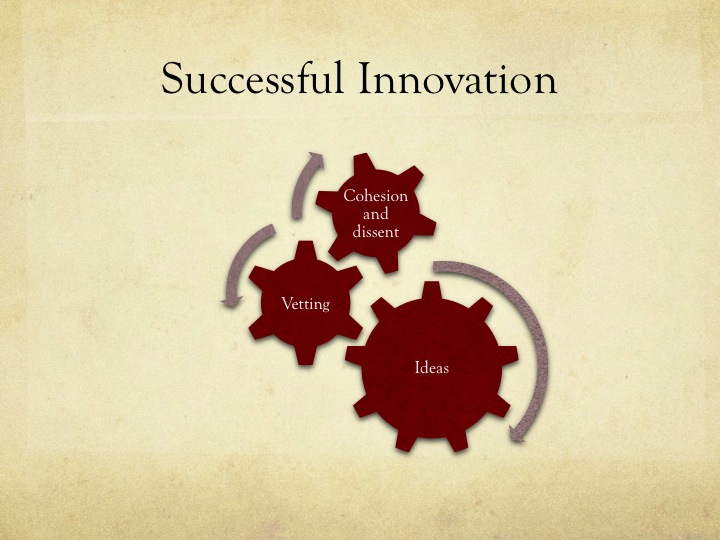
When everyone thinks the same and is relocation to move away from best practices, companies rot. To drive innovation, you need sustained original thinking in your company. The way to do this, as Grant shows, is to build a culture of non-comformity. You must give your team opportunities and incentives to generate new ideas and push beyond the obvious or traditional. You also need to vet those ideas so that the best are executed on, not simply the most popular.

Slide1

Generate a plethora of ideas

It is critical to get people to generate many, many ideas. In research cited by Grant, the first 20 ideas people generate are significantly less original than their next 15. Across all fields and functions, volume leads to quality (rather than opposing it).

Get people to think boldly. Rather than asking them for improvements, ask them to propose alternative strategies. Have them think like competitors, how would they attack you in the marketplace.

You also get better ideas by asking them individually rather than in groups. When people generate ideas together, many of the best ideas do not get shared. Some people, intentionally or not, dominate the conversation while others hold back to avoid looking foolish.

Another way to generate ideas is actually a throw-back, bring back the suggestion box. While you may end up in an HBR cartoon, suggestion boxes are quite useful as they provide a large number of ideas. As Grant writes, “the major benefit of suggestion boxes is that they multiply and diversify the ideas on the horizon, opening new avenues for innovation.”

Developing a sense for good ideas

While the first step to innovation is generating great ideas, equally important is listening to the right opinions and solutions. Rather than using a democratic process to select ideas, assign people with great track records innovating to select the right ideas. You may want to weigh people’s vote based on their innovation track record or limit the vote to those with a real track record of innovation success (if you have them). The key is not turning it into a democratic group process as many people will not have a good understanding of which ideas have the best potential.

Another successful mechanic is to run a contest or tournament. As Grant writes, “When an innovation tournament is well designed, you get a large pool of initial ideas, but they’re clustered around key themes instead of spanning a range of topics. People spend a lot of time preparing their entries, which can boost quality, but the work happens in a discrete window of time, so the contest is not a recurring distraction. Thorough evaluation helps to filter out the bad ideas. The feedback process typically involves having a group of subject matter experts and fellow innovators review the submissions, rate their novelty and usefulness, and provide suggestions for improvement.”

Cultivating both cohesion and dissent

While you may develop a plan to generate and evaluate ideas, you need to put the appropriate processes in place to maintain originality over time. It is not necessarily building a cohesive leadership team. While in some cases that works, in other cases you introduce groupthink. Even unintentionally, like-minded people gravitate to each other, so you run the risk the leadership team all approaches problems the same way. It is thus critical to make dissent one of your company’s core values. “Cohesion and dissent sound contradictory, but a combination of the two is what brings novel ideas to the table—and keeps a strong culture from becoming a cult.”

A critical tool is to build a framework for choosing between conflicting opinions and allowing the best ideas to win out. When companies fail to prioritize values, performance suffers. Values should be rank-ordered so that when employees face choices between competing courses of action, they know what comes first.

Another tool that runs counter to conventional wisdom is to solicit problems, not just solutions. Although you probably love when employees come up with solutions, there’s an unintended consequence: Inquiry gets dampened. If an employee is always expected to have an answer ready, they will arrive at meetings with their diagnosis complete, missing out on the chance to learn from a range of perspectives.

Another tool to help create a stream of original ideas is that rather than appointing a devil’s advocate, find one. To have impact (rather than simply go through the motions), the devil’s advocate actually has to hold a dissenting opinion and the group has to believe that the dissent is real. Only in this situation will the group seriously consider the dissent and evaluate the idea more critically.

You should also encourage people to challenge you in the open (rather than the my door is always open cliché). If employees see open dissent, and see that it is viewed as a positive, then they too are likely to express their true opinions. You can also get people to challenge you by broadcasting your weakness. I will often tell my team I am not a game designer and encourage them to challenge me on design issues.

Ideas are the first step in innovation

If you build a culture that generates many ideas, and then have a process in place to evaluate them critically and move on the best, you are more likely to innovate. These new ideas can keep your company from stagnating and help you stay above the competition.

Key takeaways

  1. The first step in innovating successfully is generating a overabundance of ideas from your employees.
  2. Rather than having people focus, encourage them to generate many, many ideas from asking individually to running contests to bringing back the suggestion box.
  3. It is then critical to evaluate the ideas effectively, primarily by having those with the best track record in innovation making the choices (or having their opinions weighed higher) than a purely democratic process.

Share this:

  • Click to share on Facebook (Opens in new window) Facebook
  • Click to share on LinkedIn (Opens in new window) LinkedIn
Like Loading...
Unknown's avatarAuthor Lloyd MelnickPosted on June 22, 2016May 2, 2016Categories General Social Games Business, General Tech BusinessTags ideation, innovation3 Comments on Turn everyone into an innovator

You need to create a great cross-platform experience

While most game companies talk cross-platform, they really mean putting their product on multiple platforms rather than optimizing play for customers who want to play on different devices at different times. They are missing an important opportunity, or alienating their users, by not focusing more effort on creating a great experience across platforms. I came across an article on Adweek’s SocialTimes, Study: Customers (Especially Millenials) Hate When You Fail To Deliver Cross-Platform Experiences, that provided great data on what happens when you do not have a good cross-platform user journey.

Surprisingly strong activity across devices

More than half users switch devices mid-activity. The number is highest for Millennials, where 90 percent switch devices mid-activity. With GenXers, it falls to 76 percent and with those 55 or older, it is 58 percent. What is striking in these numbers is that even with the lowest number, more than 50 percent still switch devices mid-activity.

When it comes to playing games, the number falls but is still quite significant. 14 percent of all US customers change devices mid-activity. 25 percent of US Millennials change devices mid-activity while playing games.

What it means for messaging

You thus need to craft messaging that is relevant for a player or user who started on one device and is now playing your game or shopping on your site on a different device. The article quotes an Adobe analyst as saying, “that means digital marketers have a unique challenge of being able to really understand that a Web visitor who shows up on a smartphone is the same customer four hours later on a tablet, or seven hours later on a desktop. They have to piece that experience together in order to craft a consistent message to that one consumer, regardless of which device they use.”

What it means for games

While many games now allow you to share your balance across devices, there is an opportunity to please better your players be integrating further. There are several steps a game company can make to create a great cross-device experience.

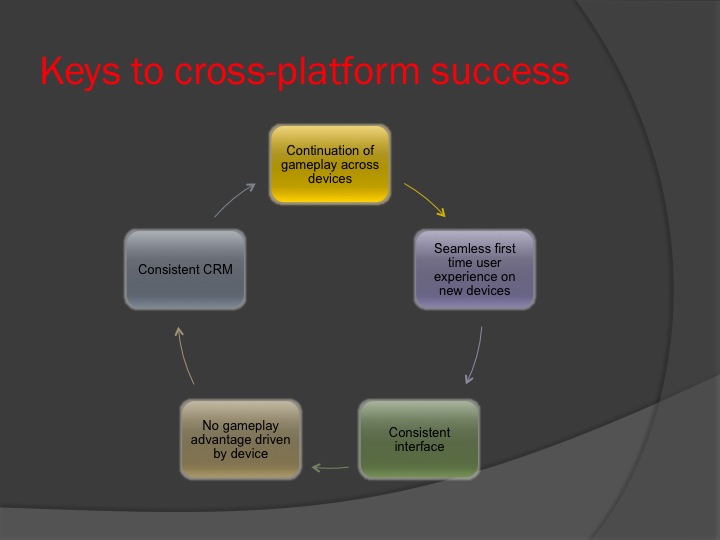
  • A player should be able to pick up a game in the exact same place on a new device simply by opening the app. If they are in a tournament or raiding another player, they should pick up that raid as if they were on their original device.
  • When they first install on the other device, the journey to synching their accounts should be seamless and as few steps as possible.
  • The interfaces should be optimized for each device (let’s not make an inferior product in the drive for standardization) but consistent and familiar for players moving from other devices.
  • Players on one device should not have a gameplay advantage (or disadvantage) on different platforms.
  • Ensure your CRM is consistent across devices and not redundant (do not hit someone with the same message three times when they use three different devices in a short time period).

Slide1
The benefits are worth it

I have written many times about satisfying your customer and catering to their multi-device activity is one of these instances. If you do not create a great experience, a competitor will and you will start losing players. Moreover, these are probably your most engaged customers, so the cost of replacing them is even greater.

Key takeaways

  1. More than 50 percent of all users change devices mid-activity, with this number increasing to 90 percent for Millenials. With those playing games, 14 percent change devices mid-activity, rising to 25 percent for Millenials.
  2. To leverage this situation, you should build your game so it is easy to play across multiple devices, keeping a familiar interface, sharing a wallet and keeping the game fair.
  3. Your CRM also should reinforce a consistent message across devices without the messages stepping on each other.

Share this:

  • Click to share on Facebook (Opens in new window) Facebook
  • Click to share on LinkedIn (Opens in new window) LinkedIn
Like Loading...
Unknown's avatarAuthor Lloyd MelnickPosted on June 15, 2016May 1, 2016Categories General Social Games Business, General Tech Business, Mobile Platforms, UncategorizedTags Cross device, Millenials1 Comment on You need to create a great cross-platform experience

How to become a growth company again

In February, I discussed the challenges companies have dealing with a changing business environment and a corollary to that challenge is how to reignite growth once your company has stagnated. Chris Zook and James Allen tackled this problem in an article, Reigniting Growth, in the Harvard Business Review. In the article, the authors point out that almost all companies eventually face stall-out, “a sudden large drop in revenue and profit growth or a collapse of once high shareholder returns to well below the cost of capital. Stall-out occurs when the growth engine that powered a company to success stops working. This rarely happens because the business model has suddenly become obsolete—a common misconception. Rather, [their] research shows that the business has almost always become too complex, most often owing to bureaucracy that slows the company’s metabolism, or internal dysfunction that distorts information and hampers managers’ ability to make rapid decisions and take swift action on them.”

There is a consistent theme when looking at big companies that have stalled-out. They talk about being swamped with bureaucracy, overwhelmed by Powerpoints and an inability to act decisively even on great opportunities. While competition impacts your growth, success hinges on remaining fast, perceptive, innovative and adaptable. 94 percent of leaders of companies with $5 billion plus revenue believe internal dysfuntion was the main barrier to growth, not competition or lack of opportunity.

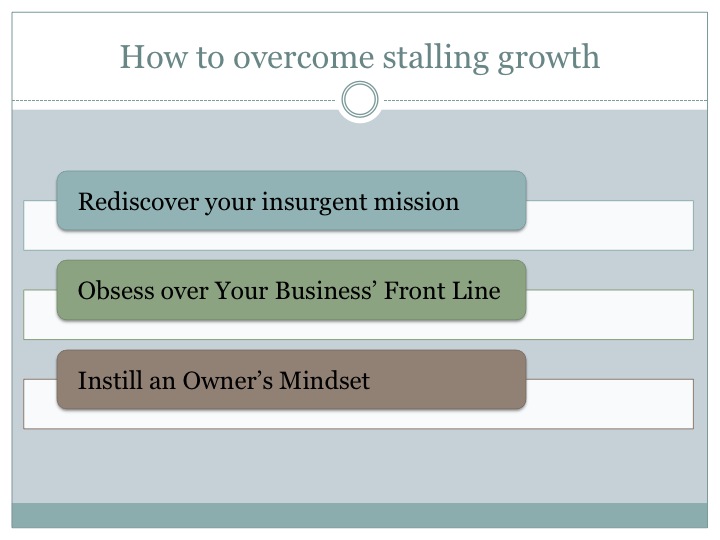
The authors identify three qualities that can help overcome stall-out. By rediscovering your insurgent mission, obsessing over the business front line and instilling an owner’s mindset, companies can reignite growth.

Rediscover your insurgent mission

The first key is to regain the focus and mission that drove your company’s growth. When stall-out occurs, it is almost always connected to creeping complexity. The authors suggest companies experiencing stall-out need to liberate resources, narrow focus and harness the vigor that drove early growth. The company should shed noncore assets and businesses. Then attack complexity in the core processes. Finally, your company should focus on reducing product complexity.

Part of the problem is the democratization – or socialism – of resources. As companies grow, internal budget processes spread resources evenly across businesses and opportunities. While this may feel fair to the management team, and all employees, it impacts growth and drives the company to mediocrity. Successful leaders instead make bold budget decisions to redifferentiate the company, usually establishing a major new capability that set off waves of growth.

Even after growth is reignited, companies need to renew their approach as being business insurgents. Companies should view their customers as underserved and their industries as setting insufficient standards, and should constantly emphasize what is special about themselves. Bold goals—not just the aim of living to fight another day—will sustain growth.

Conversely, you should not be scared to shrink your company to become more efficient and focused. By cutting back, it forces your company to focus on what is most important and reduce bureaucracy that does not increase value. It also allows you to dedicate more resources to growing your company.

Obsess over Your Businesses’ Front Line

The second key to reigniting growth is focusing on the front line of your business. As Zook and Allen write, “this obsession, which can often be traced back to a strong founder, shows up in three ways: an elevated status for frontline employees, a preoccupation with individual customers at all levels of the company, and an institutional curiosity about the details of the business.”

Usually, this obsession is what generated growth initially and the layering of bureaucracy chipped away at it. Other companies likely responded to the weakening relationships and provided better customer relationships and hired your best employees. By moving the focus back to what built the company, you can reignite growth.

Instill an Owner’s Mindset

The final component to overcoming stall-out is instilling an owner’s mindset throughout the organization. This is not just P&L responsibility, but giving employees personal responsibility for their actions and deployment of resources. Allow, and encourage, your employees to take risks. Eliminate the bureaucracy (think risk committees or really any committee) that takes decision making out of their hands. Allow them to partner with external companies. Encourage people to form internal teams to test new ideas. The key is give people the power to get things, important things, done.

Slide1

Preempt stall-out

While the article focused on how to overcome stall-out, more importantly it also implicitly shows how to avoid stall-out. Rather than reaching a situation where growth has stalled, if you leverage the three keys above while still in a growth stage you should continue to grow rather than have to deal with a turnaround.

Key Takeaways

  • Most successful companies eventually face a sudden, large drop in revenue or growth, stall-out, that is largely caused by an increase in bureaucracy.
  • To overcome stall-out, companies need to focus on what made them great initially, obsess over their customers and front-line employees and instill a true owner’s mindset where employees are empowered to make key decisions.
  • In addition to overcoming stall-out, these practices can help growing companies avoid the problem altogether.

Share this:

  • Click to share on Facebook (Opens in new window) Facebook
  • Click to share on LinkedIn (Opens in new window) LinkedIn
Like Loading...
Unknown's avatarAuthor Lloyd MelnickPosted on June 8, 2016May 2, 2016Categories General Social Games Business, General Tech Business, GrowthTags Growth, revenue, stall-out1 Comment on How to become a growth company again

The oft-neglected Arabic market

I am always on the look-out for new markets with good potential and a recent article on AdWeek’s SocialTimes caught my attention about the Arabic-language markets. Most of the buzz in the last year or so has been around sub-Saharan Africa, and while that is an intriguing markets most of their economies still lag significantly, and even more so technologically, behind the Arabic geographies.

Arabic language map

The article quotes a study from Northwestern University in Qatar that a disproportionately high number of the top Facebook pages, YouTube channels and Twitter accounts are in Arabic. Saudi Arabia actually leads the world for YouTube viewers on mobile (50 percent of videos consumed) and the United Arab Emirates also posts impressive numbers (40 percent).

Games and entertainment represent a particularly interesting opportunity. When you breakdown the regions traffic, entertainment is first or second in every market (jockeying with interest in brands). The UAE, in particular, is a strong consumer of entertainment content.

I am not saying that you should pivot to focus on the Arabic-speaking market but you should look at it as a serious opportunity. Test user acquisition in the key markets (UAE, Saudi Arabia, Qatar and Kuwait). If you see traction for your app, consider translation into Arabic and potentially further localization of your content. In today’s hyper-competitive world of user acquisition, you cannot neglect potentially lucrative markets.

Key takeaways

  • The Arabic speaking markets represents an emerging opportunity and should be in the same conversation as sub-Saharan Africa.
  • Entertainment content, and thus games, is particularly successful in these markets.
  • You should test user acquisition in the key Arabic markets and then consider translation and localization if you generate traction.

Share this:

  • Click to share on Facebook (Opens in new window) Facebook
  • Click to share on LinkedIn (Opens in new window) LinkedIn
Like Loading...
Unknown's avatarAuthor Lloyd MelnickPosted on June 1, 2016May 1, 2016Categories General Social Games Business, General Tech Business, Growth, International Issues with Social Games, Social Games MarketingTags Arabic, international, saudi arabia, uae2 Comments on The oft-neglected Arabic market

Try to be the dumbest person in the room

I have seen many examples of people who want to be the smartest at a meeting, or on an email thread, but the most successful are the ones who want to be the dumbest at the meeting. While it may feel that the strategy of highlighting your intelligence is important for your career or management, the opposite is true. Instead, if you focus on trying not to be the smartest person in the room, you are likely to be the most successful. You will get better input, more creative ideas and improved team performance when you allow others to be the smartest.

Shut up
from alliefallie.tumblr.com

Surround yourself with the best

First, you should surround yourself with the best people available. If your goal is to be the smartest, then you are not necessarily putting great people around you. Thus, their performance is likely to be sub-optimal. Great people generate great results and you need to be willing to surround yourself with great people. It is these top performers who drive success.

Not going to learn from yourself

If you spend most of a meeting talking or trying to impress, you are not learning anything. How can you learn when you are talking. If you are trying to find the optimal solution to a problem but focus the conversation on what you are saying, you will cap out at your best solution to the problem, not the best solution in the room. By letting everyone speak and respecting their ideas, you will have the option of selecting the best one. Assuming it is your decision, you then have the option of your best idea or your best idea plus all the others that are proposed. In a worst case, you can still proceed with your idea but now you have many more options.

Everyone has good ideas

If you look at all the fantastic ideas throughout time, you will see that there was not one (or even) a small group responsible for the majority of them. While Stephen Hawking wrote about singularity, Albert Einstein built the theory of relativity, Michio Kaku came up with string theory, etc. The point is that no matter how smart any one person is, there are millions of other very intelligent people. This phenomenon exists on all levels, from the best physicists to the smartest marketers to the best product managers. While you may have some very creative solutions to improve monetization, do not think that others in the room do not have even better ideas.

Great leaders are not great at everything

If you are a great leader, there is no way you are also great at every functional area you are responsible for. You may have wonderful leadership skills, and have risen to that position by innovating on the growth team and building a Unicorn. That does not mean you know analytics better than your lead analyst or finance better than your CFO. You should defer to the experts rather than trying to tell them how to do their work.

Listen

It is not only important to let other’s talk at meetings, it is more important to listen to them. Nobody is going to be motivated to talk if you are not listening. People can tell if you are asking them to talk just to check off a box or whether you and others are actually listening and digesting what they are saying. More importantly, you are not generating any additional value by having people propose ideas or raise concerns and then not addressing them.

Don’t ignore

The above point leads to a critical element of why you want to be the dumbest in the room, you want to leverage the suggestions and ideas everyone has. This is not an exercise in getting buy-in from everyone by pretending to listen to their concerns or advise and then going with your initial idea. The goal is to get the best comments from everybody, have the team work together to synthesize the suggestions into an idea superior to anything anyone (yourself included) initially had. Come out with a better idea, not a perceived feel good exercise that really puts you in the same position.

Measure on results, not sound bites

The measure of success of a meeting, or a working group, or an email thread is not how smart it made you look but that it generated the best possible results. These results are what will also drive your long-term success, not how much you impressed the others at the meeting or on the email (last thought, you didn’t impress them anyway but made them think you were pompous).

Key takeaways

  • Rather than trying to sound the smartest at a meeting, you should aim to be the dumbest.
  • It is more important to surround yourself with great people who will bring performance to a level higher than any individual can achieve.
  • You not only need to get input from everyone but actually use the input to come up with better solutions than you are initially proposing.

Share this:

  • Click to share on Facebook (Opens in new window) Facebook
  • Click to share on LinkedIn (Opens in new window) LinkedIn
Like Loading...
Unknown's avatarAuthor Lloyd MelnickPosted on May 25, 2016May 23, 2021Categories General Social Games Business, General Tech BusinessTags collaboration, Meetings, teams2 Comments on Try to be the dumbest person in the room

Subscriptions 3.0

Although most of my success is with the traditional free-to-play (F2P) in-app purchase business model, the big opportunity will be on layering additional monetization on this model. One old model that I think represents a great opportunity for casual games is the subscription model, a model that pre-dates online gaming. A recent article on Alist, Subscriptions Reborn for Gaming, does a good job summarizing the history and pointing to the future of the subscription model.

Subscriptions in gaming in days past

First, it’s important to note that the subscription model is not new to gaming. The rise of MMORPGs, think World of Warcraft or Everquest, was driven by subscription revenue. At it’s peak (2010), World of Warcraft had over 10 million subscribers (most at over $20 per month).

The importance of subscriptions, however, subsided with the growth of in-app purchases. Most MMORPGs moved to a mixed or purely F2P model. Now. World of Warcraft is the only major product that is largely subscription based, and it offers free play up to level 20.

Other online entertainment have gone the opposite way

While gaming has moved away from subscriptions, it is increasingly important for other online businesses. Amazon Prime, Amazon’s streaming media and free delivery service, with over 50 million US subscribers and about 80 million worldwide. Music has evolved from selling albums or singles to subscription services like Spotify and Pandora. DVDs sales have plummeted while Netflix now has over 80 million subscribers. Thus, in other entertainment spaces, the subscription model is driving revenue now.

Subscriptions in gaming now

While not many games are offering subscriptions, yet, many gamers are already subscribing. Microsoft and Sony both have tens of millions of subscribers to Xbox Live and Playstation Network, respectively, for access to multi-player gaming and new, free games. Electronic Arts is seeing success with its Origin Access subscription service, which for about $4/month gives players access to classic EA games as well as new games before other customers.

The opportunity for subscriptions in gaming

While there is clearly a demand for game subscriptions, one hurdle that remains is Apple’s restriction on iOS subscriptions. With Apple, to offer an “auto-renewable subscription,” that is a subscription that automatically renews rather than asking the customer to purchase it again after a set period of time, you must provide a product that cannot be used up over time, what they call a non-consumable. A consumable could be an hour-long experience point boost in a game app. On the other hand, a non-consumable could take the form of an unlocking a theme, since it could be restored again later.

If you assume that Apple will not change its policy soon, you should not create separate strategies for Android and Apple given the importance of the iOS platform, instead build a subscription model that works for both. While there is no set of best practices yet in the mobile space for leveraging the subscription model, I suggest following the plan below to test this model

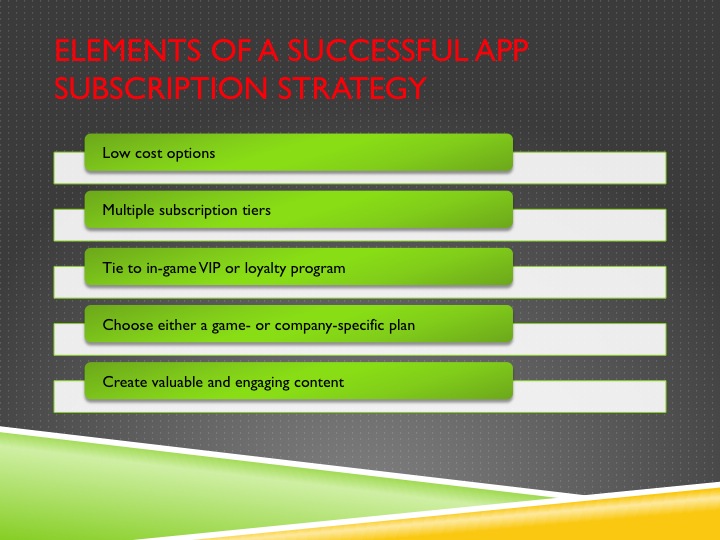
  1. Look at micro-subscription, small monthly amounts. $0.99 or $1.99 is not a large burden on players but not only will it generate revenue but will get them further invested in your product.
  2. Consider multiple subscription tiers. $0.99 for the silver subscription, $4.99 for the gold. This provides opportunities for your most engaged players to get the most benefit but is also accessible for all players.
  3. If you have an in-game VIP or loyalty program, offer subscriptions for players to move up or stay at a certain level. I would pay $10/month to retain my Platinum Status on American Airlines, let other people buy into status (plus it puts a monetary reward on it for players who earned it).
  4. Decide whether it is a company wide subscription (like EA’s Origin Access) or if it is game specific. The former obviously makes sense only if you have, or plan to have, a broad range of titles.
  5. Decide what to include in the subscriptions but always test. Different options include early access to new content or games, discount on purchases (which also may include IAP monetization), special avatars or themes or a regular XP boost. The benefits are game/company specific but should be broad enough to ensure a majority of players would see value.

As the model evolves, it will be interesting to see what does and does not resonate with players. By watching the space, you can learn best practices and build from there.

Slide1

Try it

While the subscription model is unproven in casual games and there is no defined model on how to do it right, you should still try it. It is increasingly difficult to monetize mobile apps, or at least monetize at a level that covers your acquisition costs. By adding subscriptions, you may find a secret to increasing lifetime value and thus enabling growth.

Key takeaways

  • Gamers have responded to the subscriptions model since MMORPGs, though it lost favor to in-app purchases recently.
  • Other areas on online entertainment – music, film, video – are driven by the subscription model.
  • Subscriptions represent an opportunity, though currently unproven, to increase revenue and customer lifetime value.

Share this:

  • Click to share on Facebook (Opens in new window) Facebook
  • Click to share on LinkedIn (Opens in new window) LinkedIn
Like Loading...
Unknown's avatarAuthor Lloyd MelnickPosted on May 18, 2016May 1, 2021Categories General Social Games Business, Mobile PlatformsTags in-app purchases, monetization, Subscription1 Comment on Subscriptions 3.0

What poker can teach you about business

Joining PokerStars last year had one unexpected side benefit, learning poker skills that makes me more effective. Shortly after starting at PokerStars, I had two of our resident ex-pro poker players give me a crash course in Poker so I can understand our products better. While I am still far from a good player, several of the principles they taught are equally important to succeeding professionally.

Blog JP photo

Don’t bluff

The first thing I was told was never to bluff. This advice is equally valuable in the workplace. Do not threaten an action if you do not plan to follow through. Once you do and the other party calls your bluff, you no longer have any credibility. Moreover, you can put yourself in a weak position if you are bluffing and the other party has a stronger hand than you believe, then they may raise (challenge you) and you will not be able to respond.

This principle does not only impact negotiating with other companies but also handling your career. I remember several years ago an employee coming in threatening to leave for another offer if we did not give him a significant raise. Unfortunately, their work did not warrant a raise and we wished them luck with the other position. It turned out that they did not actually have another offer and were left unemployed.

Don’t assume another player is bluffing

A corollary to not bluffing is never assume your opponent (or in this case a company you are negotiating with) is bluffing. In most cases, the counter-party actually has a strong position. Thus, determine your best course of action under the assumption that they are in a strong position. That may mean making a deal with them that is sub-optimal for you but still better than no deal, rather than pushing too hard and ending up with nothing because they have strong alternatives. As my Yoda said, “take the word bluff out of your vocabulary.

Be aggressive with a strong hand

While you should avoid acting like you have a strong hand when you do not, be aggressive when you do have a strong hand. That is the time to get the best deal for yourself or your company. You do not get many fantastic hands in life (the equivalent of a royal flush), so when you do you need to make up for all the times you folded because you did not try to bluff or assumed your opponent was not bluffing.

I spoke earlier of a situation of a person with a very weak hand trying to bluff their way to a higher salary only to lose their position; I also saw someone with a very strong hand play it into security for life. In the latter case, a colleague was responsible for a very successful game, one that positioned the company for success. Rather than simply smiling and accepting a nice (guaranteed) bonus check, they threatened to leave unless they got a new contract that guaranteed them financial security and creative control effectively for life. They could do this because the successful game not only made them critical for their company but meant they could go virtually anywhere they pleased. He thus used this strong hand to not only secure his future but that of his children.

Patience

The need to only play strong hands (derived from not bluffing), but play them powerfully, also creates a need for patience. In poker, you have very few strong hands, probably less than one out of five. That means 80 percent of the time you need to fold and sit back and watch everyone else play.

This patience is much easier said than done. Most people, myself included, do not like to wait. You are anxious to play, you feel you are letting yourself or your company down by not acting. Most of the time, though, the optimal strategy is folding until you have a strong hand that you play aggressively. It may not be the most fun but it is the most effective.

Don’t bet your entire bankroll

Another key principle is to never bet your entire bankroll. Even if you feel you have a strong hand, you should not risk more than 25 percent of your bank roll. Rather than a hard number, I have heard you should not bet more than you are comfortable loosing.

Launching a great new product is a good example. You may have a product that has been testing well and you believe in strongly. Rather than bet your entire company on the success of the product, you need to keep resources to support the rest of your business. Elon Musk has shown this with the launch of the Model 3. While Tesla clearly believes this is their breakthrough product, they continue to develop the Model X SUV and improve the Model S. While you may think your new product is the future, a competitive product can undercut it or the market may not react the same as it did during testing.

Information is critical

In poker, good players leverage data to optimize their chances of winning. This data can come from knowing the odds of what hands are likely, watching how other players are playing (see below) or pulling data on opposing players from various data sources. They also do not provide information when not required. They do not show what cards they have if they folded or if the other player folds before showdown. Less is more when disclosing information.

In the business world, success is also driven by information. If you are trying to do a deal with a company and know that they are about to have an important earnings call and word of your deal will help stock price, you can extract better terms than if you treated the negotiation as if it was happening in a void.

Watch and listen

The final, and possibly most important lesson, was to spend most of your time studying your opponents. By understanding your opponent, anticipating patterns in their behavior, translating their body language to future action, you can decide on the best course of action.

An example of the power of observation is a story I was told about a professional poker player who won a tournament purely based on observation. The player never once looked at his cards. Instead, he folded, called and bet based on what he saw of his opponents. Never underestimate the power of observation.

Key takeaways

  • Remove bluffing from your vocabularly. Do not try to bluff your opponent in business and do not assume they are bluffing.
  • When you are in a strong position, push your advantage.
  • Observe everyone you are interacting with and use those observations to put their actions into context.

Share this:

  • Click to share on Facebook (Opens in new window) Facebook
  • Click to share on LinkedIn (Opens in new window) LinkedIn
Like Loading...
Unknown's avatarAuthor Lloyd MelnickPosted on May 11, 2016May 1, 2021Categories General Social Games Business, General Tech Business, Lloyd's favorite postsTags bluffing, PokerStars, StrategyLeave a comment on What poker can teach you about business

Using scarcity to increase revenue

I recently came across a great post, 9 Essential Ways to Use Scarcity to Increase Sales, on how to use scarcity to increase sales, something we all strive for. Scarcity is a technique used by traditional retailers for ages but something that applies to digital and virtual goods as well. By creating a perceived scarcity, customers are more likely to make a purchase quickly. It boils down to the phrase, “you always want what you can’t get.”

Scarcity promotions

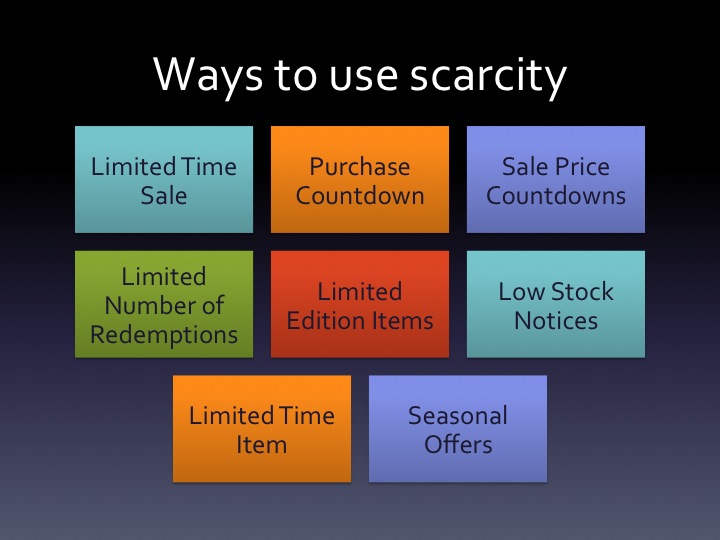
There are several ways to use scarcity, including for virtual items:

  • Limited time sale. Make an offer that lasts for only a limited time. For example, players can get twice the normal amount of virtual currency with a purchase if the purchase is made in the next 24 hours.
  • Purchase countdown. Building on a limited time sale, Putting a timer or countdown within a sales context means defining some scarcity parameters. When the customer has a firm grasp on how much time he or she has left to make a decision, it adds a sense of urgency to the process.
  • Sale price countdowns. Countdowns can also be used in the context of a limited time sale price to remind viewers how much time is left to act before the discounted offer goes away.
  • Limited number of redemptions. Offer a sale that is only available for the first X customers.
  • Limited edition item. Sell a product where there are only a limited number made. This can be modified for virtual goods, there will only be a certain number of the good sold.
  • Low stock notices. While largely for retail, this can also be used with virtual goods, particularly limited edition virtual goods.
  • Limited time item. A virtual item or package that is only available for a certain number of days or hours.
  • Seasonal offers. A sale or item only available for a certain season. It can be anything from a Halloween Pumpkin latte to a Independence Day Virtual Chip bundle.

Slide1

Scarcity basics

For scarcity to work, there are several criteria that you need to meet. The first key is that it is useful. Making something that has no value scarce does not magically impart value on the item or offering. There needs to be an underlying value that can be accentuated by scarcity.

The offering should be transferable. By allowing people to share the offer, the offer filters to those who value it. Finally, you need to be able to own it, even a virtual good. One of the values of scarcity is that you can show it off and there is no way to show off something you cannot possess.

There are several reasons why scarcity works, and understand these reasons can help you create a stronger offering:

  • Scarce items feel exclusive.
  • Scarce items appear more valuable.
  • Scarce items make people feel powerful.

In the article, the authors also point to four limits on using scarcity:

  1. Test to know what works. As with anything, testing is always recommended. AB test different techniques, time limits, product limits, etc.
  2. Too much pressure is a bad thing. Give the user or customer time to make their decision.
  3. Everything in moderation. Limited edition or limited time sales work if they feel special, if there is one every day people soon realize they are only a sales tactic.
  4. Scarcity tactics are not a fix for lagging sales. If your product is not appealing, offering less of it will not turn things around. These tactics make a good product more successful, they are not a way to trick people into using a bad product.

Scarcity is a tool

Scarcity can be a very useful tool when building your promotion strategy. It is not a silver bullet but used effectively can help improve sales and conversions.

Key takeaways

  • Scarcity, or perceived scarcity, is a very useful tool for increasing sales.
  • Scarcity works because it makes items feel exclusive, appear more valuable and make the buyers feel powerful.
  • Scarcity is best used in limited time sales or limited edition items.

Share this:

  • Click to share on Facebook (Opens in new window) Facebook
  • Click to share on LinkedIn (Opens in new window) LinkedIn
Like Loading...
Unknown's avatarAuthor Lloyd MelnickPosted on May 4, 2016April 18, 2016Categories General Social Games Business, Growth, Social Games MarketingTags promotions, Sales, ScarcityLeave a comment on Using scarcity to increase revenue

Why the fear of cannibalization is fear of the inevitable

One of the worst reasons to take action (or not launch a product) is fear of cannibalization. Companies in almost all industries, including game companies, often create strategy to minimize how much some of their products or promotions pull users away from other products from the company. The concept is that you want to optimize your company’s profits by driving users to the most profitable products and ensuring that you do not move a customer or player to a product that costs less.

Some companies have very advanced algorithms to ensure they only move customers to new or other products if it does not have a greater negative impact on the product they are using or playing. Other times they will only release products in certain markets to protect their core market.

While in the short term these strategies can enhance sales, they have a long-term negative impact on profitability and can even endanger your company. The problem with this approach is that while cannibalization may diminish short term profits, it prevents competitors from winning over your customers.

The logic for forgetting about cannibalization

The argument against focusing on cannibalization is simple logic. If a customer or player will switch to one of your other offering, even if they spend less in that offering, they prefer it, otherwise they would not switch. They might prefer the price point or just like the product better but they are happier with the new offering than the existing one they are consuming. If the customer prefers the new product, then any competitive offering will have to be that much better to entice them away from your company.

You can create a simple equation to show the cost of cannibalization. To put it into mathematical terms, lets call your existing product X. Your new product is Y. You earn A per week for X and 0.5A per week for Y. Your analysis says to keep your customer from switching from X to Y, even if you need to ban the customer from Y.

The problem is that your company does not exist in a vacuum. Your competitor will eventually launch its own product Z which costs your customer 0.75A per week (or A per week but provides more value). Even if it takes 8 weeks for your competitor to launch, they eventually will. Thus, you may earn 8A from the customer but nothing else. Instead, if you have a six month (24 week) typical customer lifetime, you earn 12A from that customer instead of 8A. While cannibalization seems like a negative, moving your customer to the less expensive offering actually increases your revenue 50 percent.

Your competition will kill your product if you do not

The primary reason that you cannot avoid cannibalizing your product is that virtually all companies are in a competitive ecosystem. As smart as you think you are, your competitors are also smart and always trying to make their products better. If you can build your product at a lower price, they can build a pretty good copy at a lower price. If you can improve the product by adding certain features or changing the theme, one of your competitors has probably had the same idea and will also try it. While it may take some time for your customer to learn about the competitive product, they will in time. If you keep your customer from their optimal product, a competitor will offer it to them.

Retention, retention, retention

I have written about retention many times and how it impacts the lifetime value of your customer or player. Retention is the key to optimizing a user’s lifetime value, even if they spend a lot if they only do it once or twice it is hard to generate much revenue compared to a loyal user for years. Additionally, as the costs of acquiring users not only in games but in many businesses continues to increase, the relative value of existing customers also increases. It becomes more expensive to replace these customers with new ones so keeping existing customers is critical.

Focusing on cannibalization, however, means you are not giving customers the product they most want to consume. If you let your customer choose which offering they prefer, they will chose the one that puts them on the highest indifference curve (in non-economics speak, the one that makes them happiest). If instead, you decide to limit their options, you are putting them on a lower indifference curve (they are less happy). The less content a customer is, the more likely they are to churn.

The 9X rule strikes again

Further compounding the value of giving your customer their best possible experience is the 9X rule. I wrote about this rule a couple of years ago but in effect it says that a new product needs to be nine times better for someone to switch to it. That’s why a product like the Microsoft Surface, which may be a better tablet, garners very little market share because it is not nine times better than the iPad most people are already using.

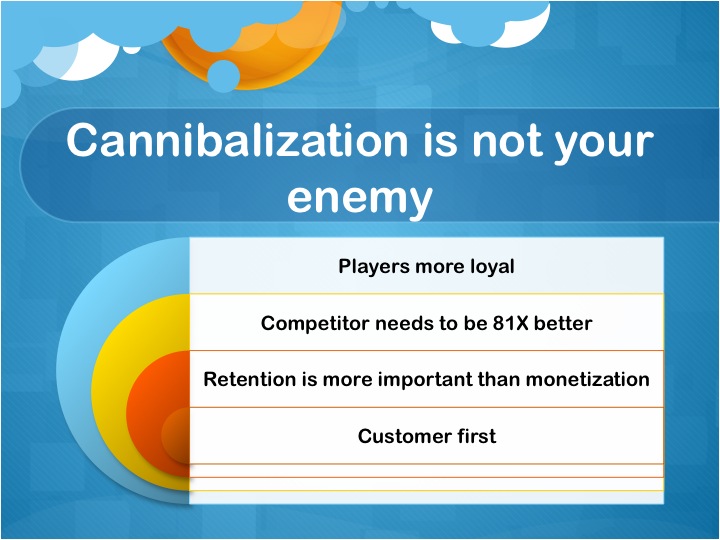
The need for a product to be 9X better to get someone to switch compounds the argument above about the value of moving people to their favorite product even if it cannibalizes another offering from your company. They would not switch unless the new offering was 9X better. For a competitor then to win them over, it needs to be another 9X better. So rather than winning your customer over with something 9X better than your original product, they need to release a product 81X (9X9) better than the original product. This simple equation shows how much more competitive you are by disregarding cannibalization.

Focus on the customer

The bottom line is that rather than creating complex and sophisticated algorithms to minimize cannibalization, you should focus on providing as much value to your existing customer as possible. If this value causes a revenue loss, that is the price you have to pay to keep the customer longer and maximize their lifetime value to your company.

Key takeaways

  1. Concern about product cannibalization, customers switching to a less profitable product of your’s, are misguided and potentially cost your company revenue.
  2. If you do not direct your customers to the offerings they prefer from your company competitor’s will give them a reason to switch and you will permanently lose that customer.
  3. By allowing your customers to move to one of your offerings that they prefer, a competitor will need to offer them something 81X better than the product they are currently using rather than just 9X better.

Slide1

Share this:

  • Click to share on Facebook (Opens in new window) Facebook
  • Click to share on LinkedIn (Opens in new window) LinkedIn
Like Loading...
Unknown's avatarAuthor Lloyd MelnickPosted on April 13, 2016May 1, 2021Categories General Social Games Business, General Tech Business, GrowthTags 9X, CannibalizationLeave a comment on Why the fear of cannibalization is fear of the inevitable

Posts pagination

Previous page Page 1 … Page 14 Page 15 Page 16 … Page 46 Next page

Get my book on LTV

The definitive book on customer lifetime value, Understanding the Predictable, is now available in both print and Kindle formats on Amazon.

Understanding the Predictable delves into the world of Customer Lifetime Value (LTV), a metric that shows how much each customer is worth to your business. By understanding this metric, you can predict how changes to your product will impact the value of each customer. You will also learn how to apply this simple yet powerful method of predictive analytics to optimize your marketing and user acquisition.

For more information, click here

Follow The Business of Social Games and Casino on WordPress.com

Enter your email address to follow this blog and receive notifications of new posts by email.

Join 791 other subscribers

Most Recent Posts

  • Join me at PDMA Inspire for my talk on new product prioritization
  • Why keep studying?
  • The next three years of this blog
  • Interview with the CEO of Murka on the biggest growth opportunity in gaming, Barak David

Lloyd Melnick

This is Lloyd Melnick’s personal blog.  All views and opinions expressed on this website are mine alone and do not represent those of people, institutions or organizations that I may or may not be associated with in professional or personal capacity.

I am a serial builder of businesses (senior leadership on three exits worth over $700 million), successful in big (Disney, Stars Group/PokerStars, Zynga) and small companies (Merscom, Spooky Cool Labs) with over 20 years experience in the gaming and casino space.  Currently, I am the GM of VGW’s Chumba Casino and on the Board of Directors of Murka Games and Luckbox.

Topic Areas

  • Analytics (114)
  • Bayes' Theorem (8)
  • behavioral economics (8)
  • blue ocean strategy (14)
  • Crowdfunding (4)
  • DBA (2)
  • General Social Games Business (459)
  • General Tech Business (195)
  • Growth (88)
  • International Issues with Social Games (50)
  • Lloyd's favorite posts (101)
  • LTV (54)
  • Machine Learning (10)
  • Metaverse (1)
  • Mobile Platforms (37)
  • Prioritization (1)
  • Social Casino (52)
  • Social Games Marketing (105)
  • thinking fast and slow (5)
  • Uncategorized (33)

Social

  • View CasualGame’s profile on Facebook
  • View @lloydmelnick’s profile on Twitter
  • View lloydmelnick’s profile on LinkedIn

RSS

RSS Feed RSS - Posts

RSS Feed RSS - Comments

Categories

  • Analytics (114)
  • Bayes' Theorem (8)
  • behavioral economics (8)
  • blue ocean strategy (14)
  • Crowdfunding (4)
  • DBA (2)
  • General Social Games Business (459)
  • General Tech Business (195)
  • Growth (88)
  • International Issues with Social Games (50)
  • Lloyd's favorite posts (101)
  • LTV (54)
  • Machine Learning (10)
  • Metaverse (1)
  • Mobile Platforms (37)
  • Prioritization (1)
  • Social Casino (52)
  • Social Games Marketing (105)
  • thinking fast and slow (5)
  • Uncategorized (33)

Archives

  • September 2023
  • December 2021
  • July 2021
  • March 2021
  • February 2021
  • January 2021
  • December 2020
  • November 2020
  • October 2020
  • September 2020
  • August 2020
  • July 2020
  • June 2020
  • May 2020
  • April 2020
  • March 2020
  • February 2020
  • January 2020
  • November 2019
  • October 2019
  • September 2019
  • June 2019
  • May 2019
  • April 2019
  • March 2019
  • February 2019
  • January 2019
  • December 2018
  • June 2018
  • May 2018
  • April 2018
  • March 2018
  • February 2018
  • January 2018
  • December 2017
  • June 2017
  • May 2017
  • April 2017
  • March 2017
  • February 2017
  • January 2017
  • December 2016
  • November 2016
  • October 2016
  • September 2016
  • June 2016
  • May 2016
  • April 2016
  • March 2016
  • February 2016
  • January 2016
  • December 2015
  • November 2015
  • October 2015
  • September 2015
  • July 2015
  • June 2015
  • May 2015
  • April 2015
  • March 2015
  • February 2015
  • January 2015
  • December 2014
  • November 2014
  • October 2014
  • September 2014
  • August 2014
  • July 2014
  • June 2014
  • May 2014
  • April 2014
  • March 2014
  • February 2014
  • January 2014
  • December 2013
  • November 2013
  • October 2013
  • September 2013
  • August 2013
  • July 2013
  • June 2013
  • May 2013
  • April 2013
  • March 2013
  • February 2013
  • January 2013
  • December 2012
  • November 2012
  • October 2012
  • September 2012
  • August 2012
  • July 2012
  • June 2012
  • May 2012
  • April 2012
  • March 2012
  • February 2012
  • January 2012
  • December 2011
  • November 2011
  • October 2011
  • September 2011
  • August 2011
  • July 2011
  • June 2011
  • May 2011
  • December 2010
January 2026
S M T W T F S
 123
45678910
11121314151617
18192021222324
25262728293031
« Sep    

by Lloyd Melnick

All posts by Lloyd Melnick unless specified otherwise
Google+

Enter your email address to subscribe to this blog and receive notifications of new posts by email.

Join 791 other subscribers
Follow Lloyd Melnick on Quora

RSS HBR Blog

  • What Actually Works to Change Someone’s Mind
  • Our Favorite Management Tips of 2025
  • How to Manage—and Motivate—Gen Z
  • The Most-Watched HBR Videos of 2025
  • The HBR Charts that Help Explain 2025
  • The Most Popular HBR Podcast Episodes of 2025
  • How the Best Leaders Develop and Spend “Innovation Capital”
  • The 10 Most Popular HBR Articles of 2025
  • How Work Changed in 2025, According to HBR Readers
  • What Leaders Can Learn from a Formula 1 Turnaround

RSS Techcrunch

  • An error has occurred; the feed is probably down. Try again later.

RSS MIT Sloan Management Review Blog

  • Calm: The Underrated Capability Every Leader Needs Now
  • The Top Five MIT SMR Videos of 2025
  • Three Steps Toward Fairer Talent Management
  • From Crisis to Coopetition: What Leaders Can Learn From Anesthesiologists
  • AI Coding Tools: The Productivity Trap Most Companies Miss
  • How Procter & Gamble Uses AI to Unlock New Insights From Data
  • Rewire Organizational Knowledge With GenAI
  • Hungry for Learning: Wendy’s Will Croushorn
  • Beat Burnout: 10 Essential MIT SMR Reads
  • How Leaders Stay True to Themselves and Their Stakeholders
The Business of Social Games and Casino Website Powered by WordPress.com.
  • Subscribe Subscribed
    • The Business of Social Games and Casino
    • Join 726 other subscribers
    • Already have a WordPress.com account? Log in now.
    • The Business of Social Games and Casino
    • Subscribe Subscribed
    • Sign up
    • Log in
    • Report this content
    • View site in Reader
    • Manage subscriptions
    • Collapse this bar
 

Loading Comments...
 

    %d