Skip to content

The Business of Social Games and Casino

How to succeed in the mobile game space by Lloyd Melnick

Category: Growth

Recommended Holiday Reading

Contagious: Why Things Catch OnLast year I recommended the ten professional books that I had found most valuable. I recently finished reading Contagious: Why Things Catch On and found it incredibly enlightening. The author, Jonah Berger, is a Wharton professor who is probably the leading expert on generating word of mouth.

Word of mouth is one of those black boxes that many growth or marketing professionals resignedly claim is a matter of luck. Berger, who has spoken to Google and Facebook among others, shows the fundamentals of creating a product that will generate word of mouth (the growth of which is not necessarily marketing, but rather integrated with building your game the right way). I will write more about Berger’s work in the future but you should put it at the top of your holiday reading list.

Share this:

  • Click to share on Facebook (Opens in new window) Facebook
  • Click to share on LinkedIn (Opens in new window) LinkedIn
Like Loading...
Unknown's avatarAuthor Lloyd MelnickPosted on November 25, 2013November 20, 2013Categories General Social Games Business, Growth, Social Games MarketingTags Contagious, Growth, Jonah Berger, marketing, Word of Mouth2 Comments on Recommended Holiday Reading

The best option left in game financing: growing your company

I get many questions on how to raise money, and in the current business environment the best strategy is growing your business through cash flow. Institutional investors who are open to the game industry are primarily looking for companies that are at a later stage, have significant cash flows and customer bases and are already close to an exit. In fact, the venture capital environment has shifted for almost all enterprises, with a typical A-round (the first round of institutional investment) now primarily going to more advanced companies that already have traction. A few months ago, I wrote about Turning Your Customers into Venture Capital and the importance of that practice has been magnified in recent months.

You do not need investment to create a billion dollar company

I recently read Hamdi Ulukaya’s article in Harvard Business Review on how he grew Chobani (the Greek yogurt maker) into a $1 billion business without any external capital. This article drove home that financing from cash flow could not only be a way to create a nice, profitable lifestyle business but also create a billion dollar business that could IPO if it wanted to go that route. If you are not going to rely on a huge investment to build your company, though, you need to do everything the right way since you cannot just fall back on a big pile of cash. As Ulukaya wrote, “Too many entrepreneurs believe it’s impossible to scale a business without relying on VCs or other equity investors. That view is wrong. If I could grow a company from zero to $1 billion in less than a decade in a capital-intensive industry, many other businesses can too.”

Chobani in top 10 Yogurt Makers

Continue reading “The best option left in game financing: growing your company”

Share this:

  • Click to share on Facebook (Opens in new window) Facebook
  • Click to share on LinkedIn (Opens in new window) LinkedIn
Like Loading...
Unknown's avatarAuthor Lloyd MelnickPosted on October 9, 2013October 18, 2013Categories General Social Games Business, GrowthTags Chobani, Hamdi Ulukaya, Institutional investors, investment, Venture Capital3 Comments on The best option left in game financing: growing your company

The dangers of fast following

One of the biggest problems I see in the San Francisco/Silicon Valley area is the fallacy that fast following is a way to build a successful business. For those not familiar with this concept, it is identifying a successful business model or product, replicating it quickly and bringing the new company or product to market. There are some successful examples, none probably worth more than Microsoft’s fast following of WordPerfect with Word, Lotus 1-2-3 with Excel and Freelance Graphics with Powerpoint. This strategy generated hundreds of billions of dollars for Microsoft and its shareholders. This example is the exception rather than the rule, as fast following is more likely to sub-optimize or fail.
Fast Follower

A strategy built on arrogance

A key indicator that fast following is a flawed strategy is that it is built on arrogance. Fast followers are saying they can take an idea or product and do it better than the original company or anyone else. The question then arises, “Why are you going to be better?” Continue reading “The dangers of fast following”

Share this:

  • Click to share on Facebook (Opens in new window) Facebook
  • Click to share on LinkedIn (Opens in new window) LinkedIn
Like Loading...
Unknown's avatarAuthor Lloyd MelnickPosted on October 2, 2013October 9, 2013Categories General Social Games Business, GrowthTags entrepreneur, fast following, microsoft3 Comments on The dangers of fast following

The secret of creating a hit game

It all comes down to one word: simplicity. This sounds very easy but creating a simple game experience is one of the most difficult elements of game design. In the social and mobile space, the games that are most appealing to the mass market are those that are very straightforward, simple experience. You can understand the game and start playing in the time it takes to get a latte at Starbucks (and often for less money). If you think of the games that have defined casual and social gaming, including Bejeweled, Farmville, Angry Birds and Candy Crush Saga, they are all easy to begin playing and simple to understand. Yet how many thousands of companies have unsuccessfully tried to quickly follow these successes with disappointing results?

Candy Crush iconHave fun fast

The key factor is that the player should be able to start playing and having fun immediately. They should not have to memorize an intricate system or go through a long tutorial. No long manuals, no Google searches, no emailing friends for instructions should be needed, or even considered, by the player. First, the player needs to be exposed immediately to the core game loop, that is the underlying mechanic the makes the game fun and keeps the player coming back. The quicker the player gets engaged with the core game loop, and not distracted by other features, the better. This engagement is seldom achieved through a tutorial, a convoluted story or mini-games. Design your game so the player can start playing quickly and understand what they are doing and their goals without it being explained to them. Continue reading “The secret of creating a hit game”

Share this:

  • Click to share on Facebook (Opens in new window) Facebook
  • Click to share on LinkedIn (Opens in new window) LinkedIn
Like Loading...
Unknown's avatarAuthor Lloyd MelnickPosted on August 13, 2013August 19, 2013Categories General Social Games Business, GrowthTags Candy Crush Saga, Game development, simplicity6 Comments on The secret of creating a hit game

Want to be a world-class growth hacker? Then get out of the building!

Great article about the importance of thinking about your customer when growing your product.

Share this:

  • Click to share on Facebook (Opens in new window) Facebook
  • Click to share on LinkedIn (Opens in new window) LinkedIn
Like Loading...
Unknown's avatarAuthor Lloyd MelnickPosted on April 22, 2013April 22, 2013Categories Growth, Social Games MarketingLeave a comment on Want to be a world-class growth hacker? Then get out of the building!

Three rules for becoming a truly great game company

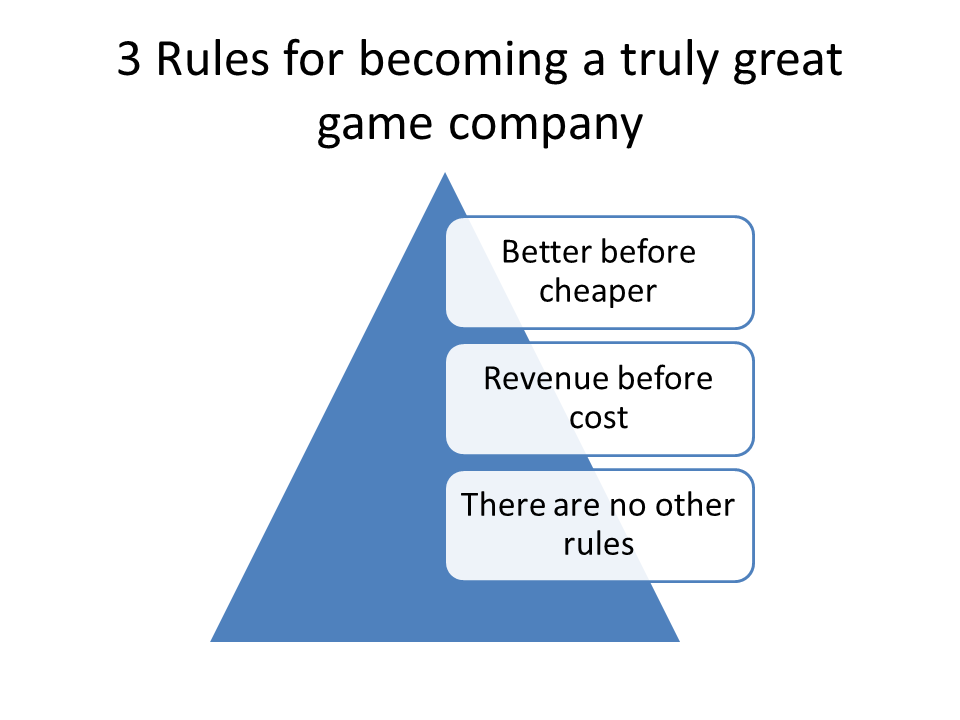
A recent article in the Harvard Business Review, “Three Rules for Making A Company Truly Great,” pointed to three elemental rules that were consistently followed by exceptional companies. There are a lot of hyperbole and clichés about how to create great companies, but the research by Michael Raynor and Mumtaz Ahmed (in the HRB article) shows that three fundamental principles are the keys to success. This finding was based on a statistical study of thousands of companies, so it is much more analytic than what business book happens to be at the top of the charts in a particular week. It is also apparent that these principles apply to social and mobile game companies.

3 Rules for becoming a truly great game Continue reading “Three rules for becoming a truly great game company”

Share this:

  • Click to share on Facebook (Opens in new window) Facebook
  • Click to share on LinkedIn (Opens in new window) LinkedIn
Like Loading...
Unknown's avatarAuthor Lloyd MelnickPosted on April 4, 2013April 9, 2013Categories General Social Games Business, GrowthTags mobile games, social gamesLeave a comment on Three rules for becoming a truly great game company

Reblog of a good post on Player Valuation for Marketing in Free to Play Games

Good post on the value of non-payers.

Philip Driver's avatarGames Marketer

Aggressive monetization and targeting of high value players is receiving more and more attention from game developers, especially in the mobile channel. This had led to a more analytical approach to game creation. Now before I discuss the industry standard metrics of CAC (Customer Acquisition Cost), ARPU (Average Revenue per User) and LTV (Lifetime Value), I want to touch on something I am concerned is becoming overlooked in the Free to Play Market, the value of non-paying players.

Free to play is just one of many video games business models and the basic premise is that whilst the game itself is free to play or download, certain elements of the game are monetized to create revenue. This can be items, characters, time savers etc. that create the revenue that pays for the development and subsequent profitability of the game.

As the use of Free to Play expands amongst game makers…

View original post 2,030 more words

Share this:

  • Click to share on Facebook (Opens in new window) Facebook
  • Click to share on LinkedIn (Opens in new window) LinkedIn
Like Loading...
Unknown's avatarAuthor Lloyd MelnickPosted on March 21, 2013March 21, 2013Categories General Social Games Business, Growth, LTVLeave a comment on Reblog of a good post on Player Valuation for Marketing in Free to Play Games

Growth tactics for mobile game and social media companies

Growth Hacking ConferenceThe big buzz phrase in the Bay Area the last year or so has been “growth hacking,” and the ideas behind it can help significantly game companies. The underlying principle in the phrase is that modern start-ups should be focused on using the new tools available via technology to grow rapidly their user base rather than relying on older, sometimes outdated, marketing techniques. Growth—unlike marketing—usually encompasses multiple aspects of an organization, with the growth team not only bringing in users but also working with the product team to optimize the product for growth. It stresses the importance of product to growth and how the two should work together rather than having marketing set aside in a corner. The phrase itself was coined by Sean Ellis, CEO of Qualaroo and the first marketer at many great tech companies including Dropbox and LogMeIn.

What is a growth team?

A quora post from Andy Johns (currently on Quora’s growth team and one of the early members of Facebook’s growth team) described the typical people an early stage company would put on its growth team: Continue reading “Growth tactics for mobile game and social media companies”

Share this:

  • Click to share on Facebook (Opens in new window) Facebook
  • Click to share on LinkedIn (Opens in new window) LinkedIn
Like Loading...
Unknown's avatarAuthor Lloyd MelnickPosted on February 25, 2013February 26, 2013Categories Analytics, General Social Games Business, Growth, International Issues with Social Games, Social Games MarketingTags Chamath Palihapitiya, Elliot Shmukler, Growth, iteration, marketing, Sean Ellis, testing, user acquisition3 Comments on Growth tactics for mobile game and social media companies

Posts pagination

Previous page Page 1 … Page 8 Page 9

Get my book on LTV

The definitive book on customer lifetime value, Understanding the Predictable, is now available in both print and Kindle formats on Amazon.

Understanding the Predictable delves into the world of Customer Lifetime Value (LTV), a metric that shows how much each customer is worth to your business. By understanding this metric, you can predict how changes to your product will impact the value of each customer. You will also learn how to apply this simple yet powerful method of predictive analytics to optimize your marketing and user acquisition.

For more information, click here

Follow The Business of Social Games and Casino on WordPress.com

Enter your email address to follow this blog and receive notifications of new posts by email.

Join 791 other subscribers

Most Recent Posts

  • Join me at PDMA Inspire for my talk on new product prioritization
  • Why keep studying?
  • The next three years of this blog
  • Interview with the CEO of Murka on the biggest growth opportunity in gaming, Barak David

Lloyd Melnick

This is Lloyd Melnick’s personal blog.  All views and opinions expressed on this website are mine alone and do not represent those of people, institutions or organizations that I may or may not be associated with in professional or personal capacity.

I am a serial builder of businesses (senior leadership on three exits worth over $700 million), successful in big (Disney, Stars Group/PokerStars, Zynga) and small companies (Merscom, Spooky Cool Labs) with over 20 years experience in the gaming and casino space.  Currently, I am the GM of VGW’s Chumba Casino and on the Board of Directors of Murka Games and Luckbox.

Topic Areas

  • Analytics (114)
  • Bayes' Theorem (8)
  • behavioral economics (8)
  • blue ocean strategy (14)
  • Crowdfunding (4)
  • DBA (2)
  • General Social Games Business (459)
  • General Tech Business (195)
  • Growth (88)
  • International Issues with Social Games (50)
  • Lloyd's favorite posts (101)
  • LTV (54)
  • Machine Learning (10)
  • Metaverse (1)
  • Mobile Platforms (37)
  • Prioritization (1)
  • Social Casino (52)
  • Social Games Marketing (105)
  • thinking fast and slow (5)
  • Uncategorized (33)

Social

  • View CasualGame’s profile on Facebook
  • View @lloydmelnick’s profile on Twitter
  • View lloydmelnick’s profile on LinkedIn

RSS

RSS Feed RSS - Posts

RSS Feed RSS - Comments

Categories

  • Analytics (114)
  • Bayes' Theorem (8)
  • behavioral economics (8)
  • blue ocean strategy (14)
  • Crowdfunding (4)
  • DBA (2)
  • General Social Games Business (459)
  • General Tech Business (195)
  • Growth (88)
  • International Issues with Social Games (50)
  • Lloyd's favorite posts (101)
  • LTV (54)
  • Machine Learning (10)
  • Metaverse (1)
  • Mobile Platforms (37)
  • Prioritization (1)
  • Social Casino (52)
  • Social Games Marketing (105)
  • thinking fast and slow (5)
  • Uncategorized (33)

Archives

  • September 2023
  • December 2021
  • July 2021
  • March 2021
  • February 2021
  • January 2021
  • December 2020
  • November 2020
  • October 2020
  • September 2020
  • August 2020
  • July 2020
  • June 2020
  • May 2020
  • April 2020
  • March 2020
  • February 2020
  • January 2020
  • November 2019
  • October 2019
  • September 2019
  • June 2019
  • May 2019
  • April 2019
  • March 2019
  • February 2019
  • January 2019
  • December 2018
  • June 2018
  • May 2018
  • April 2018
  • March 2018
  • February 2018
  • January 2018
  • December 2017
  • June 2017
  • May 2017
  • April 2017
  • March 2017
  • February 2017
  • January 2017
  • December 2016
  • November 2016
  • October 2016
  • September 2016
  • June 2016
  • May 2016
  • April 2016
  • March 2016
  • February 2016
  • January 2016
  • December 2015
  • November 2015
  • October 2015
  • September 2015
  • July 2015
  • June 2015
  • May 2015
  • April 2015
  • March 2015
  • February 2015
  • January 2015
  • December 2014
  • November 2014
  • October 2014
  • September 2014
  • August 2014
  • July 2014
  • June 2014
  • May 2014
  • April 2014
  • March 2014
  • February 2014
  • January 2014
  • December 2013
  • November 2013
  • October 2013
  • September 2013
  • August 2013
  • July 2013
  • June 2013
  • May 2013
  • April 2013
  • March 2013
  • February 2013
  • January 2013
  • December 2012
  • November 2012
  • October 2012
  • September 2012
  • August 2012
  • July 2012
  • June 2012
  • May 2012
  • April 2012
  • March 2012
  • February 2012
  • January 2012
  • December 2011
  • November 2011
  • October 2011
  • September 2011
  • August 2011
  • July 2011
  • June 2011
  • May 2011
  • December 2010
December 2025
S M T W T F S
 123456
78910111213
14151617181920
21222324252627
28293031  
« Sep    

by Lloyd Melnick

All posts by Lloyd Melnick unless specified otherwise
Google+

Enter your email address to subscribe to this blog and receive notifications of new posts by email.

Join 791 other subscribers
Follow Lloyd Melnick on Quora

RSS HBR Blog

  • How One Manufacturer Achieved Net Zero at Zero Cost
  • What Can U.S. Employers Do About Rising Healthcare Costs?
  • When You Have to Execute a Strategy You Disagree With
  • 4 Ways to Build Durable Relationships with Your Most Important Customers
  • What Jargon Says About Your Company Culture
  • Research: When Used Correctly, LLMs Can Unlock More Creative Ideas
  • Your New Role Requires Strategic Thinking…But You’re Stuck in the Weeds
  • For Circular Economy Innovation, Look to the Global South
  • Why Great Leaders Focus on the Details
  • Corporate Disclosure in the Age of AI

RSS Techcrunch

  • An error has occurred; the feed is probably down. Try again later.

RSS MIT Sloan Management Review Blog

  • AI Coding Tools: The Productivity Trap Most Companies Miss
  • How Procter & Gamble Uses AI to Unlock New Insights From Data
  • Rewire Organizational Knowledge With GenAI
  • Hungry for Learning: Wendy’s Will Croushorn
  • Beat Burnout: 10 Essential MIT SMR Reads
  • How Leaders Stay True to Themselves and Their Stakeholders
  • Our Guide to the Winter 2026 Issue
  • Broadening Future Perspectives at the Bank of England
  • A Faster Way to Build Future Scenarios
  • Assess What Is Certain in a Sea of Unknowns
The Business of Social Games and Casino Website Powered by WordPress.com.
  • Subscribe Subscribed
    • The Business of Social Games and Casino
    • Join 726 other subscribers
    • Already have a WordPress.com account? Log in now.
    • The Business of Social Games and Casino
    • Subscribe Subscribed
    • Sign up
    • Log in
    • Report this content
    • View site in Reader
    • Manage subscriptions
    • Collapse this bar
 

Loading Comments...
 

    %d