
This article clearly shows why you need to focus on your best customers or VIPs,. Development, product management and marketing need to all understand the need to attract and retain VIPs. I also appreciate the fact that the post does not suggest that your revenue should be a bell-shaped distribution; as I previously wrote, there is nothing wrong with a heavy-tail distribution.
Why scale should not be a founder’s focus
I read a great blog post by Y Combinator Co-Founder Paul Graham that showed why start-ups need to focus on activities that do not scale. Graham debunks the theory held by many start-ups that if they build a great mousetrap, customers will flock to it and if customers do not, then the product must be a failure. He points out that startups succeed because the founders make them take off (with a few exceptions).
Get users
Graham starts by pointing out that the most frequent non-scalable activity founders do is recruiting users manually. New companies cannot wait for users to find their product, they need to go out and get users. This could be by going to friends and family. It could be by going to other companies that you network with. It could be by knocking on door after door.
There are two reasons founders resist going out and recruiting users individually. One is a combination of shyness and laziness. They’d rather sit at home writing code than go out and talk to a bunch of strangers and probably be rejected by most of them. But for a startup to succeed, at least one founder will have to spend a lot of time on sales and marketing. The other reason founders ignore this path is that the absolute numbers seem so small at first. 10 more users may not seem like a big deal for someone who has just watched The Social Network, but if it moves you from 100 to 110 users in a week, that is a 10 percent increase. Keep increasing 10 percent every week and then they will be making movies about you. Continue reading “Why scale should not be a founder’s focus”
When Founders And Investors Split Over An Acquisition Offer

Great post for any Founder or member of the Exec team of a start-up on the reality of diverging investor/entrepreneur interests. Neither side is wrong, but it’s good to understand the underlying motivations.
Growth through content
Too often, companies rely on paid user acquisition and tricks to grow their apps, services or games, while neglecting to consider growth in their content (e.g., blog posts, infographics) creation. There was recently a great blog post by Kissmetrics that discussed how to growth hack your content, so that these efforts contribute to your growth. I recommend you read the post but will summarize the key points.
To become a “content hacker,” as Kissmetrics calls it, there are five key tactics: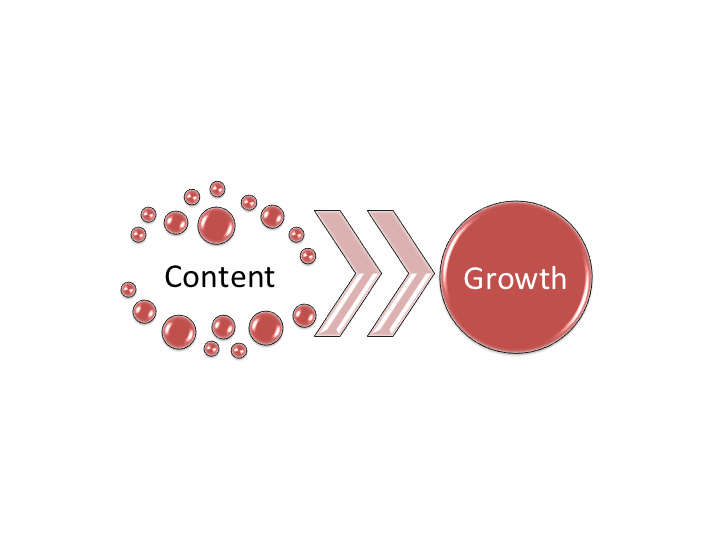
- Create great headlines.The headline is the most important part of your post or content. To create a powerful headline, you do not want to give away your full post, nor do you want to give it away in the shared image or text. You also do not want to be negative or shrill (who wants to read a depressing post). Also, do not try to be too clever.
- Make your content more shareable. You need to make it easy to share your headline and content with the world, and not with just the usual share buttons. Some of the tools they suggest include Markerly, a simple sharing widget that automatically makes images or highlighted text shareable on your site. This plug-in
can be added to any site with some simple JavaScript code. Another option is adding Click to Tweet calls-to-action in your post. Continue reading “Growth through content”
Coursera Machine Learning course
If any of my readers would like to join me, I just signed up for Stanford professor Andrew Ng’s course on Machine Learning.
Would love for people to also take it so we can discuss in this blog.
What is machine learning and why it is crucially important
A few weeks ago, I posed a question on Quora about the differences between machine learning and predictive analytics. I was surprised at the number of people who started following the question and actually liked it (although it sounded rhetorical, I was hoping to understand machine learning better). A recent article in Fast Company about The New York Times, of all companies, did a great job of explaining the fundamental value of machine learning.
My interest in machine learning was ignited recently as it has become the hot buzzword in the Bay Area; some have argued if you add machine learning to your PowerPoint you can add a zero to the end your company’s valuation. While that claim is obviously an exaggeration, investors are among the savviest businessmen, so their interest in machine learning shows it is a crucial emerging space.
The article discusses Chris Wiggins, a biologist The New York Times just hired as its Chief Data Scientist. Wiggins’ mandate is to build and lead the Times’ machine learning team. In Fast Company’s interview with Wiggins, it became clear exactly what machine learning is, how it is different than predictive analytics and why it is important.
What is machine learning
According to Wiggins, “Machine learning sits at the intersection of data engineering and mathematical modeling. The thing that makes it different from statistics traditionally, is far more focus on building algorithms.”

Also, while statistics is traditionally focused on explaining data, machine learning is geared to building predictive models. When Netflix or Amazon make product recommendations to you, they are using machine learning to predict what you would be interesting in experiencing. Continue reading “What is machine learning and why it is crucially important”
The key to growth: word of mouth
Last year I recommended Jonah Berger’s fantastic book Contagious: Why Things Catch On, which discusses how to generate word-of-mouth marketing for your product. It is a particularly valuable book for mobile game companies, where word of mouth is often credited with the success of a product (see Flappy Bird) but is a virtual black box, with most companies considering it a matter of luck. Rather than luck, Berger shows how you build a product or marketing campaign to generate word-of-mouth success.


Word of mouth is the primary factor behind 20 percent to 50 percent of all buying decisions, according to Berger, and probably an even stronger force in games. Berger shows that while traditional advertising is still useful, word of mouth from everyday consumers is at least ten times more effective. Continue reading “The key to growth: word of mouth”
The heart of good forecasting: Be conservative
I recently read a paper, “The Golden Rule of Forecasting: Be Conservative” by Armstrong, Green and Graefe, that showed empirically the most important principles in making forecasts and predictions. Given the value of accurate forecasting (e.g., for building your business, making investments, choosing between product strategies), by understanding the golden rule you will help optimize your decision making.

What is particularly compelling about this paper is that it is based on extensive research and empirical studies. So while many forecasting and decision-making guidelines are based on hypothesis or observation, The Golden Rule of Forecasting is based on data.
At the heart of the golden rule of forecasting is that you should be conservative; forecasters must seek all knowledge relevant to the problem and use methods that have been validated for the situation.
With “be conservative” as the overarching golden rule, the authors performed extensive research to develop a list of guidelines that help lead to good forecasts and identified practices that generate poor decisions. Continue reading “The heart of good forecasting: Be conservative”
Bayes’ Theorem Part 3: Making the best green light decisions
The last couple of weeks, I wrote about how Bayes’ Rule is the strongest tool for making good business decisions. In this post, I will address one of the most important decision and how Bayes’ Rule can help, deciding what games or products to green light. In the game space, the green light decision is when a company decides whether or not to fund fully a project and put it into production. Some companies have a highly defined process, while others rely on intuition. The lessons of Moneyball already say who is going to win between those using a process and analytics and those using intuition, so I am going to focus this post on how to apply Bayes’ Theorem so you apply the right data. Although I am focusing the post on green lighting game projects, it can be applied to any new product.

One of the most common green light mistakes I have seen in the game industry is companies deciding on the merits of a game primarily based on how much fun the demo or prototype is. Related to this, they look at how the features of the demo/prototype compare with competitors and if it has enough competitive advantages they move forward. With the latter approach, you may feel you are looking at the opportunity very analytically but you are actually neglecting the most important data points.
Bayes’ Rule shows that often the best information for decision making is most likely the data from all previous game releases. As I wrote about last month, Bayes’ Theorem is a rigorous method for interpreting evidence in the context of previous experience or knowledge. Bayes’ Theorem transforms the probabilities that look useful (but are often not), into probabilities that are useful. It is important to note that it is not a matter of conjecture; by definition a theorem is a mathematical statement has been proven true. Denying Bayes’ Theorem is like denying the theory of relativity. Continue reading “Bayes’ Theorem Part 3: Making the best green light decisions”
Digital Platforms: The Center of The Future Economy
A recent article in the Economist, “Something to stand on,” shows how digital platforms are the heart of the new economy, and by extension the strongest opportunities for entrepreneurs and investors. Platforms provide the basis for people and companies to build businesses, services, features or just about anything. The core building blocks remain stable so that the other parts can evolve more rapidly by combining, recombining, and adding new ones.
Platforms are not a new concept; they exist in the non-digital world but started garnering attention as the software industry exploded in the 1980s. In the physical world, railways could be considered a platform as they allowed services such as mail order to develop. The power grid is another platform, as it facilitated the creation of multiple electrical household appliances. Shipping containers (those big crates on ships) were a platform that boosted global trade.
Platforms, however, started getting attention as an economic driver (and source of business success) with the rise of the software industry. Microsoft identified—much earlier than its competitors—that power and profit rests with those who control the operating system (in its case, Windows). It also saw that the key to creating a successful platform is building a thriving ecosystem around it to gain a network effect. The more programs that run on Windows, the more users will want it, and therefore the more attractive it will be to developers. Continue reading “Digital Platforms: The Center of The Future Economy”
 The Business of Social Games and Casino