
Skip to content

The Business of Social Games and Casino

How to succeed in the mobile game space by Lloyd Melnick

Tag: Clayton Christensen

Lessons for gaming and tech companies from the Peter Drucker Forum

Lessons for gaming and tech companies from the Peter Drucker Forum

Last year, I had the opportunity to attend (virtually) the The Peter Drucker Institute’s Forum on Leadership. What I found particularly compelling (and why I attended) was that the majority of the speakers were successful business leaders, rather than people whose primary calling was providing advice. I always prefer proven actions to theories.

Below, I am highlighting some of the key highlights and takeaways for companies in the gaming space, particularly tied to innovation, leadership, remote work and leading during a crisis.

The kryptonite of innovation: Excel

One of the most interesting lessons from the seminar was a story from Scott Cook, founder and CEO of Intuit, recalling one of Clayton Christensen’s (the guru of innovation) experience with innovation at Intel. According to Cook, Christensen identified spreadsheets as the root cause of Intel’s inability to innovate. He had been brought in by Andy Grove to help Intel and was given access to all new businesses that Intel had created. At the time, Intel had launched 60 new business initiatives, and every single one failed.

No innovation

As Intel was a huge company, there was robust documentation for all the initiatives. Christensen reviewed the documents and found that the common flaw was the spreadsheet. Whatever the company’s required IRR (internal rate of return) in the proposal, the P&L always showed you would get that IRR. Yet, in the end, all 60 had failed. The spreadsheets actually focused the teams on manipulating the numbers rather than finding product/market fit. This lesson resonated strongly with me, as I have seen many companies in the gaming space try to use robust analysis to greenlight new game projects and the reality never came close to the spreadsheet (in fact, the performance of the projects seemed uncorrelated to the projections).

Key takeaway: Using spreadsheets to analyze a new business venture is worthless or even creates negative value. It is impossible to predict accurately the new ventures performance and takes away from testing businesses in the wild.

The opposite of spreadsheets, tools to generate innovation

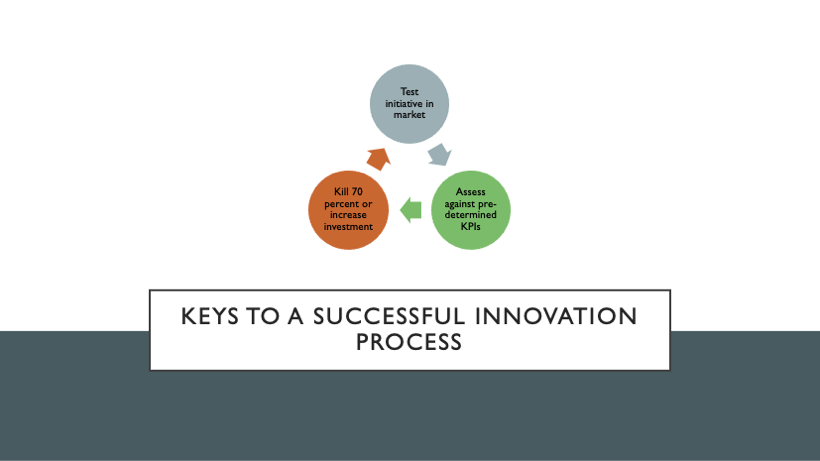
While spreadsheets are not the solution to innovating, several speakers provided excellent guidance. One speaker provided a clear alternative to Intel’s failed strategy of innovating by financial analysis. Rather than try to pick winners, admit you do not know what projects will succeed. In stark contrast to Intel, Bosch invested in 200 projects in two years. It gave each a small amount of seed investment. After three months, the teams had to prove the project had traction, using predetermined KPIs. After three more months, the team again had to prove it had promise; at this stage Bosch kills 70 percent of projects, with the others receiving additional investment. After another three months, it kills another seventy percent of projects, adding to the investment in the survivors.

Keys to a successful innovation process

Howard Yu, the LEGO professor of Innovation at IMD Business School explained that companies have no trouble trying disruptive innovation but scaling it. This problem is one I experienced in multiple large companies that were trying to expand into new areas.

These projects turn into side hobbies and never impact the core business, moreover, they leave the company vulnerable to disruption. I once joked that an effort I led at a big company had the promise of being a footnote on its financial statements after five years if we continuously outperformed our plan.

Even when buying companies for innovation, companies often fail to scale this disruption. To overcome this situation, the leadership team must have a shared vision of the future. They and their Board needs to have difficult conversations, including firing and hiring. Most importantly, the CEO has to have a curious mind and recognize what kind of world we live in to capitalize on opportunities and mitigate the biggest risks. A great example of a “curious” executive is Bill Gates, who reads over 50 books a year.

Key takeaways: The best way to grow innovation is testing multiple initiatives, evaluating them critically, stopping the majority of projects and then increasing investment in those showing traction. For a company to innovate and not simply play at innovation, it also needs a curious leader who builds a shared vision of the future.

The value of micro-businesses

Another great insight came from Kevin Nolan, the CEO of GE Appliances. GE Appliances is the fastest growing appliance business in North America and owned by Haier, the Chinese conglomerate known for innovation. Nolan discussed his experience at GE Appliances, where the company was originally built on efficiency and productivity but had been dying slowly due to slow moving ideas and bureaucracy. In the fast evolving consumer appliance environment, GE needed to be creative and nimble but instead had become bureaucratic. Ideas were based on the weight of PowerPoint presentations rather than product/market fit. Success was measured on getting into next year’s budget. GE was slow moving and not responsive to the market, unable to compete in a fast paced, short cycle business. Thus, GE sold the unit to Haier, though Nolan expected more of the same from the new Chinese owners.

Instead, Haier realized that employees want to be entrepreneurs. It broke the business into small pieces so it could focus on agility and competition. Haier preached that the only person employees should listen to is the users, they pay the salary, not the company. The philosophy being that your boss is not inside your company but outside, your consumer. Nolan said, “burn your org charts, they represent hierarchy, bureaucracy.”

It broke company down from 4 to 14 product lines and shifted to micro-enterprises. By micro-enterprises, business lines or products that had full P&L responsibility and autonomy. Effectively, GE created a collection of CEOs. The idea behind the micro-businesses is that the team needs to live in a zero distance world from its customer. Every micro-enterprise looks at their individual customers, not the aggregate customers of the company.

The goal for Nolan and Haier was to get zero distance between the customer and employees, perpetually getting the gap smaller and smaller. It was also critical for every micro-business to get tight with its commercial team. That is where got actionable feedback, not one of the staff functions. As Nolan said, “finance can’t tell you what you need to do in the future.”

With this strategy of micro-businesses, GE Appliances is now the fastest growing company in the very competitive North American market and the number one smart home company. It also has the highest employee satisfaction rating in the industry.

Key takeaways: In the gaming space, you can set up every product as a micro-business, with P&L responsibility. Give the team autonomy and allow them to focus on the specific customers of their game, rather than the entire company.

Inverted pyramid of leadership

Any strong management conference will include interesting ideas about leadership, and this one did not fail to deliver in that area. One of the speakers, John Ferriola, the former CEO of Nucor (a company with over 26,000 employees), explained the concept of the inverted pyramid. According to Ferriola, command and control only works where safety and compliance are critical. Otherwise, a business in the 21st century need to invert the pyramid, based on meritocracy and freedom for the employees.
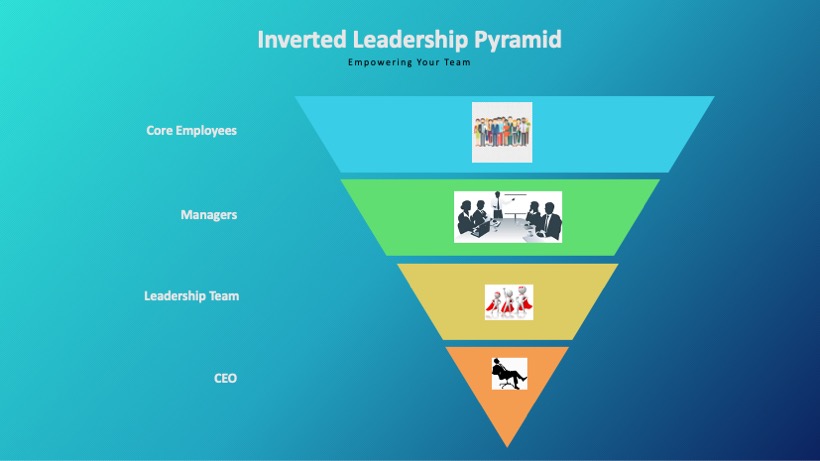
Inverted pyramid

At Nucor, the CEO (at the time, Ferriola) works for the employees, not the other way around. Nucor believes every leader at every level must lead with a servant’s heart; their job is to take care of their team. The leader’s job is to create an environment where others can succeed and then trust that once they create that environment, the team will do the best thing. No leader can have all the knowledge to make always the right decision, instead leverage the cumulative resources of your team to take the best path of action.

As part of the inverted pyramid, every employee can bring ideas or complaints to the CEO, with the caveat that they need to discuss the idea first with their immediate supervision. Then employee can speak directly to the CEO without any fear of reprisal. All employees had the CEO’s office number, home number and cell phone.

Key takeaways: Rather than building a strict hierarchy, structure your company so the leaders can serve their teams and create an environment where employees are empowered to take the best action.

Empowering the top of your pyramid

Once you accept the concept of the inverted pyramid, there are many techniques to empower your employees, who are now at the top of the pyramid. Tracey Davidson, the Deputy CEO of Handelsbanken explains it comes down to fundamentally trusting your colleagues. To achieve this trust, you need to align around a common set of core values; at Handelsbanken they have had the same goal and core values for 50 years. For these goals to be successful, they must be:

  • Simple
  • Easy to remember
  • Shared focus
  • Focused on satisfying customers, not costs or profit

Ms. Davidson explained that when people have a clear mandate, they do their best work. At a structural level, trusting employees allowed them to decentralize their organization and treat each branch treated as a mini-business supported by the central business (consistent to the conversation about micro-businesses above).

It was interesting how empowering employees converged with creating micro-businesses. In Handelsbanken’s case, by turning each branch into a micro-business, they did not have to change policies or decisions for people to make decisions in new parts of the bank. Each branch controls its own P&L. The branch decides where it is going to spend, where expenditures are pitched on a peer basis. Branches see that if they control costs well, then every new customer has a bigger impact.

Handelsbanken also gives each branch details on costs so they can set their own pricing. The central branch provides all the costs of capital as well as other costs and the local branch then decides pricing and whether or not to loan to a local customer.

As part of empowering the branches, they have to live with consequences of their decisions. If capital exposure cost goes up with a bad customer, it impacts the branch. Branch performance reflects customer performance, not kicked into a group KPI. This philosophy has helped Handelsbanken consistently outperform its peers.

Another example of empowering your team is from the CEO of Michelin, Florentino Menegaux. Menegaux points out that as the leader you need to suck the stress from the organization and your team and return the energy. Michelin started as a command and control culture but he realized it was contradictory to trying to focus on customers. He needed to realign processes to tap into the collective intelligence and understanding of customer, rather than relying on processes. To make this change, and put employees at the top of the pyramid, he identified three keys:

  1. Trust. Empowerment and performance begins with trust. Never underestimate the casual genius of every human being.
  2. Freedom. If you want people to think outside of the box, you need to give employees ability to do so.
  3. Culture. If you want to transform people on the front lines to be empowered, you have to transform the culture and work with everyone to address challenging behaviors.

Menegaux concluded by pointing out that humans collectively are more powerful than a computer but computers allow people to be more human. He suggested we use technology to unleash human potential, rather than measuring 1,000 KPIs.

Key takeaways: To empower your team and move to an inverted pyramid, you need to provide clear and simple goals and allow your employees to figure out the best way to achieve them.

How to lead in a remote environment

The conference explored another element of leadership, particularly important now, leading in a remote or work from home environment. What made someone a great leader even two years ago may not work now, where you can no longer meet informally with your team or easily observe their day-to-day activities.

Donna Flynn, the VP of Global Talent at Steelcase focused on the emphatic traits leaders now need to develop. She identified three keys to leading successfully in a remote environment:

  1. Be intentional and clear with your team.
  2. Develop a “third eye” for emotional intelligence, as you need to view your team through an emotional lens.
  3. Help your team manage both their energy collectively and individually. Well-being is a top line issue for leaders to always consider.

Flynn also provided some useful, more tactical advice:

  • Large group discussions are not as interactive, so it is good to follow them up or even precede them with small group discussions.
  • You need to connect with your team, not only your direct reports, one-to-one. Focus on frequent touch points across your team and show vulnerability so they open up to you.
  • Work from home will be a node in the ecosystem and the office another node. Some will chose to go to the office daily. Others will chose to go for specific activities. Design your processes and team for this cadence of interactions and build the conditions to achieve desired outcomes.

Guy Ben-Ishai of Google added additional insights into effectively leading in a work-from-home or remote environment. According to Ben-Ishai, successful remote leadership comes down to maintaining your presence. If you are not present, you cannot really lead. You can achieve this presence with frequent interactions with a broad number of people, even when working remotely. You should insist on taking the time and having periodic check-ins with employees, colleagues and other leaders.

Key takeaways: In a work-from-home or remote work environment, great leaders need to maintain their presence. You can do this with frequent, personal interactions with teammates, employees and other colleagues.

Using a crisis to improve

Covid has not only provided a challenge in leading remote workers but it also has presented opportunities for many companies. Great leaders can turn a crisis into an opportunity. To lead effectively through a crisis, you need to think outside the box and focus on your customers.

Sara Mathew the Chair of the Board at Freddie Mac recounted the story of one of her greatest professional successes. She joined Dun & Bradstreet as CFO a week before 9/11, which almost put the company out of business. To deal with the crisis, Ms. Mathew brought in the consulting group McKinsey, who proposed a very draconian process to survive. She was tasked with changing Europe to break even. Customers had lost trust in the brand because of data quality. The team was worn out with the issue, it was all they heard day in and day out. Yet there was still a sense of optimism as employees maintained pride in D&B.

Ms. Mathews tried something revolutionary, collaborating with their top competitor. Her goal was to give access to their technology platform and data and convert it into franchise model. In 18 months, she created franchises around the world for every market except three where they were already number one. Europe moved from a loss to a $100 million profit. Customer satisfaction improved 30 points. D&B’s stock price went from $20 to $80 and Ms. Mathews became CEO.

Ms. Mathews explained that this success, driven by a crisis, was not genius but the result of trying a radical idea. She also highlighted that the idea did not come from the top, it came from a customer.

In addition to the example of Ms. Mathew, Jorgen Vig Knudstorp, LEGO’s Executive Chairman explained how LEGO used the crisis as an opportunity to reinforce its mission. LEGO annually spends about $300 million to promote children with challenges to learn through play. LEGO increased its investment another $100 million during the pandemic for similar initiatives, as the non-profits they work with were facing extraordinary challenges to continue their work. Knudstorp explains that when you are under pressure, it is a good opportunity to put your money where you mouth is.

Key takeaways: To navigate your way out of a crisis, listen to your customers to come up with novel solutions.

Key takeaways:

  • The best way to grow innovation is testing multiple initiatives, evaluating them critically, killing the majority and then increasing investment in those showing traction in a regular cycle. For a company to innovate and not simply play at innovation, it also needs a curious leader who builds a shared vision of the future.
  • Rather than building a strict hierarchy, structure your company so the leaders can serve their teams and create an environment where employees are empowered to take the best action.
  • To navigate your way out of a crisis, listen to your customers to come up with novel solutions.

Share this:

  • Click to share on Facebook (Opens in new window) Facebook
  • Click to share on LinkedIn (Opens in new window) LinkedIn
Like Loading...
Unknown's avatarAuthor Lloyd MelnickPosted on February 17, 2021February 28, 2021Categories General Social Games Business, General Tech BusinessTags Clayton Christensen, Covid19, hierarchy, innovation, leadership, Micro-business, Work from homeLeave a comment on Lessons for gaming and tech companies from the Peter Drucker Forum

Yes, Coin Master is Disruptive

Yes, Coin Master is Disruptive

There has been much debate lately, including on my Facebook page, whether Coin Master from Moon Active is truly disrupting the social casino genre or whether it should be classified in a different category. Much of the debate shows how challenging it is to disrupt a segment or an industry. Coin Master is classic disruption, and understanding the debate helps conceive of additional ways to disrupt.

For those not familiar with Coin Master, it is a mobile game currently generating over $250,000/day currently or an annualized run rate based on Q4 2018 of over $280 million (source: Eilers & Krejcik Gaming, LLC). This would make it the second largest social casino game, behind Slotomania but ahead of well known titles like Doubledown, Heart of Vegas, Big Fish Casino, Hit It Rich!, etc.

Given the success of Coin Master, there are many excellent articles about the gameplay mechanics, monetization, etc., and I will not repeat what others have written better than I could. For those who have not played Coin Master, there is a single, (simple) slot machine and not only do you win coins, you also can attack and raid other villages. You then use your coins to build your village.

Coin master

Coin Master uses a slot mechanic as part of the core game loop, hence why it may be categorized as a social casino product. As a social casino product, many think it has successfully disrupted a highly profitable but stagnant space. Conversely, as there are RPG and Invest-Express elements, it is also argued that it should not be considered social casino, thus it is not disruptive. The latter argument, however, misses the point of disruption.

Disruption, the Blue Ocean Way

One way to approach disrupting an industry is to take a Blue Ocean methodology. I have written frequently about Blue Ocean strategy and am a strong advocate of this technique. In Blue Ocean strategy, you create a new market space by serving the non-customers of an industry, making the competition irrelevant. You do this by adding-reducing-eliminating-increasing features.

This approach is exactly what Moon Active did with Coin Master. They built a game that served people who were not currently engaged in social casino. They also did not try to compete directly with Playtika or Aristocrat, with the eight figure marketing budgets those companies have, they disrupted the industry by finding untapped demand.

Moon Active’s strategy perfectly followed the Blue Ocean framework of adding-reducing-eliminating-increasing features

  • Add.  Key elements that Moon Active added include raiding and attacking friends and city-building (invest express).
  • Reduce.  Among the elements that Moon Active reduced were number of slot machines, quality (graphics and depth) of slots and purchase options.
  • Eliminate.  Moon Active also eliminated several features that are seen in virtually all other social casino products. These include locked machines, pay-tables, jackpots, tournaments and a reward system.
  • Increase.  Finally, Moon Active increased certain elements. Among the features increased were the value of progression, interaction with your friends and the importance of card collection.

There are many examples of companies in other industries that disrupted their industry with a Blue Ocean approach. Cirque de Soleil is one of the most popular examples, as the circus business was stagnant until Cirque de Soleil reinvented the industry by creating a new type of product that appealed to different customers. Ringling Brothers did not consider Cirque a competitor and most argued that it was a different, not disrupting the circus industry. Amazon did the same to retail when it started selling books online. Barnes & Noble and Borders did not consider it disruptive, and retailers in other industries certainly did not, as their customers were not looking to buy books (or shoes or electronics) online. When Wikipedia launched, Encyclopedia Britannica did not consider it a competitor. Now you probably would use Wikipedia to remember what Britannica was.

In all of these Blue Ocean cases, many argued the disruptive competitor was not a competitor or in the same category because it was so disruptive. That is the case with Coin Master and those who are arguing it is not disrupting the social casino space are largely proving that it is true disruption.

Coin Master is also an example of Classic Disruption theory

If you prefer red oceans and have not succumbed to Blue Ocean strategy, Coin Master is also a textbook example of classic disruption theory. Clay Christensen is considered the father of understanding innovation and disruption, with his book The Innovator’s Dilemma required reading at every tech (and most non-tech) company. In The Innovator’s Dilemma, incumbent businesses focus on improving their product to better meet customers’ needs but eventually lose their market to disruptors who appeal to less sophisticated customers initially but end up providing a more appealing, broader solution.

The incumbent understands its customers and is continually improving its product to suit better these customers. Christensen stresses, however, that it leaves the incumbent open to disruption. By focusing on existing customers, new entrants can create a product, often inexpensively, that appeals to a different set of customers (there are parallels with Blue Ocean). Institutionally, the incumbents are forced to resist appealing to these customers out of concern of alienating existing players.

An example would be the growth of the personal computer business. The PC initially did not compete with mainframes and mini-computers. Incumbents did not want to build these machines because they knew their customers needed a powerful machine and would not be interested in the “silly” PC. That arrogance allowed small companies (like Dell and Compaq) to build their business. Incumbents did not consider PC companies’ competitors because it did not fit the framework of what a computer does. Eventually their products became so good that the customer of the incumbents shifted and thus the PC disrupted the computer business.

In the Coin Master case, existing social casino companies know players well and are constantly building better slots and apps to meet these customers’ expectations. That is why you are seeing average revenue per user increase linearly, the companies are getting better at delivering value to existing social casino customers. Moon Active, however, created a slot machine with relatively low production value that does not compete for the player who wants an authentic casino slots experience. Coin Master appeals to a broad market while still leveraging a slot mechanic.

Just as with the Blue Ocean analysis, most of the industries Christensen studies that were disrupted in this manner did not consider the product or company creating the disruption a competitor, at least initially. Blackberry did not consider the iPhone a competitor, Blockbuster did not consider Netflix a competitor, GM did not consider Honda a competitor and server hardware companies never thought AWS would impact their business.

Why disruption matters

Rather than being an academic argument, it is important to realize that Moon Active is actually disrupting the social casino space. First, while disruptive products initially do not impact incumbents, in times they do shift the industry and create new winners and losers. While Digital Equipment, Data General, Olivetti, et. al., thrived for years they are now afterthoughts. Second, the disruptor is blazing a path for other companies. Coin Master will go from a Blue Ocean to a Red Ocean product, and there will be other successes in the new Red Ocean. Most importantly, Coin Master shows how to disrupt the social casino space. It is not about changing the type of jackpots or the orientation of the screen, it is about creating a social casino product that makes the competition irrelevant.

Key takeaways

  1. Coin Master has taken the social casino space by storm, generating more than $250,000/day, by disrupting the space and deviating from how other social casino products compete.
  2. Coin Master exemplifies how to disrupt an industry, appealing to non-customers of the industry by adding new features, increasing others while eliminating some elements and reducing the emphasis on other features.
  3. Coin Master is a textbook example of how to disrupt and succeed in the social casino space, by creating a product that makes the competition irrelevant.

Share this:

  • Click to share on Facebook (Opens in new window) Facebook
  • Click to share on LinkedIn (Opens in new window) LinkedIn
Like Loading...
Unknown's avatarAuthor Lloyd MelnickPosted on March 19, 2019March 2, 2021Categories blue ocean strategy, General Social Games Business, General Tech Business, Social CasinoTags blue ocean, blue ocean strategy, Clayton Christensen, Coin Master, disruption, Innovator's Dilemma, social casino3 Comments on Yes, Coin Master is Disruptive

Summer reading list

I came across some great books this year, many of which I summarized in this blog, and thought it would be helpful to list the books I have found most valuable professionally over the years. I will focus, though, on the recent ones that have had a strong impact.

Thinking Fast and Slow

Any reading list I create must start with Thinking, Fast and Slow by Daniel Kahneman. It is by far the most important book I have read. Kahneman provides fantastic insights into decision making, which not only help you understand deeply your customers but also your own decision making processes. Although the book is somewhat dense and not an easy read, it will impact everything you do once you finish it. Thinking, Fast and Slow

Predictably Irrational

The perfect complement to Thinking, Fast and Slow, is Predictably Irrational by Dan Ariely. Ariely also focuses on decision making, from a behavioral economics perspective, but discusses it in a manner more entertaining than any novel I have read. This book has a certain point in my heart as Dan was on the Board of Advisors of my first company (Merscom), and his advice was as good as his book. This is a book you may stay up all night reading that will also help you build a much more successful product. Predictably Irrational

Hooked

Next on my list is Hooked: How to Build Habit-Forming Products by Nir Eyal, a book I recently blogged about. Hooked is probably the hottest book among tech companies this year and presents a great framework for creating products that customers will keep coming back to. Hooked: How to Build Habit-Forming Products

Contagious

Jonah Berger’s Contagious: Why Things Catch On is probably the book I have quoted most this year. Another book I summarized earlier in the year, Contagious tells you how to generate word of mouth for your product based on real academic research, not urban myths that do not really work. I think I have quoted Contagious in more Quora answers than all other books combined (click here to read my post about Contagious). Contagious: Why Things Catch On

Blue Ocean Strategy

I normally hate strategy books because they either focus on trite phrases with no practical value or use anecdotes that may or may not be transferable. Blue Ocean Strategy: How To Create Uncontested Market Space And Make The Competition Irrelevant by W. Chan Kim and Renee Mauborgne, on the other hand, is a book that helps you create a truly effective strategy (click here for my post on Blue Ocean Strategy). Like Contagious, it is based on academic research, and it provides a framework for building a truly great company. Blue Ocean Strategy

The Innovator’s Dilemma

While The Innovator’s Dilemma: When New Technologies Cause Great Firms to Fail (Management of Innovation and Change) by Clayton Christensen may not be directly useful for many of you, it is most applicable to leaders of market leading companies, it provides a very helpful understand of how disruptive technologies emerge. For the game industry (which accounts for many of my readers), it is particularly illuminating and helps explain many of the shifts we have seen (my post on the key learnings from The Innovator’s Dilemma).

The Signal and the Noise

Finally, another thought-provoking book that helps you understand much better how to use analytics, and not misuse them, is The Signal and the Noise: Why So Many Predictions Fail-but Some Don’t by Nate Silver. Nate Silver, best known for being the best prognosticator of the past two elections, destroys many of the fallacies around predictive models and provides a broad infrastructure on how metrics can help (read my post on the lessons I took away from the book). The Signal and The Noise

These books will probably get you through the next month or so. As I come across more great ones, I will definitely share them with everyone.

Share this:

  • Click to share on Facebook (Opens in new window) Facebook
  • Click to share on LinkedIn (Opens in new window) LinkedIn
Like Loading...
Unknown's avatarAuthor Lloyd MelnickPosted on June 24, 2014July 23, 2014Categories General Social Games BusinessTags blue ocean strategy, Clayton Christensen, Contagious, dan ariely, Daniel Kahneman, Hooked, Innovator's Dilemma, Jonah Berger, Nate Silver, Nir Eyal, predictably irrational, signal and the noise, thinking fast and slow5 Comments on Summer reading list

Understanding the innovator’s dilemma

Earlier this year, I wrote how using analytics to gain deep customer insight could inhibit innovation, based on Clayton Christensen’s Innovator’s Dilemma. I wanted to dive deeper into the Innovator’s Dilemma, as it is important to all tech companies, from those trying to grow to those trying to disrupt established industries. I will also tie everything together by showing how the free-to-play model disrupted the electronic game industry, destroying companies like Acclaim and Midway and creating billion-dollar companies like King.com and Kabam.

What is the innovator’s dilemma

At its core, the innovator’s dilemma is the apparent contradiction between knowing your customers intimately and optimizing your product for them, versus the fact that innovation will be driven by a different group of customers. Additionally, if you are a successful company the problem is magnified, as the new market may initially be much smaller than your current market and thus not warrant your attention. Finally, as Christensen writes, “blindly following the maxim that good managers should keep close to their customers can sometimes be a fatal mistake.”

Christensen cites many examples in the book, but one of the strongest is how the disc drive industry evolved. Some great companies, IBM, Control Data, Seagate, made all the right textbook moves by innovating based on what their customers wanted and then found themselves outflanked by other companies. In fact, the established 14-inch drive manufacturers were held captive by customers. Mainframe computer manufacturers did not need or want an 8-inch drive. They explicitly did not want it: They wanted drives with increased capacity at a lower cost per megabyte. So the drive manufacturers created products that their customers were demanding, missed the market for PC drives and then the manufacturers of PC drives went upstream and took their core market. This is a cycle that has been repeated in the drive industry buy also in multiple high-tech and low-tech industries. Continue reading “Understanding the innovator’s dilemma”

Share this:

  • Click to share on Facebook (Opens in new window) Facebook
  • Click to share on LinkedIn (Opens in new window) LinkedIn
Like Loading...
Unknown's avatarAuthor Lloyd MelnickPosted on March 25, 2014June 4, 2014Categories General Social Games Business, Growth, Lloyd's favorite postsTags Clayton Christensen, customer intimacy, disruption, disruptive technology, innovation, Innovator's Dilemma5 Comments on Understanding the innovator’s dilemma

Data and analytics: the enemy of innovation

One issue that is likely to haunt some of the high-flying tech and game companies that are currently doing wonderfully is their reliance on data and analytics can inhibit innovation. Clayton Christensen, the esteemed Harvard professor who wrote the seminal work on innovation, The Innovator’s Dilemma: When New Technologies Cause Great Firms to Fail, explains how deep customer understanding works against strong firms keeping up with innovators in their space. The use of data and analytics to understand and anticipate customer needs is now the driving force behind most of the exciting tech and gaming companies. This strength, however, could leave these companies vulnerable to new competition and turn today’s stars into tomorrow’s duds.

Innovator’s Dilemma

The Innovator’s Dilemma

To understand the situation data reliant companies will find themselves in it is important to understand first the innovator’s dilemma. Although I will blog about it in more detail this year, (I will not try to capture all the nuances of Christensen’s book; I strongly recommend you read it for yourself), the underlying thesis is that often great companies fail to be the disruptive innovative force in their industry because they have such a deep understanding of their customer’s needs they do not see disruptive opportunities that initially cater to other users. Instead, they continually create better products for their customers, which sustains technology but cannot disrupt. Disruptive companies come in with a simpler technology that aims at a different market, gains traction there and then encroaches on (and eventually destroys) the established firms. This cycle has been repeated in multiple industries. As Christensen writes, “blindly following the maxim that good managers should keep close to their customers can sometimes be a fatal mistake.” Continue reading “Data and analytics: the enemy of innovation”

Share this:

  • Click to share on Facebook (Opens in new window) Facebook
  • Click to share on LinkedIn (Opens in new window) LinkedIn
Like Loading...
Unknown's avatarAuthor Lloyd MelnickPosted on January 14, 2014January 21, 2014Categories General Social Games Business, Growth, Lloyd's favorite postsTags Clayton Christensen, innovation, Innovator's Dilemma4 Comments on Data and analytics: the enemy of innovation

Get my book on LTV

The definitive book on customer lifetime value, Understanding the Predictable, is now available in both print and Kindle formats on Amazon.

Understanding the Predictable delves into the world of Customer Lifetime Value (LTV), a metric that shows how much each customer is worth to your business. By understanding this metric, you can predict how changes to your product will impact the value of each customer. You will also learn how to apply this simple yet powerful method of predictive analytics to optimize your marketing and user acquisition.

For more information, click here

Follow The Business of Social Games and Casino on WordPress.com

Enter your email address to follow this blog and receive notifications of new posts by email.

Join 789 other subscribers

Most Recent Posts

  • Join me at PDMA Inspire for my talk on new product prioritization
  • Why keep studying?
  • The next three years of this blog
  • Interview with the CEO of Murka on the biggest growth opportunity in gaming, Barak David

Lloyd Melnick

This is Lloyd Melnick’s personal blog.  All views and opinions expressed on this website are mine alone and do not represent those of people, institutions or organizations that I may or may not be associated with in professional or personal capacity.

I am a serial builder of businesses (senior leadership on three exits worth over $700 million), successful in big (Disney, Stars Group/PokerStars, Zynga) and small companies (Merscom, Spooky Cool Labs) with over 20 years experience in the gaming and casino space.  Currently, I am the GM of VGW’s Chumba Casino and on the Board of Directors of Murka Games and Luckbox.

Topic Areas

  • Analytics (114)
  • Bayes' Theorem (8)
  • behavioral economics (8)
  • blue ocean strategy (14)
  • Crowdfunding (4)
  • DBA (2)
  • General Social Games Business (459)
  • General Tech Business (195)
  • Growth (88)
  • International Issues with Social Games (50)
  • Lloyd's favorite posts (101)
  • LTV (54)
  • Machine Learning (10)
  • Metaverse (1)
  • Mobile Platforms (37)
  • Prioritization (1)
  • Social Casino (52)
  • Social Games Marketing (105)
  • thinking fast and slow (5)
  • Uncategorized (33)

Social

  • View CasualGame’s profile on Facebook
  • View @lloydmelnick’s profile on Twitter
  • View lloydmelnick’s profile on LinkedIn

RSS

RSS Feed RSS - Posts

RSS Feed RSS - Comments

Categories

  • Analytics (114)
  • Bayes' Theorem (8)
  • behavioral economics (8)
  • blue ocean strategy (14)
  • Crowdfunding (4)
  • DBA (2)
  • General Social Games Business (459)
  • General Tech Business (195)
  • Growth (88)
  • International Issues with Social Games (50)
  • Lloyd's favorite posts (101)
  • LTV (54)
  • Machine Learning (10)
  • Metaverse (1)
  • Mobile Platforms (37)
  • Prioritization (1)
  • Social Casino (52)
  • Social Games Marketing (105)
  • thinking fast and slow (5)
  • Uncategorized (33)

Archives

  • September 2023
  • December 2021
  • July 2021
  • March 2021
  • February 2021
  • January 2021
  • December 2020
  • November 2020
  • October 2020
  • September 2020
  • August 2020
  • July 2020
  • June 2020
  • May 2020
  • April 2020
  • March 2020
  • February 2020
  • January 2020
  • November 2019
  • October 2019
  • September 2019
  • June 2019
  • May 2019
  • April 2019
  • March 2019
  • February 2019
  • January 2019
  • December 2018
  • June 2018
  • May 2018
  • April 2018
  • March 2018
  • February 2018
  • January 2018
  • December 2017
  • June 2017
  • May 2017
  • April 2017
  • March 2017
  • February 2017
  • January 2017
  • December 2016
  • November 2016
  • October 2016
  • September 2016
  • June 2016
  • May 2016
  • April 2016
  • March 2016
  • February 2016
  • January 2016
  • December 2015
  • November 2015
  • October 2015
  • September 2015
  • July 2015
  • June 2015
  • May 2015
  • April 2015
  • March 2015
  • February 2015
  • January 2015
  • December 2014
  • November 2014
  • October 2014
  • September 2014
  • August 2014
  • July 2014
  • June 2014
  • May 2014
  • April 2014
  • March 2014
  • February 2014
  • January 2014
  • December 2013
  • November 2013
  • October 2013
  • September 2013
  • August 2013
  • July 2013
  • June 2013
  • May 2013
  • April 2013
  • March 2013
  • February 2013
  • January 2013
  • December 2012
  • November 2012
  • October 2012
  • September 2012
  • August 2012
  • July 2012
  • June 2012
  • May 2012
  • April 2012
  • March 2012
  • February 2012
  • January 2012
  • December 2011
  • November 2011
  • October 2011
  • September 2011
  • August 2011
  • July 2011
  • June 2011
  • May 2011
  • December 2010
October 2025
S M T W T F S
 1234
567891011
12131415161718
19202122232425
262728293031  
« Sep    

by Lloyd Melnick

All posts by Lloyd Melnick unless specified otherwise
Google+

Enter your email address to subscribe to this blog and receive notifications of new posts by email.

Join 789 other subscribers
Follow Lloyd Melnick on Quora

RSS HBR Blog

  • Mental Health in the C-Suite
  • When Managing Your Team Becomes Too Much
  • 6 Red Flags That Keep Good Candidates from Getting Hired
  • A Formula to Help Quantify the True Value of Marketing - SPONSOR CONTENT FROM ZETA GLOBAL
  • Make Better Strategic Decisions Amid Uncertainty
  • How AI Is Upending How Consulting Firms Hire Talent
  • Senior Leaders Still Need Learning and Development
  • What Happens When AI Sets Wages
  • Cultivating an Experimental Mindset in Your Organization
  • New Research on How the Best Managers Shape Employees’ Careers

RSS Techcrunch

  • An error has occurred; the feed is probably down. Try again later.

RSS MIT Sloan Management Review Blog

  • Leaders at All Levels: How a Leader at Fidelity Supercharged Productivity
  • Change Management: How to Avoid the Hero Trap
  • Protection, Provenance, and Prompts: YouTube’s Angela Nakalembe
  • The Burnout Age: Real Pain Requires Real Solutions
  • Reimagining Marketing Strategy for the AI Era
  • Decode Competing Signals to Act Strategically
  • How LLMs Work: Top 10 Executive-Level Questions
  • Tame Collaboration Complexity
  • How Site Visits Speed Innovative Changes
  • Ten Expert Tips for Smarter Hiring
The Business of Social Games and Casino Website Powered by WordPress.com.
  • Subscribe Subscribed
    • The Business of Social Games and Casino
    • Join 724 other subscribers
    • Already have a WordPress.com account? Log in now.
    • The Business of Social Games and Casino
    • Subscribe Subscribed
    • Sign up
    • Log in
    • Report this content
    • View site in Reader
    • Manage subscriptions
    • Collapse this bar
 

Loading Comments...
 

    %d