Skip to content

The Business of Social Games and Casino

How to succeed in the mobile game space by Lloyd Melnick

Tag: HR

When you might lose some of your team

There was an interesting article in the Harvard Business Review, Why People Quit Their Jobs, that provides great analysis on when your team members are most likely to leave. I have written repeatedly on the importance of recruiting a great team, and the logical next step of retaining the great people you have recruited, and one key to retention is understanding when your people are most likely to leave.

Why people leave

Before looking at when people leave, it is important to recap why people leave. Traditionally there are three key reasons people will leave a job they have held for several years:

  1. They do not like their boss
  2. They do not see opportunities for promotion or growth
  3. They get a better opportunity (and often higher compensation

When people leaveslide1
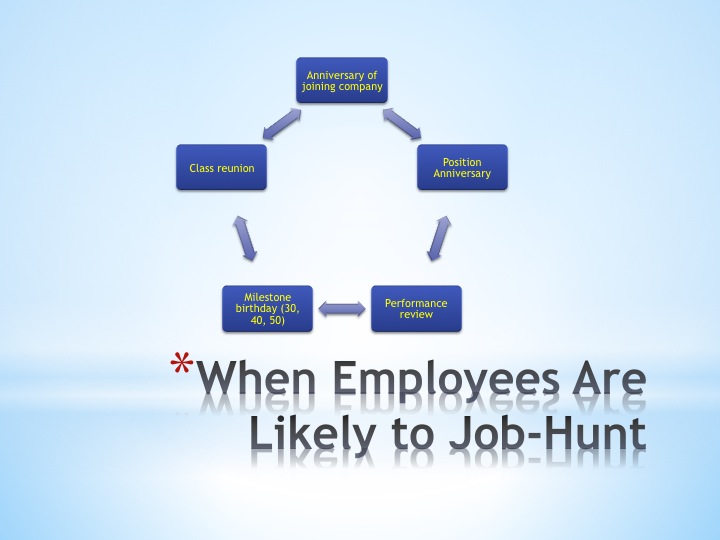
Research cited in the article shows that there are certain events that trigger people to review their situation and thus exacerbates the above reasons people leave. The strongest of these events is work anniversaries, a natural time of reflection on whether joining the company turned out the way the person expected, when job-hunting activity increases 6-9 percent. These anniversaries are not only limited to joining the company but also starting a new role. Also, a formal review is likely to trigger a job search, especially if it does not include a promotion or clear promotion path.

The research also showed there are triggers outside of the company that also prompt heightened job search. Birthdays, particularly milestone birthdays (30, 40, 50, etc.) prompts employees to reflect on their life situation and whether they should pursue a move. School anniversaries serve a similar purpose, as they prompt employees to compare themselves against their classmates. The research shows a 16 percent increase in job-hunting activity after reunions. The key is that events outside of the workplace have a strong impact on whether an employee will be looking for another position.

Other clues to leavers

In addition to the extrinsic and intrinsic factors that trigger job search, there are other ways to identify employees (or teams) more likely to leave. Computer monitoring can identify higher usage of LinkedIn or other job search websites. Tracking employee badges can detect those leaving the office frequently, presumably to interview or speak with recruiters. There are even technology firms that can predict likelihood to leave based on who people are connecting with on LinkedIn.

What you should do

As I wrote, you should always be recruiting your own team to minimize their chance of leaving. Realistically, not everyone has the time or resources to do this so at a minimum you can use the above triggers and hints to focus on those employees when they are most likely to leave. Ensure that you have clear conversations with them their career path in the company, and if they do not have one you should work to create one. Also, encourage your HR team to recruit internal candidates who are likely to be job-hunting for other positions at the company, so if they are going to move they still stay within in the company. Research shows that pre-emptive intervention is much more effective that waiting for someone to get an offer and then making a counter-offer, as 50 percent of those you retain by counter-offer will still leave within twelve months.

Key takeaways

  • Retaining employees is important as recruiting them, and understanding when they are likely to start looking for other positions allows you to pre-empt a move
  • Employees generally leave because they dislike their boss, do not see opportunities for promotion or growth, or get a better opportunity
  • They are most likely to start or increase their job search during work related events (work anniversary, position anniversary, performance review) or life events (major birthday, class reunion, etc.).

Share this:

  • Click to share on Facebook (Opens in new window) Facebook
  • Click to share on LinkedIn (Opens in new window) LinkedIn
Like Loading...
Unknown's avatarAuthor Lloyd MelnickPosted on February 22, 2017February 19, 2017Categories General Social Games Business, General Tech BusinessTags HR, recruiting, retention1 Comment on When you might lose some of your team

Recruiting, or why you want to Coach Team USA

Key takeaways

  1. A critical key to success is attracting the right talent to your team. This provides a competitive advantage over other companies.
  2. A key element to successful recruiting is for leadership to own and drive the process, rather than relying on HR (who are a critical component, however)
  3. The other key is proactively finding opportunities to raise your and your company’s profile to help your long-term recruiting capability, particularly speaking and writing openings.

This past summer, Duke head basketball coach Mike Krzyzewski (Coach K) led Team USA to its third consecutive gold medal under his leadership. Coach K took over Team USA in 2005 and while his accomplishments for Team USA are impressive, it points to a bigger story about the value of recruiting. In that time, Coach K has won two National Championships at Duke and coaching Duke is his primary job. Many of his fellow coaches are upset that the high profile nature of coaching Team USA helps him recruit (and succeed at Duke). Regardless of whether it is fair, it shows a clear path to success.

coach-k-team-2016

Recruiting is different in the US and Europe

Having worked in both the US and Europe, one clear advantage I see from US companies is their focus on recruiting. In the US, recruiting is seen as a responsibility of all management, and the more senior you are the more you are expected to bring great people into your team or company. Many American leaders are judged by the team they put together.

In Europe, although the company may actually have more employee-friendly policies, recruiting is left to the recruiting team or external placement firms, with it being a tertiary activity for leadership. While most leaders understand the value of hiring the best people, they do not see it as part of their job responsibilities.

What drives US recruiting

It is helpful to understand why recruiting is treated differently by US and European companies. There are two things that drive the US focus on recruiting:

    1. The sports ecosystem. In the US, collegiate (university) sports are as important if not more than professional sports. While professional sports teams (both in the US and Europe) can secure talent by paying more, in collegiate sports payment is not allowed (I can write multiple posts about the reality of the situation but not important for this point). Thus, the successful teams are primarily the ones who can attract the best players.
    2. Talent is very mobile.

As LinkedIn Founder Reid Hoffman once wrote, the US is a free agent economy. Employees often look at their job as a short-term opportunity and move on to better new opportunities frequently. This liquidity means for companies to succeed they need a constant stream of good talent with the right skillset.

Lessons from Coach K

As somebody who went to Duke and followed sports my whole life, the American philosophy on recruiting is embodied by Coach K. While you cannot have great results without being a capable floor coach, he has excelled by generating a steady and deep continuous flow of talented recruits.

There are two lessons that I learned from Coach K that can help anyone, including European business leaders, recruit more effectively.

First, recruiting must start at the top. While some university coaches rely on their assistants to attract talent, great coaches make recruiting their top priority. They show up for high school games, have dinner with recruits and their families and personally call and contact recruits. While their assistants do much of the work (breaking down film to prioritize candidates, coordinating schedules, answering questions),the great coaches take the lead in the process. In business, great leaders also do not rely on their HR team but work in concert with HR. They identify the talent, work with their coaches and players to build an environment attractive to the recruits and “close the sale,” they are not simply added to an interview list and done with it when they tell HR who they want to hire.

The second element and one that prompted this post is they use all opportunities to improve your odds of recruiting the best talent. Coach K could have spent his summers at the beach but instead he coached Team USA. What this effort did was raise his profile and give him a great unique selling point when sitting with a potential Duke recruit: do they want to be coached by the same person who is coaching LeBron James, Kobe Bryant and Kevin Durant. Additionally, every time Team USA played on television (which is effectively everytime it played), it was a long commercial for Coach K.

While in business there is no direct equivalent of Team USA, there are many comparable opportunities. At the top of the spectrum are shows like The Apprentice or Shark Tank, this exposure greatly helps the underlying business’ ability to recruit. Even if you cannot get a slot on television, speaking at conference or writing articles for trade press (or even blogging) generate exposure and a unique selling point when recruiting. The critical thing is to seek out these opportunities as part of your overall strategy to use recruiting as a competitive advantage.

The Key

The key is to use recruiting proactively, and put the necessary emphasis and focus on it, to gain a competitive advantage for your business. This effort requires that you lead the initiative, do not rely on others, and look at all opportunities as long-term ways to improve your recruiting effectiveness.

Share this:

  • Click to share on Facebook (Opens in new window) Facebook
  • Click to share on LinkedIn (Opens in new window) LinkedIn
Like Loading...
Unknown's avatarAuthor Lloyd MelnickPosted on October 26, 2016May 1, 2021Categories General Social Games Business, General Tech BusinessTags Duke, HR, recruitingLeave a comment on Recruiting, or why you want to Coach Team USA

Why reducing headcount hurts profits

I find it surprising when investors, particularly Wall Street, cheer a company for reducing head count because it is usually not a good business decision. I am not making a moral statement; it is about the underlying business reasons. While reducing head count does immediately reduce the cost side of your business (outside of redundancy expenses), it usually has a greater impact over time on revenue.

People create revenue

Your team is how your company creates revenue. They build the products customers pay money to purchase. They provide support so customers return and continue spending with your company. They market the product so people learn about the product and buy it. At the root of business, companies employ people because they make money for the company. The logical extension of this argument is that if you reduce the number of people, you will have less people generating revenue.

Julian Simon trumps Malthus

Malthus and Julian Simon were two economists of different eras but more importantly different philosophies, and history has proven Simon correct. Malthus lived in a time when people had a short life span and had to spend most of their time on difficult work. He theorized that as the population grew, the situation would get worse as there would be less food, more disease and overall fewer resources to go around.

Julian Simon, conversely, argued that people were incredibly resourceful and always came up with more efficient ways to use resources. Thus, as the population grows, there would actually be more to go around and people would live better. When people argued that oil would run out or we would not have enough food to feed ourselves, he argued that these would not be problem’s due to human intellect.
Simon famously bet Robert Ehrlich, a Malthusian economist, to pick any five metals and Simon argued the price would decrease over time. Simon won the bet. Continue reading “Why reducing headcount hurts profits”

Like Loading...
Unknown's avatarAuthor Lloyd MelnickPosted on November 18, 2015January 4, 2016Categories General Social Games Business, General Tech BusinessTags headcount, HR, Julian Simon, Malthus, Paul Ehrlich, reduction in force, revenue, Simon Ehrlich wager1 Comment on Why reducing headcount hurts profits

Don’t forget to recruit your own team

The value of a good team cannot be overstated, it is more important than strategy, technology and even cash available. I have written before on some of the principals for recruiting a great team and how you should never stop recruiting. It is ironic how much effort companies put to recruiting the best but do not put the same effort into their existing team members until it is too late.

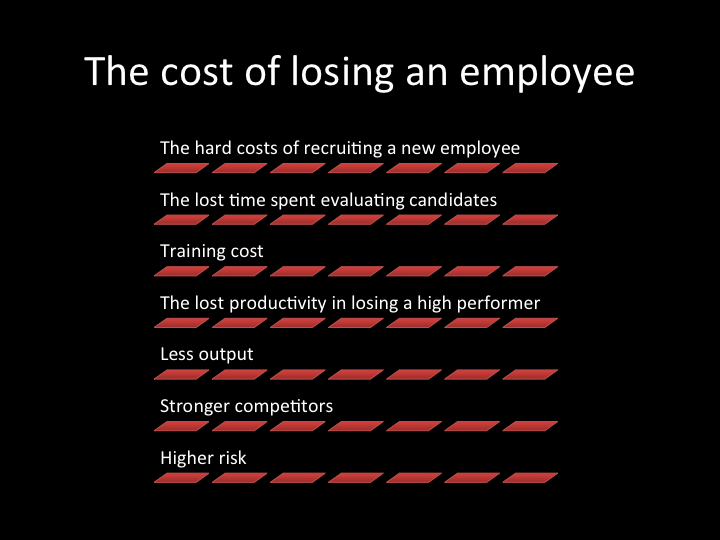
While most companies acknowledge the importance of recruiting, they often neglect the complementary principle that you need to put as much effort in keeping your existing team satisfied. Just as increasing user acquisition costs intensifies the value of retaining existing players, the increasing difficulty in finding great employees intensifies the need to minimize employee churn. There are multiple costs of replacing a good employee

Losing an employee is more costly than you realize
  • The hard costs of recruiting a new employee. This can be payments to a recruiter, referral fees to employees, travel costs to attend recruiting, travel costs to bring candidates in for interviews, etc.
  • The lost time spent evaluating candidates. The time you and your team spend reviewing resumes/CVs, interviewing candidates and discussing options. These days, almost all candidates go through multiple rounds of interviews before being offered a position. Each of those interviews takes 30 minutes or more of someone’s time, if you value that time based on the interviewer’s salary, you quickly get into the thousands of dollars (even more for a senior candidate who meets with leadership).
  • Training costs. These are both direct and indirect. You may have to send the new employee to various external training courses to prepare him for the job. More likely you will need to spend you time or your colleagues will training the new person on how the company works, practical issues (i.e. where the bathroom is), systems, interactions with other teams and what they need to perform their tasks optimally. Again, there is a cost for every minute that you and colleagues spend getting a new hire up to speed. When you break out salaries by how much the person earns per hour, this training cost often runs into the thousands of dollars.
  • The lost productivity in losing a high performer. You should never consider replacing an employee as an upgrade. If there are better people on the market, you need to recruit them proactively and replace weak team members. Assuming you adhere to this principle, if someone leaves voluntary, it means their replacement is not likely to be as good as the existing team member. The cost can range from minimal to huge in having somebody not as good performing a role on your team.
  • Less output. If you employ somebody, they should be providing a valuable service (or else you should proactively have eliminated the position). When you lose somebody, that task either does not get done until a replacement is in place or you must take other people off of their tasks (which again are worthwhile or you should not having them doing it). In either case, the overall output of your organization decreases.
  • Stronger competitors. When a good employee leaves, by definition they go somewhere else. That somewhere else is often a competitor, so not only are you losing their services but a competitor is likely improving. If Messi were to leave Barcelona for Real Madrid, the loss to Barcelona would be magnified by the improvement of their arch competitor.
  • Higher risk. Regardless of how rigorous your recruitment process, there is always risk that you make a bad hire. Many people interview above their actual competence, while others may just not be a good fit for your organization and processes. Thus, you have the risk that not only will the new hire be slightly weaker, they may prove incapable of doing the job and themselves have to be replaced. Then you have both an extended period of the job not getting done (or people being pulled off other tasks) and a repeat of the costs above.

Continue reading “Don’t forget to recruit your own team”

Like Loading...
Unknown's avatarAuthor Lloyd MelnickPosted on November 4, 2015May 1, 2021Categories General Social Games Business, General Tech Business, Lloyd's favorite postsTags employee retention, HR, productivity, recruiting, retention, training1 Comment on Don’t forget to recruit your own team

Define your own tour of duty

A few weeks ago, I wrote about Reid Hoffman’s book Alliance and his innovative ideas on how to structure the employee company relationship. One issue that some people raised to me was it sounded great, but if your company does not believe in creating tours of duty, it was not very useful. I am not much for giving non-actionable advice (hence why I am not a consultant ☺), so I wanted to address the situation by discussing what you can do to leverage this powerful concept even if your company does not.

The Alliance by Reid Hoffman

What is a tour of duty

I do not want to go into too much detail since you may have read my post in October, but to recap: A tour of duty occurs when the employer and employee mutually agree on a finite project, with goals for the employees contribution. It also includes how the tour of duty will benefit the employee. To create a fictitious example, say Uber wants to open the Las Vegas market to its service. When recruiting a VP, rather than pitching them on working for Uber for life, the hiring manager specifically lays out that the task will be a two-year project to penetrate Las Vegas. The employee will need to work with the legal team to counteract the local taxi companies and then recruit drivers. The candidate would learn how to lobby local governments and launch a location-based tech product. Both agree that at the end of the two-year tour of duty, there may be another tour of duty at Uber that is mutually beneficial or the employee might use the skills he learned to help another company. Continue reading “Define your own tour of duty”

Share this:

  • Click to share on Facebook (Opens in new window) Facebook
  • Click to share on LinkedIn (Opens in new window) LinkedIn
Like Loading...
Unknown's avatarAuthor Lloyd MelnickPosted on November 13, 2014December 1, 2014Categories General Social Games Business, General Tech BusinessTags Alliance, Free Agent, HR, Reid Hoffman, Tour of DutyLeave a comment on Define your own tour of duty

Using tours of duty to have a better company employee relationship

One of the best books I read this year is The Alliance: Managing Talent in the Networked Age by Reid Hoffman. The core concept in the book is that there is no longer employment for life but there is still a way to build a win-win relationship between employers and employees. Hoffman and his co-authors suggest a tour-of-duty type relationship, where employer and employee agree to a short or medium term engagement with a defined goal.
The Alliance by Reid Hoffman

The current reality

Hoffman begins by pointing out that in the at-will era (when employers can and do fire employees at their discretion), employees thus think of themselves as “free agents,” seeking out the best opportunities for growth and changing jobs whenever they get a better offers. He points to a 2012 study that found even though about half of employees wanted to stay with their current employer, most of them felt that they would have to take a job at a different company to advance their careers. Hoffman writes, “loyalty is scarce, long-term ties are scarcer, but there’s plenty of disillusionment to go around.”

Related to this point, employees’ trust of management is at an all-time low. One reason employees do not trust their employer is that the foundation of the relationship is built on dishonesty. When employees are courted, they are told about the fantastic long-term opportunities. When they answer interview question, they comment on how there goal is to spend their life contributing to the company. Both parties know this is nonsense but feel they must utter these phrases. It creates a relationship built on lies and a relationship without trust is a relationship without loyalty. A business without loyalty is a business without long-term thinking. A business without long-term thinking is a business that’s unable to invest in the future and thus one doomed to fail.

Tour of duty concept

A tour of duty is when the employer and employee mutually agree on a finite project, with goals for the employee’s contribution. It also includes how the tour of duty will benefit the employee. To create a fictitious example, say Uber wants to open the Las Vegas market to its service. When recruiting a VP, rather than pitching them on working for Uber for life, the hiring manager specifically lays out that the task will be a two-year project to penetrate Las Vegas. The employee will need to work with the legal team to counteract the local taxi companies and then recruit drivers. The candidate would learn how to lobby local governments and launch a location based tech product. Both agree that at the end of the two-year tour of duty, there may be another tour of duty at Uber that is mutually beneficial or the employee might use the skills he learned to help another company. For example, he may go over to Peapod to open the Austin market with the skills he learned at Uber. Uber benefits by having a successful launch in Las Vegas, and the employee is more valuable and has a great new opportunity. The important thing is both parties are honest with each other and they have built a mutually beneficial relationship. Continue reading “Using tours of duty to have a better company employee relationship”

Like Loading...
Unknown's avatarAuthor Lloyd MelnickPosted on October 23, 2014November 4, 2014Categories General Social Games Business, General Tech Business, Lloyd's favorite postsTags HR, recruiting, Reid Hoffman, The Alliance3 Comments on Using tours of duty to have a better company employee relationship

How to find talented employees

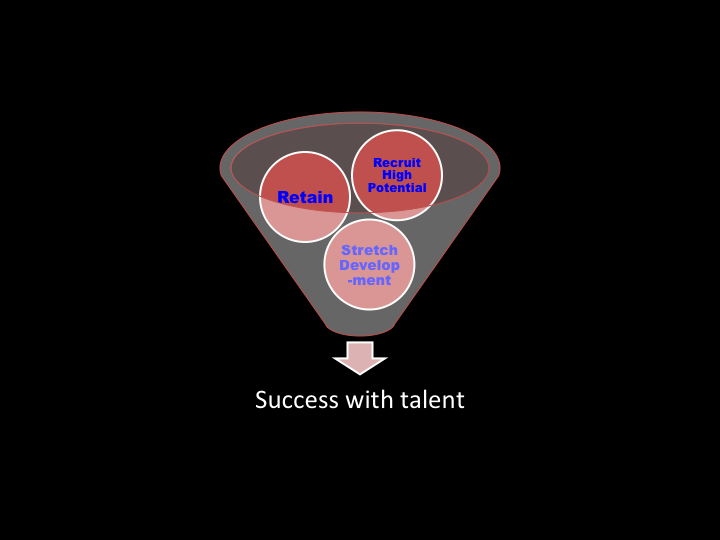
Finding strong members for your team is one of the most important skills needed to succeed and a recent Harvard Business Review article, “21st Century Talent Spotting” by Claudio Fernandez-Araoz, provides some strong insights on how to optimize your talent search. With skills and competencies now the key to finding employees, rather than past experience, you must become skilled at judging potential. This situation is exacerbated by the rapidly changing nature of the tech and game spaces, what worked yesterday are not necessarily the skills you need today.
Slide1
In the last millennium, workers were selected for physical attributes which readily translated into higher success at physical labor, from building a canal to fighting a war. Business then evolved to judge candidates on intelligence, experience and past performance. Much work was standardized, so if you were looking for an engineer or an accountant or a CEO, you would find somebody who has already succeeded in such a role and there was a high likelihood they would replicate this success. Then hiring evolved to the competency model, which stipulated that managers (and other workers) be evaluated on specific characteristics and skills that would help predict outstanding performance in the roles for which they were being hired. Hiring managers would decompose jobs into competencies and look for candidates with the best combination of these skills. Continue reading “How to find talented employees”

Share this:

  • Click to share on Facebook (Opens in new window) Facebook
  • Click to share on LinkedIn (Opens in new window) LinkedIn
Like Loading...
Unknown's avatarAuthor Lloyd MelnickPosted on August 27, 2014October 14, 2014Categories General Social Games BusinessTags Claudio Fernandez-Araoz, development, hiring, HR, Potential, recruiting, retention, stretch development, talent1 Comment on How to find talented employees

The right way to build, run and compensate your team

Netflix logoA recent article in Harvard Business Review by Netflix’s former Chief Talent Officer, Patty McCord, did a great job of explaining five core principles of building your team that could benefit any company. McCord, who was Chief Talent Officer at Netflix for 14 years, believes their policy towards HR is a key reason the company has been so successful. At its root, Netflix’s success is tied to hiring great people, and by hiring great people it creates a much better environment for the other great people (as everyone carries their weight). The other related foundation of Netflix’s success with its people was a willingness to let go of those who were not a good fit (or no longer a good fit). Netflix’s principles can help any company build a fantastic and high performing team. Overall, there are five core principles to Netflix’s success with its team.

Hire adults and treat them like adults

Rather than create long, complex and often bureaucratic policies on how employees should do everything, Netflix provides very high-level guidance and expects its employees to act in the company’s best interest. During the hiring process, it focuses on employees who can do this without strict guidance or careful observation. If they find they made a hiring mistake, they let the employee go. Continue reading “The right way to build, run and compensate your team”

Share this:

  • Click to share on Facebook (Opens in new window) Facebook
  • Click to share on LinkedIn (Opens in new window) LinkedIn
Like Loading...
Unknown's avatarAuthor Lloyd MelnickPosted on January 30, 2014February 6, 2014Categories General Social Games BusinessTags Compensation, HR, leadership, NetflixLeave a comment on The right way to build, run and compensate your team

Being an employee at a start-up

There was recently a great blog post by Mark Suster (a serial entrepreneur and VC with GRP Partners), in which a friend of his put together a list about what young employees should know, particularly when starting at an early-stage company. I think this advice is useful not only for young employees but people moving (or considering moving) from a larger corporation into the start-up world. I also found it useful as a leader to bring young team members along more effectively.

Mark Suster

Suster’s friend’s advice

You will not get constructive feedback unless you request it. Although executives in start-ups have great intentions and truly care about their employees, they usually do not spend much time giving employees constructive criticism. When juggling all of their immediate priorities, employee feedback and counseling usually gets pushed to the bottom of the list. Often if there is an issue, rather than dealing with the employee they will just resolve the situation themselves. If you want to grow professionally, you need to reach out to your boss (and other members of the management team) and find out what you can be doing better. Continue reading “Being an employee at a start-up”

Share this:

  • Click to share on Facebook (Opens in new window) Facebook
  • Click to share on LinkedIn (Opens in new window) LinkedIn
Like Loading...
Unknown's avatarAuthor Lloyd MelnickPosted on December 20, 2012January 10, 2013Categories General Social Games BusinessTags HR, Mark SusterLeave a comment on Being an employee at a start-up

Get my book on LTV

The definitive book on customer lifetime value, Understanding the Predictable, is now available in both print and Kindle formats on Amazon.

Understanding the Predictable delves into the world of Customer Lifetime Value (LTV), a metric that shows how much each customer is worth to your business. By understanding this metric, you can predict how changes to your product will impact the value of each customer. You will also learn how to apply this simple yet powerful method of predictive analytics to optimize your marketing and user acquisition.

For more information, click here

Follow The Business of Social Games and Casino on WordPress.com

Enter your email address to follow this blog and receive notifications of new posts by email.

Join 791 other subscribers

Most Recent Posts

  • Join me at PDMA Inspire for my talk on new product prioritization
  • Why keep studying?
  • The next three years of this blog
  • Interview with the CEO of Murka on the biggest growth opportunity in gaming, Barak David

Lloyd Melnick

This is Lloyd Melnick’s personal blog.  All views and opinions expressed on this website are mine alone and do not represent those of people, institutions or organizations that I may or may not be associated with in professional or personal capacity.

I am a serial builder of businesses (senior leadership on three exits worth over $700 million), successful in big (Disney, Stars Group/PokerStars, Zynga) and small companies (Merscom, Spooky Cool Labs) with over 20 years experience in the gaming and casino space.  Currently, I am the GM of VGW’s Chumba Casino and on the Board of Directors of Murka Games and Luckbox.

Topic Areas

  • Analytics (114)
  • Bayes' Theorem (8)
  • behavioral economics (8)
  • blue ocean strategy (14)
  • Crowdfunding (4)
  • DBA (2)
  • General Social Games Business (459)
  • General Tech Business (195)
  • Growth (88)
  • International Issues with Social Games (50)
  • Lloyd's favorite posts (101)
  • LTV (54)
  • Machine Learning (10)
  • Metaverse (1)
  • Mobile Platforms (37)
  • Prioritization (1)
  • Social Casino (52)
  • Social Games Marketing (105)
  • thinking fast and slow (5)
  • Uncategorized (33)

Social

  • View CasualGame’s profile on Facebook
  • View @lloydmelnick’s profile on Twitter
  • View lloydmelnick’s profile on LinkedIn

RSS

RSS Feed RSS - Posts

RSS Feed RSS - Comments

Categories

  • Analytics (114)
  • Bayes' Theorem (8)
  • behavioral economics (8)
  • blue ocean strategy (14)
  • Crowdfunding (4)
  • DBA (2)
  • General Social Games Business (459)
  • General Tech Business (195)
  • Growth (88)
  • International Issues with Social Games (50)
  • Lloyd's favorite posts (101)
  • LTV (54)
  • Machine Learning (10)
  • Metaverse (1)
  • Mobile Platforms (37)
  • Prioritization (1)
  • Social Casino (52)
  • Social Games Marketing (105)
  • thinking fast and slow (5)
  • Uncategorized (33)

Archives

  • September 2023
  • December 2021
  • July 2021
  • March 2021
  • February 2021
  • January 2021
  • December 2020
  • November 2020
  • October 2020
  • September 2020
  • August 2020
  • July 2020
  • June 2020
  • May 2020
  • April 2020
  • March 2020
  • February 2020
  • January 2020
  • November 2019
  • October 2019
  • September 2019
  • June 2019
  • May 2019
  • April 2019
  • March 2019
  • February 2019
  • January 2019
  • December 2018
  • June 2018
  • May 2018
  • April 2018
  • March 2018
  • February 2018
  • January 2018
  • December 2017
  • June 2017
  • May 2017
  • April 2017
  • March 2017
  • February 2017
  • January 2017
  • December 2016
  • November 2016
  • October 2016
  • September 2016
  • June 2016
  • May 2016
  • April 2016
  • March 2016
  • February 2016
  • January 2016
  • December 2015
  • November 2015
  • October 2015
  • September 2015
  • July 2015
  • June 2015
  • May 2015
  • April 2015
  • March 2015
  • February 2015
  • January 2015
  • December 2014
  • November 2014
  • October 2014
  • September 2014
  • August 2014
  • July 2014
  • June 2014
  • May 2014
  • April 2014
  • March 2014
  • February 2014
  • January 2014
  • December 2013
  • November 2013
  • October 2013
  • September 2013
  • August 2013
  • July 2013
  • June 2013
  • May 2013
  • April 2013
  • March 2013
  • February 2013
  • January 2013
  • December 2012
  • November 2012
  • October 2012
  • September 2012
  • August 2012
  • July 2012
  • June 2012
  • May 2012
  • April 2012
  • March 2012
  • February 2012
  • January 2012
  • December 2011
  • November 2011
  • October 2011
  • September 2011
  • August 2011
  • July 2011
  • June 2011
  • May 2011
  • December 2010
December 2025
S M T W T F S
 123456
78910111213
14151617181920
21222324252627
28293031  
« Sep    

by Lloyd Melnick

All posts by Lloyd Melnick unless specified otherwise
Google+

Enter your email address to subscribe to this blog and receive notifications of new posts by email.

Join 791 other subscribers
Follow Lloyd Melnick on Quora

RSS HBR Blog

  • How One Manufacturer Achieved Net Zero at Zero Cost
  • What Can U.S. Employers Do About Rising Healthcare Costs?
  • When You Have to Execute a Strategy You Disagree With
  • 4 Ways to Build Durable Relationships with Your Most Important Customers
  • What Jargon Says About Your Company Culture
  • Research: When Used Correctly, LLMs Can Unlock More Creative Ideas
  • Your New Role Requires Strategic Thinking…But You’re Stuck in the Weeds
  • For Circular Economy Innovation, Look to the Global South
  • Why Great Leaders Focus on the Details
  • Corporate Disclosure in the Age of AI

RSS Techcrunch

  • An error has occurred; the feed is probably down. Try again later.

RSS MIT Sloan Management Review Blog

  • AI Coding Tools: The Productivity Trap Most Companies Miss
  • How Procter & Gamble Uses AI to Unlock New Insights From Data
  • Rewire Organizational Knowledge With GenAI
  • Hungry for Learning: Wendy’s Will Croushorn
  • Beat Burnout: 10 Essential MIT SMR Reads
  • How Leaders Stay True to Themselves and Their Stakeholders
  • Our Guide to the Winter 2026 Issue
  • Broadening Future Perspectives at the Bank of England
  • A Faster Way to Build Future Scenarios
  • Assess What Is Certain in a Sea of Unknowns
The Business of Social Games and Casino Website Powered by WordPress.com.
  • Subscribe Subscribed
    • The Business of Social Games and Casino
    • Join 726 other subscribers
    • Already have a WordPress.com account? Log in now.
    • The Business of Social Games and Casino
    • Subscribe Subscribed
    • Sign up
    • Log in
    • Report this content
    • View site in Reader
    • Manage subscriptions
    • Collapse this bar
 

Loading Comments...
 

    %d