Skip to content

The Business of Social Games and Casino

How to succeed in the mobile game space by Lloyd Melnick

Tag: innovation

90-day plan to increase your company’s innovation

While everyone agrees that companies need to innovate to succeed, actually doing it is often quite challenging. While most successful companies can lay credit to some innovations, most have occurred by chance and the companies actually lack an orderly, reliable way to innovate regularly. A recent article in the Harvard Business Review, “Build an Innovation Engine in 90 Days” by Scott Anthony and two of his colleagues, does a great job of laying out a tactical plan to help your company to innovate.

Slide1

While some companies address this problem by building large—and expensive—innovation centers or R&D facilities, Anthony shows there is a middle way that almost any company can pursue regardless of resources. In many ways, what Anthony describes (and the term he uses) is the equivalent of the minimum viable product (MVP), from lean start-up fame. In this case, it is a minimum viable innovation system (MVIS). There are four phases to building such a system, and it takes about 90 days.

Phase 1: Define your innovation buckets

There are two types of innovation: improving existing products or operations, and generating growth by reaching new customer segments or markets. For an innovation program (including an MVIS) to be successful, everyone involved must understand the two types of innovation. If your team fails to make this distinction, you increase the likelihood that you either discount the importance of innovations that strengthen the ongoing business or demand too much revenue from the new-growth initiatives too early. Innovations meant to improve the core business (the former of the two innovation categories) should be tied to the current strategy and managed mostly with the primary organizational structure. The return on these projects will be relatively quick with high initial returns and thus should be funded at scale.

While all of your innovation projects may be focused on core activities, they you are probably missing preparing for the future and reaching your long-term goals. New growth initiatives, the latter category, should fill this gap. These new growth initiatives push the frontier of your strategy by offering new or complementary products to existing customers, moving into adjacent product or geographic markets, or developing something utterly original, perhaps delivered in a novel way. Continue reading “90-day plan to increase your company’s innovation”

Like Loading...
Unknown's avatarAuthor Lloyd MelnickPosted on December 4, 2014December 15, 2014Categories General Social Games Business, General Tech Business, Growth, Lloyd's favorite postsTags innovation, MVIS, Scott AnthonyLeave a comment on 90-day plan to increase your company’s innovation

Foster a growth mindset in your company to improve growth

There are two ways of looking at employees, and for them to look at themselves, either a fixed mindset where they either possess or lack talent, or a growth mindset, where your team can develop new skills. An article in the Harvard Business Review, “How Companies Can Profit from a ‘Growth Mindset’” by Stanford’s Carol Dweck, shows the benefits having a growth mindset has for your company.

Mindset: The New Psychology of Success

According to Dweck’s research, failure is the end of the world for some people but an exciting opportunity for others. People with a growth mindset enjoy challenges, strive to learn and consistently see potential to develop new skills. Conversely, those with a fixed mindset view talent as a quality they either have or do not have.

In the article, Dweck extends her definition of mindsets from individuals to companies. Dweck and her colleagues found that some organizations believe their people have a certain amount of talent, thus a fixed mindset. Others held the opposite view and those companies were considered to have a growth mindset.

Dweck also found the company mindset had a significant impact on its employees. In organizations with a fixed mindset, employees largely felt there was a handful of “star” employees that were highly valued. The employees who felt this way were less committed than employees at growth-mindset companies and did not think the company had their back. These employees worried about failing so they pursued fewer innovative projects. They regularly kept secrets, cut corners and cheated to try to get ahead. Continue reading “Foster a growth mindset in your company to improve growth”

Like Loading...
Unknown's avatarAuthor Lloyd MelnickPosted on November 20, 2014December 1, 2014Categories General Social Games Business, General Tech Business, Growth, Lloyd's favorite postsTags Carol Dweck, collaboration, Growth, innovationLeave a comment on Foster a growth mindset in your company to improve growth

Understanding the innovator’s dilemma

Earlier this year, I wrote how using analytics to gain deep customer insight could inhibit innovation, based on Clayton Christensen’s Innovator’s Dilemma. I wanted to dive deeper into the Innovator’s Dilemma, as it is important to all tech companies, from those trying to grow to those trying to disrupt established industries. I will also tie everything together by showing how the free-to-play model disrupted the electronic game industry, destroying companies like Acclaim and Midway and creating billion-dollar companies like King.com and Kabam.

What is the innovator’s dilemma

At its core, the innovator’s dilemma is the apparent contradiction between knowing your customers intimately and optimizing your product for them, versus the fact that innovation will be driven by a different group of customers. Additionally, if you are a successful company the problem is magnified, as the new market may initially be much smaller than your current market and thus not warrant your attention. Finally, as Christensen writes, “blindly following the maxim that good managers should keep close to their customers can sometimes be a fatal mistake.”

Christensen cites many examples in the book, but one of the strongest is how the disc drive industry evolved. Some great companies, IBM, Control Data, Seagate, made all the right textbook moves by innovating based on what their customers wanted and then found themselves outflanked by other companies. In fact, the established 14-inch drive manufacturers were held captive by customers. Mainframe computer manufacturers did not need or want an 8-inch drive. They explicitly did not want it: They wanted drives with increased capacity at a lower cost per megabyte. So the drive manufacturers created products that their customers were demanding, missed the market for PC drives and then the manufacturers of PC drives went upstream and took their core market. This is a cycle that has been repeated in the drive industry buy also in multiple high-tech and low-tech industries. Continue reading “Understanding the innovator’s dilemma”

Share this:

  • Click to share on Facebook (Opens in new window) Facebook
  • Click to share on LinkedIn (Opens in new window) LinkedIn
Like Loading...
Unknown's avatarAuthor Lloyd MelnickPosted on March 25, 2014June 4, 2014Categories General Social Games Business, Growth, Lloyd's favorite postsTags Clayton Christensen, customer intimacy, disruption, disruptive technology, innovation, Innovator's Dilemma6 Comments on Understanding the innovator’s dilemma

Data and analytics: the enemy of innovation

One issue that is likely to haunt some of the high-flying tech and game companies that are currently doing wonderfully is their reliance on data and analytics can inhibit innovation. Clayton Christensen, the esteemed Harvard professor who wrote the seminal work on innovation, The Innovator’s Dilemma: When New Technologies Cause Great Firms to Fail, explains how deep customer understanding works against strong firms keeping up with innovators in their space. The use of data and analytics to understand and anticipate customer needs is now the driving force behind most of the exciting tech and gaming companies. This strength, however, could leave these companies vulnerable to new competition and turn today’s stars into tomorrow’s duds.

Innovator’s Dilemma

The Innovator’s Dilemma

To understand the situation data reliant companies will find themselves in it is important to understand first the innovator’s dilemma. Although I will blog about it in more detail this year, (I will not try to capture all the nuances of Christensen’s book; I strongly recommend you read it for yourself), the underlying thesis is that often great companies fail to be the disruptive innovative force in their industry because they have such a deep understanding of their customer’s needs they do not see disruptive opportunities that initially cater to other users. Instead, they continually create better products for their customers, which sustains technology but cannot disrupt. Disruptive companies come in with a simpler technology that aims at a different market, gains traction there and then encroaches on (and eventually destroys) the established firms. This cycle has been repeated in multiple industries. As Christensen writes, “blindly following the maxim that good managers should keep close to their customers can sometimes be a fatal mistake.” Continue reading “Data and analytics: the enemy of innovation”

Share this:

  • Click to share on Facebook (Opens in new window) Facebook
  • Click to share on LinkedIn (Opens in new window) LinkedIn
Like Loading...
Unknown's avatarAuthor Lloyd MelnickPosted on January 14, 2014January 21, 2014Categories General Social Games Business, Growth, Lloyd's favorite postsTags Clayton Christensen, innovation, Innovator's Dilemma4 Comments on Data and analytics: the enemy of innovation

Identifying the best ideas through open innovation

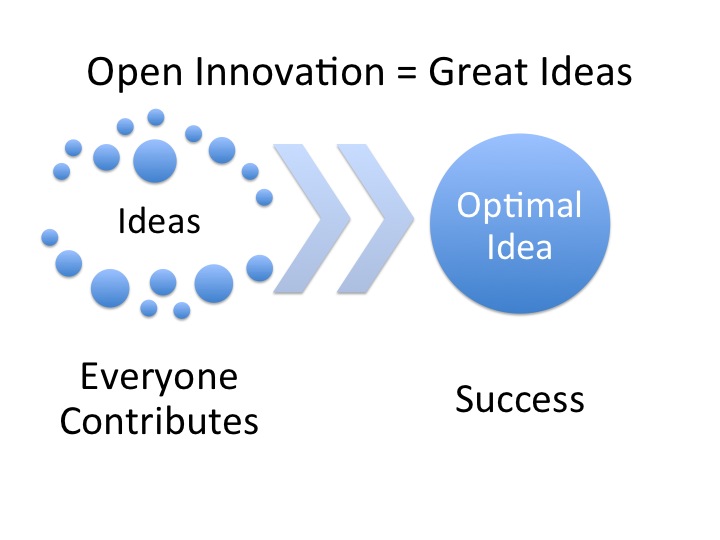
There was a great article recently in the MIT Sloan Management Review,  Using Open Innovation to Identify the Best Ideas by Andrew King and Karim Lakhani, that discusses how to use open innovation, both across your company and with your customers, to find the best ideas. The article describes how companies are opening up innovation (which can be anything from game design to new products to new processes to marketing creative) but also the challenges you face when doing so. As the authors point out, success relies on finding the best ways to organize and manage the process.

Slide1

Opening the ideation process

The first step in optimizing open innovation is successfully opening the idea-generation process. You need to first decide whom you are opening the process to: your entire team, the company, your key customers, all customers or the world. Once you have selected whom the process is open to, you need to create the optimal way to generate strong ideas. Continue reading “Identifying the best ideas through open innovation”

Share this:

  • Click to share on Facebook (Opens in new window) Facebook
  • Click to share on LinkedIn (Opens in new window) LinkedIn
Like Loading...
Unknown's avatarAuthor Lloyd MelnickPosted on December 11, 2013January 7, 2014Categories Crowdfunding, General Social Games BusinessTags Andrew King, ideation, innovation, Karim Lakhani, mit sloan management review, Open InnovationLeave a comment on Identifying the best ideas through open innovation

Innovating with Analytics

I have written several times about the opportunities for social game companies to use analytics beyond just game development, balancing and monetization. An article in the most recent issue of the MIT Sloan Management Review, “Innovating with Analytics,” shines more light on how analytics can help build competitive advantage. Given that all social and mobile game companies already use data extensively to improve their games, the only way a social game company could thus gain a competitive advantage with analytics is to innovate.

In yesterday’s post, I discussed how the Oakland A’s baseball team pioneered the use analytics to build an advantage, but then lost that advantage when other baseball teams copied their approach. This year, however, they won their division by apparently finding an innovative way to use analytics to again build competitive advantage.
 
MIT Sloan Management Review logo

Continue reading “Innovating with Analytics”

Share this:

  • Click to share on Facebook (Opens in new window) Facebook
  • Click to share on LinkedIn (Opens in new window) LinkedIn
Like Loading...
Unknown's avatarAuthor Lloyd MelnickPosted on October 4, 2012October 16, 2012Categories Analytics, General Social Games BusinessTags analytics, innovation, mit sloan management review, social gamesLeave a comment on Innovating with Analytics

How a social game company should create competitive advantage

I have been part of many discussions about the best way to build competitive advantage for a game company, and a recent article in the MIT Sloan Management Review has helped crystallize my thinking. The article, “Creating Value Through Business Model Innovation,” shows the benefits of focusing on creating competitive advantage through your business model rather than through product or branding. That is, it is more important to create a unique, sustainable and innovative business model than better games or unique branding. The article pointed to a survey by the Economist Intelligence Unit that found that a majority of business managers favored new business models over new products and services as a source of competitive advantage.

MIT Sloan Management Review logo

Continue reading “How a social game company should create competitive advantage”

Share this:

  • Click to share on Facebook (Opens in new window) Facebook
  • Click to share on LinkedIn (Opens in new window) LinkedIn
Like Loading...
Unknown's avatarAuthor Lloyd MelnickPosted on May 29, 2012August 27, 2012Categories General Social Games Business, Lloyd's favorite postsTags business models, innovation, novelty, social games2 Comments on How a social game company should create competitive advantage

Posts pagination

Previous page Page 1 Page 2

Get my book on LTV

The definitive book on customer lifetime value, Understanding the Predictable, is now available in both print and Kindle formats on Amazon.

Understanding the Predictable delves into the world of Customer Lifetime Value (LTV), a metric that shows how much each customer is worth to your business. By understanding this metric, you can predict how changes to your product will impact the value of each customer. You will also learn how to apply this simple yet powerful method of predictive analytics to optimize your marketing and user acquisition.

For more information, click here

Follow The Business of Social Games and Casino on WordPress.com

Enter your email address to follow this blog and receive notifications of new posts by email.

Join 791 other subscribers

Most Recent Posts

  • Join me at PDMA Inspire for my talk on new product prioritization
  • Why keep studying?
  • The next three years of this blog
  • Interview with the CEO of Murka on the biggest growth opportunity in gaming, Barak David

Lloyd Melnick

This is Lloyd Melnick’s personal blog.  All views and opinions expressed on this website are mine alone and do not represent those of people, institutions or organizations that I may or may not be associated with in professional or personal capacity.

I am a serial builder of businesses (senior leadership on three exits worth over $700 million), successful in big (Disney, Stars Group/PokerStars, Zynga) and small companies (Merscom, Spooky Cool Labs) with over 20 years experience in the gaming and casino space.  Currently, I am the GM of VGW’s Chumba Casino and on the Board of Directors of Murka Games and Luckbox.

Topic Areas

  • Analytics (114)
  • Bayes' Theorem (8)
  • behavioral economics (8)
  • blue ocean strategy (14)
  • Crowdfunding (4)
  • DBA (2)
  • General Social Games Business (459)
  • General Tech Business (195)
  • Growth (88)
  • International Issues with Social Games (50)
  • Lloyd's favorite posts (101)
  • LTV (54)
  • Machine Learning (10)
  • Metaverse (1)
  • Mobile Platforms (37)
  • Prioritization (1)
  • Social Casino (52)
  • Social Games Marketing (105)
  • thinking fast and slow (5)
  • Uncategorized (33)

Social

  • View CasualGame’s profile on Facebook
  • View @lloydmelnick’s profile on Twitter
  • View lloydmelnick’s profile on LinkedIn

RSS

RSS Feed RSS - Posts

RSS Feed RSS - Comments

Categories

  • Analytics (114)
  • Bayes' Theorem (8)
  • behavioral economics (8)
  • blue ocean strategy (14)
  • Crowdfunding (4)
  • DBA (2)
  • General Social Games Business (459)
  • General Tech Business (195)
  • Growth (88)
  • International Issues with Social Games (50)
  • Lloyd's favorite posts (101)
  • LTV (54)
  • Machine Learning (10)
  • Metaverse (1)
  • Mobile Platforms (37)
  • Prioritization (1)
  • Social Casino (52)
  • Social Games Marketing (105)
  • thinking fast and slow (5)
  • Uncategorized (33)

Archives

  • September 2023
  • December 2021
  • July 2021
  • March 2021
  • February 2021
  • January 2021
  • December 2020
  • November 2020
  • October 2020
  • September 2020
  • August 2020
  • July 2020
  • June 2020
  • May 2020
  • April 2020
  • March 2020
  • February 2020
  • January 2020
  • November 2019
  • October 2019
  • September 2019
  • June 2019
  • May 2019
  • April 2019
  • March 2019
  • February 2019
  • January 2019
  • December 2018
  • June 2018
  • May 2018
  • April 2018
  • March 2018
  • February 2018
  • January 2018
  • December 2017
  • June 2017
  • May 2017
  • April 2017
  • March 2017
  • February 2017
  • January 2017
  • December 2016
  • November 2016
  • October 2016
  • September 2016
  • June 2016
  • May 2016
  • April 2016
  • March 2016
  • February 2016
  • January 2016
  • December 2015
  • November 2015
  • October 2015
  • September 2015
  • July 2015
  • June 2015
  • May 2015
  • April 2015
  • March 2015
  • February 2015
  • January 2015
  • December 2014
  • November 2014
  • October 2014
  • September 2014
  • August 2014
  • July 2014
  • June 2014
  • May 2014
  • April 2014
  • March 2014
  • February 2014
  • January 2014
  • December 2013
  • November 2013
  • October 2013
  • September 2013
  • August 2013
  • July 2013
  • June 2013
  • May 2013
  • April 2013
  • March 2013
  • February 2013
  • January 2013
  • December 2012
  • November 2012
  • October 2012
  • September 2012
  • August 2012
  • July 2012
  • June 2012
  • May 2012
  • April 2012
  • March 2012
  • February 2012
  • January 2012
  • December 2011
  • November 2011
  • October 2011
  • September 2011
  • August 2011
  • July 2011
  • June 2011
  • May 2011
  • December 2010
December 2025
S M T W T F S
 123456
78910111213
14151617181920
21222324252627
28293031  
« Sep    

by Lloyd Melnick

All posts by Lloyd Melnick unless specified otherwise
Google+

Enter your email address to subscribe to this blog and receive notifications of new posts by email.

Join 791 other subscribers
Follow Lloyd Melnick on Quora

RSS HBR Blog

  • How One Manufacturer Achieved Net Zero at Zero Cost
  • What Can U.S. Employers Do About Rising Healthcare Costs?
  • When You Have to Execute a Strategy You Disagree With
  • 4 Ways to Build Durable Relationships with Your Most Important Customers
  • What Jargon Says About Your Company Culture
  • Research: When Used Correctly, LLMs Can Unlock More Creative Ideas
  • Your New Role Requires Strategic Thinking…But You’re Stuck in the Weeds
  • For Circular Economy Innovation, Look to the Global South
  • Why Great Leaders Focus on the Details
  • Corporate Disclosure in the Age of AI

RSS Techcrunch

  • An error has occurred; the feed is probably down. Try again later.

RSS MIT Sloan Management Review Blog

  • AI Coding Tools: The Productivity Trap Most Companies Miss
  • How Procter & Gamble Uses AI to Unlock New Insights From Data
  • Rewire Organizational Knowledge With GenAI
  • Hungry for Learning: Wendy’s Will Croushorn
  • Beat Burnout: 10 Essential MIT SMR Reads
  • How Leaders Stay True to Themselves and Their Stakeholders
  • Our Guide to the Winter 2026 Issue
  • Broadening Future Perspectives at the Bank of England
  • A Faster Way to Build Future Scenarios
  • Assess What Is Certain in a Sea of Unknowns
The Business of Social Games and Casino Website Powered by WordPress.com.
  • Subscribe Subscribed
    • The Business of Social Games and Casino
    • Join 726 other subscribers
    • Already have a WordPress.com account? Log in now.
    • The Business of Social Games and Casino
    • Subscribe Subscribed
    • Sign up
    • Log in
    • Report this content
    • View site in Reader
    • Manage subscriptions
    • Collapse this bar
 

Loading Comments...
 

    %d