I have written many times about customer lifetime value (LTV), but primarily from a theoretical framework. In this post, I will use Groupon to exemplify many of the key principles at work with LTV. Groupon is very well known, particularly in the United States, as a coupon or discount-deal website that normally offers 50 percent off deals with local merchants, particularly restaurants, spas and similar retailers. Started in 2008, it went public in 2011 and currently has a market cap over $4 billion.
The Groupon problem
One of the biggest issue Groupon has run into the is the perception that most retailers who run Groupon promotions find them highly damaging, and there are frequent stories of Groupon promotions that have put companies out of business. It is easy to see how this could happen, as Groupon typically gives customers a 50 percent discount and then keeps 25 percent of the remaining funds. Thus, a retailer only sees a total of 25 percent of the normal revenue they would from the consumer if the person had made the purchase without a Groupon. Since most retailers do not have a 75 percent margin, they will lose money on the Groupon. Moreover, because of Groupon’s strong distribution, they may lose a lot of money.
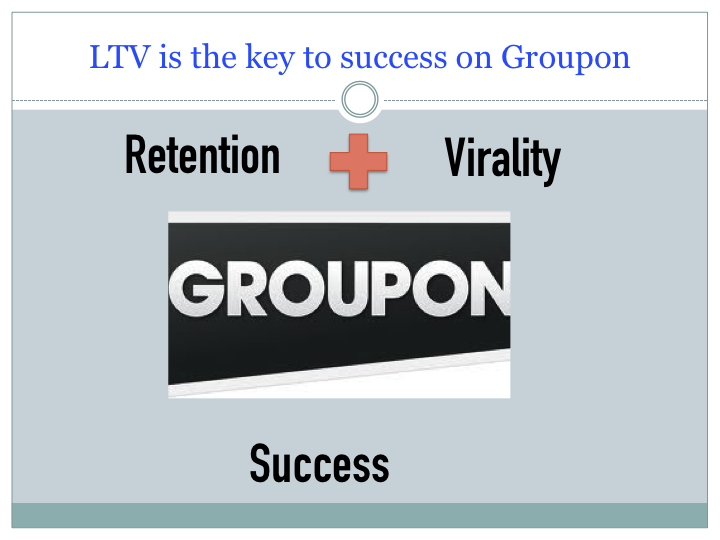
If a retailer, however, understands customer lifetime value, it can make the right decision about the value of offering the Groupon and whether it is a positive to their store.
The importance of retention
The first element of LTV that is crucial to Groupon success is retention. If people normally come to your business once and never come back, the Groupon is not going to work. You will lose 75 percent of the check or bill and never see the customer again.
Conversely, if once you get a customer they come back twice a week for six months, then the Groupon is a great marketing tool. While you will lose money on the initial transaction, you will have 48 (2 times per week, 4 weeks per month for 6 months) more profitable transactions, which will more than cover the loss. As I discussed in my post about retention, retention is the key to success in any business and the Groupon examples shows the impact of weak versus great retention.
How virality plays into the equation
Virality is also a key to the success of a Groupon. If people use the Groupon deal but do not tell friends about it, then the Groupon must generate enough lifetime revenue from that user to be a new positive. While this is possible, it increases the risk that the Groupon initiative is not successful if you do not have strong retention.
If you create, however, an experience that people tell their friends about, and then their friends try your establishment and you can retain them, the value to you of offering the Groupon increases dramatically. I have written before about how to create strong word of mouth, and it is more than just offering a good product, but if you follow the STEPP model (create a product or offering with social currency, triggers, emotions, practical and public) and users bring in more users, the Groupon can have tremendous impact.
Let’s say someone buys the Groupon and comes into your store. Because of the discount the purchase is a net wash and the consumer value is no more or less than the cost of servicing him/her with the Groupon. If, however, the consumer persuades five friends to also visit, and each of those friends adds $20 of profit, then the Groupon has generated $100 in profit for you.
Why segmentation by LTV is so crucial
The other key lesson regarding LTV that is exemplified by Groupon is the necessity for understanding different segments of your user base and how Groupon users fit into these segments. Many establishments (let’s use restaurants for this example) have found out that Groupon users do not fit the same model as their other customers. While they may normally see great retention and virality, Groupon customers just go to wherever they have a coupon and do not revisit or talk about establishments. Thus, a restaurant may normally have a very high LTV for a typical user, say $100, so if the Groupon cost them $50 per user, long-term they would still make $50 from the promotion. However, if the Groupon customer exhibits different traits and only uses the Groupon and never comes back, the restaurant loses $50 per customer. In many ways, Groupons can be looked at as the equivalent of incentive installs in the app space; while there is a role for this channel you must measure the value of these installs differently than other marketing channels.
Thus, it is important to see how the Groupon demographic normally behaves for the establishment. If you expect the Groupon to generate male users with an average age of 25, with a low income, look at the LTV of that user segment when estimating the impact of the Groupon rather than the LTV of all your customers. Also, do a test (limited number of offers) and get data on how Groupon users perform compared with other marketing channels, and divert your resources where they will have the greatest yield between marketing cost and lifetime value.
It is not about tricking your customer
One thing that you will notice I did not discuss is the common practice of trying to trick users of Groupons into spending more to lessen the cost of the Groupon. You can adjust the amount of the Groupon so the typical session cost or restaurant check is not covered, the user spends more, and you either profit from the Groupon or lose less. This technique ignores the underlying issue that you are trying to build a business with a strong long-term stream of profits. Manipulating customers short term could pay a few bills or extend your runway a month, but unless you address the lifetime value issues you will be left with nothing long-term.
The right decision making regarding Groupons
Despite the popular Techcrunch piece, “WhyGroupon is Poised to Collapse,” Groupon is not a loan shark or other immoral business. Rather it is another marketing tool that advertisers will only use successfully if they understand and can optimize their customer lifetime value. If they have a low LTV, nothing is going to help. Their Groupons will fail, but so will their advertising in newspapers or online (or the guy wearing the sign outside the restaurant). If they can create customers with a high LTV, they will see a long-term positive net return from offering Groupons.
Also notice how monetization is not the key driver here of success. It is less about how much you make or lose on the initial transaction that leads to program success, and more about how well you generate virality (and how good your virality is). Even if you improve your margin slightly, the impact of improving monetization tied to the Groupon will be much less than the impact of the other two variables (retention and virality) .
Key takeaways
- Groupon promotions showcase the importance of LTV. Despite negative press, Groupons can be successful if you understand and can optimize your customer lifetime value.
- Your Groupon promotion will only work if you can generate strong retention or great virality. If customers come back or tell their friends about your business, then the Groupon will have a positive ROI.
- Monetization is not a big factor for Groupon success. A change in monetization may make the program cost less but long term success of the program and your business depends on strong retention and virality.




 The Business of Social Games and Casino