Skip to content

The Business of Social Games and Casino

How to succeed in the mobile game space by Lloyd Melnick

Category: Analytics

The use of analytics in the marketing, development or deployment of social games

Why you should not focus just on existing players or customers

Many companies, especially game companies, build out their products based on how early customers like the product but this approach can inhibit growth. An article in the Harvard Business Review, “Focus On the Customers You Want, Not the Ones You Have” by JP Eggers, shows that the hard part in creating a successful product or game is not appealing to users early but sustaining.

The problem with early users

CustomersEarly players are by definition early adapters. They probably have a higher preference for innovation and are more likely to take risks. They may have different ways of making decisions, including whether they monetize in a game, if they invite friends or if they come back. An early player may be very enthusiastic and tell friends but then go on to the next shiny object, so basing decision on their play would suggest you should focus on getting them to bring in as many users as possible before they leave.

Companies run into problems if they base product decisions on these early adopters, which is often the case. Eggers also points to research that shows early adopters are different. According to Eggers, “early adopters are typically younger, more willing to take risks, more eager to try new things, more affluent, and substantially less numerous … First, what worked with early adopters isn’t likely to work with later adopters. In launching new products or services, start-ups tend to accumulate deep knowledge about customers at the leading edge of a technology. But that knowledge doesn’t necessarily apply to other consumer groups; that’s one reason so many new firms struggle to create second rounds of offerings. To be successful, companies need to innovate for the consumers they want, not the ones they have.”

Another issue comes up because early adopters do not want to see the product expand to the mass market. A chess app may appeal strongly to grandmasters but if it becomes something the mass-market plays, the grandmasters may no longer want to use the product. Similarly, Facebook lost some of their young users when their parents started using it, but there were hundreds of millions more adults than teens. Although it worked for Facebook, the influx of users so alienated the early users of MySpace, you may no longer even remember MySpace.

A solution

There are several strategies to combat the problem of having a product that either is not attractive to new users or alienates existing users:

  • Innovate for future users. Build features and new content so it appeals to new users, what people not currently using your product would want.
  • Engage early adopters. By engaging your customers, you ensure they feel connected to the product. Letting them have a voice, even if you cannot always listen to it, keeps them engaged and likely to cope with changes they do not consider ideal.

The key is understanding that what appealed to your first users, and their behavior, is not necessarily what will drive your growth.

Key Takeaways

  1. Early users will not have the same preferences and consumption patterns as customers you attract later in the product’s life cycle.
  2. If you slavishly build features and new content for existing users, it may not appeal to new users.
  3. The key is to innovate for new users while keeping your early adopters engaged so will tolerate the changes to the product.

Like Loading...
Unknown's avatarAuthor Lloyd MelnickPosted on July 8, 2015May 1, 2021Categories Analytics, General Social Games Business, General Tech Business, Growth, Social Games MarketingTags customers, early adopters, Growth, targetingLeave a comment on Why you should not focus just on existing players or customers

Trends in Analytics from BDA Conference

On Tuesday I went to the BDA Conference on Big Data Analytics. Conferences like these are always interesting to see at a high-level how analytics and its uses are evolving. This conference was no different and some of the trends that came through the various sessions suggest where future opportunities will be to leverage analytics:

  • A big challenge, and opportunity, is integrating data from multiple sources to get a more complete picture of your customers. Until recently, analyzing data in your product was the primary way to understand users (and play patterns in games) but now there is valuable data available from multiple sources. Data from social media (what people are saying about you and your product, sentiment, etc), data from beacons and other sensors, data from user acquisition, etc. When you integrate this data, you get a more complete understanding of your users and their motivations.
  • Data is connecting people and things, expanding the universe of data. There is now extensive data on how people interact with their surroundings and this will grow.
  • Using data is moving from the province of data scientists and analysts to everyone in the organization. This trend is driven by easier to use and manipulate tools, not by increased training. Designers and product managers and marketers are not becoming data experts but the tools now allow easy visualization, point and click charts, swipe and pinch access.
  • Top companies are now using the various data sources to understand holistically the customer journey and then driving activities to increase the value from the customer during their journey. The critical change is that you are using different data sources to pick up the user at different points (think of a race with cameras along the course and how the telecast switches between cameras).
  • People are now using, and expecting, data on a real time basis. Increasingly everyone in the organization has real time access to data and can drive actions based on this information. No longer are people waiting for the charts on yesterday’s activity.

Key takeaways

  1. The universe of data is exploding, with multiple data sources and good analytics now blends this data to provide a complete picture of the customer.
  2. Data is no longer being controlled by a few people in BI (business intelligence), user-friendly tools are allowing everyone in the organization to access and control data easily to enhance their decision-making
  3. Data allows companies to see the entire customer journey, with different data sources filling in different parts of the journey.

BDA

Like Loading...
Unknown's avatarAuthor Lloyd MelnickPosted on June 18, 2015January 4, 2016Categories Analytics, General Social Games Business, General Tech BusinessTags analytics, BDA, big data, blending, customer journeyLeave a comment on Trends in Analytics from BDA Conference

Why your next feature probably won’t make an impact

I have been around many games and products that had poor results but the game teams kept thinking that everything would be fixed with the new features they had on the roadmap. It never worked. A recent post by Andrew Chen, “The Next Feature Fallacy,” shows the metrics of why adding product does not turnaround an unsuccessful one.

New features won’t change the key metrics

Chen leads off his post with the sobering metrics that for a typical web app (mobile apps see similar numbers) that get, 20 percent of visitors sign up, 80 percent finish on-boarding, 40 percent return the next day, 20 percent return the next week and 10 percent return after 30 days. Thus, for every 1,000 visitors, you still have 20 after 30 days (and this is not even a poorly performing app). Chen’s graph below highlights this funnel:

Andrew Chen's tragic curve

Chen points out that most features will not impact this curve for two reasons:

  1. Too few people will use the feature. Most features target retained users, but as the above shows that if it is a feature post-D7 (day 7) it will only touch 20 out of 1,000 users, and if it is D7 it only impacts 40.
  2. The other key failing is that the feature will make a small impact when users to engage. This is often the case when key functions are displayed like optional actions outside of the onboarding process.

This problem of focusing on features that will not fix your game are a result of focusing on users/players already deeply engagement and trying to make their experience better. Continue reading “Why your next feature probably won’t make an impact”

Like Loading...
Unknown's avatarAuthor Lloyd MelnickPosted on June 11, 2015January 4, 2016Categories Analytics, General Social Games Business, General Tech BusinessTags analytics, features, product management1 Comment on Why your next feature probably won’t make an impact

Why your game’s metrics mean nothing

From the beginning of time (or at least 2009), companies have been basing decisions on game metrics, investors have used performance metrics to base investment decisions and outside analysts have used game metrics to estimate the health of a company. Unfortunately, all of these applications of metrics are deeply flawed and often mislead the decision-makers, investors and analysts (sometimes intentionally, sometimes not).

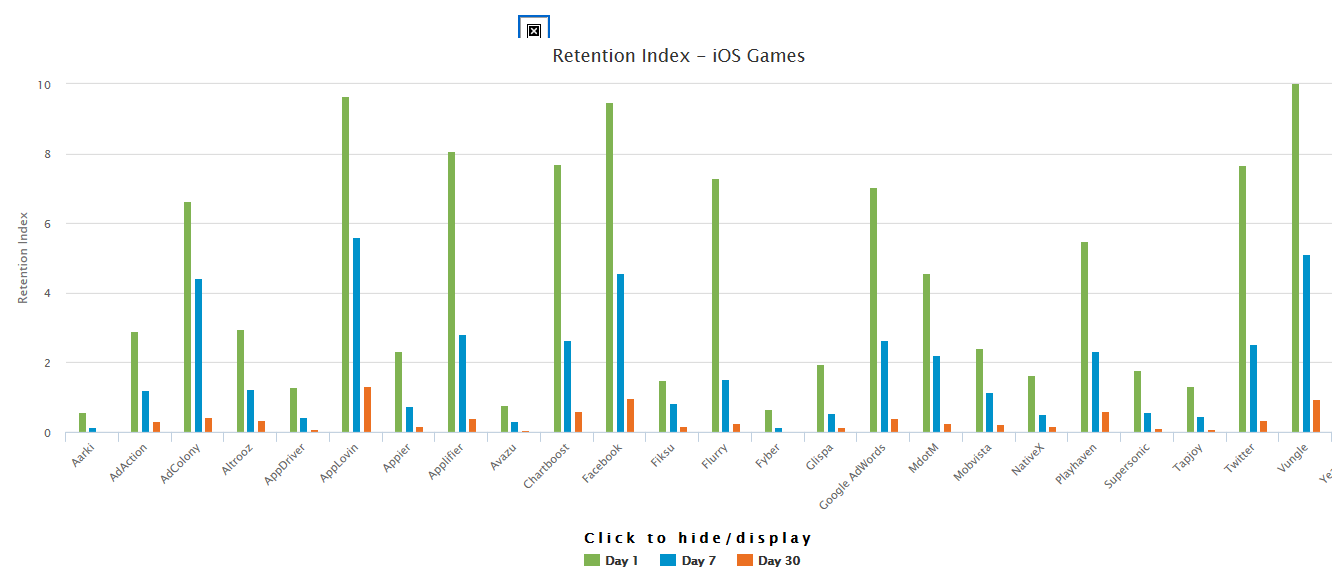
The charts below from Appsflyer show the critical flaw in looking at a game’s metrics:

Appsflyer iOS

Retention performance on Android by source:
AppsFlyerAndroid

It all depends on the source

The first lesson from these charts is that performance depends largely on the source of users. Although these charts show retention metrics, I am certain monetization and virality performance shows similar behavior. Thus, your performance metrics are incredibly biased by the source of traffic and metrics for your game overall only reflect the quality of the various user sources.

As an example, assume your Bingo game has D7 (Day 7) retention of 20% and an ARPDAU (average revenue per daily active user) of $0.25. Your main competitor’s game had D7 retention of 10% and an ARPDAU of $0.15. Based on this information, you may decide to cancel other projects and focus on this game. As a corporate development expert, you may aggressively try to acquire this company. The problem, however, is that the competitive game may be three years old and the company is using a very weak user acquisition channel that does not have a high cost because they have gotten all potential users from the better channels. Conversely, you may have acquired users through a Facebook mobile ad campaign targeting high-value Bingo players. Thus, your new users are of much higher quality than those from competitive Bingo game.

Even if your game is significantly worse, its metrics would look better at this stage. If you decide to focus on this game, the new users you bring in end up performing much worse than when you made the decision. This deterioration is not due to the game getting worse; it’s just based on a different set of users. If you end up acquiring the company for $100 million, you will then find out that as you try to grow it, you have trouble getting new profitable users.

Trends can be misleading

Trends one of are the most powerful analytics tools in your arsenal, as they show how your product or game is performing over time and if it is improving or deteriorating. Looking at the Appsflyer charts, however, it’s easy to see that that trends can largely be created by changes in the user mix. As the user acquisition team changes the mix of players, the new mix could create upward trends even if the game has not improved or deteriorated. The changes in behavior will be caused by the changes in user mix.

The only metric that counts

I have written many times about customer lifetime value (LTV), and the variance in metrics by source shows the central importance of focusing on the lifetime value to CPI (cost-per-install) equation. To summarize, LTV is how much profit a new player will generate for you in total and is a function of retention, monetization and virality. As long as your LTV is higher than the cost of acquiring that customer (CPI for paid user acquisition on mobile or web), you want to continue acquiring players.

Given the variance in performance by source that the AppsFlyer charts show, the LTV by source will also have huge variance. Thus, the goal is to have an LTV higher than the cost of user for that source. The LTV on a global scale is not important, it is finding pockets where LTV is greater than CPI and then acquiring against those targets. Any target KPIs (key performance indicators) outside of LTV being greater than CPI are worthless because this last equation will determine the success of your game. Anything else can be manipulated (e.g., buying users from certain sources who generate your “goals”). As long as LTV exceeds CPI for a source, you can acquire users from that source and grow your game. Once there are no sources where the LTV for that source are higher than the CPI (even if overall LTV is higher than many sources but not higher by source), you cannot buy users and the game will stop growing and start withering.

What it means

The high variance in performance of players by source has several important implications:

  • You must track performance of users on a cohort/source basis. Only by comparing similar users can you understand how your game is performing.
  • The sophistication of your user acquisition/growth team is critical. Managing CPIs is meaningless if it is not tied to the performance of the users; you need growth experts who can get you users with the highest yield (delta between LTV and CPI). You also may otherwise miss opportunities where your metrics may not appear to support buying expensive traffic, but that traffic will perform so well that it is a good value.
  • Holistic game metrics (sometimes referred to as vanity metrics) are meaningless or even misleading. You need to focus on keeping LTV higher than CPI for your sources of traffic.

The critical point is not to focus on vanity metrics that can be manipulated and are not actionable. Instead, focus on the performance of your product for specific cohorts of customers.

Key takeaways

  1. There is an extremely high variance in performance of users based on the source of the users. Thus, it is misleading to look at overall metrics as they are largely a result of your user sources.
  2. You must track performance of users on a cohort/source basis. Only by comparing similar users can you understand how your game is performing.
  3. It is critical to build a strong growth or user acquisition team. Managing CPIs is meaningless if it is not tied to the performance of the users, you need growth experts who can get you users with the highest yield (delta between LTV and CPI).
Like Loading...
Unknown's avatarAuthor Lloyd MelnickPosted on June 4, 2015January 4, 2016Categories Analytics, General Social Games Business, General Tech Business, Growth, Lloyd's favorite posts, LTVTags analytics, appsflyer, CPI, LTV, metricsLeave a comment on Why your game’s metrics mean nothing

The importance of competitive intelligence

In most businesses, the need to know what your competitors are doing is a given. In the social gaming space, however, competitive intelligence (CI) is either an afterthought or not even considered critical. That thinking at best leads to a sub-optimal product and at worst facilitates losing your market to another product.

Why Competitive Intelligence is important

Good competitive intelligence is invaluable to all companies, including those in the mobile and casino gaming spaces.

  1. CI shows you the minimum quality level acceptable for your game. In the mobile space, most users will try multiple applications and then settle on one, a winner take all environment, though in casino they may play two or three. Thus, your potential customers are also playing your competitors’ products and deciding which one to invest their time in the future. If your game is clearly inferior, weaker graphics, slower tech, etc., you have lost.
  2. Your competitors are not stupid and you should learn from them. Internally, they are looking at the same opportunities and problems you are trying to tackle. By understanding features and initiatives they are taking to improve, they can inspire you on ways to manage the situation. Not that you want to copy everything they are doing, but understand how they are approach problems and if you have a different approach make sure your solution is better before deploying it.
  3. You can learn from their mistakes. It is great to make mistakes because it means you are trying unique initiatives; it is not great to repeat mistakes as that has no value. What is even better is if somebody else makes the mistake to learn from them without having the cost.
  4. You ensure you are value competitive. A car company would not never release a new model without understanding how its price and features compare with other cars. It would base the price on the competitive feature set, including branding, and then price their car so it is a reasonable option for consumers. Very few people will purchase an auto when they can get a comparable one for half the price.In the game space, companies mistakenly believe users are price inelastic. Many players, particularly those likely to monetize, understand what they are spending money for and how much they will get for it. The value is often in play time (e.g., I will spend $20 in a bingo app to play an extra hour). If the player feels your game is much more expensive than comparable games, they are less likely to spend in your app and will shift their spending to competitors (and you will see lower revenue from higher prices).

Continue reading “The importance of competitive intelligence”

54.154041 -4.485911
Like Loading...
Unknown's avatarAuthor Lloyd MelnickPosted on April 16, 2015May 1, 2021Categories Analytics, General Social Games Business, Lloyd's favorite postsTags business intelligence, competition, competitive intelligence3 Comments on The importance of competitive intelligence

Keeping the edge you built with analytics

Now that virtually every game company, and every tech company, understands and uses analytics in its operations, simply having strong analytics is no longer a competitive advantage. If everyone is doing the same thing, it becomes the cost of doing business. In the early days of social gaming, Zynga, Playdom and the other leaders built a huge advantage because they had great (at the time) analytics system and used the information to adjust their games based on player demands. Now, even the most traditional game companies (yes, I mean EA) are using analytics to optimize live games and third party providers allow even start-ups access to advanced analytics.

Slide1

Sustaining competitive advantage

A recent article in the MIT Sloan Management Review, “Sustaining an Analytics Advantage” by Peter Bell, shows ways companies can still use analytics to build competitive advantage even when analytics are prevalent. While some of the suggestions are not relevant to game or tech companies, there are some that are invaluable: Continue reading “Keeping the edge you built with analytics”

Like Loading...
Unknown's avatarAuthor Lloyd MelnickPosted on April 14, 2015January 4, 2016Categories Analytics, General Social Games BusinessTags analytics, big data, competitive advantageLeave a comment on Keeping the edge you built with analytics

Creating that Aha moment

There was a great blog post on the Mode Blog, “Facebook’s Aha Moment is Simpler Than You Think,” which provided a straightforward strategy to creating Aha moments. Aha moments when a player or user understands the value of your product are widely considered the key to growth.

Slide1

The key point of the post was that you create the aha moment through simple math and strong messaging; it is not a complex task that requires advanced analytics. Take Facebook’s self-defined aha moment, acquiring seven friends in ten days. In practice, this is not a binary. Some people may fall in love with Facebook after getting three friends in a week; others may need to get twenty friends in thirty days. This fact does not take away from the aha moment, it is actually the point of the aha moment. The blog post states, “Facebook’s decision to define their ‘aha moment’ in such simple terms suggests they weren’t trying to optimize it to be precise as possible. Other “aha moments”—30 follows, 1 file upload, 2,000 messages—follow the same pattern: they emphasize simplicity over science…. Because “aha moments” aren’t about precision, but about defining a core principle and a quotable rally cry for the entire company. “

Defining the aha moment

To create a useful aha moment, you need to tie it to a metric that defines customer value. Keep in mind that it is not one “moment,” Facebook’s aha moment is over ten days and requires seven different actions (friending seven people).

The most useful metrics for quantifying your aha moment are based on retention. Customers who find value come back. If you identify which actions separate retained customers from lost ones, you will know what drives customer value and then have your “aha moment.” Continue reading “Creating that Aha moment”

Like Loading...
Unknown's avatarAuthor Lloyd MelnickPosted on February 12, 2015April 24, 2021Categories Analytics, General Social Games Business, General Tech Business, GrowthTags aha moment, analytics, Growth, retentionLeave a comment on Creating that Aha moment

How to avoid a product change or new feature debacle

A recent post on TechCrunch about TaskRabbit’s roll-out of a new market structure, largely seen as a failed roll-out, offers many lessons for all types of companies. TaskRabbit rolled out a very different version of its market place last July and faced what many called a “revolt” and “rabbit revolution.” Outside of the business reasons for the change and whether it was a net positive for the company (still debatable), there are many lessons from the experience for any company.

TaskRabbit logo

Do not surprise your customers

TaskRabbit’s change to a new platform caught many of its customers by surprise, leading to immediate protests. TaskRabbit had tested its new platform in the United Kingdom (where it previously did not have a presence) and saw substantial improvement in its metrics. Based on these results, it decided to replace its platform in the U.S. with the new model. As TechCruch wrote, “as soon as the launch actually went live, the protests and confusion started to pour in.” The company underestimated just how strong the bidding and auction model was ingrained in its brand identity here in the U.S., and how that resonated emotionally with users. Continue reading “How to avoid a product change or new feature debacle”

Like Loading...
Unknown's avatarAuthor Lloyd MelnickPosted on January 27, 2015January 29, 2015Categories Analytics, General Social Games Business, General Tech BusinessTags customer service, metrics, new feature, taskrabbitLeave a comment on How to avoid a product change or new feature debacle

Ignorance is a competitive advantage

I recently had a conversation with a gaming industry CEO whom I deeply respect that reinforced a MIT Sloan Management Review article, “Embrace Your Ignorance” by Michael Schrage, about how the savviest leaders promote and embrace ignorance. The thesis for both Schrage and the CEO was that you cannot accurately predict what your customers will want, like or need. Thus, you need to embrace this ignorance and run experiments to get the data.

Moneyball and The Innovator’s Dilemma

I have seen many companies where the leadership “felt” they understood the customer and would develop new products for these customers. It leads to project green light meetings very similar to the draft room in Moneyball, where people argue based on their experience which initiatives have the most potential. It is also one of the biggest contributors to the huge number of failed projects, particularly in the gaming space where we typically see more than 8 out of 10 new games fail.

This issue is actually often a bigger problem with executives who have had past successes. Even if they knew their existing or past customers very well, they do not necessarily know what a broader or new market wants. Even their existing data can skew innovation effort, which is the core point of the Innovator’s Dilemma: Companies that have been leap-frogged often create innovations for existing markets rather than new markets.

You already are ignorant—accept it

Slide1

In Schrage’s article, he discusses how Microsoft’s Ronny Kohavi (a pioneer in online experimentation) challenges tech-savvy audiences when he speaks. Kohavi shows screenshots of actual A/B tests that Microsoft has run for website design. He then asks his audience to predict the outcome of the tests. Although the audience is sophisticated, they almost always fragment with different opinions. Kohavi then advises, “stop debating…it’s easier to get data.” Continue reading “Ignorance is a competitive advantage”

Like Loading...
Unknown's avatarAuthor Lloyd MelnickPosted on January 13, 2015January 29, 2015Categories Analytics, General Social Games Business, General Tech Business, Lloyd's favorite postsTags analytics, experimentation, ignorance, Innovator's Dilemma, michael schrage, MoneyballLeave a comment on Ignorance is a competitive advantage

Analytics in 2015

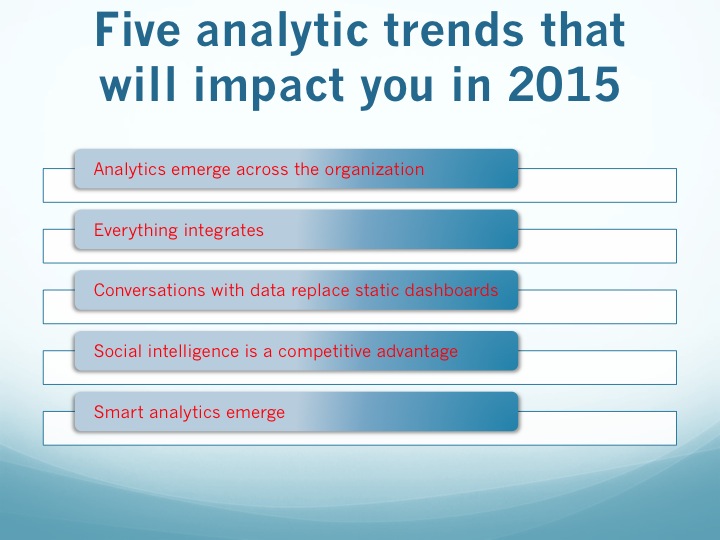
Since Thomas Davenport wrote Competing on Analytics in 2007, the use of analytics has evolved from a niche contributor to the central role of successful companies decision making, product development, marketing and other core functions. A great white paper published by Tableau highlights what it considers the top 10 trends for business intelligence. Of these ten trends, there are five that I agree will impact significantly companies this year.

Slide1

Analytics emerge across the organization

Analytics will no longer be a domain dominated by analysts and data scientists; instead everyone in the organization will be using analytics daily for their decision making. Easier-to-use technologies that provide browser-based or mobile analytics let people answer ad-hoc business questions. Companies that recognize this as a strategic advantage will begin to support managers and front-line personnel with data, tools and training to help them do their jobs more effectively.

Everything integrates

There has been a huge amount of innovation across the data space, resulting in mixed environments for everything from data storage to analytics to business applications. Although there will not be one system or application for all of your needs, the different analytic systems will be more integrated and easier to use, making them more accessible across your company. You will laugh at the multiple logins and clunky processes you had to use during analytics 1.0. Continue reading “Analytics in 2015”

Like Loading...
Unknown's avatarAuthor Lloyd MelnickPosted on January 8, 2015January 29, 2015Categories Analytics, General Social Games Business, General Tech BusinessTags analytics, social intelligence, social media, TableauLeave a comment on Analytics in 2015

Posts pagination

Previous page Page 1 … Page 3 Page 4 Page 5 … Page 12 Next page

Get my book on LTV

The definitive book on customer lifetime value, Understanding the Predictable, is now available in both print and Kindle formats on Amazon.

Understanding the Predictable delves into the world of Customer Lifetime Value (LTV), a metric that shows how much each customer is worth to your business. By understanding this metric, you can predict how changes to your product will impact the value of each customer. You will also learn how to apply this simple yet powerful method of predictive analytics to optimize your marketing and user acquisition.

For more information, click here

Follow The Business of Social Games and Casino on WordPress.com

Enter your email address to follow this blog and receive notifications of new posts by email.

Join 791 other subscribers

Most Recent Posts

  • Join me at PDMA Inspire for my talk on new product prioritization
  • Why keep studying?
  • The next three years of this blog
  • Interview with the CEO of Murka on the biggest growth opportunity in gaming, Barak David

Lloyd Melnick

This is Lloyd Melnick’s personal blog.  All views and opinions expressed on this website are mine alone and do not represent those of people, institutions or organizations that I may or may not be associated with in professional or personal capacity.

I am a serial builder of businesses (senior leadership on three exits worth over $700 million), successful in big (Disney, Stars Group/PokerStars, Zynga) and small companies (Merscom, Spooky Cool Labs) with over 20 years experience in the gaming and casino space.  Currently, I am the GM of VGW’s Chumba Casino and on the Board of Directors of Murka Games and Luckbox.

Topic Areas

  • Analytics (114)
  • Bayes' Theorem (8)
  • behavioral economics (8)
  • blue ocean strategy (14)
  • Crowdfunding (4)
  • DBA (2)
  • General Social Games Business (459)
  • General Tech Business (195)
  • Growth (88)
  • International Issues with Social Games (50)
  • Lloyd's favorite posts (101)
  • LTV (54)
  • Machine Learning (10)
  • Metaverse (1)
  • Mobile Platforms (37)
  • Prioritization (1)
  • Social Casino (52)
  • Social Games Marketing (105)
  • thinking fast and slow (5)
  • Uncategorized (33)

Social

  • View CasualGame’s profile on Facebook
  • View @lloydmelnick’s profile on Twitter
  • View lloydmelnick’s profile on LinkedIn

RSS

RSS Feed RSS - Posts

RSS Feed RSS - Comments

Categories

  • Analytics (114)
  • Bayes' Theorem (8)
  • behavioral economics (8)
  • blue ocean strategy (14)
  • Crowdfunding (4)
  • DBA (2)
  • General Social Games Business (459)
  • General Tech Business (195)
  • Growth (88)
  • International Issues with Social Games (50)
  • Lloyd's favorite posts (101)
  • LTV (54)
  • Machine Learning (10)
  • Metaverse (1)
  • Mobile Platforms (37)
  • Prioritization (1)
  • Social Casino (52)
  • Social Games Marketing (105)
  • thinking fast and slow (5)
  • Uncategorized (33)

Archives

  • September 2023
  • December 2021
  • July 2021
  • March 2021
  • February 2021
  • January 2021
  • December 2020
  • November 2020
  • October 2020
  • September 2020
  • August 2020
  • July 2020
  • June 2020
  • May 2020
  • April 2020
  • March 2020
  • February 2020
  • January 2020
  • November 2019
  • October 2019
  • September 2019
  • June 2019
  • May 2019
  • April 2019
  • March 2019
  • February 2019
  • January 2019
  • December 2018
  • June 2018
  • May 2018
  • April 2018
  • March 2018
  • February 2018
  • January 2018
  • December 2017
  • June 2017
  • May 2017
  • April 2017
  • March 2017
  • February 2017
  • January 2017
  • December 2016
  • November 2016
  • October 2016
  • September 2016
  • June 2016
  • May 2016
  • April 2016
  • March 2016
  • February 2016
  • January 2016
  • December 2015
  • November 2015
  • October 2015
  • September 2015
  • July 2015
  • June 2015
  • May 2015
  • April 2015
  • March 2015
  • February 2015
  • January 2015
  • December 2014
  • November 2014
  • October 2014
  • September 2014
  • August 2014
  • July 2014
  • June 2014
  • May 2014
  • April 2014
  • March 2014
  • February 2014
  • January 2014
  • December 2013
  • November 2013
  • October 2013
  • September 2013
  • August 2013
  • July 2013
  • June 2013
  • May 2013
  • April 2013
  • March 2013
  • February 2013
  • January 2013
  • December 2012
  • November 2012
  • October 2012
  • September 2012
  • August 2012
  • July 2012
  • June 2012
  • May 2012
  • April 2012
  • March 2012
  • February 2012
  • January 2012
  • December 2011
  • November 2011
  • October 2011
  • September 2011
  • August 2011
  • July 2011
  • June 2011
  • May 2011
  • December 2010
January 2026
S M T W T F S
 123
45678910
11121314151617
18192021222324
25262728293031
« Sep    

by Lloyd Melnick

All posts by Lloyd Melnick unless specified otherwise
Google+

Enter your email address to subscribe to this blog and receive notifications of new posts by email.

Join 791 other subscribers
Follow Lloyd Melnick on Quora

RSS HBR Blog

  • Regaining Momentum After a Holiday Break
  • When You’ve Outgrown Your Relationship with a Trusted Advisor
  • Research: Conventional Cybersecurity Won’t Protect Your AI
  • Weave Mentorship into the Fabric of Your Organization
  • To Execute a Unified Strategy, Leaders Need to Shadow Each Other
  • What Companies that Excel at Strategic Foresight Do Differently
  • How Bristol Myers Squibb Transformed Working Capital to Fund Its Future - SPONSOR CONTENT FROM EY-PARTHENON
  • When Being a Family Business Becomes a Competitive Advantage
  • How to Handle a Difficult Board Member
  • How to Strengthen Your Focus When Demands Never Let Up

RSS Techcrunch

  • An error has occurred; the feed is probably down. Try again later.

RSS MIT Sloan Management Review Blog

  • Build Better Pay-for-Performance (PFP) Compensation Plans
  • Your People Are Not All Right
  • Five Trends in AI and Data Science for 2026
  • Stop Making Hollow Apologies at Work
  • Calm: The Underrated Capability Every Leader Needs Now
  • The Top Five MIT SMR Videos of 2025
  • Three Steps Toward Fairer Talent Management
  • From Crisis to Coopetition: What Leaders Can Learn From Anesthesiologists
  • AI Coding Tools: The Productivity Trap Most Companies Miss
  • How Procter & Gamble Uses AI to Unlock New Insights From Data
The Business of Social Games and Casino Website Powered by WordPress.com.
  • Subscribe Subscribed
    • The Business of Social Games and Casino
    • Join 726 other subscribers
    • Already have a WordPress.com account? Log in now.
    • The Business of Social Games and Casino
    • Subscribe Subscribed
    • Sign up
    • Log in
    • Report this content
    • View site in Reader
    • Manage subscriptions
    • Collapse this bar
 

Loading Comments...
 

    %d