Skip to content

The Business of Social Games and Casino

How to succeed in the mobile game space by Lloyd Melnick

Category: General Social Games Business

Lifetime Value Part 25: Why retention is THE KPI

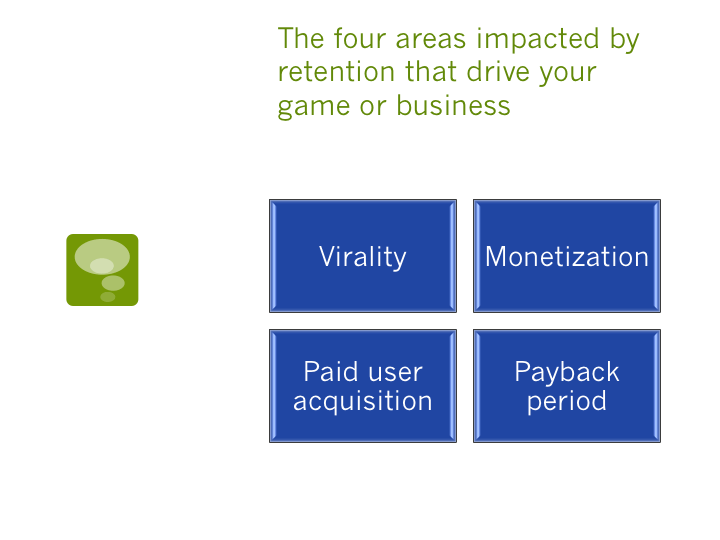
Whenever I write about lifetime value (LTV), I always try to stress that the key to growing a high LTV is retention. I recently came across an article, The One Growth Metric that Moves Acquisition, Monetization, and Virality by Brian Balfour, one of the top experts on growth, that does a wonderful job of showing just how powerful retention is to your LTV. Balfour identifies four areas that retention impacts.

Slide1

Acquisition

As you improve retention of existing users, you also acquire more new customers. A number of organic acquisition channels, such as virality and user-generated content (UGC), work when existing users take an action that introduces new users to your game or product (via inviting friends, sharing, word-of mouth, creating new content, etc.). A larger base of active users leads to better acquisition metrics. Players remaining in your game or product can invite new people to the product, so the more you retain, the more players who can send invites.

Monetization

Monetization is the second area impacted by retention. I get very frustrated when people, usually Product Managers, act as if there is a trade-off between retention and monetization. The reality is that retention drives monetization rather than damaging it. First, retention allows players to spend more frequently. If you retain a customer for three months rather than one month, they have 3X the opportunity to spend. Moreover, if your model is more robust than simply discreet purchases (either in-app purchases for a game or sales for a retailer), you also generate a longer stream of advertising or subscription revenue the longer the user is engaged with your product.

User acquisition becomes a competitive advantage

Paid user acquisition is one of the critical elements to growing a game or app, you need to have a positive return on ad spend to justify scaling your product. More importantly, since a bidding model drives user acquisition in the app space, with acquisition muscle you can push competitors out of acquisition channels, dominating a market and growing faster. As described earlier, your users are generating more revenue (they are in the product longer so spending more often and driving ad and subscription revenue), you can afford to outspend your competitors.

Payback period

Retention accelerates your payback period, allowing you to avoid raising additional funds or providing more free cash flow to funnel into acquisition. Payback period is the amount of time to pay for your full loaded user acquisition costs. As Balfour writes, “if you have a longer payback period, you either need to raise more money to fuel acquisition or wait longer to reinvest in acquisition. If you have a shorter payback period you will be able to reinvest the cash earned sooner in acquisition. Since improving retention drives monetization – meaning you make more money over a designated period of time – it also shortens your payback period.”

Build with retention top of mind

With retention driving so much value, you need both to create products that will retain customers or players and then the live services need to focus on improving retention. While it is sexy to try to boost ARPDAU, you will create the most value by strengthening your retention.

Key takeaways

  1. Retention is the most important area to focus on, as it drives four areas critical to growth: virality, monetization, paid acquisition and payback period.
  2. Retention generates more users because there is more virality, word of mouth, user generated content and an ability to spend more to acquire.
  3. Retention drives revenue because players have more opportunities to make purchases and generate additional advertising and subscription revenue.

Share this:

  • Click to share on Facebook (Opens in new window) Facebook
  • Click to share on LinkedIn (Opens in new window) LinkedIn
Like Loading...
Unknown's avatarAuthor Lloyd MelnickPosted on March 13, 2018February 4, 2018Categories General Social Games Business, General Tech Business, Growth, LTVTags Brian Balfour, customer lifetime value, lifetime value, monetization, retention, ViralityLeave a comment on Lifetime Value Part 25: Why retention is THE KPI

How to truly personalize and test

How to truly personalize and test

In 2018, if you are not delivering a personalized customer journey in your game or product you will fail. Personalization, for marketing, for customer experience, for CRM, for almost everything, is the current buzzword but it is still rare that companies have a comprehensive plan to create a personal experience. David Norton, former CMO at Harrah’s Casino group and architect of its Total Rewards program, discusses several ways companies can personalize effectively in his book The High Roller Experience.

Personalization is critical not only to a great customer experience but also to optimizing efficiency. As Norton writes, “personalizing the marketing communication approach will dramatically improve the efficiency of marketing spend both by eliminating activities that will not be fruitful and by improving response through more appropriate offers.” As your competitors are already optimizing, if you are not you will not be able to spend as many marketing dollars as they can, putting you at a fatal disadvantage.

How to create a personalized experience

Realistically, you are not going to have one-to-one personalization on day one, so you need practical planning to create a personal experience. A great way to start is replicate what Harrah’s did as a way to improve its marketing effectiveness, using a basic life cycle approach: new business, non-loyal, loyal, and defector. If you initially communicate differently with these segments, you will see an increase in overall ROI.

You also need to leverage the data you have on customers beyond the typical events. At Harrah’s, they looked at implied preferences based on all the information they had about their customers normal behavior, such as what customers did on their visits to our properties, including games played, offers redeemed, and nongaming activities, and then stored the preferences at a customer level for easy use in campaigns. They noted whether the customers preferred slot or table games, if they participated in gaming tournaments, if they most often came midweek or on the weekend, how often they redeemed offers when they came, what type of entertainment they preferred, which channel of communication they preferred, and a host of other factors. They used these implied preferences as inclusion and exclusion rules in campaigns. By excluding customers from programs that they had no chance to respond to based on their past behavior, they significantly improved response rates and cost savings. Most importantly, as Norton wrote, “we made our customers happier.”

Find the segments with high ROI

As alluded to above, you do not need to create hundreds of micro-segments initially but you do need to determine which segments you should invest in. Non-loyal customers represent a particularly attractive segment to target, as this is where you have the biggest opportunity to win market share. At Harrah’s, they targeted this segment by giving them increased value for more frequent visits, generating a significant increase in revenue from this group than they had predicted. In gaming, this creates opportunities, especially in the social and real money casino spaces, where players normally play three to five competitive apps.

Another segment rich with opportunity is defectors. Harrah’s found a way to identify those customers who had broken their typical visitation pattern as opposed to the standard inactive program practice of waiting 6 or 12 months to reach out to them, at which time they would have been long gone. This practice created lower churn and more value from this segment.

Treat VIPs extra special

I have written multiple times about VIP, and you need to ensure your personalization extends to giving VIPs a very special experience. This includes making sure you not only identify VIPs who make a large purchase in one product (or in Caesars case one property) but the ones who have the highest lifetime value. For an online company, the key is looking at number of transactions and adding across products to get the best picture of who your true VIPs are. You then need to treat VIPs in one product as VIPs in all your products. One of the biggest failures of personalization is when a VIP in one product or one retail location then goes to another and is treated as a standard customer.

Personalize all touch points

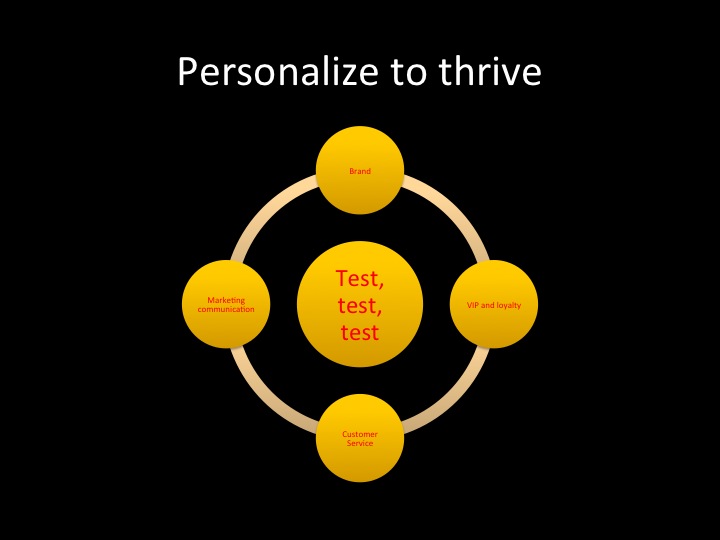
It is not just personalizing communications that is critical but you also need to personalize all the core functions. According to Norton, personalization needs to extend to brand, loyalty and customer service. As Norton writes, “if a company can execute against all three of these well, it is going to outperform its competitors….Customers increasingly want a seamless experience across touchpoints with a brand, and contact channels are often one of the greatest frustration points.”

Do not forget customer service (CS)

Given that you need to personalize all touch points, the one that companies most often miss is customer service. The service profit chain is not a theory but a powerful motivator and value creator.

It is absolutely essential, however, to think about the holistic customer service experience and understand the interplay among various channels. The call center and other contact channels are a valuable commodity. When personalized, CS can drive revenue and brand advocacy and provide valuable customer data. Norton writes, “I have always viewed customer care as a critical marketing channel that can build customer relationships, be a source of relevant information about the customer, and of course turn demand into revenue.“ Many of the product improvements that have led to the most revenue growth in my past two positions originated from feedback from our customer facing team members and VIP hosts.

CS is also an area for innovation, as you can improve your offering through technology. Customers may embrace technology before your company might, so CS can be a great vehicle to try new tools and channels.

To truly leverage customer service as a tool to improve personalization and the customer journey, you need to measure it at a granular level. This helps drive service improvement efficiently.

Testing is the key

You need to constantly test to ensure you are personalizing optimally. As Norton writes, “constantly testing and learning and holding out control groups is the best way to optimize marketing spend. This allows companies to find the most appropriate message and to spend .”

The first step is to automate the test process. If it takes months to evaluate what happened, the results become useless as the competitive landscape has changed.

It is also critical to have a control group for each campaign and program. While this policy seems automatic, there is often pressure to release what you believe is the optimal campaign or communications to everyone, as you do not want to leave money on the table. Holding out customers, however, from a specific marketing program is much more informative in determining which marketing activities drive the most incremental profitability, changing the customer’s behavior to spend more with you than with a competitor. This is also a better strategy than a universal control group, which does not show you the relative performance of different marketing programs.

As mentioned above, customer service is critical to personalization and measuring customer service with a significant level of granularity provides tremendous insight about the customer experience and helps identify areas for improvement. As Norton writes, “being able to correlate improved service to increased revenue, and developing a well-constructed incentive plan, leads to great outcomes for both a company and its customers— especially when there is innovation around challenged service touchpoints that drive overall customer satisfaction with the brand.”

Personalize, personalize, personalize

The key to success in the current business environment is personalization, your customers expect it, and if you do not deliver they will go to a competitor. And you need to deliver not only in communication but also in customer service and VIP. Then you need to optimize to ensure you are delivering a truly effective personal experience. This is not a secret to gaining competitive advantage, it is the cost of doing business.

Key takeaways

  • Personalization improves the efficiency of marketing spend by eliminating activities that will not be fruitful and by improving response through more appropriate offers
  • Think holistically about the customer journey. Ensure all parts of it are personalized, from the initial communication through the product to customer service and support.
  • Testing and control groups are the best ways to optimize your marketing and ensure your personalization efforts are creating value.

Slide1

Share this:

  • Click to share on Facebook (Opens in new window) Facebook
  • Click to share on LinkedIn (Opens in new window) LinkedIn
Like Loading...
Unknown's avatarAuthor Lloyd MelnickPosted on March 6, 2018March 6, 2018Categories General Social Games Business, Growth, Social Games MarketingTags CS, customer service, David Norton, loyalty, personalization, vipLeave a comment on How to truly personalize and test

Hypercasual, the real next big thing in mobile gaming

There is a lot of buzz now about hypercasual games, and, for once, I agree with the buzz. There is a new big thing in gaming every year – a new console, technology, mechanic, etc. – that people expect to change the industry, investment flocks to it and a few years later it becomes an afterthought and a lot of people have to send out their resumes. I am usually skeptical of these fads, if you look at my posts there is not one about VR, blockchain, 3D, etc., but hypercasual is the exception

Hypercasual, is not a fad because it taps into what is one of the strongest drivers of building a successful product, simplicity. I have written repeatedly about how people gravitate to easy products that minimize cognitive load, and often use the example of Uber’s success to show that simple and straightforward can generate tens of billions of dollars of value. Hypercasual games tap into that formula for success.

A recent article, 100 Million Downloads: How Hypercasual Mobile Games Are Rewriting the Game Design Rulebook by Tom Kinniburgh, does a great job of both quantifying the success of the genre and pointing out key rules to building hypercasual games.

What is hypercasual

The first step to analyzing the hypercasual market is defining what is hypercasual. If you do not define it, you cannot build towards it. As Kinniburgh writes, “the term ‘hypercasual’ has become a collective way to reference games of this nature. Such titles typically have a single mechanic and a single goal, yet reaching a high score can be fiendishly difficult.” Effectively the core game loop is very straightforward, do one thing, get rewarded (so you can try again) and keep repeating to get a higher score.

Slide1

The state of the hypercasual market

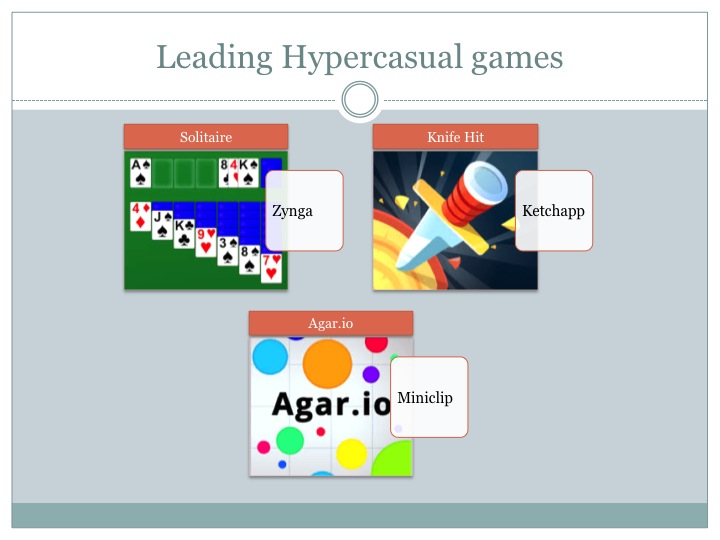
Hypercasual is not the next big thing that developers and investors are flocking to but an already established space in the game ecosystem with hundreds of millions of players. There are already tens, if not hundreds, of hypercasual games with over 100 million downloads. To put that number in perspective, 100 million downloads is more downloads than if everyone in Germany or France or the UK installed the app. These games include Agar.io, Finger Driver, Balls Race, Dunk and most of the other games at the top of the various app stores’ charts. The acquisition of Harpin, a one-person studio that built a solitaire game, for over $42 million also validates the hypercasual market, as companies usually do some due diligence before investing millions of dollars.

How to build a hypercasual game

The core game mechanic is even more important in the hypercasual space. As mentioned above, hypercasual games have a single mechanic that the player keeps repeating to get a superior score. Thus, the single mechanic needs to be fun, easy and compelling or else the player will not want to continue.

This core mechanic must also be easy for the player to understand quickly and provide for ever improving scores. Kinniburgh writes, “Great hypercasual are easy to grasp, but rely on players having a perfect run to succeed, and they measure that perfection with a score.”

By being easy to understand quickly, players recognize that playing more leads to better scores. If it is difficult to comprehend how to play, the score and activity would not be linked in the player’s mind so they would not be driven to keep playing. Also, if continued play did not yield higher scores, then the key incentive to more gameplay would not exist.

This simplicity exists throughout the game. Unlike other game genres, you do not introduce more features (complexity) as the game progresses. According to Kinniburgh, “great games in this genre rely on mechanics that provide everything the player needs to play from the start of the game, either with a single life on offer – such as Flappy Bird – or with multiple lives, like Ballz. In each case, however, the game ends when said lives count reaches zero.”

While the gameplay mechanic needs to stay consistent, the game must also scale so players do not get bored. If they can master the game, then the score is capped. Instead, you need to introduce variety by making higher levels more difficult (less time, bigger opponents, etc) or making the level more complex (a puzzle game with more area blocked). According to Kinniburgh, there are three ways to scale hypercasual games:

  • Changing the underlying environment
  • Changing the speed
  • Adding a PvP element

When designing, use one or a combination of these elements to keep the player engaged.

How do you make money

I, and most others, would not care about hypercasual if there was not a way to translate the popularity of these games into revenue. The most obvious answer is in-game advertising. Throughout the game space, advertising is becoming an increasingly important revenue stream. Players in games already see rewarded video as a benefit; adding watch to earn almost always increases your retention metrics. Machine learning now allows for more targeted advertising, creating a better user experience (you see ads you are actually interested in) and a better value for advertisers (you only pay to show ads to people who are really potential customers). These two forces are further driving ad revenues for game companies.

Hypercasual taps into this trend because of the sheer number of players you attract. With hundreds of millions of players, algorithms have more data on who to target with what, providing better advertiser and user experiences. And, with each player generating some revenue, hundreds of millions of players directly translates to more revenue.

In addition to direct advertising revenue, you can improve company revenue by using hypercasual as an acquisition channel. While the Harpin acquisition may be ROI positive based on advertising revenue, my guess is that the revenue it generates by driving players to Zynga Poker and other games with strong lifetime values actually is more valuable than the direct revenue from Harpin’s games. Using hypercasual as a portfolio play rather than a standalone opportunity further builds value.

Future opportunities for hypercasual

With many trends, by the time you read about it, it is too late to capitalize, but in the case of hypercasual there are still many opportunities. First, the underlying principle of a single, simple mechanic will always lead to a good user experience. My philosophy is simpler is better, and hypercasual is defined by simplicity.

Also, for those in the casino space, hypercasual has barely raised its head. While Harpin and several other hypercasual companies have built great businesses around solitaire or solitaire like apps, that is largely the extent of its penetration of the most exciting gaming vertical (social casino). There are no hypercasual games that target slot players, which represents about 80 percent of the social casino market. Same for table games (roulette, baccarat, etc), which seem to lend themselves perfectly to hypercasual.

The opportunity also is not limited to free to play casino, but the real money space can learn from it. The success of lottery products not only shows willingness to gamble on hypercasual experiences but a strong and continuing desire to do so. Also, the high customer acquisition costs in real money suggests the value of hypercasual as an acquisition tool would dwarf the benefits free to play companies get from these games.

Key takeaways

  1. Hundreds of millions of people play hypercasual games; apps that have a single game mechanic where players keep returning to get a higher score.
  2. Hypercasual games are a great opportunity in the free to play social casino market, as there is still no hypercasual games that target slots players, the biggest segment of that space
  3. Hypercasual is also an untapped opportunity in real money gaming, as lotteries show players willingness to gamble on a hypercasual experience and they provide a way to offset the very high customer acquisition costs.

Share this:

  • Click to share on Facebook (Opens in new window) Facebook
  • Click to share on LinkedIn (Opens in new window) LinkedIn
Like Loading...
Unknown's avatarAuthor Lloyd MelnickPosted on February 27, 2018March 1, 2018Categories General Social Games Business, Social Casino, Social Games MarketingTags harpin, hypercasual, user acquisition2 Comments on Hypercasual, the real next big thing in mobile gaming

The ten most valuable business books I have ever read

The ten most valuable business books I have ever read

A colleague recently asked me what ten books I would recommend to him and it turned into a much more difficult question than I expected. While it is relatively easy to rank books you read in the last few month or even year, picking the ten most useful at all time is very hard, a lot of books have contributed to my growth. After much thought, I came out with my top ten books and after going through the exercise I felt the list could be useful to everyone.

While I did not initially rank the books, given everyone’s limited time, I have now ranked them from one to ten based on how much value I derived from the book. Below are my top-10, with the most valuable one first (given that this is not Miss Universe, I did not think creating suspense by starting at number 10 made sense):

  1. Thinking, Fast and Slow by Daniel Kahneman. Kahneman’s book about human behavior and decision making has influenced me more than any other work. It has helped me understand what drives others and mistakes I commonly made. The book will help you make better decision, understand your customers better, be a superior leader and create more compelling products.
  2. Blue Ocean Strategy: How to Create Uncontested Market Space and Make the Competition Irrelevant. Blue Ocean Strategy drives how I develop strategy everywhere I have had the opportunity. It starts by showing the superior results in creating a new market space rather than competing directly in an existing space and this leads to a framework for building long term competitive advantage.
  3. Predictably Irrational by Dan Ariely. Predictably Irrational is my favorite book on the list, reading Dan Ariely is comparable to reading a Michael Lewis or even Tom Clancy book, a true page turner. Ariely’s work is in the same space as Kahneman, behavioral economics, or why people make the decisions that they do. In effect, people are not rational (which undercuts traditional economics) but their irrationality is not haphazard, it is predictable. Like Kahneman’s work, reading Predictably Irrational will improve your decision making, leadership and ability to interact with your customers.
  4. Hooked: How to Build Habit-Forming Products by Nir Eyal. Hooked is the best book I have read about how to create truly compelling product. It provides a framework for building something that customers will engage with regularly, thus having a high lifetime value.
  5. Smart Customers, Stupid Companies: Why Only Intelligent Companies Will Thrive, and How To Be One of Them. This book highlighted the value of personalization before it was cool. It anticipated the trend of customers expecting an experience tailored to them before everyone gave it lip service and still provides compelling evidence on the value of personalization.
  6. The Signal and the Noise: Why So Many Predictions Fail–but Some Don’t by Nate Silver For those of you who are not familiar with Nate Silver, he is probably the best known US statistician because of his success predicting election results (though he did miss on Trump) and high profile sports analytics sight. The Signal and the Noise is fantastic at explaining in a very easy to understand way how analytics work, why they sometimes do not, and how you can apply them.
  7. The Ultimate Question. The Ultimate Question is effectively an explanation of NPS (Net Promoter Score) and framework on how to apply it. I find NPS the most useful KPI after LTV (and a key driver of it) and this book helps you understand how to apply it correctly as it is often the most misused KPI.
  8. Collaboration: How Leaders Avoid the Traps, Build Common Ground, and Reap Big Results by Morten Hansen. Hansen’s book made it into my top-10 largely because collaboration is so often misused to justify more meetings and design by committee, which destroys value. Hansen, instead, shows you how to collaborate to create increased efficiency and better results.
  9. Contagious: Why Things Catch On by Jonah Berger. Contagious is in the top-10 because it is the only work I have ever read that really shows you how to make a product or marketing viral. Given the value of virality in LTV, this book provides core knowledge that will help your marketing, CRM and product decisions.
  10. Moneyball by Michael Lewis. The tenth spot in this list was actually the hardest to fill, as I had to drop many other great books. Moneyball, however, changed the way I looked at the video game and digital entertainment ecosystems. It highlighted similar opportunities as Billy Beane saw in building a baseball club. And, like with Dan Ariely’s books, it was a lot of fun to read.


As I just wrote, there were a lot of contenders for the top ten and a lot of valuable books I would love to include. If you are looking for other great books to read, I also recommend (this time not in order):

  • Grit: The Power of Passion and Perseverance
  • The High Roller Experience: How Caesars and Other World-Class Companies Are Using Data to Create an Unforgettable Customer Experience.
  • Blue Ocean Shift: Beyond Competing – Proven Steps to Inspire Confidence and Seize New Growth.
  • 10% Happier: How I Tamed the Voice in My Head, Reduced Stress Without Losing My Edge, and Found Self-Help That Actually Works–A True Story.
  • Whale Hunt in the Desert: Secrets of a Vegas Superhost.
  • Essentialism: The Disciplined Pursuit of Less.
  • The Innovator’s Dilemma: When New Technologies Cause Great Firms to Fail (Management of Innovation and Change).
  • Toughness: Developing True Strength On and Off the Court by Jay Bilas.
  • The Success Matrix: Winning in Business and in Life.

Happy reading and also please post your suggestions.

Share this:

  • Click to share on Facebook (Opens in new window) Facebook
  • Click to share on LinkedIn (Opens in new window) LinkedIn
Like Loading...
Unknown's avatarAuthor Lloyd MelnickPosted on February 20, 2018April 11, 2020Categories blue ocean strategy, General Social Games Business, General Tech Business, thinking fast and slowTags blue ocean, dan ariely, Daniel Kahneman, Jonah Berger, Nate Silver, Reading List, thinking fast and slow2 Comments on The ten most valuable business books I have ever read

Becoming truly customer-centric and personalized

Focusing and organizing your company around the customer, not functions or products, is the only way to become truly customer-centric. While loyalty and rewards programs are a great tool to increase engagement, they are only one part of becoming customer-centric. Not only does David Norton’s The High Roller Experienceprovide a roadmap for building a strong loyalty program, it also shows how Harrah’s/Caesar’s casino group created a truly customer-centric company.

Put the customer at the center

Slide1

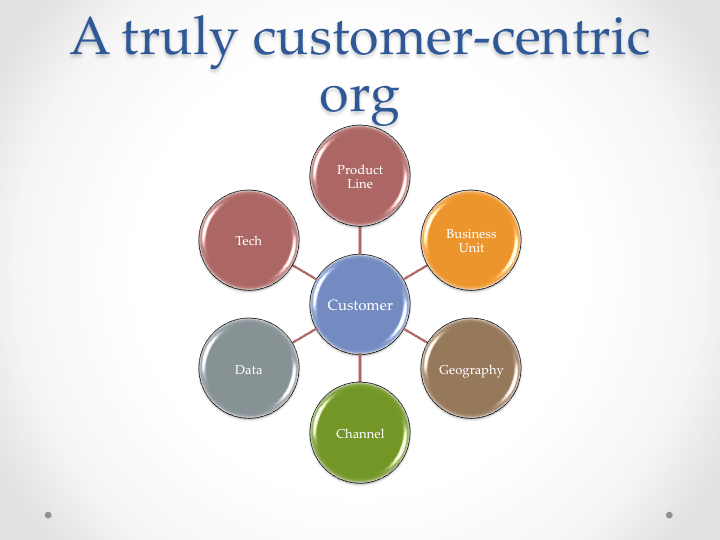
By definition, to be customer-centric, you need to put the customer at the center of your company. The leadership of most businesses build their organization around product line, business unit, or geography, which makes it quite difficult to take a customer-centric approach to running the company. The customer becomes a by-product of the organization’s design rather than the core around which the company revolves. As Norton writes, “customer centricity means that the customer is the company’s and not an individual business unit’s. It is an ability to interact with the customer cohesively and consistently regardless of which business unit the customer is dealing with.”

You also need to put the customer at the center of your data. Norton writes, “being able to truly understand the customer and present relevant content at the right moment through the right channel is the holy grail for which companies should strive in order to engender deep loyalty from customers. Data and technology can enhance the customer experience while simultaneously driving incremental profits for the company. “

To achieve this convergence of data and technology, you should build cross-functional task forces that include analytics, technology and the various functions that interact with the customer. These teams can then derive how to understand the individual customer behavior and integrate the results at each touch point so the customer gets the optimal experience for them.

It is more than loyalty

Being customer-centric is much more than loyalty. While Norton created Total Rewards, Harrah’s incredibly successful loyalty program, he writes, “loyalty is about understanding your customers in detail and interacting with them in a highly personalized way at every point of contact with your brand.” Loyalty is about more than a rewards program where customers are fixated on point accumulation and the company is primarily concerned about the cost of contingent liability. It is about interacting with the customer across their entire journey, at every interaction with your company.

It cannot be product specific

As mentioned earlier, you cannot be customer centric if you are focused on product lines or types. You need to look at the customer across all of your products. This focus also then allows you to help the customer find the products and experiences that are most likely to resonate with them.

Looking at the customer across products also enhances the lifetime value of the customer to the company. If you set up your data and organization around the customer and not product, you can predict who of the low-value masses has the potential to shop across products, largely by looking at demographic and behavioral factors. You can then target these customers so as not to confuse the individual product positioning in mass advertising.

Put the customer at the center

With customer now expecting a personalized and great experience, and getting it from the top companies (Netflix, Amazon, etc), you need to move from a 20th century company to a customer centric company. Blow up your organization and structure it around the user. Build your analytics and business intelligence so it tracks the customer journey and allows you to touch every player individually the right way at the right time. When you build your company around the customer, you build it to succeed.

Key takeaways

  • Being a customer centric organization is much more than having a great loyalty program.
  • You need to structure your organization around the customer, not along product lines or geography or channels.
  • Your data also needs to be customer centric, understanding the customer at all points of their journey and ensuring that it then feeds this data back to given the customer the best personal experience for them.

Share this:

  • Click to share on Facebook (Opens in new window) Facebook
  • Click to share on LinkedIn (Opens in new window) LinkedIn
Like Loading...
Unknown's avatarAuthor Lloyd MelnickPosted on February 13, 2018January 14, 2018Categories General Social Games Business, General Tech Business, Lloyd's favorite postsTags Customer centric, customers, data, organizational structureLeave a comment on Becoming truly customer-centric and personalized

The dark cloud over social casino revenue

While projections for the social casino (free to play slots and poker) industry continue to be overwhelmingly positive and the industry has never seen a revenue decline on a sequential basis, there is an ominous KPI that nobody is discussing. While the industry continues to grow, that growth is from better monetization, not bringing new customers into the market. This fact potentially puts a ceiling on potential growth or worse portends to a future decline.

Slide1 Continue reading “The dark cloud over social casino revenue”

Share this:

  • Click to share on Facebook (Opens in new window) Facebook
  • Click to share on LinkedIn (Opens in new window) LinkedIn
Like Loading...
Unknown's avatarAuthor Lloyd MelnickPosted on February 6, 2018February 5, 2018Categories General Social Games Business, Lloyd's favorite posts, Social CasinoTags Growth, monetization, social casino2 Comments on The dark cloud over social casino revenue

The secrets to creating a top VIP (high roller) rewards initiative

The value of VIPs in social games and social casino is now a truism, everyone realizes that less than 0.5 percent of players drive more than 80 percent of revenue in most social casino games. Given this reality, an effective VIP scheme is a strong tool to convince customers to be more loyal and learn more about all of your customers’ preferences to personalize further your communication strategy.

This truth has driven many companies to create VIP programs and VIP concierge initiatives. I am proud to say I built one of the first at Zynga, but in the social space the are often haphazard and do not incorporate the learnings from other industries. Many companies create the programs with little insight into what makes a truly great VIP initiative.

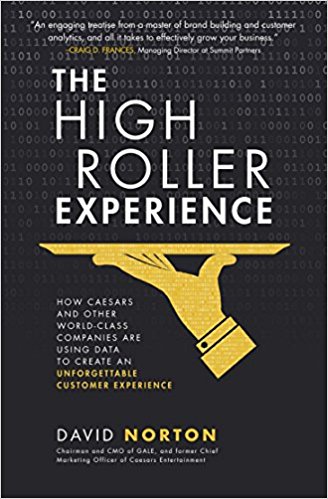
A new book from David Norton does a wonderful job of showing how to build a great rewards program (as well as other initiatives I will write about later), The High Roller Experience. Norton is the former CMO at Harrah’s (Caesars) and created its Total Rewards program, probably the most successful program in the casino space, so he knows what he is talking about.
High roller

While the value in building a rewards program is largely unquestioned, the challenge is underestimated. Norton points out that customers are on average in 18 loyalty programs, but only actively engage with about a third of them. This lack of use means that not only are companies wasting millions of dollars on programs by rewarding customers who do not value the rewards but actually incur a higher opportunity cost by not engaging many of their customers. These unengaged customers could potentially have a huge financial impact on the company. Norton points out several keys to building a successful loyalty program.

Make the currency bankable and under the customer’s control

A successful rewards program starts with bankable currency. The rewards system should create a currency that customers save up across multiple session, visits, applications, etc. and use however they want. For online and real money casinos, this currency represents a big shift, as compensation to high rollers is often subjective and disproportionally allocated to the most vocal customers. You should allocate a majority of your rewards/compensation budget to a points based program (Norton mentions Harrahs/Caesars put 80% of their $350 million budget to Total Rewards) that customers understand and control.

An effective program then allows customers to use the bankable currency the way they want to use it, so they get the most possible value (to them) out of the program. At Harrahs, the marketing around their Total Rewards program was “MORE”: more control for the customers, meaning they could use their comps for a broader variety of things than food— and could use them in more locations. To drive this point to customers, Harrahs supported the launch of the second iteration of Total Rewards with an advertising campaign that it called the 100 Million Reward Credit Giveaway with a broad set of prizes that were reflective of what was available in the program, including merchandise and experiences at its properties such as Jazz Fest in New Orleans or lift tickets at Heavenly in Lake Tahoe. This campaign showed all the different ways customers could potentially use their points.

Get customers engaged

If customers are not engaged with your loyalty program, nothing else matters. You can have the best loyalty program on paper, but you need to get your customers to engage. Given how many loyalty programs they are already members of; you must find ways to ensure they are interacting with yours. Harrah’s discovered that guest satisfaction with Total Rewards was much lower for those customers that had not yet redeemed any of their Reward Credits, the theory being that they had yet to have a positive experience with the program’s new currency.

To get customers more engaged and likely to redeem, you need to eliminate friction in the customer experience when customers interact with your loyalty program. Rather than having hurdles to redemption (which may save you funds in the short term), make the experience quick and easy. Also, promote as Harrah’s did the different rewards players can earn and notify those players who have outstanding points of the options they have. Get them to redeem and enjoy the benefits of your program.

Create multiple tiers

The next key to a successful loyalty program is multiple tiers. Tiers create aspiration and engender loyalty. Compelling tiers are a productive way to create aspiration from customers and have them give you more share of their spend.

With multiple tiers, you can maximize the return on rewards by providing the most to customers where you have the greatest opportunity to increase their lifetime value. Tiers must be meaningfully differentiated.; having meaningful differences in the benefits and services between tiers is critical.

The rewards spend also should be surgical, tied to incremental spend and behaviors, as opposed to programmatic, associated with purchases the customer would have given you anyway.

You also need to provide always aspirational tiers. People want to advance, make progress, so there must be a tier for them to strive for. Although you may not want to market the tier formally (you do not want to alienate other high tier players) but you do need to let your top customers know there is even a higher tier (possibly through your VIP hosts or targeted social media). I remember speaking to a VIP several years ago, one of our top spenders, and his biggest complaint was he was already on the highest tier so why keep playing (regardless of the fun in product and the benefits he was accruing).

Have aspirational levels

As just discussed, you should also ensure there are aspirational benefits in the highest tiers. These tiers provide benefits, experiences, and services that customers value, often more than points, and are a key part of successful loyalty programs. If developed properly, the cost to deliver differentiated benefits will not be directly correlated to the customer’s spend.

At Harrahs, one of the key changes they made to the Total Rewards program was adding the Seven Stars tier in mid-2004. According to Norton, “there were several reasons that led us to want to add a tier at the extreme high end of our customer distribution. First, we discovered that we were capturing only a 50 percent share from our Diamond customers, as many of them were trying to achieve the equivalent tier at a competitor much like a business traveler in some markets tries to achieve status in two airline programs to provide more choices to be upgraded when flying. We wanted to make the decision more difficult to try to attain a high status at a competitor. Second, we found that for our top 5,000 out of 10 million customers, there was significant revenue churn year to year at an individual level. That is one year a customer would spend $85,000 and the next $70,000. Given that this group was spending or losing $80,000 a year with us, a 20 + percent revenue drop from a quarter of them was significant. We realized that some of this drop was a matter of having less time or disposable income to gamble in a given year, but we also felt that a big reason for the variation year to year was that there was no transparent goal to attain.“ These reasons drove development of an ultra-exclusive tier for Harrah’s most valuable customers.

Differentiate service to loyal customers

The next key to a successful loyalty program is differentiating the services customers experience. If built properly, the perceived value of premium service is much higher than the actual cost of delivering the service. The additional revenue the special services creates will not be linear to the additional revenue it generates.

By providing unique and better services as customers move up tiers, your loyalty program will have a stronger impact. Norton points out “airline programs do this very well with their tier benefits such as early boarding, the chance to be upgraded, and shorter security lines that enhance the travel experience. A mix of service items and access to unique “priceless” experiences should be developed as part of a three- to four-tier program depending on the size and distribution of the database. “

There are several ways this can be achieved in games. You can provide players with early access or unique content, allow them to attend VIP experiences (visits to your office or special events) or even provide special badges.

Transparency is important

For the loyalty program to have its strongest impact, particularly driving customers to try to move up tiers, you need to be transparent. Let your customers check their status where and how they want to: online, on a mobile site or in an app. Wherever they see their status, also remind them of what they need to do to attain or retain a status, especially as the earning time frame approaches its end.

So is profitability

While it is important to be transparent, the key is to build a program that increases profitability. Norton points out that “While there is a need to have an earning process that is easily understood to members, points earning should be tied to profitability and, ideally, to incremental behavior even though it adds a level of complexity.” In the case of Harrah’s, customers earned points tied to how much profit (not simply revenue) they generated. If they played slot machines that had a lower return to player than other slots, they would earn more rewards for playing those slots.

This approach also allows you to drive behavior that in the long-term is strategically beneficial. If you are launching a new business or game, you can provide extra points for consuming the new product. This provides a more cost effective way of launching a new business or testing a new game.

While it is hard to convey to players how exactly they are earning points, Total Rewards overcame this problem by clearly showing players the rewards they had and what they just earned. The additional benefit from this approach is that players who are rewards driven learn what activity generates the most points and then focus on that activity. If the activity also generates the most profits, then that is exactly the outcome you want.

Downgrade status

Another hotly debated topic is whether you should downgrade status or if customers who earn a high status keep it for a lifetime. I have been in many “debates” about this point, with the argument for status being permanent being that you do not want to insult a top customer or give them a reason to move to a competitor (because their status has been downgraded). Norton, however, makes a compelling case that status should be earned on an annual basis.

First, the desire to maintain or increase status is compelling, and often drives the behavior you want at the end of the status period. Second, it separates customers who will spend at a low level regardless of whether there is a loyalty program, so you do not waste resources on rewarding players who do not value the rewards.

Start with less

When you are building and rolling out your rewards program, it is best to start with the minimum viable product. You can (and should) always add features and benefits but it is very challenging to take away something once you give it to a customer. Launch with a small number of meaningful components that you can execute and that customers can understand, but realize it is always better to add elements than it is to have to take them away.

Monitor and model rigorously

Loyalty programs can have a great impact on customer behavior but also a great cost. Successful programs require rigorous financial analysis that includes models of customer behavior. The key is to understand the incremental behavior the program generates against the costs of the program for each customer segment. The more granularity you build into the segmentation, the easier to optimize as you can discontinue rewards to segments where there is not a positive ROI, change the mix to segments where there is a low ROI and accelerate efforts where you see a strong ROI.

Innovate and iterate

You can always improve your reward program. Even if you do everything right at launch, your customers are unique and different elements of the program will resonate more with customers. You need to identify those elements and build off of that, as competitors will always be launching new loyalty initiatives to win over your customers. Even with Harrah’s Total Rewards, Norton writes, “despite our many accolades, we at Caesars never stopped evolving, testing, and tinkering with Total Rewards, making it great for customers, but also for us.“

Integrate rewards and CRM

The final, but possibly most important, key to a successful rewards program is integrating it with your CRM. Loyalty schemes and CRM should work together to drive optimal customer behavior. Tiers in loyalty programs provide the clear goals that encourage loyalty, and CRM activities give incentive in between the tier hurdles. Additionally, the loyalty program provides great insights into customer behavior. It shows you where they spend their time and what their aspirations are. You can then feed this information back into all of your CRM campaigns to ensure they have the greatest impact.

Do it, but do it right

To succeed today, you have to have a loyalty program and that needs to be your first priority. Just having one, however, does not ensure success. Most people are in many loyalty programs but only a few influence their behavior. For you to have a truly effective one and get a strong return from it, you need to follow the steps above.

Key takeaways

  1. Service benefits are an economical way to add real value. Creating compelling differentiated benefits and experiences is a very economical way to add value to a loyalty program and deepen relationships with customers.
  2. Successful loyalty programs require rigorous financial analysis that includes models of customer behavior so you can understand the incremental performance for each customer segment.
  3. Great loyalty programs are integrated with your CRM. Loyalty schemes and CRM should work together to drive optimal customer behavior.
Share this:

  • Click to share on Facebook (Opens in new window) Facebook
  • Click to share on LinkedIn (Opens in new window) LinkedIn
Like Loading...
Unknown's avatarAuthor Lloyd MelnickPosted on January 30, 2018January 14, 2018Categories General Social Games Business, General Tech Business, Lloyd's favorite posts, Social CasinoTags brand loyalty, David Norton, High Roller Experience, loyalty, vip, VIPs2 Comments on The secrets to creating a top VIP (high roller) rewards initiative

Why people gamble, and pay real money to play social casino games

When I accepted my first job in the social casino (free to play slot machines) space, I did not understand fully (or believe) why anyone would pay to play a casino game (slots, poker, bingo, etc.) if they could not win money. After all, people gambled to win money, or so I thought. It was, however, difficult to argue with the data that showed social casino consistently the most profitable genre in social and mobile gaming. Moreover, I also did not fully understand why people would spend real money for a virtual good (i.e. a virtual tractor) and assumed the two must be related.

Those questions prompted me to do research before starting my position in the social casino, which led to my blog post Why would anyone buy a virtual good? . The post also included information that people gamble for three reasons – economic, symbolic and pleasure-seeking – and only one of them was tied to making money.

Recently, I came across an article, Segmenting slot machine players: a factor-cluster analysis by Sandy Chen, Stowe Shoemaker and Dina Marie Zemke, that provides even more insight into why people would spend money on a social casino game. While the research was about real money slots players, it shows their motivations are often non-financial; that is they are not playing to make money.

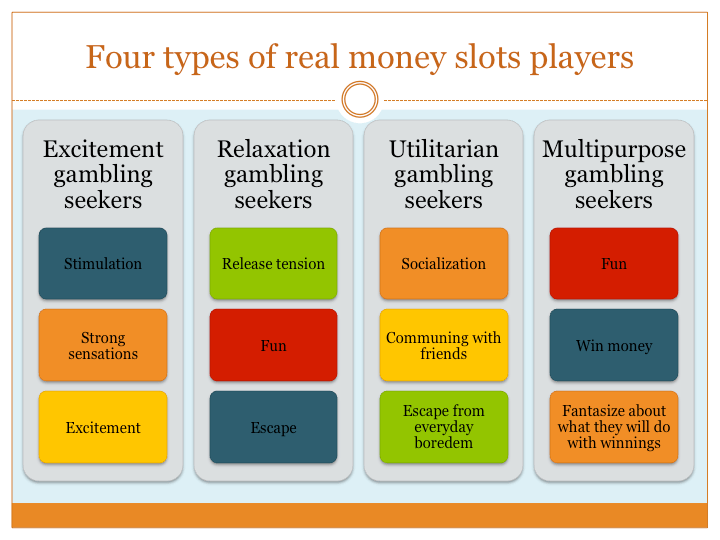
Chen, Shoemaker and Zemke segmented slots players into four clusters based on five sets of factors, and by looking at each cluster it provides a good understanding of the people who play and monetize on social slots products. The five factors are ego-driven, learning, relaxation, excitement and financial rewards. Based on how players ranked the various factors, the authors were able to create four distinct clusters that show different types of players. Below, I recap the four clusters, which you can then use to make your products and marketing better fit for your target customers.

Slide1

The “excitement gambling seekers” cluster

Players who are excitement gambling seekers are playing for the stimulation. Their primary motivation is the strong sensations they experience while playing, the positive memories from winning moments and the thrill of winning or losing. Excitement seekers were the largest cluster of slots players (27.5%) in the research.

The key takeaway about this cluster is they are not playing to win or make money, they are playing for the same reason someone rides a roller coaster, excitement.

The “relaxation gambling seekers” cluster

These customers are playing slots to escape. Their key motivation is to release tension and because the game is fun. They will often credit slots as the best way to relax completely. This cluster is more interested in the experience of playing rather than focusing on winning. This is has more men than women (51.5% to 49.5% respectively). 25.5 percent of slots players make up this cluster.

The key takeaway with this cluster is that they are playing largely for the same reason someone goes to the cinema or reads a book, to relax and escape. As with the excitement cluster, they are not looking for financial rewards.

The “utilitarian gambling seekers” cluster

These are players who play as a means of socialization, communing with friends or as an escape from everyday boredom. It is referred to as utilitarian because the purpose is functional (utilitarian) and players gamble to satisfy experiential motives. About 20 percent of the players sampled fell into this cluster (which was also the oldest group).

These players place little value in some of the features many social casinos focus on. They do not care about themes or progressive jackpots. One of their most important considerations is the minimum bet of the slot machines.

Earlier this month, I wrote about Robert Thaler’s work on behavioural economics, including his theory regarding mental accounting. Mental accounting is a psychological theory of how limited cognition affects spending, saving, and other household behavior. In particular, people group their expenditures into different categories (housing, food, clothes, etc.), with each category corresponding to a separate mental account. Each account has its own budget and its own separate reference point, which results in restricted movement between the accounts. When integrated with the research of Chen, Shoemaker and Zemke, mental accounting explains how people have a set sum to spend on slots and will chose the purchase that allows them to optimize use of those funds.

The “multipurpose gambling seekers” cluster

The multi-purpose cluster, as its name suggests, play for several reasons. Players in this cluster play because slots are fun but also because there is a good chance to win and it is in their budget. These are players who think (fantasize) about what they will do with their winnings and want to make a lot of money. These players normally do not care about themes around games. About 27 percent of slots players are in the multipurpose cluster.

The takeaway with this cluster is that it combines a desire to win money with the entertainment value of playing. These are the players who might seek a real money alternative when it is available but play free to play (social) slots if they are in a location where they do not have access to real money.

How men and women differ

One other interesting insight in this research is the difference between male and female slots players. Many female players were excitement gambling seekers or utilitarian gambling seekers, while male players were relaxation or multipurpose gambling seekers. Thus, if you target different genders, your messaging and promotions should apply to what they are more likely to find important.

Remember these are real money players

The most important takeaway from the above cluster analysis is that it was done with real money land based slots players, not social players. This is critical because even people gambling in the traditional sense are largely not gambling to make money but for excitement, relaxation, etc. Once their motivations are understood, it is obvious why people would spend to play slot machines where the real money opportunity does not exist. As the authors write, “American slot players were mainly motivated by hedonic and experiential motives…gambling is a type of recreation or entertainment in America.” Hence, why social casino is such a strong and growing genre.

Key takeaways

  1. Research shows that there are four types of slots players, with each group having different motivations.
  2. Three of the four groups are driven by non-economic reasons (excitement, relaxation, fun, etc.) to play slots, thus they get the same satisfaction from social casino products that they get from playing real money slots.
  3. Gambling is primarily recreation and entertainment in the US.

Share this:

  • Click to share on Facebook (Opens in new window) Facebook
  • Click to share on LinkedIn (Opens in new window) LinkedIn
Like Loading...
Unknown's avatarAuthor Lloyd MelnickPosted on January 23, 2018January 14, 2018Categories General Social Games Business, Growth, Lloyd's favorite posts, Social CasinoTags excitement, gambling, online gambling, real money online gambling, relaxation, slots, social casino6 Comments on Why people gamble, and pay real money to play social casino games

The good and the bad from Aristocrat’s 2017 acquisitions

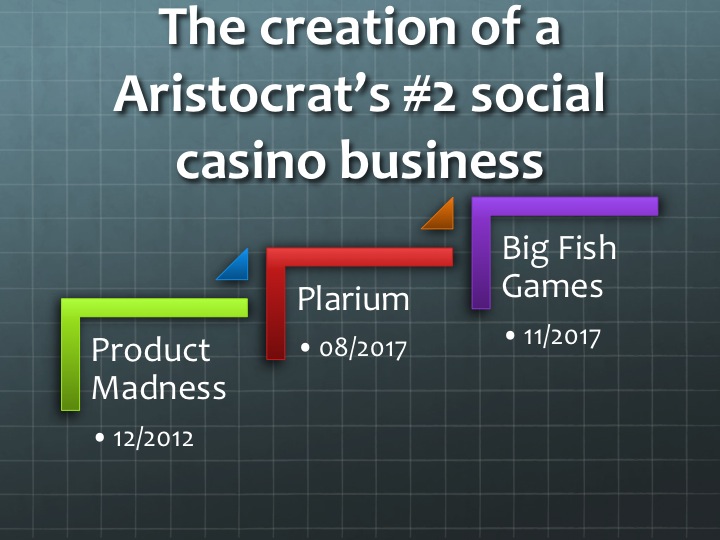
Last year, one company, Aristocrat, made two of the largest moves in the social casino space. In August, Aristocrat announced it was acquiring Plarium for $500 million. It followed up that transaction by acquiring Big Fish Games from Churchill Downs in November for almost $1 billion. While there were other deals in the space last year, these two showed Aristocrat’s intention to try to dominate the space. While one of these transactions was very savvy, the other is one they are likely to regret.

Slide1

I have been through many mergers and acquisitions, including several at the company that is probably the best at integrating new businesses, Disney, and there are two hallmarks to successful M&A (mergers and acquisition).

  1. The first key is that at least one of the parties adds value to the other party. The company that is being acquired could have a technology or expertise that makes the acquiring company more valuable. An example would be Google’s acquisition of DeepMind. Post acquisition, DeepMind was able to accelerate Google’s own AI efforts as well as potentially improve its search technology. The other type of benefit is where the acquiring company adds value to the company it acquires, either through tech, expertise or channels. An example here would be Disney’s acquisition of Marvel, where it used its superior film making skills to help Marvel separate its movie business from competitor DC Comics, owned by Warner Brothers.
  2. The second key to a successful acquisition is that the rationale is the combined business is more than the sum of its parts. An acquisition is not likely to generate long-term value if it is only meant to make a company bigger. If the number two company in a space buys the number three company it may become number one but that is not a real financial benefit (unless it paid below market price), the return on capital is likely to remain unchanged. Only if the combination makes the new entity more efficient does it generate a market return above a traditional investment.

As with all rules, there are exceptions. Private equity (PE) companies consistently have a strong return on investment by acquiring companies whose value can be increased by making them more efficient either organically or via combining them with other businesses. Even in these situations, however, the PE companies are actually adding value because they have an expertise in efficiency or an ability to acquire financing at a lower cost.

Looking through the lens of increasing value for one or both parties in an acquisition, it becomes much clearer where Aristocrat got it right and where it is likely to fail.

Big Fish Games

The Big Fish acquisition was a master stroke by Aristocrat. Big Fish, whose crown jewel is the Big Fish social casino app, has been one of the leaders in the social casino space for more than five years. In 2014, Churchill Downs acquired Big Fish for $885 million, hoping to grow the business even further. This was a case of not adding any value, however, as Big Fish did not boost Churchill’s core business and they were not able to help Big Fish grow.

Big Fish traditionally succeeded in the social casino space by layering true social features on a average to below average slots and casino product. The social features both kept core players engaged and drove high revenue from players, especially VIPs. Big Fish Casino was consistently in the top 5 percent of monetization, generating over $0.80 in ARPDAU, more than twice many of its competitors. Big Fish, however, has largely stagnated the last couple of years under Churchill’s ownership as other companies, such as Huuuge Games, have replicated the social features leaving Big Fish’s lower quality casino offering a liability.

Aristocrat, meanwhile, has grown from a major land-based slots developer to one of the top-five social casino companies. Combining its Product Madness social slots business (acquired in 2012) with their land based real money content, they have gone from an afterthought to a top social slots company. It’s Heart of Vegas title is consistently among the top-5 grossing title, often number one, and they dominate the world’s second largest social casino market, Australia.

By acquiring Big Fish, Aristocrat is likely to improve both the Big Fish business and its internal social casino efforts. Big Fish will benefit from access to Aristocrat’s land based slots content, eliminating its greatest weakness (mediocre slots). Big Fish should also gain market share in Australia, given Aristocrat’s dominant position there.

Conversely, Aristocrat will grow its core social business (Product Madness) by understanding how to bring the most valuable social features to social casino. These features have driven revenue for Big Fish (and competitors like Huuuge) but they are a challenge to implement. Big Fish’s expertise with social features is likely to improve the core Aristocrat social casino products.

Plarium

The Plarium story is not likely to have as happy an ending. While Plarium is a very competent mid-core game company (with great games like Vikings) and Aristocrat is a great social casino company, there are few areas they can help each other. Plarium’s games appeal to a younger, male demographic while Aristocrat’s social casino (and land based) products appeal to older (55+) women. This is an awful starting point for cooperation. Few of Plarium’s players are likely to be interested in social casino games, and those who do are even less likely to be VIPs. Conversely, a social slots player is not likely to be interested in a mid-core combat game. Additionally, the product features that work in a combat game like Vikings will not be transferable to the social casino business while Plarium will learn very little from Aristocrat’s product management.

The best case for Aristocrat is that Plarium continues to grow its revenue and contribution and proves to be a sound financial decision. I say best case as the acquisition needs to be compared to any other investment since it will not improve the core business. The reality is most acquisitions fail and as Aristocrat is not adding any value to Plarium; for it to have a positive ROI simply in financial terms they need to have seen a better value opportunity than anyone else. Given the cost of the acquisition, I would not bet on it.

The Future

2018 will bring more deals in the social casino space, it’s not a prediction but an extrapolation of the past eight years. The deals that will be successful long-term are the ones that are symbiotic, where one of both companies brings additional value to the combined entity.

Key takeaways


  • Successful mergers or acquisitions are ones where at least one of the companies also improves the other company, not simply adding together financial results.
  • Aristocrat’s acquisition of Big Fish is likely to be a successful acquisition, as Aristocrat can share its great real money slots content with Big Fish and Big Fish can provide its expertise in creating social features.
  • Aristocrat’s acquisition of Plarium is less likely to end up a success, as they have completely different player bases and there is little opportunity for cross over.


Share this:

  • Click to share on Facebook (Opens in new window) Facebook
  • Click to share on LinkedIn (Opens in new window) LinkedIn
Like Loading...
Unknown's avatarAuthor Lloyd MelnickPosted on January 16, 2018December 31, 2017Categories General Social Games Business, Social CasinoTags Aristocrat, Big Fish Games, Churchill Downs, Mergers and Acquisition, PlariumLeave a comment on The good and the bad from Aristocrat’s 2017 acquisitions

What the Nobel Prize in Economics means for social gaming

In 2017, Richard Thaler won the Nobel Prize in Economic Science, and it validated one of the areas that could benefit social game companies highly. Thaler is one of the leaders in Behavioral Economics, where Daniel Kahneman previously won a Nobel Prize and the field Dan Ariely popularized in books including Predictably Irrational. The underlying idea in Behavioral Economics is that people do not always act rationally but their irrationally is consistent and can be modeled.


Nobel prize

In traditional economics, economists make simplifying assumptions, with one of the most common being that people are perfectly rational. This simplification allows economists to build powerful models to analyze a multitude of different economic issues and markets. Nevertheless, economists and psychologists have documented systematic deviations from the rational behavior assumed in standard economics. By incorporating new insights from human psychology into economic analysis, Thaler provided a valuable set of analytical and experimental tools for understanding and predicting human behavior.

Many of the concepts and findings that Thaler identified are particularly relevant for game companies, particularly free-to-play gaming, and the broader technology space. By reviewing his primary findings, you can make your products more appealing and successful.

Endowment effect

The endowment effect is how people value items they own more than they would if they objectively viewed the item. Somebody might not accept $10,000 for their used car, but if a car dealer offered the same car to them they would not pay $8,000 for it. This leads to sub-optimal solutions but is also a tool for keeping people engaged with your product, potentially by giving them something they may lose if they do not remain active.

Thaler also showed that the endowment effect implies a difference between out-of-pocket costs and opportunity costs. People tend to view out-of-pocket costs as losses, weighted more heavily, while opportunity costs are considered foregone gains, weighted less heavily.

Mental accounting

Mental accounting is a psychological theory of how limited cognition affects spending, saving, and other household behavior. One motivation driven by mental accounting is that people group their expenditures into different categories (housing, food, clothes, etc.), with each category corresponding to a separate mental account. Thaler found that mental accounts are used more generally as a way for rational individuals to simplify their financial decision-making. Each account has its own budget and its own separate reference point, which results in restricted movement between the accounts.

In addition, advance purchases (e.g., buying a billion chips) are typically thought of as investments rather than purchases. At the same time, consumption of a good purchased earlier and used as planned (using the chips you bought last week for a new virtual item when it is released) is often coded as “free,” or even as savings. Decoupling spending and consumption in this way reduces the pain of buying.

Mental accounting is potentially important in three ways to social game companies. First, players might group their purchases by different areas, they may be willing to spend X for chips and Y for new content. Second, customers may have a total budget for social gaming and your priority is getting a larger share of the pie rather than increasing the pie. Finally, by getting people to purchase a large amount at once and then use it over time, they are less likely to feel pain from their consumption.

Diminishing sensitivity

Thaler’s theory of diminishing sensitivity predicts that compound outcomes will be added together or separated before being evaluated. If customers try to edit outcomes to maximize their pleasure, they will try to segregate gains and integrate losses, to cancel small losses against larger gains, and (under some conditions) to segregate small gains (“silver linings”) from large losses. This is particularly relevant when structuring the pay-outs and volatility of social casino offierings.

Planner-doer model

In the planner-doer model, an individual is assumed to be both a narrow-minded doer, who evaluates options just for their current value, and a farsighted planner, who is concerned with lifetime utility. By appealing to both the planner and the doer, you can increase long term engagement of customers.

Social preferences

Perceived fairness is a strong determinant of behavior. People are more likely to accept a price increase if they feel the company needs to in order to remain profitable or to keep employees. People, however, feel it is unfair to increase prices due to rising demand. People who think they are being treated unfairly are likely to look for alternative products. This is particularly a problem in the digital world, where customers face different prices and AB tests and often consider it unfair that other players are getting a better value.

Further reading required

Since I have not earned a Nobel Prize (yet), I recommend you read Thaler’s work directly, including his book Nudge. There are many lessons that will make you both more effective individually and potentially make your products perform better.

Key takeaways

  • Richard Thaler won the Nobel Prize for Economics last year, by showing that people do not always act rationally but their irrationally is consistent and can be modeled
  • One of the key theories Thaler drove was the Endowment Effect, where people value goods they own more than the same good objectively.
  • His insights into mental accounting are also quite useful, as Thaler demonstrates that people bucket goods into different categories and have budgets for each category. Related, they treat advance purchases differently, looking at consumption as consumption of a free good rather than spending money.

Share this:

  • Click to share on Facebook (Opens in new window) Facebook
  • Click to share on LinkedIn (Opens in new window) LinkedIn
Like Loading...
Unknown's avatarAuthor Lloyd MelnickPosted on January 9, 2018December 31, 2017Categories General Social Games Business, General Tech BusinessTags behavioral economics, diminishing sensitivity, endowment effect, mental accounting, planner-doer model, Richard Thaler, social preferences4 Comments on What the Nobel Prize in Economics means for social gaming

Posts pagination

Previous page Page 1 … Page 10 Page 11 Page 12 … Page 46 Next page

Get my book on LTV

The definitive book on customer lifetime value, Understanding the Predictable, is now available in both print and Kindle formats on Amazon.

Understanding the Predictable delves into the world of Customer Lifetime Value (LTV), a metric that shows how much each customer is worth to your business. By understanding this metric, you can predict how changes to your product will impact the value of each customer. You will also learn how to apply this simple yet powerful method of predictive analytics to optimize your marketing and user acquisition.

For more information, click here

Follow The Business of Social Games and Casino on WordPress.com

Enter your email address to follow this blog and receive notifications of new posts by email.

Join 791 other subscribers

Most Recent Posts

  • Join me at PDMA Inspire for my talk on new product prioritization
  • Why keep studying?
  • The next three years of this blog
  • Interview with the CEO of Murka on the biggest growth opportunity in gaming, Barak David

Lloyd Melnick

This is Lloyd Melnick’s personal blog.  All views and opinions expressed on this website are mine alone and do not represent those of people, institutions or organizations that I may or may not be associated with in professional or personal capacity.

I am a serial builder of businesses (senior leadership on three exits worth over $700 million), successful in big (Disney, Stars Group/PokerStars, Zynga) and small companies (Merscom, Spooky Cool Labs) with over 20 years experience in the gaming and casino space.  Currently, I am the GM of VGW’s Chumba Casino and on the Board of Directors of Murka Games and Luckbox.

Topic Areas

  • Analytics (114)
  • Bayes' Theorem (8)
  • behavioral economics (8)
  • blue ocean strategy (14)
  • Crowdfunding (4)
  • DBA (2)
  • General Social Games Business (459)
  • General Tech Business (195)
  • Growth (88)
  • International Issues with Social Games (50)
  • Lloyd's favorite posts (101)
  • LTV (54)
  • Machine Learning (10)
  • Metaverse (1)
  • Mobile Platforms (37)
  • Prioritization (1)
  • Social Casino (52)
  • Social Games Marketing (105)
  • thinking fast and slow (5)
  • Uncategorized (33)

Social

  • View CasualGame’s profile on Facebook
  • View @lloydmelnick’s profile on Twitter
  • View lloydmelnick’s profile on LinkedIn

RSS

RSS Feed RSS - Posts

RSS Feed RSS - Comments

Categories

  • Analytics (114)
  • Bayes' Theorem (8)
  • behavioral economics (8)
  • blue ocean strategy (14)
  • Crowdfunding (4)
  • DBA (2)
  • General Social Games Business (459)
  • General Tech Business (195)
  • Growth (88)
  • International Issues with Social Games (50)
  • Lloyd's favorite posts (101)
  • LTV (54)
  • Machine Learning (10)
  • Metaverse (1)
  • Mobile Platforms (37)
  • Prioritization (1)
  • Social Casino (52)
  • Social Games Marketing (105)
  • thinking fast and slow (5)
  • Uncategorized (33)

Archives

  • September 2023
  • December 2021
  • July 2021
  • March 2021
  • February 2021
  • January 2021
  • December 2020
  • November 2020
  • October 2020
  • September 2020
  • August 2020
  • July 2020
  • June 2020
  • May 2020
  • April 2020
  • March 2020
  • February 2020
  • January 2020
  • November 2019
  • October 2019
  • September 2019
  • June 2019
  • May 2019
  • April 2019
  • March 2019
  • February 2019
  • January 2019
  • December 2018
  • June 2018
  • May 2018
  • April 2018
  • March 2018
  • February 2018
  • January 2018
  • December 2017
  • June 2017
  • May 2017
  • April 2017
  • March 2017
  • February 2017
  • January 2017
  • December 2016
  • November 2016
  • October 2016
  • September 2016
  • June 2016
  • May 2016
  • April 2016
  • March 2016
  • February 2016
  • January 2016
  • December 2015
  • November 2015
  • October 2015
  • September 2015
  • July 2015
  • June 2015
  • May 2015
  • April 2015
  • March 2015
  • February 2015
  • January 2015
  • December 2014
  • November 2014
  • October 2014
  • September 2014
  • August 2014
  • July 2014
  • June 2014
  • May 2014
  • April 2014
  • March 2014
  • February 2014
  • January 2014
  • December 2013
  • November 2013
  • October 2013
  • September 2013
  • August 2013
  • July 2013
  • June 2013
  • May 2013
  • April 2013
  • March 2013
  • February 2013
  • January 2013
  • December 2012
  • November 2012
  • October 2012
  • September 2012
  • August 2012
  • July 2012
  • June 2012
  • May 2012
  • April 2012
  • March 2012
  • February 2012
  • January 2012
  • December 2011
  • November 2011
  • October 2011
  • September 2011
  • August 2011
  • July 2011
  • June 2011
  • May 2011
  • December 2010
January 2026
S M T W T F S
 123
45678910
11121314151617
18192021222324
25262728293031
« Sep    

by Lloyd Melnick

All posts by Lloyd Melnick unless specified otherwise
Google+

Enter your email address to subscribe to this blog and receive notifications of new posts by email.

Join 791 other subscribers
Follow Lloyd Melnick on Quora

RSS HBR Blog

  • What Actually Works to Change Someone’s Mind
  • Our Favorite Management Tips of 2025
  • How to Manage—and Motivate—Gen Z
  • The Most-Watched HBR Videos of 2025
  • The HBR Charts that Help Explain 2025
  • The Most Popular HBR Podcast Episodes of 2025
  • How the Best Leaders Develop and Spend “Innovation Capital”
  • The 10 Most Popular HBR Articles of 2025
  • How Work Changed in 2025, According to HBR Readers
  • What Leaders Can Learn from a Formula 1 Turnaround

RSS Techcrunch

  • An error has occurred; the feed is probably down. Try again later.

RSS MIT Sloan Management Review Blog

  • Calm: The Underrated Capability Every Leader Needs Now
  • The Top Five MIT SMR Videos of 2025
  • Three Steps Toward Fairer Talent Management
  • From Crisis to Coopetition: What Leaders Can Learn From Anesthesiologists
  • AI Coding Tools: The Productivity Trap Most Companies Miss
  • How Procter & Gamble Uses AI to Unlock New Insights From Data
  • Rewire Organizational Knowledge With GenAI
  • Hungry for Learning: Wendy’s Will Croushorn
  • Beat Burnout: 10 Essential MIT SMR Reads
  • How Leaders Stay True to Themselves and Their Stakeholders
The Business of Social Games and Casino Website Powered by WordPress.com.
  • Subscribe Subscribed
    • The Business of Social Games and Casino
    • Join 726 other subscribers
    • Already have a WordPress.com account? Log in now.
    • The Business of Social Games and Casino
    • Subscribe Subscribed
    • Sign up
    • Log in
    • Report this content
    • View site in Reader
    • Manage subscriptions
    • Collapse this bar
 

Loading Comments...
 

    %d