Skip to content

The Business of Social Games and Casino

How to succeed in the mobile game space by Lloyd Melnick

Category: General Social Games Business

Five Steps to Reduce Churn

I have wrote and spoken several times recently about how increasing user acquisition costs are impacting the social game industry, particularly social casino, and some strategies to offset and even capitalize on this trend. One of the best ways to combat this problem is to focus your resources on reducing churn rather than acquiring new users. As the cost of acquiring a user increases, the cost of replacing that user also increases. While companies devote ever larger budgets and build bigger teams for user acquisition, they fail to devote comparable resources to retaining the players they already have. Moreover, in the social casino space, players often play 3-5 apps, so the less they play your title, the more they are playing a competitor‘s slot.

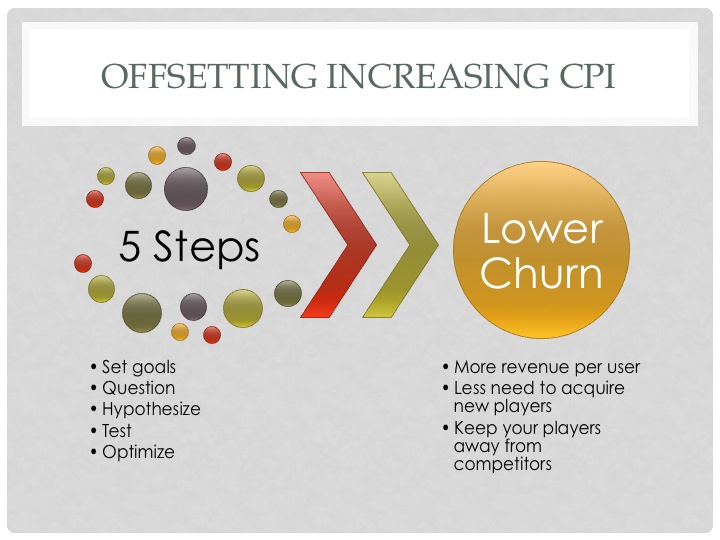
I recently came across a blog post, “How to reduce Churn by building a bulletproof retention process” by Andrew Tate, that lays out five ways that you can reduce churn. Tate starts with the example of Burbn, a Foursquare clone that had a huge churn issue. Using analytics, the team saw that users found it too complicated and were using the app to post pictures rather than check in. So they modified the app based on this data to reduce churn and renamed it Instagram. Let’s just say it worked out okay for the Burbn team. This example shows how a focus on reducing churn can be the difference between failure and billions.
Slide1

Focus on the small gains

The first step to combating churn is to take a lot of small steps rather than looking for the magic formula. One change or feature is not going to improve retention 50 percent. If you can reduce churn a few percent every build, you eventually will get negative churn rather than seeing your game lose all its users and revenue. Thus, it is more critical to build a process that always is working to reduce churn rather than fire off a churn reducing feature and then go on to your next KPI (key performance indicator).

Define goals

To create the process discussed above, you first need to set goals. As with all goals, they need to be measurable and clearly defined as well as time based. Reducing churn is not a goal, but reducing churn by 50 percent in three months is a goal. Then you should break this goal into sub-goals, with Tate suggesting

  • Reduce short-term churn by 20 percent
  • Reduce medium-term churn by 20 percent
  • Reduce long-term churn by 10 percent

With goals in place, you can track your progress as you create individual AB tests and set an end-point for the process. This technique aligns the entire team on a visible and understandable goal. Continue reading “Five Steps to Reduce Churn”
54.152337 -4.486123

Share this:

  • Click to share on Facebook (Opens in new window) Facebook
  • Click to share on LinkedIn (Opens in new window) LinkedIn
Like Loading...
Unknown's avatarAuthor Lloyd MelnickPosted on October 28, 2015May 1, 2021Categories General Social Games Business, General Tech Business, Growth, Social Games MarketingTags churn, CPI, user acquisition, user churnLeave a comment on Five Steps to Reduce Churn

Blue Ocean Opportunities in the Red Ocean of Social Casino

For those of you who were not at Casual Connect and missed my talk on Blue Ocean opportunities in social casino and why they are the best path forward, below is a copy of my deck. The key takeaways are

  1. Social casino is one of the bloodiest of red oceans, with excellent well-financed companies competing ferociously. The best path to success is to take a Blue Ocean approach.
  2. Blue Ocean is all about turning non-customers into customers, rather than competing for the same customer.
  3. You do this by looking at what you can remove from the existing product offering, what you can add, what you can increase and what you can reduce. This leads to a new offering that appeals to new users.

The full presentation can be seen here:

Like Loading...
Unknown's avatarAuthor Lloyd MelnickPosted on October 26, 2015April 11, 2020Categories blue ocean strategy, General Social Games Business, Growth, Lloyd's favorite postsTags blue ocean, Casual Connect, mobile, slots, social casino, social games, Strategy2 Comments on Blue Ocean Opportunities in the Red Ocean of Social Casino

Dawn of a new era of in-game advertising

Last week I wrote about the rising cost of paid user acquisition. this week I want to dive deeper into how advertising can help mitigate this issue. Ironically, my former employer, Zynga, made a creative move recently in this direction. Zynga announced SponsoredPLAY, an in-game advertising product where sponsors offer special content or levels that enhance rather than detract from gameplay. I do not know enough about the offering to comment on it directly but it shows how game companies need to think to thrive in the coming age of higher cost per installs.

Why advertising is the natural hedge

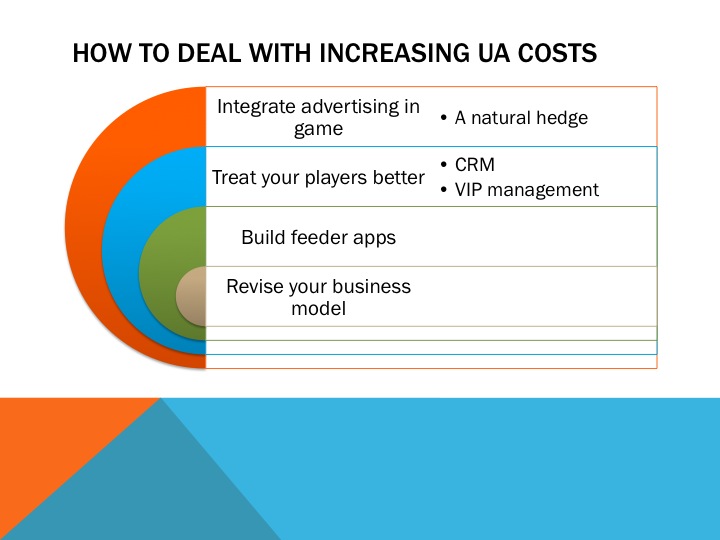
Last week I discussed the fundamentals of the paid user acquisition space and why it pointed to dramatically higher CPIs (cost per installs) in the near future. There are several options to cope with this situation but one of the strongest is to increase advertising revenue in your game. Once advertising becomes a significant component of your revenue mix, any increase your CPIs due to higher advertising rates should also generate additional ad revenue on the other side of the equation. The more CPIs increase, the more your ad revenue increases.

Advertising 2.0

Unfortunately, increasing advertising is not as easy as putting banner ads in your games. Last January I wrote how consumers are much savvier now and expect their communications with companies to be as smart and sophisticated as they are. The same holds true for advertising.

For advertising to work in 2015 and beyond, it must achieve certain functions that most ads do notSlide1

  • Targeted: The advertising should be relevant to the customer. A 50-year-old man should not see an ad for a Miley Cyrus concert.
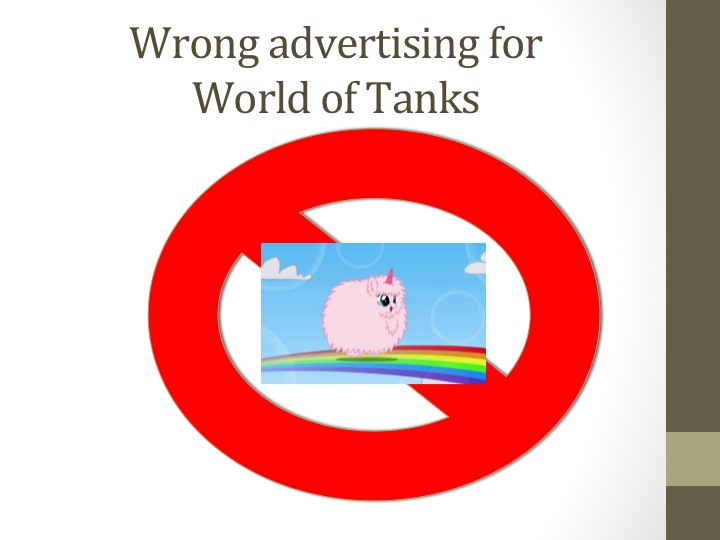
  • Contextual: The advertising should fit naturally with the overall game experience. You should not be playing Game of War and all of a sudden see an advertisement with pink fluffy unicorns dancing on rainbows.
  • Beneficial: Rather than having the advertising annoy the player, enhance their experience. Use it to deliver benefits that they would not normally receive.
  • Segment: You do not have to show ads to everyone. You may only want to show ads to non-spenders. If the ads are truly beneficial, you may actually want to show them more frequently to spenders. The important thing is to create as small clusters as possible and then create an advertising strategy that optimizes the value for that cluster (IAP [in-app purchases], subscription, advertisements).
  • Multiple formats: You should not limit your advertising strategy to one type of advertising, just as you would not limit your in-app purchases to only allowing players to buy chickens. Different types of ads will work in different parts of your game and some types will be more relevant to certain users. Use the full arsenal of advertising to optimize your player’s experience and the revenue they generate.
  • Flexibility: The digital marketing world is still in its infancy. Rather than have a laser focus on one ad unit or strategy, keep abreast of developments in the industry and continually evolve your strategy as best practices evolve.

Continue reading “Dawn of a new era of in-game advertising”

Share this:

  • Click to share on Facebook (Opens in new window) Facebook
  • Click to share on LinkedIn (Opens in new window) LinkedIn
Like Loading...
Unknown's avatarAuthor Lloyd MelnickPosted on October 21, 2015January 4, 2016Categories General Social Games Business, Social Games MarketingTags advertising, CPI, IAP, in-app purchases, in-game advertising, monetization, sponsored play, zynga1 Comment on Dawn of a new era of in-game advertising

Stop by my talks at Casual Connect

If you are attending Casual Connect next week, please stop by the panel I am on about user acquisition Monday morning at 11 or my talk about bringing Blue Ocean Strategy to social casinos Monday at 16:30 (4:30 PM for you Americans).  I look forward to seeing you there.

Casual-Connect-Tel-Aviv-2015

Share this:

  • Click to share on Facebook (Opens in new window) Facebook
  • Click to share on LinkedIn (Opens in new window) LinkedIn
Like Loading...
Unknown's avatarAuthor Lloyd MelnickPosted on October 15, 2015October 15, 2015Categories General Social Games Business, UncategorizedTags Casual Connect, Lloyd Melnick, Tel AvivLeave a comment on Stop by my talks at Casual Connect

Why your business model should not rely solely on in-app purchases

I have seen many disparate data points recently that when looked at holistically show how the free to play business model needs to evolve from relying on in-app purchases. While previously a strong in-game economy that generated significant revenue from in-app purchases was sufficient to create large profits for successful games, changes in the economics of the industry suggest in-app purchases will not be enough to support even successful games. The obvious answer is the advertising model, but even this model needs evolution to keep up with the times.

The data points

There are multiple data points that suggest CPIs (cost-per-installs) for performance marketing are not only increasing, but are likely to increase at the rate where they will surpass the lifetime value of acquired users for most games.

More apps, more spend

Slide1Most of the major game publishers are planning to grow through the launch of multiple new apps, particularly in the social casino space (where user acquisition costs are already high). While speaking colleagues recently, I learned that two of the major social slot companies have three new SKUs each planned for 2016, with planned spend of over $250,000 per day for each company already budgeted. They also expect their major competitors to each launch 1-2 new SKUs next year (and all in the first half of next year).

CPIs are simply a matter of supply and demand, and given that the advertising inventory is not increasing, it is inevitable that the cost of installs will increase. Even if the new apps are not targeted in your space, there is a limited number of people who will download a game and these companies will start to target your potential customers also because they will dry up their demographic.

Companies scapegoating user acquisition teams and agencies

The second data point is how many companies, including some of the biggest in the space, are replacing the leadership of their UA (user acquisition) teams and firing UA agencies they have worked with for several years. Many people I know have recently been approached for senior UA positions, and many of these people do not have significant UA experience. What is occurring is publishers are seeing a lower return on their advertising investment, or a negative return, and believe the problem is their UA team or advertising agency. Continue reading “Why your business model should not rely solely on in-app purchases”

Like Loading...
Unknown's avatarAuthor Lloyd MelnickPosted on October 14, 2015January 4, 2016Categories General Social Games Business, Growth, Lloyd's favorite posts, LTV, Social Games MarketingTags advertising, in-app purchases, LTV, UA, user acquisition2 Comments on Why your business model should not rely solely on in-app purchases

Why gamification usually sucks

Companies from outside the game industry often envy our industry and try to replicate our practices to improve their profitability. They often refer to this practice as “Gamification,” presumably making products like waste removal as entertaining as games. At the end of the day, they usually fail miserably but never understand why. The reason why they fail, though, is that these companies are gaining the wrong lessons from the game industry.

Slide1

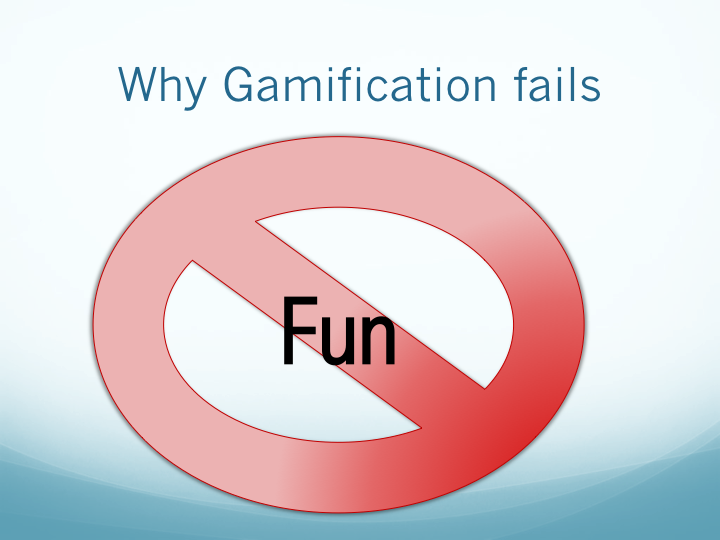
Games, almost by definition, are an entertainment industry. People play games because they are fun. The problem is people do not take out the trash or stop smoking because it is fun. And you don’t make these activities fun by “gamifying” them.

For most of these companies, they are not really looking at trying to create an entertainment product, they are actually trying to manipulate customers. They understand how games can be habit forming, to use the terminology of Nir Eyal in Hooked, but most of the companies are actually hoping to create an unhealthy addiction.

Many outside the industry, and some unfortunately inside the industry, believe people play games only due to the retention and monetization mechanics. It’s the simplification of games, referring to them as Skinner boxes, that lead people down the wrong path.

The companies that feel games are about manipulation are not successful when they try to apply game mechanics. The problem occurs because successful games are not successful due to manipulation. They are successful because users get an entertainment value. Sometimes these techniques do enhance monetization or retention to the detriment of gameplay, though in those cases the game normally implodes, but if the person is not having fun in the game they will not come back or spend money. Even the game companies that do not realize the goal is for the player to have fun also fail, you can’t succeed by tricking players.

The gamification problem

And that is the problem with gamification; the goal is usually manipulation and not entertainment. They are trying to turn something that is not fun into something that people will use more often or spend more money on by adding leaderboards or spoilage or a collection mechanic. None of these things create fun, and the gamification fails.

Like Loading...
Unknown's avatarAuthor Lloyd MelnickPosted on October 7, 2015January 4, 2016Categories General Social Games Business, General Tech BusinessTags fun, gamification1 Comment on Why gamification usually sucks

More discounts, less fees

Slide1Having traveled a lot recently, I noticed a phenomenon that presents opportunities to all companies. When companies or industries introduce new charges or fees, customers rebel. Examples include baggage and change fees by airlines and overdraft fees by banks. Customers react by switching if they have options (some industries have such fees across the industry), decreasing loyalty or just consuming less of the product. It is not a surprise that airlines are beset with bankruptcies and banks are much less profitable than in the past (hence the need for bailouts).

While most of those industries argue the fees are essential for profitability, there is another option. Rather than frame the charge as a fee, increase the overall price and provide incentives for the user to get a discount. Rather than charge a fee for maid service, some hotels now give customers a credit or loyalty points for waiving the maid service. Rather than being upset that they are being charged for maid service, the customer is happy that they just received a $5 credit for not having their bed made. I am sure this $5 is included in the cost of the room but the customer leaves with a better impression of the hotel than if they had been charged a fee.

There is an argument that people will select the lowest cost provider regardless, and if the fee is built into the price the customer will go elsewhere, but Southwest Airlines proves this argument does not have much validity. Southwest is one of the few US airlines not to charge for baggage (and thus probably adds the cost to the ticket price), yet Southwest is the only airline to be profitable since 1971. Customers are savvy and those companies that are condescending towards them pay the price in the long-run.

What this means to you

If you do not run an airline or hotel, you may think that there is no way to apply this understanding but that is not the case. It applies to virtually any business, particularly e-commerce. Rather than charging for overnight shipping, offer free shipping but give customers a discount if they accept standard delivery. If you have a free-to-play game, rather than charging users extra if they are not VIPs, give a discount if they join your loyalty program. The key is turn your pricing into something that enhances the customer experience.

Like Loading...
Unknown's avatarAuthor Lloyd MelnickPosted on September 30, 2015January 4, 2016Categories General Social Games Business, General Tech Business, Lloyd's favorite posts, Social Games MarketingTags discounts, fees, monetization, pricingLeave a comment on More discounts, less fees

Why you should not focus just on existing players or customers

Many companies, especially game companies, build out their products based on how early customers like the product but this approach can inhibit growth. An article in the Harvard Business Review, “Focus On the Customers You Want, Not the Ones You Have” by JP Eggers, shows that the hard part in creating a successful product or game is not appealing to users early but sustaining.

The problem with early users

CustomersEarly players are by definition early adapters. They probably have a higher preference for innovation and are more likely to take risks. They may have different ways of making decisions, including whether they monetize in a game, if they invite friends or if they come back. An early player may be very enthusiastic and tell friends but then go on to the next shiny object, so basing decision on their play would suggest you should focus on getting them to bring in as many users as possible before they leave.

Companies run into problems if they base product decisions on these early adopters, which is often the case. Eggers also points to research that shows early adopters are different. According to Eggers, “early adopters are typically younger, more willing to take risks, more eager to try new things, more affluent, and substantially less numerous … First, what worked with early adopters isn’t likely to work with later adopters. In launching new products or services, start-ups tend to accumulate deep knowledge about customers at the leading edge of a technology. But that knowledge doesn’t necessarily apply to other consumer groups; that’s one reason so many new firms struggle to create second rounds of offerings. To be successful, companies need to innovate for the consumers they want, not the ones they have.”

Another issue comes up because early adopters do not want to see the product expand to the mass market. A chess app may appeal strongly to grandmasters but if it becomes something the mass-market plays, the grandmasters may no longer want to use the product. Similarly, Facebook lost some of their young users when their parents started using it, but there were hundreds of millions more adults than teens. Although it worked for Facebook, the influx of users so alienated the early users of MySpace, you may no longer even remember MySpace.

A solution

There are several strategies to combat the problem of having a product that either is not attractive to new users or alienates existing users:

  • Innovate for future users. Build features and new content so it appeals to new users, what people not currently using your product would want.
  • Engage early adopters. By engaging your customers, you ensure they feel connected to the product. Letting them have a voice, even if you cannot always listen to it, keeps them engaged and likely to cope with changes they do not consider ideal.

The key is understanding that what appealed to your first users, and their behavior, is not necessarily what will drive your growth.

Key Takeaways

  1. Early users will not have the same preferences and consumption patterns as customers you attract later in the product’s life cycle.
  2. If you slavishly build features and new content for existing users, it may not appeal to new users.
  3. The key is to innovate for new users while keeping your early adopters engaged so will tolerate the changes to the product.
Like Loading...
Unknown's avatarAuthor Lloyd MelnickPosted on July 8, 2015May 1, 2021Categories Analytics, General Social Games Business, General Tech Business, Growth, Social Games MarketingTags customers, early adopters, Growth, targetingLeave a comment on Why you should not focus just on existing players or customers

Advertising is not a bad thing

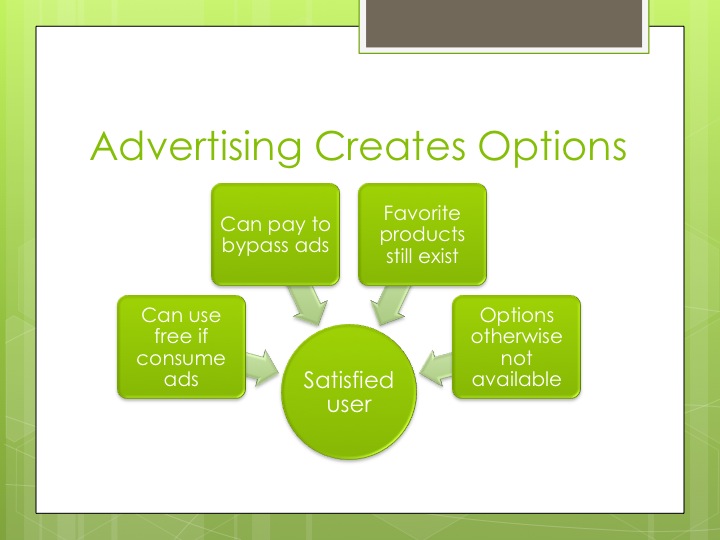
I have heard many people in the game industry complain that advertising in games (free to play or otherwise) is a bad thing, or even immoral. The reality is it is actually a benefit to people—your customers—if done properly. It provides players with more options, allows developers to create games they would not try and allows people’s favorite games to remain live.

More options and value for players

The most effective advertising in games is advertising that the player sees as creating value. These benefits manifest themselves in several ways:
Slide1

  • ”Watch to earn” videos or other advertising that allows players to earn in-game currency by participating in advertising rather than spending money. This often takes the form of watching video ads or participating in special offers (such as taking a survey or subscribing to Netflix. This is a huge benefit, not detriment to they player, as they control completely whether they participate in the advertising or decide not to (and either forego the benefits or use real currency to acquire them).
  • Allowing development of advertising supported games. Some of the most popular games would not be possible if there was no in-game advertising. Virtually all of the revenue from games like Words with Friends comes from advertising. The game is incredibly popular with tens of millions of players and requires a development team to continue creating content to keep those players happy. Without advertising, those games would not exist and the millions of fans would not have a great source of entertainment.
  • Players are always unhappy when their favorite classic free-to-play games are “sunset,” which is the equivalent of sending a horse to the glue factory. Advertising sometimes provides an alternative to euthanizing a game. If a developer can incorporate advertising to cover its costs of maintaining the game, it then has no reason to sunset the product.

Other industries

Most other industries embrace advertising because it provides the same benefits to users. Viewers of television often prefer networks that do not charge (though they complain about it sometimes) rather than pay subscription fees. Those who hate advertising, though, have options to focus on networks like HBO or use services like Netflix. Print readers often enjoy subsidized costs for newspapers and magazines as advertising revenue allow the magazine to offset most or all of its costs. Additionally, advertising allows many publications to give away their product for free in exchange for the user to consume ads.

Parting thoughts

The reality is that advertising benefits players in many ways and developers should embrace it as a way to provide more value to users. By integrating advertising into the business model, you can find ways to add value to your players and give options to players you other wise had to neglect because they did not monetize through in-app purchases.

Key takeaways

  1. In-game advertising is a way to provide additional value to your players.
  2. It allows players who do not want to purchase items to earn them by participating in the advertising.
  3. Advertising allows game companies to provide games or maintain games that otherwise would not exist.
54.153880
-4.485703
Like Loading...
Unknown's avatarAuthor Lloyd MelnickPosted on July 1, 2015January 4, 2016Categories General Social Games Business, General Tech BusinessTags advertising, in-game advertising, lifetime value, monetizationLeave a comment on Advertising is not a bad thing

We are not concerned about monetization and other lies people tell investors

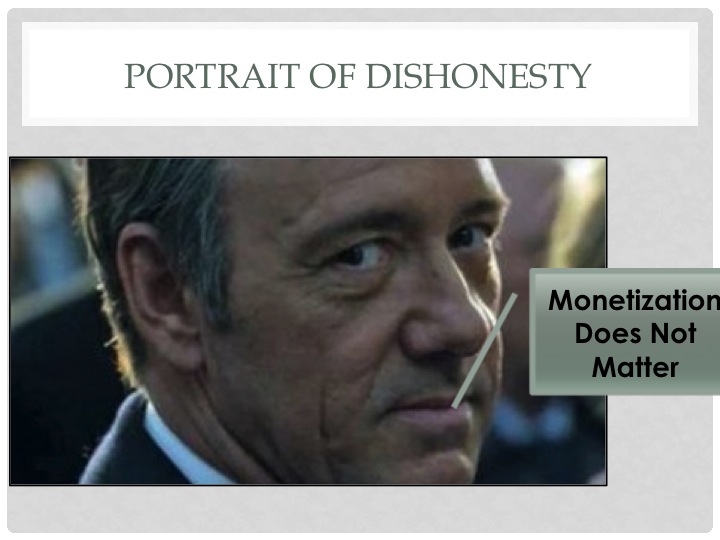
A friend recently mentioned how he met with a game company who told him they were doing great but not focused on monetization yet. This should be a red flag if you hear this at your company or a company you are thinking of working with.

Slide1

What it means not to be concerned about monetization

If there was a Google translate for game development, when you type in the phrase we are not focused on monetization yet, the output would be “want don’t want to admit to ourselves or to you that our game does not work and is a failure.” Continue reading “We are not concerned about monetization and other lies people tell investors”

54.153910
-4.485678
Like Loading...
Unknown's avatarAuthor Lloyd MelnickPosted on June 23, 2015January 4, 2016Categories General Social Games Business, General Tech Business, LTVTags lies, lifetime value, monetizationLeave a comment on We are not concerned about monetization and other lies people tell investors

Posts pagination

Previous page Page 1 … Page 17 Page 18 Page 19 … Page 46 Next page

Get my book on LTV

The definitive book on customer lifetime value, Understanding the Predictable, is now available in both print and Kindle formats on Amazon.

Understanding the Predictable delves into the world of Customer Lifetime Value (LTV), a metric that shows how much each customer is worth to your business. By understanding this metric, you can predict how changes to your product will impact the value of each customer. You will also learn how to apply this simple yet powerful method of predictive analytics to optimize your marketing and user acquisition.

For more information, click here

Follow The Business of Social Games and Casino on WordPress.com

Enter your email address to follow this blog and receive notifications of new posts by email.

Join 791 other subscribers

Most Recent Posts

  • Join me at PDMA Inspire for my talk on new product prioritization
  • Why keep studying?
  • The next three years of this blog
  • Interview with the CEO of Murka on the biggest growth opportunity in gaming, Barak David

Lloyd Melnick

This is Lloyd Melnick’s personal blog.  All views and opinions expressed on this website are mine alone and do not represent those of people, institutions or organizations that I may or may not be associated with in professional or personal capacity.

I am a serial builder of businesses (senior leadership on three exits worth over $700 million), successful in big (Disney, Stars Group/PokerStars, Zynga) and small companies (Merscom, Spooky Cool Labs) with over 20 years experience in the gaming and casino space.  Currently, I am the GM of VGW’s Chumba Casino and on the Board of Directors of Murka Games and Luckbox.

Topic Areas

  • Analytics (114)
  • Bayes' Theorem (8)
  • behavioral economics (8)
  • blue ocean strategy (14)
  • Crowdfunding (4)
  • DBA (2)
  • General Social Games Business (459)
  • General Tech Business (195)
  • Growth (88)
  • International Issues with Social Games (50)
  • Lloyd's favorite posts (101)
  • LTV (54)
  • Machine Learning (10)
  • Metaverse (1)
  • Mobile Platforms (37)
  • Prioritization (1)
  • Social Casino (52)
  • Social Games Marketing (105)
  • thinking fast and slow (5)
  • Uncategorized (33)

Social

  • View CasualGame’s profile on Facebook
  • View @lloydmelnick’s profile on Twitter
  • View lloydmelnick’s profile on LinkedIn

RSS

RSS Feed RSS - Posts

RSS Feed RSS - Comments

Categories

  • Analytics (114)
  • Bayes' Theorem (8)
  • behavioral economics (8)
  • blue ocean strategy (14)
  • Crowdfunding (4)
  • DBA (2)
  • General Social Games Business (459)
  • General Tech Business (195)
  • Growth (88)
  • International Issues with Social Games (50)
  • Lloyd's favorite posts (101)
  • LTV (54)
  • Machine Learning (10)
  • Metaverse (1)
  • Mobile Platforms (37)
  • Prioritization (1)
  • Social Casino (52)
  • Social Games Marketing (105)
  • thinking fast and slow (5)
  • Uncategorized (33)

Archives

  • September 2023
  • December 2021
  • July 2021
  • March 2021
  • February 2021
  • January 2021
  • December 2020
  • November 2020
  • October 2020
  • September 2020
  • August 2020
  • July 2020
  • June 2020
  • May 2020
  • April 2020
  • March 2020
  • February 2020
  • January 2020
  • November 2019
  • October 2019
  • September 2019
  • June 2019
  • May 2019
  • April 2019
  • March 2019
  • February 2019
  • January 2019
  • December 2018
  • June 2018
  • May 2018
  • April 2018
  • March 2018
  • February 2018
  • January 2018
  • December 2017
  • June 2017
  • May 2017
  • April 2017
  • March 2017
  • February 2017
  • January 2017
  • December 2016
  • November 2016
  • October 2016
  • September 2016
  • June 2016
  • May 2016
  • April 2016
  • March 2016
  • February 2016
  • January 2016
  • December 2015
  • November 2015
  • October 2015
  • September 2015
  • July 2015
  • June 2015
  • May 2015
  • April 2015
  • March 2015
  • February 2015
  • January 2015
  • December 2014
  • November 2014
  • October 2014
  • September 2014
  • August 2014
  • July 2014
  • June 2014
  • May 2014
  • April 2014
  • March 2014
  • February 2014
  • January 2014
  • December 2013
  • November 2013
  • October 2013
  • September 2013
  • August 2013
  • July 2013
  • June 2013
  • May 2013
  • April 2013
  • March 2013
  • February 2013
  • January 2013
  • December 2012
  • November 2012
  • October 2012
  • September 2012
  • August 2012
  • July 2012
  • June 2012
  • May 2012
  • April 2012
  • March 2012
  • February 2012
  • January 2012
  • December 2011
  • November 2011
  • October 2011
  • September 2011
  • August 2011
  • July 2011
  • June 2011
  • May 2011
  • December 2010
January 2026
S M T W T F S
 123
45678910
11121314151617
18192021222324
25262728293031
« Sep    

by Lloyd Melnick

All posts by Lloyd Melnick unless specified otherwise
Google+

Enter your email address to subscribe to this blog and receive notifications of new posts by email.

Join 791 other subscribers
Follow Lloyd Melnick on Quora

RSS HBR Blog

  • What Actually Works to Change Someone’s Mind
  • Our Favorite Management Tips of 2025
  • How to Manage—and Motivate—Gen Z
  • The Most-Watched HBR Videos of 2025
  • The HBR Charts that Help Explain 2025
  • The Most Popular HBR Podcast Episodes of 2025
  • How the Best Leaders Develop and Spend “Innovation Capital”
  • The 10 Most Popular HBR Articles of 2025
  • How Work Changed in 2025, According to HBR Readers
  • What Leaders Can Learn from a Formula 1 Turnaround

RSS Techcrunch

  • An error has occurred; the feed is probably down. Try again later.

RSS MIT Sloan Management Review Blog

  • Calm: The Underrated Capability Every Leader Needs Now
  • The Top Five MIT SMR Videos of 2025
  • Three Steps Toward Fairer Talent Management
  • From Crisis to Coopetition: What Leaders Can Learn From Anesthesiologists
  • AI Coding Tools: The Productivity Trap Most Companies Miss
  • How Procter & Gamble Uses AI to Unlock New Insights From Data
  • Rewire Organizational Knowledge With GenAI
  • Hungry for Learning: Wendy’s Will Croushorn
  • Beat Burnout: 10 Essential MIT SMR Reads
  • How Leaders Stay True to Themselves and Their Stakeholders
The Business of Social Games and Casino Website Powered by WordPress.com.
  • Subscribe Subscribed
    • The Business of Social Games and Casino
    • Join 726 other subscribers
    • Already have a WordPress.com account? Log in now.
    • The Business of Social Games and Casino
    • Subscribe Subscribed
    • Sign up
    • Log in
    • Report this content
    • View site in Reader
    • Manage subscriptions
    • Collapse this bar
 

Loading Comments...
 

    %d