Skip to content

The Business of Social Games and Casino

How to succeed in the mobile game space by Lloyd Melnick

Category: General Social Games Business

Trends in Analytics from BDA Conference

On Tuesday I went to the BDA Conference on Big Data Analytics. Conferences like these are always interesting to see at a high-level how analytics and its uses are evolving. This conference was no different and some of the trends that came through the various sessions suggest where future opportunities will be to leverage analytics:

  • A big challenge, and opportunity, is integrating data from multiple sources to get a more complete picture of your customers. Until recently, analyzing data in your product was the primary way to understand users (and play patterns in games) but now there is valuable data available from multiple sources. Data from social media (what people are saying about you and your product, sentiment, etc), data from beacons and other sensors, data from user acquisition, etc. When you integrate this data, you get a more complete understanding of your users and their motivations.
  • Data is connecting people and things, expanding the universe of data. There is now extensive data on how people interact with their surroundings and this will grow.
  • Using data is moving from the province of data scientists and analysts to everyone in the organization. This trend is driven by easier to use and manipulate tools, not by increased training. Designers and product managers and marketers are not becoming data experts but the tools now allow easy visualization, point and click charts, swipe and pinch access.
  • Top companies are now using the various data sources to understand holistically the customer journey and then driving activities to increase the value from the customer during their journey. The critical change is that you are using different data sources to pick up the user at different points (think of a race with cameras along the course and how the telecast switches between cameras).
  • People are now using, and expecting, data on a real time basis. Increasingly everyone in the organization has real time access to data and can drive actions based on this information. No longer are people waiting for the charts on yesterday’s activity.

Key takeaways

  1. The universe of data is exploding, with multiple data sources and good analytics now blends this data to provide a complete picture of the customer.
  2. Data is no longer being controlled by a few people in BI (business intelligence), user-friendly tools are allowing everyone in the organization to access and control data easily to enhance their decision-making
  3. Data allows companies to see the entire customer journey, with different data sources filling in different parts of the journey.

BDA

Like Loading...
Unknown's avatarAuthor Lloyd MelnickPosted on June 18, 2015January 4, 2016Categories Analytics, General Social Games Business, General Tech BusinessTags analytics, BDA, big data, blending, customer journeyLeave a comment on Trends in Analytics from BDA Conference

You need a good game, not a feature

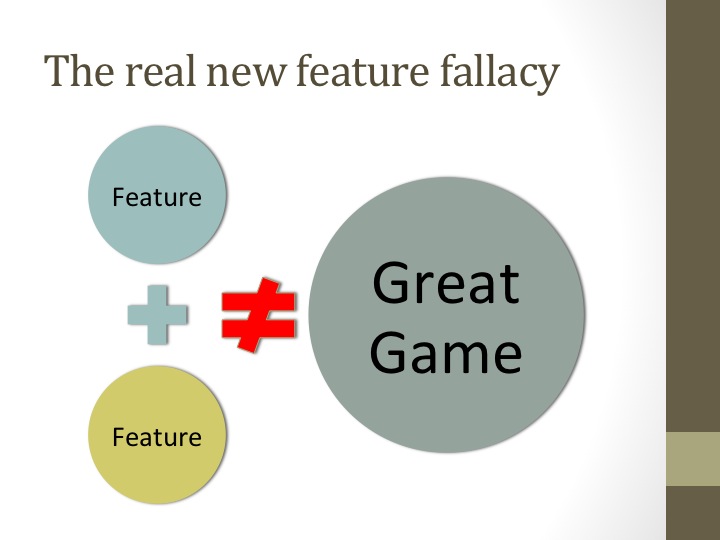
Last week, I summarized Andrew Chen’s “New Feature Fallacy,” which your new features need to touch players at the top of the funnel to improve your game. Several colleagues offered suggestion why the fallacy is a fallacy. In thinking further, the true fallacy is that any feature can fix a broken product.

Games are not a collection of features, there needs to be a core game loop that is fun. Then you can improve your LTV by building on that game loop, but if the loop does not exist there are no features that can help.

Slide1

You often see this problem in the free-to-play game space, where product management teams believe that successful products are a collection of features. Their roadmaps list each feature with the improvement in metrics it will generate. They then add up all of these improvements and come up with estimates that show how the game will generate millions of dollars. The company then invests because it wants to make millions of dollars (or investors buy shares in the company) and a year or so later they wonder why the game does not work.

Related, they look at each feature in a vacuum and AB test it. All of the features show positive improvement in metrics. The game, however, fails. A senior product who is probably the best PM I ever met once said to me it was curious how every AB test an unnamed game company we worked out had fantastic results, so good the PMs would create presentations so others in the company could copy them, yet the company’s revenue and user base continued to decline rather dramatically. Unfortunately, he was one of the few who found it “curious.” Continue reading “You need a good game, not a feature”

Like Loading...
Unknown's avatarAuthor Lloyd MelnickPosted on June 16, 2015April 5, 2021Categories General Social Games Business, Lloyd's favorite posts, Social CasinoTags core loop, feature, game design3 Comments on You need a good game, not a feature

Why your next feature probably won’t make an impact

I have been around many games and products that had poor results but the game teams kept thinking that everything would be fixed with the new features they had on the roadmap. It never worked. A recent post by Andrew Chen, “The Next Feature Fallacy,” shows the metrics of why adding product does not turnaround an unsuccessful one.

New features won’t change the key metrics

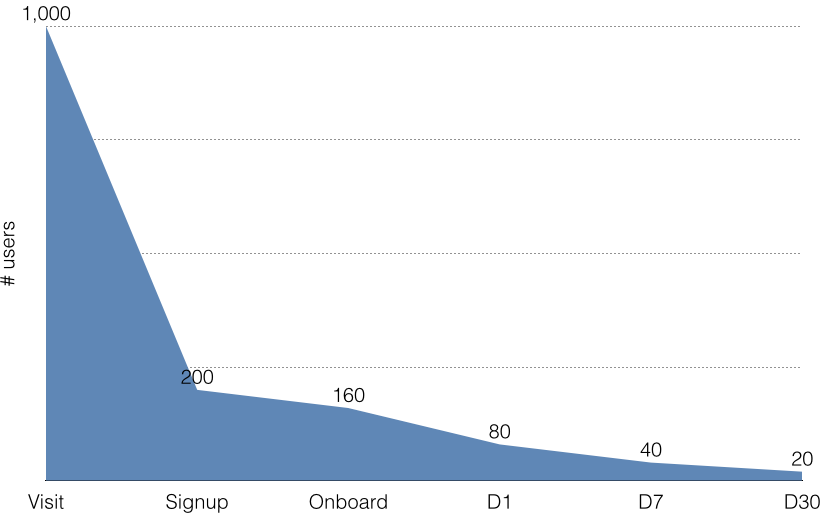
Chen leads off his post with the sobering metrics that for a typical web app (mobile apps see similar numbers) that get, 20 percent of visitors sign up, 80 percent finish on-boarding, 40 percent return the next day, 20 percent return the next week and 10 percent return after 30 days. Thus, for every 1,000 visitors, you still have 20 after 30 days (and this is not even a poorly performing app). Chen’s graph below highlights this funnel:

Andrew Chen's tragic curve

Chen points out that most features will not impact this curve for two reasons:

  1. Too few people will use the feature. Most features target retained users, but as the above shows that if it is a feature post-D7 (day 7) it will only touch 20 out of 1,000 users, and if it is D7 it only impacts 40.
  2. The other key failing is that the feature will make a small impact when users to engage. This is often the case when key functions are displayed like optional actions outside of the onboarding process.

This problem of focusing on features that will not fix your game are a result of focusing on users/players already deeply engagement and trying to make their experience better. Continue reading “Why your next feature probably won’t make an impact”

Like Loading...
Unknown's avatarAuthor Lloyd MelnickPosted on June 11, 2015January 4, 2016Categories Analytics, General Social Games Business, General Tech BusinessTags analytics, features, product management1 Comment on Why your next feature probably won’t make an impact

A review of Mary Meeker’s 2014 Internet Trends versus actuals

Last week, I summarized what I thought were the relevant points from Mary Meeker’s 2015 analysis of Internet Trends, which also made me want to go back and see how prescient her 2014 analysis turned out to be.

Mary Meeker
Mary Meeker

With any analyst, it is important to realize nobody can predict the future. If they could, they would be billionaires as they would themselves only invest in the next Apples and Facebooks, not the next Netscapes and MySpaces.

Below are some key trends she predicted last year and my take on how they have been applicable:

  • Internet usage is growing fastest in markets that are difficult to monetize. India remains a key focus for Meeker in her 2015 analysis but she is now most interested in China and India, rather than other emerging markets (Nigeria and Indonesia) while companies have shown an ability to monetize China (sometimes dwarfing their western competitors).
  • Smartphone growth is following the same pattern as Internet growth. That growth has continued.
  • Tablets are seeing great growth. I would say this was Meeker’s biggest miss, as she missed the growth of “phablets,” which both Apple and Samsung saw.
  • Mobile becomes an increasingly dominant form of web usage. Meeker was completely on target.
  • US operating systems dominate mobile phones worldwide. I would put this one as a maybe. They do right now but Xiaomi and other very formidable Chinese competitors are redefining mobile operating systems (though still based on Android, for the time being).
  • Mobile ad spend still has tremendous upside. This continues to be a theme for Meeker and I agree with her underlying logic.
  • App revenue is still the strongest mobile revenue source. Although not a theme this year, it continues to be true.
  • Cyber threats are intensifying. True, as the hack of the US government last week showed.
  • Tech venture financing is still depressed. I have not seen the latest data but seems to be rebounding with some companies getting great valuations.
  • Education may be at an inflection point. We have not seen the inflection point yet but the fundamentals remain that this industry will change dramatically.
  • Healthcare is another sector that may be at an inflection point. Like education, we have not yet seen the big changes here but it seems inevitable.
  • Messaging is an exciting space. If anything, this has become a more exciting space with bigger opportunities.
  • Image and video sharing rising quickly. Continues to grow, though video seems to have eclipsed photo sharing.
  • The dominance of apps is resulting in unbundling of the Internet. Not a theme in 2015, this trend largely continues.
  • Apps are re-imagining activities and businesses. Not as many apps have disrupted traditional businesses in the past 12 months but probably because the low hanging fruit was already disrupted.
  • Biggest re-imagining will be people with mobile devices and sensors uploading troves of findable and shareable data. I would classify this as a miss by Meeker, as this trend has not had a huge impact.
  • Sensor use rising rapidly. Again, this has not continued into 2015 and Meeker does not focus on it in her 2015 report.
  • Computing costs dropping dramatically. Probably a trend since 1985, enough said.
  • Compelling user interfaces are part of why many business are being re-imagined. Although I agree with her analysis, it was not a key part of the 2015 landscape.
  • Data mining and analytic tools that mine and organize data are growing rapidly. She does not discuss this in 2015 but possibly because it has become such an integral part of the business ecosystem it is no longer worth mentioning as a trend.
  • Apps are replacing television channels. Still happening but television has been incredibly resilient, though with Showtime following HBO this should continue as a long-term trend.
  • Social television boosts the impact of ads. We really have not seen this phenomenon at all.

When looking back at her analysis from 2014, I was personally surprised about how accurate her predictions were. While some are still playing out, her analysis proves very valuable in understanding how technology is evolving (and it is a heck of a lot better than my predictions).

Like Loading...
Unknown's avatarAuthor Lloyd MelnickPosted on June 9, 2015January 4, 2016Categories General Social Games Business, General Tech Business, International Issues with Social Games, Mobile PlatformsTags advertising, China, data mining, education, emerging markets, india, Internet trends, Mary Meeker, messaging apps, phablets, sensors, tablets, video sharing1 Comment on A review of Mary Meeker’s 2014 Internet Trends versus actuals

Why your game’s metrics mean nothing

From the beginning of time (or at least 2009), companies have been basing decisions on game metrics, investors have used performance metrics to base investment decisions and outside analysts have used game metrics to estimate the health of a company. Unfortunately, all of these applications of metrics are deeply flawed and often mislead the decision-makers, investors and analysts (sometimes intentionally, sometimes not).

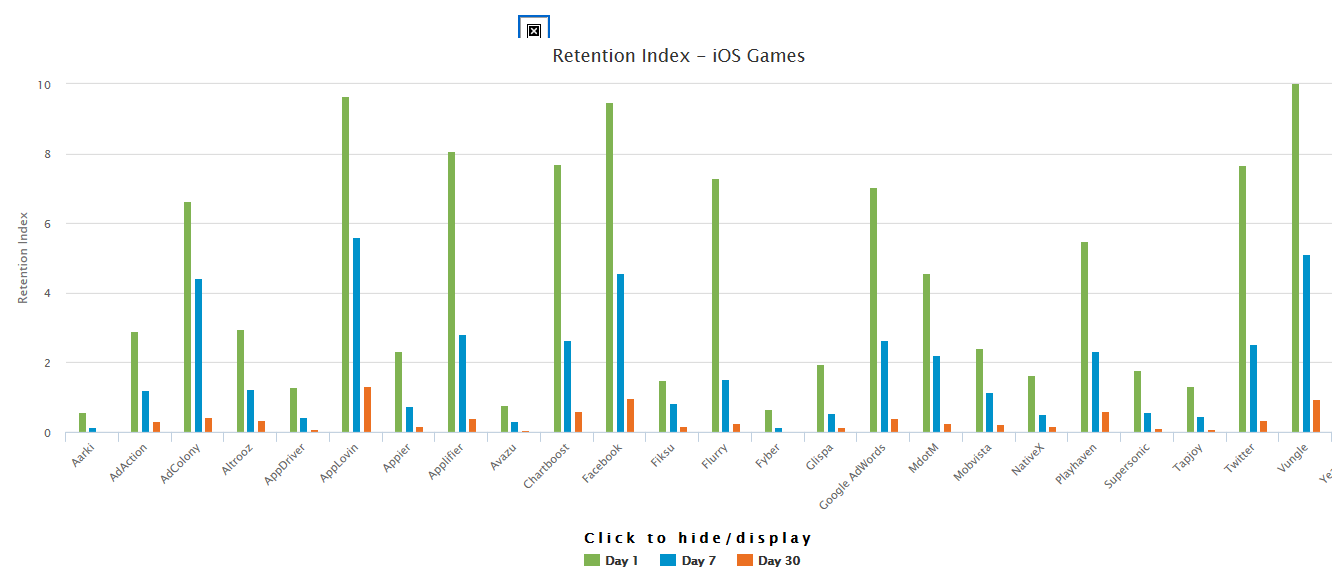
The charts below from Appsflyer show the critical flaw in looking at a game’s metrics:

Appsflyer iOS

Retention performance on Android by source:

AppsFlyerAndroid

It all depends on the source

The first lesson from these charts is that performance depends largely on the source of users. Although these charts show retention metrics, I am certain monetization and virality performance shows similar behavior. Thus, your performance metrics are incredibly biased by the source of traffic and metrics for your game overall only reflect the quality of the various user sources.

As an example, assume your Bingo game has D7 (Day 7) retention of 20% and an ARPDAU (average revenue per daily active user) of $0.25. Your main competitor’s game had D7 retention of 10% and an ARPDAU of $0.15. Based on this information, you may decide to cancel other projects and focus on this game. As a corporate development expert, you may aggressively try to acquire this company. The problem, however, is that the competitive game may be three years old and the company is using a very weak user acquisition channel that does not have a high cost because they have gotten all potential users from the better channels. Conversely, you may have acquired users through a Facebook mobile ad campaign targeting high-value Bingo players. Thus, your new users are of much higher quality than those from competitive Bingo game.

Even if your game is significantly worse, its metrics would look better at this stage. If you decide to focus on this game, the new users you bring in end up performing much worse than when you made the decision. This deterioration is not due to the game getting worse; it’s just based on a different set of users. If you end up acquiring the company for $100 million, you will then find out that as you try to grow it, you have trouble getting new profitable users.

Trends can be misleading

Trends one of are the most powerful analytics tools in your arsenal, as they show how your product or game is performing over time and if it is improving or deteriorating. Looking at the Appsflyer charts, however, it’s easy to see that that trends can largely be created by changes in the user mix. As the user acquisition team changes the mix of players, the new mix could create upward trends even if the game has not improved or deteriorated. The changes in behavior will be caused by the changes in user mix.

The only metric that counts

I have written many times about customer lifetime value (LTV), and the variance in metrics by source shows the central importance of focusing on the lifetime value to CPI (cost-per-install) equation. To summarize, LTV is how much profit a new player will generate for you in total and is a function of retention, monetization and virality. As long as your LTV is higher than the cost of acquiring that customer (CPI for paid user acquisition on mobile or web), you want to continue acquiring players.

Given the variance in performance by source that the AppsFlyer charts show, the LTV by source will also have huge variance. Thus, the goal is to have an LTV higher than the cost of user for that source. The LTV on a global scale is not important, it is finding pockets where LTV is greater than CPI and then acquiring against those targets. Any target KPIs (key performance indicators) outside of LTV being greater than CPI are worthless because this last equation will determine the success of your game. Anything else can be manipulated (e.g., buying users from certain sources who generate your “goals”). As long as LTV exceeds CPI for a source, you can acquire users from that source and grow your game. Once there are no sources where the LTV for that source are higher than the CPI (even if overall LTV is higher than many sources but not higher by source), you cannot buy users and the game will stop growing and start withering.

What it means

The high variance in performance of players by source has several important implications:

  • You must track performance of users on a cohort/source basis. Only by comparing similar users can you understand how your game is performing.
  • The sophistication of your user acquisition/growth team is critical. Managing CPIs is meaningless if it is not tied to the performance of the users; you need growth experts who can get you users with the highest yield (delta between LTV and CPI). You also may otherwise miss opportunities where your metrics may not appear to support buying expensive traffic, but that traffic will perform so well that it is a good value.
  • Holistic game metrics (sometimes referred to as vanity metrics) are meaningless or even misleading. You need to focus on keeping LTV higher than CPI for your sources of traffic.

The critical point is not to focus on vanity metrics that can be manipulated and are not actionable. Instead, focus on the performance of your product for specific cohorts of customers.

Key takeaways

  1. There is an extremely high variance in performance of users based on the source of the users. Thus, it is misleading to look at overall metrics as they are largely a result of your user sources.
  2. You must track performance of users on a cohort/source basis. Only by comparing similar users can you understand how your game is performing.
  3. It is critical to build a strong growth or user acquisition team. Managing CPIs is meaningless if it is not tied to the performance of the users, you need growth experts who can get you users with the highest yield (delta between LTV and CPI).

Like Loading...
Unknown's avatarAuthor Lloyd MelnickPosted on June 4, 2015January 4, 2016Categories Analytics, General Social Games Business, General Tech Business, Growth, Lloyd's favorite posts, LTVTags analytics, appsflyer, CPI, LTV, metricsLeave a comment on Why your game’s metrics mean nothing

What Mary Meeker’s Internet Trends 2015 Means to You

As always, super-analyst come venture capitalist Mary Meeker just published her Internet Trends for 2015, and, as always, I wanted to summarize the trends most relevant for those in the game and gaming industries (and for those who prefer Meeker’s actual analysis, her presentation is embedded at the bottom of this post).

I always find her analysis very interesting but you need to take anyone’s predictions with a grain of salt. After all, they are predictions of the future and very few are good at predicting the future (hence why I don’t try). Most analysts who try show why they are analysts and not trillionaires. Next week, I will look at Meeker’s 2014 predictions and see how they performed. Regardless, it is interesting to see what a leading thinker in the space sees as the major trends we are experiencing.

Below are the elements of Meeker’s analysis I consider critical for success:

  • Slide 6: Of the top 15 Internet companies in 1995, only Apple is still on the list. Thus, the companies we consider critical partners today may not be relevant in the future while new companies are likely to dominate.
  • Slide 14: Internet is becoming an increasingly large elements of peoples’ lives, with people now spending 5.6 hours/day on it (and 51% of that time from mobile devices).
  • Slide 16: Advertisers are still spending much more on print advertising versus mobile given the relative share of media consumption. Given that markets eventually find equilibrium, this figure suggests advertising revenue opportunities on mobile should grow sharply and there may be an opportunity for new mobile ad delivery mechanics.
  • Slides 23 and 24 show the importance of vertical (portrait) viewing (mobile phone format versus traditional television),having grown to 29 percent from 5 percent. This figure shows the importance of optimizing for both formats.
  • Slide 47: Six of the top-10 most used apps are messaging apps. Shows the importance of messaging to the gaming space.
  • Slide 52: Many people use different messaging apps for different purposes, not a winner takes it all market.
  • Slide 53: Mobile messaging apps may evolve into central communications hubs.
  • Slide 54: Notifications are evolving and are now allowing for direct interaction and are more up close and personal. CRM strategies must evolve to leverage this increasingly important interaction channel.
  • Slide 57-65 show the importance of user generated content, from Twitter to Twitch
  • Slide 88: One of the less positive slides, points to the growth and severity of Cyber Attacks. This slides shows how security will be important to all firms.
  • Slide 151: The size of the Chinese market is beyond what most people think. In one day, 1 billion “red envelopes” were sent on WeChat.
  • Slide 158: By taking less of a share than their US competitors, Taobao (versus eBay) and Meituan (versus Groupon) grew to more than twice the size than their competitors. This suggests that lowering the take rate can increase growth and profits.
  • Slide 165: India seems to be at an inflection point suggesting it may be the next China. It is already the third largest Internet market, with 232 million Internet users (and adding 63 million annually).

There are many other interesting areas of Meeker’s analysis, such as the growth in online platforms and marketplaces, but they are not as relevant (maybe) to my readers. I recommend, however, you take a look at the whole presentation:

54.167012
-4.450894
Like Loading...
Unknown's avatarAuthor Lloyd MelnickPosted on June 2, 2015June 1, 2015Categories General Social Games Business, General Tech Business, International Issues with Social GamesTags advertising, China, india, Internet trends, Mary Meeker, messaging, notifications, PNs1 Comment on What Mary Meeker’s Internet Trends 2015 Means to You

How to build a good design team

I came across a great post, “The Redesign of the Design Process” by Jared Spool, that shows the best product or game designs comes from teams of people with a strong market focus. It no longer comes down to having a visionary designer, if that was ever the case.

Spool point out that the process that a team uses to create great designs does not happen by chance. It needs to be intentionally built. The process itself needs to be designed.

Slide1

What does the user research say?

Although many designers and teams conduct user research, the most successful teams “design” how that research fits into its process. Rather than do superficial, and sometimes counter-productive, research, the most successful design teams are determined about the process of fitting what they have learned into their existing knowledge.

Spool points out, “The user researcher’s role has changed. It used to be about running studies. Now it’s about growing the team’s understanding of their users. In this new role, the user researcher still needs to run a high-quality study. However, the real emphasis is to truly understand what the team thinks about their users. Then, using their well-adapted toolbox of user research techniques, they identify where that thinking is faulty. In time, a great UX researcher guides the team to a more accurate understanding of the user, which means design innovations are more likely to emerge.” Continue reading “How to build a good design team”

54.154039
-4.485858
Like Loading...
Unknown's avatarAuthor Lloyd MelnickPosted on May 21, 2015January 4, 2016Categories General Social Games Business, General Tech BusinessTags Design process, user researchLeave a comment on How to build a good design team

”Mobile First” is so 2012

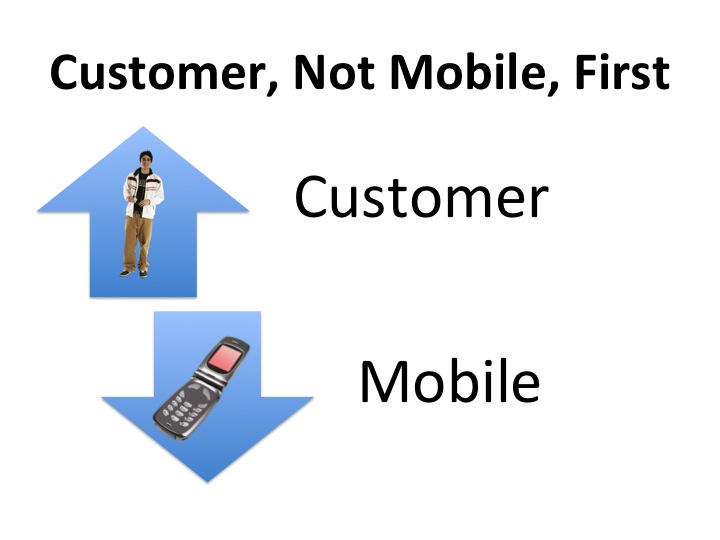
The phrase “mobile first” helped many developers succeed as apps overtook Facebook and web products in user acceptance. The concept, however, no longer has significant meaning as virtually every company is focused on the mobile consumer. What was a key part of every successful tech and game company’s strategy for the last four or five years, focus on mobile before web, is no longer a key to success. A recent blog post on Inside Telecom, “Why ‘Mobile First’ May Already Be Outdated,” shows that successful mobile app developers are now creating web apps for larger screens.Slide1

It is about the screen

The post makes a great point that mobile is not about the actual device (after all, why is an iPad mobile and laptop not, since you can take both with you and cannot make calls on either) but about the way people access and consume information.

Last year, everyone was optimizing for phones and tablets, now the target is the iPhone 6 Plus and other phablets. Will next year be the year of tiny screens on your wrist. The article points out that “the optimal screen size is still a moving target.”
When considering product development, the only screen size you are certain of is the big one. Most people sit in front of a large monitor for a major part of their workday and then have a large television at home and that probably will never change. Continue reading “”Mobile First” is so 2012”

Like Loading...
Unknown's avatarAuthor Lloyd MelnickPosted on May 19, 2015January 4, 2016Categories General Social Games Business, General Tech BusinessTags customer, mobile first, screenLeave a comment on ”Mobile First” is so 2012

How to hook your competitor’s customers

I have written frequently about the importance of knowing your competitors (competitive intelligence) and I also love Nir Eyal’s Hooked model to build products that retain; I just came across a slideshow by Nir that brings both of these concepts together. Nir’s presentation, “4 Ways to Win Your Competitor’s Customer Habits” (presentation below), shows the four ways companies build better hooks than their competitors.

As a quick recap, the Hook Model describes an experience designed to connect the user’s problem to a solution frequently enough to form a habit. Eyal defines habits as behaviors done with little or no conscious thought. The convergence of access, data, and speed is making the world a more habit-forming place.Businesses that create customer habits gain a significant competitive advantage. It has four phases: trigger, action, variable reward, and investment.

Eyal identified four ways to win customer habits. If your product becomes the one the customer is hooked on, then you will enjoy their continued business.

Slide1

Faster HOOKS

The first technique is faster hooks. The faster the user passes through the model, the greater the product’s or game’s habit forming potential. Nir Eyal uses the example of Netflix, which won over people’s viewing habits from Blockbuster by delivering movies what were waiting for users rather than forcing them to get in a car, pick the movie, pay and drive home.

To achieve faster HOOKS, first understand the must-have reason people are using your product or game. Next, lay out the steps the customer must take to get the job done. Finally, once the series of tasks from intention to outcome is understood, simply start removing steps until you reach the simplest possible process. Continue reading “How to hook your competitor’s customers”

Like Loading...
Unknown's avatarAuthor Lloyd MelnickPosted on May 14, 2015April 24, 2021Categories General Social Games Business, General Tech Business, GrowthTags competition, habit forming, Hooked, HOOKS, Nir EyalLeave a comment on How to hook your competitor’s customers

How to develop repeat customers

Most people understand the importance of selling to your existing customers, or monetizers in a free to play environment, but most efforts and features are built around attracting new customers. That despite the fact that the probability of selling to an existing customer is 60-70 percent while the chance of selling to a new prospect is 5-20 percent, according to Marketing Metrics. A recent online article from Matt Perl called “5 Sexy Rules of Customer Retention,” (better named than any of my posts) discusses five straightforward ways to improve sales to existing users.

Slide1

Reward your customers

You often give incentives to new users, give repeat customers some reward. As Dan Ariely has written, free is very powerful, so giving your customers something free (with no strings attached) is a very powerful tool. I once wrote how thank you notes can help your business, as they can provide a low cost way to give back something to your customers.

Recognize customers from their online footprint

The goal is to recognize customers automatically when they come into your game or encourage them to register. The less friction involved (if you can identify and track automatically without violating privacy issues), the more customers you can touch in this way. Company or product portals are a strong and deep way to tie together a customer with your brand and if your customer comes to you without any pushing than you are doing a great job. Continue reading “How to develop repeat customers”

Like Loading...
Unknown's avatarAuthor Lloyd MelnickPosted on May 12, 2015April 24, 2021Categories General Social Games Business, General Tech Business, Social Games MarketingTags Customer satisfaction, lifetime value, LTV, reactivation, vipLeave a comment on How to develop repeat customers

Posts pagination

Previous page Page 1 … Page 18 Page 19 Page 20 … Page 46 Next page

Get my book on LTV

The definitive book on customer lifetime value, Understanding the Predictable, is now available in both print and Kindle formats on Amazon.

Understanding the Predictable delves into the world of Customer Lifetime Value (LTV), a metric that shows how much each customer is worth to your business. By understanding this metric, you can predict how changes to your product will impact the value of each customer. You will also learn how to apply this simple yet powerful method of predictive analytics to optimize your marketing and user acquisition.

For more information, click here

Follow The Business of Social Games and Casino on WordPress.com

Enter your email address to follow this blog and receive notifications of new posts by email.

Join 791 other subscribers

Most Recent Posts

  • Join me at PDMA Inspire for my talk on new product prioritization
  • Why keep studying?
  • The next three years of this blog
  • Interview with the CEO of Murka on the biggest growth opportunity in gaming, Barak David

Lloyd Melnick

This is Lloyd Melnick’s personal blog.  All views and opinions expressed on this website are mine alone and do not represent those of people, institutions or organizations that I may or may not be associated with in professional or personal capacity.

I am a serial builder of businesses (senior leadership on three exits worth over $700 million), successful in big (Disney, Stars Group/PokerStars, Zynga) and small companies (Merscom, Spooky Cool Labs) with over 20 years experience in the gaming and casino space.  Currently, I am the GM of VGW’s Chumba Casino and on the Board of Directors of Murka Games and Luckbox.

Topic Areas

  • Analytics (114)
  • Bayes' Theorem (8)
  • behavioral economics (8)
  • blue ocean strategy (14)
  • Crowdfunding (4)
  • DBA (2)
  • General Social Games Business (459)
  • General Tech Business (195)
  • Growth (88)
  • International Issues with Social Games (50)
  • Lloyd's favorite posts (101)
  • LTV (54)
  • Machine Learning (10)
  • Metaverse (1)
  • Mobile Platforms (37)
  • Prioritization (1)
  • Social Casino (52)
  • Social Games Marketing (105)
  • thinking fast and slow (5)
  • Uncategorized (33)

Social

  • View CasualGame’s profile on Facebook
  • View @lloydmelnick’s profile on Twitter
  • View lloydmelnick’s profile on LinkedIn

RSS

RSS Feed RSS - Posts

RSS Feed RSS - Comments

Categories

  • Analytics (114)
  • Bayes' Theorem (8)
  • behavioral economics (8)
  • blue ocean strategy (14)
  • Crowdfunding (4)
  • DBA (2)
  • General Social Games Business (459)
  • General Tech Business (195)
  • Growth (88)
  • International Issues with Social Games (50)
  • Lloyd's favorite posts (101)
  • LTV (54)
  • Machine Learning (10)
  • Metaverse (1)
  • Mobile Platforms (37)
  • Prioritization (1)
  • Social Casino (52)
  • Social Games Marketing (105)
  • thinking fast and slow (5)
  • Uncategorized (33)

Archives

  • September 2023
  • December 2021
  • July 2021
  • March 2021
  • February 2021
  • January 2021
  • December 2020
  • November 2020
  • October 2020
  • September 2020
  • August 2020
  • July 2020
  • June 2020
  • May 2020
  • April 2020
  • March 2020
  • February 2020
  • January 2020
  • November 2019
  • October 2019
  • September 2019
  • June 2019
  • May 2019
  • April 2019
  • March 2019
  • February 2019
  • January 2019
  • December 2018
  • June 2018
  • May 2018
  • April 2018
  • March 2018
  • February 2018
  • January 2018
  • December 2017
  • June 2017
  • May 2017
  • April 2017
  • March 2017
  • February 2017
  • January 2017
  • December 2016
  • November 2016
  • October 2016
  • September 2016
  • June 2016
  • May 2016
  • April 2016
  • March 2016
  • February 2016
  • January 2016
  • December 2015
  • November 2015
  • October 2015
  • September 2015
  • July 2015
  • June 2015
  • May 2015
  • April 2015
  • March 2015
  • February 2015
  • January 2015
  • December 2014
  • November 2014
  • October 2014
  • September 2014
  • August 2014
  • July 2014
  • June 2014
  • May 2014
  • April 2014
  • March 2014
  • February 2014
  • January 2014
  • December 2013
  • November 2013
  • October 2013
  • September 2013
  • August 2013
  • July 2013
  • June 2013
  • May 2013
  • April 2013
  • March 2013
  • February 2013
  • January 2013
  • December 2012
  • November 2012
  • October 2012
  • September 2012
  • August 2012
  • July 2012
  • June 2012
  • May 2012
  • April 2012
  • March 2012
  • February 2012
  • January 2012
  • December 2011
  • November 2011
  • October 2011
  • September 2011
  • August 2011
  • July 2011
  • June 2011
  • May 2011
  • December 2010
January 2026
S M T W T F S
 123
45678910
11121314151617
18192021222324
25262728293031
« Sep    

by Lloyd Melnick

All posts by Lloyd Melnick unless specified otherwise
Google+

Enter your email address to subscribe to this blog and receive notifications of new posts by email.

Join 791 other subscribers
Follow Lloyd Melnick on Quora

RSS HBR Blog

  • What Actually Works to Change Someone’s Mind
  • Our Favorite Management Tips of 2025
  • How to Manage—and Motivate—Gen Z
  • The Most-Watched HBR Videos of 2025
  • The HBR Charts that Help Explain 2025
  • The Most Popular HBR Podcast Episodes of 2025
  • How the Best Leaders Develop and Spend “Innovation Capital”
  • The 10 Most Popular HBR Articles of 2025
  • How Work Changed in 2025, According to HBR Readers
  • What Leaders Can Learn from a Formula 1 Turnaround

RSS Techcrunch

  • An error has occurred; the feed is probably down. Try again later.

RSS MIT Sloan Management Review Blog

  • Calm: The Underrated Capability Every Leader Needs Now
  • The Top Five MIT SMR Videos of 2025
  • Three Steps Toward Fairer Talent Management
  • From Crisis to Coopetition: What Leaders Can Learn From Anesthesiologists
  • AI Coding Tools: The Productivity Trap Most Companies Miss
  • How Procter & Gamble Uses AI to Unlock New Insights From Data
  • Rewire Organizational Knowledge With GenAI
  • Hungry for Learning: Wendy’s Will Croushorn
  • Beat Burnout: 10 Essential MIT SMR Reads
  • How Leaders Stay True to Themselves and Their Stakeholders
The Business of Social Games and Casino Website Powered by WordPress.com.
  • Subscribe Subscribed
    • The Business of Social Games and Casino
    • Join 726 other subscribers
    • Already have a WordPress.com account? Log in now.
    • The Business of Social Games and Casino
    • Subscribe Subscribed
    • Sign up
    • Log in
    • Report this content
    • View site in Reader
    • Manage subscriptions
    • Collapse this bar
 

Loading Comments...
 

    %d