Skip to content

The Business of Social Games and Casino

How to succeed in the mobile game space by Lloyd Melnick

Category: General Social Games Business

Lessons for the game industry from Louisville’s national championship

The most important lesson from yesterday’s national championship is that to be truly successful, you must always be working to improve. Last year, when Kentucky won the national championship, I wrote a piece on how it highlighted the importance of recruiting great talent. This year the lesson is that great leaders (and I definitely put Pitino in that category) never take a break on working to make their organizations better.

Louisville national championship 2013

What was particularly illuminating was Rick Pitino’s (the coach of Louisville) comment this morning during a radio interview that he “broke down” tape already from the game. For those who are not sports, or basketball, fans, a coach spends the majority of his time watching tapes of his games so he understands what his team is doing right and wrong and tape of opponents so he knows their strengths and weaknesses. Pitino’s need to break down tape highlights several things: Continue reading “Lessons for the game industry from Louisville’s national championship”
Share this:

  • Click to share on Facebook (Opens in new window) Facebook
  • Click to share on LinkedIn (Opens in new window) LinkedIn
Like Loading...
Unknown's avatarAuthor Lloyd MelnickPosted on April 9, 2013April 16, 2013Categories General Social Games BusinessTags lessons for game industry, Louisville, Rick PitinoLeave a comment on Lessons for the game industry from Louisville’s national championship

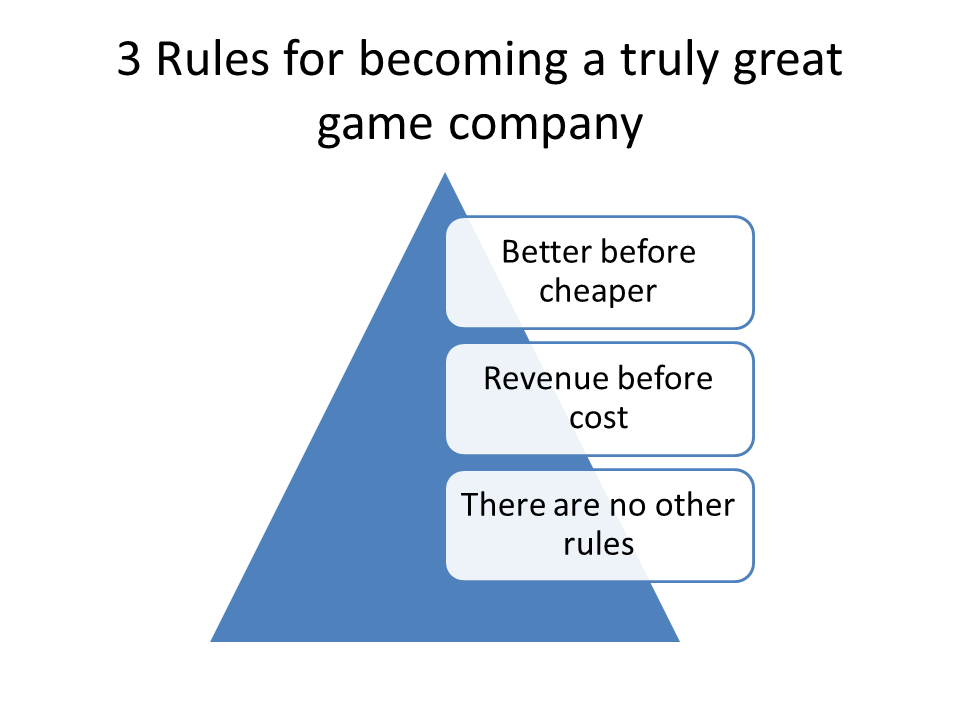
Three rules for becoming a truly great game company

A recent article in the Harvard Business Review, “Three Rules for Making A Company Truly Great,” pointed to three elemental rules that were consistently followed by exceptional companies. There are a lot of hyperbole and clichés about how to create great companies, but the research by Michael Raynor and Mumtaz Ahmed (in the HRB article) shows that three fundamental principles are the keys to success. This finding was based on a statistical study of thousands of companies, so it is much more analytic than what business book happens to be at the top of the charts in a particular week. It is also apparent that these principles apply to social and mobile game companies.

3 Rules for becoming a truly great game Continue reading “Three rules for becoming a truly great game company”

Share this:

  • Click to share on Facebook (Opens in new window) Facebook
  • Click to share on LinkedIn (Opens in new window) LinkedIn
Like Loading...
Unknown's avatarAuthor Lloyd MelnickPosted on April 4, 2013April 9, 2013Categories General Social Games Business, GrowthTags mobile games, social gamesLeave a comment on Three rules for becoming a truly great game company

Reblog of a good post on Player Valuation for Marketing in Free to Play Games

Good post on the value of non-payers.

Philip Driver's avatarGames Marketer

Aggressive monetization and targeting of high value players is receiving more and more attention from game developers, especially in the mobile channel. This had led to a more analytical approach to game creation. Now before I discuss the industry standard metrics of CAC (Customer Acquisition Cost), ARPU (Average Revenue per User) and LTV (Lifetime Value), I want to touch on something I am concerned is becoming overlooked in the Free to Play Market, the value of non-paying players.

Free to play is just one of many video games business models and the basic premise is that whilst the game itself is free to play or download, certain elements of the game are monetized to create revenue. This can be items, characters, time savers etc. that create the revenue that pays for the development and subsequent profitability of the game.

As the use of Free to Play expands amongst game makers…

View original post 2,030 more words

Share this:

  • Click to share on Facebook (Opens in new window) Facebook
  • Click to share on LinkedIn (Opens in new window) LinkedIn
Like Loading...
Unknown's avatarAuthor Lloyd MelnickPosted on March 21, 2013March 21, 2013Categories General Social Games Business, Growth, LTVLeave a comment on Reblog of a good post on Player Valuation for Marketing in Free to Play Games

Why would anyone buy a virtual good?

Many do not understand, or even accept, the motivation for people to spend real money for virtual goods. Some are even more amazed at the success of virtual casinos, where players gamble but can never collect their winnings. They discount it as manipulation or irrational thinking by the consumer. In fact, purchasing virtual goods is a very rational behavior consistent with how people conduct other aspects of their life. Understanding this motivation will help you develop a game that better satisfies your customers’ needs.

Why people shop

Although some people shop because they need something (food, clothing, steak), yet there are many other reasons people shop. In a seminal piece from the Journal of Marketing entitled “Why People Shop?“, Edward Tauber wrote that the obvious answer (“to purchase something”) “can be a most deceptive one and reflects a marketing myopia.” Below are several reasons that Tauber hypothesizes drive shopping behavior, which do not reflect ending up with a physical good. These reasons can also drive monetization in a game: Continue reading “Why would anyone buy a virtual good?”

Share this:

  • Click to share on Facebook (Opens in new window) Facebook
  • Click to share on LinkedIn (Opens in new window) LinkedIn
Like Loading...
Unknown's avatarAuthor Lloyd MelnickPosted on March 20, 2013April 9, 2013Categories General Social Games Business, Lloyd's favorite postsTags gambling, monetization, shopping, virtual goods7 Comments on Why would anyone buy a virtual good?

Lifetime Value Part 8: Incorporating costs and expenses in LTV

An aspect of lifetime value that is often neglected but could mean the difference between the ability to advertise (or not), are the costs associated with your game (or product for those outside the gaming space). As I have discussed in detail in the first seven posts on customer lifetime value (LTV), your lifetime value has to exceed to cost per install of a new user (CPI) to justify advertising. The LTV is a formula incorporating retention, virality and monetization. The other areas, though, that you need to look at are costs that lower the revenue stream from the user. Continue reading “Lifetime Value Part 8: Incorporating costs and expenses in LTV”

Share this:

  • Click to share on Facebook (Opens in new window) Facebook
  • Click to share on LinkedIn (Opens in new window) LinkedIn
Like Loading...
Unknown's avatarAuthor Lloyd MelnickPosted on March 13, 2013April 21, 2013Categories Analytics, General Social Games Business, LTVTags Epic UDK, Kontagent, licensing, LTV, Mixpanel, royaltiesLeave a comment on Lifetime Value Part 8: Incorporating costs and expenses in LTV

Don’t charge for your app, PLEASE (at least if you want to make money)

One of the greatest mistake game companies make is building or launching products that are paid apps, not free-to-play (F2P), which then monetize through micro-transactions. Despite the fact that survey after survey shows F2P games generate more revenue than paid apps, virtually all the investment money goes to F2P products (and VCs are pretty intelligent) and most companies that abandon paid apps for F2P never go back, there are a surprisingly high number of companies still focusing on the paid app model. In particular, many mobile studios whose roots are in the traditional (console) gaming world still prefer the paid app model. As I am often asked to help game companies, it is very frustrating when they forgo my advice and build a paid app. The usual refrain is “But look at Angry Birds.”

F2P vs Paid download

A recent analysis by Forbes (“Rovio’s Revenue Crisis and the App Market Evolution”) shows beyond a shadow of a doubt it is just foolish to still be building paid apps, even if you are Rovio. To summarize the key analysis and findings from the Forbes data: Continue reading “Don’t charge for your app, PLEASE (at least if you want to make money)”

Share this:

  • Click to share on Facebook (Opens in new window) Facebook
  • Click to share on LinkedIn (Opens in new window) LinkedIn
Like Loading...
Unknown's avatarAuthor Lloyd MelnickPosted on March 11, 2013April 11, 2013Categories General Social Games Business, Lloyd's favorite postsTags F2P, monetization, paid app, rovioLeave a comment on Don’t charge for your app, PLEASE (at least if you want to make money)

Dell’s Ophelia can be the biggest thing to rock gaming since the iPhone

The unveiling this week at Mobile World Congress from Dell about their Ophelia project (thank you Jon Downey for bringing it to my attention) may have a profound impact on the game industry as early as Q3 of this year. Ophelia is a stick that turns a TV or monitor into your computer (through the HDMI port initially but there will be a USB version in the future), powered by Android. It is effectively your computer on a stick, which then integrates with Dell’s cloud services and allows you to use your apps or play your games. You can even upload and download files as if you were at your PC (or Mac).

image from CNET

Think about pulling out your Ophelia stick, plugging it into your TV and you can just start playing Bejeweled or Slotmania. Later, you plug it into your monitor at work. When you’re traveling, just plug it into the TV in your hotel room. You can play all your games, edit your documents, view your pictures, and anything you would do with a laptop or tablet. Continue reading “Dell’s Ophelia can be the biggest thing to rock gaming since the iPhone”

Share this:

  • Click to share on Facebook (Opens in new window) Facebook
  • Click to share on LinkedIn (Opens in new window) LinkedIn
Like Loading...
Unknown's avatarAuthor Lloyd MelnickPosted on February 28, 2013March 5, 2013Categories General Social Games Business, Mobile PlatformsTags Dell Ophelia, mobile1 Comment on Dell’s Ophelia can be the biggest thing to rock gaming since the iPhone

Growth tactics for mobile game and social media companies

Growth Hacking ConferenceThe big buzz phrase in the Bay Area the last year or so has been “growth hacking,” and the ideas behind it can help significantly game companies. The underlying principle in the phrase is that modern start-ups should be focused on using the new tools available via technology to grow rapidly their user base rather than relying on older, sometimes outdated, marketing techniques. Growth—unlike marketing—usually encompasses multiple aspects of an organization, with the growth team not only bringing in users but also working with the product team to optimize the product for growth. It stresses the importance of product to growth and how the two should work together rather than having marketing set aside in a corner. The phrase itself was coined by Sean Ellis, CEO of Qualaroo and the first marketer at many great tech companies including Dropbox and LogMeIn.

What is a growth team?

A quora post from Andy Johns (currently on Quora’s growth team and one of the early members of Facebook’s growth team) described the typical people an early stage company would put on its growth team: Continue reading “Growth tactics for mobile game and social media companies”

Share this:

  • Click to share on Facebook (Opens in new window) Facebook
  • Click to share on LinkedIn (Opens in new window) LinkedIn
Like Loading...
Unknown's avatarAuthor Lloyd MelnickPosted on February 25, 2013February 26, 2013Categories Analytics, General Social Games Business, Growth, International Issues with Social Games, Social Games MarketingTags Chamath Palihapitiya, Elliot Shmukler, Growth, iteration, marketing, Sean Ellis, testing, user acquisition3 Comments on Growth tactics for mobile game and social media companies

Disrupting video/television and its effect on all media including games

Veteran entrepreneur and investor Mark Suster recently blogged about how online video will disrupt the traditional television space and this evolution with online video will extend beyond television to disrupt many industries, including social media and games. Suster describes how the Harlem Shake video on YouTube started as a skit launched 20 January that generated about 10 million views, was then popularized into an Internet meme by text from an Australian team, and then Maker Studios turned it into a video that has generated more than 17 million views. What is exciting about Harlem Shake is that it has effectively been produced by tens of thousands of people, creating 50,000 versions viewed 200 million times.

Harlem Shake

Suster makes the point that Harlem Shake is an example of the disruptive potential of a world filled with millions of people who can create great content and now have the resources to do so. Continue reading “Disrupting video/television and its effect on all media including games”

Share this:

  • Click to share on Facebook (Opens in new window) Facebook
  • Click to share on LinkedIn (Opens in new window) LinkedIn
Like Loading...
Unknown's avatarAuthor Lloyd MelnickPosted on February 21, 2013February 25, 2013Categories General Social Games BusinessTags Mark Suster, MOOC, online video, televisionLeave a comment on Disrupting video/television and its effect on all media including games

Why app toys fail and Skylanders soar

The Wall Street Journal reported that more than 90 percent of app toys fail around the same time Activision announced that Skylanders’ sales exceeded $500 million. Among the failed app toys were Barbie Dolls and Hot Wheels cars with special conductors to control games on a tablet from Hasbro, Disney’s Cars AppMates, and a version of the Game of Life from Hasbro in which players spin a wheel on an iPad rather than a physical wheel. Yet, Activision’s physical virtual goods continue to sell incredibly well, driving Activision’s profitability. This interesting juxtaposition of news shows the value of using the equivalent of in-app purchases rather than the business models designed around retailing, distribution and manufacturing processes from the last century.

Disney AppMates

What is wrong with App Toys?

The biggest problem with app toys is that the toy makers are simply trying to move the same product to a new platform. The toy companies do not understand what creates compelling experiences on tablets (or consoles or phones, for that matter). Instead, they are replicating the same experience people have with the physical goods in the virtual world, which is not what consumers are looking for. They are competing with (thousands of) native games and products that are created to meet customers’ needs. It becomes obvious why the app toys cannot compete. Continue reading “Why app toys fail and Skylanders soar”

Share this:

  • Click to share on Facebook (Opens in new window) Facebook
  • Click to share on LinkedIn (Opens in new window) LinkedIn
Like Loading...
Unknown's avatarAuthor Lloyd MelnickPosted on February 19, 2013February 25, 2013Categories General Social Games Business, LTVTags app toys, free to play, monetization, physical virtual goods, SkylandersLeave a comment on Why app toys fail and Skylanders soar

Posts pagination

Previous page Page 1 … Page 34 Page 35 Page 36 … Page 46 Next page

Get my book on LTV

The definitive book on customer lifetime value, Understanding the Predictable, is now available in both print and Kindle formats on Amazon.

Understanding the Predictable delves into the world of Customer Lifetime Value (LTV), a metric that shows how much each customer is worth to your business. By understanding this metric, you can predict how changes to your product will impact the value of each customer. You will also learn how to apply this simple yet powerful method of predictive analytics to optimize your marketing and user acquisition.

For more information, click here

Follow The Business of Social Games and Casino on WordPress.com

Enter your email address to follow this blog and receive notifications of new posts by email.

Join 791 other subscribers

Most Recent Posts

  • Join me at PDMA Inspire for my talk on new product prioritization
  • Why keep studying?
  • The next three years of this blog
  • Interview with the CEO of Murka on the biggest growth opportunity in gaming, Barak David

Lloyd Melnick

This is Lloyd Melnick’s personal blog.  All views and opinions expressed on this website are mine alone and do not represent those of people, institutions or organizations that I may or may not be associated with in professional or personal capacity.

I am a serial builder of businesses (senior leadership on three exits worth over $700 million), successful in big (Disney, Stars Group/PokerStars, Zynga) and small companies (Merscom, Spooky Cool Labs) with over 20 years experience in the gaming and casino space.  Currently, I am the GM of VGW’s Chumba Casino and on the Board of Directors of Murka Games and Luckbox.

Topic Areas

  • Analytics (114)
  • Bayes' Theorem (8)
  • behavioral economics (8)
  • blue ocean strategy (14)
  • Crowdfunding (4)
  • DBA (2)
  • General Social Games Business (459)
  • General Tech Business (195)
  • Growth (88)
  • International Issues with Social Games (50)
  • Lloyd's favorite posts (101)
  • LTV (54)
  • Machine Learning (10)
  • Metaverse (1)
  • Mobile Platforms (37)
  • Prioritization (1)
  • Social Casino (52)
  • Social Games Marketing (105)
  • thinking fast and slow (5)
  • Uncategorized (33)

Social

  • View CasualGame’s profile on Facebook
  • View @lloydmelnick’s profile on Twitter
  • View lloydmelnick’s profile on LinkedIn

RSS

RSS Feed RSS - Posts

RSS Feed RSS - Comments

Categories

  • Analytics (114)
  • Bayes' Theorem (8)
  • behavioral economics (8)
  • blue ocean strategy (14)
  • Crowdfunding (4)
  • DBA (2)
  • General Social Games Business (459)
  • General Tech Business (195)
  • Growth (88)
  • International Issues with Social Games (50)
  • Lloyd's favorite posts (101)
  • LTV (54)
  • Machine Learning (10)
  • Metaverse (1)
  • Mobile Platforms (37)
  • Prioritization (1)
  • Social Casino (52)
  • Social Games Marketing (105)
  • thinking fast and slow (5)
  • Uncategorized (33)

Archives

  • September 2023
  • December 2021
  • July 2021
  • March 2021
  • February 2021
  • January 2021
  • December 2020
  • November 2020
  • October 2020
  • September 2020
  • August 2020
  • July 2020
  • June 2020
  • May 2020
  • April 2020
  • March 2020
  • February 2020
  • January 2020
  • November 2019
  • October 2019
  • September 2019
  • June 2019
  • May 2019
  • April 2019
  • March 2019
  • February 2019
  • January 2019
  • December 2018
  • June 2018
  • May 2018
  • April 2018
  • March 2018
  • February 2018
  • January 2018
  • December 2017
  • June 2017
  • May 2017
  • April 2017
  • March 2017
  • February 2017
  • January 2017
  • December 2016
  • November 2016
  • October 2016
  • September 2016
  • June 2016
  • May 2016
  • April 2016
  • March 2016
  • February 2016
  • January 2016
  • December 2015
  • November 2015
  • October 2015
  • September 2015
  • July 2015
  • June 2015
  • May 2015
  • April 2015
  • March 2015
  • February 2015
  • January 2015
  • December 2014
  • November 2014
  • October 2014
  • September 2014
  • August 2014
  • July 2014
  • June 2014
  • May 2014
  • April 2014
  • March 2014
  • February 2014
  • January 2014
  • December 2013
  • November 2013
  • October 2013
  • September 2013
  • August 2013
  • July 2013
  • June 2013
  • May 2013
  • April 2013
  • March 2013
  • February 2013
  • January 2013
  • December 2012
  • November 2012
  • October 2012
  • September 2012
  • August 2012
  • July 2012
  • June 2012
  • May 2012
  • April 2012
  • March 2012
  • February 2012
  • January 2012
  • December 2011
  • November 2011
  • October 2011
  • September 2011
  • August 2011
  • July 2011
  • June 2011
  • May 2011
  • December 2010
January 2026
S M T W T F S
 123
45678910
11121314151617
18192021222324
25262728293031
« Sep    

by Lloyd Melnick

All posts by Lloyd Melnick unless specified otherwise
Google+

Enter your email address to subscribe to this blog and receive notifications of new posts by email.

Join 791 other subscribers
Follow Lloyd Melnick on Quora

RSS HBR Blog

  • When There’s Nowhere to Promote a Star Employee
  • Why AI Boosts Creativity for Some Employees but Not Others
  • Where McKinsey—and Consulting—Go From Here
  • How Equitable Confronted Its Inertia After 160 Years in Business
  • Our Favorite Management Tips on Creating Meaning and Happiness at Work
  • The Case for Sharpening Your Math Skills in the Age of AI
  • Don’t Underestimate the Value of Professional Friendships
  • New Research on Copycat Products, Your Pitch-Day Dress Code, When Hand Gestures Help Persuasion, and More
  • Leaders, Bring Your Best Self into the New Year
  • What Actually Works to Change Someone’s Mind

RSS Techcrunch

  • An error has occurred; the feed is probably down. Try again later.

RSS MIT Sloan Management Review Blog

  • Five Trends in AI and Data Science for 2026
  • Stop Making Hollow Apologies at Work
  • Calm: The Underrated Capability Every Leader Needs Now
  • The Top Five MIT SMR Videos of 2025
  • Three Steps Toward Fairer Talent Management
  • From Crisis to Coopetition: What Leaders Can Learn From Anesthesiologists
  • AI Coding Tools: The Productivity Trap Most Companies Miss
  • How Procter & Gamble Uses AI to Unlock New Insights From Data
  • Rewire Organizational Knowledge With GenAI
  • Hungry for Learning: Wendy’s Will Croushorn
The Business of Social Games and Casino Website Powered by WordPress.com.
  • Subscribe Subscribed
    • The Business of Social Games and Casino
    • Join 726 other subscribers
    • Already have a WordPress.com account? Log in now.
    • The Business of Social Games and Casino
    • Subscribe Subscribed
    • Sign up
    • Log in
    • Report this content
    • View site in Reader
    • Manage subscriptions
    • Collapse this bar
 

Loading Comments...
 

    %d