Skip to content

The Business of Social Games and Casino

How to succeed in the mobile game space by Lloyd Melnick

Category: General Social Games Business

Consolidate your gains (if you have them)

Consolidate your gains (if you have them)

While many companies and business are struggling to survive the Covid19 pandemic, some businesses and industries have been fortunate to see a boost. Mobile gaming, social casino and iGaming as well as many other online businesses (from Zoom to HouseParty to Netflix) have experienced extraordinary results due to more people being stuck at home and many land-based businesses closed. In particular, social casino companies have experienced about a 20 percent uplift in revenue (even higher in the social poker space), while many online real money casinos and poker companies have seen record revenue (including Stars Group, Evolution Gaming
and
Flutter).

If you have been fortunate enough to benefit financially (I think all of us would trade it for a return to normal and an end to the suffering people are experiencing) from the pandemic, now is the time to think about your next steps, in particular, what you need to do to lock in the gains. There are three routes lucky companies can go

    1. Consolidate the gains. Many gaming companies are seeing an unprecedented number of new players and players spending at higher levels. You can take steps that when the world returns to normal you retain these incremental players and help them sustain their new monetization level.
    2. Enjoy it while it lasts. The increase in users and revenue for gaming companies has largely come at little or negative (due to lower marketing expense) incremental expense, thus directly impacting net profit. Companies can use this profit to pay down debt or increase dividends to shareholders (investors, founders, etc.) and other stakeholders (i.e. employees).
    3. Assume it will continue. Some companies might treat the improvement as less of a windfall but more of a new normal internally driven rather than created by the pandemic.

You probably guessed from the title of this post my recommendation is that now is the time to lock in as much of the gains as possible. This pandemic is (hopefully) a once in a lifetime event, companies that can but do not leverage their good fortune will look back in 12-18 months and deeply regret missing the opportunity to move to the next level.

While it could be tempting to pull as much of the incremental profit out of the company, especially in businesses that have struggled, it creates a short-term rush that will leave you in no better position than you were six months ago. Three years from now, five years from now, ten years from now, the utility gained by pulling out the revenue will be forgotten rather than having created a business worth multiple multiples of what it is currently worth.

In the past, I have seen people use extraordinary experiences (the financial crisis, 9/11, etc.,) as an excuse for poor performance while attributing any benefits to the underlying business. Executives may want to take credit for a 20-50 percent uplift, but just as executives at EasyJet and Virgin Australia did not suddenly become stupid overnight, it’s important to realize your product did not suddenly become great and will maintain its momentum post-pandemic.

Locking in the gains

While you can argue the gains are temporary, it is a choice rather than an eventuality. As a believer in online gaming, I am confident that with the appropriate actions you can maintain much of your current success. Brett Nowak, founder and CEO of Liquid & Grit and arguably the pre-eminent expert on the social casino space, recently pointed out that mobile and social gaming is probably the best entertainment value in the world. For $5 or $10 a month (or even zero) you can enjoy a game for tens or hundreds of hours. Compare that to the cost of going to a movie or a concert or sporting event or even buying a book and the utility of your spend is tremendous. What the pandemic has done is exposed millions of people to this incredible entertainment value.

The companies that will benefit long-term are the ones that can turn this short-term boost into a long-term behavior change for the new customers. There are two elements you need to focus on. The first is retaining your new customers, keeping them from abandoning your game when casinos open or they are no longer spending 24 hours at home. The second element is keeping your players’ monetization at the higher levels. By focusing on these two areas, you can set a new, higher, floor for your product and continue growing.
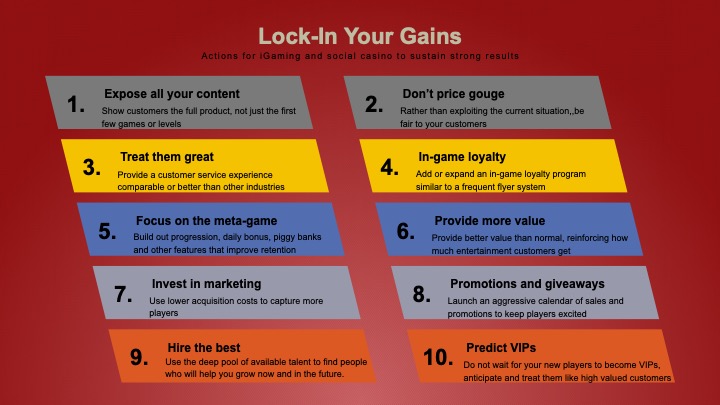
Slide1

Retaining your new customers

The best way to retain the influx of players is by reinforcing to them the great entertainment they are getting so they have less desire to return to the cinema or casino. There are multiple actions you can take to retain these players:

  • Expose them to all that is great. Most entertainment alternatives cannot offer the breadth and depth that a game provides. If the player, however, only sees a small part of your offering, they have no idea what they are missing. Run promotions where you open for a limited time elder-play levels, slot machines that they would not normally have access to or powers and weapons normally available for senior players.
  • Treat them like they expect to be treated. While online gaming provides a great value, often our customer facing teams are less mature than other industries. I have written many times about the importance of creating a WOW experience for your players but with new customers who are used to WOW experiences at their casino or favorite restaurant, it is even more important. Now is the time to double down on giving a great experience, especially to the players likely to become VIPs, who may be used to red carpet VIP treatment at casinos or in other parts of their lives. Match the experience they would get if they go back to their normal haunts.
  • Focus on the meta-game. Social games are great at creating an environment that encourages players to come back regularly. Features like progression, daily bonuses, locking mechanics, piggy banks, etc., create incentives and habits for players to return regularly. These features often promote loss aversion in players or make it a matter of prestige to return, so focusing on building a compelling set of retention features will help prevent churn of your new players.
  • In-game loyalty. Now is the time to improve or add a loyalty system to your game (think airline frequent flyer program). By definition, a good loyalty program increases the loyalty of the customer. Loyalty programs increase the cost the player feels when leaving, making them less likely to churn. Loyalty programs also help form habits that make your game part of their daily activity.
  • Invest in marketing. Now is the best time to invest in marketing to acquire new players, even though many have cut their marketing budgets. Given the damage some industries have faced, overall advertising has decreased, thus cutting the costs most gaming companies face for new users (supply and demand). Instead of acquiring the same number of players you had planned to but at a lower cost, you can use these savings to invest in additional marketing to grow faster than you had projected.
  • Hire the best. While your company may come through the pandemic unscathed or better, unfortunately many others are not. This situation provides a unique opportunity to bring in talent that can take you to the next level that normally would never be available. Even if you do not have an immediate need, consider accelerating your people growth now.

Maintain customers’ monetization

While retaining players is always a challenge, maintaining monetization is much more straightforward. In addition to keeping the new users who have discovered your offering due to being locked in their homes, you want to give them a reason to keep their spend at current levels. The “secret” is giving people value. If you give your customers great entertainment for every dollar they spend, they will learn that your game is a better investment than alternatives. There are several steps you can take to reinforce this understanding

    • Don’t price gouge. Some companies, especially those that consider the pandemic a short-term opportunity, are tempted to use the current situation to extract as much as possible from players. While it could boost short-term profits, it is likely to leave players less satisfied and thus more likely to revert to other options as the lockdowns ease.
    • Provide more value. Rather than squeezing players, now is the time to be more generous (you can afford it with the increased revenue). Ensure that they get more hours of gameplay, more exciting virtual goods, etc., from the purchases they make now. This action will reinforce in their mind the great entertainment value your game is compared with other entertainment products.
    • Conduct great promotions and giveaways. As the pandemic recedes, launch an aggressive calendar of sales promotions as well as giveaways to keep customers engaged at previous levels. Again, be generous as the goal is not to get a short-term boost but to reinforce what a great product you have and then keep these players engaged at current levels for months and years.
    • Predict VIPs. Most iGaming and social game companies have learned the value of VIPs, as it drives profitability in the space. Many of your new customers who eventually would become VIPs, however, have not had time to achieve the criteria that would qualify them for VIP treatment. Loosen your criteria so that you can capture future VIPs and give them exceptional treatment that they will not want to lose. This treatment is particularly critical in the iGaming and social casino space where they will probably have a host waiting for them at their land based casino when it reopens.

It’s up to you

The current Covid19 crisis means it is not business as usual. If your business is one of the few companies actually benefitting, do not make the mistake of missing a once in a lifetime opportunity to go to the next level. Now is the time to do everything you can to retain your new customers and give them a reason to keep monetization at new levels.

Key takeaways

  1. While most of the economy is suffering right now, some online companies, particularly in the iGaming and social gaming space, are benefiting. These lucky games need to lock in these gains rather than miss a once in a lifetime opportunity.
  2. To consolidate gains, companies need to minimize churn from this new cohort of players and provide customers a reason to maintain their new monetization levels.
  3. Some of the most effective ways to retain these new customers include exposing them to the full product, introducing a loyalty program, enhancing meta-features and providing great customer service.
Share this:

  • Click to share on Facebook (Opens in new window) Facebook
  • Click to share on LinkedIn (Opens in new window) LinkedIn
Like Loading...
Unknown's avatarAuthor Lloyd MelnickPosted on May 6, 2020April 25, 2020Categories General Social Games Business, General Tech Business, Growth, Social Casino, Social Games MarketingTags Coronavirus, Covid19, iGaming, real money online gambling, social casino2 Comments on Consolidate your gains (if you have them)

Podcast on outlook for social casino sector

Podcast on outlook for social casino sector

I was fortunate recently to be invited to the Deconstructor of Fun podcast to talk with Joseph Kim and Brett Nowak (Founder/CEO of Liquid & Grit) about the future of the social casino space. For anyone interested in our conversation, listen to the Podcast or view the discussion on YouTube.

Share this:

  • Click to share on Facebook (Opens in new window) Facebook
  • Click to share on LinkedIn (Opens in new window) LinkedIn
Like Loading...
Unknown's avatarAuthor Lloyd MelnickPosted on May 1, 2020May 1, 2020Categories General Social Games Business, Social CasinoTags podcast, social casinoLeave a comment on Podcast on outlook for social casino sector

Winners and Losers in the entertainment space post-Coronavirus

Winners and Losers in the entertainment space post-Coronavirus

While it is impossible to predict exactly what businesses in the (broadly defined) entertainment space will benefit from Coronavirus and which are likely to fail, some basic and timeless principles help understand the likely winners and losers. There are two keys for successful entertainment company.

First, an abundance of content is the biggest revenue driver. While quality is obviously important, nobody wants to consume bad content, quantity is also critical. Content is a consumable and once it is consumed people look for more, if it is not available they will find something else. Successful operators constantly deliver new quality content to keep customers engaged.

Second, the subscription model is emerging as the dominant model in the entertainment space (not necessarily a new phenomenon, as Netflix and Amazon Prime have been around for years), growing from its existing stronghold to other parts of media. Additionally, subscriptions driven by Coronavirus are more likely to stay resilient in the aftermath of Covid19 as they will require action to cancel rather than asking people to continue making purchases.

Using this filter of abundant content or a compelling subscription model, it becomes easier to ascertain what companies and products will emerge from the Coronavirus situation in a good position.

Winners

There are likely winners that will emerge from the current situation. Those that I consider most prone to benefit include:

  • TikTok. While TikTok was already experiencing amazing growth, Coronavirus provided the rocket fuel. TikTok is a video sharing network used to create short dance, lip-sync, comedy, and talent videos. Since it relies on user-generated content, its increased traffic driven by Covid19 has led to increased content, creating a network effect that makes it an even more compelling destination for customers.
  • Houseparty. Houseparty is a social networking service that enables group video chatting through mobile and desktop apps. Since Houseparty relies on users to create content, in this case chats and virtual parties, it enjoys the same benefits as TikTok, increased use has led to increased content. Already a winner as it was acquired last month by Epic Games (Unreal, Fortnite, etc.), Houseparty is poised to grow its first party base and spread into Epic’s family of games developed using Unreal.
  • Netflix. It is hard to say the largest streaming media company can benefit further, but Netflix is likely to see a long-term benefit. With the broadest range of programming including a plethora of original programming, Netflix cemented its value to existing customers while bringing in new subscribers. One only has to hear the words Tiger King to know how Netflix has won.
  • Amazon Prime. Amazon Prime, Amazon’s streaming video service, which also includes free delivery on Amazon purchases, is likely to enjoy the same benefits as Netflix due to its abundance of content. Given its huge library of third-party content coupled with a large amount (though less compelling than Netflix) of original content, very few customers (if any) are likely to have become satiated. New subscribers are apt to continue their subscription while existing customers are less prone to churn as they have experienced the value of their Prime subscriptions.
  • Steam. Just as video streaming services with abundant content like Netflix and Amazon Prime will benefit, Steam will profit in the video gaming space. Steam describes itself as the ultimate destination for playing, discussing and creating games. Like Netflix and Amazon, it has the largest catalog of quality PC games and its library continues to grow faster than customers can consume the content. This ever-growing library will help it sustain the growth from Covid19.
  • Coursera. Electronic learning was already a sector in its ascendancy and the increasing number of people looking for options to stay busy while in lockdown or quarantine sped the adoption of this sector. Coursera has the most courses from top learning institutions and given the importance of breadth and depth of content, it is thus likely to be the biggest winner in its space.
  • Udemy. Udemy is similar to Coursera in that it is an online learning platform. Unlike Coursera, however, Udemy crowd-sources its content, allowing individuals and companies to create content. This crowd-sourcing strategy helps it offers thousands of courses on a huge variety of topics. With quantity of content paramount, Udemy is likely to benefit greatly in the aftermath of Covid19.
  • Hit Free-2-Play games. Early data has shown that Coronavirus has increased downloads almost across the board for mobile and free-to-play games but the revenue increase is more localized to the top games. This phenomenon reflects that most hit games already have a deep reservoir of content, giving players many options and incentives to spend. This growth is likely to sustain after Covid19 as the more players spend in the game, the more invested they feel and are thus less likely to churn.

Losers

While there are multiple winners in the entertainment space, Coronavirus is also likely to highlight the companies with a flawed value proposition.

  • Quibi Quibi is a new streaming service focused on delivering professionally created content in 10 minute episodes. Founded by Jeffrey Katzenberg and Meg Whitman, it has raised almost $2 billion. Quibi’s lack of content spells disaster, despite what you may think of Quibi’s business model, execution or ability to raise investment. While Netflix and Amazon Prime have had years to develop original content, Quibi has had less than two years and it shows in a very non-compelling catalog. Due to its model, Quibi also needs to create six episodes (at about 10 minutes each) for every episode of original content a competitor creates (at 60 minutes each) to deliver the same value to the customer. Moreover, as both Netflix and Amazon were able to launch and grow their businesses using third party content to supplement their initial offerings (in the early days it was their initial offering) and give a broad catalog to customers, as Quibi is introducing a new format there is no third party content available. Moreover, while TikTok can generate almost unlimited crowd sourced content, Quibi has shunned this option. This lack of content spells doom for Quibi.
  • Apple Arcade and Google Stadia. Apple Arcade and Google Stadia are two streaming games services on Apple’s iOS and Google’s Android
    platforms, respectively. While both are subscription services and should thus benefit, content dooms them. Although they both offer a somewhat large number of games, they must compete with the near unlimited number of games on their own app stores. Layering on to this challenge is that most mobile games are free-to-play, you can enjoy the games without ever making a purchase, so they do not have a compelling value proposition for their subscriptions.
  • Movie theatres. One segment of the entertainment space whose existing challenges were accelerated by Coronavirus are movie theatres. Unlike streaming services like Netflix or Amazon Prime, theatres do not have a plethora of content or offer a subscription service. Thus, they are unlikely to recapture many of the customers they have lost.
  • edX. edX is an online learning platform similar to Coursera, founded by MIT and Harvard universities. Unlike Coursera, though, edX has a much more limited catalog of courses. Given the importance of content, it is likely to fall behind its more robust rivals.
  • Mediocre Free-2-Play games. The rich get richer. While the hit games are enjoying a big boost in revenue due to players staying at home, mid-tier games are not seeing a similar uplift. While their downloads have increased, it is not translating into more in-app purchases. In part, this activity is driven by the top games having a very deep pool of content, be it virtual goods, levels, battle passes, etc. Their success allows them to create even more content as content creation is resource intensive. In the aftermath of Covid19, the gap between the haves and the have not games is likely to have increased while customers who sampled games with limited content are probably done with those games.

Maybe

There is one entertainment offering that I am not willing to call a winner or loser yet, Disney+. There are mixed signal using both the content and subscription screen.

While Wall Street has lauded the initial subscriber numbers for Disney+, I am not convinced it will be a long term success. In only a few months, more than 50 million people subscribed to the service, exceeding even the most optimistic projections. Given these subscriber numbers, it is easy to assume that the service will be a long-term success approaching the value of a Netflix.

The concern, however, should be the depth and breadth of content. Unlike Netflix and Amazon Prime, Disney+’s content is limited to the Disney family (Disney, Star Wars, Marvel, National Geographic and Pixar). While this is very compelling content for many (about 50 million) initially, will it sustain? People consume content and even this large back catalog of offerings will be old to many of the 50 million in a few months or a year. Relying on first party content, will Disney be able to keep a sufficient content flow not only to appeal to new customers but keep from churning a big portion of these 50 million subscribers.

Key takeaways

  1. While streaming and digital entertainment has enjoyed a windfall from people staying at home, winners and losers will emerge in the aftermath of Covid19.
  2. The winners will be the companies that have a very deep and broad content offering (either by first party development or crowdsourcing) and leverage effectively the subscription model, while losers are likely to have limitations on their proposition.
  3. Among the likely winners are crowdsourcing champions TikTok and HouseParty as well as streaming services like Netflix, Amazon Prime, Coursera and Steam. Likely losers are Quibi, edX, Apple Arcade and Stadia who either have limited or less compelling content. The jury is still out on whether Disney will have enough content to make Disney+ a long-term winner.

Share this:

  • Click to share on Facebook (Opens in new window) Facebook
  • Click to share on LinkedIn (Opens in new window) LinkedIn
Like Loading...
Unknown's avatarAuthor Lloyd MelnickPosted on April 29, 2020April 13, 2020Categories General Social Games BusinessTags Coronavirus, Covid19, Disney, Quibi, TikTok2 Comments on Winners and Losers in the entertainment space post-Coronavirus

Design + Behavioral Economics = Apple

Design + Behavioral Economics = Apple

I recently read a great book on Jony Ive (Jony Ive: The Genius Behind Apple’s Greatest Products by Leander Kahney), the designer who created most of Apple’s products, that provided insights into the keys to Apple’s success. What was particularly interesting is how much of his design philosophy was consistent with the behavioral economics and consumer behavior insights that I wrote about earlier this year after reading Rory Sutherland’s Alchemy.

Kahney’s book also showed that what many, including myself, considered good luck or timing by Apple were the result of decisions driven by Ive’s design philosophy. The iPod was not simply an MP3 player at the right time, the iPhone was not just another mobile phone that hit a nerve with customers and the iMac was not simply a pretty PC. These were all products driven by a fundamental design philosophy backed by consumer behavior principles.

iMac

While most people acknowledge Apple’s strengths, its success (one of the five largest companies in the world, valued at over $1 trillion) highlights how leveraging these principles builds value. It is impossible to replicate what Jobs and Ive did – just as an American football team cannot simply replicate what Belichek and Brady did – there are underlying principles that can help any company. These concepts are also extendable to other industries, including digital ones like iGaming and the video game sector.

Simple is better

One of the key takeaways from Alchemy was that “Less is More”, a product with less functionality is more likely to change fundamentally behavior. This belief is also at the center of Ive’s design philosophy. Kahney writes about Ive, “the process of simplification is design 101, a mind-set that every design student is taught in school. But not every student adopts it, and it’s rarely applied with the ruthless discipline practiced by Jony…. The shy boy from Chingford is happiest when the user doesn’t notice his work at all.” Ive’s philosophy is also consistent with Job’s mantra: ‘Simplicity is the ultimate sophistication.’

This philosophy drove how Ive approached design. Not only did he aim for simple design, it was the centerpiece of how Apple built products. First, Ive did not focus on making his products pretty or cool; instead the focus was on simplicity. As Ive once said, “we are not interested in design statements. We do everything we can to simplify design.”

With Ive, simplicity was not limited to how a product looked. According to Kahney, “as part of his characteristic drive to reduce and simplify, Jony wanted to reduce the number of parts and therefore the number of part-to-part joints. Previously, when IDg [Apple’s internal design group] had done a similar dismantling of an original iPhone, the team counted nearly thirty interfaces where parts meet. After the iPhone underwent a unibody makeover, the number of interfaces shrank to just five.” Apple repeated this design principle over multiple products, from laptops (starting with the MacBook Air to phones to desktop computers). In all these cases, simplicity was much more than skin deep.

The story of the iPod is a great example of how an unwavering focus on simplicity led to incredible commercial success. Before reading Kahney’s book, I thought the iPod was a combination of good timing (music going digital), a beautiful looking design and integrated software (iTunes). The reality was that the iPod was a transformational product because of Ive’s and Job’s unwavering focus on simplicity.

The iPod was a result of Jony’s simplification philosophy. Kahney writes that “it could have been just another complex MP3 player, but instead he turned it into the iconic gadget that set the design cues for later mobile devices.”

original ipod

What made the iPod successful was not cool new features but what it did not have. At the time, most electronic devices had removable batteries, meaning they needed a battery door, plus an internal wall to seal the device’s guts from the user when the battery door is opened. Jony dispensed with both, creating a tighter, smaller gadget. Ive also eliminated the on-off button, which infuriated many users (and reviewers). Instead he had the idea of pressing any button to turn the device on, and then to have it turn itself off after a period of inactivity, a stroke of minimalist genius.

On the software side, Apple acquired a third-party MP3 jukebox program for the Mac, SoundJam MP, from a small company, Casady & Greene. Apple then hired Casady & Greene’s top programmer, Jeff Robbin. Robbin’s team moved to Apple’s HQ and set about retooling SoundJam, stripping out many features to make it accessible to first-time users. Under the direction of Jobs, Robbin spent several months simplifying the program, which eventually turned into iTunes. The key to iTunes was what Robins removed from the program after it was acquired by Apple, not what features were added.

itunes

The iPod example not only shows the power of simplicity but also how hard it is. Getting rid of the on-off button took much more effort and time than simply redesigning or moving the button. Simplifying iTunes required the dedicated effort from one of the best developers in the world. What led to success, however, was Apple’s willingness to devote extraordinary resources to eliminating features and complexity rather than the natural tendency to put those resources into building more.

Play to people’s habits

A second takeaway, again consistent with Alchemy, is the importance of building something for how people behave, not just what they need. As Sutherland pointed out, not only is the logical and rational path not necessarily optimal, it is also not the one our customers might be pursuing. Before Apple, one of Ive’s biggest successes was designing the TX2 pen for a Japanese company. Jony’s innovation was to put something on a pen that was purely there to fiddle with. The pen’s design was not just about shape, but also there was an emotional side to it. The pen immediately became the owner’s prize possession, something people always wanted to play with. As Kahney writes, this “‘fiddle-factor’ notion may have seemed trivial to some, but the incorporation of the ball and clip transformed the pen into something special.”

tx2

Ive’s unusual pen anticipated built the kind of allegiance that later Ive-designed products at Apple would inspire. The handle on the iMac shows Ive’s understanding of non-traditional consumer behavior. It is not for carrying the iMac around, but to build a bond with the consumer by encouraging them to touch it. Kahney says, “it was an important but almost intangible innovation that would change the way people interacted with computers.”

imac

Be bold

Another lesson in Apple’s success is to be bold. While people often feel it is less risky to iterate on proven design, the opposite is true. I once wrote it is less risky to pursue a Blue Ocean strategy than a Red Ocean one, as the latter places you in the middle of intense competition. In Alchemy, Sutherland also points out Logic does not necessarily lead to great, in many ways it drives you to average. The same is true of design, everyone is looking at making incremental improvements and your “new” design is likely to look like 20 of your competitors.

Ive and Jobs philosophy of simplification led to a need to make bold breaks from the past. The iMac was the first legacy-free computer. Apple ditched ADB, SCSI and serial ports, and included only Ethernet, infrared and USB. Apple also abandoned the floppy drive. These choices, particularly abandoning the floppy, generated intense criticism but were consistent with Ive’s and Job’s philosophy. If they were afraid of criticism, however, the iMac would not have disrupted the space.

Just as simplicity is not easy, neither is going legacy free when Apple designed the iPhone. Rather than improving on a Nokia or Motorola design, Ive and Jobs started from scratch. Kahney writes, “Apple attorney Harold McElhinny would describe the immense amount of work the project required. ‘It required an entirely new hardware system … It required an entirely new user interface and that interface had to become completely intuitive.’ He also said Apple took a huge leap of faith moving into a new product category. ‘Think about the risk. They were a successful computer company. They were a successful music company. And they were about to enter a field that was dominated by giants … Apple had absolutely no name in the [phone] field. No credibility….The arrival of the iPhone at Macworld was the culmination of more than two and half years of intense hardship, learning and dedication to bring it to market. As one Apple executive summed it up, ‘Everything was a struggle. Every. Single. Thing was a struggle for the entire two-and-a-half years.’”

Part of not just iterating involves focusing on the new experience, not other elements of the product. With the iPhone, Ivy and his team designed the phone without ever seeing the operating system. They initially worked with a blank screen and later, a picture of the interface with cryptic mock icons. Likewise, the software engineers never got to see the prototype hardware.

Start with the user

When applying behavioral economics, you learn that market research is often as unreliable as other data. As well as not always acting rationally, people often do not know what they prefer. Ive’s approach was consistent, as Kahney writes, “’we don’t do focus groups–that is the job of the designer,’ said Jony. ‘It’s unfair to ask people who don’t have a sense of the opportunities of tomorrow from the context of today to design.’….Jony was interested in getting things right and fit for a purpose. He was completely interested in humanizing technology.”

The iMac is a great example of this principle in practice. The machine did not revolve around chip speed or market share but Jony built it by focusing on how do people want to feel about it and what part of our minds should it occupy.

At Apple, designers focused on imagining objects that did not exist and bring them to life. Part of what they had to envision was defining the experience that a customer has when they touch and feel an Apple product, from the materials to the textures to the colors.

For Ive, the first step in creating a product was developing the design story. He did not feel he was building a product but instead was building the user’s perceptions and meaning of the product. According to Jon Fortt of the San Jose Mercury News, “Apple’s focus on the needs of the consumer made the iMac a hit. ‘What made the original iMac cool was not its color or shape. It was Apple’s demonstrated willingness to open the possibilities of Internet computing to an audience that had been ignored by the brainiacs who design PCs.’”

The focus was not on legacy but on the customer and how the user would feel about the device. Ivy once said, ‘when we are at these early stages in design, when we’re trying to establish some of the primary goals–often we’ll talk about the story for the product–we’re talking about perception. We’re talking about how you feel about the product, not in a physical sense, but in a perceptual sense.’

Attention to detail

Another key to Apple’s success is the attention to detail that Ive gave to design. His colleagues said, “whatever he did was never quite enough; he was always looking to improve the design….The level of finish was what was always amazing about his work relative to others. Others were and are capable of the conceptual thought and creativity but very few capable of that level of finish….The differences from one [of Ive’s] model to the next were subtle, but the step-by-step evolution betrayed Jony’s drive to thoroughly explore his ideas and get it right. Building scores of models and prototypes would become another trademark in his career at Apple.”

While many designers would focus on the visuals, Ive worried just as much about the guts of his designs. When people disassembled models he created, they found the inside of the models included the components. Ive had even worked out the thickness of the parts and how they would be manufactured in an injection moulder. Thus, when his designs moved to production, Apple could fulfill the vision without having to modify them to work.

The importance of attention to detail is reflected in how Jobs and Ive responded to impending bankruptcy. As Kahney quotes an Apple employee at the time, “you would have thought that, when what stands between you and bankruptcy is some money, your focus would be on making some money, but that was not [Steve Jobs’s] preoccupation. His observation was that the products weren’t good enough and his resolve was, ‘We need to make better products.’” The focus on making the perfect product is what Apple rode from near bankruptcy to near world domination.

Needs to encompass everything

Related to the focus on attention to detail was a focus on design encompassing everything, not simply the visual. I was amazed that Ive’s high-powered design team (and Jobs) would put the same effort in a product’s packaging as the actual product. Kahney writes, “boxes may seem trivial, but Jony’s team felt that unpacking a product greatly influenced the all-important first impressions. ‘Steve and I spend a lot of time on the packaging,’ Jony said then. ‘I love the process of unpacking something. You design a ritual of unpacking to make the product feel special. Packaging can be theater, it can create a story.’”

The iPod was Apple’s first product where Ive applied his design genius to packaging. The result was an elaborate box that cradled the iPod like a piece of jewelry. This packaging was an integral part of the iPod’s success and Apple’s transformation.

packaging

Ive and his design team also focused on the insides of a product, normally the responsibility of engineers. When designing the iMac, the original solutions the team came up with pushed the boundaries of traditional manufacturing.

Ive also almost singlehandedly redefined how high-end laptops are manufactured. Kahney explains, “Jony was proud of the PowerBook’s construction, and dismantled one for his 2003 Designer of the Year exhibition at the Design Museum. ‘We took [it] to pieces so you can see our preoccupation with a part of the product that you’ll never see,’ Jony said. ‘I think–I hope–there’s an inherent beauty in the internal architecture of the product and the way we’re fabricating the product: laser-welding different gauges of aluminum together and so on….Jony went on to explain the manufacture of the MacBook Air, Apple’s new razor-thin laptop. Instead of taking multiple sheets of metal and layering them, the new process began with a thick block of metal and, in a reversal of the old process, produced a frame by removing material rather than by adding it. Multiple parts were replaced by just one–hence the name unibody.”

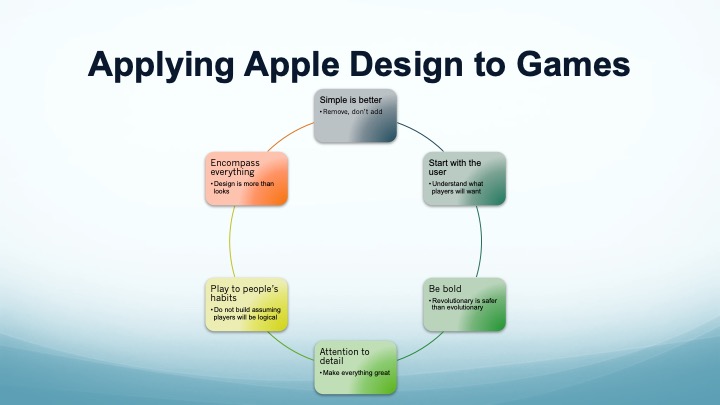
Lessons for iGaming and video game companies

Slide1

When I started reading Jony Ive: The Genius Behind Apple’s Greatest Products by Leander Kahney, I thought it would be an interesting book with a few tidbits I could apply in the casino space. Instead, almost everything that made Ive, Jobs and Apple great can help both iGaming and social casino companies:

  1. Simple is better. Most gaming companies focus on adding features and content to grow, while the opposite may generate more success. Look at what you can take out to give the player a better, more directed, experience.
  2. Play to people’s habits. People do not always act logically. Rather than assuming they will, look at how they actually behave and test different (sometimes illogical) approaches.
  3. Be bold. Rather than trying to do what everyone else is doing a little bit better (which they are all trying to do), try a new and unique approach.
  4. Start with the user. Design your product by understanding how your customer will enjoy and use it.
  5. Attention to detail. Do not settle for good enough, make sure every element, even the smallest, are as great as you can build.
  6. Encompass everything. Focus on everything, not just the look but the underlying architecture, customer service and all the parts of your product.

If we learn from Ive and Jobs, we can create new and better products despite how competitive the casino space is.

Key takeaways

  • Steve Jobs, and his design guru, Jony Ive, turned Apple into one of the world’s most valuable companies because of an unwavering commitment to design.
  • Their design philosophy focused on simplicity, the greatest Apple products came from eliminating features and complexity while stream-lining performance.
  • Other keys to Apple’s design success are a focus on how the customer will experience the product, not asking customers but understanding customers, making bold decisions rather than evolutionary ones, a focus on detail and including all elements of the product in the design process.

Share this:

  • Click to share on Facebook (Opens in new window) Facebook
  • Click to share on LinkedIn (Opens in new window) LinkedIn
Like Loading...
Unknown's avatarAuthor Lloyd MelnickPosted on April 22, 2020April 6, 2020Categories General Social Games Business, General Tech Business, Lloyd's favorite posts, Social CasinoTags Apple, Consumer behavior, jony ive, Product design, simplicity2 Comments on Design + Behavioral Economics = Apple

Finding Blue Ocean opportunities in gaming in the post-Covid19 world

Finding Blue Ocean opportunities in gaming in the post-Covid19 world

Rather than trying to predict when the pandemic will end or the final impact, which is impossible, now is the time to start planning for business opportunities in the aftermath of Coronavirus. I have never been a big fan of predictions, if anyone could predict the future or even trends their income would dwarf Warren Buffet’s, rather it is often an exercise in confirmation bias (remembering our correct predictions) or vanity. A recurring theme, however, of this blog has been the benefits of pursuing Blue Ocean strategy, an approach that has a higher expected return than traditional strategy. While not predicting when the current crisis will end or what the world will look like after it, it is smart to begin planning your economic future.

If you are fortunate enough to experience growth or even stability during the current crisis or are one of the many unfortunate to be furloughed or made redundant during this time, in both scenarios it is important to start preparing your next steps as the world exits the Covid19 situation. A recent article on Forbes, There Will Be Blue Ocean’s Everywhere Post Pandemic by Bob Zukis, reminded me how you should juxtapose Blue Ocean strategy with planning for the aftermath of Covid19. After the pandemic, the often-rare Blue Oceans will be abundant. Anticipating these Blue Oceans and building a strategy to leverage them could result in not only financial stability but big future successes.

Key principles of Blue Ocean Strategy

Before determining how to apply Blue Ocean strategy, it is important to understand the key fundamentals of this approach. First, Blue Ocean is all about turning non-customers into customers, rather than competing for the same customer. By pursuing a Blue Ocean strategy, you create an uncontested market space and make the competition irrelevant. Rather than taking market share, you are creating markets.

Second, developing and implementing a blue ocean strategy involves four crucial actions: eliminate, raise, reduce and create. These are changes to your existing product or a way a market segment is approached. To pursue a Blue Ocean strategy targeting the real money online casino space, for example:

  • the first step would be to eliminate. As online players are generally more focused on the underlying gaming mechanic, you might eliminate dealers.
  • The next step is raise, that is increase something in the product so it appeals more to this segment. Since casino players are looking for slots, you may launch with 500 different slot machines, more than any land-based casino.
  • The third step is to reduce. In this example, since you have a lower cost base, you can probably reduce the amount of each players bet (hold or RTP) that you keep.
  • Finally, you need to create, that is add in new functionality for the target audience. If you are creating products for online casino players, maybe you would add in social features that would replace some of the tertiary benefits they get from going to a land-based casino, like a chat function.

If you try to build a Blue Ocean strategy and fail to include these four steps, you will not end up with a true Blue Ocean plan and competitors will quickly eat into any success you experience.

Blue Ocean, gaming and Coronavirus

Covid19 will create an unprecedented plethora of Blue Ocean opportunities, including in the gaming space. Zukis wrote, “rarely do blue oceans appear out of nowhere in business. But they’ll be splashing up everywhere post-pandemic…. When they’ve appeared lately, they can often be more like blue lakes than oceans, and extreme competition from other fishers can quickly turn the lake red.”

You need to understand how the ecosystem will evolve after the pandemic, particularly online. Zukis says, “[the] digital operating system is what will help them find these oceans and navigate the journey safely.” That is, the way people consume and companies deliver content will change. The competitive landscape will also evolve due to the pandemic. While it is impossible to predict the post-pandemic situation, there are several variables to consider and questions to ask when anticipating where the new Blue Oceans will be both for iGaming and social casino (but this can be extended to virtually any space):

  1. Competition. Many companies may not survive the pandemic. If land based casinos contract significantly, not only would that create land-based opportunities but also may open up other areas that these casinos dominated.
  2. Regulatory. Will governments, particularly in US states, loosen online gaming regulations to create jobs or generate tax revenue to help pay the huge debt they are building.
  3. Online collaboration. Will people be more likely to replace business meetings and social get togethers with their virtual equivalents, continuing to use products like Zoom and Houseparty.
  4. Advertising. With the economic disruption caused by Covid19, the cost of advertising should change (potentially long-term if certain industries do not rebound), new channels will emerge while other channels will disappear.
  5. Openness to digital Will people, especially older people, be more likely to replace land-based activities with digital content. In the gaming space, will people who previously only would gamble on a physical machine now be open to or even prefer playing digitally.
  6. Economic situation. Will the world or individual countries rebound quickly or suffer a prolonged downturn. Will the economic shift the importance of certain markets.
  7. Spend patterns. Will people be more conservative in their spend after the huge economic disruption; as Depression era people always felt a need to keep a strong cash reserve. Conversely, will people spend more easily because they had not spent for months.
  8. WFH. Companies may decide it is more efficient to let employees continue to work from home or people may decide they prefer WFH than going into an office.
  9. Investment. Will it be easier to raise funds from VC or Angels, will new investment sources appear or will funds dry up.
  10. New digital platforms. Will crowd-sourced apps and services like TikTok and HouseParty evolve to become dominant platforms and new ways to reach customers or will new providers like Disney+ and Quibi become the path to reach players.
  11. Conferences. Rather than visiting conferences, people may prefer to attend virtual conferences. This can lead to fewer conferences or more virtual ones.
  12. Travel. Will people revert to past travel patterns, travel more to make up for time spent at home or travel less because fears have increased.
  13. International trade. Will it become easier or harder to operate across borders.
  14. Commercial real estate. Rents may plummet if retailers are unable to reopen or more companies move to working from home.

By looking at the above variables and then integrating them with the eliminate/raise/reduce/create framework, not only will Blue Ocean opportunities appear but you will appreciate how to pursue them.

Anticipate the competition and move forward

One consideration that is often neglected when building a Blue Ocean Strategy is anticipating the competition and this issue is particularly relevant now. In the post-Covid19 environment, this factor will be even more important as you are not looking for new opportunities in a vacuum; there are hundreds, if not thousands, of other people also thinking about what to do next. They may be forced into the situation because their company has gone out of business or they lost their job or may be looking to accelerate momentum they gained from being in the right place at the right time.

When evaluating your Blue Ocean options, realize that the most obvious ones are likely to be pursued by others. Thus, that beautiful Blue Ocean on your screen may be full of blood before you even get there. That is why it is critical to follow the Blue Ocean framework painstakingly, truly focus on what you can eliminate/raise/reduce/create, and ensure you reach the optimal option. While any new initiative may fail, if you follow this strategy you have the best chance of seeing an outsized return.

Key takeaways

  • Blue Ocean strategy historically has a much higher ROI than pursing a Red Ocean approach and Covid19 will create an plethora of Blue Ocean opportunities.
  • A Blue Ocean strategy is one where you avoid the competition rather than trying to beat them; you do this by eliminating/raising/reducing/creating features.
  • You also need to anticipate what others will do, avoid the obvious as it won’t be a Blue Ocean if five others get there first.

Share this:

  • Click to share on Facebook (Opens in new window) Facebook
  • Click to share on LinkedIn (Opens in new window) LinkedIn
Like Loading...
Unknown's avatarAuthor Lloyd MelnickPosted on April 15, 2020April 12, 2020Categories blue ocean strategy, General Social Games Business, General Tech Business, Social CasinoTags blue ocean, blue ocean strategy, Coronavirus, Covid191 Comment on Finding Blue Ocean opportunities in gaming in the post-Covid19 world

The Reese’s Peanut Butter Cup of game monetization models

The Reese’s Peanut Butter Cup of game monetization models

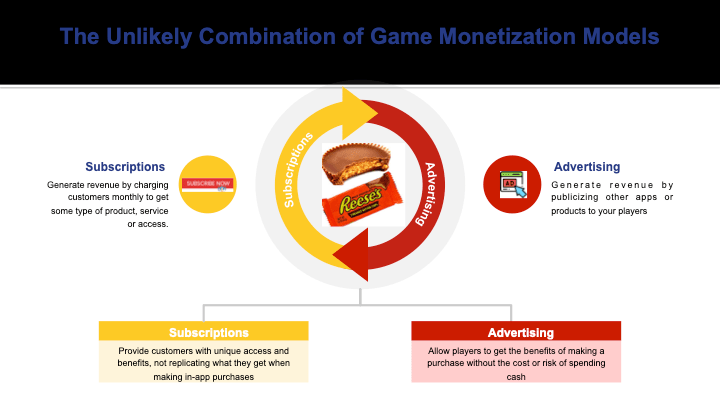
I am always on the lookout for monetization models that can augment or disrupt the gaming space and I have recently come across a hybrid one that has great potential. I think subscriptions are a great way to create recurring revenue and increased loyalty. I am also a big fan of in-game advertising, as it allows players who would not normally monetize to gain greater value from a product while delivering revenue to the creator. I also recently noted the success of hypercasual games, which has been driven by advertising.

Slide1

Recent research in the streaming space highlights an intriguing opportunity for game companies. A survey of consumers with connected televisions found that 76 percent are open to see ads in exchange for free streaming services. Additionally, 64 percent of consumers say they don’t plan to add a subscription video streaming service in the next year.

There are two very important implications of this research. The first is that while traditional subscriptions are still promising, many people are reluctant to add more subscriptions to their monthly burn. While it is still too early to understand the impact of Coronavirus, people may become even more conservative with their cash flow as they have to deal with a new economic environment. Second, rather than ask people to sign up for a regular charge, they are more likely to agree to a subscription if the cost is “free,” simply watching an advertisement(s).

Opportunities

For game companies, this peanut butter cup (the combination of subscriptions and advertising) presents multiple opportunities:

  • Create an additional subscription stream where players deliver revenue through ads. While the amount you can generate has a lower ceiling with ads, you can still build a subscription model using ads. By relying on ads rather than purchases, you also reduce customers’ barrier to signing up so you are more likely to get high pick up rate.
  • Use advertising to drive a game streaming service. While Stadia, and possibly Apple Arcade, have not gained much traction with a traditional subscription model, an ad-driven purchase model might allow them to get critical mass.
  • Leverage ad-driven subscriptions to sell flow of regular game or content release. If you are a hypercasual publisher, an ad driven subscription model can give players access to X/month games.

Ad driven subscriptions can also be integrated into different stages of your customer lifecycle or a broader subscription model. Rather than asking people to commit before they are hooked on your product, allowing players to subscribe by watching ads the first month or the first three months lowers their risk while getting them to become a subscriber. You then convert them later in the funnel to full paying subscribers.

You can also allow players who have lapsed or churned to renew their subscription by watching an ad. Thus, if they had to cancel because of cash flow issues or if they were not getting sufficient value to cover the cost, ad-driven subscriptions are an additional way to retain some revenue from these players and keep them in your ecosystem.

Challenges

While offering an ad-driven mechanic for customers to subscribe creates many options, it also presents challenges. First, one of the great benefits of subscriptions is that it gets your customers invested in the product. This makes them more committed and engaged. If they acquire the subscription by watching an ad(s), they may not be as committed to the long-term relationship. Second, to generate sufficient subscription revenue, a customer will need to watch or be exposed to multiple ads. If they are just watching ad after ad in one sitting, the value you can deliver to advertisers will be minimal. You will need to come up with creative solutions to generate enough ad revenue to justify providing a subscription. Finally, a subscription requires regular purchases, which is how subscriptions delivers reliable revenue. It is simple to bill a player regularly for their subscription and it becomes passive activity for your customer. With advertising, they will have to proactively watch ads every time the subscription renews. One potential alternative would be showing interstitial ads or ads in another frame, rather than relying on a watch-to-earn mechanic.

Figure it out

Just because nobody before Reese’s thought of a good way to combine chocolate with peanut butter did not mean it was a bad idea. It is the same with ads and subscriptions. The companies that crack the code first for merging these two monetization models are likely to see great returns.

Key takeaways

  1. Two of the most promising business models to grow the game industry are subscriptions and advertising, so combining the two can create a unique opportunity.
  2. There are three ways game companies can leverage this opportunity: create an in-game subscription option that incorporates ads, use subscriptions to grow a streaming service or publish a flow of games that customers subscribe to via subs.
  3. Challenges include generating enough subscription revenue through ads, getting customers to feel committed and figuring out a mechanic for players to renew.

Share this:

  • Click to share on Facebook (Opens in new window) Facebook
  • Click to share on LinkedIn (Opens in new window) LinkedIn
Like Loading...
Unknown's avatarAuthor Lloyd MelnickPosted on April 8, 2020March 28, 2020Categories General Social Games Business, GrowthTags advertising, monetization, SubscriptionLeave a comment on The Reese’s Peanut Butter Cup of game monetization models

Podcast on Working from Home during the Coronavirus situation

Podcast on Working from Home during the Coronavirus situation

If you are interested in issues related to working from home and missed my appearance Wednesday on IndieGameBusiness yesterday, the podcast is available here.

Slide1

Share this:

  • Click to share on Facebook (Opens in new window) Facebook
  • Click to share on LinkedIn (Opens in new window) LinkedIn
Like Loading...
Unknown's avatarAuthor Lloyd MelnickPosted on April 2, 2020April 2, 2020Categories General Social Games Business, General Tech BusinessTags podcast, Work from homeLeave a comment on Podcast on Working from Home during the Coronavirus situation

Live conversation on getting the most of Working from Home

Live conversation on getting the most of Working from Home

Excited to be a guest today (Wednesday, 1 April) at 1200 noon EST on the IndieGameBusiness podcast to discuss how you can survive, and thrive, while working from home. If you are free, tune in and ask some questions. It can be watched live on Mixer, Twitch, YouTube, LinkedIN, and Facebook.

Share this:

  • Click to share on Facebook (Opens in new window) Facebook
  • Click to share on LinkedIn (Opens in new window) LinkedIn
Like Loading...
Unknown's avatarAuthor Lloyd MelnickPosted on April 1, 2020March 31, 2020Categories General Social Games Business, General Tech BusinessTags Work from homeLeave a comment on Live conversation on getting the most of Working from Home

Diversity is much more than superficial fixes

Diversity is much more than superficial fixes

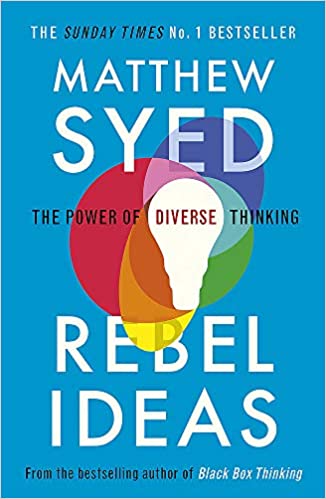
When I worked at the Stars Group, I learned the value of having a diverse team. My team had people from the US, UK, Russia, France, Israel, Isle of Man, Kazakhstan, The Netherlands, Ireland and India; while colleagues at the company increased this list even more. This diversity led to solutions and approaches that helped us to create great products (and results) with limited resources. While I already grasped the value of diversity, Rebel Ideas by Matthew Syed showed how you can magnify this value.

Rebel Ideas

Strive for cognitive diversity

At the core of Rebel Ideas is the concept of cognitive diversity, that you need people that think differently rather than just look different. While you can create an incredible relay team by cloning Usain Bolt, Apple’s design department would not have been as incredible if they simply cloned Jony Ive. Tackling complex problems demands more than just intelligence or skill. Two designers may have different nationalities and genders, but if they use the same inputs, materials, techniques and approaches to solve problems they will come to similar designs. If you recruit designers, however, who use different approaches, they will draw on different materials, ask different questions and make different assumptions.

To get the broadest range of solutions, and thus the one most likely to be optimal, you need true diversity. Diversity should not be limited to demographic attributes, like gender, race, age, sexual orientation or religion. It must be a diversity of the mind, or cognitive diversity, something we cannot achieve simply by cloning our top performers. It is by finding people with different mindsets.

One other way to get diversity is by not boxing people in. Do not limit design ideas to designers or product management to product managers. You will find that by letting people participate in conversations out of their core function they will often bring a new layer of diversity. One of the best examples is again Apple, where its design team drove some of the biggest manufacturing innovations.

Avoid homophily

While the idea of cognitive diversity is logical, we often face a counterforce that prevents us from achieving this diversity, homophily. People surround themselves with others that they identify with due to appearance, beliefs, hobbies or perspective. This subconscious and usually unintentional habit, known as homophily, happens because it is validating to have your ideas reflected back by those around you.

Unfortunately, homophily also inhibits the success of a team as it creates collective blindness. Even if a team is made up of highly intelligent individuals, if they think alike, they will not know what they are seeing or missing.

Communicate to support diversity

Once you have true cognitive diversity, you need to ensure that the benefits of diversity are not lost due to communications issues. It does not help to have a diverse group if only one or two people are heard.

You need to avoid what Syed refers to as dominance hierarchy. Even with a diverse team, in group situations such as projects, meetings, brainstorming sessions, calls, etc., a leader will either be appointed or emerge. The issue that arises is that this de facto structure may silence non-leaders. Unless leaders foster open communication, you will lose ideas.

The solution is to create an environment of psychological safety. Leaders should harness the benefits of cognitive diversity by establishing an environment that encourages ideas sharing. A technique that helps is brainwriting, where employees contribute ideas by writing them down anonymously and then voting on the best ones. Syed points out that psychological safety is the most important factor in driving success, since generating ideas is a crucial step in arriving at optimal solutions.

Another key to leveraging communications to amplify diversity is avoiding echo chambers. Echo chambers form when your beliefs are reiterated by those around us, in person or online. It is often driven by homophily, as we love to hear how great our ideas are and how smart we are. If opposing points enter our echo chamber, they sometimes do not encourage us to question our own positions; they actually polarize us further. The best way to combat the echo chamber is by forming meaningful connections with individuals, even (or especially) if we are fundamentally different.

One other way to leverage diversity is by creating a shadow board, a group you go to that challenges and reviews key decisions. Set up a shadow board with people who are cognitively diverse from you, including having shared different experiences. Shadow boards highlight the importance of sharing wisdom and individual perspectives. Sharing ideas within a cognitively diverse team creates a mutually beneficial environment, where recipients gain wisdom and givers become connected within a supportive network.

Intrinsic diversity

As part of building diversity, it is also useful to develop your own internal diversity. Some of the most innovative businessmen are immigrants, from Steve Jobs to Elon Musk. As immigrants, they have had to traverse multiple cultures, training their minds to identify new possibilities. They see how their own ideas combine to form great solutions and combine their own ideas with the concepts of others in imaginative ways. This approach drives innovation.

Syed points out that we can diversify our thinking by ensuring that we do not become a slave to one area of interest, crossing conceptual borders if not geographical ones. This was a practice Charles Darwin adopted. Alternating his research between botany, zoology, geology and psychology gave him a fresh perspective and allowed him to draw ideas together across fields.

Key takeaways

  1. While most people accept the value of diversity, it is often looked at too narrowly. True diversity is not based on demographic or sex or background but creating a team where people think differently and approach problems in unique ways, cognitive diversity.
  2. The challenge in creating cognitive diversity is homophily, gravitating to people like you or share similar ideas.
  3. Once you have a cognitively diverse team you need to structure your communications to leverage this diversity by preventing leaders from dominating discussions, get people who are not outgoing to write down and submit their ideas, avoid creating an echo chamber and building a shadow board of advisors.

Share this:

  • Click to share on Facebook (Opens in new window) Facebook
  • Click to share on LinkedIn (Opens in new window) LinkedIn
Like Loading...
Unknown's avatarAuthor Lloyd MelnickPosted on March 31, 2020March 23, 2020Categories General Social Games Business, General Tech BusinessTags cognitive diversity, team building, teams1 Comment on Diversity is much more than superficial fixes

Being efficient while working from home

With so many people currently working from home, it is more important than ever that we use that time efficiently. Recently Nir Eyal, author of Hooked, shared a great infographic from the Silicon Valley Insiders blog by Dan Brodovich. As I have now been running a high performing team for almost a year while working from home, many of the insights reinforced lessons I have learned (sometimes the hard way). The key is to minimize and manage distractions, using four steps, and turning them into positives.

Master internal triggers

The first step is to become proactive rather than reactive. To master internal triggers, you first need to understand what drives you. According to Eyal and Brodovich, most people are driven by a desire to avoid discomfort and pain. Thus, you are likely to focus on a task that allows you to avoid a problem situation, rather than dealing with the more important problem.

The situation you avoid might be uncomfortable or put you in conflict with someone you have trouble working, so you sub-optimize by spending your time on something else. Rather than working on your sales strategy for the next quarter with the VP of Sales, who you personally do not get along with, you might end up working on your expense report to avoid having to deal with the VP. Not having a sales strategy has a much bigger impact on your company than getting your expense report submitted does.

To deal with this type of situation, you need to look externally for potential emotional discomfort, then write it down acknowledging the trigger and look at why you are tempted to do something else. This process is similar to an alcoholic addressing their problem by first acknowledging there is a problem.

Then, you need to change the task to make it more enjoyable or interesting. In the Sales example, you can gamify yourself by placing an internal bet that you avoid conflict and get the plan done in 48 hours. Then the activity becomes winning your internal bet rather than dealing with a tough process. If it is a boring task that you are avoiding because of the boredom, you can make it more interesting by introducing variability or discovery as part of the process (a book-keeping task where you are trying to find the biggest cost driver).

Finally, you should look inward and realize you do not have infinite willpower. Accept that you have to manage yourself and treat yourself like you would treat a friend facing similar challenges.

Make time for what needs to get done

The second step is to plan and time box your day so you focus on the activities you want to focus on, rather than get distracted. For me, this step is the most important. I use Google calendar to schedule almost all of my day, from the calls and meetings I feel are important, to time to work on projects I need to get done and even lunch and other personal activities. With a robust calendar, it becomes clear if a distraction is actually a distraction and what it is taking you away from accomplishing.

Brodovich also stresses that it is important to “schedule time for yourself first so you can be in the best shape for other commitments.” He points out you should focus on how you allocate your time, not the end result (the results will come from good allocation). Given that many of us are not only currently working at home but in a lockdown or quarantine environment, you need to schedule physical activity and entertainment diversions to maintain your health and well-being.

It is also important to value and thus allocate time to relationships. You need to start with your family, the people you love. While working from home is often thought of as a boost to work-life balance, you can easily be drawn into spending 20 hours a day on Slack and see less of your family than when you worked at an office and spent time with them after you got home. Similarly, you need to value your relationships at work, be it colleagues, your team or your boss, as high or higher than the specific tasks you are working on. When working in an office, you naturally gravitate to working together for the common good, when working from home this natural collaboration needs to be replaced by proactively ensuring you are helping the company in the best way possible. Brodovich suggests, “make time for alignment with stakeholders at work to inform about your tasks and schedule to avoid work-related distractions. Sync as frequently as your schedule changes or on a weekly basis.” The key is to schedule these relationships as part of your day, both the personal time and strengthening the bonds with your colleagues.

Limit external triggers

The next step is to “hack back” external triggers, reduce external triggers that distract you from your scheduled tasks. There are many of these that we can manage:

  • E-mail. Limit the time you spend on email by sending fewer messages and writing short emails. Every message you send leads to a series of additional emails, so stopping early not only saves the time of one message but potentially tens of messages. Some tricks are only responding to emails during certain hours, delaying when your message is sent and creating labels to prioritize when you need to respond to an email.
  • Group chat. I love Brodovich’s suggestion to “treat chat like a sauna – it is unhealthy to stay too long.” As with email, schedule time each day to review and comment in chats and only invite those relevant to a conversation into a chat channel.
  • Meetings. Working from home is the best opportunity to rationalize your meeting schedule, a subject near and dear to my heart. Start by gently declining invitations to meetings that are not important to your work and where you do not add much value. A good test is if you will spend more time at the meeting checking your email or chats (another problem, see above), you probably do not need to be in the meeting in the first place. Also, make sure you only invite people to meetings who are needed, either for their participation or to help their work. Meetings are not the time to be nice or show someone you are thinking of them, instead respect people’s time and make sure it is the best use of it. Finally, create an agenda for any meeting to ensure everyone is prepared and they themselves can decide if it is valuable.
  • Your mobile devices. Do I really need to stress how your phone or iPad can be a distraction? You can limit the distraction by deleting apps you no longer need, putting apps you know are distracting on a device that you will not use while working from home and managing notifications.
  • Your computer desktop. You will find that you suffer less distractions if you remove clutter from your desktop and shut off all non-essential notifications.
  • Articles. Click bating is a lot more powerful than you realize and you will often go down a rabbit hole of spending too much time on articles that do not improve your work. Brodovich suggests not reading articles on your web browser but instead saving interesting content for your mobile device (so you can review it when you are not working) as well as listening to articles and podcasts when you are out and about (maybe not as easy if you are stuck home due to Covid19).
  • Feeds. Another area to reduce distractions is hacking back feeds. Brodovich points out that feeds are built to distract you. It is how Facebook and Twitter have become incredibly valuable companies. Change the settings (or move the apps) to disable these feeds.

Prevent distractions with pre-commitments and pacts

The final step to improving efficiency while working from home is to use pacts or commitments in advance to inhibit distractions. While we have to focus on social distancing, see if you can work in conjunction with a colleague or friend so you can pressure each other to stay on task. You can also use tech to keep you from distractions (some suggestions in the post include Forest, Focusmate and SelfControl.

Related, you can use price pacts to ensure you stay focused. These are deals with yourself that you will donate or give someone else $X if you do not stay on task. You need to ensure the chosen task is a short term goal or achievement for this tactic to work.

Finally, you should develop a self-identity that connects with your self-image of not being distractible. Brodovich suggests that you “call yourself indistractable’ to identify yourself with one and therefore behave like one….Share your commitment with others so that you can get external confirmation of your new identity”

Working from home is a great opportunity

While many are working from home given the challenges everyone is facing, we all need to make the most of this time. By following these steps, you can remain efficient and productive, even potentially improving on the work you have been doing in a traditional office.

Key takeaways

  1. With the huge increase in people working from home, now is the time to look at best practices so you make the most of this time and remain as efficient and productive as you were in the office, and the best way to do this is stay focused.
  2. You should understand yourself and create a robust schedule for your day, that includes both work and personal activities. Not only will this allow you to focus on what you know you should do but also it will make clear the cost of distractions.
  3. You should also minimize distractions by critically reducing time spent on and with emails, group chats, social media feeds, online articles and your mobile devices.

Working from hom from Nir Eyal

Share this:

  • Click to share on Facebook (Opens in new window) Facebook
  • Click to share on LinkedIn (Opens in new window) LinkedIn
Like Loading...
Unknown's avatarAuthor Lloyd MelnickPosted on March 24, 2020March 24, 2020Categories General Social Games Business, General Tech BusinessTags Nir Eyal, Triggers, Work from home1 Comment on Being efficient while working from home

Posts pagination

Previous page Page 1 … Page 3 Page 4 Page 5 … Page 46 Next page

Get my book on LTV

The definitive book on customer lifetime value, Understanding the Predictable, is now available in both print and Kindle formats on Amazon.

Understanding the Predictable delves into the world of Customer Lifetime Value (LTV), a metric that shows how much each customer is worth to your business. By understanding this metric, you can predict how changes to your product will impact the value of each customer. You will also learn how to apply this simple yet powerful method of predictive analytics to optimize your marketing and user acquisition.

For more information, click here

Follow The Business of Social Games and Casino on WordPress.com

Enter your email address to follow this blog and receive notifications of new posts by email.

Join 791 other subscribers

Most Recent Posts

  • Join me at PDMA Inspire for my talk on new product prioritization
  • Why keep studying?
  • The next three years of this blog
  • Interview with the CEO of Murka on the biggest growth opportunity in gaming, Barak David

Lloyd Melnick

This is Lloyd Melnick’s personal blog.  All views and opinions expressed on this website are mine alone and do not represent those of people, institutions or organizations that I may or may not be associated with in professional or personal capacity.

I am a serial builder of businesses (senior leadership on three exits worth over $700 million), successful in big (Disney, Stars Group/PokerStars, Zynga) and small companies (Merscom, Spooky Cool Labs) with over 20 years experience in the gaming and casino space.  Currently, I am the GM of VGW’s Chumba Casino and on the Board of Directors of Murka Games and Luckbox.

Topic Areas

  • Analytics (114)
  • Bayes' Theorem (8)
  • behavioral economics (8)
  • blue ocean strategy (14)
  • Crowdfunding (4)
  • DBA (2)
  • General Social Games Business (459)
  • General Tech Business (195)
  • Growth (88)
  • International Issues with Social Games (50)
  • Lloyd's favorite posts (101)
  • LTV (54)
  • Machine Learning (10)
  • Metaverse (1)
  • Mobile Platforms (37)
  • Prioritization (1)
  • Social Casino (52)
  • Social Games Marketing (105)
  • thinking fast and slow (5)
  • Uncategorized (33)

Social

  • View CasualGame’s profile on Facebook
  • View @lloydmelnick’s profile on Twitter
  • View lloydmelnick’s profile on LinkedIn

RSS

RSS Feed RSS - Posts

RSS Feed RSS - Comments

Categories

  • Analytics (114)
  • Bayes' Theorem (8)
  • behavioral economics (8)
  • blue ocean strategy (14)
  • Crowdfunding (4)
  • DBA (2)
  • General Social Games Business (459)
  • General Tech Business (195)
  • Growth (88)
  • International Issues with Social Games (50)
  • Lloyd's favorite posts (101)
  • LTV (54)
  • Machine Learning (10)
  • Metaverse (1)
  • Mobile Platforms (37)
  • Prioritization (1)
  • Social Casino (52)
  • Social Games Marketing (105)
  • thinking fast and slow (5)
  • Uncategorized (33)

Archives

  • September 2023
  • December 2021
  • July 2021
  • March 2021
  • February 2021
  • January 2021
  • December 2020
  • November 2020
  • October 2020
  • September 2020
  • August 2020
  • July 2020
  • June 2020
  • May 2020
  • April 2020
  • March 2020
  • February 2020
  • January 2020
  • November 2019
  • October 2019
  • September 2019
  • June 2019
  • May 2019
  • April 2019
  • March 2019
  • February 2019
  • January 2019
  • December 2018
  • June 2018
  • May 2018
  • April 2018
  • March 2018
  • February 2018
  • January 2018
  • December 2017
  • June 2017
  • May 2017
  • April 2017
  • March 2017
  • February 2017
  • January 2017
  • December 2016
  • November 2016
  • October 2016
  • September 2016
  • June 2016
  • May 2016
  • April 2016
  • March 2016
  • February 2016
  • January 2016
  • December 2015
  • November 2015
  • October 2015
  • September 2015
  • July 2015
  • June 2015
  • May 2015
  • April 2015
  • March 2015
  • February 2015
  • January 2015
  • December 2014
  • November 2014
  • October 2014
  • September 2014
  • August 2014
  • July 2014
  • June 2014
  • May 2014
  • April 2014
  • March 2014
  • February 2014
  • January 2014
  • December 2013
  • November 2013
  • October 2013
  • September 2013
  • August 2013
  • July 2013
  • June 2013
  • May 2013
  • April 2013
  • March 2013
  • February 2013
  • January 2013
  • December 2012
  • November 2012
  • October 2012
  • September 2012
  • August 2012
  • July 2012
  • June 2012
  • May 2012
  • April 2012
  • March 2012
  • February 2012
  • January 2012
  • December 2011
  • November 2011
  • October 2011
  • September 2011
  • August 2011
  • July 2011
  • June 2011
  • May 2011
  • December 2010
January 2026
S M T W T F S
 123
45678910
11121314151617
18192021222324
25262728293031
« Sep    

by Lloyd Melnick

All posts by Lloyd Melnick unless specified otherwise
Google+

Enter your email address to subscribe to this blog and receive notifications of new posts by email.

Join 791 other subscribers
Follow Lloyd Melnick on Quora

RSS HBR Blog

  • What Actually Works to Change Someone’s Mind
  • Our Favorite Management Tips of 2025
  • How to Manage—and Motivate—Gen Z
  • The Most-Watched HBR Videos of 2025
  • The HBR Charts that Help Explain 2025
  • The Most Popular HBR Podcast Episodes of 2025
  • How the Best Leaders Develop and Spend “Innovation Capital”
  • The 10 Most Popular HBR Articles of 2025
  • How Work Changed in 2025, According to HBR Readers
  • What Leaders Can Learn from a Formula 1 Turnaround

RSS Techcrunch

  • An error has occurred; the feed is probably down. Try again later.

RSS MIT Sloan Management Review Blog

  • Calm: The Underrated Capability Every Leader Needs Now
  • The Top Five MIT SMR Videos of 2025
  • Three Steps Toward Fairer Talent Management
  • From Crisis to Coopetition: What Leaders Can Learn From Anesthesiologists
  • AI Coding Tools: The Productivity Trap Most Companies Miss
  • How Procter & Gamble Uses AI to Unlock New Insights From Data
  • Rewire Organizational Knowledge With GenAI
  • Hungry for Learning: Wendy’s Will Croushorn
  • Beat Burnout: 10 Essential MIT SMR Reads
  • How Leaders Stay True to Themselves and Their Stakeholders
The Business of Social Games and Casino Website Powered by WordPress.com.
  • Subscribe Subscribed
    • The Business of Social Games and Casino
    • Join 726 other subscribers
    • Already have a WordPress.com account? Log in now.
    • The Business of Social Games and Casino
    • Subscribe Subscribed
    • Sign up
    • Log in
    • Report this content
    • View site in Reader
    • Manage subscriptions
    • Collapse this bar
 

Loading Comments...
 

    %d