Skip to content

The Business of Social Games and Casino

How to succeed in the mobile game space by Lloyd Melnick

Category: General Tech Business

When to reinvent your company

There was a great article in the Harvard Business Review, “Knowing When to Reinvent” by Mark Bertolini, David Duncan and Andrew Waldeck, that does a great job of showing the indicators of when you need to reinvent your business. Although Bertolini is CEO of Aetna, the insurance company, the lessons are very relevant for game and technology companies.

Slide1In my twenty plus years in the game industry, I have seen many great companies fail because they waited too long to reinvent their business. You can look at companies that missed the shift from PC to console (the Infogrames and CDVs), the transition from console to free to play (the THQs and SEGAs), or the transition from Facebook to mobile (the Zyngas and PopCaps). Conversely, I have seen many fail when they lose focus and chase the cool shiny object too early (the NeoGeos and Playdoms).

Bertolini, et al., first make the point that “no business survives over the long term without reinventing itself.” While nobody argues this point, knowing when to start a deliberate strategic transformation is extremely challenging. There are several obstacles to such a change:

  • Employees feel threatened;
  • Customers can be confused or alienated;
  • Investors see uncertainty and often punish what they consider higher risk.

Ironically, the better a company is doing, the harder it is to pursue strategic reinvention. Investors (i.e. the stock market) are happy with current performance. Although they may prefer a wait and see attitude, that can often lead to reinventing yourself too late (which happened to Borders and Blockbusters).

To understand when you should start the process of reinventing your company, the article’s authors define five fault lines that show the underlying business is less stable than it appears. The fault lines focus on business fundamentals:

  1. Is your business serving the right customers and using the appropriate performance metrics?
  2. Is your business positioned properly in its ecosystem and using the best business model?
  3. Does your business’ employees and partners have the needed expertise?

These three areas lead to five fault lines that show if your business needs reinventing. Continue reading “When to reinvent your company”

Share this:

  • Share on Facebook (Opens in new window) Facebook
  • Share on LinkedIn (Opens in new window) LinkedIn
Like Loading...
Unknown's avatarAuthor Lloyd MelnickPosted on December 16, 2015January 4, 2016Categories General Social Games Business, General Tech BusinessTags Mark Bertolini, Reinvent, Strategy2 Comments on When to reinvent your company

Don’t undervalue time

A colleague recently made a strong case on why he should spend a few hundred extra dollars to fly into a more convenient airport, and his argument was so effective it helped me realize how much money is wasted in efforts to save money. In particular, people often undervalue (or do not value at all) their own, employees’ and colleagues’ time. As someone who started his career as an entrepreneur, I find myself even more guilty of this mistake.

Although everyone understands their time has value, we often do not realize the extent of this value or think to apply it to many situations. It is, however, pretty easy, to look at the cash value of your time. Let’s say you earn $50,000 a year. Without overcomplicating the equation to take into effect holiday, overtime, etc., you can divide 50,000 by 52 to estimate a value of $961.50 per week. You can then divide $961.50 by 5 to get $192 per workday. Then divide that number by 8 to get your hourly value, in this case $24. If your salary is $100,000 double the number, $150k, triple, etc. You should also perform the same calculations for members of your team (I would also keep the data handy).

If you are an entrepreneur, you can estimate what the salary would be to get someone to do the same work (of course, they would never be as good as you but at worst you are then just creating a conservative estimate of the value of your time). Once you understand how much your time is worth, you can then look at different activities and make more rational decisions.

time-equals-moneyBusiness travel

The first area where understanding the true value of time has a major impact is business travel. There are two different ways this analysis should impact your travel: it can help you choosing routes/schedule and whether to travel at all.

First, as in the situation I mentioned above, it may be a better value to choose a more expensive ticket. If you have a salary of $100,000 and route A costs $500 gets you into the office at 9 AM, and route B costs $350 and gets you in the office at 2 PM, route A is the better option. Yet many companies travel policy and just overall company philosophy might push you to route B to save $150. The problem is, that $150 is costing you $240, based on the calculation above, so route B is actually $90 more expensive for your company. You are being frugal by selecting the more expensive travel.

Second, you need to decide whether the trip is worthwhile. Rather than simply looking at the cost of the trip versus the expected benefits, add in the cost of your being out of the office. This can simply be travel time if you expect to be 100 percent productive while traveling or it can be the full time of the travel. Thus, if you are thinking about a three-day business trip where airfare is $500 and hotels are another $500 but you won’t get any work done other than the business conducting by traveling, you should not consider the cost of the trip $1,000 but instead about $1,600 (if you are at a $50,000 salary). Measuring the cost in this manner makes many business trips counter-productive. Continue reading “Don’t undervalue time”

Share this:

  • Share on Facebook (Opens in new window) Facebook
  • Share on LinkedIn (Opens in new window) LinkedIn
Like Loading...
Unknown's avatarAuthor Lloyd MelnickPosted on December 9, 2015May 1, 2021Categories General Social Games Business, General Tech Business, UncategorizedTags Efficiency, time, trade shows, travelLeave a comment on Don’t undervalue time

It all comes down to the eye of the tiger

I was recently speaking with a former colleague who is a leader of one of the most successful businesses I have been part of, a mini-corn (a near unicorn, $500 million – $1 billion valuation), and I realized that there is one overriding driver of large scale success, and it is determination. Anyone who reads my blog (and by definition that means you) realizes I am a huge advocate of analytics based decision making, blue ocean strategy, open management, customer driven products, etc. These are all great and will help you grow and optimize your business but the truly huge companies get there because of the sheer determination and take no prisoner attitude of their leaders.

I was fortunate enough to be part of a team like this and people often ask what was the secret to its success. They often assume it is great technology, design genius or some black box, even internally most of us did not see it (myself included), but the key driver of greatness was the sheer determination of the top leadership. The leadership’s entire focus was on growth, always grow, never stop, never slow down, never let anything or anyone get in the way.

Not a popularity contest

This attitude would often make people uncomfortable but they would never stop pushing. This often meant taking risks that other companies would not take or risks that others in the company did not want to take. It often meant hurting feelings, not just of competitors but those internally who lost resources or prestige to the steamroller.

Steamroller

What stands out is that this leadership team that ended up generating huge success never cared if they were liked internally or externally. All they cared about was getting the most resources and making the decisions that drove their business higher, and only drove their business higher.

Never enough

It also meant never being satisfied, and this last principle is what helped me see the overall determination. Even when this leadership team had seen more success than anyone else I have ever met, they still have as much hunger as the first day I met them. It is still all about growth, not just winning but owning the space and then it will be about further distancing themselves from number two. It’s probably very much the same as why Bill Belichick does not stop when the Patriots are up by 10 in the fourth quarter, but will still continue passing and competing until they win by 31. Continue reading “It all comes down to the eye of the tiger”

Share this:

  • Share on Facebook (Opens in new window) Facebook
  • Share on LinkedIn (Opens in new window) LinkedIn
Like Loading...
Unknown's avatarAuthor Lloyd MelnickPosted on December 2, 2015January 4, 2016Categories General Social Games Business, General Tech Business, Growth, Lloyd's favorite postsTags Growth, leadership, mini-corn, Uber, UnicornLeave a comment on It all comes down to the eye of the tiger

Why PowerPoints are often awful

About a year ago, I wrote how PowerPoint-based presentations are a sales killer, and recently an incident in the sports world reinforced my claim. In my post last year, I argued PowerPoints were counter-productive because rather than encouraging a dialogue they presented only what you felt your audience wanted to hear.

Even Kobe Bryant fails with PowerPoints

This summer, Kobe Bryant and the LA Lakers learned about the shortcomings of PowerPoints that I described (I’m a little shocked Kobe is not reading my blog regularly, but I guess he was busy rehabilitating). Kobe and the Lakers were trying to entice free agent LaMarcus Aldridge, who was being pursued by multiple NBA teams, to sign with the Lakers. When they met with Aldridge, they put on a beautiful presentation on the benefits of playing with the Lakers and playing in Los Angeles.

Following the meeting, the Lakers felt it went very well because the presentation was so powerful but it was actually a disaster. According to Business Insider, the Lakers felt they had a 50 percent chance at Aldridge and that the meeting went “very well.”

In reality, Aldridge considered it a disaster because the Lakers did not convince him how the team would become a championship contender. He felt the presentation focused too much on outside opportunities, not on basketball. Aldridge subsequently signed with the San Antonio Spurs. Continue reading “Why PowerPoints are often awful”

Share this:

  • Share on Facebook (Opens in new window) Facebook
  • Share on LinkedIn (Opens in new window) LinkedIn
Like Loading...
Unknown's avatarAuthor Lloyd MelnickPosted on November 24, 2015January 4, 2016Categories General Social Games Business, General Tech BusinessTags Kobe Bryant, LA Lakers, LaMarcus Aldridge, PPT, presentations1 Comment on Why PowerPoints are often awful

Why reducing headcount hurts profits

I find it surprising when investors, particularly Wall Street, cheer a company for reducing head count because it is usually not a good business decision. I am not making a moral statement; it is about the underlying business reasons. While reducing head count does immediately reduce the cost side of your business (outside of redundancy expenses), it usually has a greater impact over time on revenue.

People create revenue

Your team is how your company creates revenue. They build the products customers pay money to purchase. They provide support so customers return and continue spending with your company. They market the product so people learn about the product and buy it. At the root of business, companies employ people because they make money for the company. The logical extension of this argument is that if you reduce the number of people, you will have less people generating revenue.

Julian Simon trumps Malthus

Malthus and Julian Simon were two economists of different eras but more importantly different philosophies, and history has proven Simon correct. Malthus lived in a time when people had a short life span and had to spend most of their time on difficult work. He theorized that as the population grew, the situation would get worse as there would be less food, more disease and overall fewer resources to go around.

Julian Simon, conversely, argued that people were incredibly resourceful and always came up with more efficient ways to use resources. Thus, as the population grows, there would actually be more to go around and people would live better. When people argued that oil would run out or we would not have enough food to feed ourselves, he argued that these would not be problem’s due to human intellect.
Simon famously bet Robert Ehrlich, a Malthusian economist, to pick any five metals and Simon argued the price would decrease over time. Simon won the bet. Continue reading “Why reducing headcount hurts profits”

Like Loading...
Unknown's avatarAuthor Lloyd MelnickPosted on November 18, 2015January 4, 2016Categories General Social Games Business, General Tech BusinessTags headcount, HR, Julian Simon, Malthus, Paul Ehrlich, reduction in force, revenue, Simon Ehrlich wager1 Comment on Why reducing headcount hurts profits

Don’t forget to recruit your own team

The value of a good team cannot be overstated, it is more important than strategy, technology and even cash available. I have written before on some of the principals for recruiting a great team and how you should never stop recruiting. It is ironic how much effort companies put to recruiting the best but do not put the same effort into their existing team members until it is too late.

While most companies acknowledge the importance of recruiting, they often neglect the complementary principle that you need to put as much effort in keeping your existing team satisfied. Just as increasing user acquisition costs intensifies the value of retaining existing players, the increasing difficulty in finding great employees intensifies the need to minimize employee churn. There are multiple costs of replacing a good employee

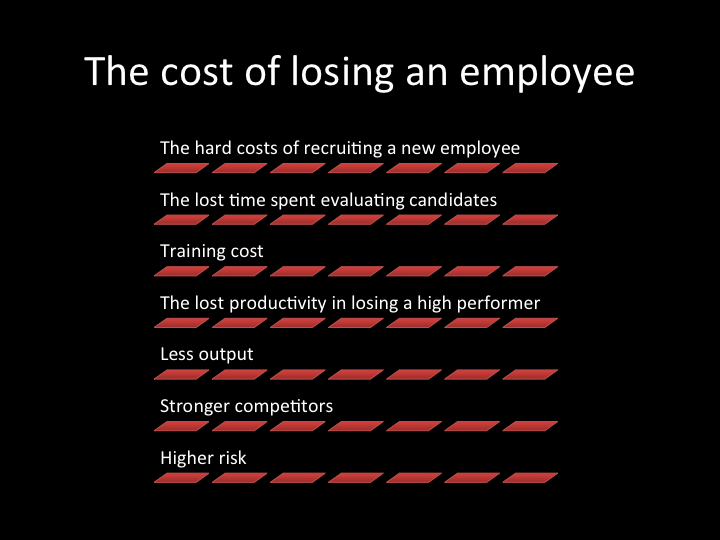
Losing an employee is more costly than you realize
  • The hard costs of recruiting a new employee. This can be payments to a recruiter, referral fees to employees, travel costs to attend recruiting, travel costs to bring candidates in for interviews, etc.
  • The lost time spent evaluating candidates. The time you and your team spend reviewing resumes/CVs, interviewing candidates and discussing options. These days, almost all candidates go through multiple rounds of interviews before being offered a position. Each of those interviews takes 30 minutes or more of someone’s time, if you value that time based on the interviewer’s salary, you quickly get into the thousands of dollars (even more for a senior candidate who meets with leadership).
  • Training costs. These are both direct and indirect. You may have to send the new employee to various external training courses to prepare him for the job. More likely you will need to spend you time or your colleagues will training the new person on how the company works, practical issues (i.e. where the bathroom is), systems, interactions with other teams and what they need to perform their tasks optimally. Again, there is a cost for every minute that you and colleagues spend getting a new hire up to speed. When you break out salaries by how much the person earns per hour, this training cost often runs into the thousands of dollars.
  • The lost productivity in losing a high performer. You should never consider replacing an employee as an upgrade. If there are better people on the market, you need to recruit them proactively and replace weak team members. Assuming you adhere to this principle, if someone leaves voluntary, it means their replacement is not likely to be as good as the existing team member. The cost can range from minimal to huge in having somebody not as good performing a role on your team.
  • Less output. If you employ somebody, they should be providing a valuable service (or else you should proactively have eliminated the position). When you lose somebody, that task either does not get done until a replacement is in place or you must take other people off of their tasks (which again are worthwhile or you should not having them doing it). In either case, the overall output of your organization decreases.
  • Stronger competitors. When a good employee leaves, by definition they go somewhere else. That somewhere else is often a competitor, so not only are you losing their services but a competitor is likely improving. If Messi were to leave Barcelona for Real Madrid, the loss to Barcelona would be magnified by the improvement of their arch competitor.
  • Higher risk. Regardless of how rigorous your recruitment process, there is always risk that you make a bad hire. Many people interview above their actual competence, while others may just not be a good fit for your organization and processes. Thus, you have the risk that not only will the new hire be slightly weaker, they may prove incapable of doing the job and themselves have to be replaced. Then you have both an extended period of the job not getting done (or people being pulled off other tasks) and a repeat of the costs above.

Continue reading “Don’t forget to recruit your own team”

Like Loading...
Unknown's avatarAuthor Lloyd MelnickPosted on November 4, 2015May 1, 2021Categories General Social Games Business, General Tech Business, Lloyd's favorite postsTags employee retention, HR, productivity, recruiting, retention, training1 Comment on Don’t forget to recruit your own team

Five Steps to Reduce Churn

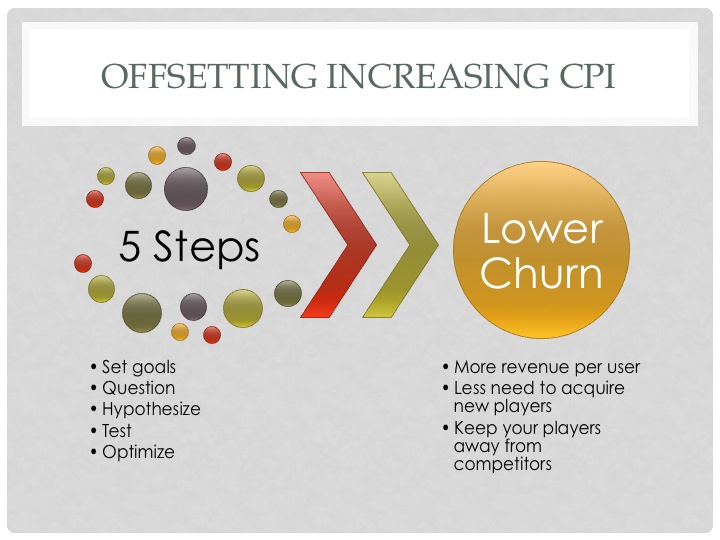
I have wrote and spoken several times recently about how increasing user acquisition costs are impacting the social game industry, particularly social casino, and some strategies to offset and even capitalize on this trend. One of the best ways to combat this problem is to focus your resources on reducing churn rather than acquiring new users. As the cost of acquiring a user increases, the cost of replacing that user also increases. While companies devote ever larger budgets and build bigger teams for user acquisition, they fail to devote comparable resources to retaining the players they already have. Moreover, in the social casino space, players often play 3-5 apps, so the less they play your title, the more they are playing a competitor‘s slot.

I recently came across a blog post, “How to reduce Churn by building a bulletproof retention process” by Andrew Tate, that lays out five ways that you can reduce churn. Tate starts with the example of Burbn, a Foursquare clone that had a huge churn issue. Using analytics, the team saw that users found it too complicated and were using the app to post pictures rather than check in. So they modified the app based on this data to reduce churn and renamed it Instagram. Let’s just say it worked out okay for the Burbn team. This example shows how a focus on reducing churn can be the difference between failure and billions.

Slide1

Focus on the small gains

The first step to combating churn is to take a lot of small steps rather than looking for the magic formula. One change or feature is not going to improve retention 50 percent. If you can reduce churn a few percent every build, you eventually will get negative churn rather than seeing your game lose all its users and revenue. Thus, it is more critical to build a process that always is working to reduce churn rather than fire off a churn reducing feature and then go on to your next KPI (key performance indicator).

Define goals

To create the process discussed above, you first need to set goals. As with all goals, they need to be measurable and clearly defined as well as time based. Reducing churn is not a goal, but reducing churn by 50 percent in three months is a goal. Then you should break this goal into sub-goals, with Tate suggesting

  • Reduce short-term churn by 20 percent
  • Reduce medium-term churn by 20 percent
  • Reduce long-term churn by 10 percent

With goals in place, you can track your progress as you create individual AB tests and set an end-point for the process. This technique aligns the entire team on a visible and understandable goal. Continue reading “Five Steps to Reduce Churn”

54.152337 -4.486123

Share this:

  • Share on Facebook (Opens in new window) Facebook
  • Share on LinkedIn (Opens in new window) LinkedIn
Like Loading...
Unknown's avatarAuthor Lloyd MelnickPosted on October 28, 2015May 1, 2021Categories General Social Games Business, General Tech Business, Growth, Social Games MarketingTags churn, CPI, user acquisition, user churnLeave a comment on Five Steps to Reduce Churn

Why gamification usually sucks

Companies from outside the game industry often envy our industry and try to replicate our practices to improve their profitability. They often refer to this practice as “Gamification,” presumably making products like waste removal as entertaining as games. At the end of the day, they usually fail miserably but never understand why. The reason why they fail, though, is that these companies are gaining the wrong lessons from the game industry.

Slide1

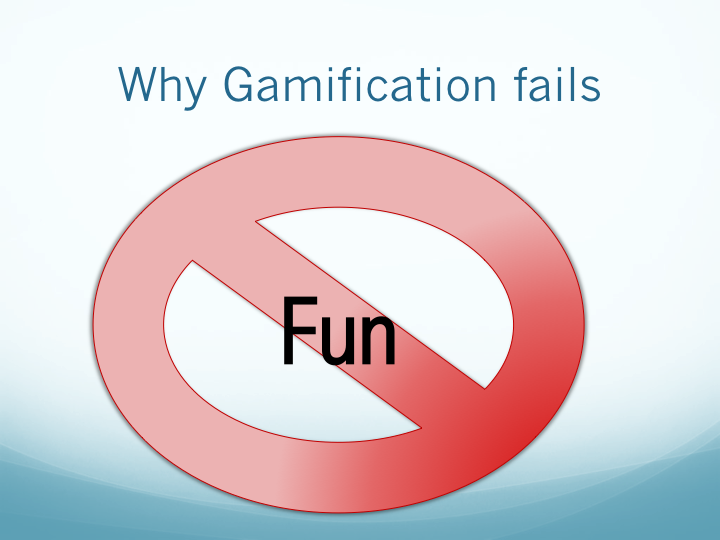
Games, almost by definition, are an entertainment industry. People play games because they are fun. The problem is people do not take out the trash or stop smoking because it is fun. And you don’t make these activities fun by “gamifying” them.

For most of these companies, they are not really looking at trying to create an entertainment product, they are actually trying to manipulate customers. They understand how games can be habit forming, to use the terminology of Nir Eyal in Hooked, but most of the companies are actually hoping to create an unhealthy addiction.

Many outside the industry, and some unfortunately inside the industry, believe people play games only due to the retention and monetization mechanics. It’s the simplification of games, referring to them as Skinner boxes, that lead people down the wrong path.

The companies that feel games are about manipulation are not successful when they try to apply game mechanics. The problem occurs because successful games are not successful due to manipulation. They are successful because users get an entertainment value. Sometimes these techniques do enhance monetization or retention to the detriment of gameplay, though in those cases the game normally implodes, but if the person is not having fun in the game they will not come back or spend money. Even the game companies that do not realize the goal is for the player to have fun also fail, you can’t succeed by tricking players.

The gamification problem

And that is the problem with gamification; the goal is usually manipulation and not entertainment. They are trying to turn something that is not fun into something that people will use more often or spend more money on by adding leaderboards or spoilage or a collection mechanic. None of these things create fun, and the gamification fails.

Like Loading...
Unknown's avatarAuthor Lloyd MelnickPosted on October 7, 2015January 4, 2016Categories General Social Games Business, General Tech BusinessTags fun, gamification1 Comment on Why gamification usually sucks

More discounts, less fees

Slide1Having traveled a lot recently, I noticed a phenomenon that presents opportunities to all companies. When companies or industries introduce new charges or fees, customers rebel. Examples include baggage and change fees by airlines and overdraft fees by banks. Customers react by switching if they have options (some industries have such fees across the industry), decreasing loyalty or just consuming less of the product. It is not a surprise that airlines are beset with bankruptcies and banks are much less profitable than in the past (hence the need for bailouts).

While most of those industries argue the fees are essential for profitability, there is another option. Rather than frame the charge as a fee, increase the overall price and provide incentives for the user to get a discount. Rather than charge a fee for maid service, some hotels now give customers a credit or loyalty points for waiving the maid service. Rather than being upset that they are being charged for maid service, the customer is happy that they just received a $5 credit for not having their bed made. I am sure this $5 is included in the cost of the room but the customer leaves with a better impression of the hotel than if they had been charged a fee.

There is an argument that people will select the lowest cost provider regardless, and if the fee is built into the price the customer will go elsewhere, but Southwest Airlines proves this argument does not have much validity. Southwest is one of the few US airlines not to charge for baggage (and thus probably adds the cost to the ticket price), yet Southwest is the only airline to be profitable since 1971. Customers are savvy and those companies that are condescending towards them pay the price in the long-run.

What this means to you

If you do not run an airline or hotel, you may think that there is no way to apply this understanding but that is not the case. It applies to virtually any business, particularly e-commerce. Rather than charging for overnight shipping, offer free shipping but give customers a discount if they accept standard delivery. If you have a free-to-play game, rather than charging users extra if they are not VIPs, give a discount if they join your loyalty program. The key is turn your pricing into something that enhances the customer experience.

Like Loading...
Unknown's avatarAuthor Lloyd MelnickPosted on September 30, 2015January 4, 2016Categories General Social Games Business, General Tech Business, Lloyd's favorite posts, Social Games MarketingTags discounts, fees, monetization, pricingLeave a comment on More discounts, less fees

Why you should not focus just on existing players or customers

Many companies, especially game companies, build out their products based on how early customers like the product but this approach can inhibit growth. An article in the Harvard Business Review, “Focus On the Customers You Want, Not the Ones You Have” by JP Eggers, shows that the hard part in creating a successful product or game is not appealing to users early but sustaining.

The problem with early users

CustomersEarly players are by definition early adapters. They probably have a higher preference for innovation and are more likely to take risks. They may have different ways of making decisions, including whether they monetize in a game, if they invite friends or if they come back. An early player may be very enthusiastic and tell friends but then go on to the next shiny object, so basing decision on their play would suggest you should focus on getting them to bring in as many users as possible before they leave.

Companies run into problems if they base product decisions on these early adopters, which is often the case. Eggers also points to research that shows early adopters are different. According to Eggers, “early adopters are typically younger, more willing to take risks, more eager to try new things, more affluent, and substantially less numerous … First, what worked with early adopters isn’t likely to work with later adopters. In launching new products or services, start-ups tend to accumulate deep knowledge about customers at the leading edge of a technology. But that knowledge doesn’t necessarily apply to other consumer groups; that’s one reason so many new firms struggle to create second rounds of offerings. To be successful, companies need to innovate for the consumers they want, not the ones they have.”

Another issue comes up because early adopters do not want to see the product expand to the mass market. A chess app may appeal strongly to grandmasters but if it becomes something the mass-market plays, the grandmasters may no longer want to use the product. Similarly, Facebook lost some of their young users when their parents started using it, but there were hundreds of millions more adults than teens. Although it worked for Facebook, the influx of users so alienated the early users of MySpace, you may no longer even remember MySpace.

A solution

There are several strategies to combat the problem of having a product that either is not attractive to new users or alienates existing users:

  • Innovate for future users. Build features and new content so it appeals to new users, what people not currently using your product would want.
  • Engage early adopters. By engaging your customers, you ensure they feel connected to the product. Letting them have a voice, even if you cannot always listen to it, keeps them engaged and likely to cope with changes they do not consider ideal.

The key is understanding that what appealed to your first users, and their behavior, is not necessarily what will drive your growth.

Key Takeaways

  1. Early users will not have the same preferences and consumption patterns as customers you attract later in the product’s life cycle.
  2. If you slavishly build features and new content for existing users, it may not appeal to new users.
  3. The key is to innovate for new users while keeping your early adopters engaged so will tolerate the changes to the product.
Like Loading...
Unknown's avatarAuthor Lloyd MelnickPosted on July 8, 2015May 1, 2021Categories Analytics, General Social Games Business, General Tech Business, Growth, Social Games MarketingTags customers, early adopters, Growth, targetingLeave a comment on Why you should not focus just on existing players or customers

Posts pagination

Previous page Page 1 … Page 12 Page 13 Page 14 … Page 20 Next page

Get my book on LTV

The definitive book on customer lifetime value, Understanding the Predictable, is now available in both print and Kindle formats on Amazon.

Understanding the Predictable delves into the world of Customer Lifetime Value (LTV), a metric that shows how much each customer is worth to your business. By understanding this metric, you can predict how changes to your product will impact the value of each customer. You will also learn how to apply this simple yet powerful method of predictive analytics to optimize your marketing and user acquisition.

For more information, click here

Follow The Business of Social Games and Casino on WordPress.com

Enter your email address to follow this blog and receive notifications of new posts by email.

Join 791 other subscribers

Most Recent Posts

  • Join me at PDMA Inspire for my talk on new product prioritization
  • Why keep studying?
  • The next three years of this blog
  • Interview with the CEO of Murka on the biggest growth opportunity in gaming, Barak David

Lloyd Melnick

This is Lloyd Melnick’s personal blog.  All views and opinions expressed on this website are mine alone and do not represent those of people, institutions or organizations that I may or may not be associated with in professional or personal capacity.

I am a serial builder of businesses (senior leadership on three exits worth over $700 million), successful in big (Disney, Stars Group/PokerStars, Zynga) and small companies (Merscom, Spooky Cool Labs) with over 20 years experience in the gaming and casino space.  Currently, I am the GM of VGW’s Chumba Casino and on the Board of Directors of Murka Games and Luckbox.

Topic Areas

  • Analytics (114)
  • Bayes' Theorem (8)
  • behavioral economics (8)
  • blue ocean strategy (14)
  • Crowdfunding (4)
  • DBA (2)
  • General Social Games Business (459)
  • General Tech Business (195)
  • Growth (88)
  • International Issues with Social Games (50)
  • Lloyd's favorite posts (101)
  • LTV (54)
  • Machine Learning (10)
  • Metaverse (1)
  • Mobile Platforms (37)
  • Prioritization (1)
  • Social Casino (52)
  • Social Games Marketing (105)
  • thinking fast and slow (5)
  • Uncategorized (33)

Social

  • View CasualGame’s profile on Facebook
  • View @lloydmelnick’s profile on Twitter
  • View lloydmelnick’s profile on LinkedIn

RSS

RSS Feed RSS - Posts

RSS Feed RSS - Comments

Categories

  • Analytics (114)
  • Bayes' Theorem (8)
  • behavioral economics (8)
  • blue ocean strategy (14)
  • Crowdfunding (4)
  • DBA (2)
  • General Social Games Business (459)
  • General Tech Business (195)
  • Growth (88)
  • International Issues with Social Games (50)
  • Lloyd's favorite posts (101)
  • LTV (54)
  • Machine Learning (10)
  • Metaverse (1)
  • Mobile Platforms (37)
  • Prioritization (1)
  • Social Casino (52)
  • Social Games Marketing (105)
  • thinking fast and slow (5)
  • Uncategorized (33)

Archives

  • September 2023
  • December 2021
  • July 2021
  • March 2021
  • February 2021
  • January 2021
  • December 2020
  • November 2020
  • October 2020
  • September 2020
  • August 2020
  • July 2020
  • June 2020
  • May 2020
  • April 2020
  • March 2020
  • February 2020
  • January 2020
  • November 2019
  • October 2019
  • September 2019
  • June 2019
  • May 2019
  • April 2019
  • March 2019
  • February 2019
  • January 2019
  • December 2018
  • June 2018
  • May 2018
  • April 2018
  • March 2018
  • February 2018
  • January 2018
  • December 2017
  • June 2017
  • May 2017
  • April 2017
  • March 2017
  • February 2017
  • January 2017
  • December 2016
  • November 2016
  • October 2016
  • September 2016
  • June 2016
  • May 2016
  • April 2016
  • March 2016
  • February 2016
  • January 2016
  • December 2015
  • November 2015
  • October 2015
  • September 2015
  • July 2015
  • June 2015
  • May 2015
  • April 2015
  • March 2015
  • February 2015
  • January 2015
  • December 2014
  • November 2014
  • October 2014
  • September 2014
  • August 2014
  • July 2014
  • June 2014
  • May 2014
  • April 2014
  • March 2014
  • February 2014
  • January 2014
  • December 2013
  • November 2013
  • October 2013
  • September 2013
  • August 2013
  • July 2013
  • June 2013
  • May 2013
  • April 2013
  • March 2013
  • February 2013
  • January 2013
  • December 2012
  • November 2012
  • October 2012
  • September 2012
  • August 2012
  • July 2012
  • June 2012
  • May 2012
  • April 2012
  • March 2012
  • February 2012
  • January 2012
  • December 2011
  • November 2011
  • October 2011
  • September 2011
  • August 2011
  • July 2011
  • June 2011
  • May 2011
  • December 2010
February 2026
S M T W T F S
1234567
891011121314
15161718192021
22232425262728
« Sep    

by Lloyd Melnick

All posts by Lloyd Melnick unless specified otherwise
Google+

Enter your email address to subscribe to this blog and receive notifications of new posts by email.

Join 791 other subscribers
Follow Lloyd Melnick on Quora

RSS HBR Blog

  • With Rise of Agents, We Are Entering the World of Identic AI
  • Innovations in Olympic Speed Skating: When to Reveal a Novel Approach
  • Why AI Adoption Stalls, According to Industry Data
  • Why Your Digital Investments Aren’t Creating Value
  • What You Must Deliver to Win Customers Today
  • The Benefits—and Challenges—of an Insider CEO
  • Building Better Connections with AI-Powered Customer Experience Orchestration - SPONSOR CONTENT FROM ADOBE
  • To Lead Through Uncertainty, Unlearn Your Assumptions
  • A Blueprint for Enterprise-Wide Agentic AI Transformation - SPONSOR CONTENT FROM GOOGLE CLOUD CONSULTING
  • To Thrive in the AI Era, Companies Need Agent Managers

RSS Techcrunch

  • An error has occurred; the feed is probably down. Try again later.

RSS MIT Sloan Management Review Blog

  • Why Digital Dexterity Is Key to Transformation
  • The Case for Making Bold Bets in Uncertain Times
  • AI Coding Tools for Knowledge Work: What Executives Need to Know
  • Why Salespeople Fear Pitching Radical Innovation
  • Stay Ahead of Geopolitical Supply Chain Risks
  • How to Profit From Retro-Innovation
  • What the UN Treaty on Cybercrime May Mean for You
  • Enshittification Comes to ‘Smart’ Products
  • Four Key Roles ‘Elders’ Offer Their Organizations
  • Validating LLM Output? Prepare to Be ‘Persuasion Bombed’
The Business of Social Games and Casino Website Powered by WordPress.com.
  • Subscribe Subscribed
    • The Business of Social Games and Casino
    • Join 726 other subscribers
    • Already have a WordPress.com account? Log in now.
    • The Business of Social Games and Casino
    • Subscribe Subscribed
    • Sign up
    • Log in
    • Report this content
    • View site in Reader
    • Manage subscriptions
    • Collapse this bar
 

Loading Comments...
 

    %d