Skip to content

The Business of Social Games and Casino

How to succeed in the mobile game space by Lloyd Melnick

Tag: mobile games

Don’t give up, there are still great opportunities in mobile (aka make mobile great again)

Key takeaways

  1. The mobile market is far from dead. The misperception that the opportunity has passed is driven by the selective memory of a better past than existed and the current focus on copying existing successful products.
  2. The opportunity on mobile is still great, with projections of 5 billion smartphone users by 2019 and over 1 billion people on Facebook.
  3. Rather than complain or try to create yet another slot or mid-core game, challenge yourself to think outside the box. Focus on creating uncontested market space and making the competition irrelevant.

Don’t give up, there are still great opportunities in mobile (aka make mobile great again)

I doubt a day goes by without someone whining and winging about how tough the games and mobile market is today and although it is difficult, there are still great opportunities.

Why many think the mobile market sucks

There are a few reasons people feel the market is so challenging. First, there is always a selective memory of how great things used to be. I was there when the mobile market was perceived as a gold rush. And for the first few iOS games, they did great. It was, however, always challenging. I remember at Playdom all of our failed efforts (and various heads of mobile) to penetrate this market. Playdom was not alone, as many companies (EA/Playfish, Zynga, Kabam, CrowdStar and innumerable others) lost tons of money (and users) in the mobile space. I call this the “Make Mobile Great Again” phenomenon, similar to the Americans who have a very nostalgic view of the country 20 or 30 years ago.

The second reason for the perception of the difficulty of mobile is the red ocean mentality of most of the complainers. I have written before about blue ocean versus red ocean strategy, with the latter a strategy to beat established competitors in a known market rather than expanding the market to appeal to non-users. Mobile now is incredibly difficult if you are pursuing a red ocean strategy. Players have invested months or years in existing products (Clash of Clans, Game of War, Slotomania, etc.) and getting them to switch does not mean putting out a product a little bit better but creating a game that is 9 times better ( see my blog post from 2014 on why a new product needs to be 9X better to get users to switch ).

Then add to the challenge of creating something 9X better that the competition is really good these days. Even the game companies out of favor have experienced and deep teams of game designers, product managers and engineers. They also have millions of dollars they are investing in their new games (in some cases sitting on billions in the bank) to make them better, get new users and reactivate lapsed players. They are not waiting for you to launch a new game and take away their chart position (and revenue).

The bottom line is the market is very challenging if you are just trying to compete with games already on the market (but it always sucked to compete in a red ocean). That does not mean, however, that the mobile market itself is no longer a great opportunity.

The next great platform is still mobile

A recent blog post from Greylock Partners by Josh Elman, a leading Silicon Valley VC, makes the point that The Next Great Platform is the One That We Already Have.  In the world of venture capital, they also hear all the time that there are no longer opportunities in mobile (in their case, it is often that Facebook, Snapchat, Instagram, Twitter, etc. have consumed the entire market) and that they need to look at the next big thing (VR, AR, drones, IOT, insert hot new trend here).

Elman, like me, is not ready to give up on mobile. He pointed out that in 2002-2004, everyone was complaining that all of the opportunities on the Internet were over: Yahoo and AOL were the dominant portals, Google controlled search and Amazon owned eCommerce. Post 2004, however, we saw Friendster then LinkedIn, MySpace, YouTube and a small company named Facebook. So maybe the Internet was not exactly devoid of opportunity.

What is particularly interesting is that these companies (many of whom enjoy huge valuations), did not even need a technological inflection point to enter the market. Instead, they grasped the opportunity from user-generated content followed by a social and psychological shift. Even the new technologies were largely improvements on existing tech.

The opportunity now is tremendous. Billions and billions of people use Smartphones (5 billion by 2019). More than one billion people are active on Facebook and over 100 million use Instagram monthly, according to Facebook. And for those still not convinced there is still an opportunity, the chart below shows all the new apps (albeit not gaming) that rose to the top of the charts just this year.

hits-of-2016

Where the mobile opportunities are

If you are expecting me now to list some great opportunities, you have not read the rest of this post very carefully. The opportunities in mobile are not doing what everyone else is doing but understanding where you can create apps and games to reach people in a new way.

As Elman writes, “What happened in the Web 2.0 era was that some companies succeeded in creating totally new experiences, engaging consumers, and enabling them to connect with other people in a way that had never happened before online. Now that we’re in a fully mobile world, I think there is a lot of room to create new experiences and connect people. “

Rather than complain or try to create yet another slot or mid-core game, challenge yourself to think outside the box. Focus on creating uncontested market space and making the competition irrelevant. Then you can leverage the still great mobile platform.

Share this:

  • Click to share on Facebook (Opens in new window) Facebook
  • Click to share on LinkedIn (Opens in new window) LinkedIn
Like Loading...
Unknown's avatarAuthor Lloyd MelnickPosted on September 28, 2016April 11, 2020Categories blue ocean strategy, General Social Games Business, General Tech Business, Lloyd's favorite posts, Mobile PlatformsTags Facebook, mobile, mobile games, Venture Capital2 Comments on Don’t give up, there are still great opportunities in mobile (aka make mobile great again)

Lifetime Value Part 9: Uncertainty and LTV

The key to using customer lifetime value (LTV) effectively is the understanding that it is a prediction, not a value. In my previous eight posts on LTV, I stressed the importance of LTV to the success of your game and company and the key components in determining LTV. After reading Nate Silver’s The Signal and the Noise, I realized that it is crucial to understand that LTV is a prediction and suffers the same risk as other predictions (e.g., elections, weather, sports scores).
The Uncertainty Principle

Many people mistakenly believe (and I may have inadvertently implied this in a previous post), that LTV is an exact function of virality, monetization and retention. It implies you put those variables into a formula and get out a number that shows precisely how much a player is worth. That would be the case if you did it with historical information after five years and then calculated how much that player had been worth to you. However, you are calculating how much the player will be worth, which is inherently different because you are predicting their future value.

The uncertainty principle, a key tenet of quantum mechanics (as popularized by Stephen Hawking), postulates that perfect predictions are impossible if the universe itself is random. Since you cannot have a perfect prediction, your LTV cannot be a distinctly quantified value. You are predicting future events (how much the player will monetize, how viral they will be and how long they will stay in your game) based on the available data. Your LTV model is a simplification of the world the player is in; you are looking at several variables but you cannot look at everything (e.g., chance of war, plague, everyone switching to Blackberry devices). In effect, your LTV calculation is very similar to a sportscaster’s estimate of how many home runs Albert Pujols will hit or a weatherman’s prediction on the likelihood of a hurricane to hit Cape Hatteras. Continue reading “Lifetime Value Part 9: Uncertainty and LTV”

Share this:

  • Click to share on Facebook (Opens in new window) Facebook
  • Click to share on LinkedIn (Opens in new window) LinkedIn
Like Loading...
Unknown's avatarAuthor Lloyd MelnickPosted on April 23, 2013June 4, 2014Categories Analytics, General Social Games Business, Lloyd's favorite posts, LTVTags analytics, Chaos Theory, lifetime value, LTV, mobile games, Nate Silver, Qualitative Information, Quantum Mechanics, social games, Uncertainty Principle11 Comments on Lifetime Value Part 9: Uncertainty and LTV

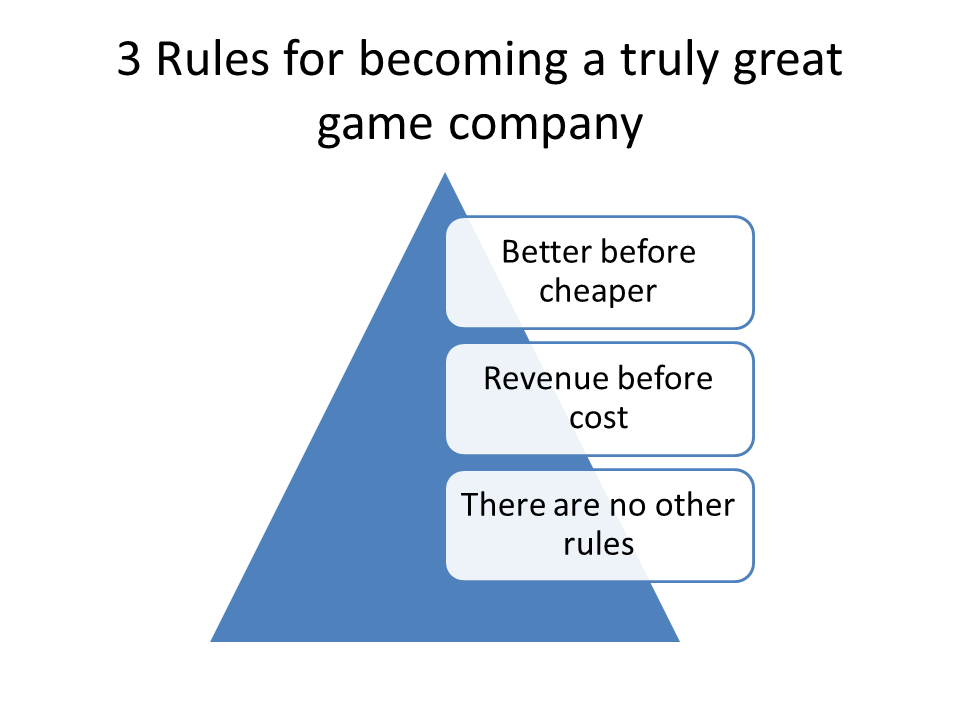
Three rules for becoming a truly great game company

A recent article in the Harvard Business Review, “Three Rules for Making A Company Truly Great,” pointed to three elemental rules that were consistently followed by exceptional companies. There are a lot of hyperbole and clichés about how to create great companies, but the research by Michael Raynor and Mumtaz Ahmed (in the HRB article) shows that three fundamental principles are the keys to success. This finding was based on a statistical study of thousands of companies, so it is much more analytic than what business book happens to be at the top of the charts in a particular week. It is also apparent that these principles apply to social and mobile game companies.

3 Rules for becoming a truly great game Continue reading “Three rules for becoming a truly great game company”

Share this:

  • Click to share on Facebook (Opens in new window) Facebook
  • Click to share on LinkedIn (Opens in new window) LinkedIn
Like Loading...
Unknown's avatarAuthor Lloyd MelnickPosted on April 4, 2013April 9, 2013Categories General Social Games Business, GrowthTags mobile games, social gamesLeave a comment on Three rules for becoming a truly great game company

Get my book on LTV

The definitive book on customer lifetime value, Understanding the Predictable, is now available in both print and Kindle formats on Amazon.

Understanding the Predictable delves into the world of Customer Lifetime Value (LTV), a metric that shows how much each customer is worth to your business. By understanding this metric, you can predict how changes to your product will impact the value of each customer. You will also learn how to apply this simple yet powerful method of predictive analytics to optimize your marketing and user acquisition.

For more information, click here

Follow The Business of Social Games and Casino on WordPress.com

Enter your email address to follow this blog and receive notifications of new posts by email.

Join 791 other subscribers

Most Recent Posts

  • Join me at PDMA Inspire for my talk on new product prioritization
  • Why keep studying?
  • The next three years of this blog
  • Interview with the CEO of Murka on the biggest growth opportunity in gaming, Barak David

Lloyd Melnick

This is Lloyd Melnick’s personal blog.  All views and opinions expressed on this website are mine alone and do not represent those of people, institutions or organizations that I may or may not be associated with in professional or personal capacity.

I am a serial builder of businesses (senior leadership on three exits worth over $700 million), successful in big (Disney, Stars Group/PokerStars, Zynga) and small companies (Merscom, Spooky Cool Labs) with over 20 years experience in the gaming and casino space.  Currently, I am the GM of VGW’s Chumba Casino and on the Board of Directors of Murka Games and Luckbox.

Topic Areas

  • Analytics (114)
  • Bayes' Theorem (8)
  • behavioral economics (8)
  • blue ocean strategy (14)
  • Crowdfunding (4)
  • DBA (2)
  • General Social Games Business (459)
  • General Tech Business (195)
  • Growth (88)
  • International Issues with Social Games (50)
  • Lloyd's favorite posts (101)
  • LTV (54)
  • Machine Learning (10)
  • Metaverse (1)
  • Mobile Platforms (37)
  • Prioritization (1)
  • Social Casino (52)
  • Social Games Marketing (105)
  • thinking fast and slow (5)
  • Uncategorized (33)

Social

  • View CasualGame’s profile on Facebook
  • View @lloydmelnick’s profile on Twitter
  • View lloydmelnick’s profile on LinkedIn

RSS

RSS Feed RSS - Posts

RSS Feed RSS - Comments

Categories

  • Analytics (114)
  • Bayes' Theorem (8)
  • behavioral economics (8)
  • blue ocean strategy (14)
  • Crowdfunding (4)
  • DBA (2)
  • General Social Games Business (459)
  • General Tech Business (195)
  • Growth (88)
  • International Issues with Social Games (50)
  • Lloyd's favorite posts (101)
  • LTV (54)
  • Machine Learning (10)
  • Metaverse (1)
  • Mobile Platforms (37)
  • Prioritization (1)
  • Social Casino (52)
  • Social Games Marketing (105)
  • thinking fast and slow (5)
  • Uncategorized (33)

Archives

  • September 2023
  • December 2021
  • July 2021
  • March 2021
  • February 2021
  • January 2021
  • December 2020
  • November 2020
  • October 2020
  • September 2020
  • August 2020
  • July 2020
  • June 2020
  • May 2020
  • April 2020
  • March 2020
  • February 2020
  • January 2020
  • November 2019
  • October 2019
  • September 2019
  • June 2019
  • May 2019
  • April 2019
  • March 2019
  • February 2019
  • January 2019
  • December 2018
  • June 2018
  • May 2018
  • April 2018
  • March 2018
  • February 2018
  • January 2018
  • December 2017
  • June 2017
  • May 2017
  • April 2017
  • March 2017
  • February 2017
  • January 2017
  • December 2016
  • November 2016
  • October 2016
  • September 2016
  • June 2016
  • May 2016
  • April 2016
  • March 2016
  • February 2016
  • January 2016
  • December 2015
  • November 2015
  • October 2015
  • September 2015
  • July 2015
  • June 2015
  • May 2015
  • April 2015
  • March 2015
  • February 2015
  • January 2015
  • December 2014
  • November 2014
  • October 2014
  • September 2014
  • August 2014
  • July 2014
  • June 2014
  • May 2014
  • April 2014
  • March 2014
  • February 2014
  • January 2014
  • December 2013
  • November 2013
  • October 2013
  • September 2013
  • August 2013
  • July 2013
  • June 2013
  • May 2013
  • April 2013
  • March 2013
  • February 2013
  • January 2013
  • December 2012
  • November 2012
  • October 2012
  • September 2012
  • August 2012
  • July 2012
  • June 2012
  • May 2012
  • April 2012
  • March 2012
  • February 2012
  • January 2012
  • December 2011
  • November 2011
  • October 2011
  • September 2011
  • August 2011
  • July 2011
  • June 2011
  • May 2011
  • December 2010
January 2026
S M T W T F S
 123
45678910
11121314151617
18192021222324
25262728293031
« Sep    

by Lloyd Melnick

All posts by Lloyd Melnick unless specified otherwise
Google+

Enter your email address to subscribe to this blog and receive notifications of new posts by email.

Join 791 other subscribers
Follow Lloyd Melnick on Quora

RSS HBR Blog

  • What Actually Works to Change Someone’s Mind
  • Our Favorite Management Tips of 2025
  • How to Manage—and Motivate—Gen Z
  • The Most-Watched HBR Videos of 2025
  • The HBR Charts that Help Explain 2025
  • The Most Popular HBR Podcast Episodes of 2025
  • How the Best Leaders Develop and Spend “Innovation Capital”
  • The 10 Most Popular HBR Articles of 2025
  • How Work Changed in 2025, According to HBR Readers
  • What Leaders Can Learn from a Formula 1 Turnaround

RSS Techcrunch

  • An error has occurred; the feed is probably down. Try again later.

RSS MIT Sloan Management Review Blog

  • Calm: The Underrated Capability Every Leader Needs Now
  • The Top Five MIT SMR Videos of 2025
  • Three Steps Toward Fairer Talent Management
  • From Crisis to Coopetition: What Leaders Can Learn From Anesthesiologists
  • AI Coding Tools: The Productivity Trap Most Companies Miss
  • How Procter & Gamble Uses AI to Unlock New Insights From Data
  • Rewire Organizational Knowledge With GenAI
  • Hungry for Learning: Wendy’s Will Croushorn
  • Beat Burnout: 10 Essential MIT SMR Reads
  • How Leaders Stay True to Themselves and Their Stakeholders
The Business of Social Games and Casino Website Powered by WordPress.com.
  • Subscribe Subscribed
    • The Business of Social Games and Casino
    • Join 726 other subscribers
    • Already have a WordPress.com account? Log in now.
    • The Business of Social Games and Casino
    • Subscribe Subscribed
    • Sign up
    • Log in
    • Report this content
    • View site in Reader
    • Manage subscriptions
    • Collapse this bar
 

Loading Comments...
 

    %d