I will be speaking today at 11 at Groundwork Labs, the Durham-based technology accelerator, on why companies in any industry need to focus on LTV, the primary levers and its impact on success. Anyone interested and in the area is free to come by. Much of the discussion has been covered previously in this blog, but feel free to check out the presentation on Slideshare:
Author: Lloyd Melnick
I am GM of Chumba at VGW, where I lead the Chumba Casino team. Previously, I was Director of StarsPlay, the social gaming vertical for the Stars Group. I was also Sr Dir at Zynga's social casino (including Hit It Rich! slots, Zynga Poker and our mobile games), where I led VIP CRM efforts and arranged licensing deals. I have been a central part of the senior management team (CCO, GM and CGO) at three exits (Merscom/Playdom, Playdom/Disney and Spooky Cool/Zynga) worth over $700 million.
Using probability to build a game portfolio likely to succeed
One of the biggest challenges for a social or mobile game company is managing the challenges of an industry that is hit-driven. Understanding the laws of probability is a good step in overcoming this hurdle. Since the beginning of time, game companies have been struggling with the hit-driven nature of our industry. Although new markets and technologies (e.g., casual, social, and mobile games) held out the promise of not being as hit-driven, they all ended up having a few titles drive the majority of revenue. The number I use is that 25 percent of games will break even or make a profit after launch (without accounting for development expense); this means that there’s a 75 percent failure rate. (I have heard estimates that as many as 90 percent of game projects fail and I would not argue strongly against that number, but for the sake of analysis I will use a success rate of 25 percent.)

The argument for taking a portfolio approach
Basic probability theory shows the importance of having multiple independent game projects to improve your company’s chance of success (more on independence later). By using probability, the benefits of taking a portfolio approach become clear. Continue reading “Using probability to build a game portfolio likely to succeed”
Lifetime Value Part 4: The role of retention in LTV and how to impact it
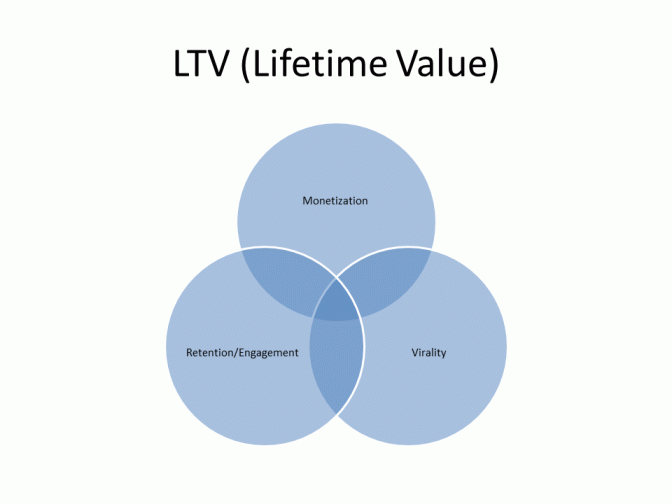
Retention is one of three components that you use to determine LTV (lifetime value of a customer) and in many ways most important to the success of a product (and the most difficult to improve significantly after launch). Three weeks ago, I wrote about the central importance of lifetime value (LTV) to the success of your game and your company. This week I want to discuss retention, its importance and how you can improve it.
How to define retention
Retention is how often players play your game and thus, also, how long they remain active players. As with all the LTV metrics, different companies use different measures of retention to determine lifetime value.
There are several components of retention for you to track and roll into your LTV formula. Continue reading “Lifetime Value Part 4: The role of retention in LTV and how to impact it”
Accounting issues tied to crowd-funding
This is a great post on GamesBrief about accounting issues tied to crowd-funding (as a site note, I highly recommend you follow GamesBrief). I have written before about how crowd-funding is increasingly important, especially in the games space. Although the post is focused primarily on the UK (and accounting is different in every country), it highlights some universal issues everyone should be aware of regarding crowd-funding.

Facebook’s importance, or lack thereof, for social gaming
I have been reluctant to join the bandwagon of people declaring Facebook dead, either overall or as a social gaming platform, but I have gotten to the point where I have lost confidence in Facebook. It has been fashionable since Facebook’s IPO to say the platform was in trouble because of the shift to mobile. In the game space, the anti-Facebook crowd got started even earlier, suggesting the only wise course for social game companies was to develop for mobile platforms instead of Facebook. I was reluctant to join this chorus, given the incredible user numbers Facebook has and the revenue that some games were still generating on Facebook (which dwarfed comparable mobile games). However, I have been rethinking my position.
 Continue reading “Facebook’s importance, or lack thereof, for social gaming”
Lifetime Value Part 3: Monetization’s role in LTV and how to impact it
Monetization is one of three components that you use to determine LTV (lifetime value of a customer) and is the one that is the easiest to improve. Two weeks ago, I wrote about the central importance of lifetime value to the success of your game and your company. This week I want to discuss monetization, its importance and how you can improve it.
How to define monetization
Monetization at its core is how much money an average player spends in your game. As with the other two components of LTV, there are different facets of monetization that you can use to create a more accurate calculation. With all monetization measurements, you need to incorporate all revenue, including revenue that does not come from in-app purchases (e.g., advertising revenue, subscription revenue) to get a true picture of monetization and LTV.
 The primary metric for monetization is ARPDAU (average revenue per daily active user) but there are several other metrics that together can help you get a more robust LTV calculation. Continue reading “Lifetime Value Part 3: Monetization’s role in LTV and how to impact it”
Calculating virality
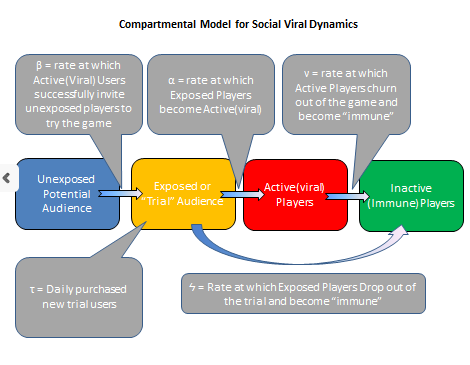
Last week, I blogged about virality and its importance to LTV. Although I listed some virality variables, it was a relatively high-level look at virality and did not go into detail about calculating it. Alex St. John (with help from Anthony Percorella and Don Alvarez) recently posted a great model that goes into detail on how to measure virality. It also accounts for many variables such as exposure and immunity that I did not discuss. I strongly recommend you read Alex’s analysis and look at the underlying dynamics.
Great financial tool for tracking against plan and re-forecasting
This is a tool that was recommended to me and I plan to start using immediately. Recommend for anyone who seriously wants to manage their business and cash flow. Thanks to Kirk Owen for recommending it to me.

Today I faced a choice. Should I go out and enjoy the beautiful weather and waves and go for a surf or should I blog about my favorite financial reporting tool? Seems like a pathetic question for a surfer to ask, or maybe this financial reporting tool is really that great. I’ll settle for an answer of “both”.
The tool in question is the Waterfall Chart. It’s a way to compare actual results across time periods (months or quarters usually) against your original Plan of Record, as well as forecasts you made along the way as more information became available. It packs a ton of information into a concise format, and provides management and Board members quick answers to the following important questions:
1. How are we doing against plan? Against what we thought last time we reforecast?
2. Where are we most likely to end up at the end…
View original post 655 more words
What Interpublic’s investment in Kiip means
The news earlier this week that Interpublic and other investors put $11 million into Kiip focuses attention on another promising revenue stream for mobile games. I first wrote about Kiip when I saw its founder speak at the Social Gaming Summit in 2011 and am excited that this investment validates that there are monetization opportunities outside of in-app purchases.

Kiip provides a service that allows advertisers to serve rewards to game players after accomplishing something in a game. For example, they may get a coupon for a free T-shirt from Abercombie & Fitch after reaching level 10. The advertiser pays Kiip to serve this offer and Kiip then gives the game publisher a share of the revenue. On a high level, it seems like a win for all three parties: the player gets something for free, the advertiser can interact with potential consumers at the height of their pleasure in a game and the game publisher receives additional revenue. The rewards should also benefit game companies by encouraging both retention and engagement in players, as they are more likely to come back and earn more rewards. Continue reading “What Interpublic’s investment in Kiip means”
Lifetime Value Part 2: Virality’s role in LTV and how to impact it
Virality is one of three components that you use to determine lifetime value of a customer (LTV) and is the one where small changes can have the greatest impact. Last week I wrote about the central importance of LTV to the success of your game and your company. This week I want to discuss one of the key elements of LTV, its importance and how you can improve it.
How to define virality
Virality can be defined as the number of new players an existing player recruits (for free), and is often referred to as a “K-score” or “K-coefficient.” The viral coefficient K is usually calculated as K=i*conv% (conversion percentage), where “i” is the number of invites sent out by each new customer and “conv%” is the percentage of invites that convert into costumers.
Although calculating the K-score seems pretty straightforward, there are many different measures you can use in your LTV calculation. In a future post, I will detail how lifetime value is calculated, but I can only provide a framework, as companies calculate it differently based on their priorities and needs. There is no perfect formula and you will always be adjusting your formula to get a more accurate picture of your player’s lifetime value.
The K-score is a time- and cohort-dependent variable. Thus, based on the earlier equation, you may measure i*conv% over the life of the game, over a month, over a week or simply in one day. You may also want to use a combination of these metrics, for example both 1-week K-score and lifetime K-score. A related measure to track that could be incorporated into your LTV is Viral Cycle Time, that is how long it takes for a user to bring in another player (and another and another); the shorter the cycle time, the quicker your growth. Continue reading “Lifetime Value Part 2: Virality’s role in LTV and how to impact it”
 The Business of Social Games and Casino