As an update to my post yesterday on Physical Virtual Goods as exemplified by Skylanders, Activision just announced that Skylanders generated over $500 million in retail sales in the US and generated more revenue than the holiday box office for kids’ films.
Author: Lloyd Melnick
I am GM of Chumba at VGW, where I lead the Chumba Casino team. Previously, I was Director of StarsPlay, the social gaming vertical for the Stars Group. I was also Sr Dir at Zynga's social casino (including Hit It Rich! slots, Zynga Poker and our mobile games), where I led VIP CRM efforts and arranged licensing deals. I have been a central part of the senior management team (CCO, GM and CGO) at three exits (Merscom/Playdom, Playdom/Disney and Spooky Cool/Zynga) worth over $700 million.
Physical virtual goods
The use of virtual goods in a physical form is one of the most interesting (and profitable) monetization techniques that I have seen. By “physical virtual goods” (my term), I mean taking a virtual good that is normally sold through an in-app purchase and making it into a physical retail item that is used to unlock the virtual good inside the game (with no functionality for the physical product).
The Skylanders example
Activision’s Skylanders are the perfect example of this monetization strategy. Activison has two video games, Skylanders Giants and Skylanders Spyro’s Adventure, that sell at retail, just as you would purchase Call of Duty or Super Mario Bros. However, instead of selling downloadable content or offering upgrades through in-app purchases (depending on the platform), players must purchase Skylanders characters at retail, place them on a game-specific portal (a device that plugs into the game console) or enter a code that comes with the character (again, depending on the platform) to unlock the character in the game. Continue reading “Physical virtual goods”
Reblog from TechCrunch: Proving The Value Of Crowdfunding, Soldsie Raises $425K And Hires One Of 72 Investors Via FundersClub
As I said, 2013 will be the year of crowd-funding.
LTV, the lifeblood of your business
The three most important letters for any social game company, and arguably any B2C or B2B company, is LTV, or “lifetime value.” Although most social game industry professionals acknowledge the importance of LTV, they often fail to realize it is the determinant to a company’s, product’s and / or game’s success and survival. It is the primary factor in why companies fail or are sold for tens or hundreds of millions of dollars.
What LTV consists of
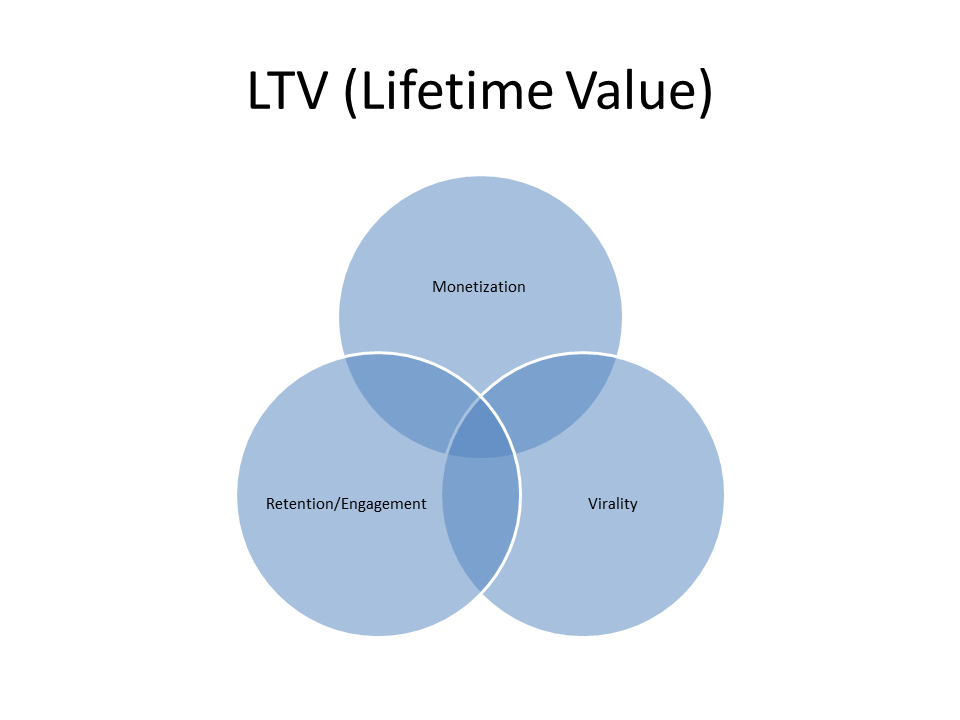
LTV is a function that shows the present value of a new customer, how much that customer is worth to your company. Although I will be focusing on its application for social games, LTV can be used for any business, from valuing new customers for a restaurant using a GroupOn promotion, to a car dealer deciding how (and whether) to motivate buyers to visit the showroom. Continue reading “LTV, the lifeblood of your business”
Two big trends in 2013
I am not a big fan of end-of-year predictions, as they are usually not worth the bandwidth they take up; instead, I thought I would instead start the year by discussing two areas that I feel are the most exciting part of the tech space. These are already sectors that are experiencing strong growth and have generated a lot of attention from investors, but hopefully this post will help you see the opportunity and how it could impact your efforts.
Equity crowd-funding
Although Kickstarter and its reward-based crowd-funding has already found a solid position in the game space, crowd-funding will explode once non-accredited investors can actually obtain equity in companies. In the spring of 2012, President Obama passed an act that will drastically alter the landscape of crowd-funding platforms. Prior to this act, a small pool of existing crowd-funding sites were only permitted to operate on a reward or donation basis (e.g., Kickstarter), essentially offering a product, discount, or enticement in exchange for monetary funding. With the launch of the JOBS Act, the ability for the general public to receive company equity in exchange for funding is now a possibility. Continue reading “Two big trends in 2013”
Happy Holidays
I wanted to wish everyone a very wonderful holiday and a fantastic new year. I look forward to sharing ideas and thoughts with all of you next year.
Being an employee at a start-up
There was recently a great blog post by Mark Suster (a serial entrepreneur and VC with GRP Partners), in which a friend of his put together a list about what young employees should know, particularly when starting at an early-stage company. I think this advice is useful not only for young employees but people moving (or considering moving) from a larger corporation into the start-up world. I also found it useful as a leader to bring young team members along more effectively.

Suster’s friend’s advice
You will not get constructive feedback unless you request it. Although executives in start-ups have great intentions and truly care about their employees, they usually do not spend much time giving employees constructive criticism. When juggling all of their immediate priorities, employee feedback and counseling usually gets pushed to the bottom of the list. Often if there is an issue, rather than dealing with the employee they will just resolve the situation themselves. If you want to grow professionally, you need to reach out to your boss (and other members of the management team) and find out what you can be doing better. Continue reading “Being an employee at a start-up”
Perspective
The shooting in Newtown on Friday helps show what is truly important from what we think is important, especially in our business lives. Seeing what the families of the victims are going through and the acts of heroism by school staff is a good contrast to the importance of things that occur at work.

It’s not that bad
People often talk about their terrible year or awful day at work but what happened on Friday shows just what bad is. If the game you launches does not do well, if your company has down-sized and you need to find a new job, if you were unable to raise investment capital and had to close down, if your boss promoted someone not as gifted as you to a senior position, you may feel things are terrible. Now compare these events to a parent who has lost a child or a husband who has lost a wife … and you realize just how minor your problems are.
You are not that great
Conversely, do not let your successes create an inflated sense of importance. Does raising that new round of capital define you as a success? Does selling your company for $100 million or even $50 billion mean you are the person you want to be? When I read the story of Vicki Soto, the teacher who gave her life to save some of her students by shielding her first-grade students, I feel she has achieved much more than Mark Zuckerberg or Sean Parker (no offense to them).
I hope we can all use the tragedy last week to better understand ourselves and our situations.
Two great resources
There are two resources/websites that are tremendously useful for everyone, but particularly social media executives. Quora is a question and answer site while Coursera offers courses online from top universities.

Quora
Quora is great for everything from getting supporting information for investor presentations and business plans to seeing how others have overcome difficult business situations. Quora works by encouraging people to post questions and then rewarding others for answering. People can up-vote and down-vote answers to drive the best or most accurate one to the top. You can also follow people on Quora if you are interested in how they would answer questions or of you think you would be interested in what questions they are following.
Questions can be about market information (or any facts you need to know), how people approach issues, what other companies have done to solve business problems, what trends or activities people are anticipating, etc. Typical questions requesting information can include how much revenue a typical Android game generates or how quickly is the tablet gaming market growing. In terms of approaching issues, you could ask how other companies growth hacked. I found responses to my question on best practices for improving retention an incredibly valuable resource in seeing how others addressed a business problem. With trends, information on Quora has shined a light on equity crowd sourcing opportunities made available by the JOBS Act. Continue reading “Two great resources”
Mary Meeker’s presentation on Internet Trends
Below is Mary Meeker’s presentation at Stanford on Internet Trends. If you are not familiar with Meeker, she is a partner at A-list VC firm Kleiner Perkins and previously was one of the top Wall Street analysts for the tech sector. At Morgan Stanley, she co-authored the “bible of the Internet,” which was the roadmap for the dot-com boom. She has since published landmark reports on online advertising, e-commerce, search, the Internet in China and the mobile Internet. She is probably one of the best resources for understanding how technology will evolve.

While I recommend you read the entire presentation, I realize you might not have time for 88 slides. With that in mind, I wanted to highlight what I felt were the most interesting points, particularly those with potential value for social media companies: Continue reading “Mary Meeker’s presentation on Internet Trends”
 The Business of Social Games and Casino