
Excited to be a guest today (Wednesday, 1 April) at 1200 noon EST on the IndieGameBusiness podcast to discuss how you can survive, and thrive, while working from home. If you are free, tune in and ask some questions. It can be watched live on Mixer, Twitch, YouTube, LinkedIN, and Facebook.
Author: Lloyd Melnick
I am GM of Chumba at VGW, where I lead the Chumba Casino team. Previously, I was Director of StarsPlay, the social gaming vertical for the Stars Group. I was also Sr Dir at Zynga's social casino (including Hit It Rich! slots, Zynga Poker and our mobile games), where I led VIP CRM efforts and arranged licensing deals. I have been a central part of the senior management team (CCO, GM and CGO) at three exits (Merscom/Playdom, Playdom/Disney and Spooky Cool/Zynga) worth over $700 million.
Diversity is much more than superficial fixes
When I worked at the Stars Group, I learned the value of having a diverse team. My team had people from the US, UK, Russia, France, Israel, Isle of Man, Kazakhstan, The Netherlands, Ireland and India; while colleagues at the company increased this list even more. This diversity led to solutions and approaches that helped us to create great products (and results) with limited resources. While I already grasped the value of diversity, Rebel Ideas by Matthew Syed showed how you can magnify this value.
Strive for cognitive diversity
At the core of Rebel Ideas is the concept of cognitive diversity, that you need people that think differently rather than just look different. While you can create an incredible relay team by cloning Usain Bolt, Apple’s design department would not have been as incredible if they simply cloned Jony Ive. Tackling complex problems demands more than just intelligence or skill. Two designers may have different nationalities and genders, but if they use the same inputs, materials, techniques and approaches to solve problems they will come to similar designs. If you recruit designers, however, who use different approaches, they will draw on different materials, ask different questions and make different assumptions.
To get the broadest range of solutions, and thus the one most likely to be optimal, you need true diversity. Diversity should not be limited to demographic attributes, like gender, race, age, sexual orientation or religion. It must be a diversity of the mind, or cognitive diversity, something we cannot achieve simply by cloning our top performers. It is by finding people with different mindsets.
One other way to get diversity is by not boxing people in. Do not limit design ideas to designers or product management to product managers. You will find that by letting people participate in conversations out of their core function they will often bring a new layer of diversity. One of the best examples is again Apple, where its design team drove some of the biggest manufacturing innovations.
Avoid homophily
While the idea of cognitive diversity is logical, we often face a counterforce that prevents us from achieving this diversity, homophily. People surround themselves with others that they identify with due to appearance, beliefs, hobbies or perspective. This subconscious and usually unintentional habit, known as homophily, happens because it is validating to have your ideas reflected back by those around you.
Unfortunately, homophily also inhibits the success of a team as it creates collective blindness. Even if a team is made up of highly intelligent individuals, if they think alike, they will not know what they are seeing or missing.
Communicate to support diversity
Once you have true cognitive diversity, you need to ensure that the benefits of diversity are not lost due to communications issues. It does not help to have a diverse group if only one or two people are heard.
You need to avoid what Syed refers to as dominance hierarchy. Even with a diverse team, in group situations such as projects, meetings, brainstorming sessions, calls, etc., a leader will either be appointed or emerge. The issue that arises is that this de facto structure may silence non-leaders. Unless leaders foster open communication, you will lose ideas.
The solution is to create an environment of psychological safety. Leaders should harness the benefits of cognitive diversity by establishing an environment that encourages ideas sharing. A technique that helps is brainwriting, where employees contribute ideas by writing them down anonymously and then voting on the best ones. Syed points out that psychological safety is the most important factor in driving success, since generating ideas is a crucial step in arriving at optimal solutions.
Another key to leveraging communications to amplify diversity is avoiding echo chambers. Echo chambers form when your beliefs are reiterated by those around us, in person or online. It is often driven by homophily, as we love to hear how great our ideas are and how smart we are. If opposing points enter our echo chamber, they sometimes do not encourage us to question our own positions; they actually polarize us further. The best way to combat the echo chamber is by forming meaningful connections with individuals, even (or especially) if we are fundamentally different.
One other way to leverage diversity is by creating a shadow board, a group you go to that challenges and reviews key decisions. Set up a shadow board with people who are cognitively diverse from you, including having shared different experiences. Shadow boards highlight the importance of sharing wisdom and individual perspectives. Sharing ideas within a cognitively diverse team creates a mutually beneficial environment, where recipients gain wisdom and givers become connected within a supportive network.
Intrinsic diversity
As part of building diversity, it is also useful to develop your own internal diversity. Some of the most innovative businessmen are immigrants, from Steve Jobs to Elon Musk. As immigrants, they have had to traverse multiple cultures, training their minds to identify new possibilities. They see how their own ideas combine to form great solutions and combine their own ideas with the concepts of others in imaginative ways. This approach drives innovation.
Syed points out that we can diversify our thinking by ensuring that we do not become a slave to one area of interest, crossing conceptual borders if not geographical ones. This was a practice Charles Darwin adopted. Alternating his research between botany, zoology, geology and psychology gave him a fresh perspective and allowed him to draw ideas together across fields.
Key takeaways
- While most people accept the value of diversity, it is often looked at too narrowly. True diversity is not based on demographic or sex or background but creating a team where people think differently and approach problems in unique ways, cognitive diversity.
- The challenge in creating cognitive diversity is homophily, gravitating to people like you or share similar ideas.
- Once you have a cognitively diverse team you need to structure your communications to leverage this diversity by preventing leaders from dominating discussions, get people who are not outgoing to write down and submit their ideas, avoid creating an echo chamber and building a shadow board of advisors.
Some additional tips for working from home

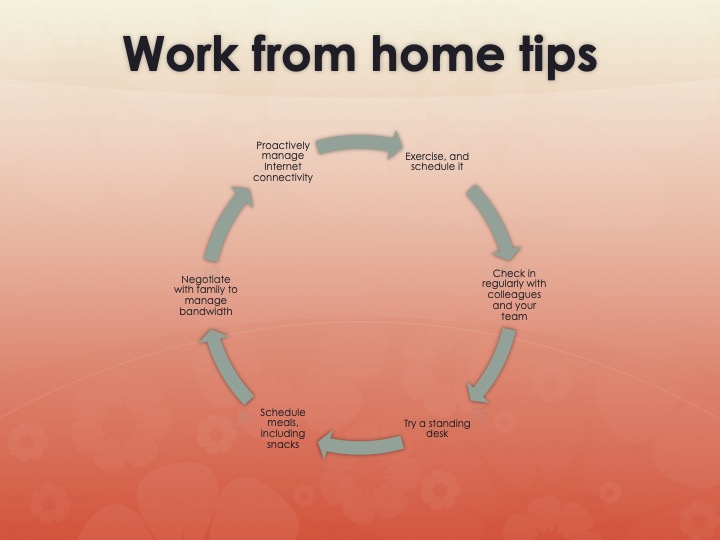
Earlier this week, I wrote some tips for working from home more productively. I have since recognized some other behaviors that have helped me not only improve efficiency but maintain my health (and sanity), some of which are particular to the current unique environment:
- Exercise, and schedule it. You will find that when working from home, you get much less activity than you normally would (even for those not particularly active). If you do not proactively address this situation, you can easily find yourself gaining weight or generally becoming less fit. To avoid distractions (either intentional or sub-conscious), schedule at least 45 minutes to an hour daily of a specific physical activity.
- Check in with colleagues and your team. One benefit when working in an office is the informal contact you have with others in the office. It may be going for a cup of coffee, chatting about the latest episode of Picard or a pick-up ping pong game. These interactions are important not only for understanding what your colleagues are working on but as an opportunity to vent or for them to vent. When working from home, you can become isolated and so can your colleagues and employees. Schedule time so you can regularly touch base with them, speak to a few a day, without an agenda, and just explore what you or they feel like discussing.
- Try a standing desk. There is some research that working from a standing desk is healthier than sitting all day, though the benefits are arguable, but even health aside it makes you more effective. I have found a standing desk helps keep me more focused and engaged during video calls while limiting distractions during other work.
- Schedule meals, including snacks. Just as you need to focus more on exercise when you are working from home, you also have to manage proactively your diet. Food is likely to be more accessible than at the office. Additionally, you will find that without your commute and with probably less time in meetings, you end up with more unscheduled time. The combination of easily accessible food and nothing to do can easily lead to more snacking and putting on extra weight. As with other parts of your day, scheduling meals and even snacks allows you to proactively choose your path.
- Negotiate with family to manage bandwidth. With more people working from home, Internet bandwidth is becoming a problem. I have recently experienced degradation on video calls, particularly at peak hours. To offset this issue, first determine if family members using the Internet concurrently are causing the bandwidth issue. If that is the case, work out a plan to manage this load, from having children stream when you do not have calls, download content off-peak rather than stream or watch video at lower quality (do you really need to see Friends in HD?). If both you and a roommate or partner works, compare schedules and try to schedule meetings at different times.
- Proactively manage Internet connectivity. With so many people working from home (and having video calls) as well as more people at home overall, some are experiencing other issues with the Internet. I have found you can largely predict when there will be bandwidth issues and have started to schedule calls and meetings at off-peak times. If you still find you are having issues, you can often alleviate them by turning off video (going voice only).
While working from home is unavoidable for some now it can also be a great opportunity. The key is to approach it proactively and optimize for a new environment, rather than simply trying to replicate your office life.
Being efficient while working from home
With so many people currently working from home, it is more important than ever that we use that time efficiently. Recently Nir Eyal, author of Hooked, shared a great infographic from the Silicon Valley Insiders blog by Dan Brodovich. As I have now been running a high performing team for almost a year while working from home, many of the insights reinforced lessons I have learned (sometimes the hard way). The key is to minimize and manage distractions, using four steps, and turning them into positives.
Master internal triggers
The first step is to become proactive rather than reactive. To master internal triggers, you first need to understand what drives you. According to Eyal and Brodovich, most people are driven by a desire to avoid discomfort and pain. Thus, you are likely to focus on a task that allows you to avoid a problem situation, rather than dealing with the more important problem.
The situation you avoid might be uncomfortable or put you in conflict with someone you have trouble working, so you sub-optimize by spending your time on something else. Rather than working on your sales strategy for the next quarter with the VP of Sales, who you personally do not get along with, you might end up working on your expense report to avoid having to deal with the VP. Not having a sales strategy has a much bigger impact on your company than getting your expense report submitted does.
To deal with this type of situation, you need to look externally for potential emotional discomfort, then write it down acknowledging the trigger and look at why you are tempted to do something else. This process is similar to an alcoholic addressing their problem by first acknowledging there is a problem.
Then, you need to change the task to make it more enjoyable or interesting. In the Sales example, you can gamify yourself by placing an internal bet that you avoid conflict and get the plan done in 48 hours. Then the activity becomes winning your internal bet rather than dealing with a tough process. If it is a boring task that you are avoiding because of the boredom, you can make it more interesting by introducing variability or discovery as part of the process (a book-keeping task where you are trying to find the biggest cost driver).
Finally, you should look inward and realize you do not have infinite willpower. Accept that you have to manage yourself and treat yourself like you would treat a friend facing similar challenges.
Make time for what needs to get done
The second step is to plan and time box your day so you focus on the activities you want to focus on, rather than get distracted. For me, this step is the most important. I use Google calendar to schedule almost all of my day, from the calls and meetings I feel are important, to time to work on projects I need to get done and even lunch and other personal activities. With a robust calendar, it becomes clear if a distraction is actually a distraction and what it is taking you away from accomplishing.
Brodovich also stresses that it is important to “schedule time for yourself first so you can be in the best shape for other commitments.” He points out you should focus on how you allocate your time, not the end result (the results will come from good allocation). Given that many of us are not only currently working at home but in a lockdown or quarantine environment, you need to schedule physical activity and entertainment diversions to maintain your health and well-being.
It is also important to value and thus allocate time to relationships. You need to start with your family, the people you love. While working from home is often thought of as a boost to work-life balance, you can easily be drawn into spending 20 hours a day on Slack and see less of your family than when you worked at an office and spent time with them after you got home. Similarly, you need to value your relationships at work, be it colleagues, your team or your boss, as high or higher than the specific tasks you are working on. When working in an office, you naturally gravitate to working together for the common good, when working from home this natural collaboration needs to be replaced by proactively ensuring you are helping the company in the best way possible. Brodovich suggests, “make time for alignment with stakeholders at work to inform about your tasks and schedule to avoid work-related distractions. Sync as frequently as your schedule changes or on a weekly basis.” The key is to schedule these relationships as part of your day, both the personal time and strengthening the bonds with your colleagues.
Limit external triggers
The next step is to “hack back” external triggers, reduce external triggers that distract you from your scheduled tasks. There are many of these that we can manage:
- E-mail. Limit the time you spend on email by sending fewer messages and writing short emails. Every message you send leads to a series of additional emails, so stopping early not only saves the time of one message but potentially tens of messages. Some tricks are only responding to emails during certain hours, delaying when your message is sent and creating labels to prioritize when you need to respond to an email.
- Group chat. I love Brodovich’s suggestion to “treat chat like a sauna – it is unhealthy to stay too long.” As with email, schedule time each day to review and comment in chats and only invite those relevant to a conversation into a chat channel.
- Meetings. Working from home is the best opportunity to rationalize your meeting schedule, a subject near and dear to my heart. Start by gently declining invitations to meetings that are not important to your work and where you do not add much value. A good test is if you will spend more time at the meeting checking your email or chats (another problem, see above), you probably do not need to be in the meeting in the first place. Also, make sure you only invite people to meetings who are needed, either for their participation or to help their work. Meetings are not the time to be nice or show someone you are thinking of them, instead respect people’s time and make sure it is the best use of it. Finally, create an agenda for any meeting to ensure everyone is prepared and they themselves can decide if it is valuable.
- Your mobile devices. Do I really need to stress how your phone or iPad can be a distraction? You can limit the distraction by deleting apps you no longer need, putting apps you know are distracting on a device that you will not use while working from home and managing notifications.
- Your computer desktop. You will find that you suffer less distractions if you remove clutter from your desktop and shut off all non-essential notifications.
- Articles. Click bating is a lot more powerful than you realize and you will often go down a rabbit hole of spending too much time on articles that do not improve your work. Brodovich suggests not reading articles on your web browser but instead saving interesting content for your mobile device (so you can review it when you are not working) as well as listening to articles and podcasts when you are out and about (maybe not as easy if you are stuck home due to Covid19).
- Feeds. Another area to reduce distractions is hacking back feeds. Brodovich points out that feeds are built to distract you. It is how Facebook and Twitter have become incredibly valuable companies. Change the settings (or move the apps) to disable these feeds.
Prevent distractions with pre-commitments and pacts
The final step to improving efficiency while working from home is to use pacts or commitments in advance to inhibit distractions. While we have to focus on social distancing, see if you can work in conjunction with a colleague or friend so you can pressure each other to stay on task. You can also use tech to keep you from distractions (some suggestions in the post include Forest, Focusmate and SelfControl.
Related, you can use price pacts to ensure you stay focused. These are deals with yourself that you will donate or give someone else $X if you do not stay on task. You need to ensure the chosen task is a short term goal or achievement for this tactic to work.
Finally, you should develop a self-identity that connects with your self-image of not being distractible. Brodovich suggests that you “call yourself indistractable’ to identify yourself with one and therefore behave like one….Share your commitment with others so that you can get external confirmation of your new identity”
Working from home is a great opportunity
While many are working from home given the challenges everyone is facing, we all need to make the most of this time. By following these steps, you can remain efficient and productive, even potentially improving on the work you have been doing in a traditional office.
Key takeaways
- With the huge increase in people working from home, now is the time to look at best practices so you make the most of this time and remain as efficient and productive as you were in the office, and the best way to do this is stay focused.
- You should understand yourself and create a robust schedule for your day, that includes both work and personal activities. Not only will this allow you to focus on what you know you should do but also it will make clear the cost of distractions.
- You should also minimize distractions by critically reducing time spent on and with emails, group chats, social media feeds, online articles and your mobile devices.

Alchemy: When psychology outmaneuvers rationality

I am a huge fan of behavioral economics — Dan Ariely is my favorite author — and find it very useful in helping with business issues. Behavioral economics blends ideas from psychology and economics, and it can provide valuable insight that individuals are sometimes not behaving in their own best interests. Behavioral economics provides a framework to understand when and how people make errors. Systematic errors or biases recur predictably in particular circumstances. A colleague recently recommended a book, Alchemy by Ogilvy Vice Chairman and marketing guru Rory Sutherland, that provides many real life applications and insights leveraging behavioral economics.
To use Sutherland’s words, “ there is an ostensible, rational, self-declared reason why we do things, and there is also a cryptic or hidden purpose. Learning how to disentangle the literal from the lateral meaning is essential to solving cryptic crosswords, and it is also essential to understanding human behavior.”
Logic can prompt you to miss great opportunities
Sutherland’s first recommendation is that the first or obvious “logical” answer may not be right or optimal. He explains that the opposite of a good idea can also be a good idea. Even if one course of action makes sense, there may be a better approach.
Logic does not necessarily lead to great, in many ways it drives you to average. If you are being logical, you can assume your competitors are also following a logical course of thinking. By following a logical path, you will end up in a red ocean at a level comparable to your competitors.
Logic can prevent you from creating great. If Steve Jobs and Jony Ive had pursued logic when designing a PC or phone for Apple, at best they would have built a better Dell or Nokia, instead of the most valuable company in the world. As Sutherland writes, “the problem with logic is that it kills off magic.” To quote Jobs, “stay hungry, stay foolish.” If great ideas initially made sense, somebody else would have already discovered them.
Another problem with logic that Sutherlands points out is that it is often used to justify bad decisions. People will use logic to either justify a bad course of action or provide protection from bad decisions, rather than seeking the best decision. Good debaters are great at using logic to justify any position rather than finding the best course of action. Sutherland writes, “business people and politicians do not quite understand this and tend to evaluate decisions by the rigor of the process that produces them, rather than by the rigor with which you evaluate their consequences….To them, the use of reason ‘looks scientific’, even if it is being used in the wrong place.”
This misuse of logic often prompts people to proceed with apparently reasonable things quickly while treating counterintuitive ideas with suspicion. It is easy to defend the reasonable thing if it fails, but people run more risk if they try the counterintuitive idea and it fails. The latter, however, provides the opportunity to separate your business from the competition.
Sutherland offers several examples of counter-intuitive ideas that generated billion dollar businesses. One would be to imagine you are in the boardroom trying to come up with a strategy to compete with Coca-Cola. The conventional answer would be to create a drink that tastes better or is less expensive. What if someone, however, suggested, a worse tasting drink packaged in a smaller container at the same or higher price. The latter is what Red Bull did and created a brand that Forbes estimates is worth almost $10 billion.
Sutherland’s point is that conventional logic is hopeless in marketing, you end up in the same place as your competitors. Even if we cannot explain eloquently why something will work (like a bad tasting expensive soft drink), we should not be blind to the fact that it does.
People are not rational
Not only is the logical and rational path not necessarily optimal, it is also not the one our customers might be pursuing. Another example that Sutherland explains is a marketing test he ran. He showed two advertisements, one a contest where a player could win free energy for a year (worth about $1,500) and another where you could win a cute penguin nightlight (worth about $20). If people react rationally, you would expect an order of magnitude more entries into the contest giving away the energy. Almost the inverse happened, 67,000 people entered to win the energy and 360,000 entered to win the cute animal nightlight. The takeaway here is not only do people not always act logically but also that cute animals are a very effective marketing technique (and you cannot use logic to determine what will be a powerful marketing message).
There are many other examples of how people do not always behave in a way that would be considered rational. The best selling wine at restaurants is usually the second least expensive. That is not because restaurants put their best value there, they will often put a less expensive bottle cost wise in that position. P assume, however, the least expensive wine is lowest quality or are embarrassed to order it for fear of looking cheap, they are not making the wisest (or rational) decision. Restaurants have also found that by offering people still or sparkling bottled water, they increase sales because many people do not ask for tap water. These examples reinforce that consumer behavior is not simply based on people making rational decisions to optimize their happiness.
Data can be misleading
One area that Sutherland focuses on that is particularly dear to me is how data is often misused. Sutherland writes that “we constantly rewrite the past to form a narrative that cuts out the non-critical points–and which replaces luck and random experimentation with conscious intent…. It is important to remember that big data all comes from the same place–the past…. A single change in context can change human behavior significantly. For instance, all the behavioral data in 1993 would have predicted a great future for the fax machine.”
Not only can data be used to criticize a good decision or justify a bad one, it is possible to construct a plausible reason for any course of action, by cherry-picking the data you choose to include in your model and ignoring inconvenient facts. I have written before about confirmation bias, and more data makes it easier to find support for some spurious, self-serving narrative. Effectively, you can find more pieces to confirm whatever you are arguing. Sutherland argues, “the profusion of data in future will not settle arguments: it will make them worse.”
Related, Sutherland points out, “people who are not skilled at mathematics tend to view the output of second-rate mathematicians with an high level of credulity, and attach almost mystical significance to their findings. Bad maths is the palmistry of the twenty-first century. Yet bad maths can lead to collective insanity, and it is far easier to be massively wrong mathematically than most people realise–a single dud data point or false assumption can lead to results that are wrong by many orders of magnitude….To put it crudely, when you multiply bullshit with bullshit, you don’t get a bit more bullshit–you get bullshit squared.”
Market research is often as unreliable as other data. As well as not always acting rationally, people often do not know what they prefer. Sutherland writes, “the trouble with market research is that people don’t think what they feel, they don’t say what they think, and they don’t do what they say. People simply do not have introspective access to their motivations….It is perfectly possible that conventional market research has, over the past fifty years, killed more good ideas than it has spawned, by obsessing with a false idea of representativeness.”
Market research also can miss what is driving a person’s decision, such as avoiding disaster rather than getting the best outcome. Someone choosing Product A over Product B would say that they thought Product A is ‘better’, even if really they meant something quite different. They may unconsciously be deciding that they prefer Product A because the odds of its being disastrously bad are only 1 percent, whereas the risk with Product B might be 2.8 percent. This distinction matters a great deal, and it is borne out in many fields of decision science. People will pay a disproportionately high premium for the elimination of a small degree of uncertainty.
Once you understand the limitations of data, you can create great outcomes. Following conventional wisdom leads you do what your competitors are doings and metrics prompt you to design for average. Averages (and medians) encourage you to focus on the middle of a market, but innovation happens at the extremes. You are more likely to come up with a good idea focusing on one outlier than on ten average players.
Perception over reality
The other issue with relying on historic data is that it assumes people’s decisions are logical, given they are often not rational that reliance can be a mistake. Sutherland aptly says, “in maths it is a rule that 2 + 2 = 4. In psychology, 2 + 2 can equal more or less than 4. It’s up to you.” At its heart, people do not value things, they value the meaning attached to these things. While the objects properties are determined by physics, what they mean is determined by psychology.
There are multiple examples of how perception forms our reality. Wine tastes better when poured from a heavier bottle or has a French label. Painkillers are more effective when people believe they are expensive. Almost everything becomes more desirable when people believe it is in scarce supply, and possessions become more enjoyable when they have a famous brand name attached.
A great example of the power of psychology is Uber’s success. Uber’s map does not reduce the waiting time for a taxi but simply makes waiting much less frustrating. Travis Kalanick, Uber’s founder, realized people are bothered more by the uncertainty of waiting than by the duration of a wait.
Another example are claims on products, as people often think packaging that implies a product is healthy or good for them (or an app), is less tasty. It does not matter what something tastes like in blind tastings, if you put low in fat or any other health indicators on the packaging, Sutherland shows that you will make the contents taste worse.
Another area where perception is more important to a customer’s satisfaction is price. Why do people love sales, rather than spending the time to find the everyday low price. Sutherland explains “a low price, unlike a discount, does not allow people any scope to write a more cheerful narrative about a purchase after the event–‘I saved £33’, rather than ‘I spent £45’.” Marketing can have a strong impact here, not only justifying a high price but also detoxifying a low one.
The importance of optimizing for perception creates many opportunities to improve your business. I have written several times about customer experience and service, and focusing on perception allows you to create a superior experience. Some ways you can impact the experience, based on Sutherland’s ideas:
- Small acts of discretionary generosity, such as waiving a charge when a customer ordered a dish they did not like or a complimentary chocolate at the end of a meal are regarded by customers as reassuring indicators of trustworthiness; we correspondingly see the absence of such signals as being a cause for concern.
- Offering more customer service touch points or opportunities for live contacts. One of the reasons why customer service is such a strong indicator of how we judge a company is because we are aware that it costs money and time to provide.
- Provide collateral outside of email. Sutherland writes, “bits deliver information, but costliness carries meaning. We do not invite people to our weddings by sending out an email. We put the information (all of which would fit on an email–or even a text message) on a gilt embossed card, which costs a fortune….We notice and attach significance and meaning to those things that deviate from narrow, economic common sense, precisely because they deviate from it. The result of this is that the pursuit of narrow economic rationalism will produce a world rich in goods, but deficient in meaning.”
It is also important to stress that it is not immoral to build a product or service to appeal to customer’s perceptions rather than logic. The Greeks did it first. There is barely a straight line in the Parthenon, the floor curves upwards in the middle, the sides bow out and the columns swell in the middle. This shape is because it is not designed to be perfect, instead it is designed to look perfect to a human standing about a hundred yards away.
Effectively, we want to make people happier and feel better. This can be achieved by improving their perception of their situation. It’s similar to a doctor who can help cure a patient either by giving a placebo or actual medicine. If the placebo serves the same purpose, it is in the patient’s interest to get the placebo (as it potentially has less side effects). As Sutherland says, “we should be researching this rather than decrying it.”
Social context is critical
Another key insight in Alchemy is the importance of social context. Sutherland explains that the context in which someone experiences something is the key to how they perceive it. According to Sutherland, “our very perception of the world is affected by context, which is why the rational attempt to contrive universal, context-free laws for human behavior may be largely doomed.”
There are many examples of where context determines how something is perceived. A hospital might have brilliant doctors, but if the reception area has old magazines we are likely to complain. If you go to a restaurant, your perception will be driven less by the food, the real value lies in social connection, and status. If you see a movie star at the table across from you and a line of Bentleys outside, you will probably end up telling your friends about an incredible dining experience. Sutherland points out, “we make far more positive comments about a dish’s appeal and taste when it is garlanded with an evocative description: ‘A label directs a person’s attention towards a feature in a dish, and hence helps bring out certain flavors and textures.’ Never forget this: the nature of our attention affects the nature of our experience.”
Less is more
I have written before how making a product simpler and less functional is one of the key ways you can build a superior product – from Uber to Monzo
to hypercasual games– and Sutherland reinforces this hypothesis. With new products or games, you can always add, but while this makes the new offering more versatile, it also reduces the clarity of its affordance, making it less pleasurable to use and quite possibly more difficult to justify buying. Sutherland explains, “the jack-of-all-trades-heuristic, whereby we naturally assume that something that only does one thing is better than something that claims to do many things.”
Sutherland pointed to the success of the Sony Walkman. Sony, by removing the recording function from Walkmans, created a product that had less functionality, but a far greater potential to a change behavior. By reducing the possible applications of the device to a single use, it clarified how people could use the device. As Sutherland says, “it is surprisingly common for significant innovations to emerge from the removal of features rather than the addition.”
How to make it work
Given that logic or date or research cannot predict much behavior, you need to find an alternative to benefit from Sutherland’s findings. It comes down to testing different approaches and trying creative ideas. Sutherland suggests, “the only way you can discover what people really want (their ‘revealed preferences’, in economic parlance) is through seeing what they actually pay for under a variety of different conditions, in a variety of contexts. This requires trial and error–which requires competitive markets and marketing.”
In addition to testing, think creatively. Sutherland suggests we spend “20 per cent of conversational time … for the consideration of alternative explanations, acknowledging the possibility that the real ‘why’ differs from the official ‘why’, and that our evolved rationality is very different from the economic idea of rationality. If we could resist the urge to be logical just some of the time, and devote that time instead to the pursuit of alchemy, what might we discover? Quite a lot of lead, I suspect. But a surprising amount of gold.”
Key takeaways
- People often do not action logically so you should not base decisions on expecting your customers to act logically
- The key is someone’s perception, not the reality. While in math 2+2 = 4, in psychology it could equal 5 (or 6 or 3), so we need to anticipate how the context will drive the perception.
- The best way to create innovative solutions is by testing different options and thinking creatively.
A fundamental of creativity

Although I am probably the last person who should be writing about creativity, I recently learned the “secret” of one of the most successful chefs of all time, an approach that can drive creativity in any industry. While reading The Sorcerer Apprentices: A Season At el Bulli by Lisa Abend, the book highlighted the key to Ferran Adria’s success. Adria’s El Bulli is arguably the most successful restaurant ever, voted the world’s best restaurant five times (2002 and 2006-2009) before closing in 2011. Ferran achieved these incredible accolades by continually innovating, not only creating new dishes but creating a new type of cuisine (molecular gastronomy).

The nucleus of this creativity was one guiding principle: don’t copy. While culinary history and achievements had been based on an original set of recipes that a talented chef would hone, polish or reimagine fitting their own vision, Ferran took a different approach. He would never start with someone else’s recipe and tinker with it. As Abend writes, “Ferran started only with himself, with his own ideas.”

Ferran built on this philosophy every season. Not only would he not copy other chefs (past or present), he would not copy himself. Every single dish was a new creation. He also did not institute a formal process to come up with new dishes, instead constantly brainstorming with his top colleagues. The lack of a formal process ensured that every dish would be new and unique, not an evolution of a previous dish.

Not for everyone
While Ferran built arguably the most creative and acclaimed restaurant ever, I am not advocating that we all start to build products in this manner.
- First, there are very few Ferran Adria’s in the world. If I tried to create a dish without looking at a recipe, it not only probably would be inedible it is more likely than not to be poisonous. If someone does not have the innate artistic ability to come up with a work of brilliance, they are unlikely to create a work of art.
- Second, focusing on creativity often does not optimize profitability. While El Bulli won best restaurant five times, it was highly unprofitable, with Ferran making most of his money by leveraging his celebrity nature. You can often make a much higher return by building on a great concept (look at Danny Meyer’s Shake Shack) than creating the best and most unique.

Ideally, you find a way to do both. By integrating true creativity into your offering, without building your entire business around the creativity, you can find your Blue Ocean. You can have an offering that appeals to both the traditional customer and a new set of customers who appreciate the creativity you provide.

Key takeaways
- Chef Ferran Adria’s El Bulli, arguably the world’s most acclaimed restaurant ever, achieved its success with an unmatched level of creativity, delivering incredible new unique dishes year after year.
- The creativity was driven by a simple philosophy, don’t copy.
- Adria would never start with someone else’s recipe and tinker with it. He would also never copy one of his previous recipes.

The lesson that Roger Bannister taught us

Roger Bannister’s sub-4 minute mile in 1954is not only inspiring but a critical lesson for business people. Until Bannister, nobody had been able run the mile in less than 4 minutes despite recorded efforts for over 1,000 years and very serious efforts starting in 1886. Before Bannister’s feat, many argued and believed that the human body was unable to run a mile in less than 4 minutes, that it was physically impossible. It was considered the Holy Grail of sports, with media and crowds constantly looking for someone who could achieve this inhuman feat.

The lesson comes not from how Bannister achieved this apparently miraculous accomplishment, but what happened next. While nobody else had been able to break the 4-minute mark despite hundreds of years of effort, 46 days after Bannister’s feat John Landry ran the mile in 3 minutes 58 seconds. About a year later, three more runners also broke the 4-minute threshold, doing it in the same race.
The lesson
The lesson to draw from Bannister’s achievement, and what followed, is that what you consider impossible may not be. Most importantly, once you are able to achieve the impossible, it becomes the new baseline and even more is possible. The key is breaking the barrier, overcoming the impossible.
Recently, I saw a successful company break the 4-minute mile and reach a new level of performance. It hit what had for years been an impossible milestone. Breaking its personal four-minute mile increased long-term profitability by 30 percent.
The company achieved this result by focusing efforts of multiple teams to create a super-revenue day. All elements of the company designed a plan to create one huge day, the one that was formally their 4-minute mile (though they hadn’t come as close as Bannister’s competitors had). These results not only led to the highest revenue day in the company’s history, but revenue previously considered unattainable.
Like the 4-minute mile, though, once they had broken through this barrier, they themselves were amazed to see that they surpassed that goal repeatedly, without the need even of special initiatives. Now what was once a ceiling is turning into a floor for the company.
Do the impossible, and then more
What the 4-minute mile and this company’s success show is that there is tremendous value in tackling what looks to be impossible. This ceiling could be 100,000 daily average users or a 5 percent conversion rate or a $10 million month, a goal that would impact you significantly and set your company up for a brighter future. If you find a way to overcome it, not only do you derive immediate value but more importantly you can change your long-term trajectory.
Key takeaways
- In 1954, Roger Bannister ran the first sub-4-minute mile, a goal many had considered humanly impossible for hundreds of years.
- Once Bannister broke the barrier, somebody else broke it less than two months later and then three runners achieved the feat in the same race about a year later.
- In business, too, once you find a way to overcome an impossible barrier you are likely to find that you can do it repeatedly and create a new floor.
Customer experience best practices from the best
Earlier this year, I wrote about how to create a customer experience that improves retention, and thus profits. Given the importance of the customer experience on retention, I have since discovered additional best practices in delivering customer WOW. The New Gold Standard by Joseph Michelli shows how the Ritz-Carlton hotel group delivers fantastic customer service.
Start with attitude
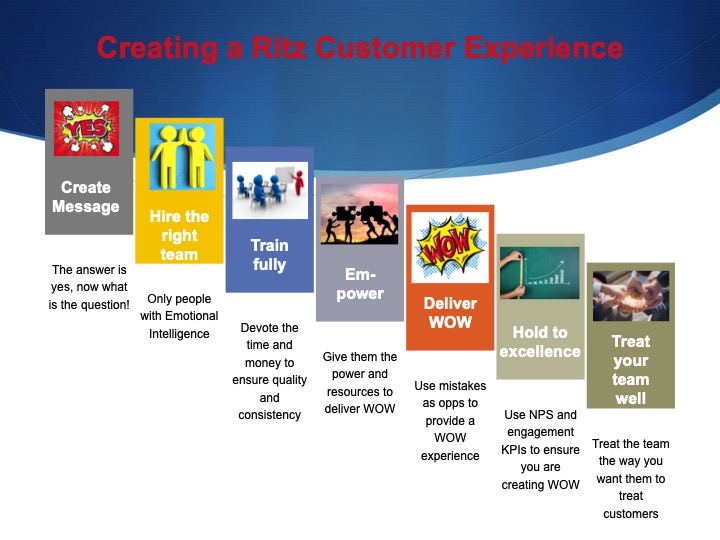
To provide a customer experience that will generate loyalty and engagement and prevent churn you first need to have a message everyone in your company is aligned with. Great customer service begins with a clear and consistent organizational focus. For the Ritz-Carlton group, the phrase “the answer is yes; . . . now what is the question?” crystallizes the attitude throughout the company. This message conveys that if the service Ritz employees offer does not surpass the expectations of guests, then the splendor of the hotel becomes far less meaningful. Michelli quotes Ritz leadership as saying, “the amenity that matters most to our guests is not a fancy chocolate on the pillow but a dedication to service that never wavers.”
Once you have developed a message that conveys the experience you want your team to provide, the approach and behaviors will flow from it. Going back to the Ritz example, by starting with “the answer is yes” everyone knows that there is never any such thing as saying “That’s not my job.” When it comes to providing a service to a guest, the word no is not in the vocabulary of those who work at Ritz-Carlton.
This attitude then guides people not only in their interactions with customers but also with each other. Richelli writes, “this spirit of wanting to serve not only our guests but to lend an extra hand to fellow staffers is how the Ritz-Carlton culture of caring permeates all of our lives.” Thus, the service message becomes an operating principle throughout the organization.
Hire right and set them up to succeed
Once you have aligned your company with a message that conveys the customer service experience you want for your customers, you need to build the team to deliver it. When I wrote about creating a great customer experience, one of the keys I highlighted was the need to align hiring with creating a great experience. You can’t teach emotional intelligence, so it is critical to hire people who can radiate warmth, friendliness, happiness and kindness. Ritz-Carlton takes the same approach, believing that excellences starts with the right raw talent instead of attempting to manage employees to overcome talent deficits.
Having people who can deliver a great customer experience does not end with hiring the right people, though, you also have to dedicate the time and resources to train them properly. Training is important not only to provide your people with the tools to create a great experience but also to ensure consistency. You want the experience someone enjoys in Paris to be as good as the experience they would enjoy with you in Sydney. Even in the online world, you want the experience someone gets when talking to an agent about a purchase issue to be as good as when they are dealing with a VIP host about a sale. With the Ritz, all managers undergo three weeks of training. The first two days cover the typical Ritz-Carlton orientation; day 3 involves the expectations of leadership including how to treat their colleagues. On Day 21, after becoming certified in the operational standards of their positions, staff members are given a forum to discuss openly the positives and negatives they have encountered in their first three weeks. It is this training, coupled with openness and feedback, that ensures all customers enjoy a consistent Ritz experience.
Empower the team
Once you have the right people with the right training, you need to empower them to give a great experience. At the Ritz, they “empower through trust…Ritz-Carlton leadership sends a clear message that every staff member has the full authority to use his or her discretion to produce grand experiences for guests…. Every person, including a member of housekeeping and an employee working in the laundry, is empowered to use judgment, without seeking permission from a supervisor, to spend up to $2,000 on each guest each day!”
Creating a great experience depends on the employees, not the leadership. If a Ritz-Carlton employee sees a problem, they own it and are expected to fix it. The job of leadership is to empower people to create that experience. With Ritz, it’s not only the $2,000 budget but also the mandate that it is up to people on the front line to generate unique and memorable experiences. Leadership at the Ritz-Carlton believes “you just can’t micromanage unique and memorable outcomes.”
Part of empowering your people is giving them the freedom to modify their work to respond to customer needs, not just giving them a budget. If a guest has a problem or needs something special, Ritz-Carlton staff will should break away from their regular duties, address and resolve the issue. This action is only possible by not micro-managing the staff or basing their performance evaluation on hard metrics (i.e. tickets responded).
Empowering your team, and giving them the needed resources, not only leads to Wow experiences but is also cost effective long-term. An analysis of manufacturers helped leadership at Ritz-Carlton appreciate that the longer defects went undetected, the more expensive the defects were to repair. Additionally, the longer a defect remained in place, the more that defect caused other errors. When problems are not resolved satisfactorily, they not only create customer churn (for the engaged Ritz-Carlton customer, this lifetime value can be in excess of $ 1 million) but they also produce people who are vocally negative about the brand.
A Ritz-Carlton leader said, “I’ve come to learn that the least costly solution is the one that happens immediately. The longer and higher a customer complaint lives in an organization, the more it grows. By the time a complaint hits senior leadership, what could have been resolved by getting the guest the amenity he or she requested with a slight enhancement turns into resolutions on a par with an upgraded night on the Club Level (an elevated service experience affording access to a lounge serving multiple daily complimentary food offerings and the ready assistance of concierge staff).”
Deliver WOW
All of these elements should come together to deliver WOW. A Wow experience hinges less on the inherent exhilaration of the product and more on delivering service that appeals to both the thinking and feeling aspects of your customer. Michelli writes “operating from this understanding that customer engagement is linked to the consumers’ wanting ‘to feel a rush, Ritz-Carlton leadership calls this desired memorable and emotional connection a ‘Wow experience’ and encourages staff to personally affect guests to achieve this level of emotional intensity…. Wow starts with a commitment to a culture of extraordinary service. Ingenuity brings it to life…. Extremely satisfied customers emerge through memorable and emotional connections forged between them and a business.”
Some of the greatest opportunities for wowing customers occur when breakdowns happen. Earlier this year I wrote that “mistakes are one of the best things that can happen in the customer experience world. Players remember the way mistakes are handled much more than the mistake and often more than the actual gaming experience. Mistakes provide an opportunity to create a great memory and a connection with your customer.” Breakdowns will occur despite the best intentions to provide flawless service. Empathy, quick attention, and a willingness to go beyond the resolution will salvage a bad situation and turn it into a winning outcome. Although many businesses go out of their way to deny responsibility for guest problems, the staff of Ritz-Carlton typically acts responsibly, without ascribing blame, through targeted corrective action.”
Hold the team to high standards and measure, measure, measure
Once you have the right people and they are trained and empowered, you need to ensure they are delivering on your core message and it is resonating with customers. If people are set up to succeed, then it is also their responsibility to create a great customer experience. You must monitor your team and make sure they are creating Wow experiences for your customers.
Not only should you work with them individually, you should look at how well your customers are responding. Start with monitoring NPS (Net Promoter Score). Net promoter score is very straightforward. It is the answer to one question, on a scale of 1-10: How likely is it that you would recommend the company to a friend? Those who are answer with a 9 or 10 are considered loyal enthusiasts who will keep buying and refer others. Those who answer 7 or 8 are passives, satisfied but unenthusiastic customers who are vulnerable to churning. Those with a score of 0-6 are considered detractors, unhappy customers who can damage your brand and impede growth through negative word-of-mouth. While target NPS scores are dependent on your industry and audience, you can monitor your team’s performance by looking at the trend, whether your NPS is improving or deteriorating.
The Ritz-Carlton takes measurement to the next level and that provides a great way to move from providing excellent customer service to delivering Wow. At Ritz, they focus on customer engagement using a methodology developed by the Gallup organization:
- How satisfied are you with Ritz-Carlton?
- How likely are you to continue to choose Ritz-Carlton?
- How likely are you to recommend Ritz-Carlton to a friend or associate?
- Ritz-Carlton is a name I can always trust?
- Ritz-Carlton always delivers on what they promise?
- Ritz-Carlton always treats me fairly?
- If a problem arises, I can always count on Ritz-Carlton to reach a fair and satisfactory resolution?
- I feel proud to be a Ritz-Carlton customer?
- Ritz-Carlton always treats me with respect. 10. Ritz-Carlton is the perfect hotel for people like me?
- I can’t imagine a world without Ritz-Carlton?
By looking at NPS and customer engagement, you can measure how well you are delivering a great customer experience. Most importantly, look at the trends and see if you are maintaining a strong experience, getting better or deteriorating. Once you understand how your customers feel, you can then work with your team to improve. Transparency is the key, at Ritz, once the data is collected, results are posted monthly, and an 18-month rolling average is used to place each hotel in a green, yellow, or red zone. You should use this data to adjust swiftly what you and your team is doing to enhance the emotional bond with your customers.
Treat your staff like you treat your customers
The final key to creating a great customer experience is treating your team the way you want them to treat your customers. Leaders need to lead by example and this includes helping people see how they should treat others. At the Ritz-Carlton, the philosophy is that everyone is as important as everyone else, from the CEO to the housekeepers and clerks. Michelli writes that “by not confusing title with importance, leadership at Ritz-Carlton understands that creating an environment of respect universally results in a respectful service….I knew the guests were very important. But a few months later I realized that the maître d’ I watched every day was just as important because every guest was proud when he talked to them. Why? Because he was a first-class professional. He was somebody special—because of the excellence he created for the guests.”
This attitude also should translate into protecting your team when necessary from customers. If a customer is disrespectful, that is no more acceptable than an employee being rude to a customer. You need to empower your team to fire customers gracefully to reinforce the importance of treating everyone well.

A story to create WOW
Integrating best practices from the Ritz-Carlton with the way Danny Meyer created a restaurant empire, it becomes clear that building a great customer experience is not about one thing (a catchy slogan, a big CS team, etc.) but about a process. First you need to create the appropriate mentality across your organization, then hire the right people, train them consistently and focus on (and measure) delivering what the customer does not even realize they want. With these elements in place, you will create a customer experience that accelerates engagement and retention of your customers and translates into higher profits.
Key takeaways
- Ritz-Carlton, one of the most profitable hospitality groups, leverages creating a great customer experience to build its competitive position
- To provide an exceptional experience, you need a message that your organization can rally around; for the Ritz-Carlton it is: the answer is yes; . . . now what is the question?
- You then need to build a team focused on delivering that experience, from hiring correctly, to training and then empowering.
Beware of equating sector performance with that of a dominant company
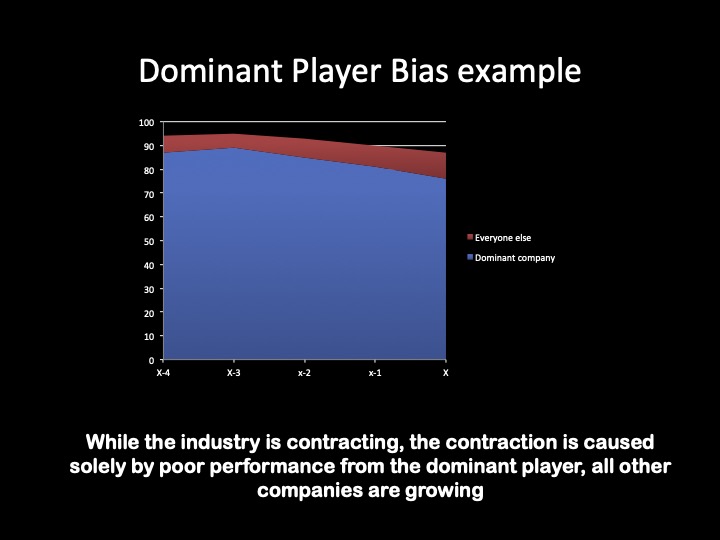
One cognitive bias that is often overlooked is equating the performance of an industry or sector with that of its dominant player. When one company represents 60, 70, 80+ percent of a market, its fortunes will drive the growth (or decline) rate of the industry. This growth, however, may be due to mistakes or issues with the dominant company rather than the underlying market and potential of the space. This bias, what I refer to as Dominant Player Bias, risks abstaining from good business opportunities and misallocating resources, missing Blue Oceans and accepting sub-optimal performance. The chart below shows how one company’s poor performance can imply the entire sector is contracting, though the problems are due to the dominant company rather than reduced interest:
There are many examples where the fortunes of the dominant company are equated with the fortunes of the industry. Facebook has nearly 70 percent of the social media market and if people lose interest in Facebook, it drives a decline in social media usage. Roughly, a 20 percent drop by Facebook, would drive down overall social media numbers about percent 15 percent (I am not using real numbers for the purpose of this example). Thus, investors may invest less in social media or other companies may accept declining usage because they feel the industry is contracting significantly. The actual cause though may be Facebook’s customers’ dissatisfaction with privacy or advertising policies. Dominant player bias has caused these investors and competitors to equate Facebook’s performance with the social media landscape.
There are several actual examples of dominant player bias (the Facebook one above is for illustrative purposes only). When Zynga’s performance dropped significantly after its IPO in 2011, many heralded the end of social gaming. The success (and valuation) of companies like King.com, Epic, Supercell, etc., show that the underlying market remained healthy and Zynga was performing due to internal issues (shift to mobile, reliance on the Facebook feed, etc.).
Underestimating the market
The first problem caused by Dominant Player Bias is that it prompts companies to underestimate, and thus under-invest, in a market. To use the Facebook example, if Facebook is facing difficulties but people misinterpret its problems for shrinking demand for social media, they are underestimating the market and thus missing potential opportunities. These opportunities include:
- The dominant player under-investing and seeking to diversify. If they do not realize that internal decisions have led to falling performance, they may seek to diversify or even exist a market with high potential because they believe the potential market is smaller than it actually is
- Competitors may shy away from trying to build a business in the market because they feel it is not worth the investment. This bias can result in under-investment in new product development, marketing or other avenues that companies could challenge the dominant player. In this case, dominant player bias is actually compounding the problem because if the market is shrinking due to poor performance by the dominant player, it is actually a great opportunity for someone else to come in and try to break its hold on the market.
- Investors are less likely to fund companies with ideas that can disrupt the market if they perceive the sector is not attractive. Investors might underestimate the potential of an opportunity if they think the market is shrinking, though the market may only be shrinking because of poor decisions by the dominant player.
While dominant player bias can be either positive or negative, it is not a significant problem when it exaggerates the market potential. If a great company is continually expanding the market, then the great company’s performance is a good proxy for the overall opportunity.
You may miss a Blue Ocean
Another issue generated by Dominant Player Bias is that it might blind companies or investors to Blue Ocean opportunities. I have written several times about Blue Ocean strategy, rather than competing directly find an adjacent market space where there is no competition, and how Blue Oceans over time generate a higher return than competing in red oceans. If you succumb to Dominant Player Bias, however, you may never find the Blue Ocean because you falsely decide it is not worth looking for. This problem is particularly salient in industries with a dominant player, because their dominance may have prevented them from appealing to anyone except their existing customers (who they feel represent the entire market).
A great example of Dominant Player Bias and how a Blue Ocean strategy proved it wrong is the circus industry. Years ago, Ringling Brothers dominated the market. However, they let their product get stale and did not react well to changing tastes. Most observers at the time, 1984, believed that the overall circus market was dying and not worthy of investment. The founders of Cirque de Soleil, however, saw past this bias and realized it was the Ringling Brothers offering, not the circus market, that was causing the decline and launched a reimagined product. Now Cirque de Soleil is orders of magnitude larger than Ringling Brothers ever was because the Cirque founders were not convinced the circus market was dying due to Ringling’s poor performance.
A convenient excuse
Whether you are the major company or one of the small players, dominant player bias can mask under-performance, and thus opportunities to improve your company. Rather than looking inwardly, either intentionally or unintentionally, poorly performing dominant companies will blame the market for poor results. This bias will lead to several problems:
- Resources are under-allocated to the market where they have a dominant position. As mentioned earlier, dominant companies normally enjoy higher profit margins. Rather than trying to grow these businesses further (and thus increase a high margin business), internal investment is diverted to other efforts that have a lower ROI because the market potential of the core market is underestimated.
- There is unnecessary diversification or divestment. If the company believes the market it dominates is declining due to existential issues, it may diversify or close its business in the sector while it could enjoy a higher return if it resolved the internal problems leading to declining results.
- The dominant player misses opportunities to expand the market because they misinterpret declining results for a smaller market.
- Allowing poorly performing leaders to remain in critical positions. Rather than realizing deficiencies in leaders, poor results are blamed on overall conditions. This mistake keeps weak leaders in place rather than in competitive markets where the strongest leaders rise to the top and help improve the company’s fortunes.
Concentration is often the cause of an industry’s decline
While most companies dream of dominating their market, the type of concentration that creates Dominant Player Bias also can negatively impact the dominant player. By not facing competition, the company is not forced to innovate or grow the market. Instead, it enjoys monopoly rents, and thus a high profit margin, but is not focused on creating additional value. Without a focus on improvement, these companies usually reach a peak where they consider their huge market share the ceiling.
They do not provide anything to people who might not like their product but would enjoy something somewhat different. They also suffer from the innovator’s dilemma, they are satisfying existing who they know very well but because of their focus on their customers they do not create offerings that appeal outside the existing market. Over time, because others experience Dominant Player Bias, nobody brings new products to market, and the perception that the market is saturated leads to the reality that there are no new customers. Additionally, when a company enjoys a dominant position, the cost to them of acquiring new customers is very high relative to the value (almost everyone knows the dominant player, the low- and mid-hanging fruit has already been picked, etc.) so resources are focused on increasing profitability, generally by cutting costs. Since there is no effective competition, in the short term the company sees higher profits but eventually people are driven to alternatives (there are always alternatives, just potentially not direct alternatives), which creates a declining market (though the market shrinking is not driven by a smaller addressable market but by the dominant player reducing the total net value it is providing). This decreasing market both negatively impacts the dominant player over the long-term and prompts other companies to avoid entering the space.
The antidote for dominant player bias
To counter Dominant Player Bias everyone (the dominant player, competitors, potential market entrants, investors, etc.) should focus on the underlying market dynamics and the value to the customer rather than the short or mid term trends in the market. Going back to the Zynga example, looking in the mirror it is clear how other companies avoided Dominant Player Bias. If rather than looking at Zynga’s troubles and extrapolating it to the social gaming market, you looked at the value they were giving game players with a product that appealed to an untapped market (non-core gamers) and a business model (free-to-play) that made it easy for consumer to test and enjoy products, you would have seen that there was still a tremendous opportunity. That is exactly what happened at King and Supercell and Scopely, who avoided Dominant Player Bias and built billion dollar companies. By focusing on how much value you can deliver, it is much easier to scope the market rather than relying on how much one company has already delivered.
Key takeways
- Dominant Player Bias is when you mistakenly think a sector is contracting because the dominant firm is performing poorly, while the underlying cause is mistakes by the dominant firm.
- Dominant Player Bias impacts both the dominant company and competitors (and potential competitors), as it prompts them to underinvest in the sector and not seek new, Blue Ocean, ways to expand the market.
- To combat Dominant Player Bias, you should look at the underlying value to customers and potential customers, rather than the performance of one company.
The subscription KPIs that matter
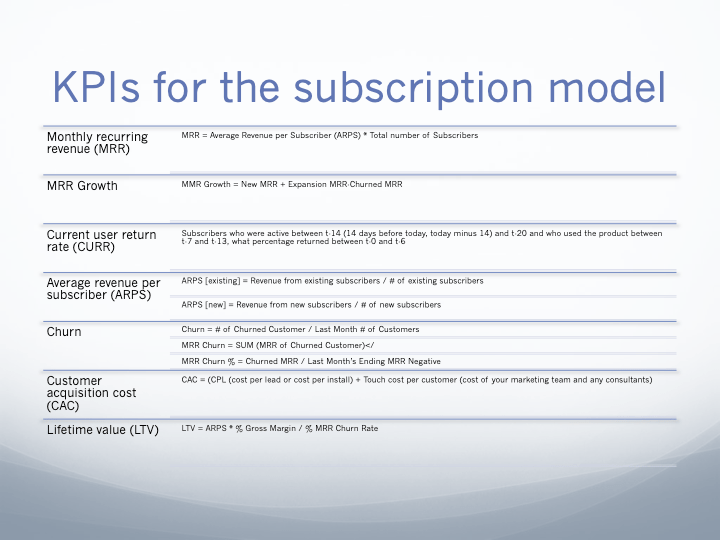

I have written several times recently about building and running a successful subscription modelin gaming but I did not address how to measure whether it is successful. To grow any business you need to understand what to measure so you can then optimize against these KPIs. While subscriptions do share some common characteristics with the free-to-play business, driven by the in-app purchase model, there are certain KPIs unique to subscriptions that you should focus on when building your program. As Leandro Faria says in The Essential SaaS Metrics Guide, “data doesn’t do you any good unless you act on it.”
MRR
Monthly recurring revenue (MRR) is generally the first KPI that companies focus on when looking at the health of their subscription program. You calculate MRR by looking at the average revenue per subscriber by the number of subscribers. If you only have one subscription level, then it is simply the monthly subscription cost times the number of subscribers. If you have subscriptions for various terms (monthly, quarterly and annual, for example), you calculate the average monthly revenue from the different subscription (an annual subscription of $144 generates $12 per subscriber in MRR). The formula is
- MRR = Average monthly revenue per subscriber (ARPS) * Total number of subscribers
The reason MRR is the first KPI that subscription businesses monitor is because it shows the value of the model. MRR effectively is how much revenue the business can count on every month. The company can then allocate this cash flow to marketing, operations, acquisitions, etc. By having a guaranteed amount of revenue (which you do not have with discrete sales or in-app purchases), you have a clear source of funds to operate your business. Most companies will extend MRR to create an Annual Run Rate (ARR), which is important both for business planning purposes and understanding the value of the subscription component of your business.
MRR Growth
In addition to looking at MRR, you should monitor MRR Growth. To analyze MRR growth, you need to break it into three components. The first is new MRR, revenue brought by newly acquired customers.
The second component of MRR growth is Expansion MRR. Expansion MRR is increases in subscription revenue from existing subscribers. This revenue is driven by up-selling and cross-selling your customers.
The third element of MRR Growth is churn. Churned MRR is the revenue that has been lost from customers cancelling or downgrading their plans.
Taking these three components into account, the overall formula for MRR Growth is:
- MMR Growth = New MRR + Expansion MRR-Churned MRR
CURR
I have written before about CURR (current user return rate), and it is as valuable in subscription businesses as it is for other online models. CURR shows how loyal your existing customers are; you should consider CURR the inverse of churn. If your CURR increases, it means you have improved your product’s appeal to existing players or customers, if CURR declines you have made your game worse. CURR is also an excellent way of looking at how your game is performing among different segments, VIPs versus payers versus never-spenders.
To calculate CURR:
- Subscribers who were active between t-14 (14 days before today, today minus 14) and t-20 and who used the product between t-7 and t-13, what percentage returned between t-0 and t-6.
Measuring CURR is critical to see how engaged your subscribers are. If CURR trends downward, you are likely to experience increasing customer churn.
.
ARPS
As mentioned above, Average Revenue Per Subscriber (ARPS) is central for calculating MRR, but it is also an important KPI itself. Increasing ARPS shows that customers are upgrading and most likely seeing high value in your offering, thus they are willing to pay more. Conversely, declining ARPS shows that customers are not experiencing sufficient value and are either down-grading or moving to free plans
You should also monitor ARPS separately for existing players versus new players. As Faria writes, “there is a good practice of measuring the Average Revenue per [subscriber] separately for new customers. So instead of having an [ARPS] metric for all your customers, you’d have two different metrics: Average Revenue per Existing [Subscriber] and Average Revenue per New [Subscriber].” To calculate:
- ARPS [existing] = Revenue from existing subscribers / # of existing subscribers
- ARPS [new] = Revenue from new subscribers / # of new subscribers
Churn
Churn is the enemy of any business, but is even more troubling for subscription businesses. You never want to lose customers, but with subscription businesses churn means you are losing not simply a sale but an entire revenue stream.
You need to monitor both Customer Churn and Revenue Churn.
Customer Churn is how many players have canceled their subscription while Revenue Churn is how much those lost customers represents in revenue. There are thus three churn KPIs you should closely monitor:
- Churn = # of Churned Customer / Last Month # of Customers
- MRR Churn = SUM (MRR of Churned Customer)
- MRR Churn % = Churned MRR / Last Month’s Ending MRR Negative
CAC
Customer Acquisition Cost (CAC) is the cost to acquire an additional customer, your marketing cost per customer. One way to calculate CAC is to consider the three variables that compose it. This method allows you to go into detail and might give you good insights about your sales process cost and conversions:
- CAC = (CPL (cost per lead or cost per install) + Touch cost per customer (cost of your marketing team and any consultants)
I prefer to focus on cost per install (CPI) or cost per subscriber (CPS). As long as your lifetime value is higher than your CPS, you can continue to acquire subscribers and manage your overhead, including your marketing infrastructure.
LTV
Speaking of customer Lifetime Value (LTV), I have written repeatedly how it is the lifeblood of a successful business. LTV is a function that shows the present value of a new customer, how much that customer is worth to your company. While the equation is effectively the same for any business (the total expected value of your customer over their lifetime), it is somewhat simpler to calculate for subscription businesses. To calculate LTV for a subscription business, the following formula captures the core elements:
-
LTV = ARPS * % Gross Margin / % MRR Churn Rate
The hybrid model
While these KPIs show the health of a subscription business, you need to modify how you use them in most social games as well as iGaming. As subscriptions will only be one element of your revenue stream, in-app purchases will remain a major part of social gaming while gambling revenue will drive the casino industry. The above KPIs will help understand the health of the subscription element of your business, and whether you should invest in growing it, but they need to be incorporated into your other KPIs to understand both the impact on your business and your overall financial health. Subscription revenue will only be one part of your overall LTV calculation while you may want to look separately at CURR of players customers versus those making in-app purchases. There are many different combinations of models but the core subscription KPIs need to be incorporating into your daily review of the health of your business.
Key takeaways
- To run a successful business, you have to constantly monitor KPIs and optimize based on this data; the subscription model is no different but the KPIs are not the same as the ones you are used to reviewing
- MRR (monthly recurring revenue) is the most important KPI for the subscription model, how much subscription revenue you generate (and can count on) each month.
- Other critical metrics for the subscription model are MRR growth average revenue per subscriber (ARPS), current user return rate (CURR), cost to acquire a customer (CAC), customer lifetime value (LTV) and churn.
 The Business of Social Games and Casino