Skip to content

The Business of Social Games and Casino

How to succeed in the mobile game space by Lloyd Melnick

Category: General Social Games Business

Finally, a new approach to monetization in free-to-play games

I am excited that the latest gaming phenomenon, Fortnite, is not only a hit game because of its content but also because it has brought a unique monetization mechanic to the mass market. For over ten years, people have been optimizing the free-to-play model, improving monetization primarily through in-app purchases. We have all talked about finding new or additional revenue mechanics but there have been no dramatic changes. Many companies have gotten better at getting players to pay more (or more players to pay) but nobody had changed the paradigm. Yet, as I have written many times, the real opportunity for growth is to find a blue ocean, do something your competitors are not.

Why Epic

Epic Games has overcome this challenge with Fortnite, creating a monetization mechanic previously seen only in niche titles. Initially, I have to admit I was particularly surprised this innovation came from Epic, as I frequently wrote that traditional game companies ( most recently Nintendo) could not succeed in the mobile space because they were too wedded to the old monetization model of discrete purchases. Epic is definitely a company that has benefitted mightily from the old model, from Unreal to Gears of War to their other hits, they have made billions of dollars from selling great games in pretty boxes. Now, though, they have disrupted the free-to-play space.

In retrospect, it is not that surprising that innovation did not come from a mobile game company. Just as traditional game companies could not embrace the free-to-play model fully, the “what are now” traditional free-to-play company cannot discard their in-app purchase (IAP) optimization strategy fully. Thus, Epic, which did not have the IAP optimization baggage, could look holistically at the opportunity and come up with a new approach.

What Epic did

Fortnite’s Battle Pass system is a unique approach to drive monetization that is showing great results. According to a recent article by Adam Telfer and Joseph Kim, Fortnite has generated $126 million in revenue, including $5.3 million mobile revenue in its first 10 days.

The Battle Pass is a mechanic that avoids pay to win (spending to get a competitive advantage over other players) but finds a way to get players to pay significantly for cosmetic benefits. Traditional thinking in free-to-play is that cosmetic accessories (avatars, skins, emotes, etc.) can only generate limited incremental revenue. With Fortnite, however, they have made the cosmetics the only way to show success and progression, so players are motivated to acquire (and show off) more and better items, and subsequently monetize to get the great cosmetics.

Battle Passes are largely a challenges mechanic, and even in traditional IAP games challenges are a proven monetization mechanic. They are a great way to drive player activity, guide them to specific activities and provide a sense of completion. It’s not surprising that the evolution from challenge systems to Battle Passes yields a new monetization mechanic.
Slide1

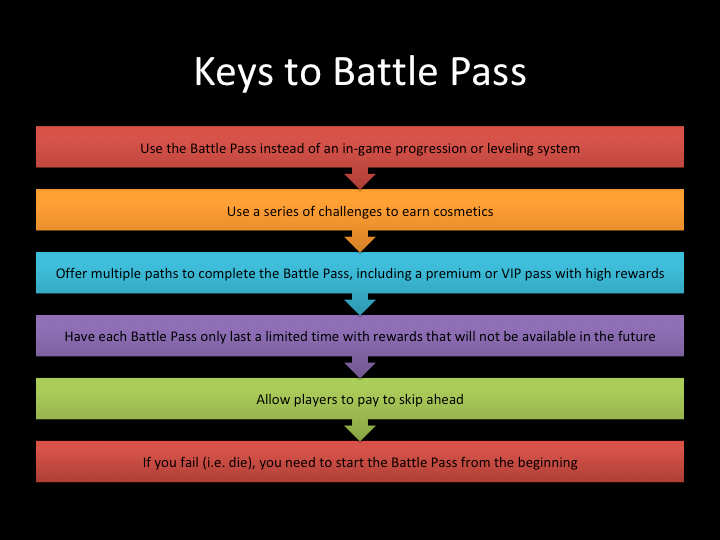
The first key element is that there is not a leveling or stats system. Thus, you cannot show others how skilled you are by pointing out you are level 5,274. Instead, status is conveyed by how great your cosmetics are. The more, and better, cosmetics, implicitly the better Fortnite player you are.

The second key element is the Battle Pass, a series of challenges to earn cosmetics. The Battle Pass is a series of challenges with each one providing cosmetic rewards.

The third key to the Battle Pass is offering multiple paths. In addition to the free path is a premium path that provides significantly more rewards. Epic is also very loose in providing rewards for the premium path, players feel they are getting an incredible value.

Fourth, each Battle Pass only lasts a season. Each of these seasons has its own cosmetics, so if you miss a season you never get them. This creates an incentive for the player to play each Battle Pass so they do not miss any content forever.

Fifth, and a key difference with traditional IAP models, players can pay to skip ahead in tiers. Since tiers are not levels, players are not actually paying to win anything, just to get to higher value cosmetics.

Sixth, if you fail at a challenge, you need to start the entire path again unless you monetize. Critically, if you die during a challenge (which happens to most players of Fortnite), you have to start at the beginning of the challenge. Thus, there is a strong incentive not to lose your progress (and plays to people’s loss aversion). People do not want to start from zero repeatedly.

How you can use Battle Passes

Battle passes effectively change monetization from the core game loop to the challenge mechanic. By eliminating levels and points, you can move monetization from interrupting gameplay to super-charging it. Challenges work in many genres but the Battle Pass takes it to the next level. Zynga credits much of its current success with Zynga Poker to challenges. Virtually any PvP game, and even some single player games, can integrate a challenge system. The key to success though will be recentering monetization on this system rather than the traditional IAP model, making it the source of showing progression and providing a VIP path.

Key takeaways

  • Fortnite is one of the biggest gaming successes ever, and it is being driven by a monetization system previously not seen in mass market free-to-play games, Battle Passes.
  • Battle Passes allow players to earn cosmetic rewards, which have a high value because they are the only way players can show progress in Fortnite.
  • By centering your monetization on a challenge system, you can develop a similar mechanic as Battle Passes.

Share this:

  • Click to share on Facebook (Opens in new window) Facebook
  • Click to share on LinkedIn (Opens in new window) LinkedIn
Like Loading...
Unknown's avatarAuthor Lloyd MelnickPosted on May 15, 2018May 13, 2018Categories General Social Games BusinessTags Battle Pass, epic games, Fortnite, free to play, monetization2 Comments on Finally, a new approach to monetization in free-to-play games

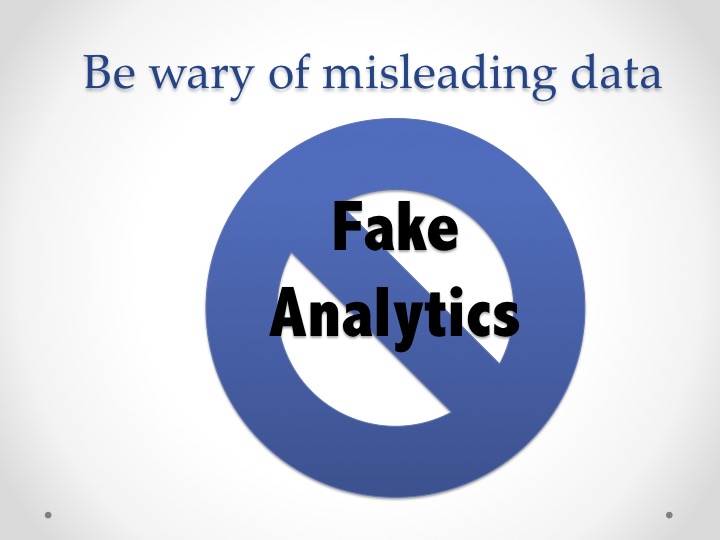
How to avoid misleading data, aka Fake Analytics

Someone I respect recently posted an article from a news source that I also respect, but the article actually highlighted how data can mislead, either intentionally or not. An article on the Guardian.com, Amazon Prime Video’s growth outpaces Netflix in UK, tells the story of how Prime Video is growing at a faster rate than Netflix. The sub-title stresses that, “cross-promotion to Amazon shoppers and new on-demand series rank it top in 2017.”

The article goes on to point out several reasons why Amazon is top in 2017:

  • New series of the Grand Tour and Transparent are fueling growth
  • Hefty cross promotion of Prime Video to regular Amazon shoppers is also contributing
  • Prime Video increased its subscribers to 4.3 million in 2017, representing 41% year-on-year growth
  • Netflix only grew 25% in the same period.

If you stopped reading the article there, and who reads an article until the end these days, you would think Amazon is doing a great job in the video market and Netflix should be very worried. If you worked at Amazon and get a similar report from your analytics team, you might high-five the head of Amazon Prime in the UK. If you were at Netflix and got a similar report from your analytics team, you might panic a little and divert resources to the UK.

The problem is that although the data is accurate it is misleading. The key figure is that Netflix added 1.6 million new subscribers in 2017, while Amazon added 1.3 million new subscribers for Prime Video in the UK. Thus Netflix actually extended its lead over Amazon by 300,000 customers in 2017. Netflix is in 8.2 million UK households (at the end of 2017), versus 3 million for Amazon.

How different would the story have been if the headline was Netflix extends lead by another 300,000. How different would the reception be at Amazon and Netflix respective headquarters if their analytics team presented data in this way.

Slide1

The mistake

The mistake in this case (and I will be generous and assume the Guardian was not click-baiting) is comparing growth rates (or any other rates) while neglecting the size of the relative base. It would be the same in football if you looked at Messi’s goal scoring versus a second year player. The latter may be scoring twice as many goals as he did as a rookie while Messi may have been flat or added a few. Thus the young player is growing his goal scoring 100% while Messi is adding only a few percent to his lifetime numbers. That does not mean that the second year player is either having as good a season as Messi or closing the gap.

The same happens in the mobile game world. Your slot game may be growing 100% month on month while Slotomania is growing 10% (not real numbers), but because their base is so high they are adding millions in revenue while you are still not profitable.

The key is only comparing trends when you are comparing apples to apples. Trends mean something if you are looking at two products or companies of comparable size in the same stage of their lifecycle. Looking at two auto companies who launched an SUV the same year in the same market makes sense, comparing growth rates of two automakers, one who is new and has no dealer network with one that has been around 100 years is worthless.

The answer

You need to look deeper into the numbers. Look at the absolute numbers. Look at the pricing. Look at the target market. Look at percent usage (in the Amazon case, how engaged are Prime users who may have bought it just to get free shipping versus Netflix users). The key to using data effectively is look deeply at the data and understand what is driving the results. You also need to make sure your analytics team does the same. It is very easy to make conclusions based on obvious trends. Avoid superficial analysis and, more importantly, superficial conclusions.

Key takeaways

  1. A recent article implied Amazon Prime Video was doing better than Netflix in the UK as it grew 41% versus 25% by Netflix.
  2. The article is misleading as Netflix actually added 300,000 more customers than Amazon. This obfuscation shows how data can mislead if you focus on trends but are not comparing comparable companies or products.
  3. The key to using data effectively is look deeply at the data and understand what is driving the results.

Share this:

  • Click to share on Facebook (Opens in new window) Facebook
  • Click to share on LinkedIn (Opens in new window) LinkedIn
Like Loading...
Unknown's avatarAuthor Lloyd MelnickPosted on May 8, 2018May 8, 2018Categories General Social Games Business, General Tech Business, GrowthTags amazon, analytics, NetflixLeave a comment on How to avoid misleading data, aka Fake Analytics

How to balance your publishing or development portfolio

How to balance your publishing or development portfolio

Most investors know that to optimize the expected value and risk of their financial portfolio they need the right mix of domestic and international stocks, bonds and cash. Many game companies, however, fail to heed the core principals of diversification when building their portfolios and deciding what projects to green light. Ironically, very successful companies often amplify this mistake by replicating (i.e. cloning) their hit.

Mistake 1: Copying your hit

The most common mistake successful game companies make is re-skinning or cloning their biggest game. The logic behind this decision is that it is quite difficult to create a hit game so copy what you know. Most frequently, however, the clone fails to reach expectations and the company is left relying on the original hit.

The flaw in this strategy, leading to a negative result, is that the new product appeals to users who are already highly engaged with your company. Since the existing product is a success, players are not looking for an alternative. They already love what they have, why give them the same thing in a different wrapper. I recently wrote about how challenging it is to steal VIP customers from a competitor because they already love the product, it is just as difficult to steal them from yourself.

In the social casino space, you often see this mistake by companies that have a hit slots product, just change the feel of the casino, keep the same slots, and then the new product does not perform as well as the original.

Mistake 2: Appealing to the exact same market

If you base your new product on one of your existing products, you will appeal to the same customers. By appealing to the same users, you are not expanding your potential market but can only increase your share of wallet.

Again, using the social casino space as an example, there are different types of slots players. If your existing game is appealing to players who enjoy land based casinos, rather than creating another product for this target market you can build off of your success by creating a product that appeals to recreational online-only players. Thus, you can still monetize the land-based players with your core product, and increase monetization by improving that game, but you open up a new market.

Mistake 3: You are not creating a blue ocean opportunity

The core of the issue in creating a copy of an existing product is you are not creating a blue ocean opportunity, that is moving to a market space where the competition is not relevant. I have written frequently about Blue Ocean strategy, and rather than repeat it the key is that you have a higher ROI by pursuing a blue ocean strategy than competing in a red (bloody competitive) market.

Blue Ocean strategy is incompatible with cloning your existing product because a new product needs to fulfill four criteria to create a blue ocean:

  1. Raise. You need to raise some of the elements of value you are currently competing on.
  2. Eliminate. You need to eliminate some features or aspects that you compete on.
  3. Add. You must add new features or attributes that other products do not have.
  4. Reduce. You have to reduce some of the features that the industry relies on.

By definition, if you are copying an existing product you are not doing any, let alone all, of these changes needed to move into a space where the competition is non-existent.

Mistake 4: No new VIPs

VIPs are the lifeblood of a successful mobile game. Less than one percent of players normally drive over 80 percent of revenue, thus it is critical to have a strong VIP base for a game to be successful. When you re-skin or clone an existing game, it becomes virtually impossible to build a strong new VIP base. Your existing VIPs already love the old product, hence why they are VIPs, so they have no reason to move (and you probably have no benefit in moving them). New customers were already exposed to the same mechanics in the existing product and chose not to become VIPs, thus it is very unlikely the new product will generate a different reaction.

What you should do

The easy part of the game industry is recommending what not to do, the challenge is how do you grow your product base. There are many different ways to run a good green light process, assess market conditions, etc., and that is not the purpose of this post (please see my post on how to create a mobile gaming hit). Instead, I recommend you build out a strong green light process that looks at the market, the competition, your strengths and gaps in the market and build your product strategy from there. If you already have a hit product, rather than start from scratch, see how you can leverage key elements of that product to expand into a different segment of the market or create an entirely new space.

Key takeaways

  • While it is tempting to try to replicate your successful product by re-skinning or cloning it, such a strategy is likely to fail as it will not expand your market.
  • Cloning a product is the inverse of pursuing a Blue Ocean strategy (which requires focusing on four core elements: Eliminate, Raise, Add, Reduce), and Blue Ocean generates a higher long-term ROI that traditional strategy.
  • If you have a hit, rather than start from scratch see how you can leverage key elements of that product to expand into a different segment of the market or create an entirely new space.

Cloning

Share this:

  • Click to share on Facebook (Opens in new window) Facebook
  • Click to share on LinkedIn (Opens in new window) LinkedIn
Like Loading...
Unknown's avatarAuthor Lloyd MelnickPosted on May 1, 2018April 30, 2018Categories General Social Games Business, Social CasinoTags Green Light, green light process, portfolio strategyLeave a comment on How to balance your publishing or development portfolio

Casual Connect Europe session on Lessons from Real Money Casino

Casual Connect Europe session on Lessons from Real Money Casino

I will be speaking next month at Casual Connect Europe on lessons from real money that give your free to play game a competitive advantage. If you are attending the show, please come by my session.

Share this:

  • Click to share on Facebook (Opens in new window) Facebook
  • Click to share on LinkedIn (Opens in new window) LinkedIn
Like Loading...
Unknown's avatarAuthor Lloyd MelnickPosted on April 30, 2018April 29, 2018Categories General Social Games Business, Social CasinoTags Casual Connect, real money online gamblingLeave a comment on Casual Connect Europe session on Lessons from Real Money Casino

The risk of status quo bias

The risk of status quo bias

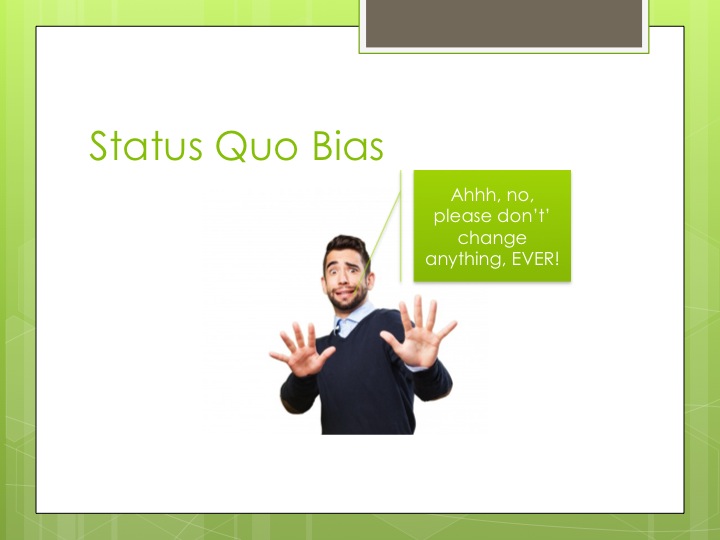
One of the most dangerous, and common, biases in our decision making is status quo bias, popularized by Nobel Prize winning economist Richard Thaler. This bias in decision-making, also commonly called inertia, prompts people to prefer for things to stay the same by doing nothing or by sticking to a previous decision. This bias becomes a problem when the expected value of a change, one that may only have small transition costs, is higher than the reward for sticking with the status quo. It is also a considerable problem with big decisions, where the benefits of change could be quite substantial.

Slide1

Why is there a Status Quo Bias

People do not intentionally make sub optimal decisions, so that leaves the question of why Status Quo Bias is so prevalent. First is the concept of loss aversion, people place a higher value on avoiding loss than acquiring gain. Many people would rather not lose $5 than win $10 and would not take such a bet with a 50 percent chance of either outcome, even though over time you would be much better off taking the bet. Status Quo Bias is tied to loss aversion because by diverging from the status quo, you often run the risk of losing something you currently have (even if the expected outcome is better).

Second is the concept of sunk cost. A sunk cost is a cost that has already been incurred and thus cannot be recovered. It should not enter into your decision making process because this cost will be the same regardless of outcome. You should only look at new costs you would incur versus the expected benefit, thus the ROI on the new, not total, costs. Sunk cost is intertwined with status quo bias because changing direction can negate previous investments, even if the expected outcome is better than sticking with the past decisions.

Third is the concept of commitments. Diverging from the status quo could force people to withdraw from previously made commitments. Individuals are likely to keep commitments to avoid reputation damage or cognitive dissonance. In the latter case, breaking with committed strategy would be subconsciously inconsistent with the initial commitment to the strategy or product and the reasoning that drove the commitment.

Let’s not forget politics

One other area that drives the status quo bias, particularly in a corporate setting, is politics. People are reluctant to pursue a strategy or product that breaks from existing dogma because they fear if a change they support fails it will be blamed on them while benefits from a successful shift will not be directly attributed. They are thus making a rational, albeit sub-optimal, decision not to support changes to the status quo.

When does it happen

There are many situations where Status Quo Bias leads to sub-optimal decision making. One area is product changes, particularly to a successful product, as the product managers or designers are reluctant to change something that is working even if the new option would be better. A car manufacturer may be reluctant to change the styling on a popular model even if overall tastes are changing. By not making the change, in the long run they will lose market share. A game designer may not want to change the user experience for fear of alienating current players but a new design could make the product much more appealing to new players and also generate more revenue long-term from existing customers.

Another area where Status Quo Bias has a destructive effect is on business models. In the video game industry, many successful game companies rejected the free-to-play model because they made millions, or even billions, of dollars based on their existing business model even though free-to-play was gaining share at a rapid rate. Now companies like THQ no longer exist because of Status Quo Bias.

New products are another area where Status Quo Bias leads to sub-optimal decisions. Companies may not introduce a new product because they fear it will negatively impact their existing products, even though the net impact would be positive. Conversely, a company that has invested significantly in a new product may continue to invest in it even if testing shows it will be a failure because they do not want to change the decision to pursue that product strategy.

How to avoid status quo bias

Admitting you have a problem is the first step in eliminating any bias, including Status Quo Bias. Recognizing there is a bias favoring inertia allows you to look at decisions more objectively. You should then focus on choosing the path that leads to the highest expected value, whether or not it represents a change.

Key takeaways

  • Status Quo Bias is when you make decisions to avoid change even when the change would have a positive expected value.
  • People often prefer the status quo because of an aversion to losses (they overvalue losing something they already have to making a gain), sunk costs and previous commitments, while internal office politics also have a strong impact on sub-optimal decisions.
  • When making decisions, you should look objectively at optimizing expected value, whether that value comes from something new or old.

Share this:

  • Click to share on Facebook (Opens in new window) Facebook
  • Click to share on LinkedIn (Opens in new window) LinkedIn
Like Loading...
Unknown's avatarAuthor Lloyd MelnickPosted on April 24, 2018March 18, 2018Categories General Social Games Business, General Tech BusinessTags decision making, Richard Thaler, status quo biasLeave a comment on The risk of status quo bias

It’s easier to create than steal VIPs

I, and many others, have written multiple times on how important VIPs are for free-to-play games but one area that is opaque is how do you get VIPs. In most free-to-play games, VIPs (which I define as a player who spends over $2,000 lifetime but is genre and game dependent) represent less than 0.5 percent of all players but generate 60-80 percent of revenue. It is thus critical for a game’s success to find and nurture VIPs.

Given the importance of VIPs, many think the road to success is stealing VIPs from competitors. This technique works in land based casinos, to a degree, and some other industries, but should not form the foundation of your efforts. If you are focused on winning competitors’ VIPs, you are likely to fail in the long term. You will be disappointed in the number of VIPs you can steal and will find that overall your game is deficient. Instead, you need to focus on creating VIPs, as that will ensure long-term success.

Why you should not rely on stealing VIPs

There are many techniques to woo competitors’ VIPs in social games but they yield surprisingly disappointing results. You can recruit competitors’ VIP hosts, troll VIP forums, target players based on their level in competitors’ games, etc. Surprisingly, however, this strategy fails to have a higher ROI than traditional user acquisition, where you cast a wide net.

VIPs love the game they are already playing

The first reason that it is very challenging to win over VIPs is that, by definition, they love the game they are currently spending in. They are VIPs because they are highly engaged and thus willing to spend liberally. If they were not happy with your competitor’s game, they would not be spending large sums of money there. A typical new product has to be 9 times better than an existing product to win over a customer. A VIP is going to be even more committed to the existing product, so your game will need to be 10X or 20X better to prompt the VIP switch. It also has to be better in areas the VIP cares about because their needs are already served with their current game.

All games are different

Unlike with some businesses, all mobile and social games are different. While players and developers often lament the copycat nature of the industry, there are no identical products in the market. It may just be a different theme or user interface, but there is a difference between games. In social slots games, everyone has different slot machines. In match-3 games, there are different themes and animations even in games that are largely the same.

Some other industries, where VIP “stealing” is easier, do not have this differentiation. In land-based casinos, most high-end casinos have the same slot machines. With department stores, most stores targeting the affluent will carry Gucci. Thus, a VIP at an MGM casino is likely to go to the casino for a game they can play at Caesars or a customer at Nordstrom can find the same product at Nieman Marcus. Conversely, it you love the slots in Hit It Rich!, you cannot play them in Heart of Vegas.

Your spender is not my spender

One thing that has surprised me in the mobile game space is that a spender in one game probably will not spend in another. I have been part of or around multiple initiatives in major mobile gaming companies to move spenders and VIPs to other products. Sometimes we have tried because the games were being phased out or we thought they would continue spending in the existing game and start spending the new game. All of these efforts have failed. They have not failed due to cannibalization but almost always there has been no correlation between spend in one game and spend in other games.

This surprising result is probably due to the reasons a person monetizes in a particular game. As discussed above, someone will spend in a game because they really love that game. They are not spending to spend, they are spending to enjoy. Thus, they are no more likely to fall in love with the new game than any other (non-spending) player.

How you should build your VIP base

Slide1

If winning over VIPs will not drive your VIP revenue, you need to create your own VIPs. Having a strong VIP base is critical to a successful game, and like most things that drive success; it requires hard work. These efforts range from developing products focused on fostering VIPs, treating your VIPs right and acquiring players most likely to become VIPs.

Building products to create VIPs

People become VIPs because they love your game, so you have to create a product with something for them to love. If your game is a weak copy of the market leader, why should they spend in an inferior lookalike (unless you are competing on price, which does not work in mobile gaming). Instead, you need to give players something unique so the 0.5 percent who could become VIPs has something to fall in love with. Give players unique content that they cannot find anywhere else, if you are in social casino, that means slot machines that are unlike your competitors.

Also, give them features that reward a huge commitment. Love is mutual, and if you are asking for their commitment you must reciprocate. Rather than having some superficial features that get boring after a few hours or days of gameplay, make very deep features that only a few players may ever get through but gives those few VIPs an incredibly deep and fulfilling experience.

Create an in-game VIP program that shows VIPs they are important and advancing. Airlines were the first to roll out frequent flyer programs; you need to have a program focused on rewarding your top players. A few months ago, I wrote about how to create a top in-product VIP program and the key is creating compelling differentiated benefits and experiences.

Treating your VIPs right

The second critical element in building a strong VIP base is to have an effective VIP host program. VIPs are very valuable (hence the V in VIP) and you need to treat them properly. Many game companies have treated a player who never spends exactly the same as someone who spends thousands. The cost, however, of losing someone who is a great customer is huge so the ROI on investing in keeping this player is also very high. A good VIP host program will proactively deal with its top customers, ensuring they are happy and anticipating problems before they arise.

Spend to reactivate

If someone loved your game at one point, there are likely still elements of the product they love. Rather than focusing on bringing in new players, also focus on bringing back your VIPs. If you have good VIP hosts, one of their priorities should be to bring back players. Spending part of your user acquisition budget to reacquire churned VIPs is likely to generate higher returns than hunting for new ones. Adding features or content that your VIPs wanted, and then letting those who left know what you now have, is often a better investment than creating generic new features.

Acquiring players who will become VIPs

Finally, although you are not likely to grow your VIP base through acquiring competitors’ VIPs, you can still increase the likelihood that your user acquisition will find future VIPs. You need first to recognize what it is about your game that VIPs love. I have found it very helpful to understand what is your North Star metric, the metric that indicates if a player will become a VIP (i.e. makes three purchases in their first seven days). You can then optimize your paid user acquisition on players that achieve this North Star metric, even moving to a CPA model where you only pay (though pay much more) for players who perform this action(s). You can also run lookalike campaigns that target players who look like your VIPs. Unlike targeting players who look like VIPs of competitors, your VIPs love something in your game and if you find similar players, there is a high likelihood they will also love it.

It’s not easy but it is worth it

There is no silver bullet in building your VIP base but it is critical for your success. Regardless of your available funds, you cannot just go out and buy your competitor’s VIPs. Instead, you need to focus your business on creating a VIP receptive product. From the product development to your marketing, you need to create a holistic experience that appeals to the customers who will drive your business.

Key takeaways

  1. VIPs, less than 0.5% of all of your players, will drive 60-80 percent of revenue for a typical social game, so it is critical you have a strong VIP base.
  2. It is virtually impossible to build VIP base by wooing your competitor’s VIPs as they already love the competitive product and thus will probably not like yours better.
  3. You should focus on building a game that gives people something unique, something they can love, so they will become VIPs.

Share this:

  • Click to share on Facebook (Opens in new window) Facebook
  • Click to share on LinkedIn (Opens in new window) LinkedIn
Like Loading...
Unknown's avatarAuthor Lloyd MelnickPosted on April 17, 2018March 18, 2018Categories General Social Games Business, Growth, Lloyd's favorite posts, Social Games MarketingTags user acquisition, vip, VIP hosting, VIP program1 Comment on It’s easier to create than steal VIPs

How to create a mobile gaming hit

One of the greatest challenges game companies face is the green light process, even for the most successful companies. Game developers continuously struggle with the question of how to create a hit and where should they allocate their development resources. the most successful game companies struggle with this challenge, even if they have told investors they have a magic formula. When I first started in social gaming, Playdom, Playfish, Crowdstar and Zynga were the dominant companies. Now, if you know any of those companies outside of Zynga you get a gold star, none of them were able to replicate their hits of 6 or 7 years ago (and Zynga has also found it a challenge). Hits define success in the mobile game space, so finding the right formula is a critical issue.

Slide1

I recently read an article, Space Ape: Chasing a genre-defining hit that describes an approach worth attempting. In the article, Space Ape, a mobile developer generating over $50 million in annual revenue, discusses its strategy to move from publishing solid titles to creating hit games. Space Ape has realized that simply replicating existing successful games and adding some minor improvements can generating solid performance but is not enough to create a hit.

Do not rely on market analytics

The first key is that you cannot use market data to predict the next hit. By its nature, market data is backward looking and can only tell you what has already been successful. It can help you create a good copy of a successful genre but will not tell you what will be the next genre defining product.

User testing and focus groups suffer the same fate. They can tell you what customers already like and dislike, maybe even what they think they will like, but customers will not think of new genres or understand what will appeal to them until they actually experience it. Apple’s success is a great example of this concept, as people never knew they would want an iPad until they actually had an iPad.

From pipeline to funnel

The key for Space Ape, and what I think should be replicated, has been moving from a production pipeline to a production funnel. In the production pipeline, a company will agonize over what product to make, and then spend considerable time refining the concept and developing the game. Effectively taking one product from concept to launch.

What Space Ape is now doing is creating hundreds of ideas for games, pouring them to the top of the funnel, with only a few making it out of the funnel. They allow their teams to move freely between designing, prototyping and developing a proof of concept.

Avoid sunk costs influencing decisions

Most importantly to Space Ape, the team can kill an idea easily, despite how many resources have been invested into the idea. This point is critical; as I have seen many game companies (including projects I have led) continue to invest in games primarily because of the investment already made. Sunk cost, a cost that has already been incurred and cannot be covered, should never be considered when deciding whether to proceed. Instead you should focus on the future investment needed and the expected return on that investment. The sunk cost is gone and no longer should matter.

Structure appropriately

To support the production funnel, Space Ape has restructured its team. Previously, 25 percent of the company focused on the production pipeline, developing new games, while 75 percent focused on maintaining its live games. Now 75 percent of the work force is focused on developing a genre defining hit, while 25 percent support existing products.

By putting sufficient resources behind the production funnel, they can generate hundreds of ideas, prototype a good percentage, pushing the promising ones to proof of concept and then developing the top ones that survive. This process ensures that many different concepts get fleshed out and they not need guess what will be a hit.

The ratio of resources focused on live games versus new development depends on your company’s situation. If you already have one or more of these genre-defining hits (i.e. King or Supercell), you should continue to put sufficient resources behind your hits to generate billions of dollars in value. Conversely, if none of your games are doing much, why keep any resources focused on them (remember sunk costs). What is critical is that you have enough people dedicated to the production funnel so you can have a plethora of ideas, prototype a high percentage of them and take the promising ones to proof of concept.

What success looks like

Moving from a production pipeline to a production funnel is a big decision, it requires significantly more resources, and you may consider it a risk. Given the carnage you see almost weekly in the mobile game industry, however, it is more of a risk to manage new product development the traditional way.

Key takeaways

  • Creating a hit game is critical to success, even for company’s already with a hit, but it is one of the most difficult challenges you face.
  • The key is moving from a production pipeline, deciding what game to create and then building it, to a production funnel, generating hundreds of ideas, prototyping some and taking the best to concept and then market.
  • To support a product pipeline, you need to structure your company to support it and ensure you allocate sufficient resources to drive many ideas through the funnel.

Share this:

  • Click to share on Facebook (Opens in new window) Facebook
  • Click to share on LinkedIn (Opens in new window) LinkedIn
Like Loading...
Unknown's avatarAuthor Lloyd MelnickPosted on April 10, 2018March 4, 2018Categories General Social Games BusinessTags Green Light, green light process, Product design, Production Funnel1 Comment on How to create a mobile gaming hit

Using color to drive growth

My team was recently working on a new product and one of the issues that came up was what color scheme would generate the best results. Rather than rely on our (great) designers and team’s overall understanding of the market, we looked into the literature of consumer behavior and the research on what behavior different colors generated. Reinforcing the value of spending time on your color choices is research that shows 90 percent of snap judgments on products can be based on color. While there is no magic formula (unfortunately make everything dark blue or yellow is not a silver bullet), you can apply consumer behavior to leverage your color choices.

Color and branding

The first area we looked to leverage color was in our branding, ensuring our logo and app icon generated a strong positive response from players. A good article on Entrepreneur, The Psychology of Color, explained that you initially need to ensure your choice of colors is considered appropriate for your product. What would be effective in a bar is very different than the colors you should use for a funeral home. Customers decide a brand’s personality largely by its color scheme. The colors also make the brand more or less recognizable (IBM is defined as Big Blue), and people prefer recognizable brands.

Color choices also can create a unique visual identity. This helps to differentiate the brand and make it more memorable.

The key to choosing the right colors for your brand are using ones that convey the personality you want people to associate with your brand. If it is excitement, colors like red and yellow generate that response. If it is trust, you are best going with a lighter shade of blue. Colors also mean different things in different contexts (green can be environmentally friendly or related to money).

Color and gender

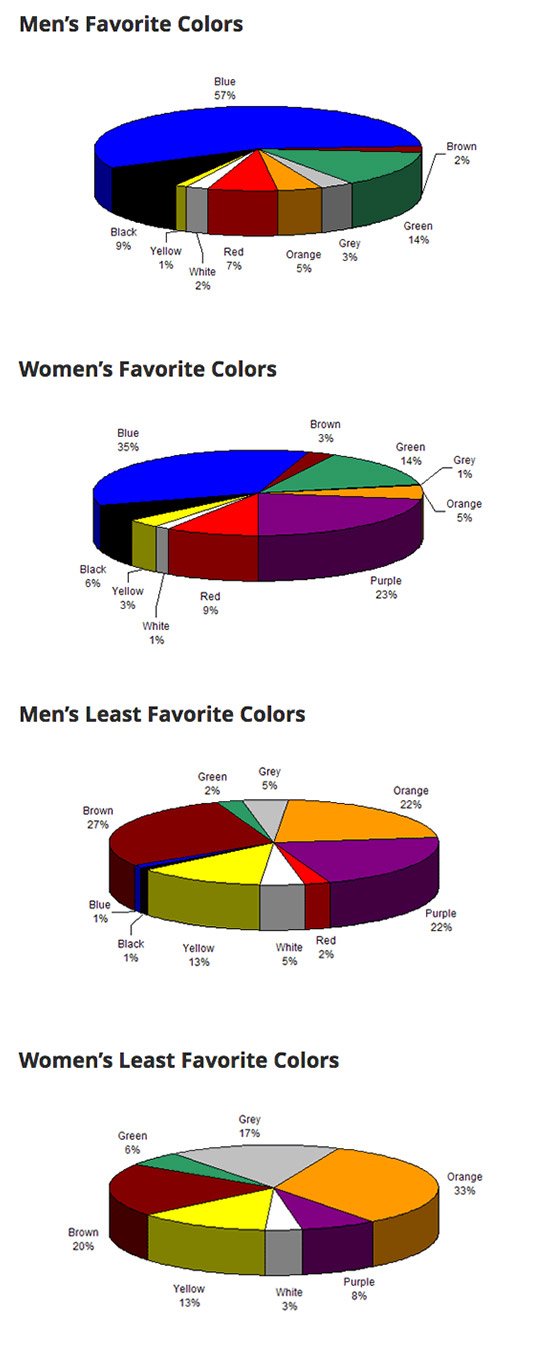
You also need to tailor your color scheme to the gender of your target customer. Blue is popular with both genders while purple is the most polarizing (loved by women and disliked by men). In general, men prefer bold colors while women prefer softer colors. Men are also more amenable to shades of colors as their favorites (colors with black added) while women prefer tints of colors (colors with white added).

color

Color and conversions

The true impact of color on conversion (making sales) is that you should use color to make an item or monetization opportunity jump out. A red “Buy Now “ button is likely to work great on a predominantly green and blue page but not work as well as a green button on a page with a lot of red. The key is using color to highlight what you want users to consider purchasing. You should use color to leverage the isolate effect.

Think about color

The key to this article is that color is important on multiple levels to your business and should not be an afterthought. The right color choices will create the brand identity you are looking for, appeal to your target market and make customers more likely to purchase.

Key takeaways

  1. Color is a very strong determinant of consumer behavior and you should spend time to make color choices with your brand, logo and product that drive the behavior you are seeking.
  2. Color scheme needs to be consistent with your brand, creating the brand personality you are trying to build.
  3. The key to driving conversions is using color to isolate the elements that will drive purchases, less important than the actual color choices is using colors that do not appear elsewhere on the page or app.

Share this:

  • Click to share on Facebook (Opens in new window) Facebook
  • Click to share on LinkedIn (Opens in new window) LinkedIn
Like Loading...
Unknown's avatarAuthor Lloyd MelnickPosted on April 3, 2018February 18, 2018Categories General Social Games Business, General Tech Business, GrowthTags brand, ColorLeave a comment on Using color to drive growth

Using consumer behavior to design your leveling or challenge system

I came across an interesting article on how you can learn from consumer behavior theory to build an effective leveling system, Using Psychology to Design Leveling Systems
by James Madigan
.  Although there are some holes in the analysis, it raises a very useful connection between loss aversion and leveling and challenge systems in games. Although intended for mobile and video games, the lessons are also applicable to any gamified application.

Madigan starts by reminding readers that customers react differently to gains than to losses. If a player is rewarded with one bonus of 750 chips and an additional reward of 250 chips, they would be less happier than if they got a single reward of 1,000 chips (even though rewards are the same). People like gains lumped together. However, if a player gets killed in a game and has to use 750 chips and then 250 chips to keep playing they would be happier than having to spend a lump sum of 1,000 chips to keep playing. Players prefer losses that are spread out. This concept was popularized by Richard Thaler and won him a Noble Prize in Economics.

These findings are tied to the principal of loss aversion, the fact that people dislike a loss of X more than they appreciate a gain of the same X. They will thus avoid situations where they can lose compared to ones where they can win. This situation becomes an interesting opportunity in game design, Madigan points out, because you can bundle wins and losses. Since we give losses more weight, a 100 chip loss coupled with a 300 chip gain does not feel like a 200 chip gain, it feels closer to zero since the loss is overvalued. Slot designers have known this for centuries, most slot math couples lots of small losses (each spin) with some big wins.

This concept also is very relevant in product design, you do not want to take something away from your players. If a player has worked to unlock a level or a slot machine, locking it later in the game would feel like a bigger loss than the gain from unlocking it or another level/machine.

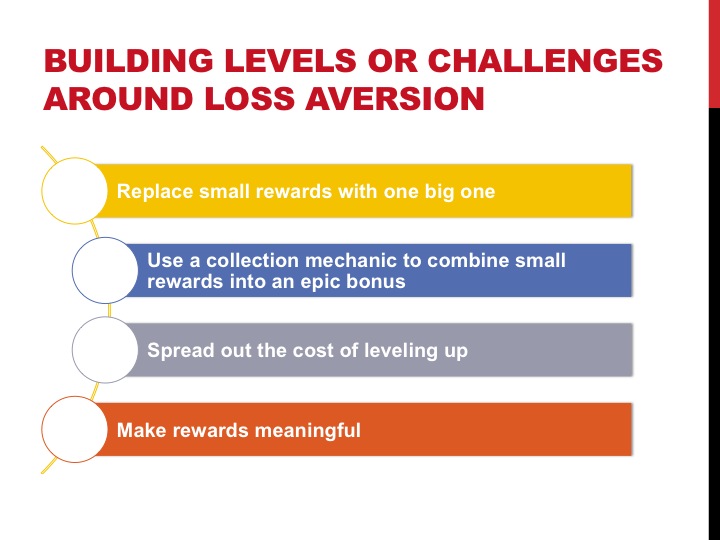
There are several key implications to optimizing your leveling system (or challenge system):

Slide1

  • Rather than give small rewards each time you level up (or complete a challenge), have them build up to one big reward. This could be by combining your leveling or challenge system with a collection mechanic, you get a piece each level and then every 10 levels can turn it in for a big reward.
  • Spread the costs of leveling up out. Rather than forcing players to win a big costly tournament or defeat an uber-boss, have the player go through multiple sinks to gain access to the big leveling reward.
  • Ensure your rewards for either leveling up or completing challenges are meaningful. Players need something big to overcome the perceived cost of the activity.

Key takeaways

  1. People, and gamers, place a higher negative value on a loss than they place a positive value on an equal gain.
  2. People prefer that their losses are spread out but their gains are large.
  3. You thus need to ensure big, meaningful rewards for leveling up or completing challenges to offset the costs (losses) of the activity. You can do this by creating a collection mechanic that leads to a large reward.

Share this:

  • Click to share on Facebook (Opens in new window) Facebook
  • Click to share on LinkedIn (Opens in new window) LinkedIn
Like Loading...
Unknown's avatarAuthor Lloyd MelnickPosted on March 27, 2018February 18, 2018Categories General Social Games BusinessTags challenges, game design, leveling, loss aversionLeave a comment on Using consumer behavior to design your leveling or challenge system

Algorithms are not humans

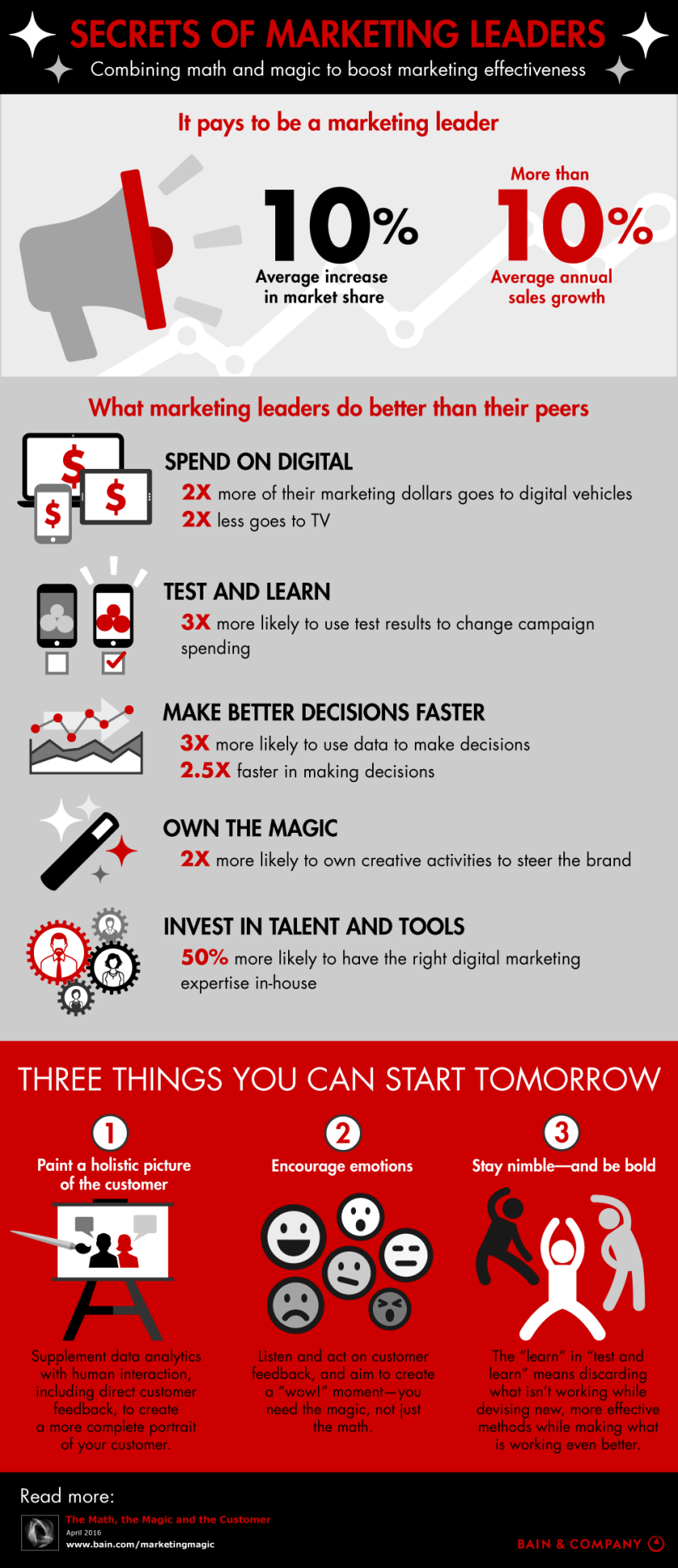
While I consider myself one of the most data-driven people in the gaming industry, I understand that quantitative data alone is not the optimal input for decision making. Combining analytics with qualitative data can often improve your decisions. You can think of it as a basic mathematic equation, if X is data and Y is qualitative information (ie. personal past experience), by definition X+Y will be equal or greater than X alone. An article by Bain & Co., one of the world’s leading consultancies, The Math, The Magic and the Customer shows how great marketers go beyond the data.

As the article points out, marketing departments now spend more on technology than IT departments. We have great tools not only to measure every marketing campaign, but each creative in the campaign, each channel we use and how each creative interacts with each customer in each channel. Often, however, we rely on this information without looking holistically at the customer or realizing that customers will not always behave consistently (or rationally). People make decisions emotionally as well as logically and as the article says, “great marketers have always known this, which is why they work hard to build an emotional bond with the customers they are targeting. They tell compelling stories about their brands through memorable messages and indelible images. At its best, this kind of marketing pops and dazzles, like magic. Marketing that ignores the magic and relies on math and science alone will be marketing that doesn’t work.”

Data and forging emotional connections are not mutually exclusive. Great marketers do not rely on just one. They use the myriad of data to create a holistic view of the customer and customer journey. The marketing is customer-centric rather than tool centric, all of the data and analysis comes down to what will be most effective in the future with the customer (not what the cohort did in the past). And as Bain writes, “contrary to the inclination of many marketers, moreover, they do not put measurement of ROI at the top of their agenda. When they can’t measure the ROI of an innovative effort, they are willing to let instinct guide their efforts—at least for a while.”

There are three keys to using data and the holistic view of the customer effectively. By combining a single view of the customer, understanding and tapping into their emotions and testing relentlessly you can replicate what is working for the most successful companies.

math and magic graphic

Paint a holistic picture of the customer

Most companies, not only online ones, have gigabytes of data about their customers. Data includes preferences, locations, device types, when and where they interact, purchase decision process, where they are browsing, what else they are doing online, etc. You can even see where your customers are and what they are doing at an exact time; you can interact on a real time basis. The information also comes from multiple sources and is stored in different locations.

The key to successful marketing is putting this data together for a single, real time, view of the customer. To achieve this goal companies must come together and the marketing team, IT team, analytics team — even finance — must all work together to share data and build systems to create a plan to build this complete view. Then the company needs to create a single customer record, where all of the information is held. While it sounds easy, this process can take years but in the interim data should be streaming into marketing so it can start looking at the customer holistically.

Encourage emotions

People are not algorithms or cells on a spreadsheet, not only is it immoral to treat them that way it is not good marketing. By understanding your customers’ journey, you can then tailor the experience to elicit the appropriate emotions at the right time. If it is a gambling game (either real money or virtual chips), provide excitement after a big win or help calm them down after a bad beat. By understanding your customers and potential customers emotions and encouraging the right one at the right time, you can make them more likely to choose and enjoy your product.

Stay nimble and be bold

You need to test many different approaches, as eliciting emotion is not easy. The important part of testing is learning from the results. Reinforce what is working and discard what is not, even if you were the advocate of the sub-optimal variant. Then think of new methods and promotions that will build on what you have learned and create even better results.

Moving forward you are not CFO

With the reliance on metrics and ROI in marketing, the marketing department is quietly becoming a mirror of finance. While metrics and ROI are critical to long-term success, so is generating emotions from your customers and potential customers. To become a truly great marketer, you need to understand how to connect to your customer as well as reading your daily dashboard.

Key takeaways

  • While data and ROI is critical to successful marketing, adding qualitative measures makes your marketing more effective as it is effectively additional data.
  • A key to successful marketing is generating the right emotion at the right time from your customer or potential customer, as emotions drive people, not data.
  • Continue testing different approaches and techniques, discarding what does not work and building off of what does work.

Share this:

  • Click to share on Facebook (Opens in new window) Facebook
  • Click to share on LinkedIn (Opens in new window) LinkedIn
Like Loading...
Unknown's avatarAuthor Lloyd MelnickPosted on March 20, 2018February 18, 2018Categories General Social Games Business, General Tech Business, Social Games MarketingTags marketing, roi, testingLeave a comment on Algorithms are not humans

Posts pagination

Previous page Page 1 … Page 9 Page 10 Page 11 … Page 46 Next page

Get my book on LTV

The definitive book on customer lifetime value, Understanding the Predictable, is now available in both print and Kindle formats on Amazon.

Understanding the Predictable delves into the world of Customer Lifetime Value (LTV), a metric that shows how much each customer is worth to your business. By understanding this metric, you can predict how changes to your product will impact the value of each customer. You will also learn how to apply this simple yet powerful method of predictive analytics to optimize your marketing and user acquisition.

For more information, click here

Follow The Business of Social Games and Casino on WordPress.com

Enter your email address to follow this blog and receive notifications of new posts by email.

Join 791 other subscribers

Most Recent Posts

  • Join me at PDMA Inspire for my talk on new product prioritization
  • Why keep studying?
  • The next three years of this blog
  • Interview with the CEO of Murka on the biggest growth opportunity in gaming, Barak David

Lloyd Melnick

This is Lloyd Melnick’s personal blog.  All views and opinions expressed on this website are mine alone and do not represent those of people, institutions or organizations that I may or may not be associated with in professional or personal capacity.

I am a serial builder of businesses (senior leadership on three exits worth over $700 million), successful in big (Disney, Stars Group/PokerStars, Zynga) and small companies (Merscom, Spooky Cool Labs) with over 20 years experience in the gaming and casino space.  Currently, I am the GM of VGW’s Chumba Casino and on the Board of Directors of Murka Games and Luckbox.

Topic Areas

  • Analytics (114)
  • Bayes' Theorem (8)
  • behavioral economics (8)
  • blue ocean strategy (14)
  • Crowdfunding (4)
  • DBA (2)
  • General Social Games Business (459)
  • General Tech Business (195)
  • Growth (88)
  • International Issues with Social Games (50)
  • Lloyd's favorite posts (101)
  • LTV (54)
  • Machine Learning (10)
  • Metaverse (1)
  • Mobile Platforms (37)
  • Prioritization (1)
  • Social Casino (52)
  • Social Games Marketing (105)
  • thinking fast and slow (5)
  • Uncategorized (33)

Social

  • View CasualGame’s profile on Facebook
  • View @lloydmelnick’s profile on Twitter
  • View lloydmelnick’s profile on LinkedIn

RSS

RSS Feed RSS - Posts

RSS Feed RSS - Comments

Categories

  • Analytics (114)
  • Bayes' Theorem (8)
  • behavioral economics (8)
  • blue ocean strategy (14)
  • Crowdfunding (4)
  • DBA (2)
  • General Social Games Business (459)
  • General Tech Business (195)
  • Growth (88)
  • International Issues with Social Games (50)
  • Lloyd's favorite posts (101)
  • LTV (54)
  • Machine Learning (10)
  • Metaverse (1)
  • Mobile Platforms (37)
  • Prioritization (1)
  • Social Casino (52)
  • Social Games Marketing (105)
  • thinking fast and slow (5)
  • Uncategorized (33)

Archives

  • September 2023
  • December 2021
  • July 2021
  • March 2021
  • February 2021
  • January 2021
  • December 2020
  • November 2020
  • October 2020
  • September 2020
  • August 2020
  • July 2020
  • June 2020
  • May 2020
  • April 2020
  • March 2020
  • February 2020
  • January 2020
  • November 2019
  • October 2019
  • September 2019
  • June 2019
  • May 2019
  • April 2019
  • March 2019
  • February 2019
  • January 2019
  • December 2018
  • June 2018
  • May 2018
  • April 2018
  • March 2018
  • February 2018
  • January 2018
  • December 2017
  • June 2017
  • May 2017
  • April 2017
  • March 2017
  • February 2017
  • January 2017
  • December 2016
  • November 2016
  • October 2016
  • September 2016
  • June 2016
  • May 2016
  • April 2016
  • March 2016
  • February 2016
  • January 2016
  • December 2015
  • November 2015
  • October 2015
  • September 2015
  • July 2015
  • June 2015
  • May 2015
  • April 2015
  • March 2015
  • February 2015
  • January 2015
  • December 2014
  • November 2014
  • October 2014
  • September 2014
  • August 2014
  • July 2014
  • June 2014
  • May 2014
  • April 2014
  • March 2014
  • February 2014
  • January 2014
  • December 2013
  • November 2013
  • October 2013
  • September 2013
  • August 2013
  • July 2013
  • June 2013
  • May 2013
  • April 2013
  • March 2013
  • February 2013
  • January 2013
  • December 2012
  • November 2012
  • October 2012
  • September 2012
  • August 2012
  • July 2012
  • June 2012
  • May 2012
  • April 2012
  • March 2012
  • February 2012
  • January 2012
  • December 2011
  • November 2011
  • October 2011
  • September 2011
  • August 2011
  • July 2011
  • June 2011
  • May 2011
  • December 2010
January 2026
S M T W T F S
 123
45678910
11121314151617
18192021222324
25262728293031
« Sep    

by Lloyd Melnick

All posts by Lloyd Melnick unless specified otherwise
Google+

Enter your email address to subscribe to this blog and receive notifications of new posts by email.

Join 791 other subscribers
Follow Lloyd Melnick on Quora

RSS HBR Blog

  • What Actually Works to Change Someone’s Mind
  • Our Favorite Management Tips of 2025
  • How to Manage—and Motivate—Gen Z
  • The Most-Watched HBR Videos of 2025
  • The HBR Charts that Help Explain 2025
  • The Most Popular HBR Podcast Episodes of 2025
  • How the Best Leaders Develop and Spend “Innovation Capital”
  • The 10 Most Popular HBR Articles of 2025
  • How Work Changed in 2025, According to HBR Readers
  • What Leaders Can Learn from a Formula 1 Turnaround

RSS Techcrunch

  • An error has occurred; the feed is probably down. Try again later.

RSS MIT Sloan Management Review Blog

  • Calm: The Underrated Capability Every Leader Needs Now
  • The Top Five MIT SMR Videos of 2025
  • Three Steps Toward Fairer Talent Management
  • From Crisis to Coopetition: What Leaders Can Learn From Anesthesiologists
  • AI Coding Tools: The Productivity Trap Most Companies Miss
  • How Procter & Gamble Uses AI to Unlock New Insights From Data
  • Rewire Organizational Knowledge With GenAI
  • Hungry for Learning: Wendy’s Will Croushorn
  • Beat Burnout: 10 Essential MIT SMR Reads
  • How Leaders Stay True to Themselves and Their Stakeholders
The Business of Social Games and Casino Website Powered by WordPress.com.
  • Subscribe Subscribed
    • The Business of Social Games and Casino
    • Join 726 other subscribers
    • Already have a WordPress.com account? Log in now.
    • The Business of Social Games and Casino
    • Subscribe Subscribed
    • Sign up
    • Log in
    • Report this content
    • View site in Reader
    • Manage subscriptions
    • Collapse this bar
 

Loading Comments...
 

    %d