Skip to content

The Business of Social Games and Casino

How to succeed in the mobile game space by Lloyd Melnick

Category: General Social Games Business

What really drives politics in your company

Key takeaways

  • Information is the strongest driver of corporate politics. Having information conveys power and people will trade power or favors for information.
  • In a political environment, not only is time wasted on politics, good people leave because they feel they have lost the political battle and decisions are not always taken on merit.
  • The best solution to fight politics is transparency. The more widely disseminated information is within a company, the less incentive there will be for corporate politics.

Most business leaders talk about and thrive to build a meritocracy where there are no politics, yet politics often dominate companies large and small. In fact, I have never seen a company in favor of a political environment. I have worked in tiny start-ups and some of the largest companies in the world, however, and politics are often a problem. Unfortunately, even one company that I co-founded in retrospect had a much bigger issue with politics than I realized at the time. In a political environment, not only is time wasted on politics, good people leave because they feel they have lost the political battle and decisions are not always taken on merit.

slide1

Information is power

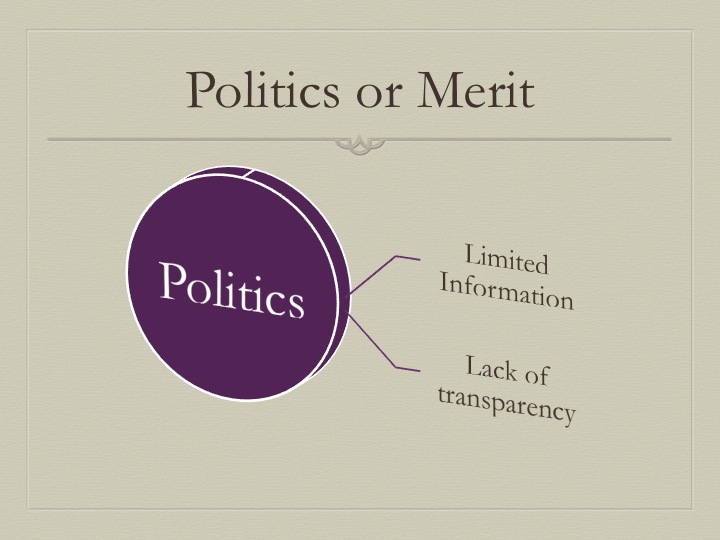
What I understand now is that the biggest driver of company politics is information. The more a company restricts the flow of information about strategy, performance, the movement/promotion of people, etc., the greater the level of corporate politics.

Lack of transparency breeds information is power syndrome. There are several reasons why information leads to politics:

  1. Information becomes a commodity, and with any commodity is has a value. People naturally want to know what is happening at their company, whether it means if they are opening a new office or promoting a new SVP. With anything people want, they will pay for it. Rather than paying with money, in a corporate setting they will pay with support or other information. Effectively, they will buy the information with other information or with favors that may or may not be in the overall corporate interests.
  2. Those with information have more power. Since people are willing to provide value for information, those with the information are able to generate support for their goals. This provides the holders of information to form coalitions that further their interests.
  3. Information creates prestige. Since information is a conduit to power, it also becomes a symbol of prestige. To know something that others do not know implies you are more powerful than those who are “ignorant.”
  4. Watching virtually any election in the world, it is clear people will do almost anything to protect their power. If the corporate environment has created an atmosphere where information is power, then people will protect their privilege to hold information. They will advocate for tighter information streams, though always with them having access to the information. They will also aggressively criticize those who share information (again, outside of themselves) because any information sharing devalues what they hold. They will also often look for justification (labor law, securities regulation, etc) to limit information flows.

Transparency trumps politics

It is not rocket science to conclude the best solution to fight politics is transparency. The more widely disseminated information is within a company, the less incentive there will be for corporate politics. Thus, you need to look closely at any information you are not sharing broadly and determine if there is a good reason not to share (rather than looking for a good reason to share). If someone claims regulatory or legal reasons, push back, especially if other companies share similar information. If you change the environment, information will not drive power, merit will.

Share this:

  • Click to share on Facebook (Opens in new window) Facebook
  • Click to share on LinkedIn (Opens in new window) LinkedIn
Like Loading...
Unknown's avatarAuthor Lloyd MelnickPosted on November 16, 2016November 5, 2016Categories General Social Games Business, General Tech BusinessTags politics, TeamworkLeave a comment on What really drives politics in your company

NPS is not just for customers

Key takeaways

  1. Net Promoter Score (NPS), a great tool to measure customer satisfaction and create a user experience that generates higher growth, and it can also be applied to internal interactions between business units to enhance efficiency.
  2. Most companies simply measure internal efficiency by budget, with a lower budget implying higher efficiency even if it is not the optimal way of driving the business.
  3. NPS allows fast feedback and allows business units to uncover the root cause of issues.

NPS is not just for customers

I am a big fan of Net Promoter Score (NPS), Bain’s system for looking at promoters and detractors among your customers and leveraging this information to make your company better and grow. I recently came across a post that shows how NPS can also be used internally to improve how people in your company work with each other. The post shows how a robust internal NPS system can alleviate this problem. For those not familiar with NPS , its beauty is in its simplicity. It asks customers (internal or external), on a scale of 1 to 10 (10 being the best), whether they would recommend the product or service. 9 and 10s are considered promoters, 7 and 8s are neutral and the rest are detractors. All are then asked why and companies follow up with detractors to move them up.

While most companies have internal support functions (finance, legal, IT, etc.), it is frequently difficult to measure how well they are performing. We often default at looking at the budget of each function, and measure improvements by lowering costs. This approach, however, does not judge if the unit is providing good value. While most units would welcome feedback, the oft-used system makes them fear any attention as it is likely to result in budget cuts or redundancies.

A robust NPS system can alleviate this issue. Rather than just looking at costs, it can look at every interaction between a business unit and the other parts of the business. It will not only give an overall score but also, by asking why someone gave them a score, understand the issues that internal customers are experiencing. The unit can then launch root-cause analysis to determine the ultimate source of failures, and it could escalate issues that it could not resolve on its own.

slide1

The post points out several keys to implementing an internal NPS system successfully:

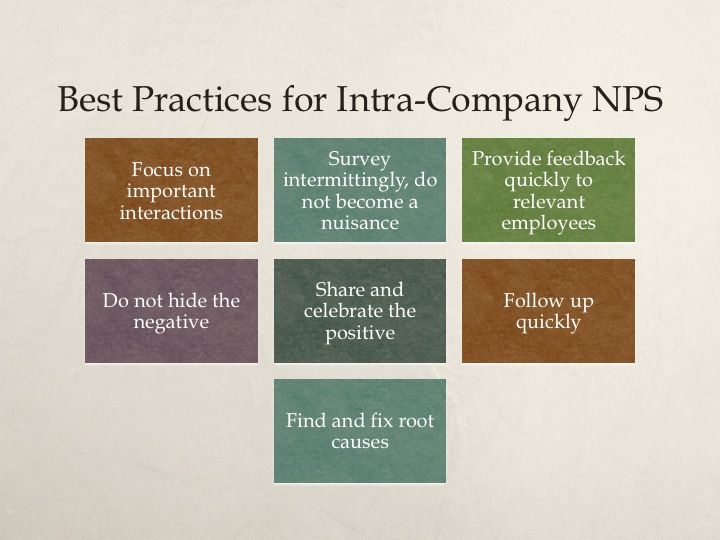
  • Focus on the business unit interactions that are important, no need to measure everything.
  • Only survey internal customers intermittingly, do not allow it to become a nuisance or distraction.
  • Quickly provide the NPS feedback to the relevant employees.
  • Do not hide or degrade the harsh comments, they are very important for improvement.
  • Share positive feedback and celebrate the successes.
  • Quickly follow up, particularly with any dissatisfaction or problems that NPS helps identify.
  • Dig deep, use root cause analysis to find why problems are occurring or recurring.

NPS can help improve your business

A good internal NPS system can help improve your company’s operations as much as NPS helps your company create satisfied customers. With better internal efficiency, you will experienced higher productivity and stronger competitiveness.

Share this:

  • Click to share on Facebook (Opens in new window) Facebook
  • Click to share on LinkedIn (Opens in new window) LinkedIn
Like Loading...
Unknown's avatarAuthor Lloyd MelnickPosted on November 9, 2016May 23, 2021Categories General Social Games Business, General Tech BusinessTags NPSLeave a comment on NPS is not just for customers

Recruiting, or why you want to Coach Team USA

Key takeaways

  1. A critical key to success is attracting the right talent to your team. This provides a competitive advantage over other companies.
  2. A key element to successful recruiting is for leadership to own and drive the process, rather than relying on HR (who are a critical component, however)
  3. The other key is proactively finding opportunities to raise your and your company’s profile to help your long-term recruiting capability, particularly speaking and writing openings.

This past summer, Duke head basketball coach Mike Krzyzewski (Coach K) led Team USA to its third consecutive gold medal under his leadership. Coach K took over Team USA in 2005 and while his accomplishments for Team USA are impressive, it points to a bigger story about the value of recruiting. In that time, Coach K has won two National Championships at Duke and coaching Duke is his primary job. Many of his fellow coaches are upset that the high profile nature of coaching Team USA helps him recruit (and succeed at Duke). Regardless of whether it is fair, it shows a clear path to success.

coach-k-team-2016

Recruiting is different in the US and Europe

Having worked in both the US and Europe, one clear advantage I see from US companies is their focus on recruiting. In the US, recruiting is seen as a responsibility of all management, and the more senior you are the more you are expected to bring great people into your team or company. Many American leaders are judged by the team they put together.

In Europe, although the company may actually have more employee-friendly policies, recruiting is left to the recruiting team or external placement firms, with it being a tertiary activity for leadership. While most leaders understand the value of hiring the best people, they do not see it as part of their job responsibilities.

What drives US recruiting

It is helpful to understand why recruiting is treated differently by US and European companies. There are two things that drive the US focus on recruiting:

    1. The sports ecosystem. In the US, collegiate (university) sports are as important if not more than professional sports. While professional sports teams (both in the US and Europe) can secure talent by paying more, in collegiate sports payment is not allowed (I can write multiple posts about the reality of the situation but not important for this point). Thus, the successful teams are primarily the ones who can attract the best players.
    2. Talent is very mobile.

As LinkedIn Founder Reid Hoffman once wrote, the US is a free agent economy. Employees often look at their job as a short-term opportunity and move on to better new opportunities frequently. This liquidity means for companies to succeed they need a constant stream of good talent with the right skillset.

Lessons from Coach K

As somebody who went to Duke and followed sports my whole life, the American philosophy on recruiting is embodied by Coach K. While you cannot have great results without being a capable floor coach, he has excelled by generating a steady and deep continuous flow of talented recruits.

There are two lessons that I learned from Coach K that can help anyone, including European business leaders, recruit more effectively.

First, recruiting must start at the top. While some university coaches rely on their assistants to attract talent, great coaches make recruiting their top priority. They show up for high school games, have dinner with recruits and their families and personally call and contact recruits. While their assistants do much of the work (breaking down film to prioritize candidates, coordinating schedules, answering questions),the great coaches take the lead in the process. In business, great leaders also do not rely on their HR team but work in concert with HR. They identify the talent, work with their coaches and players to build an environment attractive to the recruits and “close the sale,” they are not simply added to an interview list and done with it when they tell HR who they want to hire.

The second element and one that prompted this post is they use all opportunities to improve your odds of recruiting the best talent. Coach K could have spent his summers at the beach but instead he coached Team USA. What this effort did was raise his profile and give him a great unique selling point when sitting with a potential Duke recruit: do they want to be coached by the same person who is coaching LeBron James, Kobe Bryant and Kevin Durant. Additionally, every time Team USA played on television (which is effectively everytime it played), it was a long commercial for Coach K.

While in business there is no direct equivalent of Team USA, there are many comparable opportunities. At the top of the spectrum are shows like The Apprentice or Shark Tank, this exposure greatly helps the underlying business’ ability to recruit. Even if you cannot get a slot on television, speaking at conference or writing articles for trade press (or even blogging) generate exposure and a unique selling point when recruiting. The critical thing is to seek out these opportunities as part of your overall strategy to use recruiting as a competitive advantage.

The Key

The key is to use recruiting proactively, and put the necessary emphasis and focus on it, to gain a competitive advantage for your business. This effort requires that you lead the initiative, do not rely on others, and look at all opportunities as long-term ways to improve your recruiting effectiveness.

Share this:

  • Click to share on Facebook (Opens in new window) Facebook
  • Click to share on LinkedIn (Opens in new window) LinkedIn
Like Loading...
Unknown's avatarAuthor Lloyd MelnickPosted on October 26, 2016May 1, 2021Categories General Social Games Business, General Tech BusinessTags Duke, HR, recruitingLeave a comment on Recruiting, or why you want to Coach Team USA

How the Nobel Winners in Economics can help tech and game companies

Key takeaways

  • The Noble Prize in Economics this year was awarded for contract theory, which shows how contracts alleviate opposing interests between parties.
  • As the future is uncertain, most contracts do not account for all scenarios.
  • The key is that contracts determine who has the power to resolve conflicts, and it is often more important to have the future power than to get your way with specific scenarios.

How the Nobel Winners in Economics can help tech and game companies

Last Monday, the Royal Swedish Academy of Sciences announced that Oliver Hart and Bengt Holström won the Noble Prize in Economics for contract theory. One important aspect of the award is that contract theory is valuable not only to academics but also for social game and technology companies. Understanding the keys to contract theory will allow you to negotiate agreements more beneficial to your long-term interests.

noble-economics

What is contract theory

Contract theory shows how contracts help assuage clashing interests among parties. Hart and Holström’s work focuses attention on the necessity of trade-offs in setting contract terms. Such contractual relationships can deal with anything from CEO bonuses to the deductibles and co-pays for insurance, the Royal Swedish Academy of Sciences said Monday when announcing the award.

Dr. Holmström’s work has focused on employment agreements. Companies would like workers to act as if they owned the place by working hard and controlling costs while taking smart risks. Employees, however, want to be compensated as much as possible while working no harder than essential. And performance is difficult to assess. One implication of Holmstrom’s work is that it makes sense to withhold some compensation for a time, to evaluate the results of someone’s work over time and compared with their peers (both inside and outside they company).

Holmström applied a deeper analysis to the issue of performance pay, where hard work cannot always be observed properly. His work insinuated that performance-based pay should be associated as much as possible to measures of managerial performance (such as the price of a company’s share relative to those of its peers rather than the share price in isolation). But the more difficult it is to find good measures of performance, the closer a pay package should get to a simple fixed salary.

Dr. Hart’s work begins from the observation that contracts are partial instruction manuals. They cannot specify what to do in each case. Instead, they must postulate how decisions should be made. Thus, the contract is less about specifics and more about who owns final decisions. Hart’s idea is that the very basic contract, since the future is uncertain, must spell out who has the right to decide what to do when the parties cannot agree.

A common and important thread in the work by Hart and Holmström is the role of power in planning co-operative ventures. Individuals or firms with the ability to hold up arrangements—by withholding their service or the use of a resource they own—wield economic power. That power allows them to capture more of the value generated by a co-operative effort. Contracts exist to shape power relationships. In some cases, they are there to limit the exercise of hold-up power so that a venture can go forward. In others, they are intended to create or protect certain power relationships in order to encourage good behavior: workers or firms with the right to exit a relationship, for instance, force other parties to that relationship to take their interests into account.

What contract theory means for you

There are several ways you can apply Holmström and Hart’s work to a tech or game company.

  1. The first area is building a better compensation and bonus structure for your employees. You need to ensure that incentive bonuses (or commissions) actually reflect their contribution. For an account executive, they should be measured on how their accounts do versus the overall performance of all comparable accounts at the company. Thus if your product improves greatly, thus helping raise the overall company results, individual salespeople should not receive outsized benefits. One way to achieve this is by deferring the bonus or commission so that success can be measured holistically.
  2. You should place a high priority on the power to make decisions in contracts with vendors/suppliers, mergers, etc., as this power often can have a greater impact than the immediate financials of the deal. Given that a contract will not cover all contingencies, rather than trying to create rules for each contingency build a rule making framework that will protect your interests.
  3. Ensure there clear ownership and decision-making in all business relationships. If you are contracting out development of an app, understand clearly what decisions you make in the process and what decisions are ultimately up to the developer. If you are considering accepting a job offer, understand how much control you will have in reaching your bonus metrics.
  4. If you do not have ultimate control in a contract, ensure you still have sufficient power to protect your interests and ensure the venture is successful. This can take the form to the ability to exit the relationship to the capacity to bring in an arbitrator.

The key is that you need to understand and address the importance of control and power in all business relationships, whether the contract is written or implied. Since the future is uncertain, it is often this power that proves more important than formal rules about specific situations. If you do not have control, ensure you have sufficient power to protect your interests in an uncertain future.

Share this:

  • Click to share on Facebook (Opens in new window) Facebook
  • Click to share on LinkedIn (Opens in new window) LinkedIn
Like Loading...
Unknown's avatarAuthor Lloyd MelnickPosted on October 16, 2016October 16, 2016Categories General Social Games Business, General Tech BusinessTags Bengt Holmstrom, contract theory, contracts, Noble prize, Oliver HartLeave a comment on How the Nobel Winners in Economics can help tech and game companies

Marketing social casino to millennials

Key takeaways

  • The key to marketing to millennials is that marketing alone won’t succeed. Millennials will not be influenced by great 1-to-many brand marketing.
  • Instead, you need to create more value, more entertainment for the money, than their alternatives (which are not only casino products, but any form of entertainment).
  • You also need to provide a simple, compelling experience across platforms, allowing your users to have a unifed experience wherever and whenever they want.

Marketing social casino to millennials

I am speaking next week at EiG on marketing to millennials and wanted to share the key lessons you can apply to create a social casino offering more competitive for millennials. This is an issue that has caused consternation in the land based and online casino space for the past several years, as younger people are less likely to participate in traditional casino gaming. Rather than wringing your hands about the situation, there are several keys to staying relevant with the millennial demographic:

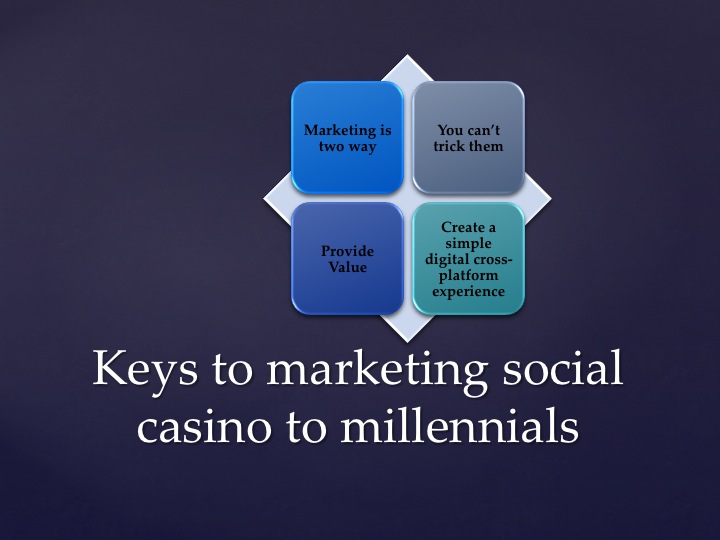
  1. Marketing is two way. Rather than focus on delivering a message to potential millennial consumers, you need to build a conversation. One to many advertising is largely ignored by millennials, if they are even watching your ads on television or have not deployed ad-blocking software online, they are probably tuning out the advertising. Thus, to introduce potential customers to your product or game, you need to engage them in conversations. You can start the conversation on a blog or social media (Twitter, Facebook, Medium, etc.) but the key is to have conversations with as many potential customers as you can, not try to deliver a message to them. Engage with them, even when they do not agree or like what you are saying, continue the conversation while listening to your potential customers. You can only build relationships with millennials if you talk with them, not talk at them.
  2. You can’t trick them. Much marketing, especially promotions, has been centered around convincing people to do what they do not want to do or should not do. This strategy, a mistake with millennials, takes two directions. First is the traditional grocery store trick, 5 for the price of 4, to get consumers who only want to buy one or two of an item to buy more than they need. The second is promotions with such convoluted T&Cs that the user never sees the benefit of the promotion. While these tactics have traditionally worked, it fails dramatically with millennials. They are more sophisticated in understanding why a company is proposing a certain promotion and are cynical enough to dissect the promotion to understand its actual benefits. Moreover, they have information readily available (it’s called Google) to find the offers that will benefit them and not fall for the ones that only benefit the company making the offer.
  3. Provide value. Since promotion won’t drive usage, you need to provide more value to users than alternatives (which may be other casino games, but also eSports, television, etc). Thus, if they are going to spend $5 or $500 in your product, they need to get more entertainment value from that expenditure than they would from an alternative (and there are many alternatives). Thus, your pricing needs to be about delivering value, not by getting as much from the player as quickly as you can.
  4. Create a simple digital cross-platform experience. Marketing and product are not two separate silos with millennials. You need to build a product that will appeal to them as marketing expertise will not make up for a sub-optimal product. For millennials, the key is creating a product that works across platform, or is platform agnostic, so they can use it on their laptop, their smartphone, their tablet, whenever and however they want. The experience needs to be consistent across all of these platforms (don’t ask them to set up separate accounts). It also needs to be simple, they are not going to spend an hour learning how to play, or even 5 minutes, they need to be able to start using the product immediately and enjoy it immediately.

slide1

Only great experiences will succeed

The key to succeeding with millennials is providing them with a great experience, not a great marketing campaign. They will not respond to marketing that does not deliver value, but if you give them a better experience than their alternatives they will respond accordingly.

Share this:

  • Click to share on Facebook (Opens in new window) Facebook
  • Click to share on LinkedIn (Opens in new window) LinkedIn
Like Loading...
Unknown's avatarAuthor Lloyd MelnickPosted on October 12, 2016October 9, 2016Categories General Social Games Business, Growth, Social Casino, Social Games MarketingTags EiG, marketing, marketing strategy, MillenialsLeave a comment on Marketing social casino to millennials

Great products fail, here is why

Key takeaways

  • Creating a great new innovative products does not guarantee success, people have to find and try it.
  • The first key is to build something that people will search for. If there is little innovative or differentiated products, people will not even search for a new product.
  • If customers will not find a product via search, you need to develop cues so they will infer that the product is different and valuable to them.

One of the most frustrating results in business is launching a great game or product and then seeing it fail. Unfortunately, this phenomenon happens more often than not. In the game space, at least 80 percent of new launches (from established studios, new studios have a worse rate) are never ROI positive (that is, they never have an LTV that allows for ad spend). Even in retail, according to a recent study of 9,000 new products that generated strong distribution, only 40 percent were sold three years later.

Although I am a huge advocate of Blue Ocean Strategy, one central challenge is getting customers to adapt the new product. In the game space, many innovative and extremely fun products fail because they never gain traction with players.

A recent article in the MIT Sloan Management Review, Why Great New Products Fail by Duncan Simester, shows why so many good products fail and how you can reduce the risk of experiencing this fate. What Simester shows is that while most companies focus on customers’ needs, they do not understand how customers decide what to purchase. By understanding the customer search and inference processes, you can build a better strategy for the customer to discover a new, innovative product.

People don’t search for innovation

The first thing you need to realize is that in a market with little innovation the customer may not realize the value of looking for a better solution, they do not even think they exist. Thus, they may not find your innovative product because they do not know to look.

casino-rush
People Do Not Know To Search for Innovative Products

Alternatively, people may think the cost of searching for an alternative or innovation is too high despite knowing of the benefits. Somebody may realize there is a game in the App Store they would prefer to what they are currently playing but do not believe it is worth the effort to search through the thousands (or millions) of alternatives, download and test tens (or hundreds) and then find the innovative product they prefer.

Additionally, your best customers are the ones least likely to search. Research cited by Simester shows a strong relationship between the amount of prior expertise a consumer has about a product category and the extent they search for information before making a purchase decision. Effectively, the person feels they already know what is best so they see little incentive to search.

Compounding this problem is that potential customers with virtually no knowledge also will not search. They do not know what questions to ask, where to find answers or how to interpret the information if it arrives. Potential customers also do not understand the features that would benefit them. Thus, innovation would not increase the chance of a sale to this type of customer, no matter how much value the innovation adds, because the customer does not understand the value of the innovation.

Customers’ Inference Process

When search is incomplete, customers shift to forming inferences. They use what they observe to infer what is too difficult or costly for them to search for. A good example Simister uses is McDonald’s obsession with keeping parking lots clean. While customers do not really care if the parking lot is messy, if they see a dirty parking lot they will infer that the restaurant itself is dirty and go somewhere else. As Simester writes, “Although purchasing decisions are a different neural process than the visual process, a similar phenomenon occurs when customers are evaluating different products or services. Customers often do not realize they are forming inferences, and even if they do, they are powerless to stop it.”

Branding and inference

The most common cues customers use to infer product value are brand and pricing. Brands infer more than only product quality as consumers use brands to signal information about themselves.

The importance of brands differ by the market and consumer. When it is easy to search and generate information about the product, brands take on less importance. This is particularly the case with the sophisticated customers described above, as they can process the product information and make informed decisions about the opportunity. Conversely, an unsophisticated customer is likely to rely on the brand because they do not know how to process the product information.

In the game space you see very little value of brand because so much information is available to players. They can look at an AppStore description, process screenshots and watch videos to determine if they like a product, rather than care whether the game is from King.com or Supercell.

The role of the brand also varies across product features. Features that are on the spec sheet typically can be discovered by search. Other features, however, such as reliability and ease of use, are not easily available and thus it is these features where the brand’s role are most prominent. Going back to the earlier game example, a player may rely on their perception of a brand to determine how aggressive monetization will be, how often the game will be updated and how reliable the back-end is.

What you should do differently for innovative products

Given the challenges of conveying to users the value (or existence) of an innovative product, you need to build new products where customers can recognize their value. Thus, during your green light or incubation process, you should look at three aspects of the potential product.

  1. Motivation to search. Will customers discover your innovation? An innovative offering will not succeed if customers do not discover it. First, are customers motivated to search? Are they willing to invest time to find a better option than they are currently using?
  2. Ability to search.Can customer search effectively? Can reviews, customer or professional, help alleviate the issue.
  3. Customer inferences. If customers cannot or will not search, you need to understand what cues consumers will use to infer the absent information. You may want to create cues to help customers with this inference process.

Innovation is not just about great products

The key is that innovation is not just about building a great product. When you are planning your new products, you need to understand if and how customers will find out about it. Build that into the product, or possibly seek an alternative if there is no clear way to educate users.

Share this:

  • Click to share on Facebook (Opens in new window) Facebook
  • Click to share on LinkedIn (Opens in new window) LinkedIn
Like Loading...
Unknown's avatarAuthor Lloyd MelnickPosted on October 5, 2016May 1, 2021Categories General Social Games Business, General Tech Business, Growth, Social Games MarketingTags Growth, innovation, new product development, new product launchLeave a comment on Great products fail, here is why

Don’t give up, there are still great opportunities in mobile (aka make mobile great again)

Key takeaways

  1. The mobile market is far from dead. The misperception that the opportunity has passed is driven by the selective memory of a better past than existed and the current focus on copying existing successful products.
  2. The opportunity on mobile is still great, with projections of 5 billion smartphone users by 2019 and over 1 billion people on Facebook.
  3. Rather than complain or try to create yet another slot or mid-core game, challenge yourself to think outside the box. Focus on creating uncontested market space and making the competition irrelevant.

Don’t give up, there are still great opportunities in mobile (aka make mobile great again)

I doubt a day goes by without someone whining and winging about how tough the games and mobile market is today and although it is difficult, there are still great opportunities.

Why many think the mobile market sucks

There are a few reasons people feel the market is so challenging. First, there is always a selective memory of how great things used to be. I was there when the mobile market was perceived as a gold rush. And for the first few iOS games, they did great. It was, however, always challenging. I remember at Playdom all of our failed efforts (and various heads of mobile) to penetrate this market. Playdom was not alone, as many companies (EA/Playfish, Zynga, Kabam, CrowdStar and innumerable others) lost tons of money (and users) in the mobile space. I call this the “Make Mobile Great Again” phenomenon, similar to the Americans who have a very nostalgic view of the country 20 or 30 years ago.

The second reason for the perception of the difficulty of mobile is the red ocean mentality of most of the complainers. I have written before about blue ocean versus red ocean strategy, with the latter a strategy to beat established competitors in a known market rather than expanding the market to appeal to non-users. Mobile now is incredibly difficult if you are pursuing a red ocean strategy. Players have invested months or years in existing products (Clash of Clans, Game of War, Slotomania, etc.) and getting them to switch does not mean putting out a product a little bit better but creating a game that is 9 times better ( see my blog post from 2014 on why a new product needs to be 9X better to get users to switch ).

Then add to the challenge of creating something 9X better that the competition is really good these days. Even the game companies out of favor have experienced and deep teams of game designers, product managers and engineers. They also have millions of dollars they are investing in their new games (in some cases sitting on billions in the bank) to make them better, get new users and reactivate lapsed players. They are not waiting for you to launch a new game and take away their chart position (and revenue).

The bottom line is the market is very challenging if you are just trying to compete with games already on the market (but it always sucked to compete in a red ocean). That does not mean, however, that the mobile market itself is no longer a great opportunity.

The next great platform is still mobile

A recent blog post from Greylock Partners by Josh Elman, a leading Silicon Valley VC, makes the point that The Next Great Platform is the One That We Already Have.  In the world of venture capital, they also hear all the time that there are no longer opportunities in mobile (in their case, it is often that Facebook, Snapchat, Instagram, Twitter, etc. have consumed the entire market) and that they need to look at the next big thing (VR, AR, drones, IOT, insert hot new trend here).

Elman, like me, is not ready to give up on mobile. He pointed out that in 2002-2004, everyone was complaining that all of the opportunities on the Internet were over: Yahoo and AOL were the dominant portals, Google controlled search and Amazon owned eCommerce. Post 2004, however, we saw Friendster then LinkedIn, MySpace, YouTube and a small company named Facebook. So maybe the Internet was not exactly devoid of opportunity.

What is particularly interesting is that these companies (many of whom enjoy huge valuations), did not even need a technological inflection point to enter the market. Instead, they grasped the opportunity from user-generated content followed by a social and psychological shift. Even the new technologies were largely improvements on existing tech.

The opportunity now is tremendous. Billions and billions of people use Smartphones (5 billion by 2019). More than one billion people are active on Facebook and over 100 million use Instagram monthly, according to Facebook. And for those still not convinced there is still an opportunity, the chart below shows all the new apps (albeit not gaming) that rose to the top of the charts just this year.

hits-of-2016

Where the mobile opportunities are

If you are expecting me now to list some great opportunities, you have not read the rest of this post very carefully. The opportunities in mobile are not doing what everyone else is doing but understanding where you can create apps and games to reach people in a new way.

As Elman writes, “What happened in the Web 2.0 era was that some companies succeeded in creating totally new experiences, engaging consumers, and enabling them to connect with other people in a way that had never happened before online. Now that we’re in a fully mobile world, I think there is a lot of room to create new experiences and connect people. “

Rather than complain or try to create yet another slot or mid-core game, challenge yourself to think outside the box. Focus on creating uncontested market space and making the competition irrelevant. Then you can leverage the still great mobile platform.

Share this:

  • Click to share on Facebook (Opens in new window) Facebook
  • Click to share on LinkedIn (Opens in new window) LinkedIn
Like Loading...
Unknown's avatarAuthor Lloyd MelnickPosted on September 28, 2016April 11, 2020Categories blue ocean strategy, General Social Games Business, General Tech Business, Lloyd's favorite posts, Mobile PlatformsTags Facebook, mobile, mobile games, Venture Capital2 Comments on Don’t give up, there are still great opportunities in mobile (aka make mobile great again)

Jacoby Brissett shows in one night what I’ve been trying to explain for years

Last night, the New England Patriots beat the Houston Texans 27-0 with Jacoby Brissett at quarterback. What is surprising to some is that Brissett is an unknown third-team rookier quarterback only playing because the star starting quarterback, Tom Brady, is suspended for four games and his back-up Jimmy Garoppolo was injured last week. What the victory so poignantly shows is that companies and teams succeed by building a good system and not letting inevitable hardships derail them.

brissett

Over two years ago, I wrote about the Next Man Up philosophy, how rather than dwelling on adversity just keep moving (not surprisingly, it was also about the Patriots). The core is that successful companies and teams focus on their goal and do not let short-term issues serve as a reason to fail.

No excuses

At its core, this philosophy is about staying focused on what you need to do to succeed, not why you might fail. It would have been easy for Patriots Coach Bill Belichick during the week to say they would “try their best” but without their top quarterbacks it will be difficult. Instead, Belichick’s message was his job is to beat the Texans, it has always been to beat the Texans and that is what he will prepare the team to do.

Companies and individuals often look for reasons why a project will not succeed or already has failed. I remember at E3 after 9/11, hearing from multiple game development companies that they ran into problems or their games did not succeed because of 9/11. The truth was they would not have succeeded regardless and most of these companies failed to ever succeed.

There will always be reasons that can rationalize why you are not successful: someone left the team, competitors are not pricing fairly, regulations have changed, blah blah blah. The reality is things never go as they are planned, there will always be unforeseen obstacles and hurdles. Good companies, good coaches and good leaders, however, do not care about the excuses and focus on the goal and how they will succeed given the circumstances. They do not make excuses when they fail, they learn from them (and avoid them).

Not rah-rah

What is also interesting in the Patriots success last night (and pretty much the last ten years) is that it was not at all driven by a great motivational speech. As well as not making excuses, Belichick did not extoll his team to play at 110% or do it for Brady. Instead, it was business as usual. We have a job to do, the variables have changed as they always do, but we will go out and do it. That is exactly what the Patriots did last night.

The press, and many people, love the charismatic, macho, inspirational leader. Rex Ryan (former New York Jet and current Buffalo Bill American Football coach) had a rabid following because he was so enthusiastic and his players loved him. Elon Musk has more fans than any businessman I have ever seen. Yet it is the Bill Belichek’s, Jeff Bezos’ and Bill Gates’ that deliver results year in and year out, and neither of them could be deemed charismatic. In fact, they are often successful because the team and the company are at the forefront, rather than their individual star.

It’s above the individual

Related to the coach not being the center of attention, the Patriots show that success is about not elevating any individual above the team or company. While the Patriots have had many great players, they have fostered a team first mentality. Even Tom Brady, New England’s injured starting quarterback who some consider the greatest quarterback of all time, celebrated on Facebook the Patriots win last night even though it theoretically could have impacted his greatness by showing the Patriots win with or without him.

This strategy also makes it easier to deal with an employee who leaves or a player that gets injured. Again, to use the Patriots example, they have now won all three games that Tom Brady has missed due to his suspension. By contrast, when the Indianapolis Colts (a traditional Super Bowl contender at that time) in 2011 lost quarterback Peyton Manning to an injury for the season, they ended up winning only two out of 16 games. In the business world, there is also almost always turnover. If you tie your success to one individual, you are much less flexible in your ability to deal with future situations.

It’s about the process

What it comes down to is building a good process to achieve your ultimate goal, whether that is hitting revenue targets or winning football matches. If you have a system that can weather external shocks you will achieve this goal rather than spending your team in a bar rationalizing why you failed and your competitors succeeded.

Key Takeaways

  1. New England’s 27-0 victory over Houston Thursday night with a third string rookie quarterback exemplifies the concept of how a good system will help any team or company succeed regardless of the circumstances.
  2. Good companies and teams succeed by not making excuses (either before or after the fact) but simply focusing on succeeding knowing that circumstances will sometimes be against them.
  3. They also succeed by ensuring they build a system not centered on an individual but one that allows for success regardless of changes to the team.

Share this:

  • Click to share on Facebook (Opens in new window) Facebook
  • Click to share on LinkedIn (Opens in new window) LinkedIn
Like Loading...
Unknown's avatarAuthor Lloyd MelnickPosted on September 23, 2016Categories General Social Games Business, General Tech Business, Lloyd's favorite postsTags leadership, Next Man Up, process1 Comment on Jacoby Brissett shows in one night what I’ve been trying to explain for years

Lessons from Overwatch to help you create a hit

One of the biggest hits in the gaming space this year has been Overwatch from Blizzard and there are several lessons game companies can learn from it. An article in Rolling Stone, Blizzard Reveals How to Make a Hit Game in 9 Easy Steps, highlights these lessons, though grossly underestimating the difficult in making a hit. I have been in the game industry since 1993 and have seen many companies do everything right but still fail. Actually, that is still the likely outcome with more than 80 percent of games failing but the expected value of a hit still makes it a (sometimes) profitable business.

By looking into the success of Overwatch, you can improve the odds of creating a successful game. Some of the keys that Blizzard’s team pointed to and that I agree with, with my prioritization:

  1. Ditch everything that gets in the way of players. According to Blizzard VP Jeffrey Kaplan, “Blizzard doesn’t focus on reducing game difficulty across the board. Instead, it preserves a game’s ‘core fantasy’ and gets rid of friction points: needlessly complex aspects where ‘normal’ human beings will step away from the computer in a moment of frustration, but the more-hardcore will stick around.”

    Blizzard looked at all the conventional norms of the industry and then asked the question of each, can they be reduced to make a simpler but still great experience. The key here, and one of the keys to great game (and product) design, is the more you eliminate, the better the product. This runs counter to conventional wisdom about always adding features.

  2. Appeal to new players with a subtle learning curve. Blizzard’s games take a long time to master, and any product that appeals to core players will need to so they can satisfy those hardcore players. These days, however, even the most hardcore gamers will not put up with a tutorial that lasts in the days or hours (and probably even minutes). The game industry has to face the same reality as electronics or car makers, the manual (or in this case tutorial) will not be opened or at most not read carefully.

    Rather than a long boring tutorial, Blizzard on boards players by controlling the early experience. “In most of its games, players start with a [short] tutorial, then play against the A.I. Finally, they start to battle other players, but in a very shallow pool amongst other beginners. They join the main group only after they figure out what’s going on. Even then, the learning process continues. In Overwatch, the “Kill Cam” and “Play of the Game” features showcase short videos that might prove instructive to beginners.”

    The key is for players to get immersed in the game quickly by controlling the competition, not by teaching. Thus they are already enjoying the game when they decide whether to come back (or monetize).

  3. Blow up your games and start over. A lot of your development efforts will fail, even if you are Blizzard or Supercell. Supercell “pops champagne” when a game fails. Blizzard has cancelled as many games as it has shipped. By canceling the games that were once promising but no longer have the magic they need to succeed, it allows your company to focus on the product most likely to succeed.

  4. Polish and prune as you go. One thing that I have not heard from other companies but makes ultimate sense is to polish and tweak your game throughout the development process, rather than at the end. I have seen many times how the last 20 percent is the difference between a hit and a failure. This reality is most obvious in the shooter space, where so many developers have great technology it is not a competitive advantage. It is the little features that generate hits, first shown by Duke Nukem’s unexpected rise in the market in 1996. At Blizzard, “instead of blocking out the larger elements and leaving the fine tweaks for the last stages, they pour effort into polishing each step as they go.” This is a great way to ensure you have a polished product that delights players even for your soft launch.

  5. Pick your genre. Blizzard has done a great job of focusing on a genre, allowing it to create product expertise, customer insight and brand equity. It’s titles, starting with World of Warcraft (or Diablo) and going to Overwatch, have all been markets targeting hardcore gamers. They know what these gamers want and have been able to create appealing products. This focus on a genre has allowed them to not only weather, but also thrive, during platform shifts (Hearthstone quickly established them as a leader on mobile).

    Conversely, Zynga shows what happens when you do not follow this strategy. After building a great business and deep customer knowledge of the casual female player with titles like Farmville and Fishville (and anything else ville they could think of), they tried to dominate the mid-core mobile space. Three CEOs later, they are still trying to gain a leadership position on mobile (where, not coincidentally, they are seeing their biggest success in social casino, which unsurprisingly targets an older female demographic).

Give yourself a fighting chance

I would summarize the key to great game development as eliminate, eliminate, eliminate and tweak, tweak, tweak. As I mentioned earlier, at least 80 percent of game launches fail (and I’m not talking Indie, look at King or Kabam or anyone not located in Finland). By creating a game that immerses players quickly and is not unduly complicated; and by focusing on a genre where you have expertise, you will have a chance to succeed where others fail. And, as Blizzard does, do not be afraid to kill projects and start tweaking from day one.

Key takeaways

  • The most important key to creating a successful game is eliminating elements and mechanics that are not really necessary. Less is more and good design is not adding more features.
  • You need to plan the early user journey so the player gets immersed and learns the game naturally, while having fun, rather than using a long tutorial as a crutch.
  • Be willing to kill projects quickly so you can focus on the games with the best chance of success.

overwatch

Share this:

  • Click to share on Facebook (Opens in new window) Facebook
  • Click to share on LinkedIn (Opens in new window) LinkedIn
Like Loading...
Unknown's avatarAuthor Lloyd MelnickPosted on September 21, 2016September 10, 2016Categories General Social Games Business, General Tech BusinessTags Blizzard, game design, Game development, Overwatch, social game designLeave a comment on Lessons from Overwatch to help you create a hit

Focusing on the core is the key to your company’s survival and success

There is no shortage of theories and articles on how to grow a business, but one I recently saw — What Netflix and House of Cards can teach us about why most companies fail by Harish Abbott — does a great job of showing the key to survival and success. Abbott starts with a statement that most experienced entrepreneurs know all too well but those who have gotten their business experience from television do not grasp, “most companies fail.” These failures, however, do not come from poor ideas or even lack of demand. The key cause of failure is not focusing on your core offering.

Focus on your core offering

To not only avoid failure but also sport significant growth, you need to identify what is your core offering and build off of that knowledge. Abbott uses the example of Netflix. Netflix, once it moved from sending DVDs to streaming, realized its key value and differentiator was content. Although it needed to deliver this content in a seamless manner, the quality of the content was what would be key to its success.

Conversely, customers did not care how they received the content, as long as it was a good experience that did not actually interfere with consuming the content. As Abbott wrote, Customers don’t care how House of Cards gets to them, so long as they can watch it anytime, anywhere. For Netflix, the realization was that the streaming technology itself was not Core to their business, but still Critical. Instead of enduring a costly and distracting build out of proprietary streaming infrastructure, Netlfix turned to Amazon Web Services (“AWS”). Netflix realized that AWS was already fast, stable, and secure.”

By outsourcing elements of its offering that were not core, they could then focus on the actual core offering. Initially, that meant securing more content than any of its competitors, the content its customers wanted. Then it meant creating new content that competitors could never access, from House of Cards to Orange is the New Black to Narcos to Stranger Things. By focusing on the core offering, Netflix now enjoys a valuation of over $40 billion.

stranger-things-poster-netflix1

Outsource what is not primary

The corollary to focusing on your core offering is outsourcing what is not core. As I just mentioned, although streaming is critical to its users experience, Netflix did not try to build a superior streaming technology. Instead, it leveraged AWS to give its users an optimal streaming experience. Marketing is core to Coke’s business, so it focuses on doing marketing internally and using external companies for bottling even though bottling is critical in the user experience (nobody wants a flat glass of coke). Apple is great at design but let’s third parties do the bulk of manufacturing.

The key is that these great, huge companies know their core strength, build on that and use others to provide everything else. The companies that fail try to do everything themselves and then cannot leverage their true advantages.

The key to success

To succeed, you first need to identify what is the core value you are providing. You then need to figure out how to focus on leveraging this core offering while using partners and products to ensure the other parts of your product still create a great customer experience.

Key takeaways

  • The key to success, and survival, is understanding your business’s core offering, why your customers will consume your product.
  • Then focus your efforts on leveraging this core offering, making it better for your customers and more difficult for competitors to copy.
  • Find good third parties to provide the other key elements of your business, but not core elements, that are necessary for a great customer experience but are not your company’s strength.

Share this:

  • Click to share on Facebook (Opens in new window) Facebook
  • Click to share on LinkedIn (Opens in new window) LinkedIn
Like Loading...
Unknown's avatarAuthor Lloyd MelnickPosted on September 14, 2016September 10, 2016Categories General Social Games Business, General Tech Business, GrowthTags core, Netflix, outsourcing1 Comment on Focusing on the core is the key to your company’s survival and success

Posts pagination

Previous page Page 1 … Page 13 Page 14 Page 15 … Page 46 Next page

Get my book on LTV

The definitive book on customer lifetime value, Understanding the Predictable, is now available in both print and Kindle formats on Amazon.

Understanding the Predictable delves into the world of Customer Lifetime Value (LTV), a metric that shows how much each customer is worth to your business. By understanding this metric, you can predict how changes to your product will impact the value of each customer. You will also learn how to apply this simple yet powerful method of predictive analytics to optimize your marketing and user acquisition.

For more information, click here

Follow The Business of Social Games and Casino on WordPress.com

Enter your email address to follow this blog and receive notifications of new posts by email.

Join 791 other subscribers

Most Recent Posts

  • Join me at PDMA Inspire for my talk on new product prioritization
  • Why keep studying?
  • The next three years of this blog
  • Interview with the CEO of Murka on the biggest growth opportunity in gaming, Barak David

Lloyd Melnick

This is Lloyd Melnick’s personal blog.  All views and opinions expressed on this website are mine alone and do not represent those of people, institutions or organizations that I may or may not be associated with in professional or personal capacity.

I am a serial builder of businesses (senior leadership on three exits worth over $700 million), successful in big (Disney, Stars Group/PokerStars, Zynga) and small companies (Merscom, Spooky Cool Labs) with over 20 years experience in the gaming and casino space.  Currently, I am the GM of VGW’s Chumba Casino and on the Board of Directors of Murka Games and Luckbox.

Topic Areas

  • Analytics (114)
  • Bayes' Theorem (8)
  • behavioral economics (8)
  • blue ocean strategy (14)
  • Crowdfunding (4)
  • DBA (2)
  • General Social Games Business (459)
  • General Tech Business (195)
  • Growth (88)
  • International Issues with Social Games (50)
  • Lloyd's favorite posts (101)
  • LTV (54)
  • Machine Learning (10)
  • Metaverse (1)
  • Mobile Platforms (37)
  • Prioritization (1)
  • Social Casino (52)
  • Social Games Marketing (105)
  • thinking fast and slow (5)
  • Uncategorized (33)

Social

  • View CasualGame’s profile on Facebook
  • View @lloydmelnick’s profile on Twitter
  • View lloydmelnick’s profile on LinkedIn

RSS

RSS Feed RSS - Posts

RSS Feed RSS - Comments

Categories

  • Analytics (114)
  • Bayes' Theorem (8)
  • behavioral economics (8)
  • blue ocean strategy (14)
  • Crowdfunding (4)
  • DBA (2)
  • General Social Games Business (459)
  • General Tech Business (195)
  • Growth (88)
  • International Issues with Social Games (50)
  • Lloyd's favorite posts (101)
  • LTV (54)
  • Machine Learning (10)
  • Metaverse (1)
  • Mobile Platforms (37)
  • Prioritization (1)
  • Social Casino (52)
  • Social Games Marketing (105)
  • thinking fast and slow (5)
  • Uncategorized (33)

Archives

  • September 2023
  • December 2021
  • July 2021
  • March 2021
  • February 2021
  • January 2021
  • December 2020
  • November 2020
  • October 2020
  • September 2020
  • August 2020
  • July 2020
  • June 2020
  • May 2020
  • April 2020
  • March 2020
  • February 2020
  • January 2020
  • November 2019
  • October 2019
  • September 2019
  • June 2019
  • May 2019
  • April 2019
  • March 2019
  • February 2019
  • January 2019
  • December 2018
  • June 2018
  • May 2018
  • April 2018
  • March 2018
  • February 2018
  • January 2018
  • December 2017
  • June 2017
  • May 2017
  • April 2017
  • March 2017
  • February 2017
  • January 2017
  • December 2016
  • November 2016
  • October 2016
  • September 2016
  • June 2016
  • May 2016
  • April 2016
  • March 2016
  • February 2016
  • January 2016
  • December 2015
  • November 2015
  • October 2015
  • September 2015
  • July 2015
  • June 2015
  • May 2015
  • April 2015
  • March 2015
  • February 2015
  • January 2015
  • December 2014
  • November 2014
  • October 2014
  • September 2014
  • August 2014
  • July 2014
  • June 2014
  • May 2014
  • April 2014
  • March 2014
  • February 2014
  • January 2014
  • December 2013
  • November 2013
  • October 2013
  • September 2013
  • August 2013
  • July 2013
  • June 2013
  • May 2013
  • April 2013
  • March 2013
  • February 2013
  • January 2013
  • December 2012
  • November 2012
  • October 2012
  • September 2012
  • August 2012
  • July 2012
  • June 2012
  • May 2012
  • April 2012
  • March 2012
  • February 2012
  • January 2012
  • December 2011
  • November 2011
  • October 2011
  • September 2011
  • August 2011
  • July 2011
  • June 2011
  • May 2011
  • December 2010
January 2026
S M T W T F S
 123
45678910
11121314151617
18192021222324
25262728293031
« Sep    

by Lloyd Melnick

All posts by Lloyd Melnick unless specified otherwise
Google+

Enter your email address to subscribe to this blog and receive notifications of new posts by email.

Join 791 other subscribers
Follow Lloyd Melnick on Quora

RSS HBR Blog

  • What Actually Works to Change Someone’s Mind
  • Our Favorite Management Tips of 2025
  • How to Manage—and Motivate—Gen Z
  • The Most-Watched HBR Videos of 2025
  • The HBR Charts that Help Explain 2025
  • The Most Popular HBR Podcast Episodes of 2025
  • How the Best Leaders Develop and Spend “Innovation Capital”
  • The 10 Most Popular HBR Articles of 2025
  • How Work Changed in 2025, According to HBR Readers
  • What Leaders Can Learn from a Formula 1 Turnaround

RSS Techcrunch

  • An error has occurred; the feed is probably down. Try again later.

RSS MIT Sloan Management Review Blog

  • Calm: The Underrated Capability Every Leader Needs Now
  • The Top Five MIT SMR Videos of 2025
  • Three Steps Toward Fairer Talent Management
  • From Crisis to Coopetition: What Leaders Can Learn From Anesthesiologists
  • AI Coding Tools: The Productivity Trap Most Companies Miss
  • How Procter & Gamble Uses AI to Unlock New Insights From Data
  • Rewire Organizational Knowledge With GenAI
  • Hungry for Learning: Wendy’s Will Croushorn
  • Beat Burnout: 10 Essential MIT SMR Reads
  • How Leaders Stay True to Themselves and Their Stakeholders
The Business of Social Games and Casino Website Powered by WordPress.com.
  • Subscribe Subscribed
    • The Business of Social Games and Casino
    • Join 726 other subscribers
    • Already have a WordPress.com account? Log in now.
    • The Business of Social Games and Casino
    • Subscribe Subscribed
    • Sign up
    • Log in
    • Report this content
    • View site in Reader
    • Manage subscriptions
    • Collapse this bar
 

Loading Comments...
 

    %d