Skip to content

The Business of Social Games and Casino

How to succeed in the mobile game space by Lloyd Melnick

Category: General Social Games Business

Why Excel is just as bad as Powerpoint

I have written a couple of times about the dangers of using Powerpoint too much but Ron Shaich, CEO of Panera Bread, beat me to warning people about the dangers of Excel. I have no problems with the quality of Powerpoint as software but it often prevents people from actually thinking and having a conversation, to making meetings one-directional.

Slide1Shaich’s post, Stop Managing from the Spreadsheet, shows how too many executives use Excel to replace thinking. Given that many of you have recently finished, hopefully, your 2016 planning cycle, you are probably well aware of the central role spreadsheets take in the strategy process. Many of you have probably spent hours (or days or weeks and maybe even months) studying spreadsheets to see trends in your business. Shaich points out, however, these spreadsheets will not prognosticate the future but just help guide you in the right direction.

Just as every investor has been warned hundreds of times, “past performance does not guarantee future returns,” the same holds even more true for your business. Look at Farmville. For many years, it was growing 20 percent or more year over year. By seeing these trends on your spreadsheet, you would take that information and then think of a way you can add five percent to the growth. What the spreadsheet is not telling you is that the majority of your user base is about to shift from Facebook to mobile devices to consume entertainment and that Supercell is launching a game called Hay Day on those devices. If you just looked at the spreadsheet and your Farmville numbers, you missed a seismic shift in your business. Not until you see the next spreadsheet with a 25 percent drop in revenue do you take action, thus fighting a defensive battle rather than taking steps to pre-empt the competition.

Shaich makes a good point that people rely on Excel because they feel it reduces risk. As he writes, “The future is filled with uncertainty and no one likes uncertainty. Uncertainty implies risk, and we all seek ways to minimize risk. The hard numbers of the spreadsheet make the future seem more certain. However, a spreadsheet is only one possibility of the answer, not the answer itself. A spreadsheet is merely a way to organize data. Its numbers generally capture trends of the past, but it is in no way predictive of what’s to come.”

Solutions to the Excel problem

One solution to this problem, which Shaich recommends, is building ranges for the future into your spreadsheets. Use the spreadsheet to not only predict the outcome, but show what could happen in a positive and a negative case (I hate the phrase best and worst case, because I have seen things get a lot better or worse than people ever would have imagined). You can then plan for different possibilities.

I would add an important remedy to the Excel problem is using more qualitative data. One thing many analysts and executives forget is that qualitative data is still data and should be built into your decision-making. It represents additional data, and I have never seen a model where more data is worse than less data. Thus, the spreadsheet may look great for Farmville, but if it looks like an old game that you no longer want to play, that is an important data point also to take into consideration. In 2013, I wrote about the value of qualitative data in LTV calculations and noted that Billy Beane, the father of Moneyball, had also expanded his scouting department to generate more qualitative data.

Although Shaich does not touch on it, another risk with Excel that you must avoid is changing the numbers to prove your strategy. Too often, when the future does not look positive, rather than struggling to come up with a strategy that addresses the reality, numbers in the spreadsheet are “adjusted” so that the future is more positive. Most of you will realize that changing the spreadsheet does not change the results of a strategy and that the problems you need to address actually may become more severe the longer they are neglected (or “adjusted”). As I wrote in Changing the Numbers does not Change the Reality, “you will only see the benefits of being a data driven company if you look at the numbers objectively and let those collecting the numbers use their best efforts to create accurate analysis.”

Key Takeaways

  1. Spreadsheets too often replace thinking when developing a strategy.
  2. Spreadsheets do not predict the future but are just a guidepost with various potential outcomes.
  3. To avoid the Excel problem, create ranges of projections, incorporate qualitative data and look at the numbers objectively.
Share this:

  • Click to share on Facebook (Opens in new window) Facebook
  • Click to share on LinkedIn (Opens in new window) LinkedIn
Like Loading...
Unknown's avatarAuthor Lloyd MelnickPosted on January 27, 2016January 26, 2016Categories Analytics, General Social Games Business, General Tech BusinessTags Excel, Ron Shaich, spreadsheetsLeave a comment on Why Excel is just as bad as Powerpoint

Bayes Theorem Part 7: Kim Kardashian

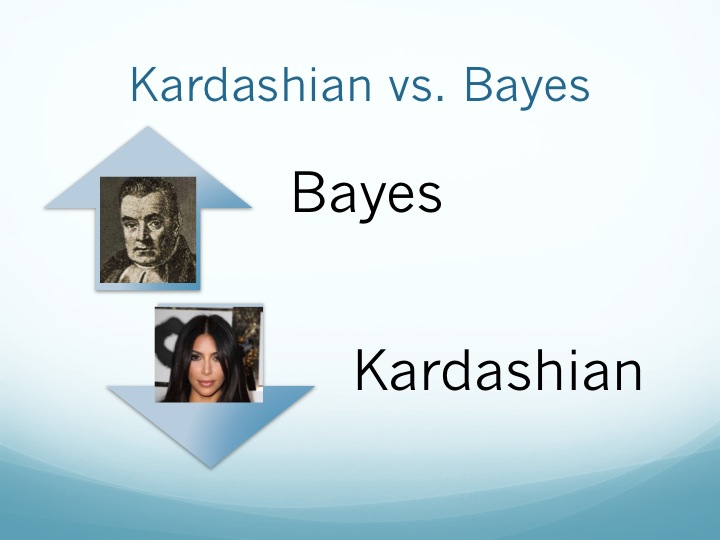
I have written several times about Bayes Theorem and its application to social and mobile gaming but the reaction to the Kim Kardashian game from Glu reminded me how often it is neglected. Bayes Theorem calculates the probability of something happening based on conditions related to the event, prior probability. The importance of Bayes Theorem is that it takes into account the underlying probability of an event happening so that you are not weighing too heavily a local data point or discrete test (you can see the actual formula in my original post).

Slide1

To illustrate, assume you are trying to determine the chance of a Libertarian candidate winning the US Presidency. You may look at the candidate and see how he checks all the right boxes and could be appealing to the mass market. Based on this information you may think he has a 20% chance of winning. But then if you look at the data of third party candidates overall in the US winning less than 1 percent of elections, you understand that even the strongest candidate at best would have slightly better than 1 percent chance of winning an election.

Reverend Thomas Bayes and Kim Kardashian

Bayes Theorem provides a useful point in not only looking at the success of Kim Kardashian: Hollywood but also applying it to your business. For those not aware, Glu Mobile launched a social/mobile game in 2014 centered around Kardashian. The game was a tremendous success for Glu, with over 35 million downloads, and helped them raise over $125 million in capital.

What is interesting is that this success has created an entirely new category, with multiple companies trying to replicate it, and this is where Bayes’ Theorem becomes important. Glu has signed other celebrities, including Britney Spears, Katy Perry and Nicki Minaj. Demi Lovato is doing a game with Pocket Gems. Rovio develoed a Shakira game. Moreover, virtually every game company and definitely every talent agent is trying to get into the celebrity mobile game business, driving up the cost of using such talent dramatically.

The problem with this approach, however, is that the game companies are neglecting Bayes’ Theorem. Most people inside the game industry agree that 80-90 percent of all games fail (by fail, do not get to ROI positive ad spend and fail to make a profit). This metric is not simply for start-ups but if you look at the major game publishers (Zynga, Kabam, King.com, etc), they deal with the same reality.

Just as having a great candidate for the Libertarian Party does not significantly change the odds of winning the election, Bayes Theorem shows that having a celebrity front a game does not significantly improve the odds of the game being successful.

Back to the Kardashian case, even with an 80 percent chance of failing, there is a 20 percent chance of success. Just because one product, Kim Kardashian: Hollywood, fell into that 20 percent you should not infer that the probability changed.

What it means for your game company

First and foremost, a celebrity does not guarantee success. Rovio’s Shakira game has already failed. Even the Kardashian game is no longer among the top grossing. Thus, a strategy based on celebrity games that does not rely on all of the games reaching Kardashian levels.

Second, everyone knows about the celebrity thing. If it was that easy to make a top-10 game by working with one, the top 10 games would feature celebrities. With so many companies using celebrities, a celebrity will no longer differentiate your product or company. You need to build a product and company strategy that creates a defendable position and compelling value proposition to your player.

Third, you need a good game. A celebrity can lower your user acquisition costs and potentially increase the number of organics, but if the game is not compelling all these new players will not monetize and leave. That does not create any value for your company.

Most importantly, structure the deal to reflect the reality the game probably has at least a 75 percent chance of failing. I know my licensing friends won’t be happy with me, but you need to limit your risk in the deal. With the success of Kim Kardashian: Hollywood, many stars are expecting seven figure royalty guarantees. While you probably do not mind paying millions if you have a top-10 hit, writing a big check for a game that has failed is very painful (and potentially bankruptcy inducing). Structure deals where you and the celebrity share in the upside but you do not bear all the risk. The good news is that and their agent probably are not familiar with Bayes’ Theorem so only expect a success, so they may be open to a revenue share.

Conclusion

Most games fail, so while a celebrity may help it is not a golden ticket to a top-10 game. You still need to deal with the underlying reality that it is a hit-driven business. Thus, it is important to manage your risk if you use a celebrity and build out a robust plan for success.

Key takeaways

  1. Bayes’ Theorem shows that the underlying probability of an event happening drives the likelihood of the event happening, despite changes in the immediate situation. For gaming, as 80-90 percent of new games fail, basing a game on a celebrity will only marginally improve those odds. Thus a game with a celebrity is probably 75-80 percent likely to fail (not formal numbers, just estimates).
  2. Do not build a strategy around the assumption that a celebrity face for a game will make the game a success, you need to still create a product strategy that builds a competitive game.
  3. Structure your deals so that the celebrity receives the bulk of their royalties if the game is successful, so you are not forced to pay millions for a failed project.

Share this:

  • Click to share on Facebook (Opens in new window) Facebook
  • Click to share on LinkedIn (Opens in new window) LinkedIn
Like Loading...
Unknown's avatarAuthor Lloyd MelnickPosted on January 20, 2016January 22, 2016Categories Bayes' Theorem, General Social Games BusinessTags Bayes' Theorem, brand, branded social games, Glu Mobile, IP, Kim Kardashian2 Comments on Bayes Theorem Part 7: Kim Kardashian

Anatomy of the perfect acquisition

This is hopefully not a spoiler for anybody, but Disney will make a lot of money from Star Wars. While most of you will put this statement down as one of the most obvious things you heard in 2015, the reality is most companies do not make money from acquisitions. Although there are no firm figures, an article in Business Insider showed that 50 to 90 percent of M&A (mergers and acquisitions) deals failed to meet their financial expectation; in my experience the reality is probably closer to the 90 percent number as creative accounting hides some of the failures.

Latest-The-Force-Awakens-Trailer-Description

Even with these numbers, you can initially write off the success of Disney’s acquisition of Lucasfilm as just luck; even though the majority of M&As fail, some do succeed. Upon further review (as we like to say at this point of the NFL season), however, it becomes clear that Disney has instead used acquisitions to create hundreds of billions of dollars of value.

  • Disney’s acquisition of Pixar has led to multiple billion dollar franchises (from Toy Story to Cars)
  • Disney’s acquisition of Marvel has helped them created multiple billion dollar film franchises (Avengers, Iron Man, Captain America, Guardians of the Galaxy)
  • Disney acquisition of ESPN has created a cash machine that largely drives Disney’s profitability (despite a recent slowdown)

So why was the Star Wars acquisition destined to succeed, while so many acquisitions by other companies are doomed to fail? It is due to a combination of investing in the acquisition, understanding the underlying value of what they bought, finding real synergies with other parts of their business and true efforts to retain and build the team.

Investing in the acquisition

When many companies make an acquisition, the cost of the acquisition is often seen as the primary cost. The acquirer is looking at the acquisition to contribute to its business rather than requiring additional investment. Many companies are acquired because they are growing but growth is not easy or automatic. They are often growing because of internal investment in their business. When this internal investment is diverted to the parent company, it moves the company off the growth path.

Star Wars is a great example of how Disney does things differently. Rather than trying to recoup the $4 billion it paid for Lucasfilm by squeezing the Star Wars franchise to get the most revenue from existing Star Wars revenue streams (e.g., toy sales, new distribution of the past movies), Disney invested an additional $400 million to create two new movies. Not only will this investment more than pay for itself (the movie is on its way to generating $1 billion) it reinvigorated sales for the IP overall. Continue reading “Anatomy of the perfect acquisition”

Share this:

  • Click to share on Facebook (Opens in new window) Facebook
  • Click to share on LinkedIn (Opens in new window) LinkedIn
Like Loading...
Unknown's avatarAuthor Lloyd MelnickPosted on December 21, 2015January 4, 2016Categories General Social Games Business, General Tech BusinessTags Disney, Mergers and Acquisition, Star WarsLeave a comment on Anatomy of the perfect acquisition

When to reinvent your company

There was a great article in the Harvard Business Review, “Knowing When to Reinvent” by Mark Bertolini, David Duncan and Andrew Waldeck, that does a great job of showing the indicators of when you need to reinvent your business. Although Bertolini is CEO of Aetna, the insurance company, the lessons are very relevant for game and technology companies.

Slide1In my twenty plus years in the game industry, I have seen many great companies fail because they waited too long to reinvent their business. You can look at companies that missed the shift from PC to console (the Infogrames and CDVs), the transition from console to free to play (the THQs and SEGAs), or the transition from Facebook to mobile (the Zyngas and PopCaps). Conversely, I have seen many fail when they lose focus and chase the cool shiny object too early (the NeoGeos and Playdoms).


Bertolini, et al., first make the point that “no business survives over the long term without reinventing itself.” While nobody argues this point, knowing when to start a deliberate strategic transformation is extremely challenging. There are several obstacles to such a change:

  • Employees feel threatened;
  • Customers can be confused or alienated;
  • Investors see uncertainty and often punish what they consider higher risk.

Ironically, the better a company is doing, the harder it is to pursue strategic reinvention. Investors (i.e. the stock market) are happy with current performance. Although they may prefer a wait and see attitude, that can often lead to reinventing yourself too late (which happened to Borders and Blockbusters).

To understand when you should start the process of reinventing your company, the article’s authors define five fault lines that show the underlying business is less stable than it appears. The fault lines focus on business fundamentals:

  1. Is your business serving the right customers and using the appropriate performance metrics?
  2. Is your business positioned properly in its ecosystem and using the best business model?
  3. Does your business’ employees and partners have the needed expertise?

These three areas lead to five fault lines that show if your business needs reinventing. Continue reading “When to reinvent your company”

Share this:

  • Click to share on Facebook (Opens in new window) Facebook
  • Click to share on LinkedIn (Opens in new window) LinkedIn
Like Loading...
Unknown's avatarAuthor Lloyd MelnickPosted on December 16, 2015January 4, 2016Categories General Social Games Business, General Tech BusinessTags Mark Bertolini, Reinvent, Strategy2 Comments on When to reinvent your company

Don’t undervalue time

A colleague recently made a strong case on why he should spend a few hundred extra dollars to fly into a more convenient airport, and his argument was so effective it helped me realize how much money is wasted in efforts to save money. In particular, people often undervalue (or do not value at all) their own, employees’ and colleagues’ time. As someone who started his career as an entrepreneur, I find myself even more guilty of this mistake.

Although everyone understands their time has value, we often do not realize the extent of this value or think to apply it to many situations. It is, however, pretty easy, to look at the cash value of your time. Let’s say you earn $50,000 a year. Without overcomplicating the equation to take into effect holiday, overtime, etc., you can divide 50,000 by 52 to estimate a value of $961.50 per week. You can then divide $961.50 by 5 to get $192 per workday. Then divide that number by 8 to get your hourly value, in this case $24. If your salary is $100,000 double the number, $150k, triple, etc. You should also perform the same calculations for members of your team (I would also keep the data handy).

If you are an entrepreneur, you can estimate what the salary would be to get someone to do the same work (of course, they would never be as good as you but at worst you are then just creating a conservative estimate of the value of your time). Once you understand how much your time is worth, you can then look at different activities and make more rational decisions.

time-equals-moneyBusiness travel

The first area where understanding the true value of time has a major impact is business travel. There are two different ways this analysis should impact your travel: it can help you choosing routes/schedule and whether to travel at all.

First, as in the situation I mentioned above, it may be a better value to choose a more expensive ticket. If you have a salary of $100,000 and route A costs $500 gets you into the office at 9 AM, and route B costs $350 and gets you in the office at 2 PM, route A is the better option. Yet many companies travel policy and just overall company philosophy might push you to route B to save $150. The problem is, that $150 is costing you $240, based on the calculation above, so route B is actually $90 more expensive for your company. You are being frugal by selecting the more expensive travel.

Second, you need to decide whether the trip is worthwhile. Rather than simply looking at the cost of the trip versus the expected benefits, add in the cost of your being out of the office. This can simply be travel time if you expect to be 100 percent productive while traveling or it can be the full time of the travel. Thus, if you are thinking about a three-day business trip where airfare is $500 and hotels are another $500 but you won’t get any work done other than the business conducting by traveling, you should not consider the cost of the trip $1,000 but instead about $1,600 (if you are at a $50,000 salary). Measuring the cost in this manner makes many business trips counter-productive. Continue reading “Don’t undervalue time”

Share this:

  • Click to share on Facebook (Opens in new window) Facebook
  • Click to share on LinkedIn (Opens in new window) LinkedIn
Like Loading...
Unknown's avatarAuthor Lloyd MelnickPosted on December 9, 2015May 1, 2021Categories General Social Games Business, General Tech Business, UncategorizedTags Efficiency, time, trade shows, travelLeave a comment on Don’t undervalue time

It all comes down to the eye of the tiger

I was recently speaking with a former colleague who is a leader of one of the most successful businesses I have been part of, a mini-corn (a near unicorn, $500 million – $1 billion valuation), and I realized that there is one overriding driver of large scale success, and it is determination. Anyone who reads my blog (and by definition that means you) realizes I am a huge advocate of analytics based decision making, blue ocean strategy, open management, customer driven products, etc. These are all great and will help you grow and optimize your business but the truly huge companies get there because of the sheer determination and take no prisoner attitude of their leaders.

I was fortunate enough to be part of a team like this and people often ask what was the secret to its success. They often assume it is great technology, design genius or some black box, even internally most of us did not see it (myself included), but the key driver of greatness was the sheer determination of the top leadership. The leadership’s entire focus was on growth, always grow, never stop, never slow down, never let anything or anyone get in the way.

Not a popularity contest

This attitude would often make people uncomfortable but they would never stop pushing. This often meant taking risks that other companies would not take or risks that others in the company did not want to take. It often meant hurting feelings, not just of competitors but those internally who lost resources or prestige to the steamroller.

Steamroller

What stands out is that this leadership team that ended up generating huge success never cared if they were liked internally or externally. All they cared about was getting the most resources and making the decisions that drove their business higher, and only drove their business higher.

Never enough

It also meant never being satisfied, and this last principle is what helped me see the overall determination. Even when this leadership team had seen more success than anyone else I have ever met, they still have as much hunger as the first day I met them. It is still all about growth, not just winning but owning the space and then it will be about further distancing themselves from number two. It’s probably very much the same as why Bill Belichick does not stop when the Patriots are up by 10 in the fourth quarter, but will still continue passing and competing until they win by 31. Continue reading “It all comes down to the eye of the tiger”

Share this:

  • Click to share on Facebook (Opens in new window) Facebook
  • Click to share on LinkedIn (Opens in new window) LinkedIn
Like Loading...
Unknown's avatarAuthor Lloyd MelnickPosted on December 2, 2015January 4, 2016Categories General Social Games Business, General Tech Business, Growth, Lloyd's favorite postsTags Growth, leadership, mini-corn, Uber, UnicornLeave a comment on It all comes down to the eye of the tiger

Why PowerPoints are often awful

About a year ago, I wrote how PowerPoint-based presentations are a sales killer, and recently an incident in the sports world reinforced my claim. In my post last year, I argued PowerPoints were counter-productive because rather than encouraging a dialogue they presented only what you felt your audience wanted to hear.

Even Kobe Bryant fails with PowerPoints

This summer, Kobe Bryant and the LA Lakers learned about the shortcomings of PowerPoints that I described (I’m a little shocked Kobe is not reading my blog regularly, but I guess he was busy rehabilitating). Kobe and the Lakers were trying to entice free agent LaMarcus Aldridge, who was being pursued by multiple NBA teams, to sign with the Lakers. When they met with Aldridge, they put on a beautiful presentation on the benefits of playing with the Lakers and playing in Los Angeles.

Following the meeting, the Lakers felt it went very well because the presentation was so powerful but it was actually a disaster. According to Business Insider, the Lakers felt they had a 50 percent chance at Aldridge and that the meeting went “very well.”

In reality, Aldridge considered it a disaster because the Lakers did not convince him how the team would become a championship contender. He felt the presentation focused too much on outside opportunities, not on basketball. Aldridge subsequently signed with the San Antonio Spurs. Continue reading “Why PowerPoints are often awful”

Share this:

  • Click to share on Facebook (Opens in new window) Facebook
  • Click to share on LinkedIn (Opens in new window) LinkedIn
Like Loading...
Unknown's avatarAuthor Lloyd MelnickPosted on November 24, 2015January 4, 2016Categories General Social Games Business, General Tech BusinessTags Kobe Bryant, LA Lakers, LaMarcus Aldridge, PPT, presentations1 Comment on Why PowerPoints are often awful

Why reducing headcount hurts profits

I find it surprising when investors, particularly Wall Street, cheer a company for reducing head count because it is usually not a good business decision. I am not making a moral statement; it is about the underlying business reasons. While reducing head count does immediately reduce the cost side of your business (outside of redundancy expenses), it usually has a greater impact over time on revenue.

People create revenue

Your team is how your company creates revenue. They build the products customers pay money to purchase. They provide support so customers return and continue spending with your company. They market the product so people learn about the product and buy it. At the root of business, companies employ people because they make money for the company. The logical extension of this argument is that if you reduce the number of people, you will have less people generating revenue.

Julian Simon trumps Malthus

Malthus and Julian Simon were two economists of different eras but more importantly different philosophies, and history has proven Simon correct. Malthus lived in a time when people had a short life span and had to spend most of their time on difficult work. He theorized that as the population grew, the situation would get worse as there would be less food, more disease and overall fewer resources to go around.

Julian Simon, conversely, argued that people were incredibly resourceful and always came up with more efficient ways to use resources. Thus, as the population grows, there would actually be more to go around and people would live better. When people argued that oil would run out or we would not have enough food to feed ourselves, he argued that these would not be problem’s due to human intellect.
Simon famously bet Robert Ehrlich, a Malthusian economist, to pick any five metals and Simon argued the price would decrease over time. Simon won the bet. Continue reading “Why reducing headcount hurts profits”

Like Loading...
Unknown's avatarAuthor Lloyd MelnickPosted on November 18, 2015January 4, 2016Categories General Social Games Business, General Tech BusinessTags headcount, HR, Julian Simon, Malthus, Paul Ehrlich, reduction in force, revenue, Simon Ehrlich wager1 Comment on Why reducing headcount hurts profits

The casual gaming opportunity nobody is talking about

Most people in the game industry are always looking at the next great technology that will drive a new wave of demand for social (and core) games but we are missing the biggest opportunity. At every tradeshow, there is debate and predictions about the next seismic shift in gaming. Some people argue it is VR (virtual reality), others feel it is phablets, some think it is 3D casino, while others are already in line for the iPhone 7+. While these platforms all could potentially drive sales, the least sexy opportunity is probably the best.

Don’t forget the bottom of the market

Inexpensive smartphones sales are growing incredibly fast, even in tier 1 markets such as the United States. According to a Bloomberg Business article, “The Cheap Phones Quietly Winning the U.S.,” ZTE has increased its market share in the US to 8 percent from 4.2 percent just a year ago. That makes ZTE the fourth biggest smartphone seller in the US, behind only Apple, Samsung and LG. Continue reading “The casual gaming opportunity nobody is talking about”

Like Loading...
Unknown's avatarAuthor Lloyd MelnickPosted on November 11, 2015January 4, 2016Categories General Social Games Business, Social Games MarketingTags market opportunity, walmart, ZTELeave a comment on The casual gaming opportunity nobody is talking about

Don’t forget to recruit your own team

The value of a good team cannot be overstated, it is more important than strategy, technology and even cash available. I have written before on some of the principals for recruiting a great team and how you should never stop recruiting. It is ironic how much effort companies put to recruiting the best but do not put the same effort into their existing team members until it is too late.

While most companies acknowledge the importance of recruiting, they often neglect the complementary principle that you need to put as much effort in keeping your existing team satisfied. Just as increasing user acquisition costs intensifies the value of retaining existing players, the increasing difficulty in finding great employees intensifies the need to minimize employee churn. There are multiple costs of replacing a good employee

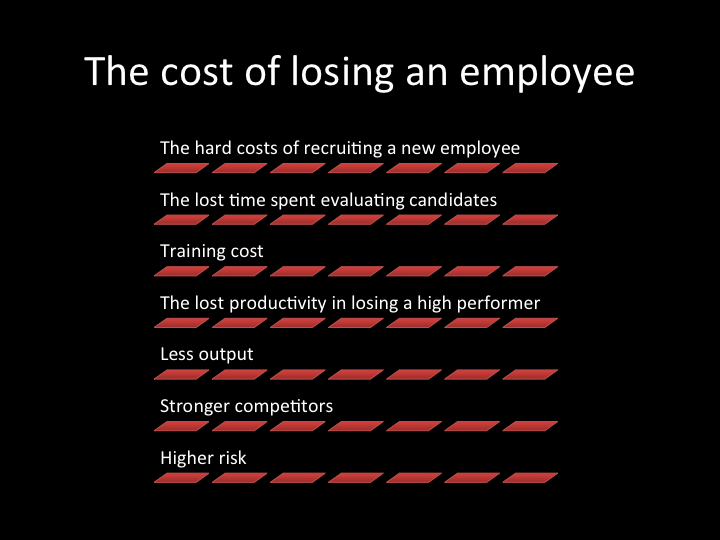
Losing an employee is more costly than you realize
  • The hard costs of recruiting a new employee. This can be payments to a recruiter, referral fees to employees, travel costs to attend recruiting, travel costs to bring candidates in for interviews, etc.
  • The lost time spent evaluating candidates. The time you and your team spend reviewing resumes/CVs, interviewing candidates and discussing options. These days, almost all candidates go through multiple rounds of interviews before being offered a position. Each of those interviews takes 30 minutes or more of someone’s time, if you value that time based on the interviewer’s salary, you quickly get into the thousands of dollars (even more for a senior candidate who meets with leadership).
  • Training costs. These are both direct and indirect. You may have to send the new employee to various external training courses to prepare him for the job. More likely you will need to spend you time or your colleagues will training the new person on how the company works, practical issues (i.e. where the bathroom is), systems, interactions with other teams and what they need to perform their tasks optimally. Again, there is a cost for every minute that you and colleagues spend getting a new hire up to speed. When you break out salaries by how much the person earns per hour, this training cost often runs into the thousands of dollars.
  • The lost productivity in losing a high performer. You should never consider replacing an employee as an upgrade. If there are better people on the market, you need to recruit them proactively and replace weak team members. Assuming you adhere to this principle, if someone leaves voluntary, it means their replacement is not likely to be as good as the existing team member. The cost can range from minimal to huge in having somebody not as good performing a role on your team.
  • Less output. If you employ somebody, they should be providing a valuable service (or else you should proactively have eliminated the position). When you lose somebody, that task either does not get done until a replacement is in place or you must take other people off of their tasks (which again are worthwhile or you should not having them doing it). In either case, the overall output of your organization decreases.
  • Stronger competitors. When a good employee leaves, by definition they go somewhere else. That somewhere else is often a competitor, so not only are you losing their services but a competitor is likely improving. If Messi were to leave Barcelona for Real Madrid, the loss to Barcelona would be magnified by the improvement of their arch competitor.
  • Higher risk. Regardless of how rigorous your recruitment process, there is always risk that you make a bad hire. Many people interview above their actual competence, while others may just not be a good fit for your organization and processes. Thus, you have the risk that not only will the new hire be slightly weaker, they may prove incapable of doing the job and themselves have to be replaced. Then you have both an extended period of the job not getting done (or people being pulled off other tasks) and a repeat of the costs above.

Continue reading “Don’t forget to recruit your own team”

Like Loading...
Unknown's avatarAuthor Lloyd MelnickPosted on November 4, 2015May 1, 2021Categories General Social Games Business, General Tech Business, Lloyd's favorite postsTags employee retention, HR, productivity, recruiting, retention, training1 Comment on Don’t forget to recruit your own team

Posts pagination

Previous page Page 1 … Page 16 Page 17 Page 18 … Page 46 Next page

Get my book on LTV

The definitive book on customer lifetime value, Understanding the Predictable, is now available in both print and Kindle formats on Amazon.

Understanding the Predictable delves into the world of Customer Lifetime Value (LTV), a metric that shows how much each customer is worth to your business. By understanding this metric, you can predict how changes to your product will impact the value of each customer. You will also learn how to apply this simple yet powerful method of predictive analytics to optimize your marketing and user acquisition.

For more information, click here

Follow The Business of Social Games and Casino on WordPress.com

Enter your email address to follow this blog and receive notifications of new posts by email.

Join 791 other subscribers

Most Recent Posts

  • Join me at PDMA Inspire for my talk on new product prioritization
  • Why keep studying?
  • The next three years of this blog
  • Interview with the CEO of Murka on the biggest growth opportunity in gaming, Barak David

Lloyd Melnick

This is Lloyd Melnick’s personal blog.  All views and opinions expressed on this website are mine alone and do not represent those of people, institutions or organizations that I may or may not be associated with in professional or personal capacity.

I am a serial builder of businesses (senior leadership on three exits worth over $700 million), successful in big (Disney, Stars Group/PokerStars, Zynga) and small companies (Merscom, Spooky Cool Labs) with over 20 years experience in the gaming and casino space.  Currently, I am the GM of VGW’s Chumba Casino and on the Board of Directors of Murka Games and Luckbox.

Topic Areas

  • Analytics (114)
  • Bayes' Theorem (8)
  • behavioral economics (8)
  • blue ocean strategy (14)
  • Crowdfunding (4)
  • DBA (2)
  • General Social Games Business (459)
  • General Tech Business (195)
  • Growth (88)
  • International Issues with Social Games (50)
  • Lloyd's favorite posts (101)
  • LTV (54)
  • Machine Learning (10)
  • Metaverse (1)
  • Mobile Platforms (37)
  • Prioritization (1)
  • Social Casino (52)
  • Social Games Marketing (105)
  • thinking fast and slow (5)
  • Uncategorized (33)

Social

  • View CasualGame’s profile on Facebook
  • View @lloydmelnick’s profile on Twitter
  • View lloydmelnick’s profile on LinkedIn

RSS

RSS Feed RSS - Posts

RSS Feed RSS - Comments

Categories

  • Analytics (114)
  • Bayes' Theorem (8)
  • behavioral economics (8)
  • blue ocean strategy (14)
  • Crowdfunding (4)
  • DBA (2)
  • General Social Games Business (459)
  • General Tech Business (195)
  • Growth (88)
  • International Issues with Social Games (50)
  • Lloyd's favorite posts (101)
  • LTV (54)
  • Machine Learning (10)
  • Metaverse (1)
  • Mobile Platforms (37)
  • Prioritization (1)
  • Social Casino (52)
  • Social Games Marketing (105)
  • thinking fast and slow (5)
  • Uncategorized (33)

Archives

  • September 2023
  • December 2021
  • July 2021
  • March 2021
  • February 2021
  • January 2021
  • December 2020
  • November 2020
  • October 2020
  • September 2020
  • August 2020
  • July 2020
  • June 2020
  • May 2020
  • April 2020
  • March 2020
  • February 2020
  • January 2020
  • November 2019
  • October 2019
  • September 2019
  • June 2019
  • May 2019
  • April 2019
  • March 2019
  • February 2019
  • January 2019
  • December 2018
  • June 2018
  • May 2018
  • April 2018
  • March 2018
  • February 2018
  • January 2018
  • December 2017
  • June 2017
  • May 2017
  • April 2017
  • March 2017
  • February 2017
  • January 2017
  • December 2016
  • November 2016
  • October 2016
  • September 2016
  • June 2016
  • May 2016
  • April 2016
  • March 2016
  • February 2016
  • January 2016
  • December 2015
  • November 2015
  • October 2015
  • September 2015
  • July 2015
  • June 2015
  • May 2015
  • April 2015
  • March 2015
  • February 2015
  • January 2015
  • December 2014
  • November 2014
  • October 2014
  • September 2014
  • August 2014
  • July 2014
  • June 2014
  • May 2014
  • April 2014
  • March 2014
  • February 2014
  • January 2014
  • December 2013
  • November 2013
  • October 2013
  • September 2013
  • August 2013
  • July 2013
  • June 2013
  • May 2013
  • April 2013
  • March 2013
  • February 2013
  • January 2013
  • December 2012
  • November 2012
  • October 2012
  • September 2012
  • August 2012
  • July 2012
  • June 2012
  • May 2012
  • April 2012
  • March 2012
  • February 2012
  • January 2012
  • December 2011
  • November 2011
  • October 2011
  • September 2011
  • August 2011
  • July 2011
  • June 2011
  • May 2011
  • December 2010
January 2026
S M T W T F S
 123
45678910
11121314151617
18192021222324
25262728293031
« Sep    

by Lloyd Melnick

All posts by Lloyd Melnick unless specified otherwise
Google+

Enter your email address to subscribe to this blog and receive notifications of new posts by email.

Join 791 other subscribers
Follow Lloyd Melnick on Quora

RSS HBR Blog

  • What Actually Works to Change Someone’s Mind
  • Our Favorite Management Tips of 2025
  • How to Manage—and Motivate—Gen Z
  • The Most-Watched HBR Videos of 2025
  • The HBR Charts that Help Explain 2025
  • The Most Popular HBR Podcast Episodes of 2025
  • How the Best Leaders Develop and Spend “Innovation Capital”
  • The 10 Most Popular HBR Articles of 2025
  • How Work Changed in 2025, According to HBR Readers
  • What Leaders Can Learn from a Formula 1 Turnaround

RSS Techcrunch

  • An error has occurred; the feed is probably down. Try again later.

RSS MIT Sloan Management Review Blog

  • Calm: The Underrated Capability Every Leader Needs Now
  • The Top Five MIT SMR Videos of 2025
  • Three Steps Toward Fairer Talent Management
  • From Crisis to Coopetition: What Leaders Can Learn From Anesthesiologists
  • AI Coding Tools: The Productivity Trap Most Companies Miss
  • How Procter & Gamble Uses AI to Unlock New Insights From Data
  • Rewire Organizational Knowledge With GenAI
  • Hungry for Learning: Wendy’s Will Croushorn
  • Beat Burnout: 10 Essential MIT SMR Reads
  • How Leaders Stay True to Themselves and Their Stakeholders
The Business of Social Games and Casino Website Powered by WordPress.com.
  • Subscribe Subscribed
    • The Business of Social Games and Casino
    • Join 726 other subscribers
    • Already have a WordPress.com account? Log in now.
    • The Business of Social Games and Casino
    • Subscribe Subscribed
    • Sign up
    • Log in
    • Report this content
    • View site in Reader
    • Manage subscriptions
    • Collapse this bar
 

Loading Comments...
 

    %d