Skip to content

The Business of Social Games and Casino

How to succeed in the mobile game space by Lloyd Melnick

Category: General Social Games Business

How to deal with Apple, Facebook, Google and other platforms

Given the importance of working with platforms and intermediaries to tech and game companies, managing the relationships with the platform becomes crucial to your success. A Harvard Business Review article earlier this year, “Mastering the Intermediaries” by Benjamin Edelman, lays out a strategic framework for optimizing these relationships.
Slide1

Regardless of your business, if you are not a platform you probably rely on one or another type of intermediary for your success. Airlines and hotels are at the mercy of Kayak, Orbitz, Priceline and other platforms. Game companies rely on Facebook, Google and Apple for their access to customers. Small restaurants use Seamless or Foodler to reach hungry customers. Manufacturers must sell through Amazon to gain access to a large market. Moreover, almost every retailer looks to Google to refer customers.

These intermediaries provide valuable benefits (hence why everyone works with them) but they can also capture a disproportionate share of the value a company creates. These costs, also, do not dissipate through competition as most markets usually only have one or two significant platforms (mobile phones, anyone). Thus, companies feel they have no choice but to accept the fees and rules the platforms institute. Edelman’s article, however, shows strategies for recapturing some of the value companies are creating and protecting yourself from abuse by the platform. Continue reading “How to deal with Apple, Facebook, Google and other platforms”

Share this:

  • Click to share on Facebook (Opens in new window) Facebook
  • Click to share on LinkedIn (Opens in new window) LinkedIn
Like Loading...
Unknown's avatarAuthor Lloyd MelnickPosted on August 13, 2014August 24, 2014Categories General Social Games Business, Mobile PlatformsTags Apple, Benjamin Edelman, Facebook, google, Kayak, Platforms, Seamless1 Comment on How to deal with Apple, Facebook, Google and other platforms

How to make your brand trustworthy

In a time when people are very cynical about businesses, earning the trust of your customers or players is increasingly important. Trust gives validity to your marketing messages, allowing you to communicate with your customers, inform them of new products and features and thus increase their long-term lifetime value (LTV). Conversely, if customers do not trust you, there is very little you can do to retain them or reactivate them other than just compete on price.

Trust

A recent article, “How Do You Know if a brand is TRUSTworthy?!,” polled readers to list what makes a brand trustworthy. The responses are very enlightening in terms of building trust for your company or product:

  • Create social media content that is not simply marketing. By creating useful content, not just sales collateral, you are building trust with your customers.
  • Handle negativity well. Rather than ignore or avoid problems, get in front of them and clean up the issue.
  • Do not worry about simply getting a large number of followers, focus on getting followers who are truly engaged with your product or game.

Continue reading “How to make your brand trustworthy”

Share this:

  • Click to share on Facebook (Opens in new window) Facebook
  • Click to share on LinkedIn (Opens in new window) LinkedIn
Like Loading...
Unknown's avatarAuthor Lloyd MelnickPosted on August 6, 2014August 24, 2014Categories General Social Games Business, Social Games MarketingTags customer service, trust2 Comments on How to make your brand trustworthy

Why a new product or game has to be 9X better

I have seen many games and tech companies fail even though their product is better. Related, I have written why fast following is almost always a doomed strategy. A classic article from 2006 in the Harvard Business Review, “ Eager Sellers and Stony Buyers” by John Gourville, does a great job of explaining why new products need to be 9X better to disrupt and succeed.

There are thousands of companies trying to build a better mousetrap, be it a more appealing version of Clash of Clans, a better taxi service than Uber or a better marketplace than eBay. While research has shown that businesses that introduce new products are more likely to flourish than those that do not, new products fail at a rate of 40-90 percent depending on the category. One study showed that 47 percent of first movers failed, meaning that approximately half the companies that pioneered new product categories later pulled out of those businesses.

These statistics beg the question: “Why do consumers fail to buy innovative products even when they offer clear improvements over existing ones?” Few would question the objective advantages of many innovations over existing alternatives, but that is often not enough for them to succeed. To understand why new products fail to live up to companies’ expectations, Gourville delved into the psychology of behavior change. Continue reading “Why a new product or game has to be 9X better”

Share this:

  • Click to share on Facebook (Opens in new window) Facebook
  • Click to share on LinkedIn (Opens in new window) LinkedIn
Like Loading...
Unknown's avatarAuthor Lloyd MelnickPosted on July 23, 2014August 24, 2014Categories General Social Games Business, Social Games MarketingTags 9X, behavior change, John Gourville, new product launch8 Comments on Why a new product or game has to be 9X better

The Stakeholders You Need to Close a Big Deal

The Stakeholders You Need to Close a Big Deal

Excellent post on the different personal interests you need to understand when doing deals (or corp dev), shows the importance of looking at the individuals and not just the company-to-company relationship.

Share this:

  • Click to share on Facebook (Opens in new window) Facebook
  • Click to share on LinkedIn (Opens in new window) LinkedIn
Like Loading...
Unknown's avatarAuthor Harvard Business ReviewPosted on July 20, 2014July 20, 2014Categories General Social Games BusinessTags business development, corporate development, StakeholdersLeave a comment on The Stakeholders You Need to Close a Big Deal

Moneyball finally comes to VC

I have been intrigued for years that a huge financial sector has continued to rely on intuition while industry after industry has discovered that using analytics give you a better chance to succeed. Moreover, it is a sector that brags about the fact that it fails 99 percent of the time yet fails to embrace methods to improve those odds. I am talking about venture investing, the venture capital industry.
Slide1

Moneyball and the venture community

For those who have seen the movie or read the book Moneyball, which I have written about multiple times, one of the most poignant scenes is the Oakland A’s smoke filled draft room where scouts with years of experience determine the best prospects to select based on their gut of what makes a great baseball player. When I first read about it, the parallels to how game company executives select what games to green light were incredibly apparent and I was certain you would see a similar transformation of the game industry. We did, with analytics driven social game companies putting many old school game companies out of business.

The venture capital space has uncanny parallels to the pre-Moneyball baseball industry. You have investors with years of experience sitting in Red Bull filled rooms deciding which investments to pursue based on intuition. The claim that they are investing in the management team is another way of saying they are selecting those leaders who feel like rock stars; who they think look like a star. They are basing it on measurable that they feel are important but have not proven empirically are the keys to success (just as baseball executives undervalued walks and over-valued defense).

Correlation Ventures, the Billy Beane of VC

A recent article in Forbes, “Venture By Numbers,” shows this situation is changing. Correlation Ventures started in 2011 with the philosophy to bring a quant-based approach to venture investing. Their mission was to stockpile 25 years of data on every venture deal consummated, evaluate this data with proprietary algorithms and then pick investments via pattern-matching software. Continue reading “Moneyball finally comes to VC”

Share this:

  • Click to share on Facebook (Opens in new window) Facebook
  • Click to share on LinkedIn (Opens in new window) LinkedIn
Like Loading...
Unknown's avatarAuthor Lloyd MelnickPosted on July 16, 2014July 23, 2014Categories Analytics, General Social Games BusinessTags Billy Beane, Correlation Ventures, Founders, Moneyball, Oakland A's, VC, Venture Capital, venture investing1 Comment on Moneyball finally comes to VC

Blue Ocean Leadership

The best and most empirically supported strategy book I have ever read is Blue Ocean Strategy and the authors of the 2005 book, W. Chan Kim and Renee Mauborgne, just published a great article on the Harvard Business Review, “Blue Ocean Leadership.” The need for blue ocean leadership is highlighted by the statistics that only 30 percent of employees are actively committed to doing a good job, 50 percent just put their time in while 20 percent act out their discontent by negatively influencing co-workers, missing days on the job and driving customers away through poor service. Just step back and re-read that last sentence: 20 percent of all employees in the US act in counterproductive ways.

Poor leadership is the cause of this widespread employee disengagement, according to US polling agency Gallup. People do not intend to be poor leaders but they lack a clear understanding of what changes it would take to bring out the best in everyone and achieve high impact. The authors extend their research and theory from Blue Ocean Strategy, which essentially is a framework for turning non-customers into customers, and applies concepts and analytic underpinnings to help leaders release the blue ocean of unexploited talent and energy in the organization.

The key insight is that leadership should be considered a service that employees “buy” or “don’t buy.” Every leader has customers, the bosses the leader must deliver performance and the followers who need the leader’s guidance and support to achieve. When people value your leadership, they are effectively buying your leadership. They are inspired to excel. Conversely, when they do not buy your leadership, they disengage, becoming non-customers.

How Blue Ocean Leadership is different

Blue Ocean Leadership rapidly brings a step change in leadership strength. There are three overarching ways that is differs from traditional leadership:

  • Focus on acts and activities. Blue Ocean Leadership focuses on what acts and activities leaders need to undertake to boost their teams’ motivation and business results, not on who leaders need to be. It is much easier to change people’s acts and activities than their values, qualities or behavioral traits. Activities are something that any individual can change, given the right feedback and guidance.
  • Connect closely to market realities. Under Blue Ocean Leadership, the people who face market realities are asked for their direct input on how their leaders hold them back and what those leaders could do to help them best serve customers and key stakeholders. When people are engaged in defining the leadership practices that will enable them to thrive, those practices are connected to the market realities against which they need to perform, and they are then highly motivated to create the best possible profile for leaders and to make new solutions work. Their willing cooperation maximizes the acceptance of new profiles for leadership while minimizing implementation costs. Traditional leadership development programs tend to be quite generic and are often detached from what companies stand for in the eyes of customers and from the market results people are expected to achieve.
  • Distribute leadership across all management levels. Blue Ocean Leadership is designed to be applied across the three leadership levels: top, middle and frontline. It calls for profiles for leaders that are tailored to the very different tasks, degrees of power and environments that you find at each level. Extending leadership capabilities deep into the front line unleashes the latent talent and drive of a critical mass of employees, and creating strong distributed leadership significantly enhances performance across the organization. Conversely, most traditional leadership programs focus on executives and their potential for impact now and in the future.

Continue reading “Blue Ocean Leadership”

Share this:

  • Click to share on Facebook (Opens in new window) Facebook
  • Click to share on LinkedIn (Opens in new window) LinkedIn
Like Loading...
Unknown's avatarAuthor Lloyd MelnickPosted on July 10, 2014July 23, 2014Categories General Social Games Business, Lloyd's favorite postsTags Blue Ocean Leadership, leadership, leadership canvas, leadership profiles, Renee Mauborgne, W Chan Kim1 Comment on Blue Ocean Leadership

Lifetime Value Part 21: 3D LTV

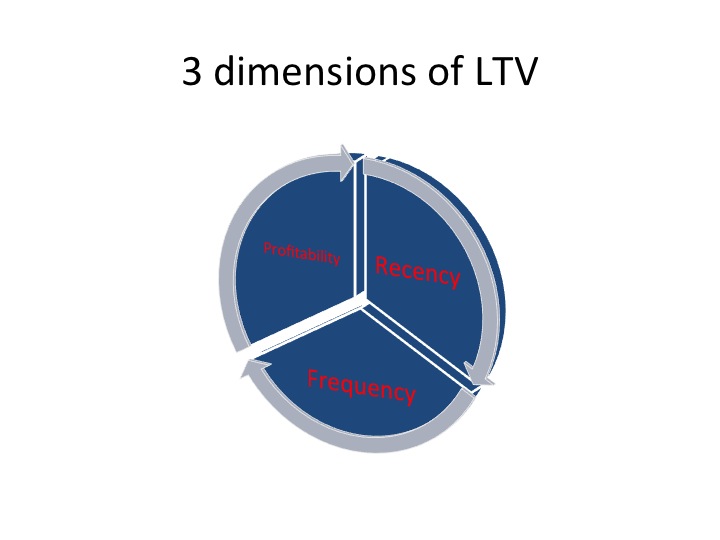
I recently read an article on Sociomantic, “Customer Lifetime Value in Three Dimensions,” about looking at lifetime value (LTV) tied to the customer journey and it adds another dimension to calculating lifetime value that could greatly improve its predictive value for you as well as pointing to areas for improvement. The article breaks LTV into three dimensions: recency, frequency and profitability (Note: The authors refer to the third dimension as “monetization.” Based on my previous posts on monetization, I felt this term would confuse my readers, as our definitions differ).

Slide1

Recency

The article points out that a key determinant of recency is when the customer last made a purchase (or in a game, last monetized). When examining the recency dimension of your customers, you should analyze which cohorts purchased which items. With this information, you can then predict subsequent purchases, including what items each cohort (actually each customer) is likely to purchase. This analysis provides an LTV for each cohort (or even customer) and can power a machine learning recommendation engine or post-purchase retargeting engine that would increase LTV. Continue reading “Lifetime Value Part 21: 3D LTV”

Share this:

  • Click to share on Facebook (Opens in new window) Facebook
  • Click to share on LinkedIn (Opens in new window) LinkedIn
Like Loading...
Unknown's avatarAuthor Lloyd MelnickPosted on July 8, 2014July 23, 2014Categories Analytics, General Social Games Business, LTVTags frequency, lifetime value, LTV, profitability, recency1 Comment on Lifetime Value Part 21: 3D LTV

Lifetime Value Part 20: What others are doing to optimize lifetime value

There was an article recently that cited a study from Econsultancy and Sitecore that highlighted what companies and advertising agencies are doing across multiple industries to increase customer lifetime value. I have written many times about the importance of lifetime value (LTV), and how it is the core of whether your company or product is successful. The article points out that 75 percent of global company marketers agree that LTV is crucially important. I think it is important to understand what companies in other industries are doing to optimize lifetime value so rather than just following your peers, you can build an advantage over them.

A single customer view

The most common response when asked, “What is the most effective tool to optimize LTV ?” was a single customer view. The recognition that key insights are being missed also supports recent findings showing that marketers are struggling to develop a holistic view of their customers. For example, you may have data from inside your product how consumers act, survey data from your users, focus test results and feedback from customer service. What you may not be doing is integrating all of this data to understand the customer experience and their frustrations. Many companies just look at the in-product metrics but by looking at the data holistically you are more likely to find the levers to optimize best your product. Continue reading “Lifetime Value Part 20: What others are doing to optimize lifetime value”

Share this:

  • Click to share on Facebook (Opens in new window) Facebook
  • Click to share on LinkedIn (Opens in new window) LinkedIn
Like Loading...
Unknown's avatarAuthor Lloyd MelnickPosted on July 2, 2014August 20, 2014Categories General Social Games Business, LTV, Social Games MarketingTags cross-selling, customer experience, customer service, customer view, lifetime value, LTV, personalized interaction, up-selling1 Comment on Lifetime Value Part 20: What others are doing to optimize lifetime value

Summer reading list

I came across some great books this year, many of which I summarized in this blog, and thought it would be helpful to list the books I have found most valuable professionally over the years. I will focus, though, on the recent ones that have had a strong impact.

Thinking Fast and Slow

Any reading list I create must start with Thinking, Fast and Slow by Daniel Kahneman. It is by far the most important book I have read. Kahneman provides fantastic insights into decision making, which not only help you understand deeply your customers but also your own decision making processes. Although the book is somewhat dense and not an easy read, it will impact everything you do once you finish it. Thinking, Fast and Slow

Predictably Irrational

The perfect complement to Thinking, Fast and Slow, is Predictably Irrational by Dan Ariely. Ariely also focuses on decision making, from a behavioral economics perspective, but discusses it in a manner more entertaining than any novel I have read. This book has a certain point in my heart as Dan was on the Board of Advisors of my first company (Merscom), and his advice was as good as his book. This is a book you may stay up all night reading that will also help you build a much more successful product. Predictably Irrational

Hooked

Next on my list is Hooked: How to Build Habit-Forming Products by Nir Eyal, a book I recently blogged about. Hooked is probably the hottest book among tech companies this year and presents a great framework for creating products that customers will keep coming back to. Hooked: How to Build Habit-Forming Products

Contagious

Jonah Berger’s Contagious: Why Things Catch On is probably the book I have quoted most this year. Another book I summarized earlier in the year, Contagious tells you how to generate word of mouth for your product based on real academic research, not urban myths that do not really work. I think I have quoted Contagious in more Quora answers than all other books combined (click here to read my post about Contagious). Contagious: Why Things Catch On

Blue Ocean Strategy

I normally hate strategy books because they either focus on trite phrases with no practical value or use anecdotes that may or may not be transferable. Blue Ocean Strategy: How To Create Uncontested Market Space And Make The Competition Irrelevant by W. Chan Kim and Renee Mauborgne, on the other hand, is a book that helps you create a truly effective strategy (click here for my post on Blue Ocean Strategy). Like Contagious, it is based on academic research, and it provides a framework for building a truly great company. Blue Ocean Strategy

The Innovator’s Dilemma

While The Innovator’s Dilemma: When New Technologies Cause Great Firms to Fail (Management of Innovation and Change) by Clayton Christensen may not be directly useful for many of you, it is most applicable to leaders of market leading companies, it provides a very helpful understand of how disruptive technologies emerge. For the game industry (which accounts for many of my readers), it is particularly illuminating and helps explain many of the shifts we have seen (my post on the key learnings from The Innovator’s Dilemma).

The Signal and the Noise

Finally, another thought-provoking book that helps you understand much better how to use analytics, and not misuse them, is The Signal and the Noise: Why So Many Predictions Fail-but Some Don’t by Nate Silver. Nate Silver, best known for being the best prognosticator of the past two elections, destroys many of the fallacies around predictive models and provides a broad infrastructure on how metrics can help (read my post on the lessons I took away from the book). The Signal and The Noise

These books will probably get you through the next month or so. As I come across more great ones, I will definitely share them with everyone.

Share this:

  • Click to share on Facebook (Opens in new window) Facebook
  • Click to share on LinkedIn (Opens in new window) LinkedIn
Like Loading...
Unknown's avatarAuthor Lloyd MelnickPosted on June 24, 2014July 23, 2014Categories General Social Games BusinessTags blue ocean strategy, Clayton Christensen, Contagious, dan ariely, Daniel Kahneman, Hooked, Innovator's Dilemma, Jonah Berger, Nate Silver, Nir Eyal, predictably irrational, signal and the noise, thinking fast and slow5 Comments on Summer reading list

Lifetime Value Part 18: Ten small things that will increase LTV

While optimizing your product is a full time job and all design should focus on monetization, virality and retention, a Kissmetric blog post by Mike Bal pointed out ten tactics that can boost lifetime value. Although these are not a replacement for strong design and optimization, they will further boost your metrics.

The techniques should not only boost lifetime value, but also great more brand loyalty (thus LTV of your brand) and you will notice the common theme is they are customer centric. Continue reading “Lifetime Value Part 18: Ten small things that will increase LTV”

Share this:

  • Click to share on Facebook (Opens in new window) Facebook
  • Click to share on LinkedIn (Opens in new window) LinkedIn
Like Loading...
Unknown's avatarAuthor Lloyd MelnickPosted on June 19, 2014July 23, 2014Categories General Social Games Business, Growth, LTVTags content, Kissmetrics, lifetime value, LTV1 Comment on Lifetime Value Part 18: Ten small things that will increase LTV

Posts pagination

Previous page Page 1 … Page 25 Page 26 Page 27 … Page 46 Next page

Get my book on LTV

The definitive book on customer lifetime value, Understanding the Predictable, is now available in both print and Kindle formats on Amazon.

Understanding the Predictable delves into the world of Customer Lifetime Value (LTV), a metric that shows how much each customer is worth to your business. By understanding this metric, you can predict how changes to your product will impact the value of each customer. You will also learn how to apply this simple yet powerful method of predictive analytics to optimize your marketing and user acquisition.

For more information, click here

Follow The Business of Social Games and Casino on WordPress.com

Enter your email address to follow this blog and receive notifications of new posts by email.

Join 791 other subscribers

Most Recent Posts

  • Join me at PDMA Inspire for my talk on new product prioritization
  • Why keep studying?
  • The next three years of this blog
  • Interview with the CEO of Murka on the biggest growth opportunity in gaming, Barak David

Lloyd Melnick

This is Lloyd Melnick’s personal blog.  All views and opinions expressed on this website are mine alone and do not represent those of people, institutions or organizations that I may or may not be associated with in professional or personal capacity.

I am a serial builder of businesses (senior leadership on three exits worth over $700 million), successful in big (Disney, Stars Group/PokerStars, Zynga) and small companies (Merscom, Spooky Cool Labs) with over 20 years experience in the gaming and casino space.  Currently, I am the GM of VGW’s Chumba Casino and on the Board of Directors of Murka Games and Luckbox.

Topic Areas

  • Analytics (114)
  • Bayes' Theorem (8)
  • behavioral economics (8)
  • blue ocean strategy (14)
  • Crowdfunding (4)
  • DBA (2)
  • General Social Games Business (459)
  • General Tech Business (195)
  • Growth (88)
  • International Issues with Social Games (50)
  • Lloyd's favorite posts (101)
  • LTV (54)
  • Machine Learning (10)
  • Metaverse (1)
  • Mobile Platforms (37)
  • Prioritization (1)
  • Social Casino (52)
  • Social Games Marketing (105)
  • thinking fast and slow (5)
  • Uncategorized (33)

Social

  • View CasualGame’s profile on Facebook
  • View @lloydmelnick’s profile on Twitter
  • View lloydmelnick’s profile on LinkedIn

RSS

RSS Feed RSS - Posts

RSS Feed RSS - Comments

Categories

  • Analytics (114)
  • Bayes' Theorem (8)
  • behavioral economics (8)
  • blue ocean strategy (14)
  • Crowdfunding (4)
  • DBA (2)
  • General Social Games Business (459)
  • General Tech Business (195)
  • Growth (88)
  • International Issues with Social Games (50)
  • Lloyd's favorite posts (101)
  • LTV (54)
  • Machine Learning (10)
  • Metaverse (1)
  • Mobile Platforms (37)
  • Prioritization (1)
  • Social Casino (52)
  • Social Games Marketing (105)
  • thinking fast and slow (5)
  • Uncategorized (33)

Archives

  • September 2023
  • December 2021
  • July 2021
  • March 2021
  • February 2021
  • January 2021
  • December 2020
  • November 2020
  • October 2020
  • September 2020
  • August 2020
  • July 2020
  • June 2020
  • May 2020
  • April 2020
  • March 2020
  • February 2020
  • January 2020
  • November 2019
  • October 2019
  • September 2019
  • June 2019
  • May 2019
  • April 2019
  • March 2019
  • February 2019
  • January 2019
  • December 2018
  • June 2018
  • May 2018
  • April 2018
  • March 2018
  • February 2018
  • January 2018
  • December 2017
  • June 2017
  • May 2017
  • April 2017
  • March 2017
  • February 2017
  • January 2017
  • December 2016
  • November 2016
  • October 2016
  • September 2016
  • June 2016
  • May 2016
  • April 2016
  • March 2016
  • February 2016
  • January 2016
  • December 2015
  • November 2015
  • October 2015
  • September 2015
  • July 2015
  • June 2015
  • May 2015
  • April 2015
  • March 2015
  • February 2015
  • January 2015
  • December 2014
  • November 2014
  • October 2014
  • September 2014
  • August 2014
  • July 2014
  • June 2014
  • May 2014
  • April 2014
  • March 2014
  • February 2014
  • January 2014
  • December 2013
  • November 2013
  • October 2013
  • September 2013
  • August 2013
  • July 2013
  • June 2013
  • May 2013
  • April 2013
  • March 2013
  • February 2013
  • January 2013
  • December 2012
  • November 2012
  • October 2012
  • September 2012
  • August 2012
  • July 2012
  • June 2012
  • May 2012
  • April 2012
  • March 2012
  • February 2012
  • January 2012
  • December 2011
  • November 2011
  • October 2011
  • September 2011
  • August 2011
  • July 2011
  • June 2011
  • May 2011
  • December 2010
January 2026
S M T W T F S
 123
45678910
11121314151617
18192021222324
25262728293031
« Sep    

by Lloyd Melnick

All posts by Lloyd Melnick unless specified otherwise
Google+

Enter your email address to subscribe to this blog and receive notifications of new posts by email.

Join 791 other subscribers
Follow Lloyd Melnick on Quora

RSS HBR Blog

  • New Research on Copycat Products, Your Pitch-Day Dress Code, When Hand Gestures Help Persuasion, and More
  • Leaders, Bring Your Best Self into the New Year
  • What Actually Works to Change Someone’s Mind
  • Our Favorite Management Tips of 2025
  • How to Manage—and Motivate—Gen Z
  • The Most-Watched HBR Videos of 2025
  • The HBR Charts that Help Explain 2025
  • The Most Popular HBR Podcast Episodes of 2025
  • How the Best Leaders Develop and Spend “Innovation Capital”
  • The 10 Most Popular HBR Articles of 2025

RSS Techcrunch

  • An error has occurred; the feed is probably down. Try again later.

RSS MIT Sloan Management Review Blog

  • Calm: The Underrated Capability Every Leader Needs Now
  • The Top Five MIT SMR Videos of 2025
  • Three Steps Toward Fairer Talent Management
  • From Crisis to Coopetition: What Leaders Can Learn From Anesthesiologists
  • AI Coding Tools: The Productivity Trap Most Companies Miss
  • How Procter & Gamble Uses AI to Unlock New Insights From Data
  • Rewire Organizational Knowledge With GenAI
  • Hungry for Learning: Wendy’s Will Croushorn
  • Beat Burnout: 10 Essential MIT SMR Reads
  • How Leaders Stay True to Themselves and Their Stakeholders
The Business of Social Games and Casino Website Powered by WordPress.com.
  • Subscribe Subscribed
    • The Business of Social Games and Casino
    • Join 726 other subscribers
    • Already have a WordPress.com account? Log in now.
    • The Business of Social Games and Casino
    • Subscribe Subscribed
    • Sign up
    • Log in
    • Report this content
    • View site in Reader
    • Manage subscriptions
    • Collapse this bar
 

Loading Comments...
 

    %d