Skip to content

The Business of Social Games and Casino

How to succeed in the mobile game space by Lloyd Melnick

Category: General Social Games Business

The secret to creating a hit habit-forming product or game

The hottest book in Silicon Valley currently is Hooked: How to Build Habit-Forming Products by Nir Eyal, and for good reason; it is an incredibly valuable book for building a business. As Eyal points out, amassing millions of users is no longer good enough. Companies’ economic value is a function of the strength of the habits they create. User habits become a competitive advantage. Products that change customer routines, where users become hooked, are less susceptible to attacks from other companies.

Users who continually find value in a product are more likely to tell their friends about it. Frequent usage creates more opportunities to encourage people to invite their friends, broadcast content, and share through word-of-mouth. Hooked users become brand evangelists: Megaphones for your company, bringing in new users at little or no cost.

Habit-forming products change user behavior and create unprompted engagement. The aim is to influence customers to use your product or play your game on their own, repeatedly, without relying on overt calls-to-action such as ads or promotions. Once a habit is formed, the user is automatically triggered to use the product during routine events such as waiting in line at Starbucks. Eyal uses the Hook Model to show how to create a product or game that become habit forming for users, that have a long term competitive advantage and are more likely to generate word of mouth.

The Hook Model

The Hook Model describes an experience designed to connect the user’s problem to a solution frequently enough to form a habit. Eyal defines habits as behaviors done with little or no conscious thought. The convergence of access, data, and speed is making the world a more habit-forming place. – Businesses that create customer habits gain a significant competitive advantage. It has four phases: trigger, action, variable reward, and investment. Continue reading “The secret to creating a hit habit-forming product or game”

Share this:

  • Click to share on Facebook (Opens in new window) Facebook
  • Click to share on LinkedIn (Opens in new window) LinkedIn
Like Loading...
Unknown's avatarAuthor Lloyd MelnickPosted on June 17, 2014July 23, 2014Categories General Social Games Business, Growth, LTVTags Actions, Hook Model, Hooked, investment, Nir Eyal, Triggers, Variable Rewards7 Comments on The secret to creating a hit habit-forming product or game

The empty chair and how it can make your business succeed

I recently read about techniques Amazon CEO’s Jeff Bezos uses to create a great customer experience and one has really stuck with me as a brilliant way to get the whole organization focused on creating a product users love. It is something I am planning to replicate and it can help any company create products that delight users and get them to switch from competitors.

According to the article, even during the fledgling days of Amazon, Bezos worked hard to establish the philosophy of a company that obsesses over their customers from top to bottom. An overwhelming figure that used to always set the tone of his meetings was “the empty chair.” From the first days of Amazon, Bezos brought an empty chair into meetings and informed his top executives that they should consider that seat occupied by their customer, “the most important person in the room.” Throughout these meetings, a different weight was held on all decisions as the invisible but clear presence of the customer was always considered.

The empty chair

Multiple benefits to the empty chair

There are at least three benefits of Bezos’ empty chair strategy:

  • First, features and new products are evaluated through the customer’s perspective. Think of all the products that have come to market, particularly technology products, that did not have a clear value to customers.
  • Second, it keeps you from putting in features that are not in your customer’s or player’s interest. If people would be embarrassed to discuss a feature or new product openly in front of a real customer, there is a problem with that feature. Products that work against the customer will fail immediately or be replaced by a product consistent with the user’s interests, over time there are no secrets in product design.
  • Third, if the product is an improvement or substitute for an existing good, the empty chair forces you to understand if you are creating enough unique value to prompt the user to switch. By having the customer in the room, you need to consider whether that customer would use your product and why they would switch to it from their current product. Given that a product must be 5 or 9 times better to get someone to switch, you can use the empty chair to determine if and how your new offering is that much better.

Continue reading “The empty chair and how it can make your business succeed”

Share this:

  • Click to share on Facebook (Opens in new window) Facebook
  • Click to share on LinkedIn (Opens in new window) LinkedIn
Like Loading...
Unknown's avatarAuthor Lloyd MelnickPosted on June 10, 2014June 15, 2014Categories General Social Games Business, Growth, Lloyd's favorite postsTags amazon, customer service, empty chair, Jeff Bezos, user experience2 Comments on The empty chair and how it can make your business succeed

The value of toughness for tech companies

I recently finished Toughness: Developing True Strength On and Off the Court by Jay Bilas and was surprised how many of Bilas’ ideas from sports were also relevant to success in business. There are many examples from sports that can help you be successful in business, and Bilas’ analysis of toughness is at the forefront of these lessons. Since reading the book, I have asked my team to read regularly the article that led to the book. The underlying principle for Bilas is that toughness is not about bravado and conflict. It is found in the heart of an individual willing to devote him- or herself to what s/he knows is right. Toughness isn’t physical. It has nothing to do with size, physical strength or athleticism. It’s an intangible, an attitude, a philosophy.Toughness comes from how you handle your experiences, what you learn from them, and how others guide you through them in your life. Most importantly, it is a skill that can be improved by working on it.

Toughness: Developing True Strength On and Off the CourtBend but do not break

Bilas uses  physical materials as a means of defining real toughness. In metallurgy toughness is a measure of how much energy a material can absorb before rupturing. Scientists have devised ways to measure a metal’s toughness through lab impact tests, such as swinging a hammer from a pendulum at a metal object to calculate how much energy is required to break the object. Hardness— in metallurgy, at least— is related to toughness, but it’s not the same thing. Hardness describes how much energy it takes to bend or change a material. Being able to bend under pressure without breaking is a more important attribute than hardness. Someone who bends without breaking and bounces back up will prevail over the “hard” athlete or person, i.e., someone who is resistant to bending under pressure but will break with enough force. Persevering, getting up when you have been knocked down, is what true mental toughness is. Soccer great Julie Foudy likens her spirit to a kids’ toy, an inflatable punching bag that pops back up when it is hit. True toughness is mental toughness, and has little to do with physical toughness. As we learned from metallurgy, it is mental toughness that makes a person, player or team unbreakable, whereas physical hardness can be more easily broken. Persistence is not just about pushing forward; it is about pushing through to reach a new height, exceeding a limit you thought you had . That takes mental toughness. Toughness is not about being big or strong, or being a bully. That displays the least amount of toughness. This is lesson number one for the entrepreneur: It is most important to take a blow and be able to bounce back.

You do not need to be a jerk to be tough

Toughness has no relationship to how nice a person is. There is no reason you can’t be exceedingly nice and incredibly tough at the same time. Those two traits are not mutually exclusive. Some people feel they must create confrontation to display toughness, but confrontation just shows the ability to create confrontation. What actually shows toughness is the ability to get through a task without complaining. It is not getting rattled by challenges in completing the task, but showing concentration and patience. Instead those truly tough meet these challenges head on. Lesson number two: Toughness is not acting tough; it is not letting anything stop you from accomplishing your tasks. Continue reading “The value of toughness for tech companies”

Share this:

  • Click to share on Facebook (Opens in new window) Facebook
  • Click to share on LinkedIn (Opens in new window) LinkedIn
Like Loading...
Unknown's avatarAuthor Lloyd MelnickPosted on June 5, 2014June 15, 2014Categories General Social Games Business, Lloyd's favorite postsTags jay bilas, leadership, toughnessLeave a comment on The value of toughness for tech companies

Thoughts on Mary Meeker’s Internet Trends in 2014

It is that time of year when esteemed VC and Internet Analyst Mary Meeker publishes her Internet trends and every blogger comments on them. I was going to skip commenting this year as I am not a big fan of prognostication, I do not feel anyone can predict the future, but her ideas are thought provoking so I did want to highlight the ones that may be interesting to my readers. She also points out many trends and data points that are useful to all tech companies (the full presentation is embedded below): Continue reading “Thoughts on Mary Meeker’s Internet Trends in 2014”

Share this:

  • Click to share on Facebook (Opens in new window) Facebook
  • Click to share on LinkedIn (Opens in new window) LinkedIn
Like Loading...
Unknown's avatarAuthor Lloyd MelnickPosted on June 3, 2014June 15, 2014Categories General Social Games BusinessTags Internet trends, Mary Meeker2 Comments on Thoughts on Mary Meeker’s Internet Trends in 2014

Lifetime Value Part 16: Using lifetime value to target prospects

One of the most valuable applications of customer lifetime value (LTV) modeling is using it to target the highest-valued customers or players. I have written many times about the importance of LTV and how to calculate it. One of the most powerful applications of LTV is online customer targeting.

Slide1

As an article on MarketingProfs points out, LTV targeting starts with a deep understanding of your current customer base so you can develop high-LTV and low-LTV customer segments. Doing so will allow you to create a profile of the “personas” that will have the best retention, highest word of mouth and spend the most on your products.

High-LTV personas could be “women over 35 who spend most of their day at home.” By knowing the persona, you can create personalized messages to strategically target customers who match that profile, and reach them through a variety of channels.

Once you have built personas for your players or customers, there are four ways to leverage this understanding: Continue reading “Lifetime Value Part 16: Using lifetime value to target prospects”

Share this:

  • Click to share on Facebook (Opens in new window) Facebook
  • Click to share on LinkedIn (Opens in new window) LinkedIn
Like Loading...
Unknown's avatarAuthor Lloyd MelnickPosted on May 29, 2014June 4, 2014Categories Analytics, General Social Games Business, Growth, LTV, Social Games MarketingTags lifetime value, LTV, personas, segments, targetingLeave a comment on Lifetime Value Part 16: Using lifetime value to target prospects

The beauty of starting a business with a nice personality

While many entrepreneurs, especially those in Northern California, focus on starting the next sexy business, it is often the mundane ventures that generate the highest return. Companies like Waste Management generate billions in revenue yet investors fawn over and entrepreneurs try to replicate the Twitters and King.coms. Not that those are bad companies, but many would-be founders are overlooking opportunities in “boring” businesses that could yield billion-dollar returns.

The Amazon example

Probably the best example of this gap between the perceived opportunity and the real opportunity is Amazon. Most of the people reading this blog are probably excited about Amazon’s strategy to use drones for delivery or the newest content and original program that it has added to Amazon Prime. However, as Forbes Magazine wrote about in the article “Amazon’s Wholesale Slaughter”, its initiative in the $8 trillion wholesale distribution business is their most disruptive move yet.

Amazon Supply

AmazonSupply is an e-commerce site that targets the unsexy but huge wholesale and distribution market. While people are fascinated by the $4 trillion retail business (Amazon’s share is $74 billion) where Amazon has gained a huge share, wholesalers in the US alone generated $7.2 trillion. Continue reading “The beauty of starting a business with a nice personality”

Share this:

  • Click to share on Facebook (Opens in new window) Facebook
  • Click to share on LinkedIn (Opens in new window) LinkedIn
Like Loading...
Unknown's avatarAuthor Lloyd MelnickPosted on May 27, 2014May 29, 2014Categories General Social Games BusinessTags amazon, AmazonSupply, Uber, wholesale, wholesale distributionLeave a comment on The beauty of starting a business with a nice personality

How to use a waitlist for growth

A recent post and slideshow (slideshow below), Robinhood Waiting List Breakdown, raised a great opportunity for how all types of company can use a waiting list to generate growth. Robinhood.com is a stock brokerage related product that already has 300,000 people on its waiting list and is adding more than 1,000 daily. By looking at Robinhood, not only are there great lessons for your product launches, but even for launching new features or content in your product. For example, a company like Uber could build a waiting list if it plans to launch a dog walking service, and then when the service launches already have enough demand for critical mass. Continue reading “How to use a waitlist for growth”

Share this:

  • Click to share on Facebook (Opens in new window) Facebook
  • Click to share on LinkedIn (Opens in new window) LinkedIn
Like Loading...
Unknown's avatarAuthor Lloyd MelnickPosted on May 15, 2014May 29, 2014Categories General Social Games Business, Growth, Social Games MarketingTags Growth, robinhood, waitlist2 Comments on How to use a waitlist for growth

Lifetime Value Part 14: Machine learning and LTV

Last week I discussed how you need to manage your customers based on their expected lifetime value, and machine learning technology is a powerful tool to execute this strategy. When applied effectively, machine learning can reduce your service and support costs while increasing your profit margin. Machine learning lets you tailor virtually any part of your business to each individual customer so you optimize the value of that customer.

Slide1

Predicting and placing users in the right bucket

The first key in maximizing profitability is segmenting your customers based on expected lifetime value. You can accomplish this manually by examining their past behaviors and key metrics, but most analytic teams do not have the resources to analyze how all the metrics and data interact. Machine learning algorithms, however, can not only incorporate hundreds of variables, but also predict future behavior based on these patterns. Thus, two customers who may have both spent $500 may warrant very different treatment, if the first one is likely to spend $20,000 while the latter is projected to spend $750. Machine learning is a strong tool for making these projections and optimizing the segmentation of your users. Continue reading “Lifetime Value Part 14: Machine learning and LTV”

Share this:

  • Click to share on Facebook (Opens in new window) Facebook
  • Click to share on LinkedIn (Opens in new window) LinkedIn
Like Loading...
Unknown's avatarAuthor Lloyd MelnickPosted on May 13, 2014May 29, 2014Categories Analytics, General Social Games Business, LTV, Machine LearningTags customer service, lifetime value, LTV, Machine learning, pricingLeave a comment on Lifetime Value Part 14: Machine learning and LTV

15 tips for negotiating a job offer

I came across a great article in the Harvard Business Review, “15 Rules for Negotiating A Job Offer” by Deepak Malhotra, that hits on all the key issues when negotiating a job offer. At some point, almost everyone needs to have this skill, either your first job after leaving university or getting back in the workforce after selling a company for millions and not wanting to start another. As you probably have more experience growing a company or product or leading a team, something as seemingly simple as negotiating for your self may be a black box. These fifteen rules will help you come to a fair agreement with your potential employer: Continue reading “15 tips for negotiating a job offer”

Share this:

  • Click to share on Facebook (Opens in new window) Facebook
  • Click to share on LinkedIn (Opens in new window) LinkedIn
Like Loading...
Unknown's avatarAuthor Lloyd MelnickPosted on May 8, 2014May 29, 2014Categories General Social Games BusinessTags Deepak Malhotra, job offer, NegotiationLeave a comment on 15 tips for negotiating a job offer

Lifetime Value Part 13: Managing users and customers profitably

I have written many times about the importance of customer lifetime value (LTV), about its central role in determining a company’s success and how to impact it. In this post, In this post, I will address how to manage users (customers, players, etc.) based on LTV.

Profitability, success and LTV

Slide1

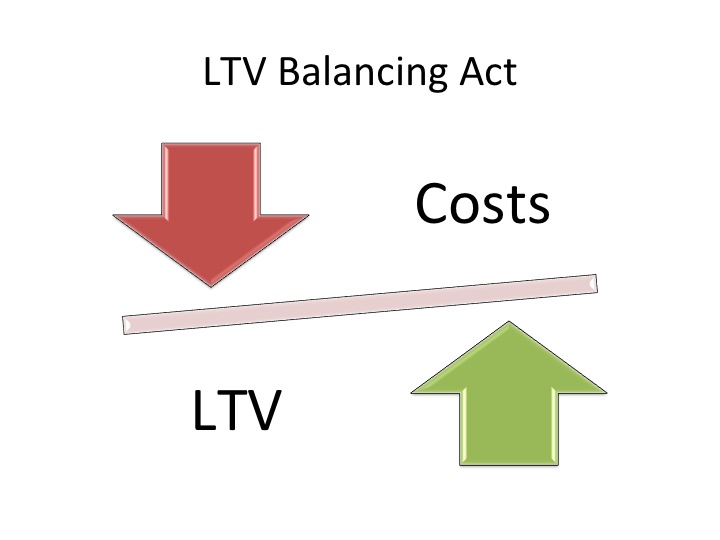
The success and growth of your company comes down to one basic principle, your customer LTV needs to be greater than the cost of acquiring and servicing the customer. The larger the difference between the value you get from a user and the costs associated with that user, the greater your profits. The greater the difference, the more resources you can devote to user acquisition. The greater the difference, the more someone will pay for your company.

The key to optimize the value of a customer versus their costs is not treating all customers the same. Each customer has a different LTV, which can be estimated from everything nearly all the data you are collecting, including from how you acquired the user, their demographic, their initial behavior, etc. The first step to optimizing your business is to determine your different customer segments (VIPs, heavy spenders, occasional spenders, one time spenders, social whales, browsers, etc.). You then put all of your users (hopefully automate this process) into these segments.

Managing a customer portfolio

Once you have segmented your users based on their behavior and predicted lifetime value, you need to manage actively this portfolio of users to optimize your profitability. For each segment, you need to build a strategy that maximizes the difference between the LTV and the costs. For users who spend frequently, you may want to give them enhanced customer service and free gifts so they come back (and spend) even more often. The costs of this additional service and gifts are more than offset by the additional revenue you generate. Conversely, for the one-time purchasers, you want to minimize expenses tied to them. Since they have a low lifetime value, you do not want to devote any resources (costs) to them. By allocating resources only where it increases the difference between LTV and costs, you optimize your profitability. Continue reading “Lifetime Value Part 13: Managing users and customers profitably”

Share this:

  • Click to share on Facebook (Opens in new window) Facebook
  • Click to share on LinkedIn (Opens in new window) LinkedIn
Like Loading...
Unknown's avatarAuthor Lloyd MelnickPosted on May 6, 2014May 29, 2014Categories General Social Games Business, Growth, LTVTags analytics, customer service, lifetime value, LTV, profitabilityLeave a comment on Lifetime Value Part 13: Managing users and customers profitably

Posts pagination

Previous page Page 1 … Page 26 Page 27 Page 28 … Page 46 Next page

Get my book on LTV

The definitive book on customer lifetime value, Understanding the Predictable, is now available in both print and Kindle formats on Amazon.

Understanding the Predictable delves into the world of Customer Lifetime Value (LTV), a metric that shows how much each customer is worth to your business. By understanding this metric, you can predict how changes to your product will impact the value of each customer. You will also learn how to apply this simple yet powerful method of predictive analytics to optimize your marketing and user acquisition.

For more information, click here

Follow The Business of Social Games and Casino on WordPress.com

Enter your email address to follow this blog and receive notifications of new posts by email.

Join 791 other subscribers

Most Recent Posts

  • Join me at PDMA Inspire for my talk on new product prioritization
  • Why keep studying?
  • The next three years of this blog
  • Interview with the CEO of Murka on the biggest growth opportunity in gaming, Barak David

Lloyd Melnick

This is Lloyd Melnick’s personal blog.  All views and opinions expressed on this website are mine alone and do not represent those of people, institutions or organizations that I may or may not be associated with in professional or personal capacity.

I am a serial builder of businesses (senior leadership on three exits worth over $700 million), successful in big (Disney, Stars Group/PokerStars, Zynga) and small companies (Merscom, Spooky Cool Labs) with over 20 years experience in the gaming and casino space.  Currently, I am the GM of VGW’s Chumba Casino and on the Board of Directors of Murka Games and Luckbox.

Topic Areas

  • Analytics (114)
  • Bayes' Theorem (8)
  • behavioral economics (8)
  • blue ocean strategy (14)
  • Crowdfunding (4)
  • DBA (2)
  • General Social Games Business (459)
  • General Tech Business (195)
  • Growth (88)
  • International Issues with Social Games (50)
  • Lloyd's favorite posts (101)
  • LTV (54)
  • Machine Learning (10)
  • Metaverse (1)
  • Mobile Platforms (37)
  • Prioritization (1)
  • Social Casino (52)
  • Social Games Marketing (105)
  • thinking fast and slow (5)
  • Uncategorized (33)

Social

  • View CasualGame’s profile on Facebook
  • View @lloydmelnick’s profile on Twitter
  • View lloydmelnick’s profile on LinkedIn

RSS

RSS Feed RSS - Posts

RSS Feed RSS - Comments

Categories

  • Analytics (114)
  • Bayes' Theorem (8)
  • behavioral economics (8)
  • blue ocean strategy (14)
  • Crowdfunding (4)
  • DBA (2)
  • General Social Games Business (459)
  • General Tech Business (195)
  • Growth (88)
  • International Issues with Social Games (50)
  • Lloyd's favorite posts (101)
  • LTV (54)
  • Machine Learning (10)
  • Metaverse (1)
  • Mobile Platforms (37)
  • Prioritization (1)
  • Social Casino (52)
  • Social Games Marketing (105)
  • thinking fast and slow (5)
  • Uncategorized (33)

Archives

  • September 2023
  • December 2021
  • July 2021
  • March 2021
  • February 2021
  • January 2021
  • December 2020
  • November 2020
  • October 2020
  • September 2020
  • August 2020
  • July 2020
  • June 2020
  • May 2020
  • April 2020
  • March 2020
  • February 2020
  • January 2020
  • November 2019
  • October 2019
  • September 2019
  • June 2019
  • May 2019
  • April 2019
  • March 2019
  • February 2019
  • January 2019
  • December 2018
  • June 2018
  • May 2018
  • April 2018
  • March 2018
  • February 2018
  • January 2018
  • December 2017
  • June 2017
  • May 2017
  • April 2017
  • March 2017
  • February 2017
  • January 2017
  • December 2016
  • November 2016
  • October 2016
  • September 2016
  • June 2016
  • May 2016
  • April 2016
  • March 2016
  • February 2016
  • January 2016
  • December 2015
  • November 2015
  • October 2015
  • September 2015
  • July 2015
  • June 2015
  • May 2015
  • April 2015
  • March 2015
  • February 2015
  • January 2015
  • December 2014
  • November 2014
  • October 2014
  • September 2014
  • August 2014
  • July 2014
  • June 2014
  • May 2014
  • April 2014
  • March 2014
  • February 2014
  • January 2014
  • December 2013
  • November 2013
  • October 2013
  • September 2013
  • August 2013
  • July 2013
  • June 2013
  • May 2013
  • April 2013
  • March 2013
  • February 2013
  • January 2013
  • December 2012
  • November 2012
  • October 2012
  • September 2012
  • August 2012
  • July 2012
  • June 2012
  • May 2012
  • April 2012
  • March 2012
  • February 2012
  • January 2012
  • December 2011
  • November 2011
  • October 2011
  • September 2011
  • August 2011
  • July 2011
  • June 2011
  • May 2011
  • December 2010
January 2026
S M T W T F S
 123
45678910
11121314151617
18192021222324
25262728293031
« Sep    

by Lloyd Melnick

All posts by Lloyd Melnick unless specified otherwise
Google+

Enter your email address to subscribe to this blog and receive notifications of new posts by email.

Join 791 other subscribers
Follow Lloyd Melnick on Quora

RSS HBR Blog

  • New Research on Copycat Products, Your Pitch-Day Dress Code, When Hand Gestures Help Persuasion, and More
  • Leaders, Bring Your Best Self into the New Year
  • What Actually Works to Change Someone’s Mind
  • Our Favorite Management Tips of 2025
  • How to Manage—and Motivate—Gen Z
  • The Most-Watched HBR Videos of 2025
  • The HBR Charts that Help Explain 2025
  • The Most Popular HBR Podcast Episodes of 2025
  • How the Best Leaders Develop and Spend “Innovation Capital”
  • The 10 Most Popular HBR Articles of 2025

RSS Techcrunch

  • An error has occurred; the feed is probably down. Try again later.

RSS MIT Sloan Management Review Blog

  • Calm: The Underrated Capability Every Leader Needs Now
  • The Top Five MIT SMR Videos of 2025
  • Three Steps Toward Fairer Talent Management
  • From Crisis to Coopetition: What Leaders Can Learn From Anesthesiologists
  • AI Coding Tools: The Productivity Trap Most Companies Miss
  • How Procter & Gamble Uses AI to Unlock New Insights From Data
  • Rewire Organizational Knowledge With GenAI
  • Hungry for Learning: Wendy’s Will Croushorn
  • Beat Burnout: 10 Essential MIT SMR Reads
  • How Leaders Stay True to Themselves and Their Stakeholders
The Business of Social Games and Casino Website Powered by WordPress.com.
  • Subscribe Subscribed
    • The Business of Social Games and Casino
    • Join 726 other subscribers
    • Already have a WordPress.com account? Log in now.
    • The Business of Social Games and Casino
    • Subscribe Subscribed
    • Sign up
    • Log in
    • Report this content
    • View site in Reader
    • Manage subscriptions
    • Collapse this bar
 

Loading Comments...
 

    %d