Skip to content

The Business of Social Games and Casino

How to succeed in the mobile game space by Lloyd Melnick

Category: General Social Games Business

The need to focus on tablets

I have written several times about the increasing options in the tablet market and the great opportunities they represent for social game companies. A recent piece on Techcrunch further illuminates this point and makes a great case on why developers should create first for tablets, then turn their attention to smartphones. The author, Tadhg Kelly, points out that Apple has sold over 100 million iPads and in 2–3 years there may be as many as 400 million tablets in the market. Moreover, price points for paid apps on tablets are higher, and Kelly expects greater monetization for free-to-play games due to longer engagement.

Galaxy Note tabletI am equally optimistic about prospects for tablets. Amazon’s new line of Kindle Fires will be a huge holiday seller. The devices are attractively priced, and the ability to focus holiday shoppers’ attention on the devices on the Amazon.com home page and through cross promotion ensures millions will see—and many likely buy—the new tablets. Barnes & Noble’s new Nook tablets share a similar advantage. Again, they are very attractive devices at even better price points. Barnes & Noble also has huge retail reach, with 689 stores and 667 college bookstores, all of which will be prominently showing the new Nook tablets during the holiday shopping season. In addition to these very attractively priced devices that will be in consumers’ faces this holiday season, Samsung (the second largest manufacturer of mobile devices) has a strong line of tablets (including the intriguing Galaxy Note Tab). Also, do not forget Google, that little California company, who has the resources to push its attractive Nexus tablet. Continue reading “The need to focus on tablets”
Share this:

  • Click to share on Facebook (Opens in new window) Facebook
  • Click to share on LinkedIn (Opens in new window) LinkedIn
Like Loading...
Unknown's avatarAuthor Lloyd MelnickPosted on October 30, 2012November 12, 2012Categories General Social Games Business, Mobile PlatformsTags galaxy note tablet, ipad, kindle fire, nook tablet, social gaming, tablets1 Comment on The need to focus on tablets

What is big data and how can social game companies leverage it

One of the popular buzzwords these days is “Big Data,” but few people, even in companies that use analytics extensively, really know what this phrase means. A recent article, co-written by one of my favorite authors, Thomas Davenport, in the MIT Sloan Management Review titled How Big Data is Different does a great job of explaining the concept and showing how it can be applied to social media.

Big data starts with all the data your company is collecting but goes well beyond it. It includes clickstream data from your games, web analytics, social media content (Tweets, blogs, Facebook wall postings, Pinterest Pins, etc.), AppData information and even YouTube views. Big data, however, also includes everything from customer service requests to game development processes and learnings. As the article points out, very little of this information is formatted in the traditional structure of conventional databases. Companies do three things to capitalize on this plethora of data: Continue reading “What is big data and how can social game companies leverage it”

Share this:

  • Click to share on Facebook (Opens in new window) Facebook
  • Click to share on LinkedIn (Opens in new window) LinkedIn
Like Loading...
Unknown's avatarAuthor Lloyd MelnickPosted on October 18, 2012October 30, 2012Categories Analytics, General Social Games BusinessTags big data, social game analytics, Thomas DavenportLeave a comment on What is big data and how can social game companies leverage it

The importance of good strategy

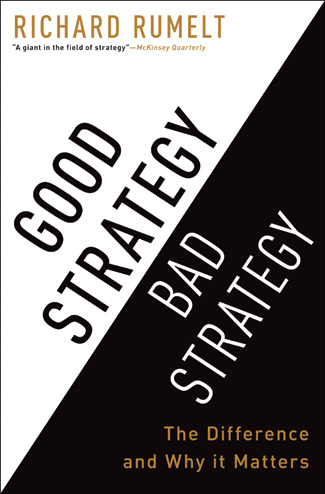
book cover: Good-StrategyBad-StrategyA colleague of mine, Ana Echeverri, recently pointed me to a fantastic article on strategy from McKinsey, The Perils of Bad Strategy (based on the book Good Strategy/Bad Strategy). The theme of the article is that many organizations believe they have a strategy when they do not, which is particularly true in the social game space. The author (Richard Rumelt) refers to this as Bad Strategy, which is more of a consensus of conflicting demands and interests rather than a good use of choice and focus.

What makes bad strategy?

There are four hallmarks of bad strategy: Continue reading “The importance of good strategy”

Share this:

  • Click to share on Facebook (Opens in new window) Facebook
  • Click to share on LinkedIn (Opens in new window) LinkedIn
Like Loading...
Unknown's avatarAuthor Lloyd MelnickPosted on October 16, 2012November 19, 2012Categories General Social Games Business, Lloyd's favorite postsTags bad strategy, blue ocean, richard rumelt, Strategy2 Comments on The importance of good strategy

Innovating with Analytics

I have written several times about the opportunities for social game companies to use analytics beyond just game development, balancing and monetization. An article in the most recent issue of the MIT Sloan Management Review, “Innovating with Analytics,” shines more light on how analytics can help build competitive advantage. Given that all social and mobile game companies already use data extensively to improve their games, the only way a social game company could thus gain a competitive advantage with analytics is to innovate.

In yesterday’s post, I discussed how the Oakland A’s baseball team pioneered the use analytics to build an advantage, but then lost that advantage when other baseball teams copied their approach. This year, however, they won their division by apparently finding an innovative way to use analytics to again build competitive advantage.
 
MIT Sloan Management Review logo

Continue reading “Innovating with Analytics”

Share this:

  • Click to share on Facebook (Opens in new window) Facebook
  • Click to share on LinkedIn (Opens in new window) LinkedIn
Like Loading...
Unknown's avatarAuthor Lloyd MelnickPosted on October 4, 2012October 16, 2012Categories Analytics, General Social Games BusinessTags analytics, innovation, mit sloan management review, social gamesLeave a comment on Innovating with Analytics

Mobile App Success

I’m speaking at a Mobile App meetup in the Triangle tonight; join if you can.

Share this:

  • Click to share on Facebook (Opens in new window) Facebook
  • Click to share on LinkedIn (Opens in new window) LinkedIn
Like Loading...
Unknown's avatarAuthor Lloyd MelnickPosted on October 1, 2012October 2, 2012Categories General Social Games BusinessLeave a comment on Mobile App Success

Here comes the Nook Tablet

With all the excitement around Amazon and Apple’s new tablet announcements in September, there was little attention given to Barnes & Noble’s plans for the Nook. There will be two new Nook tablets coming out later this year to compete directly with Apple and Amazon. One, the Nook HD (priced at $199-$299 depending on storage), is a 7-inch tablet that will compete directly with the Kindle Fire HD, Google’s Nexus 7 and the 7 inch iPad that Apple will announce imminently. Barnes & Noble will also have a 9-inch table, the Nook HD+, that directly targets the iPad and Fire HD 8.9 inch. Couple the potential and value of these devices with Microsoft’s major investment in the Nook division earlier this year, and it is apparent you should not ignore the impact of these devices.

Nook tablet Continue reading “Here comes the Nook Tablet”

Share this:

  • Click to share on Facebook (Opens in new window) Facebook
  • Click to share on LinkedIn (Opens in new window) LinkedIn
Like Loading...
Unknown's avatarAuthor Lloyd MelnickPosted on October 1, 2012October 2, 2012Categories General Social Games Business, Mobile PlatformsTags barnes & noble, kindle fire, nook tablet, tablet social gamingLeave a comment on Here comes the Nook Tablet

The heavy tail of monetization

As I mentioned in an earlier post, I just started the Networked Life course taught by Michael Kearns from the University of Pennsylvania on Coursera. Part of the coursework has been about “heavy tail distribution,” a phenomenon typical in a large-scale network (like Facebook). To summarize, a heavy tail distribution (see image below for an example) means there is a clustering of vertices (users or in the case of Facebook, friends) with a very low number of connections but a long tail of vertices (users) who have a lot of contacts. Thus, in the case of Facebook (or any other typical network) the large majority of users have only a few Friends but there is a long tail of people who have a lot of friends (say over 1,000). These latter people are called “Connectors” in network theory. What is particularly interesting is that this structure, which again is typical of large-scale networks, is effectively the inverse of a traditional bell shape distribution, which would show a few users at the low end, a peak (the top of the bell) and then quickly trail off. The heavy tail is typical of all social networks, Facebook, Twitter, LinkedIn, etc.

Typical heavy tail distribution

What I find interesting is that you find a similar curve in virtually all free-to-play social games when it comes to users’ monetization tendencies. Continue reading “The heavy tail of monetization”

Share this:

  • Click to share on Facebook (Opens in new window) Facebook
  • Click to share on LinkedIn (Opens in new window) LinkedIn
Like Loading...
Unknown's avatarAuthor Lloyd MelnickPosted on September 20, 2012October 2, 2012Categories General Social Games BusinessTags heavy tail distribution, monetization9 Comments on The heavy tail of monetization

Another Android device loses a lawsuit to Apple

In late August, I wrote about the $1 billion plus jury decision in favor of Apple against Samsung for patent violations. Last week, a German court ruled that Motorola Mobility (which is owned by Google) violated Apple’s “bounce and scroll” patent (the same one that led to Apple’s victory over Samsung in the US). If Apple puts up sufficient bond, the German court will ban the sales of Motorola Android devices and could even force them to recall all devices sold in Germany.

Motorola Droid Razr Continue reading “Another Android device loses a lawsuit to Apple”

Share this:

  • Click to share on Facebook (Opens in new window) Facebook
  • Click to share on LinkedIn (Opens in new window) LinkedIn
Like Loading...
Unknown's avatarAuthor Lloyd MelnickPosted on September 18, 2012September 20, 2012Categories General Social Games Business, Mobile PlatformsTags Apple, google, Motorola Mobility, patentLeave a comment on Another Android device loses a lawsuit to Apple

GREE and DeNA, the real companies to watch in social gaming

I find it interesting that the two largest social game companies, GREE and DeNA, generate virtually no press, while you can’t avoid articles about the third largest social game company, Zynga. I believe that because they are Japanese and not US companies they do not generate the same level of attention, but that is unfortunate. People do not draw conclusions about the viability of the airline industry by looking at Spirit’s performance or determine whether the auto industry is rebounding by analyzing Audi, so why look at the third largest game company when assessing the social game industry? If you are an investor, entrepreneur, engineer, etc., and trying to judge the opportunities in social gaming, it makes sense to benchmark against the biggest and best, and that is DeNA and GREE.

Rage of Bahamut Continue reading “GREE and DeNA, the real companies to watch in social gaming”

Share this:

  • Click to share on Facebook (Opens in new window) Facebook
  • Click to share on LinkedIn (Opens in new window) LinkedIn
Like Loading...
Unknown's avatarAuthor Lloyd MelnickPosted on September 13, 2012September 20, 2012Categories General Social Games Business, International Issues with Social Games, Mobile PlatformsTags DeNA, GREE, Japanese social gamesLeave a comment on GREE and DeNA, the real companies to watch in social gaming

The Amazon Maneuver

Over the Summer, Amazon made three moves that when looked at individually are interesting but when reviewed holistically show their plan to dominate the mobile space, which includes social gaming. First, Amazon released Living Classics, a Facebook social game. Then, it announced it had added Epix and NBC Universal content to Amazon prime. Last week, Amazon released details of its new Kindle Fire models. Taken together, these moves suggest Amazon could be as important a partner to social game companies as Apple and Facebook (and more important than Google). Continue reading “The Amazon Maneuver”

Share this:

  • Click to share on Facebook (Opens in new window) Facebook
  • Click to share on LinkedIn (Opens in new window) LinkedIn
Like Loading...
Unknown's avatarAuthor Lloyd MelnickPosted on September 11, 2012September 20, 2012Categories General Social Games Business, Mobile PlatformsTags amazon, Epix, iOS, kindle fire, Living Classics, social games2 Comments on The Amazon Maneuver

Posts pagination

Previous page Page 1 … Page 38 Page 39 Page 40 … Page 46 Next page

Get my book on LTV

The definitive book on customer lifetime value, Understanding the Predictable, is now available in both print and Kindle formats on Amazon.

Understanding the Predictable delves into the world of Customer Lifetime Value (LTV), a metric that shows how much each customer is worth to your business. By understanding this metric, you can predict how changes to your product will impact the value of each customer. You will also learn how to apply this simple yet powerful method of predictive analytics to optimize your marketing and user acquisition.

For more information, click here

Follow The Business of Social Games and Casino on WordPress.com

Enter your email address to follow this blog and receive notifications of new posts by email.

Join 791 other subscribers

Most Recent Posts

  • Join me at PDMA Inspire for my talk on new product prioritization
  • Why keep studying?
  • The next three years of this blog
  • Interview with the CEO of Murka on the biggest growth opportunity in gaming, Barak David

Lloyd Melnick

This is Lloyd Melnick’s personal blog.  All views and opinions expressed on this website are mine alone and do not represent those of people, institutions or organizations that I may or may not be associated with in professional or personal capacity.

I am a serial builder of businesses (senior leadership on three exits worth over $700 million), successful in big (Disney, Stars Group/PokerStars, Zynga) and small companies (Merscom, Spooky Cool Labs) with over 20 years experience in the gaming and casino space.  Currently, I am the GM of VGW’s Chumba Casino and on the Board of Directors of Murka Games and Luckbox.

Topic Areas

  • Analytics (114)
  • Bayes' Theorem (8)
  • behavioral economics (8)
  • blue ocean strategy (14)
  • Crowdfunding (4)
  • DBA (2)
  • General Social Games Business (459)
  • General Tech Business (195)
  • Growth (88)
  • International Issues with Social Games (50)
  • Lloyd's favorite posts (101)
  • LTV (54)
  • Machine Learning (10)
  • Metaverse (1)
  • Mobile Platforms (37)
  • Prioritization (1)
  • Social Casino (52)
  • Social Games Marketing (105)
  • thinking fast and slow (5)
  • Uncategorized (33)

Social

  • View CasualGame’s profile on Facebook
  • View @lloydmelnick’s profile on Twitter
  • View lloydmelnick’s profile on LinkedIn

RSS

RSS Feed RSS - Posts

RSS Feed RSS - Comments

Categories

  • Analytics (114)
  • Bayes' Theorem (8)
  • behavioral economics (8)
  • blue ocean strategy (14)
  • Crowdfunding (4)
  • DBA (2)
  • General Social Games Business (459)
  • General Tech Business (195)
  • Growth (88)
  • International Issues with Social Games (50)
  • Lloyd's favorite posts (101)
  • LTV (54)
  • Machine Learning (10)
  • Metaverse (1)
  • Mobile Platforms (37)
  • Prioritization (1)
  • Social Casino (52)
  • Social Games Marketing (105)
  • thinking fast and slow (5)
  • Uncategorized (33)

Archives

  • September 2023
  • December 2021
  • July 2021
  • March 2021
  • February 2021
  • January 2021
  • December 2020
  • November 2020
  • October 2020
  • September 2020
  • August 2020
  • July 2020
  • June 2020
  • May 2020
  • April 2020
  • March 2020
  • February 2020
  • January 2020
  • November 2019
  • October 2019
  • September 2019
  • June 2019
  • May 2019
  • April 2019
  • March 2019
  • February 2019
  • January 2019
  • December 2018
  • June 2018
  • May 2018
  • April 2018
  • March 2018
  • February 2018
  • January 2018
  • December 2017
  • June 2017
  • May 2017
  • April 2017
  • March 2017
  • February 2017
  • January 2017
  • December 2016
  • November 2016
  • October 2016
  • September 2016
  • June 2016
  • May 2016
  • April 2016
  • March 2016
  • February 2016
  • January 2016
  • December 2015
  • November 2015
  • October 2015
  • September 2015
  • July 2015
  • June 2015
  • May 2015
  • April 2015
  • March 2015
  • February 2015
  • January 2015
  • December 2014
  • November 2014
  • October 2014
  • September 2014
  • August 2014
  • July 2014
  • June 2014
  • May 2014
  • April 2014
  • March 2014
  • February 2014
  • January 2014
  • December 2013
  • November 2013
  • October 2013
  • September 2013
  • August 2013
  • July 2013
  • June 2013
  • May 2013
  • April 2013
  • March 2013
  • February 2013
  • January 2013
  • December 2012
  • November 2012
  • October 2012
  • September 2012
  • August 2012
  • July 2012
  • June 2012
  • May 2012
  • April 2012
  • March 2012
  • February 2012
  • January 2012
  • December 2011
  • November 2011
  • October 2011
  • September 2011
  • August 2011
  • July 2011
  • June 2011
  • May 2011
  • December 2010
January 2026
S M T W T F S
 123
45678910
11121314151617
18192021222324
25262728293031
« Sep    

by Lloyd Melnick

All posts by Lloyd Melnick unless specified otherwise
Google+

Enter your email address to subscribe to this blog and receive notifications of new posts by email.

Join 791 other subscribers
Follow Lloyd Melnick on Quora

RSS HBR Blog

  • Regaining Momentum After a Holiday Break
  • When You’ve Outgrown Your Relationship with a Trusted Advisor
  • Research: Conventional Cybersecurity Won’t Protect Your AI
  • Weave Mentorship into the Fabric of Your Organization
  • To Execute a Unified Strategy, Leaders Need to Shadow Each Other
  • What Companies that Excel at Strategic Foresight Do Differently
  • How Bristol Myers Squibb Transformed Working Capital to Fund Its Future - SPONSOR CONTENT FROM EY-PARTHENON
  • When Being a Family Business Becomes a Competitive Advantage
  • How to Handle a Difficult Board Member
  • How to Strengthen Your Focus When Demands Never Let Up

RSS Techcrunch

  • An error has occurred; the feed is probably down. Try again later.

RSS MIT Sloan Management Review Blog

  • Build Better Pay-for-Performance (PFP) Compensation Plans
  • Your People Are Not All Right
  • Five Trends in AI and Data Science for 2026
  • Stop Making Hollow Apologies at Work
  • Calm: The Underrated Capability Every Leader Needs Now
  • The Top Five MIT SMR Videos of 2025
  • Three Steps Toward Fairer Talent Management
  • From Crisis to Coopetition: What Leaders Can Learn From Anesthesiologists
  • AI Coding Tools: The Productivity Trap Most Companies Miss
  • How Procter & Gamble Uses AI to Unlock New Insights From Data
The Business of Social Games and Casino Website Powered by WordPress.com.
  • Subscribe Subscribed
    • The Business of Social Games and Casino
    • Join 726 other subscribers
    • Already have a WordPress.com account? Log in now.
    • The Business of Social Games and Casino
    • Subscribe Subscribed
    • Sign up
    • Log in
    • Report this content
    • View site in Reader
    • Manage subscriptions
    • Collapse this bar
 

Loading Comments...
 

    %d