Skip to content

The Business of Social Games and Casino

How to succeed in the mobile game space by Lloyd Melnick

Category: General Social Games Business

Why Real Money Skill Based Gaming is Doomed

Why Real Money Skill Based Gaming is Doomed

With computers now beating the best players in poker and eSports, the raison d’être for gambling on skill based games is gone. Earlier this year, Google’s DeepMind Artificial Intelligence (AI) defeated two pro-gamers at StarCraft II. While the AI’s victory did not garner much attention, people are getting used to AI beating humans, it has profound implications for part of the real money gaming ecosystem. Coupled with Libratus beating professional poker players in No-Limit Texas Hold’em and previous AI victories in Go, Chess and other games, it is clear computers already can beat humans in most skill based games and will almost certainly conquer the rest of gaming in the near future.

deepmind_logo

I will leave the implications of powerful AI on society to the Elon Musk’s and Neil deGrasse Tyson’s, but it is important not to underestimate the impact on the electronic gambling industry. This type of AI will, faster than expected, make gambling on skill based games irrelevant.

Everything takes longer than expected but than happens at a more massive scale

In many ways, people have been lulled into a false sense of security because AI has not had a significant impact on gambling, yet. Bill Gates, however, once pointed out that transformational technologies normally take longer than expected to become widespread but once they do have a far greater impact than anticipated. Personal computers followed this pattern, they were a fringe product for years and people started to dismiss them as a fad. Then almost instantaneously they found their way into all parts of life (thank you Windows) and even your grandmother was using one to check her investments. Similar phenomenon occurred with cell phones, drones, streaming video, etc.

AI is following the same pattern, particularly in skill based games (chess, poker, go, StarCraft, etc.). It is going from fringe applications and projects that take years to quick iteration and AI that is superior to humans across many game variants. As the underlying algorithms get stronger, human players will no longer hold an advantage in any skill-based game. More importantly, the tech will go from computers only owned by huge research groups to devices or apps that normal individuals can get cheaply, just as the tech once needed to send a man to the moon is not as powreful as that in a common smartphone.

Doesn’t have to be best

It will not even take the time needed for optimal AI algorithms to become ubiquitous to impact skill based gaming, average AI can beat most players. While beating the top players in StarCraft or Go generates headlines, most people do not play at the level as the top players. Thus, even a sub-optimal algorithm can beat the majority of players. Once people realize they are unlikely to win because there are good algorithms everywhere, they will have no incentive to bet (very few people outside of Browns fans bet on sure losses). If everyone can get a device or program that let’s them play a skill-based game near optimally (but not perfectly), it will still mean that 90+ percent of people will lose regularly. Even those under the delusion they are in the top 10 percent will give up after repeated negative reinforcement.

Impact will be far reaching

As with other technologies, people often do not realize how broad the impact of AI will be. Initially, people will not want to wager on any Player vs. Player skill based game, because AI could augment the opponent. This problem will then extend to betting on any skill-based game, if the human cannot beat AI it is pointless to predict who will win.

The only exception will be at live events, from a Chess Tournament to a Live eSports Tournament. As long as the event can be controlled to limit or prevent AI (which I do not believe will always be possible), people could still wager on these live events. However, as more events move online (Twitch), this will be a small opportunity.

Social casino is not immune

The knee jerk reaction is that AI will negatively impact real money gaming but have a positive effect on social (free to play) casino, the reality is social casino will bear the same negative consequences. Players in social casino are also competing against other players and when AI makes it impossible to win regularly, the appeal of Player vs. Player social casino games will also decline. Recently Zynga saw a significant negative impact from bots in Zynga Poker, one of the largest poker games in the world. The impact on social games like Zynga Poker will get worse as AI becomes more prevalent.

You cannot stop the inevitable

Companies have learned repeatedly, often the hard way, that you cannot stop progress but seem to think they can. Taxi companies fought pitched battles against Uber in courts and with protests but the successful ones adapted their business to compete. Travel agents complained to the government and providers but only the ones who reimagined their businesses survived. While some companies have slowed change, they never stop it and leave themselves in a poor position to compete.

Where the real opportunity exists

While AI will negatively impact the existing gambling space, these types of challenges always create opportunity. Gambling is simply another form of entertainment so the trick is for companies relying on skill based gambling to pivot and provide another entertaining option for their customers.

  • Maybe turn poker or backgammon into a fixed odds challenge against a computer.
  • Pivot the business model to a subscription model so that there is no benefit to winning (and thus no benefit to using AI), especially viable for free-to-play.
  • Use the great advances in virtual sports to replace traditional sports betting by offering people 24/7 events to bet on.
  • Have people gamble on computer vs. computer sporting events (i.e. an EA Fifa World Cup).
  • Create gambling that is based on individual skills (the quality of a drawing, the ability to solve math equations, etc.), player versus themselves.
  • Take traditional casino games and adapt them for the mindset of skill-based players.

The point is you need to be creative and find a new way to entertain your customers.

Key takeaways

  1. With computers now beating the best players in poker and eSports, there is no reason for gambling in skill based games to exist.
  2. The proliferation of AI in skilled base games will take longer than predicted but when it happens will be much broader than anticipated and companies won’t be able to prevent it.
  3. Instead, successful gambling companies will understand they are providing entertainment and find new ways to delight their customers.

Share this:

  • Click to share on Facebook (Opens in new window) Facebook
  • Click to share on LinkedIn (Opens in new window) LinkedIn
Like Loading...
Unknown's avatarAuthor Lloyd MelnickPosted on May 21, 2019May 14, 2019Categories General Social Games Business, General Tech Business, Social CasinoTags AI, artificial intelligence, Chess, DeepMind, Go, Machine learning, poker, real money online gamblingLeave a comment on Why Real Money Skill Based Gaming is Doomed

How to overcome survivorship bias

How to overcome survivorship bias

A few months ago I shared a story and post on Facebook about survivorship bias and was amazed how often it was liked and shared. It also highlights the risk of survivorship bias in the gaming and gambling space. The image and blurb told the story how the navy analyzed aircraft that had been damaged and based future armament decisions on where they had received battle damage, thus they were going to increase the armor on the wingtips, central body and elevators. These were the areas that showed the most bullet holes.

Facebook plane story

One statistician, Abraham Wald, the founder of statistical sequential analysis, however fortuitously stopped this misguided effort. According to Wikipedia, “ Wald made the assumption that damage must be more uniformly distributed and that the aircraft that did return or show up in the samples were hit in the less vulnerable parts. Wald noted that the study only considered the aircraft that had survived their missions—the bombers that had been shot down were not present for the damage assessment. The holes in the returning aircraft, then, represented areas where a bomber could take damage and still return home safely. Wald proposed that the Navy instead reinforce the areas where the returning aircraft were unscathed, since those were the areas that, if hit, would cause the plane to be lost.”

Survivorship bias is universal

Survivorship bias occurs everywhere. If you are a poker player, you may have a hand of three of clubs, eight of clubs, eight of diamonds, queen of hearts and ace of spades. The odds of that particular configuration are about three million to one, but as economist Gary Smith writes in Standard Deviations, “after I look at the cards, the probability of having these five cards is 1, not 1 in 3 million.”

Another example would be professional basketball. If you look at the best professional basketball players, a high percentage never went to university for more than one year. From this information, you (or your teen son) may infer the best path to the NBA is going to university for one year or less. The reality is that there are millions (if not billions) of people who went to university for less than a year and never played in the NBA (or even the G League). The LeBron Jameses and DeAndre Aytons are likely in the NBA despite playing less than a year in college due to their great skill, not because they did not go to university for more than a year.

As an investor, survivorship bias is the tendency to view the fund performance of existing funds in the market as a representative comprehensive sample. Survivorship bias can result in the overestimation of historical performance and general attributes of a fund.

In the business world, you may go to a Crossfit gym that is packed with the owner making a great living. You decide to leave your day job and replicate his success. What you did not see is the hundreds of Crossfit gyms that are not profitable and have closed.

The problem exists in gaming

You often see survivorship bias in the gaming and gambling space. People will look at a successful product and select a couple of features or mechanics they believe have driven the success. They then try to replicate it and fail miserably, only to then wonder why the strategy did not work for them. What they fail to analyze is the many failed games (for every success there are at least 8-10 failures) because they do not even know they exist. The failed games may have had more of the feature you are replicating. Getting a star like Kim Kardashian is a great idea if you only look at Kim Kardashian: Hollywood, but if you look at the hundreds of other IPs that have failed your course of action might be very different.

Survivorship bias can also lend its ugly head when building a VIP program. You talk to your VIPs and analyze their behavior, thus building a program that reinforces what they like about the game. What you neglect, however, is that other non-existent features might have created even more VIPs.

In the gambling space, you may look at a new blackjack variant that is doing great and build a strategy around creating new variants of classic games. What you did not see is all the games based on new variants that have failed.

Avoiding survivorship bias

Looking simply at successes, or even failures, leads to bad decision making. When looking at examples in your industry or other industries, you need to seek out both the successes and failures. With the failures, you need to make sure they are the failures (not the airplanes that returned shot up but the ones that were destroyed). You also should not use others successes or failures as a short cut to robust strategy decisions. You need to analyze the market, understand your strengths-weaknesses-opportunities-threats (SWOT) and do a blue ocean analysis. Only then will you build a strategy that optimizes your likelihood for success.

Key takeaways

  • In WW2, by analyzing surviving aircraft the US navy almost made a critical mistake in adding armor to future airplanes. The planes that returned were actually survivors, while it was the planes that were destroyed that showed where on the plane was the greatest need for new armor. This phenomenon is called survivorship bias.
  • This bias extends into the gaming and gambling space, as companies analyze what has worked in successful games but do not know if it also failed (perhaps to a greater degree) in products that no longer exist.
  • Rather than just looking at survivors or winners to drive your strategy, you should do a full SWOT and Blue Ocean analysis, that is the strongest long-term recipe to optimize your odds of success.

Share this:

  • Click to share on Facebook (Opens in new window) Facebook
  • Click to share on LinkedIn (Opens in new window) LinkedIn
Like Loading...
Unknown's avatarAuthor Lloyd MelnickPosted on May 14, 2019March 4, 2019Categories Analytics, General Social Games Business, General Tech Business, Social CasinoTags analytics, bias, survivor bias, Survivorship bias2 Comments on How to overcome survivorship bias

The Making of a Product Management Case Study

The Making of a Product Management Case Study

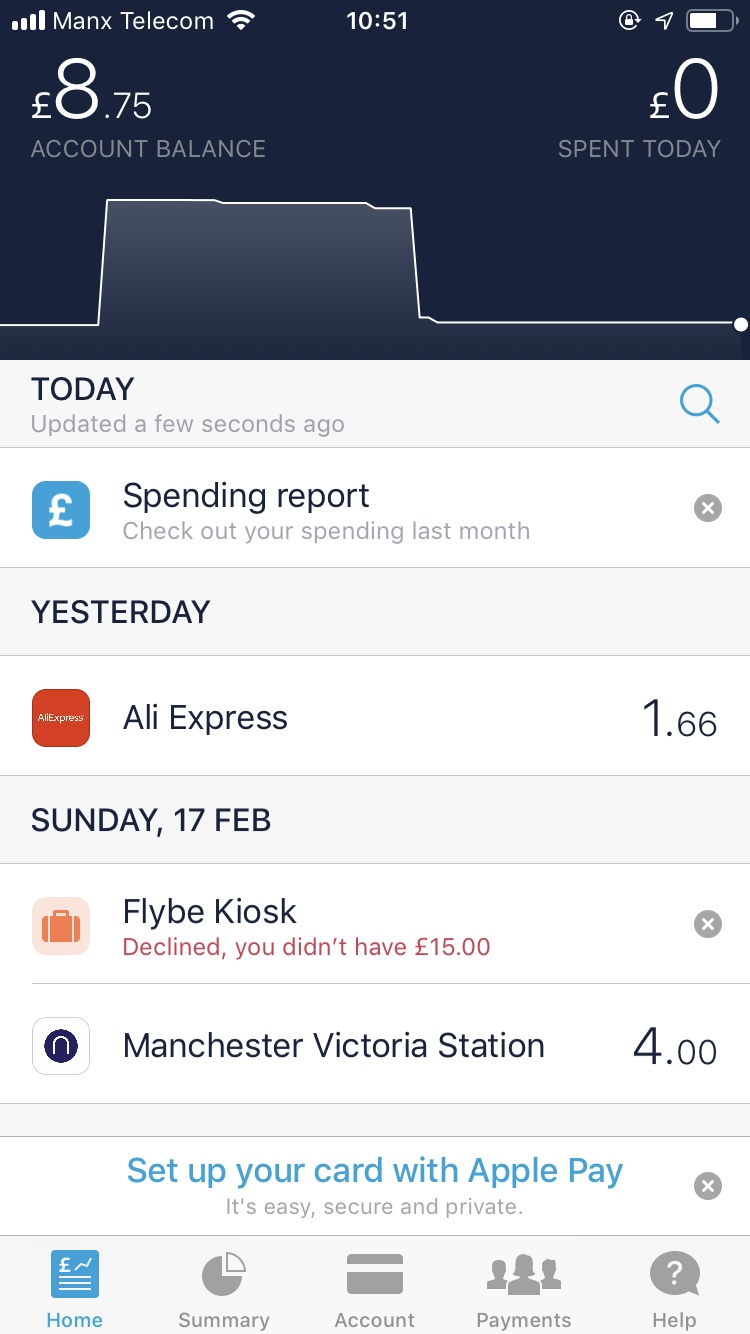
Monzo, a fintech start up approaching Unicorn status, is a Product Management case study in the making. While it is easy to pick successful businesses and look backwards, self-selecting the examples you want to make the case of what you should do, Monzo is the opposite. They are still in the start-up phase and by monitoring their progress you can see how these practices work in the real world. By looking and monitoring Monzo, you can also learn how to differentiate successfully your offering, regardless of the industry.

Truly customer centric

What differentiates Monzo from other tech start-ups is that although they are clearly data driven they are even more customer driven. I became a fan of Monzo’s strategy by starting as a customer and seeing that they were truly customer-centric. Living on the Isle of Man, it is often a challenge working with financial institutions, as we are not part of the UK or EU. While setting up a debit card with one of Monzo’s competitors, Revolut, was an exercise in frustration, Monzo clearly had its team focused on creating a good user experience. Rather than a multi-day response to chats from a CS rep based in a low-cost location (the Revolut model), Monvo offered near real time support as I was trying to navigate setting up from the Isle of Man. This customer focus secured me as a loyal customer – and advocate – at a time when I was looking for a long-term fin partner. Monzo is now my card of choice even though there offering is feature-wise like Revolut. Given the importance of engagement and retention on LTV, this was a wise investment on Monzo’s part.

Product strategy based on making customers life easier

From a product development and management point of view, Monzo is somewhat unique in that it focuses on eliminating friction from customers’ daily life rather than adding a list of features. Monzo sent to its customers a blog post from its CEO about its plans for 2019 and what struck me was that most of the new features they will test were aimed at reducing or eliminating (in Blue Ocean parlance) rather than adding:

  • Automatically compare utility options, such as energy providers, so the customer does not have to go to price comparison sites
  • A way to get a mortgage or refinance with less paperwork
  • Centralizing a customer’s loyalty schemes and reward programs
  • Offering different types of insurance without complex terms and conditions
  • Help building and tracking a customer’s credit score, as most customers do not know how their credit scores are calculated (and the credit agencies are not transparent)

What is particularly thought-provoking with these features that they are considering is not that they are innovative but that they make the customers’ life easier. They are not trying to be the coolest start-up; I did not see the words AI, crypto or VR anywhere in their roadmap. Instead, Monzo is focused on eliminating hurdles their customers face in their daily lives.

Great FTUE and simple UIUX

Another area where Monzo excels is its first-time user experience (FTUE) and user interface and experience (UIUX). When I first signed up for Monzo, I found its FTUE unique in that they turned a potentially negative experience into a positive and viral moment. When I first applied for Monzo’s debit card, they apparently were experiencing rapid growth and there was a delay in completing the KYC (know your customer) process and delivering physical debit cards. Rather than ask you to endure the delays, thus immediately decreasing your satisfaction, Monzo placed me in a queue with specific information on how many customers were ahead of me and when I would receive my card. They then allowed me to jump ahead by recommending Monzo to friends (which I did), and immediately updating how many people were still ahead of me in the queue. Even before becoming a customer, they turned me into an advocate. They then created a positive feeling by giving me control and visibility into the process.

Beyond the initial experience, Monzo has a very straightforward user interface, it is very easy to navigate and learn how to use the features. You never need a tutorial or help, the product is designed to allow you to determine quickly how to conduct transactions.
Monzo Image-1.jpg

Monzo reminds me of Uber, where upon opening the app anyone can figure out how to request a ride. Creating a simple UI, however, is more difficult than creating a complex AI. Any designer can build a UI with 100 options, nested in menu after menu. Reducing those options requires a deep understanding of the customer journey and where the customer is getting value as well as hard decisions on what to include and what to delete.

The UI is also consistent with the product approach described above on making the customers’ life easier rather than just providing them with more options. If the product team simply added feature upon feature, then even the best UI designer would be unable to keep the app’s user interface clean. With alignment between the product and design team, Monzo can focus entirely on removing complications from its customers’ lives.

Lessons

The strategy that Monzo is pursuing provides many useful practices for companies in other parts of the tech space, gaming, gambling, etc. Rather than trying to differentiate yourself from competitors by adding fancy bells and whistles, look at ways you can make your product easier and simpler than competitors (again, more difficult than just adding a new game to your offering). Also, ensure that everything is aligned to your strategy with your customer. If you are trying to provide a fast, clean experience, then not only should the product team develop consistent features, but your support team should focus on creating a complimentary experience and your design team should ensure the app reflects this focus.

Key takeaways

  1. Monzo, a UK based FinTech start-up, is a future case study in product management best practices. By looking and following Monzo, businesses in other industries can learn how to differentiate their offering.
  2. Key to Monzo is a product strategy focused on making its customers lives easier rather than adding glitzy features.
  3. Monzo is successful by aligning its entire business on making a customer’s experience simple, from product features to the first time user experience to the overall user interface through customer support.

Share this:

  • Click to share on Facebook (Opens in new window) Facebook
  • Click to share on LinkedIn (Opens in new window) LinkedIn
Like Loading...
Unknown's avatarAuthor Lloyd MelnickPosted on May 7, 2019May 7, 2019Categories General Social Games Business, General Tech BusinessTags FTUE, Monzo, product management, simplicity, uiux1 Comment on The Making of a Product Management Case Study

The Halo Effect and How to Avoid It

The Halo Effect and How to Avoid It

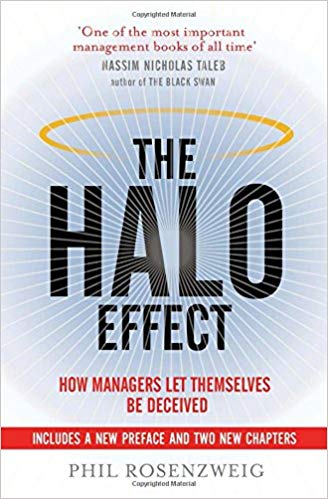
Several months ago, a colleague read and commented on
The Halo Effect by Phil Rosenzweig
, and although I have mixed opinions of the book it contains some great lessons on avoiding biases that lead to misjudging the causes of success or failure. Since reading the book, I have extended these ideas to both understand what activities to replicate and how to communicate better cause and effect.

The Halo Effect drives people to over-simplify why a company or product is succeeding, often misattributing it to leadership or a visible initiative. It can lead to negative consequences by driving incorrect hiring and firing decisions or causing incorrect strategic pivots. The Halo Effect is driven by basic psychology, Rosenzweig points out that “social psychologist Eliot Aronson observed that people are not rational beings so much as rationalizing beings. We want explanations. “

The Halo Effect is attributing a company’s success or failure to its leader or a specific strategy or tactic. People may look at a successful company and believe its acquisition or HR strategy is responsible for the success. This belief then becomes common and other companies replicate the strategy but experience different results. The problem is that the success was probably due to many or alternative factors and just copying one, which may or may not have contributed to the success, does not create the same recipe for success. You may actually be copying part of the strategy or leadership that does not work.

It is the same with individuals. If a company is successful, people are quick to credit the CEO. Articles and books are written about the leader but in reality the company was probably successful because of many factors, both external and internal. Not only then are those who copy the behavior of the CEO disappointed with their results, the successful CEO himself may find failure one year later even if they have not changed.

I have seen this issue many times in sports, both in business and other areas. A manager or coach can be brilliant one year and stupid the next. Yet the manager is the same person, with the same philosophy and strategy. Either the previous success was misattributed or the failure is. I remember when Claudio Renieri shocked everyone as Manager of Leicester City when they won the Premier League in 2016, only to be fired the club in 2017.

Ranieri

The reality is that the success is a combination of factors (including luck) and his strategy was not singly responsible for success or failure. This argument is not simply academic, as it impacts who the club hires and releases. Extended to the business world, it impacts who you put in leadership positions, promote or remove.

There are many factors that contribute to the Halo Effect. Most managers do not usually care to review discussions about data validity and methodology and statistical models and probabilities. They prefer explanations that are definitive and offer clear implications for action. They want to explain successes quickly, simply, and with an appealing logic.

There are multiple reasons that the Halo Effect is so widespread. First, it is impossible to experiment or test real life scenarios to determine actual cause and effect. Second, people love a story and the Halo Effect creates a nice (albeit inaccurate) success story. Third, many, including data analysts, mistakenly equate correlation with causality. Fourth, people often neglect to look at the overall ecosystem and try to simplify a situation to a vacuum. They look for one answer when the reality is much more complex. Finally, people often neglect to account fully for the impact of competition.

You can’t experiment to determine business success

When looking for why a company succeeds, you cannot replicate the methodology an app or game developer would use on why a feature works. There is no way to bring the rigor of experimentation to questions like why a company tripled in revenue or experienced a sales decline. If you want to know the best way to manage an acquisition, you cannot buy 100 companies, manage half of them in one way and half in another way, and compare the results. Without the ability to run a statistically significant experiment, people search for other ways to understand success and failure.

Reinforcing this problem is the confirmation bias, since there is not objective data people pull the data that confirms what they believe is the cause. People do not recognize good leadership unless they have signs about company performance from other things that can be assessed more clearly—namely, financial performance. Roswenszweig writes, “and once they have evidence that a company is performing well, they confidently make attributions about a company’s leadership, as well as its culture, its customer focus, and the quality of its people….But when some researchers took a closer look, they found that …the scores … for a given company turn out to be highly correlated—much more than should be the case given variance within each category. Furthermore, many of the scores were very much driven by the company’s financial performance, just what we would expect given the salient and tangible nature of financial results. “ In effect, they back into confirming their original hypothesis on the cause of a success (or failure).

Pick any group of highly successful companies and look backward, relying either on self-reporting or on articles in the business press, and you will find that they are said to have strong cultures, solid values, and a commitment to excellence. This does not prove these cultures are actually strong, but they are viewed as strong due to the company’s success.

People love stories

Marketers have known for a long time, as have entertainment companies, the power of stories. Rather than explaining the features in a pair of runners that would help in a soccer match, a good marketer will explain how the shoes are developed in conjunction with world-class athletes, who then go to the factory to test them. This type of story is much more compelling (even if false) than an objective review of facts. The same problem contributes to the Halo Effect.

People love to hear how the charismatic leader led the company from a start up to a Unicorn. These stories sell books and magazines (or generate web traffic). The tendency to attribute company success to a specific individual is hard to resist. We love stories because they do not simply report disconnected facts but make connections about cause and effect, often giving credit or blame to individuals. As Rosenzweig writes, “our most compelling stories often place people at the center of events. When times are good, we lavish praise and create heroes. When things go bad, we lay blame and create villains. Facts were assembled and shaped to tell the story of the moment, whether it was about great performance or collapsing performance or about rebirth and recovery. “

The book uses the examples of Cisco and ABB to reinforce the point about the power of stories. Both companies were written about in glowing terms, with many trying to replicate the approaches of John Chambers at Cisco and Percy Barnevik at ABB. As long as Cisco was growing and profitable and setting records for its share price, managers and journalists and professors inferred that it had a wonderful ability to listen to its customers, a cohesive corporate culture, and a brilliant strategy. And when the bubble burst, observers were quick to make the opposite attribution. The same happened with ABB, where Barnevik went from revered business leader to scandal plagued miscreant. The reality was neither Chambers nor Barnevik changed, the story changed to fit the new performance.

Equating correlation with causality

One of the most dangerous manifestations of the Halo Effect is equating correlation with causality. While the correlation may be useful for the purposes of suggesting causal hypotheses, it is not a method of scientific proof. A correlation, by itself, explains nothing. Rosenzweig writes, “by looking only at companies that perform well, we can never hope to show what makes them different from companies that perform less well. I call this the Delusion of Connecting the Winning Dots, because if all we compare are successful companies, we can connect the dots any way we want but will never get an accurate picture. “

Companies that consider themselves data driven and even business intelligence teams, often fall into this correlation trap. They start with a success (or failure), either their own or another company, and then dissect it by looking for correlations between the success and a certain activity. Eventually you will find something, even if the correlation is coincidental. If you are starting with a hypothesis, I guarantee you there will be one relationship that “proves” your hypothesis, no matter what you are claiming (and how accurate you are). A good data scientist can even prove a statistica significance to almost anything, they will find some test that “proves” their claim.

I always laugh at the articles written around the World Cup or Super Bowl about how the region or league of the winner will impact an election or economic growth (i.e. if a California team wins the Republicans will win the next election). Obviously, it is just random luck but there is so much activity occurring at any time there will be some correlational relationship. The sporting event, though, is not driving the activity (there is no causality) and is no more likely to predict an up economy as a coin flip would.

People fall into this trap because they are looking for an easy answer. Rather than understanding all the factors that contribute to a drop in registrations in a region, the analytics team will point to a new product introduction that occurred roughly the same time. For them, it is problem solved. Only when their sales continue to fall or extends to other regions do others begin to see that the problem is much more complex.

Single explanations often do not exist

Another issue driving the Halo Effect is that most results are not driven by one factor. So many things contribute to company performance that it is impossible hard to know exactly how much is due to one particular factor. Even if we try to control for many things outside the company we cannot control for all the many different things that go on inside the company.

All of us can probably think of examples that show this phenomenon. In my case, I was once asked during an exit interview why I quit. Rather than one answer, which the interviewer was expecting, it was a series of experiences over a year. There were several triggers but you could not attribute it to any one variable, as much as the HR person was hoping. Another example is when one of our products out-performed projections. While it would have been easy to explain it as one brilliant decision, and that is what the CEO was looking for, it was a combination of product changes, changes with the competition and a platform shift.

Rosenzweig writes, “the new CEO does something—such as setting new objectives, or bringing about a better market focus, which may help improve the corporate culture, or overhauling the approach to managing human resources, and so on. The improved performance we attribute to the CEO almost certainly overlaps with one or more other explanations for company success. Which brings us to the nub of the problem: Every one of these studies looks at a single explanation for firm performance and leaves the others aside. That would be okay if there were no correlation among them, but common sense tells us that many of these factors are likely to be found in the same company.”

The competitive impact

Related to the impact of multiple variables on performance is the competitive environment. I can be a great leader but if Jeff Bezos and Satya Nadella lead my competitors, my company would probably not perform very well and my leadership would be used as an example of what not to do. Now say I am exactly equally competent but I run an airline. My competitors are not exactly rock stars and we probably out-perform them. Then books and articles get written about how strong my leadership is and what aspects should be copied. In either case, I am doing the same thing but the Halo Effect attributes much of the result to my leadership. Same can be said for HR policies (open office, free lunch, etc) and any other driver of success. If looked at in a vacuum, the Halo Effect creates very misleading results.

As Rosenzweig writes, “the Delusion of Absolute Performance diverts our attention from the fact that success and failure always take place in a competitive environment. It may be comforting to believe that our success is entirely up to us, but as the example of Kmart demonstrated, a company can improve in absolute terms and still fall further behind in relative terms. Success in business means doing things better than rivals, not just doing things well.”

Success is short-lived, especially now

The final point that Rosenzweig makes is that success is short lived. He points out that only 74 companies on the S&P 500 in 1957 were still on the S&P 500 in 1997, forty years later. Of the 74, only 12 outperformed the overall S&P 500 index (they survived but did not thrive). Thus, what makes a company great today probably will not make it great tomorrow, but more realistically it probably is not one thing and as it evolves so will the company.

Next steps

The Halo Effect is a result of our attempts to over-simplify the world. Success and failure are driven by multiple factors and there are no shortcuts to achieving great results. While we can learn from others, we need to remain diligent and make sure not to draw simplistic conclusions. At the end of the day, there is no easy answer and no silver bullet to generate success, it comes from repeatedly make smart, data driven decisions consistent with a coherent strategy.

Key takeaways

  • The Halo Effect is attributing success or failure to an individual or specific action, which is often misleading.
  • The Halo Effect is caused by an inability to do experiments in the real world on the success of a business, people loving stories, mistakenly equating correlation with causality, looking for a single answer to a complex problem and neglected the impact of competition.
  • There is not one simple answer on how to succeed or how to avoid failure, but you must make a series of good decisions based on data.

Share this:

  • Click to share on Facebook (Opens in new window) Facebook
  • Click to share on LinkedIn (Opens in new window) LinkedIn
Like Loading...
Unknown's avatarAuthor Lloyd MelnickPosted on April 30, 2019February 27, 2019Categories Analytics, General Social Games Business, General Tech BusinessTags Halo Effect, leadership, Stories, StrategyLeave a comment on The Halo Effect and How to Avoid It

Why Coin Master May Not Become a Franchise

Why Coin Master May  Not Become a Franchise

With the success of Coin Master, and the disruption it is causing in the social casino space, many are looking to understand and replicate its success. Although Coin Master is unquestionably doing great and has found a Blue Ocean, it would be the second largest social casino product if it was officially classified in that category, you need to proceed with caution if you plan to imitate it.

I will be writing in the near future about the Halo Effect and Survivor Bias, two heuristics that often lead to flawed decisions. With both of these heuristics, people look at a success and draw conclusions from that success in retrospect and are not repeatable (i.e. Monday morning quarterback). They miss, either consciously or subconsciously, many of the factors that led to the success and are necessary to replicate it, while potentially attributing the success to dynamics that actually did not contribute positively.

Given its current momentum, it is very easy to dissect Coin Master and say A, B and C can help you make $250k/day. Rather than jump on the bandwagon, I decided to take a step back and look at what Moon Active is not doing well. I may look stupid in twelve months if Coin Master consolidates its position and continues to grow but there are some fundamental issues with the product that suggest it may decline rapidly, despite most social game franchises lasting for years (Slotomania, DoubleDown, Clash of Clans, Candy Crush, CSR Racing, etc.). The issues below suggest Coin Master might experience a much shorter life at the apex.

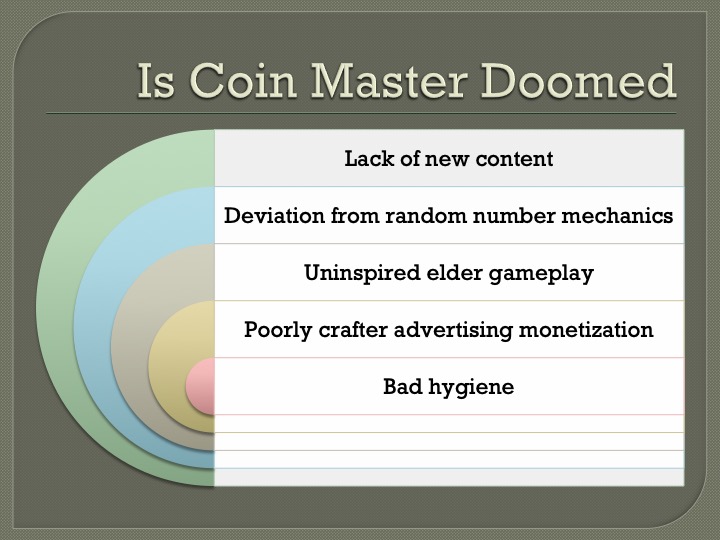
Slide1

Lack of new content

Social casino products, and social games in general, drive most of their on-going revenue from new content. From the early days of Farmville and Mafia Wars to current top grossing games like Slotomania and Fishdom, new content most consistently contributes to revenue. New content drops are accompanied by much stronger player activity, including reactivating lapsed players and getting lapsed spenders to resume purchases, with little variance (unlike a new feature that may or may not resonate with the audience). This content can be a new slot machine, a new tournament format or theme, new virtual goods, etc., and for different games different content resonates (or falls flat) with its audience. Conversely, I cannot identify one top game where the content is largely unchanged from several years ago, let alone several months ago.

Coin Master, however, adds virtually no new content for the customer. They may add new villages for players who have completed every village, but that impacts very few players and those it does impact it touches very infrequently. Moon Active only has one slot machine that never changes. There are no new slots, new symbols or other new items to rejuvenate the gaming experience.

Deviation from random number mechanics

When I took my first social casino position, after being in traditional free to play games for several years, I quickly learned how strong casino mechanics are at driving monetization. Rather than finding artificial ways to “pinch players” or otherwise drive monetization, slots have generated revenue for over 100 years in a very straightforward manner tied to the core mechanic. Moreover, the random nature of casino games creates a fantastic roller coaster experience for players.

After playing Coin Master extensively, it is clear that rather than a random experience your outcomes are choreographed by Moon Active’s Product Managers. The patterns start to repeat and players see the same outcomes session after session. The hot and cold streaks that are part of gambling, driven by random numbers and the laws of probability, are absent. I have been involved with several social casinos where product managers believed they could create a better (or more profitable) experience than random number generation could and it never works. The gameplay gets stale or players realize they are being manipulated. In the long run (or even medium term as the experience is not as good), players enjoy a true random experience better than one created by product managers.

Uninspired elder gameplay

For a game to thrive for years, it needs to keep a base of loyal and valuable players and keep growing that base. Given user acquisition costs, you cannot grow a game to franchise proportions if you have to replace the entire player base less than six months from acquiring each player. It is this core of valuable players that provide a revenue floor each month that allows you to spend aggressively for new players without creating very adverse cash flow conditions. Most games appeal to their core of experienced players by adding new features or mechanics so the player is not doing the same thing day after day, month after month, year after year. Even in slot games, social casinos release slots with very different bonus games, graphic styles, math and mechanics.

Coin Master, however, is virtually the same game day one that it is if you have played it several hours a day for six or sixteen months. The mechanics do not change or evolve, depth is not introduced, and the experience is identical to past sessions. Even Microsoft Windows apparently evolves at a faster rate than Coin Master.

Poorly crafted advertising monetization

Advertising revenue is becoming an increasingly important part of the social gaming business model, an important additional revenue stream for games that rely on in-app purchases (IAPs) and increasingly it allows products to succeed even without IAPs. Hypercasual games, which now represent about 60 percent of app-store downloads, are almost entirely ad driven. Even more importantly, advertising works with the rest of the game to improve the overall experience and increase retention (watch to earn videos allow players to keep playing or earn premium currency).

Moon Active, however, still approaches driving advertising revenue in the conventional way. It identifies players not likely to monetize through IAPs, then forces players to watch ads. From the structure of how Moon Active uses ads, it is not concerned about users churning due to ads, instead it wants to get as much ad revenue as quickly as possible. This short-term approach is likely to reduce current user return rate (CURR), which is critical to maintain DAU. It is also important to deploy advertising smartly to optimize LTV, as it is better to have someone watch four ads per month for 12 month than force ten ads on them in a month and prompt the player to churn. Similar to the lack of new content and unsophisticated elder gameplay, Coin Master is not constructed to build its player and revenue base month over the long term.

Hygiene

In addition to these large issues, there are many smaller problems (often referred to as hygiene issues) that are likely to impact Coin Master negatively. As the genre gets more competitive, these issues can be enough to get players to switch to other games. Success in the social game space often reminds me of chaos theory, where a butterfly in Beijing can impact the weather in Chicago. Small issues can have big consequences. The hygiene issues in Coin Master include:

  • Stability and tech. People often underestimate the impact technical issues have on KPIs. A small change in loading time or app size, which the player might not consciously notice, often impacts KPIs 10 percent or more. Anecdotally, I have noticed that Coin Master’s slot will crash occasionally, sometimes freezing the player out until there is an app update. Even small crashes can contribute to user churn. Related, the absence of deep linking for push notification, usually a coding or tech debt issue, limits the ability to engage players through CRM.
  • Economy balancing. As players progress through Coin Master, the economy becomes a drag on the experience. While initially a reward (daily bonus, raid proceed, etc.) might be relevant, as the game progresses this relevance varies. As the player advances, less of the features are significant (for example, watching a video has so little value there is no incentive). This problem, coupled with the lack of new content and elder gameplay mechanics, make the game less (rather than the desired more) interesting for established players.
  • Portrait only mode. Coin Master is only available in portrait mode, creating a sub-optimal experience for players on a tablet or large smartphone who are looking for an immersive experience. While some casino games are limited to either portrait or landscape mode, the decision is often driven by an abundance of content (and the need to modify so much art). With Coin Master enjoying an uncontested market space, this limitation obviously is manageable (hence the $250k/day), but again it leaves them vulnerable to a competitor taking away some of Moon Active’s players who desire a landscape experience optimized to their device.

The future of Coin Master

It is impossible to predict the future and Moon Active has found an uncontested market space that protects it from many of its sins. That moat may protect it from the issues identified above and allow it to continue to grow Coin Master. More likely, Moon Active will either address these issues (it now has extensive resources available) or new entrants in the genre will surpass Coin Master.

Key takeaways

  1. Despite being a runaway success, Coin Master generates about $250k/day, some limitations in the product suggest it will not become a long-lived franchise.
  2. Unlike most successful franchises, Moon Active fails to regularly release new content into Coin Master or provide a deeper experience for long-time players.
  3. Coin Master’s deviation from a true random gaming experience, unlike other social casinos, also provides a discernable pattern that will take away from player enjoyment over time.

Share this:

  • Click to share on Facebook (Opens in new window) Facebook
  • Click to share on LinkedIn (Opens in new window) LinkedIn
Like Loading...
Unknown's avatarAuthor Lloyd MelnickPosted on April 23, 2019April 21, 2019Categories General Social Games Business, LTV, Social CasinoTags advertising, Coin Master, content, elder gameplay, in-game advertising, Moon Active2 Comments on Why Coin Master May Not Become a Franchise

Why I Am Morally Opposed to Intuition

Why I Am Morally Opposed to Intuition

I recently told a colleague I was morally opposed to intuition and it more than raised an eyebrow, it largely shocked the person I was speaking with. As someone who has been in the game industry for too many years, I am often asked to use my intuition to review game or business ideas, prioritize product features and evaluate potential employees, so it would be easy to move my agenda forward by relying on intuition. Unfortunately, it would also be a mistake.

Intuition is often used as an excuse for not having facts to prove your case. During my first year of university, I learned that I should not rely on intuition. As I developed an appreciation for analytics and statistics, I began to understand the best way to approach making optimal decisions. Bayes Theorem further strengthened the fallacy that decisions should be taken on intuition. Then, as I have I read more about heuristics and biases in decision-making, my opposition to intuition has solidified.

Common Sense and Intuition

In my first year at University, one lesson had a very long-term impact. An English professor, discussing that common sense and intuition should not be used to argue for one side in a debate, pointed out that in the 1800s one of the primary justifications of slavery was that it was “common sense” that blacks were inferior to whites. He further attacked using common sense as an argument, showing that many of the great tragedies and mistakes were justified by common sense and intuition: The Inquisition, Holocaust, Smoot Hawley, etc.

Intuition and common sense are often an excuse for not having facts

If you are trying to get a desired decision but do not have strong data to support your decision, intuition and common sense are ways people try to still get their proposed course of action approved. Many times you are pursuing a fast decision and feel there is insufficient time to collect data. Other times data is not easily available to analyze a situation. Intuition and common sense provide an argument for moving forward quickly on a decision even when there is not data to support it.

This problem is magnified if you are in a senior position. A direct or indirect insubordinate is unlikely to argue their bosses’ or the CEO’s intuition is flawed. It is particularly dangerous for those in the senior position, who will see their “intuition” supported by subordinates, further confirming to them that it is an appropriate course of action. This confirmation replaces data in driving decisions forward, and then the leader has to deal with the consequences.

Decision making biases

Reinforcing the issues with relying on intuition and common sense is the many decision making biases people exhibit. I have written frequently about consumer behavior, particularly Daniel Kahneman’s work, that shows how people often make faulty decisions. These biases include:

  • Confirmation bias.Confirmation bias is when you ignore information that conflicts with what you believe and only select the information that confirms your beliefs.
  • The Linda Problem.When given a story about a fictional person and then potential careers for that person, virtually everyone (from students to very successful professionals) chose a persona that was a subset of a broader persona, thus impossible that the former was more likely.
  • Status quo bias. People to prefer for things to stay the same by doing nothing or by sticking to a previous decision, even if the previous decision will lead to a worse outcome.
  • The narrative fallacy. People try to comprehend information in stories, rather than looking at just the facts they create a story that links them together even if there is not really a link.
  • Dunning-Kruger effect. The Dunning-Kruger Effect is when incompetent or somewhat unskilled people think they are more skilled than they are. As the article quotes, “incompetent people do not recognize—scratch that, cannot recognize—just how incompetent they are.”
  • Backfire effect. The backfire effect is after analyzing something that you or your company are doing, if the results are negative and the action was bad, you or your colleagues refuse to accept the results.
  • Bandwagon effect. The bandwagon effect is what you would assume, the tendency to do things because many other people are doing it. People will rally around a cause, an idea, a candidate, a variation, or a strategy simply because it is popular.
  • Endowment effect.The endowment effect is how people value items they own more than they would if they objectively viewed the item. Somebody might not accept $10,000 for their used car, but if a car dealer offered the same car to them they would not pay $8,000 for it.

Rather than focus on our biases when making decisions, the key takeaway is that people often do not make optimal or rational decisions. When relying on intuition or common sense, data that can offset these biases is neglected.

Common sense usually forgets Bayes Theorem

Related to the biases people experience when relying on intuition is the inability to process statistics well. I have written frequently about Bayes Theorem and how people often infer incorrect probability of a certain result. Bayes’ Theorem is a rigorous method for interpreting evidence in the context of previous experience or knowledge. Bayes’ Theorem transforms the probabilities that look useful (but are often not), into probabilities that are useful. It is important to note that it is not a matter of conjecture; by definition a theorem is a mathematical statement has been proven true. Denying Bayes’ Theorem is like denying the theory of relativity.

By way of an example, I will repeat one I used in 2014. Say you wake up with spots all over your face. You rush to the doctor and he says that 90 percent of the people who have smallpox have the symptoms you have. Since smallpox is often fatal, your first inclination may be to panic. Rather than freak out, you then ask your doctor what is the probability you have smallpox. He would then respond 1.1 percent (or 0.011). Although still not great news, it is much better than 90 percent—but more importantly it is useful information.

The key here is that people do not understand the actual likelihood that something will occur. In this case, your intuition might say you have smallpox. If this then prompts you to fly to a smallpox clinic, you probably made a bad decision. The same happens professionally, where people make decisions by inferring the wrong probability of a possible outcome.

Slide1

When to use your intuition?

NEVER. Intuition is an excuse to make decisions without data or without putting the work into looking at the data. If your intuition is actually based on past experience, then this experience is data and you should looked at it as a data point (but only one data point and one that is not more valid because you experienced it personally). To make good decisions, you should review the data and make decisions that increase the probability of the optimal outcome. You also need to just say no when somebody asks you to make an intuition based decision, you can help provide data but never should make the decision on what your gut says.

Key takeaways

  • Intuition is a very flawed way of making decisions but is often the default, particularly for leaders with extensive experience. It is actually a way to ignore data (or avoid the work collecting it) and leads to poor decisions and priorities.
  • Intuition and common sense were often the justification for some of the worst decisions in history, from slavery to the protectionist Smoot Hawley Tariffs.
  • Intuition should never be used to make decisions. Instead, spend time collecting and analyzing data and deriving decisions with the highest probably for a positive outcome.

Share this:

  • Click to share on Facebook (Opens in new window) Facebook
  • Click to share on LinkedIn (Opens in new window) LinkedIn
Like Loading...
Unknown's avatarAuthor Lloyd MelnickPosted on April 16, 2019March 20, 2019Categories Analytics, General Social Games Business, General Tech BusinessTags bias, Common Sense, decision making, Intuition4 Comments on Why I Am Morally Opposed to Intuition

What Real Money Gaming companies should learn from the problems faced by EA and Activision Blizzard

What Real Money Gaming companies should learn from the problems faced by EA and Activision Blizzard

In January, I wrote a post on why Electronic Arts and Activision Blizzard’s stock had plummeted and what other game companies could learn from their challenges. While the lessons are relevant to social gaming companies, in many ways they are more germane to Real Money gaming companies, many of whom have also struggled to maintain their share prices.

slide1

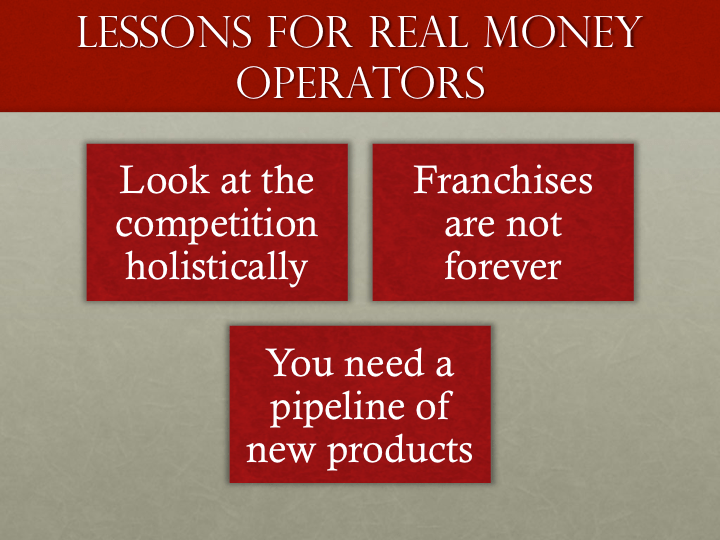
Look at the competition holistically

The first problem I identified with EA and Activision was that they focused solely on each other and other console game manufacturers when considering the competition and generating competitive responses. As Netflix stated in its shareholder letter in January, “we compete with (and lose to) Fortnite more than HBO,….When YouTube went down globally for a few minutes in October, our viewing and signups spiked for that time…There are thousands of competitors in this highly fragmented market vying to entertain consumers and low barriers to entry for those with great experiences.”

Real Money Gaming companies do not seem to have gotten the memo, they still focus primarily on each other. Most Real Money online casinos measure their competitiveness by how many games they have versus other online casinos. Sportsbets list their breadth of betting options and in-play bets versus other sports betting apps.

When the US market began to open last year, most Real Money operators looked at each other when developing their American strategy. They copied the partnerships other operators were entering into. They built similar go-to-market strategies. They took their European apps and “adapted” them for the US market.

The sole focus was outdoing their direct competitors. They did not look at how Americans consumed entertainment, how it was different than in their core markets and then build a strategy to compete with these other forms of entertainment.

The US is an example of how the Real Money operators fail to look holistically at the entertainment ecosystem and simply focus on each other. It is why margins continue to decrease and why fewer and fewer new customers enter the ecosystem. It also leaves them very vulnerable to other forms of entertainment appealing to their customers.

Franchises are not forever

The second lesson that Activision Blizzard and Electronic Arts learned the hard way is that franchises are not forever. Many of the biggest Real Money operators still rely on their existing franchise and have not built a sufficiently robust business to deal with downturns in the franchise. You can broadly define a franchise, as I would consider William Hill’s retail locations the same as Farmville, a formerly ubiquitous product that declines over time.

The Real Money space is dominated by one product companies, which leaves them particularly vulnerable to franchise erosion. Many of the operators (both large and small) rely on an individual product for success (often the product and company name are synonymous), and when that product decreases, they are in a very vulnerable position.

You need a pipeline of new products

Consistent with the above point, not only do many Real Money operators rely on one product, they do not have a green light process or plan to bring new apps to market. Often, their product development is focused on improving and optimizing their core offering. If the macro-market for that offering decreases, they do not have alternatives available to compensate.

As I wrote last month, companies need a robust green light process to identify market opportunities, particularly prospects to appeal to non-customers of the industry. Creating skins of existing products do not achieve this result; they simply provide a marketing tool and potentially nudge your product positioning. Yet very few Real Money operators launch entirely new products that have a different feature set and market appeal than their existing products.

These opportunities exist if Real Money operators will look outside of their current offering. There is no reason a Real Money sportsbook cannot offer a standalone eSports app or a Crypto sports betting solution or hypercasual sports betting games. A Real Money casino can look beyond its integrated casino to create a Live Dealer app or an app that has progression or social features. The key is for companies to assess the market opportunity, their strengths and weaknesses and create a product pipeline that will help them grow.

New products and new markets are the key to success

As the above analysis shows, Real Money gaming companies suffer the same issues as video gaming companies and firms in many industries. They lose the forest for the trees, focusing on their direct competitors and existing customers, rather than how the industry and world is evolving. These blinders leave them vulnerable as people’s preferences evolve and miss an opportunity to grow exponentially.

Key takeaways

  1. Real money operators need to avoid making the same mistakes that Electronic Arts and Activision Blizzard committed if they want their stock to be resilient.
  2. Real Money gaming companies should not simply focus on each other but realize they are competing with all entertainment companies and build products that expand their market.
  3. Real Money operators normally rely on one offering and do not have a robust product pipeline to deal with declines in their core product.

Share this:

  • Click to share on Facebook (Opens in new window) Facebook
  • Click to share on LinkedIn (Opens in new window) LinkedIn
Like Loading...
Unknown's avatarAuthor Lloyd MelnickPosted on April 9, 2019March 20, 2019Categories General Social Games BusinessTags Activision, competition, Electronic Arts, Green Light, green light process, real money online gamblingLeave a comment on What Real Money Gaming companies should learn from the problems faced by EA and Activision Blizzard

A farewell to the stars at Stars

A farewell to the stars at Stars

Almost exactly four years ago (April 4, 2015), I took over the social gaming team at Stars. While we have had some great professional achievements (increasing LTV more than 10X, winning best social poker app, launching Live Dealer games for the first time in the social space, etc.), it is the friendships that will be missed. In that time, I built some wonderful relationships with co-workers and business partners that will sorely be missed.

I learned early that Stars is much more than a company but a family, where people truly care about their colleagues. I remember the outpouring of support when my mother passed away and continue to be encouraged how people come together to help coworkers in difficult times.

There are too many people to thank individually, or even list, for an amazing four years.  I want everyone to know, though, how appreciated you all were and how you have had an immeasurable impact on me.

The most trying part of leaving, however, is the realization that I will no longer be part of the social gaming team. We have built an incredible team, one that is a success order of magnitudes more important than any revenue milestone or gaming award. While the business often faced challenges, I looked forward everyday to working with my team to overcome these challenges. In the best times, and the worst times, we all came together to deal with tactical issues but also to build something special. Everyone on the team remained focused on the team, helping each other overcome trials and leap on opportunities. We worked as a whole, and it is still surreal that I will no longer be part of that great entity.

PSP team

Many of you moved to the island to be part of our adventure and I hope it was as satisfying for you as it was for me. We did many things that were considered impossible and created something special.

Fortunately, I am not moving locations and hope to continue and build on these incredible relationships. I care deeply about my friends at Stars and will work tirelessly to stay close.  The team is in great hands and I am sure will continue to collaborate brilliantly while overcoming all hurdles.


Share this:

  • Click to share on Facebook (Opens in new window) Facebook
  • Click to share on LinkedIn (Opens in new window) LinkedIn
Like Loading...
Unknown's avatarAuthor Lloyd MelnickPosted on April 2, 2019March 8, 2019Categories General Social Games BusinessTags Lloyd Melnick, PokerStars, Stars Group3 Comments on A farewell to the stars at Stars

Yes, Coin Master is Disruptive

Yes, Coin Master is Disruptive

There has been much debate lately, including on my Facebook page, whether Coin Master from Moon Active is truly disrupting the social casino genre or whether it should be classified in a different category. Much of the debate shows how challenging it is to disrupt a segment or an industry. Coin Master is classic disruption, and understanding the debate helps conceive of additional ways to disrupt.

For those not familiar with Coin Master, it is a mobile game currently generating over $250,000/day currently or an annualized run rate based on Q4 2018 of over $280 million (source: Eilers & Krejcik Gaming, LLC). This would make it the second largest social casino game, behind Slotomania but ahead of well known titles like Doubledown, Heart of Vegas, Big Fish Casino, Hit It Rich!, etc.

Given the success of Coin Master, there are many excellent articles about the gameplay mechanics, monetization, etc., and I will not repeat what others have written better than I could. For those who have not played Coin Master, there is a single, (simple) slot machine and not only do you win coins, you also can attack and raid other villages. You then use your coins to build your village.

Coin master

Coin Master uses a slot mechanic as part of the core game loop, hence why it may be categorized as a social casino product. As a social casino product, many think it has successfully disrupted a highly profitable but stagnant space. Conversely, as there are RPG and Invest-Express elements, it is also argued that it should not be considered social casino, thus it is not disruptive. The latter argument, however, misses the point of disruption.

Disruption, the Blue Ocean Way

One way to approach disrupting an industry is to take a Blue Ocean methodology. I have written frequently about Blue Ocean strategy and am a strong advocate of this technique. In Blue Ocean strategy, you create a new market space by serving the non-customers of an industry, making the competition irrelevant. You do this by adding-reducing-eliminating-increasing features.

This approach is exactly what Moon Active did with Coin Master. They built a game that served people who were not currently engaged in social casino. They also did not try to compete directly with Playtika or Aristocrat, with the eight figure marketing budgets those companies have, they disrupted the industry by finding untapped demand.

Moon Active’s strategy perfectly followed the Blue Ocean framework of adding-reducing-eliminating-increasing features

  • Add.  Key elements that Moon Active added include raiding and attacking friends and city-building (invest express).
  • Reduce.  Among the elements that Moon Active reduced were number of slot machines, quality (graphics and depth) of slots and purchase options.
  • Eliminate.  Moon Active also eliminated several features that are seen in virtually all other social casino products. These include locked machines, pay-tables, jackpots, tournaments and a reward system.
  • Increase.  Finally, Moon Active increased certain elements. Among the features increased were the value of progression, interaction with your friends and the importance of card collection.

There are many examples of companies in other industries that disrupted their industry with a Blue Ocean approach. Cirque de Soleil is one of the most popular examples, as the circus business was stagnant until Cirque de Soleil reinvented the industry by creating a new type of product that appealed to different customers. Ringling Brothers did not consider Cirque a competitor and most argued that it was a different, not disrupting the circus industry. Amazon did the same to retail when it started selling books online. Barnes & Noble and Borders did not consider it disruptive, and retailers in other industries certainly did not, as their customers were not looking to buy books (or shoes or electronics) online. When Wikipedia launched, Encyclopedia Britannica did not consider it a competitor. Now you probably would use Wikipedia to remember what Britannica was.

In all of these Blue Ocean cases, many argued the disruptive competitor was not a competitor or in the same category because it was so disruptive. That is the case with Coin Master and those who are arguing it is not disrupting the social casino space are largely proving that it is true disruption.

Coin Master is also an example of Classic Disruption theory

If you prefer red oceans and have not succumbed to Blue Ocean strategy, Coin Master is also a textbook example of classic disruption theory. Clay Christensen is considered the father of understanding innovation and disruption, with his book The Innovator’s Dilemma required reading at every tech (and most non-tech) company. In The Innovator’s Dilemma, incumbent businesses focus on improving their product to better meet customers’ needs but eventually lose their market to disruptors who appeal to less sophisticated customers initially but end up providing a more appealing, broader solution.

The incumbent understands its customers and is continually improving its product to suit better these customers. Christensen stresses, however, that it leaves the incumbent open to disruption. By focusing on existing customers, new entrants can create a product, often inexpensively, that appeals to a different set of customers (there are parallels with Blue Ocean). Institutionally, the incumbents are forced to resist appealing to these customers out of concern of alienating existing players.

An example would be the growth of the personal computer business. The PC initially did not compete with mainframes and mini-computers. Incumbents did not want to build these machines because they knew their customers needed a powerful machine and would not be interested in the “silly” PC. That arrogance allowed small companies (like Dell and Compaq) to build their business. Incumbents did not consider PC companies’ competitors because it did not fit the framework of what a computer does. Eventually their products became so good that the customer of the incumbents shifted and thus the PC disrupted the computer business.

In the Coin Master case, existing social casino companies know players well and are constantly building better slots and apps to meet these customers’ expectations. That is why you are seeing average revenue per user increase linearly, the companies are getting better at delivering value to existing social casino customers. Moon Active, however, created a slot machine with relatively low production value that does not compete for the player who wants an authentic casino slots experience. Coin Master appeals to a broad market while still leveraging a slot mechanic.

Just as with the Blue Ocean analysis, most of the industries Christensen studies that were disrupted in this manner did not consider the product or company creating the disruption a competitor, at least initially. Blackberry did not consider the iPhone a competitor, Blockbuster did not consider Netflix a competitor, GM did not consider Honda a competitor and server hardware companies never thought AWS would impact their business.

Why disruption matters

Rather than being an academic argument, it is important to realize that Moon Active is actually disrupting the social casino space. First, while disruptive products initially do not impact incumbents, in times they do shift the industry and create new winners and losers. While Digital Equipment, Data General, Olivetti, et. al., thrived for years they are now afterthoughts. Second, the disruptor is blazing a path for other companies. Coin Master will go from a Blue Ocean to a Red Ocean product, and there will be other successes in the new Red Ocean. Most importantly, Coin Master shows how to disrupt the social casino space. It is not about changing the type of jackpots or the orientation of the screen, it is about creating a social casino product that makes the competition irrelevant.

Key takeaways

  1. Coin Master has taken the social casino space by storm, generating more than $250,000/day, by disrupting the space and deviating from how other social casino products compete.
  2. Coin Master exemplifies how to disrupt an industry, appealing to non-customers of the industry by adding new features, increasing others while eliminating some elements and reducing the emphasis on other features.
  3. Coin Master is a textbook example of how to disrupt and succeed in the social casino space, by creating a product that makes the competition irrelevant.

Share this:

  • Click to share on Facebook (Opens in new window) Facebook
  • Click to share on LinkedIn (Opens in new window) LinkedIn
Like Loading...
Unknown's avatarAuthor Lloyd MelnickPosted on March 19, 2019March 2, 2021Categories blue ocean strategy, General Social Games Business, General Tech Business, Social CasinoTags blue ocean, blue ocean strategy, Clayton Christensen, Coin Master, disruption, Innovator's Dilemma, social casino3 Comments on Yes, Coin Master is Disruptive

Optimal tools to measure the impact from sales and promotions

Optimal tools to measure the impact from sales and promotions

One of the biggest challenges game and iGaming companies face is measuring the impact of sales but a presentation by Google’s Adam Carpenter shows effective analytic tools for optimizing your promotional strategy. Most social game companies regularly run offers, from 20 percent off to double your chips to free tournament tickets with purchases; and these offers increase revenue immediately.

The problem is that it is very challenging to measure the overall and long-term impact of the sales. While it may have tripled revenue the three days the sale ran, how much did it depress revenue the following days or weeks (or preceding days/week if people waited for the sale). Many very smart analysts and product managers believe that sales and promotions create zero additional revenue, it only shifts revenue between periods (which is great if you are trying to hit a quarterly goal, not as good if you are trying to grow a product). Analysis of before and after the promotion or estimates of hangover are somewhat arbitrary and self-serving (when do you start, when do you end, what baseline do you take, etc.).

It is also important to understand what sales frequency is most beneficial Every game is different and some games generate the most absolute revenue from running frequent sales while others do best running a few large sales. It depends on your target customer, their expectations, competitive products, the game mechanics, frequency of content releases, etc. Just looking at revenue generated from the sales, however, makes it very challenging to understand how the type of sales are driving performance. The graph below, comparing regular sales to running big sale events, is difficult to interpret and could easily be misinterpreted:

slide7

The lack of a good technique for measuring the impact of sales has far-reaching implications. Companies do not know if they should run sales, how frequently to run them and the best offers to make. Getting it wrong not only could shift revenue but it may significantly depress it if players are waiting for sales and do not monetize. A mistake can also lead to a misallocation of resources, are the two product managers planning sales more valuable creating events or new features?

Monetization Tree

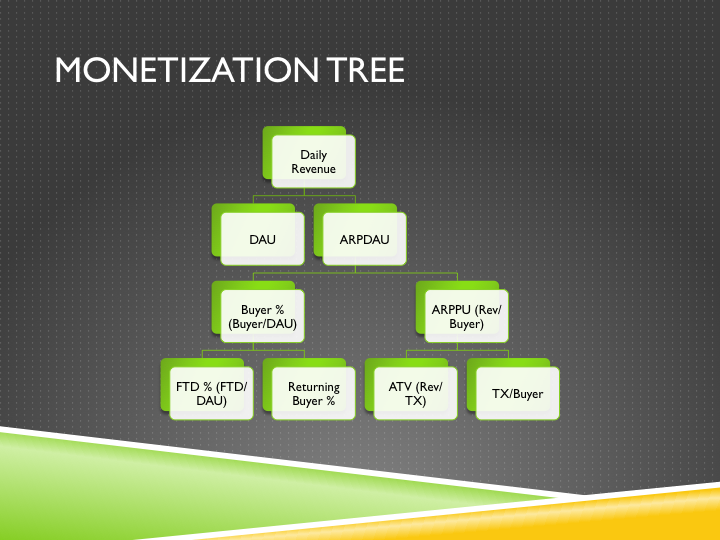
Prior to being able to analyze promotions, Carpenter suggests you understand how your game generates revenue. He does this with the revenue tree, which shows how daily revenue is driven by DAU (daily average users) and average revenue per daily unique (ARPDAU):
slide1

When Carpenter breaks down the drivers of ARPDAU, he points out that focusing on buyer percentage creates a healthier product than those that generate most of their revenue from big purchases (a high ARPPU) from a few players. He also points out it is much easier to increase ARPPU because those players have already chosen to pay but long-term your game will be safer and grow better by impacting buyer percentage.

Revenue heartbeat

After initially watching Carpenter’s presentation, we implemented the revenue heartbeat and I found it provides great insights into the effectiveness of your sale calendar. It allows you to visualize how sales are working over time.

To create a revenue heartbeat, for any given month, calculate the minimum revenue day, the maximum revenue day and the average revenue for the month. Below is a sample revenue heartbeat from Carpenter’s deck:

slide2

Your game has a healthy heartbeat if there is a tight band around the average daily revenue. You do not want to see wild variations on a monthly basis, instead you want to see that min and max form a tight band around the average. No wild variations on a month to month basis and that average revenue is growing, showing the game is growing healthily and players are engaged. The image below shows a healthy revenue heartbeat, despite the boost due to a Black Friday sale:
slide3

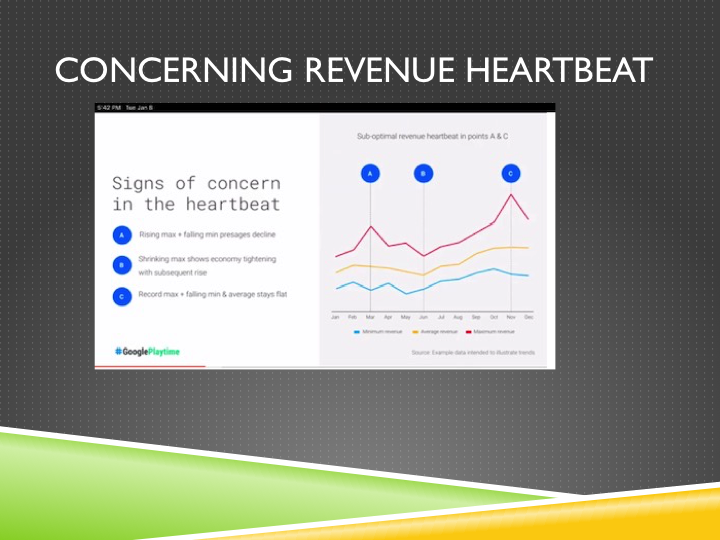
Conversely, if average revenue is regularly decreasing and you see multiple months with big gaps between average revenue and min/max, then you should be concerned. Products rarely grow when there is a negative heartbeat, below is an example from Carpenter:

slide4

When using the revenue heartbeat, do not focus on the average revenue but instead the spread between average and min/max and how it changes over time. Average revenue is also dependent on DAU (see revenue tree) and steady growth in average revenue could be due to marketing spend while masking a sick product.

Coefficient of Variation (CoV)

The coefficient of variation (CoV) complements the monetization heartbeat in helping understand if your promotional and sale behavior is optimal. Carpenter points out that CoV correlates highly with revenue growth, a low CoV means your game is much more likely to see strong growth. Games with the lowest CoV have highest month over month growth, games with high volatility experience much less growth.

slide5

It is a great KPI to understand the effectiveness of your sales and whether you are running them too frequently. To calculate the CoV, you take the monthly standard deviation of daily revenue and divide it by the mean revenue.

The chart below shows you want to have a CoV between 10-39 percent, as that is where the majority of fast growing games fall:

Slide6.png

If you are experiencing a high CoV, you should work on finding alternatives to large sales. Some options you can try include:

  • Increasing the frequency but lowering the value of the promotion, many small sales.
  • Tie sales to the release of new content, so there is a drain on resources
  • Become predictably unpredictable, have players expect something good every time they play but not know what to expect
  • Run demand events targeted to increase player engagement
  • Release time limited content
  • Use elite gatcha crates/offers

Understanding sales performance allows for optimization

By tracking your revenue heartbeat and Coefficient of Variation, you can understand how sales are impacting your performance. Given that growth is tied to low volatility, it helps you identify whether you should adjust your sales and promotion strategy. These tools also allow you to track your game over time; so even if the strategy does not change you will see if players start adapting their behavior, thus requiring a change in your strategy. While these metrics were built for mobile games, they actually can apply to any product or business, even retail.

Key Takeaways

  1. Understanding how sales and promotions are impacting your game is critical to growing revenue.
  2. The revenue heartbeat visually shows how well revenue is tracking with your big sales, you want to see a small gap between the three lines. To create a revenue heartbeat, for any given month, calculate the minimum revenue day, the maximum revenue day and the average revenue for the month.
  3. The coefficient of variation (CoV) shows how volatile your revenue is and a low CoV is correlated with growth. To calculate the CoV take the monthly standard deviation of daily revenue and divide it by the mean revenue.

Adam Carpenter’s full presentation:

Share this:

  • Click to share on Facebook (Opens in new window) Facebook
  • Click to share on LinkedIn (Opens in new window) LinkedIn
Like Loading...
Unknown's avatarAuthor Lloyd MelnickPosted on March 12, 2019January 9, 2019Categories Analytics, General Social Games Business, General Tech Business, Lloyd's favorite posts, Social CasinoTags Coefficient of variation, promotions, revenue, Revenue Heartbeat, SalesLeave a comment on Optimal tools to measure the impact from sales and promotions

Posts pagination

Previous page Page 1 … Page 6 Page 7 Page 8 … Page 46 Next page

Get my book on LTV

The definitive book on customer lifetime value, Understanding the Predictable, is now available in both print and Kindle formats on Amazon.

Understanding the Predictable delves into the world of Customer Lifetime Value (LTV), a metric that shows how much each customer is worth to your business. By understanding this metric, you can predict how changes to your product will impact the value of each customer. You will also learn how to apply this simple yet powerful method of predictive analytics to optimize your marketing and user acquisition.

For more information, click here

Follow The Business of Social Games and Casino on WordPress.com

Enter your email address to follow this blog and receive notifications of new posts by email.

Join 791 other subscribers

Most Recent Posts

  • Join me at PDMA Inspire for my talk on new product prioritization
  • Why keep studying?
  • The next three years of this blog
  • Interview with the CEO of Murka on the biggest growth opportunity in gaming, Barak David

Lloyd Melnick

This is Lloyd Melnick’s personal blog.  All views and opinions expressed on this website are mine alone and do not represent those of people, institutions or organizations that I may or may not be associated with in professional or personal capacity.

I am a serial builder of businesses (senior leadership on three exits worth over $700 million), successful in big (Disney, Stars Group/PokerStars, Zynga) and small companies (Merscom, Spooky Cool Labs) with over 20 years experience in the gaming and casino space.  Currently, I am the GM of VGW’s Chumba Casino and on the Board of Directors of Murka Games and Luckbox.

Topic Areas

  • Analytics (114)
  • Bayes' Theorem (8)
  • behavioral economics (8)
  • blue ocean strategy (14)
  • Crowdfunding (4)
  • DBA (2)
  • General Social Games Business (459)
  • General Tech Business (195)
  • Growth (88)
  • International Issues with Social Games (50)
  • Lloyd's favorite posts (101)
  • LTV (54)
  • Machine Learning (10)
  • Metaverse (1)
  • Mobile Platforms (37)
  • Prioritization (1)
  • Social Casino (52)
  • Social Games Marketing (105)
  • thinking fast and slow (5)
  • Uncategorized (33)

Social

  • View CasualGame’s profile on Facebook
  • View @lloydmelnick’s profile on Twitter
  • View lloydmelnick’s profile on LinkedIn

RSS

RSS Feed RSS - Posts

RSS Feed RSS - Comments

Categories

  • Analytics (114)
  • Bayes' Theorem (8)
  • behavioral economics (8)
  • blue ocean strategy (14)
  • Crowdfunding (4)
  • DBA (2)
  • General Social Games Business (459)
  • General Tech Business (195)
  • Growth (88)
  • International Issues with Social Games (50)
  • Lloyd's favorite posts (101)
  • LTV (54)
  • Machine Learning (10)
  • Metaverse (1)
  • Mobile Platforms (37)
  • Prioritization (1)
  • Social Casino (52)
  • Social Games Marketing (105)
  • thinking fast and slow (5)
  • Uncategorized (33)

Archives

  • September 2023
  • December 2021
  • July 2021
  • March 2021
  • February 2021
  • January 2021
  • December 2020
  • November 2020
  • October 2020
  • September 2020
  • August 2020
  • July 2020
  • June 2020
  • May 2020
  • April 2020
  • March 2020
  • February 2020
  • January 2020
  • November 2019
  • October 2019
  • September 2019
  • June 2019
  • May 2019
  • April 2019
  • March 2019
  • February 2019
  • January 2019
  • December 2018
  • June 2018
  • May 2018
  • April 2018
  • March 2018
  • February 2018
  • January 2018
  • December 2017
  • June 2017
  • May 2017
  • April 2017
  • March 2017
  • February 2017
  • January 2017
  • December 2016
  • November 2016
  • October 2016
  • September 2016
  • June 2016
  • May 2016
  • April 2016
  • March 2016
  • February 2016
  • January 2016
  • December 2015
  • November 2015
  • October 2015
  • September 2015
  • July 2015
  • June 2015
  • May 2015
  • April 2015
  • March 2015
  • February 2015
  • January 2015
  • December 2014
  • November 2014
  • October 2014
  • September 2014
  • August 2014
  • July 2014
  • June 2014
  • May 2014
  • April 2014
  • March 2014
  • February 2014
  • January 2014
  • December 2013
  • November 2013
  • October 2013
  • September 2013
  • August 2013
  • July 2013
  • June 2013
  • May 2013
  • April 2013
  • March 2013
  • February 2013
  • January 2013
  • December 2012
  • November 2012
  • October 2012
  • September 2012
  • August 2012
  • July 2012
  • June 2012
  • May 2012
  • April 2012
  • March 2012
  • February 2012
  • January 2012
  • December 2011
  • November 2011
  • October 2011
  • September 2011
  • August 2011
  • July 2011
  • June 2011
  • May 2011
  • December 2010
January 2026
S M T W T F S
 123
45678910
11121314151617
18192021222324
25262728293031
« Sep    

by Lloyd Melnick

All posts by Lloyd Melnick unless specified otherwise
Google+

Enter your email address to subscribe to this blog and receive notifications of new posts by email.

Join 791 other subscribers
Follow Lloyd Melnick on Quora

RSS HBR Blog

  • What Actually Works to Change Someone’s Mind
  • Our Favorite Management Tips of 2025
  • How to Manage—and Motivate—Gen Z
  • The Most-Watched HBR Videos of 2025
  • The HBR Charts that Help Explain 2025
  • The Most Popular HBR Podcast Episodes of 2025
  • How the Best Leaders Develop and Spend “Innovation Capital”
  • The 10 Most Popular HBR Articles of 2025
  • How Work Changed in 2025, According to HBR Readers
  • What Leaders Can Learn from a Formula 1 Turnaround

RSS Techcrunch

  • An error has occurred; the feed is probably down. Try again later.

RSS MIT Sloan Management Review Blog

  • Calm: The Underrated Capability Every Leader Needs Now
  • The Top Five MIT SMR Videos of 2025
  • Three Steps Toward Fairer Talent Management
  • From Crisis to Coopetition: What Leaders Can Learn From Anesthesiologists
  • AI Coding Tools: The Productivity Trap Most Companies Miss
  • How Procter & Gamble Uses AI to Unlock New Insights From Data
  • Rewire Organizational Knowledge With GenAI
  • Hungry for Learning: Wendy’s Will Croushorn
  • Beat Burnout: 10 Essential MIT SMR Reads
  • How Leaders Stay True to Themselves and Their Stakeholders
The Business of Social Games and Casino Website Powered by WordPress.com.
  • Subscribe Subscribed
    • The Business of Social Games and Casino
    • Join 726 other subscribers
    • Already have a WordPress.com account? Log in now.
    • The Business of Social Games and Casino
    • Subscribe Subscribed
    • Sign up
    • Log in
    • Report this content
    • View site in Reader
    • Manage subscriptions
    • Collapse this bar
 

Loading Comments...
 

    %d