Skip to content

The Business of Social Games and Casino

How to succeed in the mobile game space by Lloyd Melnick

Category: General Social Games Business

Blitzscaling or how to lightning scale your business

Blitzscaling or how to lightning scale your business

Reid Hoffman’s and Chris Yeh’s recent book (Hoffman was the founder of LinkedIn), Blitzscaling, provides great analysis on how companies like Google, Uber, Amazon have scaled so massively. As Hoffman wrote, “when you scale at speed, you can capture the market quickly and also outmaneuver potentially global competition. Given the parallels with military and sports strategies, we can call this blitzscaling. Literally: lightning scaling.”

Hoffman explains the key principles, which he refers to as Blitzscaling, in companies going from scrappy start up to corporate giants. These principles are critical if you are building a business that you plan to grow significantly or if you are an investor. It is also valuable to understand the concept of blitzscaling to understand the tech ecosystem.

The key difference between blitzscaling and traditionally business building is how quickly and large it becomes: blitz from the German WW2 phrase Blitzkrieg (lightning warfare) and scaling, which means growth. The principles below show how the Amazons and Googles grew into the biggest companies in the world (keep in mind not everyone is going to enjoy success and it is a very risky course). The principles, however, are important to understand not only if you are trying to blitzscale but also if you are in a market where a competitor is taking this approach.

Proportional growth

The first key to blitzscaling is proportional growth. Not only is blitzscaling focused on very rapid growth but also proportional, and therefore sustainable. By proportional, Hoffman means that you are expanding across your business, not just one element. For example, a lemonade stand that increases the quantity of lemonade it has available to sell 100X is not blitzscaling but if it gets more cups as well as lemonade and sets up 100 locations across the city it is. Amazon blitzscaled when it went from $5.1MM in rev and 151 people in 1996 to revenue of $1.64 BN and 7,600 people in 1999.

Be Aggressive and Fast

The second key is that you need to be aggressive and fast. Blitzscaling involves throwing caution to the wind; embracing risk is a defining component. While a traditional company would grow, secure its position, then grow further, consolidate again, then commit to growing again, etc., blitzscaling companies act differently. Growth is the only priority, logistics and securing the growth they have achieved are not important. Profitability is not critical or even relevant.

Blitzscaling companies focus on speed over efficiency. Blitzscaling is why taxi companies tremble when a peer to peer ridesharing company like Uber rolls into town. The blitzscaling company does not care about short term profitability, it is focused entirely on growth. The logic is that first scaler advantage goes to the company that is first to scale up and dominate its business ecosystem. Once a company scales, it is much more difficult for competitors to then enter the space or raise money to compete. Traditional competitors might refer to this tactic as dumb money, since the blitzscaler is not focusing on growth, it is a logical strategy for building a dominant, huge player.

Focus on growth factors

The next key to blitzscaling is focusing on four growth factors, all blitzscaling companies seek to maximize: network effects, market size, distribution and high gross margins. Network effects make first mover advantage much more important. If you look at Facebook or Uber, the network effect creates huge barriers to entry once an entrant has grown very large. In Facebook’s case, no consumer would want to be part of a different social network that did not have their friends and family. In Uber’s case, the number of riders generates many drivers (because of the revenue opportunity for drivers), which generates more riders because of the availability of Uber rides. A late entrant cannot come into a space with high network effects because they will not have enough liquidity to compete.

The second growth factor critical to blitzscaling is market size. A company’s market needs to be sizable, otherwise there just will not be enough investment money to fuel growth. Nobody will fund a blitzscaling company in a market where they cannot scale (eg. toys for pet lions).

The third growth factor is distribution. You may have a great product and large well-defined market but getting it to customers on a massive scale is not trivial. Distributing a product on such a scale can happen in two ways. First, you can use a distribution network that already exists, from UPS to Apple’s AppStore. The second way is viral distribution. You infect one customer, they infect more customers, and so forth and so on.

Gross margins are the final key growth factor. Gross margins are the money you take in once costs are covered, revenue minus the costs of the actual goods (COGs). The find the percentage, Gross margin/COGS=%, and a high percentage makes it easier to attract the investment needed to scale. Investors want to put money into opportunities where they can enjoy huge returns, and if the margins are high then potential returns are huge at scale. The importance of gross margin is why tech companies, who enjoy a very high gross margin since the marginal cost of a digital product is often negligible, dominate the list of firms who have blitzscaled.

Product/market fit and operational scalability

The greater the product fits with the market need, the higher opportunity for blitzscaling. Immediately achieving perfect product/market fit is not likely. To improve the fit and allow for blitzscaling, most companies must adjust their product to make it better suit the market’s needs. This is another area that benefits tech companies. It is easier for a tech company to be nimble regarding product/market fit; fiddling by bringing out a new version of software or testing out a new app feature requires less infrastructure than redoing a physical commodity. You need to edit code, you do not need to buy new machinery.

Operational scalability, or lack thereof, can facilitate or halt scaling. As you grow, you need to deliver more of your product. If you cannot, you are missing out on potential sales and allowing a competitor to fulfil this demand. While less of an issue for tech and mobile companies, going from having 100,000 daily unique users to 10,000,000 still has crashed many a product. Sometimes it is impossible to recover from those crashes, as customers have already abandoned your company.

Manage the growth

The challenges of scaling are complex – and they become increasingly complex as a company grows. You need a plan, operational control and a business plan for long term growth. Growing a business also increases its complexity, which can create issues with management philosophy, organizational hierarchy and company culture. These questions are especially challenging for a blitzscaling company, since it has to answer them continually (and re-evaluate) in the midst of rapid, massive growth.

Leverage existing Blitzscaling patterns

Companies are much likely to blitzscale successfully if they follow the patterns set by other companies that have already blitzscaled. Hoffman identifies seven such patterns:

  1. Sell a product that is purely digital. For example, consider an extra, purchasable outfit, or skin, for a character in a video game. Since it only exists virtually, a skin costs practically nothing to make and sell. This means gross margins of nearly 100 percent. Purely digital are a very lucrative line of business for many tech companies, especially in the mobile game industry.
  2. Go digital even with a physical product. Amazon invested in physical products but created a powerful digital-management system.
  3. The SaaS (software as a service) model, selling software using a subscription model.
  4. Leveraging the power of platforms. If you can establish your product or service as the standard platform for buying and selling products, you stand to capture a large share of total revenue (for example, Amazon makes more revenue from commissions and fees on its marketplace than the physical goods it sells as a retailer).
  5. Take advantage of online marketplaces. These are a specific type of platform – platforms that not only bring buyers and sellers together, but also let them set their own prices through the market forces of supply and demand, ie. AirBnb and eBay.
  6. The sixth pattern involves tapping into the eyeball capturing power of online content-sharing feeds, like Twitter or Facebooks’ timelines. As feeds are effective at captivating people’s attention, they are thus very attractive to advertisers, who will pay premium prices to insert their ads and sponsored content into addictive streams of information and entertainment.
  7. Advertising is the final pattern, which is to offer your product or service for free and try to make money in some other way.

These seven patterns represent how the most successful blitzscaling companies built their empires.

Becoming the next blitzscaling company

To become the next Amazon and Google, you need an outsized ambition and tolerance for taking big risks in the hope of a big payoff. The patterns above can help you achieve this ambitious goal.. Embracing uncertainty and risk while prioritizing speed over efficiency, taking advantage of four growth factors and navigating growth limiters can all set a company up for rapid and massive expansion that will be sustainable in the future. With a clear vision, blitzscaling can help a business dominate an ecosystem.

Key takeaways

  • Blitzscaling is how companies like Google, Amazon and Uber have grown massive incredibly fast. When you scale at speed, you can capture the market quickly and outmaneuver potentially global competition. Given the parallels with military and sports strategies, this process is called blitzscaling: lightning scaling.”
  • Blitzscaling involves throwing caution to the wind; blitzscaling companies focus on speed over efficiency.
  • Blitzscaling companies focus on optimizing four growth factors: network effects, market size, distribution and high gross margins.
Share this:

  • Click to share on Facebook (Opens in new window) Facebook
  • Click to share on LinkedIn (Opens in new window) LinkedIn
Like Loading...
Unknown's avatarAuthor Lloyd MelnickPosted on March 5, 2019January 10, 2019Categories General Social Games Business, General Tech Business, GrowthTags Blitzscaling, Growth, Reid Hoffman1 Comment on Blitzscaling or how to lightning scale your business

Building an analytic-driven greenlight process

Building an analytic-driven greenlight process

Launching new products is vital for the continued success of any game company but surprisingly few have a robust process for prioritizing projects. For a successful game company, new games provide an avenue for growth, as existing games will eventually plateau. Moreover, they mitigate the risk that your current successful game starts to decline.

For a young company or one still trying to make it into the top-tier, new games are even more critical. They provide a mechanism for disrupting the top-10, a new offering that can place you among the top game companies. Without a successful new product, you cannot become a successful company.

While the importance of new games is clear, it is surprising how few companies devote sufficient resources or put much process behind greenlighting projects with the highest ROI. Some of the most metrics driven companies do not use analytics when deciding on new games; they instead count on the intuition of a small circle of executives (or one person). Others start projects without any form of prioritisation. In the worst case, some do not even start new games and have nothing available when their existing products decline.

These companies are not only leaving money on the table, but potentially putting their survival at risk. Everyone has limited resources and by putting resources in the wrong projects, you may miss out on the games needed to survive and thrive.

The game industry in many ways resembles Major League Baseball in Moneyball. Management “knew” what made a good baseball player and used their intuition when building their baseball teams. The entire sport was disrupted when Billy Beane used analytics rather than intuition to build a winning team, with less resources than his competitors.

Since entering the game industry in 1993, and almost always managing limited resources, I have focused on refining the greenlight process so it drives highest ROI. Using lessons from Moneyball, I have identified three steps that lead to optimizing the ROI from new game projects. While you will still have failures (even Billy Beane drafts some busts), you will increase the odds of creating a successful product.

Step 1: Market Data

To determine your new product priorities, you first need to have a deep understanding of your market. A common mistake is to look at the market too high level or focus on your own experiences. In the former case, assume you are a social slots developer. It provides no value to know the gaming market is expected to grow 15 percent next year or even that social casino will grow an average of 8 percent every year for the next five years (both numbers are examples, not actual projections). This type of data is not actionable, it does not help you find market opportunities.

Focusing on your own experience is potentially very misleading. You may have had one product do very well. This experience could create a bias (availability bias) that there is a great opportunity in the market segment where you have done well. The reality might be you filled a niche or provided a superior alternative to the existing top competitor but that there is a very small addressable market and you already dominate it. You will also not see the biggest opportunities in the industry, another company might have launched a comparable product and seen 5X the growth by being in another market segment. If you focus on your experience, you will miss finding the biggest opportunities.

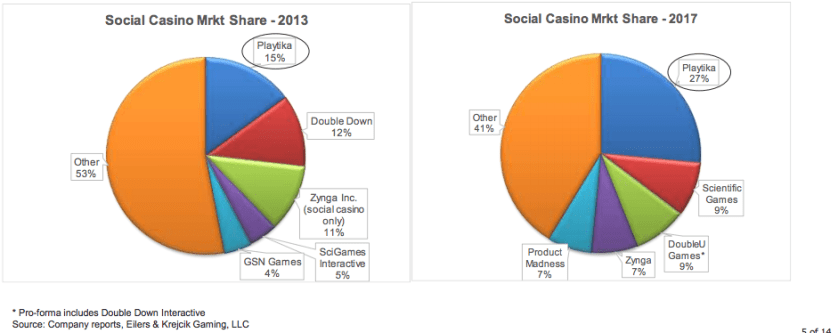
Instead, the best way to look at the market is to focus on your sub-sector, for example social casino, and understand what companies have done well and what companies have underperformed in the past twelve months. The graphic below from an Eilers presentation shows a better way to look at market data:

market data

Using the data above, you would then see what companies grew their market share and where it shrunk. The key to this step in the green light process is to analyse the data to understand where market opportunities exist. In the chart above, Product Madness went from Other to 7 percent share. You then dive deeper and learn that the growth was largely due to their pioneering progressive jackpots, so that feature then represents an opportunity. Conversely, DoubleDown dropped from 12 percent to 9 percent share, so it suggests you should deprioritize building a product that is comparable to DoubleDown’s casino.

Step 2: Blue Ocean

While it is important to understand the market, it is more important to determine Blue Ocean opportunities. The market data, by definition, only shows what you and your competition are doing. Thus, any new products based on this data will be launched into a competitive environment. Moreover, other companies are doing the same analysis, increasing competition in the areas that you have identified.

As I wrote last week, the bigger opportunity is to identify non-customers and bring them into the market. This Blue Ocean strategy has higher returns than focusing on creating a better product than your competitors for an existing market segment.

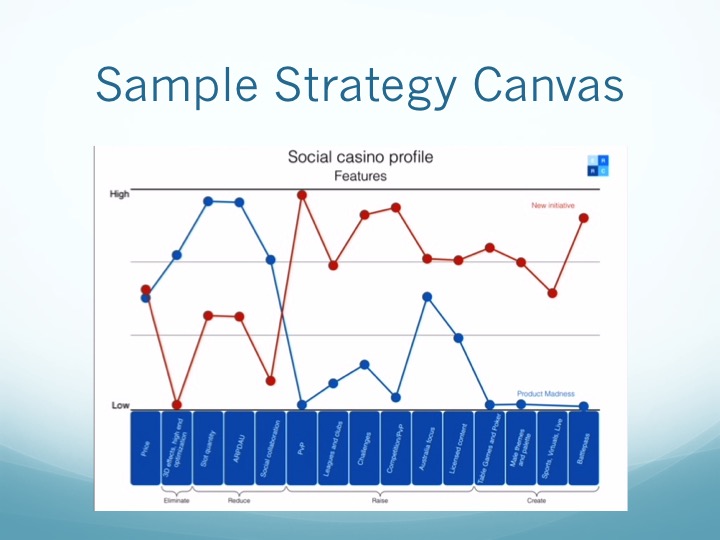
To look for Blue Ocean opportunities, you first need to create a Strategy Canvas. This canvas shows the features existing companies use to compete. You can use it to create a strategy profile that is distinctive from the competition by adding new features to compete on, eliminating some, raising others while reducing some. Below is a hypothetical example of a canvas you would create if you were with Aristocrat’s Product Madness team and looking at a new initiative (you can create these canvases at the Blue Ocean Academy website):
slide1

Once you have a strategy canvas, the next phase to building new product ideas is to understand what the canvas shows you should adjust. First, consider what you will add to the product to appeal to non-customers, by both increasing current features and including entirely new attributes.

As you will see above, to compete in a different market space, you first need to reduce (focus less) on some features you and your competitors consider important. Even more challenging, but more critical, is determining what features you will no longer compete on, the ones you will eliminate.

The reduce and eliminate element is as important as deciding what to add or increase and it is much more difficult. Many companies make the mistake of just adding to their product, feature creep. This results in a bloated product that ends up appealing to nobody. It often makes costs too high to justify the new product. It takes discipline to reduce and eliminate but that is the key to building a successful Blue Ocean product.

Step 3: Ideas and Analysis

Once you have completed the first two steps, you integrate the results to prioritize your greenlight process and create a compelling product roadmap. The key is taking the information you have gleaned from the market, the analysis you have done on non-customers (Blue Ocean) and an introspection of your capabilities and combine it to understand your company’s best opportunities.

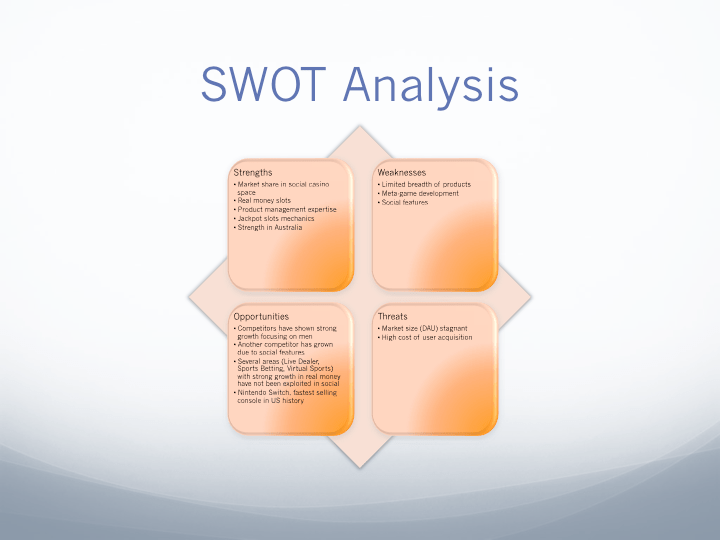
First, create a SWOT (strength/weakness/opportunity/threat] analysis. Strengths and weaknesses are focused on your company, so it is important to be objective and look at where your company is better or worse than competitors. Opportunities and threats largely comes from the first Steps (market and Blue Ocean analysis), how is the market evolving, why are companies are experiencing growth or declines and what products potentially appeal to non-customers. Below is a sample SWOT analysis:

slide1

Following the SWOT analysis, you then brainstorm game ideas that take advantage of your strength and the opportunities while mitigating your weaknesses. There are many great articles on ideation and brainstorming and I will not try to cover it here. At the end of this phase you will have a list of potential products.

The final part of Step 3 is analysing these options to prioritize what products to move forward developing. Without this analysis, all you have are a lot of “good” ideas that different people want to move forward with. To prioritize these opportunities, create a SMART spreadsheet analysis. SMART is an acronym for a Simplified Multi-Attribute Rating Technique.

To create a smart analysis, you first think of all the attributes that impact whether a game will be successful. You start with the meta-categories like virality, retention, monetization, etc., and then identify the sub-attributes in each meta-category (virality could be word of mouth and community). You then weigh each of these sub-attributes on how much they contribute to the overall success of the product, with the total weight equalling 100%. An attribute related to retention could have a weight of 30 percent or a less important attribute like triggers could be 3 percent. You then create a row for each product and give it a score on every attribute from 1 to 10. You multiply that score by the weight of the attribute and sum them up for each product. The products with the highest score(s) should be greenlit while those with a low score should be abandoned. Below is a sample SMART spreadsheet:
smart analysis

The SMART analysis is indispensible as it gives you a prioritized list of projects.

A strong greenlight process will create a strong product pipeline

A good greenlight process is critical to long-term success. It ensures you will have a steady stream of products to gain market share and replace your declining products. After an analysis of industry dynamics and opportunities to bring new customers into the industry, you need to synthesize that information into actionable insights. Creating a SWOT analysis and then SMART spreadsheet allows you to create a prioritized list of projects to focus your development efforts.

Key takeaways

  • Launching new games is critical for continued success but very few companies have a strong analytic process for prioritizing projects. By implementing a good framework, you can ensure your team is dedicated to the projects with the highest potential ROI.
  • The first two steps to a good greenlight process are understanding the market and uncovering opportunities to turn non-customers into customers. To understand the market, you should look at what competitors are enjoying success and which ones are lagging, then explore why. To identify opportunities to turn non-customers into customers, look at how you can change what the industry competes in by adding, increasing, reducing and eliminating attributes. It takes discipline to reduce and eliminate but that is the key to building a successful Blue Ocean product.
  • Once you have a list of potential projects from the industry analysis and review of non-customers, create a weighted spreadsheet (SMART analysis) that weighs the critical success factors and score each product. The products with the highest scores are the ones you should greenlight.


Share this:

  • Click to share on Facebook (Opens in new window) Facebook
  • Click to share on LinkedIn (Opens in new window) LinkedIn
Like Loading...
Unknown's avatarAuthor Lloyd MelnickPosted on February 26, 2019April 11, 2020Categories Analytics, blue ocean strategy, General Social Games Business, Lloyd's favorite posts, Social CasinoTags Green Light, green light process, SMART analysis, SWOT2 Comments on Building an analytic-driven greenlight process

Think of Non-Customers First If You Want to Grow

Think of Non-Customers First If You Want to Grow

I have been a consistent advocate of Blue Ocean strategy for years and a blog post by the Blue Ocean Team shows how you can grow your business by focusing on non-customers. Rather than fighting with your competitors to split up the existing pie, by thinking about non-customers you have greater growth potential. The blog post shows three types of non-customers and by understanding them you can tailor your product, new products or marketing to meet their needs. Below are the three groups of non-customers and my thoughts on their relevance to the social casino industry.

Non-customers who occasionally purchase or play

The first group of non-customers who represent a potential market are those who sit on the edge of the market, they purchase minimally your industry’s offerings but are always looking and quick to move to an alternative. The Blue Ocean Team uses the Pret A Manger chainas an example, as they appealed to people who reluctantly bought fast food but were looking for an alternative.

The social casino ecosystem includes many of these non-customers. These include gamers who are ready to skip to another genre (hypercasual, match-3, etc) if they see an appealing ad or the 90 plus percent of players who will play but not monetize. There are first-tier noncustomers waiting to be swayed in every industry.

Non-customers who refuse to become customers

The second group of non-customers is people who know an industry exists but have rejected it. As the Blue Ocean Team writes, “they have consciously thought about and considered your offering and then rejected it. It might be because another offering meets their needs better, or it could be that they simply can’t afford your offering. A second-tier noncustomer will compare your offering with another offering, weighing the pros and cons of each….The fact that second-tier noncustomers considered your industry means that you are far closer to possibly capturing them than you realize. So you need to find out why second-tier noncustomers refuse to use the products or services of your industry.”

In the social casino space, there are three types of these non-customers. The first is real money casino players (either land based or online) who have decided to not to play a free to play offering. They could have passed because they are only playing for economic reasons or the games offered are not what they prefer. The second is male casino players who may have rejected social casino because they consider them too “pink.” The third group is people who have tried social slot games but did not like the slot mechanic.

Non-customers who have not considered your industry

This category of non-customers has never considered your industry as an option. These non-customers have not been targeted ever by any company in your industry. This group is important to consider as it represents the largest potential market to penetrate (by definition it is everyone else). Existing companies in your industry assume these peoples needs are satisfied better by other industries.

In the social casino space, these are people who do not know or care that social slots games exist. It can be gamblers, gamers (other genres) or even people who have not played a mobile game.

What non-customers mean for social casino

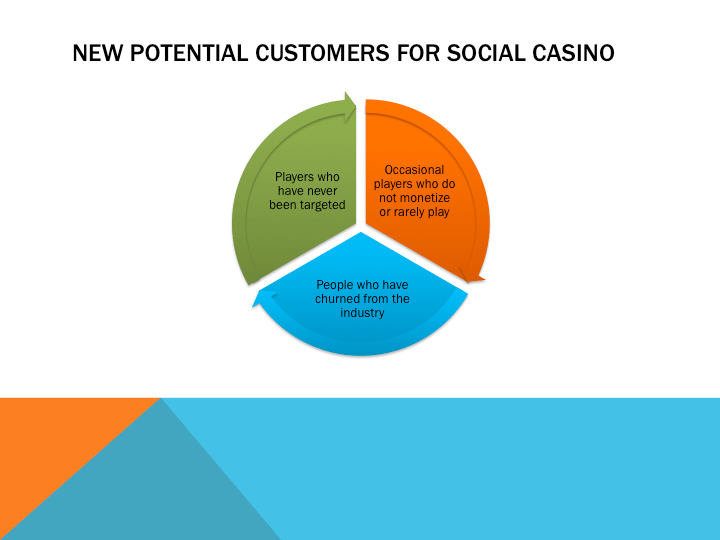
Non-customers are particularly important to social casino as the ecosystem has been growing consistently but through better monetization rather than an increase in customers. If the industry is going to continue growing or if you want to gain market share, appealing to non-customers is the best option. First, you can tailor a product appeal to people who play but do not monetize or play rarely. Second, you can build a product for people who have churned, tried social casino games but left. Finally, you can build a social casino product for people who the industry has never targeted.

While the successful companies will come up with concepts internally and not rely on this blog to provide the answers, the key will be creating social casino products that do not simply replicate the existing games. That means looking at mechanics other than slots. Is also means creating an environment that is not targeting 40+ women. To successfully turn non-customers into customers, the parameters of the products also must shift.

Key takeaways

  1. While many companies look at their competitors and try to grow by building a better product for existing customers, the biggest opportunity exists in appealing to non-customers.
  2. There are three types of non-customers: those who occasionally purchase or play, those who have rejected the current offerings and those who have not considered your industry.
  3. If social casino is going to continue growing or if you want to gain market share, appealing to non-customers is the best option. First, you can tailor a product appeal to people who play but do not monetize or play rarely. Second, you can build a product for people who have churned, tried social casino games but left. Finally, you can build a social casino product for people who the industry has never targeted.

Share this:

  • Click to share on Facebook (Opens in new window) Facebook
  • Click to share on LinkedIn (Opens in new window) LinkedIn
Like Loading...
Unknown's avatarAuthor Lloyd MelnickPosted on February 19, 2019April 11, 2020Categories blue ocean strategy, General Social Games Business, General Tech Business, GrowthTags blue ocean strategy, customers, Growth, Strategy1 Comment on Think of Non-Customers First If You Want to Grow

Creating growth loops to scale your game

Creating growth loops to scale your game

While apps and games have traditionally grown by having the acquisition team focus on the funnel, a recent blog post, Growth Loops are the New Funnels by growth guru Brian Balfour, shows a better strategy is to build growth loops. Rather than asking your marketing or user acquisition team to optimize user acquisition channels, growth loops has product and acquisition working holistically to build a product that will scale.

The traditional thinking

The strategy most game and app developers is create a great product, then optimize the acquisition funnel. After creating the product, they focus on optimizing the funnel below (testing different channels and strategies) to scale. This is a very KPI driven exercise, with each level of the funnel optimized through experiments and testing. The funnel consists of five categories, in this order:

  1. Acquisition. Helping as many users as possible discover the game. This can be discovered by visitors in the app store, downloads, app install, etc.
  2. Activation. Once acquiring a user, how many start playing the game (or using the app). This category can be measured by first spin (in a casino game), players who Facebook Connect, new accounts, completed tutorial, etc.
  3. Retention. Retention is the next, and arguably most important, category in the funnel. In games, this is often measured by how many players come by the next day (D1), return in a week (D7) or are active a month after installing (D30). Other good retention metrics are CURR (current rate of returning users) or engagement metrics (how much time spent in app).
  4. Referral. How many of your active players are helping bring new players. This category can be measured by actual referrals or K-score (number between 0-100 that indicates the strength of engagement between your product and your contacts, accounts, opportunities and leads).
  5. Revenue. The final layer of the funnel is revenue, how well you monetize the players. This metric is measured by ARPDAU (average revenue per daily active user), conversion rate (how many players spend), frequency of purchases, total lifetime spend, etc.

Successful companies would optimize the above funnel, testing different channels, creative, etc., at each step of the funnel, then optimizing spend to improve these KPIs.

The new approach

Rather than focusing on the five categories in the growth funnel, Balfour suggests a holistic approach to growth. As Balfour points out, while the growth funnel has helped many companies scale, it is over eleven years old and the industry has since evolved. Funnels lead to silos, where the product team has its own domain, growth has its empire while monetization owns its business. This strategy can lead to failure as the product is not built to optimize the channels where it will be distributed (e.g. the AppStores).

The key is building a product or game where growth is part of the core product loop, not a separate task done by a growth or acquisition or marketing team. As Balfour writes, “The fastest growing products are better represented as a system of loops, not funnels. Loops are closed systems where the inputs through some process generates more of an output that can be reinvested in the input. There are growth loops that serve different value creation including new users, returning users, defensibility, or efficiency.”

The key to a successful growth loop is the customer or player reinvesting the value of the loop to drive the initial elements of the loop Pinterest does this by investing in creating content that shows up high in search engines, users then find the content and either return to Pinterest or sign up for it, Pinterest then serves related content with the user saves, thus creating more searchable content (the beginning of the loop). SurveyMonkey has a growth loop where a user signs up, creates a survey, sends the survey out, when the recipients finish the survey the are served an opportunity to sign up with SurveyMonkey, and those sign-ups restart the loop.

Just as with your financial investments, a critical element of the power of growth loops is that they compound growth. Rather than the linear approach of the growth funnel, a growth loop continuously adds to create more output and revenue. The more output that is reinvested by the user or player, the larger the output created from the next cycle. This compounding is critical as rather than creating a multitude of growth loops, you want to measure and focus on the ones that have the greatest impact.

As growth loops are holistic systems, they are also more defensible than growth funnel. In a funnel, any element of the funnel can be attacked. Growth loops, however, integrate product, channel and monetization model specific to your game and thus harder for other companies to copy.

Why loops are better

Balfour explains that growth loops change your entire business, largely for the better. The key benefits include:

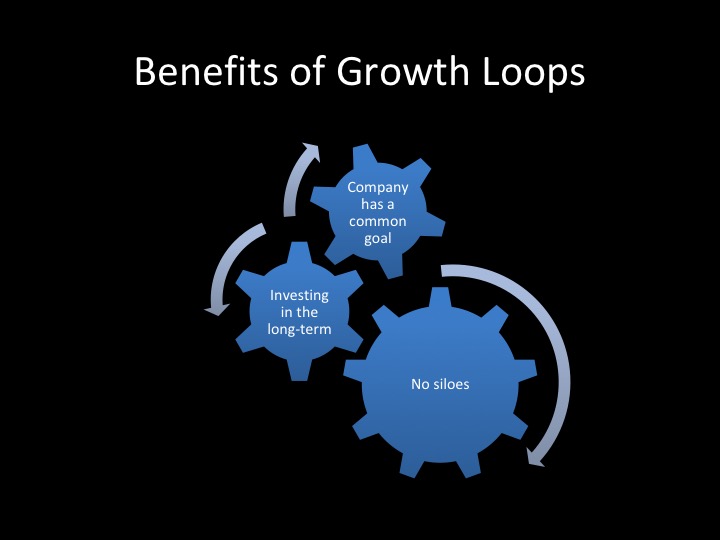
  • You get away from siloes (product, marketing, etc) and work together. Growth loops force companies to build a system.
  • You invest resources in systems that are more sustainable long-term, that continue to grow on their own.
  • You organize your personnel and teams towards a common goal, aligning and optimizing the growth loops.

Next steps

When building your company and designing your games or products, think holistically. Understand how you will create growth loops that will feed themselves and build a long-term dominant product. With games, ensure that there are loops in the game that drive the acquisition phase.

Key takeaways

  • Growth loops represent the evolution from a traditional acquisition funnel to a loop that continually creates value. Loops are closed systems where the inputs through some process generates more of an output that can be reinvested in the input.
  • Rather than creating siloes, growth loops help marketing, product, monetization, analytics work holistically.
  • A key value derived from growth loops is they have a compounding effect, they continually add value to the initial investment and thus perpetually grow the underlying product.
  • Share this:

    • Click to share on Facebook (Opens in new window) Facebook
    • Click to share on LinkedIn (Opens in new window) LinkedIn
    Like Loading...
Unknown's avatarAuthor Lloyd MelnickPosted on February 12, 2019January 4, 2019Categories General Social Games Business, General Tech Business, Growth, Social Games MarketingTags funnel, Growth3 Comments on Creating growth loops to scale your game

Highlights from ICE 2019

Highlights from ICE 2019

After spending three days at ICE, the largest B2B iGaming show in the world, I wanted to share some of the highlights. While there was nothing dramatically different this year, it reinforced several trends:

There are many red oceans

I have written many times about blue oceans and red oceans, the former being spaces in the market where your competitors are irrelevant, the latter where you are competing directly with others. In the iGaming space, there is very little creativity and almost all the companies are just trying to be a little better than their competitors. There are a few silos in the industry, and within each silo the companies are largely interchangeable. Virtually all the companies, large and small, are imitating each other and adding minor twists around the fringes. The concern with this situation is that in a red ocean it is very challenging to maintain your margins and generate long-term growth.

Content as a commodity

The iGaming industry is evolving to a position where content is becoming a commodity, in part driven by the red ocean mentality. Technology and globalization is also contributing to this situation, as the barriers to entry are exceedingly low for content development. A good artist and designer anywhere — Chicago, Bangalore, Vilnius or Jakarta — can create a beautiful slot. While math is critical, there are many great mathematicians who can make the beautiful slot into a decent game. Not only does good content flood the market, it allows operators to create their own content cost effectively and skim a large part of their revenue into machines that do not generate third party royalties.

While this problem runs counter to the concept that content is king, content is not king if it is virtually the same. Content that stands out still enjoys premium pricing and attracts more players and operators. Great content cannot be replaced with quickly made internal product. Very little content, though, falls into this bucket and most is competing for an increasingly small revenue pool.

While this situation is bad news for content creators, it is great for operators. The plethora of slot providers puts the basic supply and demand formula in favor of operators. They can negotiate more favorable royalty deals or build their own competitive machines with minimal cost.

Platforms offering zero value

Consistent with the glut of content is a glut of platforms and aggregators. In the video game space, there are many “publishers” who will license a game, take a share (sometimes very significant) and just submit the game to the AppStores, adding virtually zero value.

In the iGaming space, many people have created platforms where they aggregate slots content and distribute it to operators. The problem is that many of these platforms or aggregators have few relationships with operators, and even the operators who have integrated them put the content in the back of the virtual store. There were many stories at ICE of slots developers who have generated dollars or only cents from an integration with a platform. Just as in the video gaming space, content providers need to do their due diligence before selecting a platform.

Lots of people speaking American

For many years, G2E has been the gambling show that Americans went to while ICE was largely for Europeans, but I heard many American accents this year. Additionally, some traditionally US focused companies — Everi, AGS, Scientific Games, etc. — had large presences at ICE. It shows the US companies, particularly content providers, understand that the online real money market (which is dominated by Europeans) dwarfs the US land based market. Europe provides a great opportunity for many of these companies, though it also means more content on the market.

Not everyone got the memo about crypto

While the bloom is off the crypto rose almost everywhere, particularly tech, many iGaming companies are still operating on the momentum it had twelve months ago. Throw the word crypto on a mediocre offering and expect it to be worth an order of magnitude more. This approach is consistent with how the industry reacts and copies rather than seeks blue oceans, so I am confident that next year there will be very little crypto left and they will be chasing the next one year old trend.

The promise of virtual sports

Not all the news is bad. The quality and breadth of the virtual sports offerings is very impressive. Walking through the virtuals area was like being at a sports bar with multiple TVs showing live events. The rendered virtual sports are often better than games available for console, like Madden or FIFA. There are also some great offerings that put together video clips of live events and create a virtual event. I expect virtual sports to be a big growth area online (both real money and social) in the next few years.

Highlight-

Key takeaways

  • At ICE this year, there was little new and many companies copying each other, competing in a red ocean.
  • There is a glut of slots content, driving down revenue for slots providers but potentially providing a cost savings for operators.
  • Virtual sports represents the best opportunity for growth, as the quality of the content is improving exponentially.

Share this:

  • Click to share on Facebook (Opens in new window) Facebook
  • Click to share on LinkedIn (Opens in new window) LinkedIn
Like Loading...
Unknown's avatarAuthor Lloyd MelnickPosted on February 7, 2019Categories General Social Games Business, Social CasinoTags content, ICE, slots, Virtual Sports1 Comment on Highlights from ICE 2019

Lifetime Value Part 26: My most valuable retention KPIs

Lifetime Value Part 26:  My most valuable retention KPIs

I have written many times about customer lifetime value (LTV)and how it is the critical determinant of a company’s success (any company, from mobile games to retailers). A user’s lifetime value has to exceed the cost of acquiring the customer, otherwise companies cannot grow and will eventually die.

Last year, I discussed that out of the three key components of LTV – monetization, virality and retention – retention was the one most critical for success. While people sometimes focus on monetization, its impact on the long-term value of a customer is limited. Think of a retail store. Would they rather have a customer who comes in, makes a $100 purchase but never returns or somebody who comes in every week and makes a purchase ranging from $10 to $25? Obviously, they would prefer the latter. Successful businesses, games, apps, have great retention, thus creating high LTVs and allowing for more marketing spend.

While the mathematical case for focusing on retention is incontrovertible, many companies have not perfected how to measure retention effectively. Most social game companies, among the most sophisticated users of analytics, rely on measuring retention by D1/D7/D30 retention (how many players who installed on Day 0 are play after one day, seven days and thirty days, respectively). While this method is an acceptable (and sometimes powerful) way of tracking how new users are performing, even D30 retention only reflects behavior of customers acquired in the last month. It does not show how well the game or company is retaining its existing customer base.

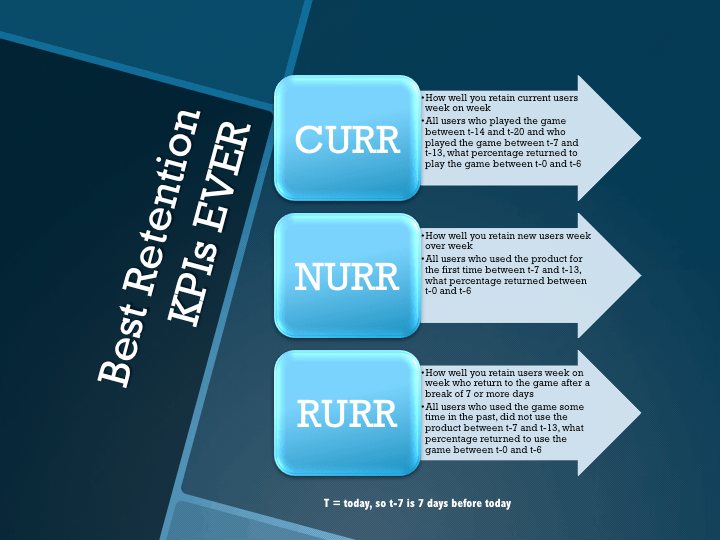
When I was at Zynga, I came across a metric that perfectly captures how well you are performing with your existing customers, CURR (current user return rate). CURR is complemented by NURR (new user return rate) and RURR (returning user return rate). Since leaving Zynga, not only have I taken these KPIs with me, I have used them as a key focus for optimizing products. A post by Nathan Williams, SaaS Retention Metrics: Lessons from Free-to-Play Games, reminded me how important these KPIs are and how to best use them.

urr retention chart

CURR

CURR (current user return rate) is the most important KPI to track (or at least a tie with NPS). It shows how loyal your existing customers are; you should consider CURR the inverse of churn. If your CURR increases, it means you have improved your product’s appeal to existing players or customers, if CURR declines you have made your game worse. CURR is also an excellent way of looking at how your game is performing among different segments, VIPs versus payers versus never-spenders.

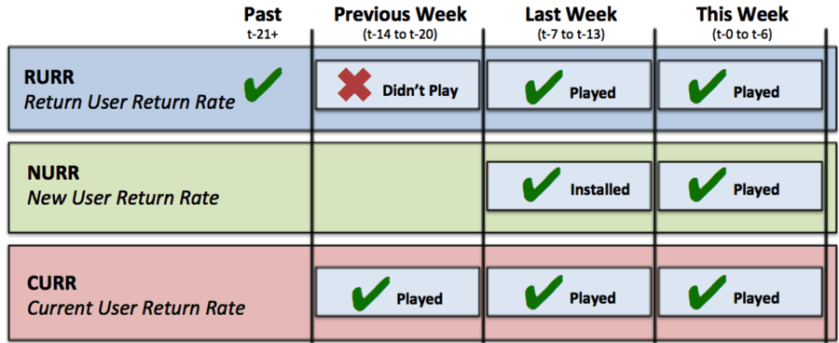
To calculate CURR, you start with all the users who played the game between t-14 (14 days before today, today minus 14) and t-20 and who used the product between t-7 and t-13, what percentage returned to play between t-0 and t-6. The benchmark for a good, but not great, game is 80 percent.

NURR

NURR (new user return rate) is a great metric for understanding how appealing your game is to players you have just acquired. A low NURR shows you have a bad initial experience (or a bad traffic source), turning off many users. It is virtually impossible to acquire players profitably with a low NURR.

To calculate NURR, take all the players who used the game for the first time between t-7 and t-13 and look at what percentage returned to the game between t-0 and t-6. You can benchmark NURR at about 30 percent, though it is dependent on the type of game and platform. There is much higher variance in NURR than CURR among successful games (a game on desktop could succeed with a much lower NURR than a game on Google Play).

RURR

RURR (return user return rate) shows how many people who had churned and returned to your game stay active. It is a great way of measuring how well your game can capitalize on CRM and paid reactivation campaigns. If the number is low, you are doing a great job of bringing players back but the product is still not compelling to these players.

You can calculate RURR by taking all the players who were active at some point but did not use the product between t-14 and t-20, and did use the product between t-7 and t-13, what percentage returned to play the game between t-0 and t-6. There is also significant variance in this benchmark but I usually target 40 percent for social casino games.

slide1

Use *URR to track product performance

Once you start monitoring CURR/RURR/NURR, you should use them to understand what is working and where there are issues. If you see a significant change in CURR, it is almost certainly caused by recent product changes. Low NURR indicates either you have broken your FTUE or you have added weak sources of traffic. A low RURR indicates your CRM or reactivation team is doing a good job but you need to add product features to keep the players you are brining back.

Key takeaways

  1. Retention is the key driver of customer lifetime value (LTV), and CURR/NURR/RURR are the most accurate metrics to track retention.
  2. CURR (current user return rate) is your most valuable metric, the percent of your current players who are staying active. It shows whether changes in your product are appealing to or deterring your player base.
  3. NURR (new user return rate) shows if your initial user experience is strong while RURR (return user return rate) shows if your game is appealing to players who have churned but decide to try it again.

Share this:

  • Click to share on Facebook (Opens in new window) Facebook
  • Click to share on LinkedIn (Opens in new window) LinkedIn
Like Loading...
Unknown's avatarAuthor Lloyd MelnickPosted on February 5, 2019January 4, 2019Categories Analytics, General Social Games Business, General Tech Business, Growth, Lloyd's favorite posts, LTV, Social CasinoTags analytics, curr, LTV, retention4 Comments on Lifetime Value Part 26: My most valuable retention KPIs

Convergence of social and real money casino goes both ways

Convergence of social and real money casino goes both ways

When I listed my expectations for 2019, the one that generated the most conversation was that the convergence between Real Money Gaming and social casino would accelerate. The underlying driver of this convergence is that both ecosystems are strong and have many learnings to offer. Real Money casino is a $10.6 billion business. Meanwhile, social casino is a $5.4 billion industry that has grown every year since 2012 and is projected to continue growing 7-12 percent per year through 2022.

What social casino can learn from Real Money gaming

Content is king

Real Money casinos focus on adding more content (slots and table games) to increase revenue. While social casino operators also will profess content is king and acknowledge that new games are the strongest driver of KPIs, they do not have the singular focus on adding content that their Real Money counterparts have. Most social casino companies are happy releasing a new slot every second week and launching with 20-30 machines. Conversely, the top Real Money casinos often have over 500 slots and introduce new games much more rapidly.

Given the proven results from launching new content, social casinos should look at much more aggressive content schedules. To achieve this result, social casinos will need to move from their reliance on exclusive, homemade content.

Real Money operators can launch hundreds of games because they license the slots non-exclusively, thus providing access to thousands of slot machines and table games. While exclusivity does provide a unique selling point, many of the homemade social slots are not truly unique. They have common themes and standard math, they are effectively a commodity. Thus the exclusivity is only a perceived advantage, it has no value to the player. Rather than recreating the wheel for every machine, social casinos can still create a unique machine every two weeks (or four weeks or one week) but supplement it with non-exclusive content from the many third-party slot developers.

Cross-sell

While most social casino operators are focused on creating a strong slots app and then optimizing acquisition for that app, Real Money operators have a more robust model. While they still will acquire slots players for their casino products, they have entire verticals that exist largely to acquire players that can be cross-sold into casino. Virtually all the Real Money Bingo products derive the bulk of their revenue from slots. While sports betting is a profitable real money vertical on its own, all of the major sports betting companies rely on slots to drive LTV and allow for more aggressive user acquisition.

In the social space, the siloes are much stronger. Only Kama Games, which uses products like Blackjackist and Roulettist to drive traffic to its poker offering, regularly uses other casino mechanics to acquire players and then cross sell them to its core poker product. Even the social game companies with strong bingo products generally treat bingo as a standalone vertical with its own P&L, just acquiring players for bingo rather than to cross sell into their slots offerings.

Social game companies need to look more at their ecosystem rather than individual products. This will allow them to acquire more players at a higher ROI.

New mechanics

All successful social casino products are based on mechanics proven in the real money space (either land based or online) but not all real money gaming mechanics have made it to social casino. One of the challenges faced by social casino is that the number of players is no longer growing. While revenue continues to increase, it is driven by better monetization of the player base, rather than expanding the player base. One of the most obvious ways to appeal to more players is offering more gameplay options.

There are several real money mechanics that could benefit social casino companies:

  • Sports betting. Sports betting is the largest Real Money gaming vertical, worth well over $22 billion. Social casino companies have tried to replicate Real Money sports betting apps with no success; they have failed for several reasons. The products are normally very complicated, not lending itself to a new sports betting player. Sports betting is also very event driven (you are only interested when there is a match you want to bet on), while social games rely on strong daily retention. Despite these issues, given the overall interest in sports, strength of social fantasy applications and lack of Real Money sports betting in some core markets, a creative game designer can come up with the killer social app for this segment.
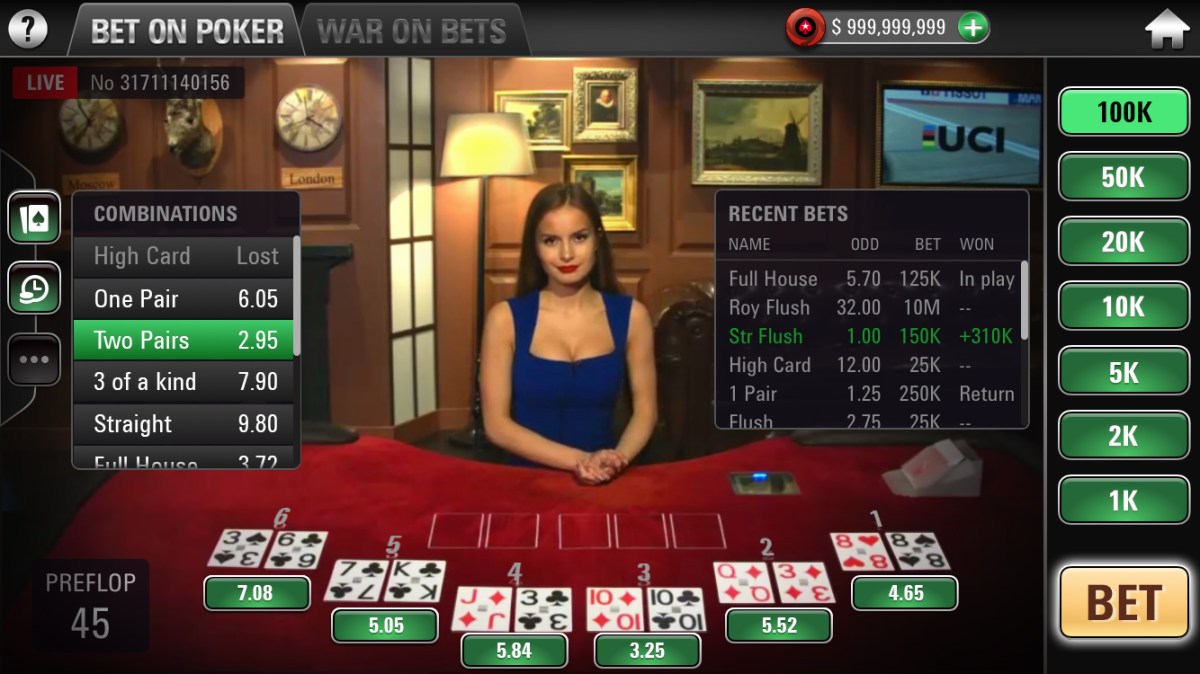
  • Virtual sports. Virtual sports is an important but small part of the online real money gaming ecosystem. Technology, however, has made it much more viable and a great option for social casino companies. Virtual sports are similar to slot machines in that winning is based on a random number generator with set odds, they just simulate a real sporting event. Technology, however, has made these simulated games look as good as real sports. The video below from virtual sports provider Inspired Gaming shows these matches look better than what you would see on a gaming console. Unlike actual sports betting, virtual sports are always available to the player so you can create an experience players can return to daily.
  • Live dealer. Live dealer games are the fastest growing mechanic in the real money gaming space. Companies led by Evolution Gaming, provide games where customers play against a live dealer or host through a video feed. Just as with virtual sports, technology has made this offering much better than only a few years ago, with smoother and higher quality streaming. It is the fastest growing segment of real money gaming and virtually when any B2C company reports its financial results, Live Dealer is the highlight or only bright spot. There are challenges integrating it into social games, bandwidth costs, one-to-one dealer requirements, etc., but as Stars Group showed these issues can be overcome.
  • PSP_ftue_bop.jpg

New Audience

Real Money gaming shows that the addressable market is not limited to 40+ women. While 73 percent of social casino players are female, 65 percent of real money gamers (and 55 percent of real money casino players) are men. With user growth stagnant in social casino, appealing to a male demographic can expand the market for social casino.

Offer driven user acquisition

While social casino companies are more sophisticated with their overall digital marketing, Real Money operators are better at using promotional offers to bring in players. Promotions, such as a free money welcome bonus, spin to win, triple winnings their first day playing, etc., have a very strong pull. While the cost in Real Money of these promotions is sometimes challenging, in social casino they are less risky as providers are only gifting virtual currency. These offers are complicated by AppStore restrictions but this challenge is not insurmountable and more creative offers will improve social game companies user acquisition efforts.

VIP 3.0

While social casino is more reliant on VIPs than Real Money casinos, more than 60 percent of social casino revenue comes from 0.5 percent of players, Real Money operators are much more sophisticated in working with their VIPs. Only a few social casino operators, such as Zynga, have true VIP management programs, most social casinos have one person (who may also be responsible for social media or support) who runs their VIP “program.” Conversely, the most successful real money casinos have a more robust VIP support initiative:

  • Proactive. While much of VIP management in social casino is better customer support for spenders, VIP management in Real Money gaming consists of proactively reaching out to your top players and understanding them as a process. The VIP team can then anticipate problems or opportunities and provide a better experience to the player.
  • Rake back or loss return. Many real money gaming companies (both land based and online) refund part of player losses to their best players. This practice allows players to take more risks and helps overcome periods of bad luck. While it is a controversial practice, many in the real money space lament the cost is not worth the effort, it is a strong way to increase loyalty of your most active players.
  • First class promotions. Why are most fights in Las Vegas, answer is so the casinos can give their VIPs front row seats. Real Money operators will send their top players to great sporting events, sold out concerts, the top restaurants or even a luxury cruise to show their appreciation. While VIPs will often spend over $200,000 in a social game, these VIPs are often rewarded with a t-shirt (if they are lucky). Treating top VIPs similarly to the real money industry will keep them more engaged with social casino offerings.
  • Hospitality events. Not only do Real Money casinos send their VIPs to great events, they create great events. By creating your own event, you are building something unique that competitors cannot replicate and the player cannot get anywhere else. Thus, they are less likely to churn as they would not want to lose access to these events, while they can always buy fight or concert tickets. It is also a great opportunity for your VIP team to build personal relationships with your VIPs, and the personal bond is often stronger than financial benefits of being a VIP.

By replicating these practices, social casinos can reduce VIP churn and improve their lifetime value to the company.

What Real Money gaming can learn from social casino

Although Real Money casino is a larger business, in many ways it is less sophisticated than social gaming. For many years, Real Money casino operators could succeed by getting a stable product in front of customers. With LTVs upward of $400, they had significant margin of error in user acquisition and product features. Conversely, social casinos continuously had to optimize all facets of their business to continue growing. This optimization has led to the development of many features and tactics that can benefit Real Money gaming.

Progression

Providing progression serves many valuable purposes in games. First, it gives people a reason to play, they want to keep moving forward. Even in Real Money gaming, studies have shown over 65 percent do not play to win money, thus progression will appeal to the majority of these customers.

Progression also prevents churn. Loss aversion is a very strong driver of behaviour, people do not want to lose something they already have. The endowment effect also explains that they will also overvalue it.

In addition to reducing churn, progression increases engagement. Players want to complete as many levels as quickly as possible. If there are outstanding levels, they will want to reach them as they will want to finish everything open.

Progression also is a strong monetization driver. Candy Crush is a great example of a game genre that did not monetize but by adding progression King.com was able to create a billion-dollar franchise. Progression prompts players to want to keep playing even when they are out of chips, so thus depositing more, and to play at higher stakes, increasing their bet size.

In the Real Money casino world, where players will often jump between casino offerings to capitalize on the best promotions, progression creates loyal and valuable customers.

Social features

Social features are another strong behaviour driver that has largely been perfected by free to play games. Social interaction is a core value for customers, driving success across many industries. While many features satisfy base needs, social interaction appeals to a higher need and thus people are willing to pay more for it and less likely to give it up. The success of Big Fish Casino, and more recently Huuuge Games, shows how social features can create a unique and very profitable market position. Outside of the casino space, Clash of Clans is a great example of social features driving billions in revenue.

There are many different types of social features that Real Money casino operators can implement, with some of the most successful including:

  • Guilds or clans, where players join together to overcome challenges or compete with other groups.
  • Group challenges, so players have to team together to win rewards.
  • Chat, to enable players to interact with each other.
  • Customizable and useful player profiles, so players can know more about other players.
  • Social shares to unlock gifts.
  • Personalized videos, so players can share their gameplay with friends.
  • Team competitions, where players form teams to get higher scores (which could be chips won) than other teams.
  • Synchronous slot game play.
  • Social lobby, so players know they are not playing alone.
  • Visibility into where friends and other players are winning.
  • Player review of games and slots, similar to Amazon.
  • Referral program, so your players can also be your evangelists.

Some of these features will work better in certain products than others but a mix of these features will not only create bonds with your players but amongst your players.

UIUX

Social casino developers provide a much cleaner and smoother user interface (UI) and user experience (UX) than real money gaming companies. Players can quickly start playing and there is virtually no learning curve. It is easy to navigate in the product, take advantage of offers and understand every offering. Real Money, conversely, often overwhelms the customer with choice, increasing the cognitive load. This problem is not only in the lobby but in the products, betting options are often very complex and confusing. Overall, social gaming companies create an experience much more consistent with customers expectations in 2019.

In-product VIP

While Real Money gaming companies are great at hosting and managing their VIPs, social game companies are much better at giving them incentives and rewards in product. Virtually all social casinos have an in-game VIP system, where the more VIPs play, the more privileges they earn. This type of automated system provides continuous reinforcement and reminds VIPs why they want to remain in their favourite product.

Events

Within the past year, social casinos have become very adept at creating events that boost engagement. It could be the December Challenge or the Race to the Mountain Top, but in effect it is a collection of challenges and specialized content that is available for a limited time. Often the player has a chance to win an item(s) that is only available by completing the event and will not be available again, creating an incentive both to participate and to visit the game regularly (so they know about the events). These events also break the monotony of playing the same games repeatedly. Finally, they can provide an incentive to try new slots or mechanics.

The most successful social games are now running at least one event daily and this practice can be replicated in the Real Money world. A regular schedule of events increase loyalty, engagement and monetization.

Key takeaways

  1. The strength of both the Real Money Gaming and social casino businesses suggest they both have many lessons to offer.
  2. Social casino companies should focus on adding even more content than they do currently (in part by using third party content they do not have exclusively), create an ecosystem based on cross-sell, try game mechanics from Real Money gaming (sports, virtual sports, live dealer), try to engage male players, create more unique new player offers and replicate the high-touch VIP programs found in real money.
  3. Real Money casinos can improve their profitability by adding progression mechanic, social features, more simple user interface and user experience, in-product VIP programmes and daily events.

Share this:

  • Click to share on Facebook (Opens in new window) Facebook
  • Click to share on LinkedIn (Opens in new window) LinkedIn
Like Loading...
Unknown's avatarAuthor Lloyd MelnickPosted on January 29, 2019January 28, 2019Categories General Social Games Business, Growth, Lloyd's favorite posts, Social Casino, Social Games MarketingTags cross-selling, Live Dealer, real money online gambling, slots, social casino, sports, uiux, vip, VIP hosting, Virtual Sports1 Comment on Convergence of social and real money casino goes both ways

Why Indie Devs Should Pay Attention to Hypercasual

If you are interested in hypercasual games and but were unable to watch my appearance last week on Indie Game Business, the show is now available on YouTube. It was also a fantastic opportunity to reminisce about the game business with my first hire, Jay Powell. To view the show:

Share this:

  • Click to share on Facebook (Opens in new window) Facebook
  • Click to share on LinkedIn (Opens in new window) LinkedIn
Like Loading...
Unknown's avatarAuthor Lloyd MelnickPosted on January 28, 2019Categories General Social Games BusinessTags hypercasualLeave a comment on Why Indie Devs Should Pay Attention to Hypercasual

Saving millions on meetings

Saving millions on meetings

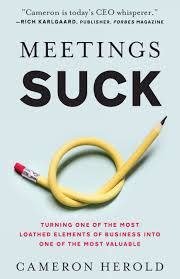
Most people hate meetings but they still waste hours upon hours of not only their time but colleagues time on them annually. I always like to work between Christmas and New Years because I get more done than I feel I typically do in a month. I realized this year that the reason for the much higher productivity is that I am not spending most of every day in meetings, often ones with questionable value. If you add the cost (wages) from my wasted time to that of all the other people who are not optimizing their time during meeting where they are not deriving or creating value, there is an opportunity to increase significantly your team or company’s operational efficiency.

Based on this realization and having read Meetings Suck by Cameron Herold, I developed some policies that I recommend you replicate:

  • Delete all meetings once a year (easiest in January) and then only reschedule the ones you need and only with the people you need to attend. This is a strategy I wrote about in 2015, that I stole from a top-five game company, that company now is one of the two or three largest in the US.
  • Talk, don’t meet. Sometimes a quick conversation can resolve items without needing a meeting.
  • Ensure everyone invited needs to be there. If someone is on there phone during the whole meeting, it is less that person’s fault than the meeting organizer who brought in someone who was not needed.
  • Let people opt-out. If somebody says they do not want to attend a meeting, respect their wishes.
  • Prepare before a meeting. If you are going to be reviewing financials or KPIs, have the analysis complete and know what you want to discuss. Nobody wants to sit around watching you work on a spreadsheet during a meeting
  • Have people arrive early. Everyone should be early for meetings so that they can stay on time. You and your colleagues should get to the meeting five minutes early so that people can settle and be ready at the start time. By starting late, you are wasting money having people just sit around.
  • Schedule meetings for 25 minutes. That will allow five minutes to get to the next meeting early. Abandon one hour (or longer) meetings, so that the meetings stay focused. It is better to schedule a follow up than have an extra 30 mins that people feel they have to fill. Only schedule 55 minutes when you are confident you will need all 55 minutes,
  • Share an agenda with all attendees. Share an agenda for meetings a few days in advance and allow people to opt out if there is no business relevant to them being discussed. If you use Outlook or a similar organizer, best to put the agenda in the invite.
  • Include a timetable. With the agenda, include a timetable so people can attend for the part of the meeting relevant
  • If you make these changes, you will be surprised at how liberated you feel. Meetings will take on improved importance, making them more interesting to you but also to your colleagues. Everyone will benefit from better meetings.

    Key takeaways

    • Improving efficiency from meetings can save your company money, significant savings can come from reducing the wages lost by people attending meetings that they do not contribute to and do not derive value.
    • Start with a clean slate, delete all meetings and only add ones you need, and invite the people who need to be there.
    • Reduce meetings to 25 minutes so you can start on time (and arrive on time for the next meeting) and share an agenda and timetable before the meeting.

    Share this:

    • Click to share on Facebook (Opens in new window) Facebook
    • Click to share on LinkedIn (Opens in new window) LinkedIn
    Like Loading...
    Unknown's avatarAuthor Lloyd MelnickPosted on January 22, 2019January 21, 2019Categories General Social Games BusinessTags Meetings3 Comments on Saving millions on meetings

    Talk on Hypercasual, this Wednesday (23 Jan)

    If you are interested in the hypercasual phenomenon and ecosystem, I will be discussing it with Jay Powell and Dan Long on Indie Game Business, Wednesday at 5 PM UK time, 12 PM EST. If you cannot make the show, they will be posting the talk on YouTube.

    indie

    Share this:

    • Click to share on Facebook (Opens in new window) Facebook
    • Click to share on LinkedIn (Opens in new window) LinkedIn
    Like Loading...
    Unknown's avatarAuthor Lloyd MelnickPosted on January 21, 2019Categories General Social Games BusinessTags hypercasualLeave a comment on Talk on Hypercasual, this Wednesday (23 Jan)

    Posts pagination

    Previous page Page 1 … Page 7 Page 8 Page 9 … Page 46 Next page

    Get my book on LTV

    The definitive book on customer lifetime value, Understanding the Predictable, is now available in both print and Kindle formats on Amazon.

    Understanding the Predictable delves into the world of Customer Lifetime Value (LTV), a metric that shows how much each customer is worth to your business. By understanding this metric, you can predict how changes to your product will impact the value of each customer. You will also learn how to apply this simple yet powerful method of predictive analytics to optimize your marketing and user acquisition.

    For more information, click here

    Follow The Business of Social Games and Casino on WordPress.com

    Enter your email address to follow this blog and receive notifications of new posts by email.

    Join 791 other subscribers

    Most Recent Posts

    • Join me at PDMA Inspire for my talk on new product prioritization
    • Why keep studying?
    • The next three years of this blog
    • Interview with the CEO of Murka on the biggest growth opportunity in gaming, Barak David

    Lloyd Melnick

    This is Lloyd Melnick’s personal blog.  All views and opinions expressed on this website are mine alone and do not represent those of people, institutions or organizations that I may or may not be associated with in professional or personal capacity.

    I am a serial builder of businesses (senior leadership on three exits worth over $700 million), successful in big (Disney, Stars Group/PokerStars, Zynga) and small companies (Merscom, Spooky Cool Labs) with over 20 years experience in the gaming and casino space.  Currently, I am the GM of VGW’s Chumba Casino and on the Board of Directors of Murka Games and Luckbox.

    Topic Areas

    • Analytics (114)
    • Bayes' Theorem (8)
    • behavioral economics (8)
    • blue ocean strategy (14)
    • Crowdfunding (4)
    • DBA (2)
    • General Social Games Business (459)
    • General Tech Business (195)
    • Growth (88)
    • International Issues with Social Games (50)
    • Lloyd's favorite posts (101)
    • LTV (54)
    • Machine Learning (10)
    • Metaverse (1)
    • Mobile Platforms (37)
    • Prioritization (1)
    • Social Casino (52)
    • Social Games Marketing (105)
    • thinking fast and slow (5)
    • Uncategorized (33)

    Social

    • View CasualGame’s profile on Facebook
    • View @lloydmelnick’s profile on Twitter
    • View lloydmelnick’s profile on LinkedIn

    RSS

    RSS Feed RSS - Posts

    RSS Feed RSS - Comments

    Categories

    • Analytics (114)
    • Bayes' Theorem (8)
    • behavioral economics (8)
    • blue ocean strategy (14)
    • Crowdfunding (4)
    • DBA (2)
    • General Social Games Business (459)
    • General Tech Business (195)
    • Growth (88)
    • International Issues with Social Games (50)
    • Lloyd's favorite posts (101)
    • LTV (54)
    • Machine Learning (10)
    • Metaverse (1)
    • Mobile Platforms (37)
    • Prioritization (1)
    • Social Casino (52)
    • Social Games Marketing (105)
    • thinking fast and slow (5)
    • Uncategorized (33)

    Archives

    • September 2023
    • December 2021
    • July 2021
    • March 2021
    • February 2021
    • January 2021
    • December 2020
    • November 2020
    • October 2020
    • September 2020
    • August 2020
    • July 2020
    • June 2020
    • May 2020
    • April 2020
    • March 2020
    • February 2020
    • January 2020
    • November 2019
    • October 2019
    • September 2019
    • June 2019
    • May 2019
    • April 2019
    • March 2019
    • February 2019
    • January 2019
    • December 2018
    • June 2018
    • May 2018
    • April 2018
    • March 2018
    • February 2018
    • January 2018
    • December 2017
    • June 2017
    • May 2017
    • April 2017
    • March 2017
    • February 2017
    • January 2017
    • December 2016
    • November 2016
    • October 2016
    • September 2016
    • June 2016
    • May 2016
    • April 2016
    • March 2016
    • February 2016
    • January 2016
    • December 2015
    • November 2015
    • October 2015
    • September 2015
    • July 2015
    • June 2015
    • May 2015
    • April 2015
    • March 2015
    • February 2015
    • January 2015
    • December 2014
    • November 2014
    • October 2014
    • September 2014
    • August 2014
    • July 2014
    • June 2014
    • May 2014
    • April 2014
    • March 2014
    • February 2014
    • January 2014
    • December 2013
    • November 2013
    • October 2013
    • September 2013
    • August 2013
    • July 2013
    • June 2013
    • May 2013
    • April 2013
    • March 2013
    • February 2013
    • January 2013
    • December 2012
    • November 2012
    • October 2012
    • September 2012
    • August 2012
    • July 2012
    • June 2012
    • May 2012
    • April 2012
    • March 2012
    • February 2012
    • January 2012
    • December 2011
    • November 2011
    • October 2011
    • September 2011
    • August 2011
    • July 2011
    • June 2011
    • May 2011
    • December 2010
    January 2026
    S M T W T F S
     123
    45678910
    11121314151617
    18192021222324
    25262728293031
    « Sep    

    by Lloyd Melnick

    All posts by Lloyd Melnick unless specified otherwise
    Google+

    Enter your email address to subscribe to this blog and receive notifications of new posts by email.

    Join 791 other subscribers
    Follow Lloyd Melnick on Quora

    RSS HBR Blog

    • What Actually Works to Change Someone’s Mind
    • Our Favorite Management Tips of 2025
    • How to Manage—and Motivate—Gen Z
    • The Most-Watched HBR Videos of 2025
    • The HBR Charts that Help Explain 2025
    • The Most Popular HBR Podcast Episodes of 2025
    • How the Best Leaders Develop and Spend “Innovation Capital”
    • The 10 Most Popular HBR Articles of 2025
    • How Work Changed in 2025, According to HBR Readers
    • What Leaders Can Learn from a Formula 1 Turnaround

    RSS Techcrunch

    • An error has occurred; the feed is probably down. Try again later.

    RSS MIT Sloan Management Review Blog

    • Calm: The Underrated Capability Every Leader Needs Now
    • The Top Five MIT SMR Videos of 2025
    • Three Steps Toward Fairer Talent Management
    • From Crisis to Coopetition: What Leaders Can Learn From Anesthesiologists
    • AI Coding Tools: The Productivity Trap Most Companies Miss
    • How Procter & Gamble Uses AI to Unlock New Insights From Data
    • Rewire Organizational Knowledge With GenAI
    • Hungry for Learning: Wendy’s Will Croushorn
    • Beat Burnout: 10 Essential MIT SMR Reads
    • How Leaders Stay True to Themselves and Their Stakeholders
    The Business of Social Games and Casino Website Powered by WordPress.com.
    • Subscribe Subscribed
      • The Business of Social Games and Casino
      • Join 726 other subscribers
      • Already have a WordPress.com account? Log in now.
      • The Business of Social Games and Casino
      • Subscribe Subscribed
      • Sign up
      • Log in
      • Report this content
      • View site in Reader
      • Manage subscriptions
      • Collapse this bar
     

    Loading Comments...
     

      %d