Skip to content

The Business of Social Games and Casino

How to succeed in the mobile game space by Lloyd Melnick

Category: Growth

90-day plan to increase your company’s innovation

While everyone agrees that companies need to innovate to succeed, actually doing it is often quite challenging. While most successful companies can lay credit to some innovations, most have occurred by chance and the companies actually lack an orderly, reliable way to innovate regularly. A recent article in the Harvard Business Review, “Build an Innovation Engine in 90 Days” by Scott Anthony and two of his colleagues, does a great job of laying out a tactical plan to help your company to innovate.

Slide1

While some companies address this problem by building large—and expensive—innovation centers or R&D facilities, Anthony shows there is a middle way that almost any company can pursue regardless of resources. In many ways, what Anthony describes (and the term he uses) is the equivalent of the minimum viable product (MVP), from lean start-up fame. In this case, it is a minimum viable innovation system (MVIS). There are four phases to building such a system, and it takes about 90 days.

Phase 1: Define your innovation buckets

There are two types of innovation: improving existing products or operations, and generating growth by reaching new customer segments or markets. For an innovation program (including an MVIS) to be successful, everyone involved must understand the two types of innovation. If your team fails to make this distinction, you increase the likelihood that you either discount the importance of innovations that strengthen the ongoing business or demand too much revenue from the new-growth initiatives too early. Innovations meant to improve the core business (the former of the two innovation categories) should be tied to the current strategy and managed mostly with the primary organizational structure. The return on these projects will be relatively quick with high initial returns and thus should be funded at scale.

While all of your innovation projects may be focused on core activities, they you are probably missing preparing for the future and reaching your long-term goals. New growth initiatives, the latter category, should fill this gap. These new growth initiatives push the frontier of your strategy by offering new or complementary products to existing customers, moving into adjacent product or geographic markets, or developing something utterly original, perhaps delivered in a novel way. Continue reading “90-day plan to increase your company’s innovation”
Like Loading...
Unknown's avatarAuthor Lloyd MelnickPosted on December 4, 2014December 15, 2014Categories General Social Games Business, General Tech Business, Growth, Lloyd's favorite postsTags innovation, MVIS, Scott AnthonyLeave a comment on 90-day plan to increase your company’s innovation

How negative churn can be a strong growth driver

I came across a great post by VC Tomasz Tunguz on a great growth mechanism: negative churn. In effect, negative churn creates the same compounding effect as a high-rate bond; over time it generates tremendous growth. Negative churn means that the actual churn rate, the number of customers or players moving out of a collective group over a specific period of time, is lower than the increase in the value of the retained customers.

What is negative churn

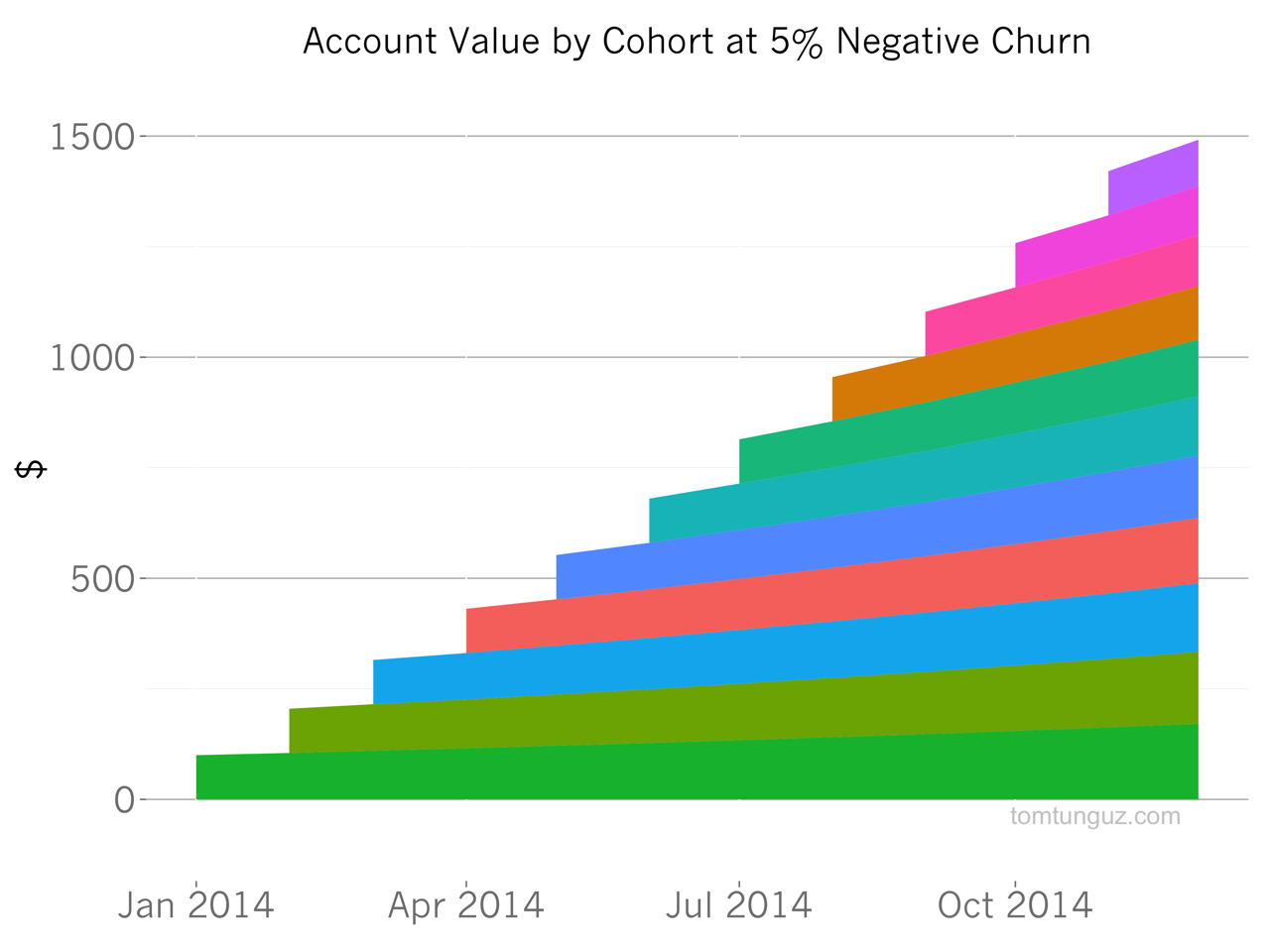
Tunguz uses a great example to illustrate negative churn. Say your company has a five percent monthly churn rate, which means that five percent of your users quit each month. In Tunguz’s example, the remaining 95 percent of the customers increase their spend with your company by ten percent, so total revenue from this cohort (group) of users is equal to 105 percent of the revenue from the previous month. Even with 5 percent monthly churn, each month this cohort of users becomes increasingly valuable.

In the 5 percent monthly churn case, the company exits the year with $919 in monthly recurring revenue and the customer lifetime value (assuming a one-year lifetime and no virality) is $77. In the negative churn case (where you have a 10 percent monthly increase in spend), your company’s revenue is 73 percent larger at $1592 and the LTV is worth $133.

In both cases, the company has the same number of customers (or game, players). But with negative churn, revenue is over 70 percent higher. This shows the power of compounding growth every month.

Acct value by cohortThis graphic from Tunguz’s blog illustrates the opportunity:

How to achieve negative churn

Continue reading “How negative churn can be a strong growth driver”

Like Loading...
Unknown's avatarAuthor Lloyd MelnickPosted on December 2, 2014December 15, 2014Categories General Social Games Business, General Tech Business, Growth, Lloyd's favorite posts, LTVTags churn, Growth, lifetime value, LTV, negative churn, Tomasz TunguzLeave a comment on How negative churn can be a strong growth driver

Foster a growth mindset in your company to improve growth

There are two ways of looking at employees, and for them to look at themselves, either a fixed mindset where they either possess or lack talent, or a growth mindset, where your team can develop new skills. An article in the Harvard Business Review, “How Companies Can Profit from a ‘Growth Mindset’” by Stanford’s Carol Dweck, shows the benefits having a growth mindset has for your company.

Mindset: The New Psychology of Success

According to Dweck’s research, failure is the end of the world for some people but an exciting opportunity for others. People with a growth mindset enjoy challenges, strive to learn and consistently see potential to develop new skills. Conversely, those with a fixed mindset view talent as a quality they either have or do not have.

In the article, Dweck extends her definition of mindsets from individuals to companies. Dweck and her colleagues found that some organizations believe their people have a certain amount of talent, thus a fixed mindset. Others held the opposite view and those companies were considered to have a growth mindset.

Dweck also found the company mindset had a significant impact on its employees. In organizations with a fixed mindset, employees largely felt there was a handful of “star” employees that were highly valued. The employees who felt this way were less committed than employees at growth-mindset companies and did not think the company had their back. These employees worried about failing so they pursued fewer innovative projects. They regularly kept secrets, cut corners and cheated to try to get ahead. Continue reading “Foster a growth mindset in your company to improve growth”

Like Loading...
Unknown's avatarAuthor Lloyd MelnickPosted on November 20, 2014December 1, 2014Categories General Social Games Business, General Tech Business, Growth, Lloyd's favorite postsTags Carol Dweck, collaboration, Growth, innovationLeave a comment on Foster a growth mindset in your company to improve growth

Using charity to improve revenue

A recent article in the Harvard Business Review, “Making Charity Pay” by Michael Norton and Jill Avery, shows how business can use philanthropy to improve profitability. They point out that charity can enhance customer loyalty, brand awareness and sales. To impact metrics positively, however, you need to implement the cause-based initiatives appropriately.

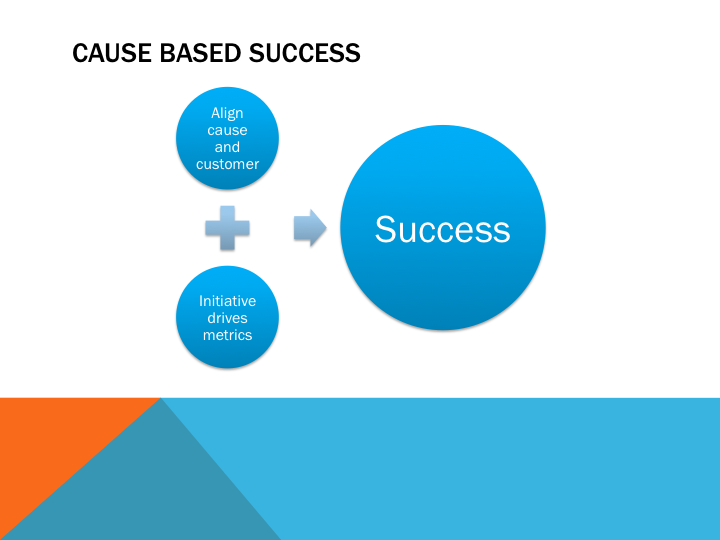
Norton and Avery analyzed both successful and unsuccessful charitable initiatives and determined that success is driven by companies aligning causes that resonate with customers in a way that drives sales.

Slide1

The first part of the equation is aligning the cause with the customer. With most successful initiatives, it means looking beyond causes that are important to you, the leadership team or maybe even your local community. You need to talk to your customers and understand what causes are important to them. One simple technique I have found particularly successful is surveying your users and asking them to rank the causes you are considering for the initiative. Continue reading “Using charity to improve revenue”

Share this:

  • Click to share on Facebook (Opens in new window) Facebook
  • Click to share on LinkedIn (Opens in new window) LinkedIn
Like Loading...
Unknown's avatarAuthor Lloyd MelnickPosted on November 11, 2014December 1, 2014Categories Analytics, General Social Games Business, General Tech Business, Growth, Social Games MarketingTags Cause based, charitable initiativesLeave a comment on Using charity to improve revenue

Psychology that can improve your metrics

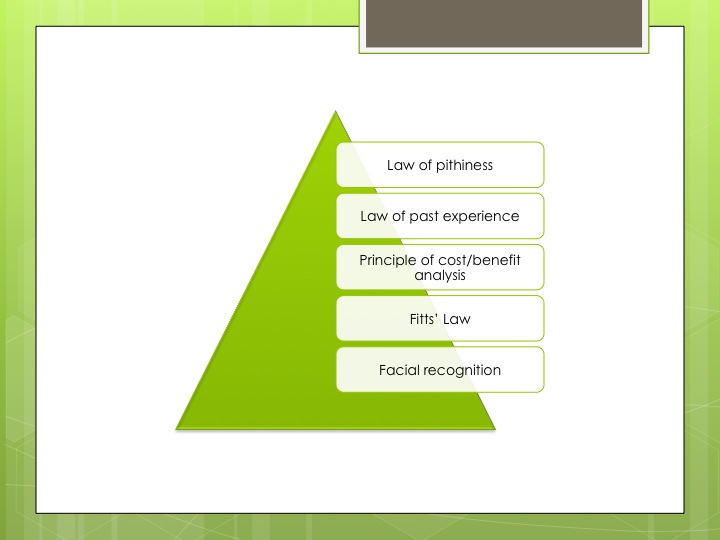
There was an interesting post recently on the Kissmetrics blog, “5 Psychological Principles of High Converting Websites,” that had some very interesting insights not just for website conversion but for overall product performance. Although I do not agree with all of these principles, understanding how your users think or play is crucial to success.

Slide1

Law of pithiness

The article starts with the law of pithiness, in which people tend to order their experiences in a symmetrical, simple manner. They prefer things that are clear and orderly, and are afraid of complex, complicated ideas or designs. The law of pithiness leads to a design principle that I think is critical: The simpler your product or game, the greater its chances for success. If it is a game, every second of training or tutorial reduces the chance it succeeds. If it is a product, the easier it is to use and the simpler it makes the users life, the more powerful it will be. Uber is successful because it takes about 15 seconds to hail a taxi, set the destination and pay. Social casinos games are habitually in the top grossing because you download the game, click on a slot machine, and you are playing. The more complex or difficult the process, the less likely for success.

Law of past experience

This principle suggests people interpret current experiences by their past experiences. If you try to change the way they need to do things, they are likely to not understand or rebel. For example, in your shopping cart or buy page, you may have a clever attractive icon for people to buy, but they are more likely to make a purchase if you have a button that says buy now because they remember that is how they make a purchase. Also, if you have an existing product with a large user base, you may improve the product but lose many of your existing users because they are used to using the product in a traditional way. For many years, in the land-based slot machine business, even when the slots went digital and only needed the push of a digital button, they had to include a mechanical arm because that is how people felt they should play a slot machine. Continue reading “Psychology that can improve your metrics”

Like Loading...
Unknown's avatarAuthor Lloyd MelnickPosted on October 28, 2014November 4, 2014Categories General Social Games Business, General Tech Business, GrowthTags cost/benefit, Facial recognition, Fitts Law, Kissmetrics, past experience, Pithiness, Psychology2 Comments on Psychology that can improve your metrics

How games help licensors

There has been a lot written about how licensing intellectual property (IP) can help game companies succeed, but in many ways the real story is how games can make the IP more valuable. While a quick look at the app stores shows multiple highly ranked games tied to IP, with EA’s The Simpsons: Tapped Out a prime example of the power of a brand, many licensors are sub-optimizing or missing out by not realizing the value a successful game has for the brand.

This lesson was driven home to me by the near-simultaneous launch of Star Wars Commander and Star Trek Trexels. While Star Wars Commander is still a top-performing game, Trexels is virtually non-existent. While the initial reaction may be that Disney (the owner of the Star Wars franchise) is realizing some income that Viacom (the owner of the Star Trek franchise) is missing out on, the true impact on both licensors is much more important. Overall, the revenue from either Commander or Trexels will not impact the licensor; both are multi-billion dollar companies. Yet the importance of the Commander success should not be overlooked.

Star wars commander

Continue reading “How games help licensors”

Share this:

  • Click to share on Facebook (Opens in new window) Facebook
  • Click to share on LinkedIn (Opens in new window) LinkedIn
Like Loading...
Unknown's avatarAuthor Lloyd MelnickPosted on October 9, 2014October 15, 2014Categories General Social Games Business, Growth, Social Games MarketingTags IP, licensing, Star Trek Trexels, Star Wars Commander1 Comment on How games help licensors

Lifetime Value Part 23: Triggers, the key to both retention and virality

One theme that comes up repeatedly in what I read, and thus write, is the importance of Triggers. In my February analysis of Jonah Berger’s book Contagious, I discussed how triggers are one of the five core elements to creating a product with word of mouth. Then in June, I discussed Nir Eyal’s bestseller, Hooked, in which the author builds a model on creating a habit-forming product; triggers represent one of four phases of the model. Given the importance of word of mouth (virality) and habit (retention) as two of the three core components of customer lifetime value (LTV), this highlights the crucial role that triggers provide in success.

The role of triggers in virality and retention

Triggers are reminders for people to talk about our product, game or ideas. In Berger’s book, triggers are the foundation of word of mouth and contagiousness. For example, you may regularly show images of your game with coffee, so that people will think about and start discussing your product when they go to Starbucks.

The first step of Eyal’s Hook Model of retention is triggers. Triggers cue the user to take action. There are two types of triggers: external and internal. Habit-forming products start by alerting users with external triggers like an email, a website link or the app icon on a phone. An external trigger communicates the next action the user should take. Online, an external trigger may take the form of a prominent button, such as the Play Now button on many games. When users start to automatically cue their next behavior, the new habit becomes part of their everyday routine. Continue reading “Lifetime Value Part 23: Triggers, the key to both retention and virality”

Share this:

  • Click to share on Facebook (Opens in new window) Facebook
  • Click to share on LinkedIn (Opens in new window) LinkedIn
Like Loading...
Unknown's avatarAuthor Lloyd MelnickPosted on October 7, 2014October 15, 2014Categories General Social Games Business, General Tech Business, Growth, LTV, Social Games MarketingTags Contagious, Hooked, Jonas Berger, LTV, Nir Eyal, Triggers1 Comment on Lifetime Value Part 23: Triggers, the key to both retention and virality

My top ten summer posts

Slide1

For those of you who foolishly decided to take a vacation this summer rather than stay at home and read my blog, I wanted to summarize what I feel were my top ten posts this summer (and below will also summarize the rests of my posts since I am sure you will want to catch up on all of them). Continue reading “My top ten summer posts”

Share this:

  • Click to share on Facebook (Opens in new window) Facebook
  • Click to share on LinkedIn (Opens in new window) LinkedIn
Like Loading...
Unknown's avatarAuthor Lloyd MelnickPosted on September 9, 2014October 14, 2014Categories Analytics, General Social Games Business, General Tech Business, Growth, LTV, Machine LearningTags analytics, lifetime value, LTV, social gamesLeave a comment on My top ten summer posts

Partnerships, focus and competition

When I recently updated my OpenTable app, I noticed they incorporated a partnership with Uber in which you can request a car when looking at an upcoming reservation and the car would already know your destination. This partnership between Uber and OpenTable is a great example of strategic thinking by both companies. I wanted to comment on it as I think all companies can learn some key lessons from the initiative.

Uber and OpenTable logos

Continue reading “Partnerships, focus and competition”

Share this:

  • Click to share on Facebook (Opens in new window) Facebook
  • Click to share on LinkedIn (Opens in new window) LinkedIn
Like Loading...
Unknown's avatarAuthor Lloyd MelnickPosted on August 21, 2014October 14, 2014Categories General Social Games Business, GrowthTags competition, focus, OpenTable, partnerships, Uber3 Comments on Partnerships, focus and competition

Lifetime Value Part 18: Ten small things that will increase LTV

While optimizing your product is a full time job and all design should focus on monetization, virality and retention, a Kissmetric blog post by Mike Bal pointed out ten tactics that can boost lifetime value. Although these are not a replacement for strong design and optimization, they will further boost your metrics.

The techniques should not only boost lifetime value, but also great more brand loyalty (thus LTV of your brand) and you will notice the common theme is they are customer centric. Continue reading “Lifetime Value Part 18: Ten small things that will increase LTV”

Share this:

  • Click to share on Facebook (Opens in new window) Facebook
  • Click to share on LinkedIn (Opens in new window) LinkedIn
Like Loading...
Unknown's avatarAuthor Lloyd MelnickPosted on June 19, 2014July 23, 2014Categories General Social Games Business, Growth, LTVTags content, Kissmetrics, lifetime value, LTV1 Comment on Lifetime Value Part 18: Ten small things that will increase LTV

Posts pagination

Previous page Page 1 … Page 5 Page 6 Page 7 … Page 9 Next page

Get my book on LTV

The definitive book on customer lifetime value, Understanding the Predictable, is now available in both print and Kindle formats on Amazon.

Understanding the Predictable delves into the world of Customer Lifetime Value (LTV), a metric that shows how much each customer is worth to your business. By understanding this metric, you can predict how changes to your product will impact the value of each customer. You will also learn how to apply this simple yet powerful method of predictive analytics to optimize your marketing and user acquisition.

For more information, click here

Follow The Business of Social Games and Casino on WordPress.com

Enter your email address to follow this blog and receive notifications of new posts by email.

Join 791 other subscribers

Most Recent Posts

  • Join me at PDMA Inspire for my talk on new product prioritization
  • Why keep studying?
  • The next three years of this blog
  • Interview with the CEO of Murka on the biggest growth opportunity in gaming, Barak David

Lloyd Melnick

This is Lloyd Melnick’s personal blog.  All views and opinions expressed on this website are mine alone and do not represent those of people, institutions or organizations that I may or may not be associated with in professional or personal capacity.

I am a serial builder of businesses (senior leadership on three exits worth over $700 million), successful in big (Disney, Stars Group/PokerStars, Zynga) and small companies (Merscom, Spooky Cool Labs) with over 20 years experience in the gaming and casino space.  Currently, I am the GM of VGW’s Chumba Casino and on the Board of Directors of Murka Games and Luckbox.

Topic Areas

  • Analytics (114)
  • Bayes' Theorem (8)
  • behavioral economics (8)
  • blue ocean strategy (14)
  • Crowdfunding (4)
  • DBA (2)
  • General Social Games Business (459)
  • General Tech Business (195)
  • Growth (88)
  • International Issues with Social Games (50)
  • Lloyd's favorite posts (101)
  • LTV (54)
  • Machine Learning (10)
  • Metaverse (1)
  • Mobile Platforms (37)
  • Prioritization (1)
  • Social Casino (52)
  • Social Games Marketing (105)
  • thinking fast and slow (5)
  • Uncategorized (33)

Social

  • View CasualGame’s profile on Facebook
  • View @lloydmelnick’s profile on Twitter
  • View lloydmelnick’s profile on LinkedIn

RSS

RSS Feed RSS - Posts

RSS Feed RSS - Comments

Categories

  • Analytics (114)
  • Bayes' Theorem (8)
  • behavioral economics (8)
  • blue ocean strategy (14)
  • Crowdfunding (4)
  • DBA (2)
  • General Social Games Business (459)
  • General Tech Business (195)
  • Growth (88)
  • International Issues with Social Games (50)
  • Lloyd's favorite posts (101)
  • LTV (54)
  • Machine Learning (10)
  • Metaverse (1)
  • Mobile Platforms (37)
  • Prioritization (1)
  • Social Casino (52)
  • Social Games Marketing (105)
  • thinking fast and slow (5)
  • Uncategorized (33)

Archives

  • September 2023
  • December 2021
  • July 2021
  • March 2021
  • February 2021
  • January 2021
  • December 2020
  • November 2020
  • October 2020
  • September 2020
  • August 2020
  • July 2020
  • June 2020
  • May 2020
  • April 2020
  • March 2020
  • February 2020
  • January 2020
  • November 2019
  • October 2019
  • September 2019
  • June 2019
  • May 2019
  • April 2019
  • March 2019
  • February 2019
  • January 2019
  • December 2018
  • June 2018
  • May 2018
  • April 2018
  • March 2018
  • February 2018
  • January 2018
  • December 2017
  • June 2017
  • May 2017
  • April 2017
  • March 2017
  • February 2017
  • January 2017
  • December 2016
  • November 2016
  • October 2016
  • September 2016
  • June 2016
  • May 2016
  • April 2016
  • March 2016
  • February 2016
  • January 2016
  • December 2015
  • November 2015
  • October 2015
  • September 2015
  • July 2015
  • June 2015
  • May 2015
  • April 2015
  • March 2015
  • February 2015
  • January 2015
  • December 2014
  • November 2014
  • October 2014
  • September 2014
  • August 2014
  • July 2014
  • June 2014
  • May 2014
  • April 2014
  • March 2014
  • February 2014
  • January 2014
  • December 2013
  • November 2013
  • October 2013
  • September 2013
  • August 2013
  • July 2013
  • June 2013
  • May 2013
  • April 2013
  • March 2013
  • February 2013
  • January 2013
  • December 2012
  • November 2012
  • October 2012
  • September 2012
  • August 2012
  • July 2012
  • June 2012
  • May 2012
  • April 2012
  • March 2012
  • February 2012
  • January 2012
  • December 2011
  • November 2011
  • October 2011
  • September 2011
  • August 2011
  • July 2011
  • June 2011
  • May 2011
  • December 2010
January 2026
S M T W T F S
 123
45678910
11121314151617
18192021222324
25262728293031
« Sep    

by Lloyd Melnick

All posts by Lloyd Melnick unless specified otherwise
Google+

Enter your email address to subscribe to this blog and receive notifications of new posts by email.

Join 791 other subscribers
Follow Lloyd Melnick on Quora

RSS HBR Blog

  • Regaining Momentum After a Holiday Break
  • When You’ve Outgrown Your Relationship with a Trusted Advisor
  • Research: Conventional Cybersecurity Won’t Protect Your AI
  • Weave Mentorship into the Fabric of Your Organization
  • To Execute a Unified Strategy, Leaders Need to Shadow Each Other
  • What Companies that Excel at Strategic Foresight Do Differently
  • How Bristol Myers Squibb Transformed Working Capital to Fund Its Future - SPONSOR CONTENT FROM EY-PARTHENON
  • When Being a Family Business Becomes a Competitive Advantage
  • How to Handle a Difficult Board Member
  • How to Strengthen Your Focus When Demands Never Let Up

RSS Techcrunch

  • An error has occurred; the feed is probably down. Try again later.

RSS MIT Sloan Management Review Blog

  • Build Better Pay-for-Performance (PFP) Compensation Plans
  • Your People Are Not All Right
  • Five Trends in AI and Data Science for 2026
  • Stop Making Hollow Apologies at Work
  • Calm: The Underrated Capability Every Leader Needs Now
  • The Top Five MIT SMR Videos of 2025
  • Three Steps Toward Fairer Talent Management
  • From Crisis to Coopetition: What Leaders Can Learn From Anesthesiologists
  • AI Coding Tools: The Productivity Trap Most Companies Miss
  • How Procter & Gamble Uses AI to Unlock New Insights From Data
The Business of Social Games and Casino Website Powered by WordPress.com.
  • Subscribe Subscribed
    • The Business of Social Games and Casino
    • Join 726 other subscribers
    • Already have a WordPress.com account? Log in now.
    • The Business of Social Games and Casino
    • Subscribe Subscribed
    • Sign up
    • Log in
    • Report this content
    • View site in Reader
    • Manage subscriptions
    • Collapse this bar
 

Loading Comments...
 

    %d