Skip to content

The Business of Social Games and Casino

How to succeed in the mobile game space by Lloyd Melnick

Category: Lloyd’s favorite posts

My favorite posts

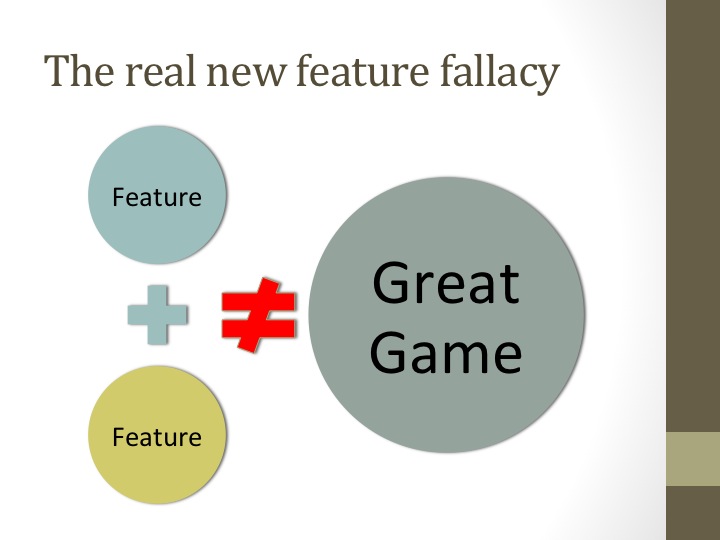
You need a good game, not a feature

Last week, I summarized Andrew Chen’s “New Feature Fallacy,” which your new features need to touch players at the top of the funnel to improve your game. Several colleagues offered suggestion why the fallacy is a fallacy. In thinking further, the true fallacy is that any feature can fix a broken product.

Games are not a collection of features, there needs to be a core game loop that is fun. Then you can improve your LTV by building on that game loop, but if the loop does not exist there are no features that can help.

Slide1

You often see this problem in the free-to-play game space, where product management teams believe that successful products are a collection of features. Their roadmaps list each feature with the improvement in metrics it will generate. They then add up all of these improvements and come up with estimates that show how the game will generate millions of dollars. The company then invests because it wants to make millions of dollars (or investors buy shares in the company) and a year or so later they wonder why the game does not work.

Related, they look at each feature in a vacuum and AB test it. All of the features show positive improvement in metrics. The game, however, fails. A senior product who is probably the best PM I ever met once said to me it was curious how every AB test an unnamed game company we worked out had fantastic results, so good the PMs would create presentations so others in the company could copy them, yet the company’s revenue and user base continued to decline rather dramatically. Unfortunately, he was one of the few who found it “curious.” Continue reading “You need a good game, not a feature”

Like Loading...
Unknown's avatarAuthor Lloyd MelnickPosted on June 16, 2015April 5, 2021Categories General Social Games Business, Lloyd's favorite posts, Social CasinoTags core loop, feature, game design3 Comments on You need a good game, not a feature

Why your game’s metrics mean nothing

From the beginning of time (or at least 2009), companies have been basing decisions on game metrics, investors have used performance metrics to base investment decisions and outside analysts have used game metrics to estimate the health of a company. Unfortunately, all of these applications of metrics are deeply flawed and often mislead the decision-makers, investors and analysts (sometimes intentionally, sometimes not).

The charts below from Appsflyer show the critical flaw in looking at a game’s metrics:

Appsflyer iOS

Retention performance on Android by source:

AppsFlyerAndroid

It all depends on the source

The first lesson from these charts is that performance depends largely on the source of users. Although these charts show retention metrics, I am certain monetization and virality performance shows similar behavior. Thus, your performance metrics are incredibly biased by the source of traffic and metrics for your game overall only reflect the quality of the various user sources.

As an example, assume your Bingo game has D7 (Day 7) retention of 20% and an ARPDAU (average revenue per daily active user) of $0.25. Your main competitor’s game had D7 retention of 10% and an ARPDAU of $0.15. Based on this information, you may decide to cancel other projects and focus on this game. As a corporate development expert, you may aggressively try to acquire this company. The problem, however, is that the competitive game may be three years old and the company is using a very weak user acquisition channel that does not have a high cost because they have gotten all potential users from the better channels. Conversely, you may have acquired users through a Facebook mobile ad campaign targeting high-value Bingo players. Thus, your new users are of much higher quality than those from competitive Bingo game.

Even if your game is significantly worse, its metrics would look better at this stage. If you decide to focus on this game, the new users you bring in end up performing much worse than when you made the decision. This deterioration is not due to the game getting worse; it’s just based on a different set of users. If you end up acquiring the company for $100 million, you will then find out that as you try to grow it, you have trouble getting new profitable users.

Trends can be misleading

Trends one of are the most powerful analytics tools in your arsenal, as they show how your product or game is performing over time and if it is improving or deteriorating. Looking at the Appsflyer charts, however, it’s easy to see that that trends can largely be created by changes in the user mix. As the user acquisition team changes the mix of players, the new mix could create upward trends even if the game has not improved or deteriorated. The changes in behavior will be caused by the changes in user mix.

The only metric that counts

I have written many times about customer lifetime value (LTV), and the variance in metrics by source shows the central importance of focusing on the lifetime value to CPI (cost-per-install) equation. To summarize, LTV is how much profit a new player will generate for you in total and is a function of retention, monetization and virality. As long as your LTV is higher than the cost of acquiring that customer (CPI for paid user acquisition on mobile or web), you want to continue acquiring players.

Given the variance in performance by source that the AppsFlyer charts show, the LTV by source will also have huge variance. Thus, the goal is to have an LTV higher than the cost of user for that source. The LTV on a global scale is not important, it is finding pockets where LTV is greater than CPI and then acquiring against those targets. Any target KPIs (key performance indicators) outside of LTV being greater than CPI are worthless because this last equation will determine the success of your game. Anything else can be manipulated (e.g., buying users from certain sources who generate your “goals”). As long as LTV exceeds CPI for a source, you can acquire users from that source and grow your game. Once there are no sources where the LTV for that source are higher than the CPI (even if overall LTV is higher than many sources but not higher by source), you cannot buy users and the game will stop growing and start withering.

What it means

The high variance in performance of players by source has several important implications:

  • You must track performance of users on a cohort/source basis. Only by comparing similar users can you understand how your game is performing.
  • The sophistication of your user acquisition/growth team is critical. Managing CPIs is meaningless if it is not tied to the performance of the users; you need growth experts who can get you users with the highest yield (delta between LTV and CPI). You also may otherwise miss opportunities where your metrics may not appear to support buying expensive traffic, but that traffic will perform so well that it is a good value.
  • Holistic game metrics (sometimes referred to as vanity metrics) are meaningless or even misleading. You need to focus on keeping LTV higher than CPI for your sources of traffic.

The critical point is not to focus on vanity metrics that can be manipulated and are not actionable. Instead, focus on the performance of your product for specific cohorts of customers.

Key takeaways

  1. There is an extremely high variance in performance of users based on the source of the users. Thus, it is misleading to look at overall metrics as they are largely a result of your user sources.
  2. You must track performance of users on a cohort/source basis. Only by comparing similar users can you understand how your game is performing.
  3. It is critical to build a strong growth or user acquisition team. Managing CPIs is meaningless if it is not tied to the performance of the users, you need growth experts who can get you users with the highest yield (delta between LTV and CPI).

Like Loading...
Unknown's avatarAuthor Lloyd MelnickPosted on June 4, 2015January 4, 2016Categories Analytics, General Social Games Business, General Tech Business, Growth, Lloyd's favorite posts, LTVTags analytics, appsflyer, CPI, LTV, metricsLeave a comment on Why your game’s metrics mean nothing

The importance of competitive intelligence

In most businesses, the need to know what your competitors are doing is a given. In the social gaming space, however, competitive intelligence (CI) is either an afterthought or not even considered critical. That thinking at best leads to a sub-optimal product and at worst facilitates losing your market to another product.

Why Competitive Intelligence is important

Good competitive intelligence is invaluable to all companies, including those in the mobile and casino gaming spaces.

  1. CI shows you the minimum quality level acceptable for your game. In the mobile space, most users will try multiple applications and then settle on one, a winner take all environment, though in casino they may play two or three. Thus, your potential customers are also playing your competitors’ products and deciding which one to invest their time in the future. If your game is clearly inferior, weaker graphics, slower tech, etc., you have lost.
  2. Your competitors are not stupid and you should learn from them. Internally, they are looking at the same opportunities and problems you are trying to tackle. By understanding features and initiatives they are taking to improve, they can inspire you on ways to manage the situation. Not that you want to copy everything they are doing, but understand how they are approach problems and if you have a different approach make sure your solution is better before deploying it.
  3. You can learn from their mistakes. It is great to make mistakes because it means you are trying unique initiatives; it is not great to repeat mistakes as that has no value. What is even better is if somebody else makes the mistake to learn from them without having the cost.
  4. You ensure you are value competitive. A car company would not never release a new model without understanding how its price and features compare with other cars. It would base the price on the competitive feature set, including branding, and then price their car so it is a reasonable option for consumers. Very few people will purchase an auto when they can get a comparable one for half the price.In the game space, companies mistakenly believe users are price inelastic. Many players, particularly those likely to monetize, understand what they are spending money for and how much they will get for it. The value is often in play time (e.g., I will spend $20 in a bingo app to play an extra hour). If the player feels your game is much more expensive than comparable games, they are less likely to spend in your app and will shift their spending to competitors (and you will see lower revenue from higher prices).

Continue reading “The importance of competitive intelligence”

54.154041 -4.485911
Like Loading...
Unknown's avatarAuthor Lloyd MelnickPosted on April 16, 2015May 1, 2021Categories Analytics, General Social Games Business, Lloyd's favorite postsTags business intelligence, competition, competitive intelligence3 Comments on The importance of competitive intelligence

Don’t treat employees like you do your fantasy league

One of the things that bothers me to no end is when managers treat employees the same way they treat their fantasy team. When you have a fantasy football or baseball (or soccer) team, you trade players, you move them around on your roster, you release players and sign free agents, etc. You may have to deal with a salary cap or other roster limitations.

Slide1

Although many people, myself included, take it very seriously, it is not the real world. You are not actually putting Jay Cutler on the field or releasing Tom Brady (as some fantasy league owners did early last year). Your moves have absolutely no impact on their success in real life.

Fantasy leagues are fun and a great social experience but they do not represent management training. What leads to fantasy league success, regularly changing your roster to leverage match-ups and hot new players, is not the way to build your team or company. Unfortunately, I have seen many cases where managers and companies treat their employees as if they are in a fantasy league. Interestingly, some of the best leaders I have worked with have fallen into this trap.

Playing “Fantasy League Company”

I sometimes see managers trading employees. One manager may need someone with a particular skill set, another manager may need to cut their head count and they agree to “trade” the first employee for a lower-cost employee.

Sometimes managers play fantasy league within their own organization. They will move people into different positions because it improves their chances to “win.” It will not be based on the employee’s performance or career path but there is a short-term opportunity to solve an issue by taking a person from one role to a potentially completely unrelated role.

Another problem arises when a company closes a division or unit. While planning the closure, management often decides where members of the team will end up. Although it is great that the team members are not losing their jobs, they are often moved to positions inconsistent with their existing position, working on products they do not believe in or forced to work with people they do not want to work with. Continue reading “Don’t treat employees like you do your fantasy league”

Like Loading...
Unknown's avatarAuthor Lloyd MelnickPosted on March 24, 2015April 24, 2021Categories General Social Games Business, General Tech Business, Lloyd's favorite postsTags fantasy league, leadership, management, personnelLeave a comment on Don’t treat employees like you do your fantasy league

It is about creating a monopoly, not winning

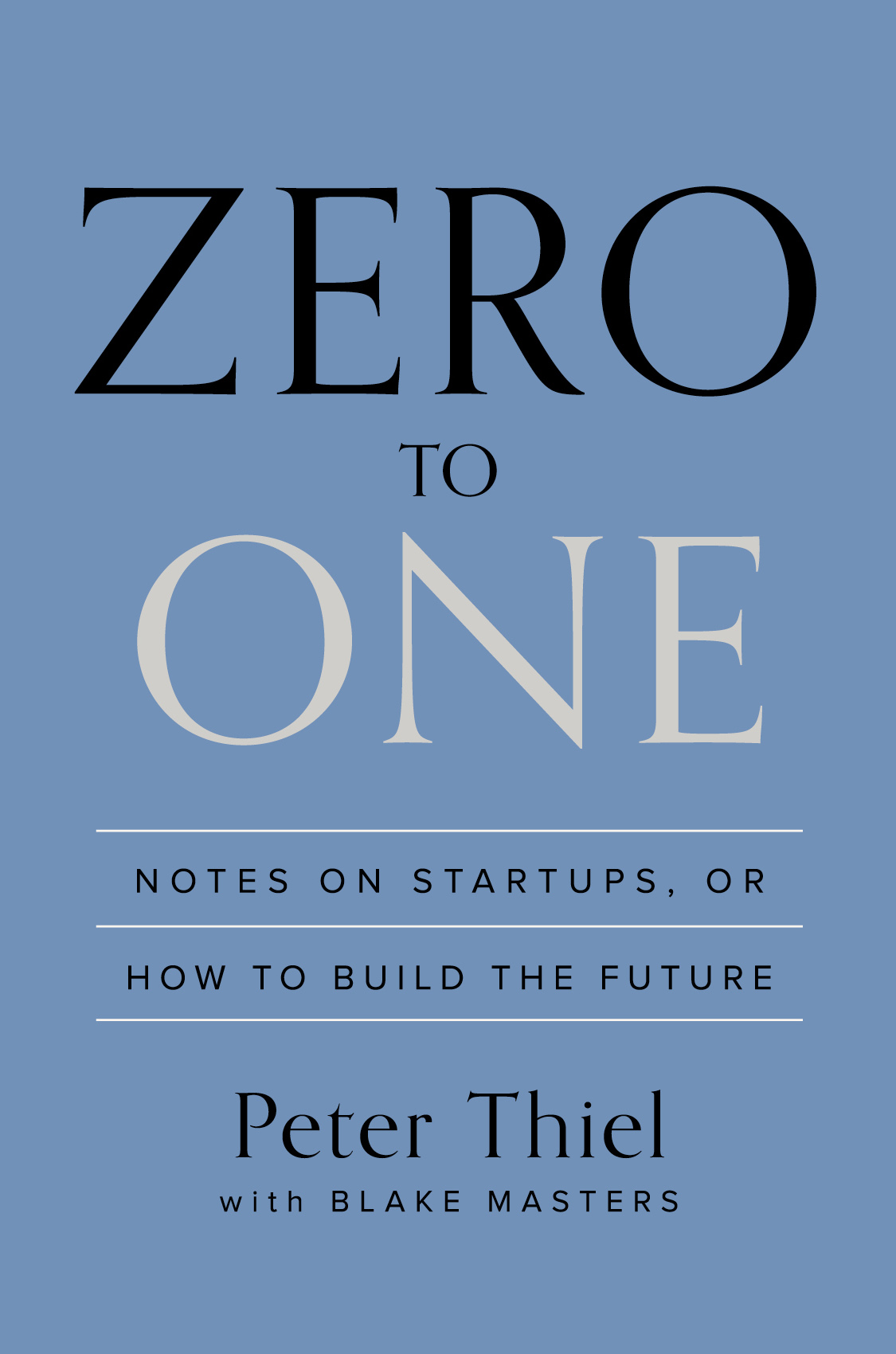
thiel_6_4_frontIn Peter Thiel’s hot book, Zero to One: Notes on Startups, or How to Build the Future, he makes many interesting observations (some I agree with, some I do not) but one in particular is particularly valuable. Thiel asserts that great companies are not great because they beat their competition, they are great because they do not have competition. Although he does not quote Blue Ocean Strategy, it is very consistent with their thesis and data that shows that companies that create new markets have much higher economic returns than those who come up with new strategies to defeat their competition.

Basic economics

Thiel’s point about the benefits of creating what he refers to as a monopoly, what I call a blue ocean opportunity, resonated with me as he use basic economics to prove the point. At its core, classical economics shows competition will drive out excess profits. That is why although Exxon makes a lot of money, they do not make a higher return on investment than another oil company. Whatever you are doing, somebody else will copy.

Thiel points out that, “Americans mythologize competition and credit it with saving us from socialist bread lines. Actually, capitalism and competition are opposites. Capitalism is premised on the accumulation of capital, but under perfect competition all profits get competed away. The lesson for entrepreneurs is clear: if you want to create and capture lasting value, don’t build an undifferentiated commodity business.“ Instead he advocates building a virtual monopoly, a company so good at what it does that no other firm can offer a close substitute. Continue reading “It is about creating a monopoly, not winning”

Like Loading...
Unknown's avatarAuthor Lloyd MelnickPosted on February 5, 2015April 24, 2021Categories General Social Games Business, General Tech Business, Growth, Lloyd's favorite postsTags blue ocean strategy, brand, competition, Excess Profits, Monopolies, Peter Thiel, Playing to Win, proprietary technology, Zero to One3 Comments on It is about creating a monopoly, not winning

Success = Vision + Process + Output

Possibly the best book I have read in the past year (not just in 2015) is The Success Matrix by Gerry Langeler. Langeler is a highly successful venture capitalist and entrepreneur who credits this concept to his success. The Success Matrix puts forth a very straightforward concept: Success needs a combination of vision, process and output. Langeler primarily uses this idea to suggest how to build and lead a successful team. Rather than trying to find people who excel at all three variables, since very few exist, great companies combine people so that the company can excel at all three elements.
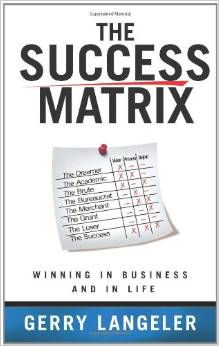

Success Matrix

The three elements of success

  • Vision. Vision represents a broadly understood sense of direction that encompasses competitive leadership in your industry over time.
    You should ask whether you or your employee has the vision of where you need to go and what you need to do over time. This vision should be sensible, focused and well grounded with a sense of direction. As Langeler writes, “this is different than any specific task, product plans or targets. It means precisely what it says. If you are headed in a direction, you know roughly where you are going, even if you don’t know exactly where you’ll end up.”
  • Process. Process is the structures, methods and procedures to produce repeatedly timely, high-quality products or services, independent of changes in people. You can determine if you have strong process whether profitable products and services are
    being produced with predictable regularity.
  • Output. Langeler defines as output as profitable products and services are being produced with predictable regularity. “Profitable products and services” is the key driver for output. It identifies if costs are in line value is recognized in the marketplace. Any Output short of profitable is wasted effort. “Predictable” regularity speaks to whether the Output is both sustained and sustainable. Short bursts of excellence are not enough.

Evaluate your team

Very few people are strong at all three components (vision, process and output) of the success matrix. If you look at vision, process and output as binaries (people are either good at them or not), there are nine possible combinations to classify everyone (e.g., good at vision and output, not process; good at process and output, not vision). Langeler actually puts labels on each of the nine possible combinations but that is the one element of his work I do not like; I feel that the labels are loaded and create unnecessary value judgments. Continue reading “Success = Vision + Process + Output”

Like Loading...
Unknown's avatarAuthor Lloyd MelnickPosted on January 29, 2015March 19, 2015Categories General Social Games Business, General Tech Business, Lloyd's favorite postsTags gerry langeler, leadership, output, process, recruiting, Success matrix, team building, visionLeave a comment on Success = Vision + Process + Output

Ignorance is a competitive advantage

I recently had a conversation with a gaming industry CEO whom I deeply respect that reinforced a MIT Sloan Management Review article, “Embrace Your Ignorance” by Michael Schrage, about how the savviest leaders promote and embrace ignorance. The thesis for both Schrage and the CEO was that you cannot accurately predict what your customers will want, like or need. Thus, you need to embrace this ignorance and run experiments to get the data.

Moneyball and The Innovator’s Dilemma

I have seen many companies where the leadership “felt” they understood the customer and would develop new products for these customers. It leads to project green light meetings very similar to the draft room in Moneyball, where people argue based on their experience which initiatives have the most potential. It is also one of the biggest contributors to the huge number of failed projects, particularly in the gaming space where we typically see more than 8 out of 10 new games fail.

This issue is actually often a bigger problem with executives who have had past successes. Even if they knew their existing or past customers very well, they do not necessarily know what a broader or new market wants. Even their existing data can skew innovation effort, which is the core point of the Innovator’s Dilemma: Companies that have been leap-frogged often create innovations for existing markets rather than new markets.

You already are ignorant—accept it

Slide1

In Schrage’s article, he discusses how Microsoft’s Ronny Kohavi (a pioneer in online experimentation) challenges tech-savvy audiences when he speaks. Kohavi shows screenshots of actual A/B tests that Microsoft has run for website design. He then asks his audience to predict the outcome of the tests. Although the audience is sophisticated, they almost always fragment with different opinions. Kohavi then advises, “stop debating…it’s easier to get data.” Continue reading “Ignorance is a competitive advantage”

Like Loading...
Unknown's avatarAuthor Lloyd MelnickPosted on January 13, 2015January 29, 2015Categories Analytics, General Social Games Business, General Tech Business, Lloyd's favorite postsTags analytics, experimentation, ignorance, Innovator's Dilemma, michael schrage, MoneyballLeave a comment on Ignorance is a competitive advantage

90-day plan to increase your company’s innovation

While everyone agrees that companies need to innovate to succeed, actually doing it is often quite challenging. While most successful companies can lay credit to some innovations, most have occurred by chance and the companies actually lack an orderly, reliable way to innovate regularly. A recent article in the Harvard Business Review, “Build an Innovation Engine in 90 Days” by Scott Anthony and two of his colleagues, does a great job of laying out a tactical plan to help your company to innovate.

Slide1

While some companies address this problem by building large—and expensive—innovation centers or R&D facilities, Anthony shows there is a middle way that almost any company can pursue regardless of resources. In many ways, what Anthony describes (and the term he uses) is the equivalent of the minimum viable product (MVP), from lean start-up fame. In this case, it is a minimum viable innovation system (MVIS). There are four phases to building such a system, and it takes about 90 days.

Phase 1: Define your innovation buckets

There are two types of innovation: improving existing products or operations, and generating growth by reaching new customer segments or markets. For an innovation program (including an MVIS) to be successful, everyone involved must understand the two types of innovation. If your team fails to make this distinction, you increase the likelihood that you either discount the importance of innovations that strengthen the ongoing business or demand too much revenue from the new-growth initiatives too early. Innovations meant to improve the core business (the former of the two innovation categories) should be tied to the current strategy and managed mostly with the primary organizational structure. The return on these projects will be relatively quick with high initial returns and thus should be funded at scale.

While all of your innovation projects may be focused on core activities, they you are probably missing preparing for the future and reaching your long-term goals. New growth initiatives, the latter category, should fill this gap. These new growth initiatives push the frontier of your strategy by offering new or complementary products to existing customers, moving into adjacent product or geographic markets, or developing something utterly original, perhaps delivered in a novel way. Continue reading “90-day plan to increase your company’s innovation”

Like Loading...
Unknown's avatarAuthor Lloyd MelnickPosted on December 4, 2014December 15, 2014Categories General Social Games Business, General Tech Business, Growth, Lloyd's favorite postsTags innovation, MVIS, Scott AnthonyLeave a comment on 90-day plan to increase your company’s innovation

How negative churn can be a strong growth driver

I came across a great post by VC Tomasz Tunguz on a great growth mechanism: negative churn. In effect, negative churn creates the same compounding effect as a high-rate bond; over time it generates tremendous growth. Negative churn means that the actual churn rate, the number of customers or players moving out of a collective group over a specific period of time, is lower than the increase in the value of the retained customers.

What is negative churn

Tunguz uses a great example to illustrate negative churn. Say your company has a five percent monthly churn rate, which means that five percent of your users quit each month. In Tunguz’s example, the remaining 95 percent of the customers increase their spend with your company by ten percent, so total revenue from this cohort (group) of users is equal to 105 percent of the revenue from the previous month. Even with 5 percent monthly churn, each month this cohort of users becomes increasingly valuable.

In the 5 percent monthly churn case, the company exits the year with $919 in monthly recurring revenue and the customer lifetime value (assuming a one-year lifetime and no virality) is $77. In the negative churn case (where you have a 10 percent monthly increase in spend), your company’s revenue is 73 percent larger at $1592 and the LTV is worth $133.

In both cases, the company has the same number of customers (or game, players). But with negative churn, revenue is over 70 percent higher. This shows the power of compounding growth every month.

Acct value by cohortThis graphic from Tunguz’s blog illustrates the opportunity:

How to achieve negative churn

Continue reading “How negative churn can be a strong growth driver”

Like Loading...
Unknown's avatarAuthor Lloyd MelnickPosted on December 2, 2014December 15, 2014Categories General Social Games Business, General Tech Business, Growth, Lloyd's favorite posts, LTVTags churn, Growth, lifetime value, LTV, negative churn, Tomasz TunguzLeave a comment on How negative churn can be a strong growth driver

Foster a growth mindset in your company to improve growth

There are two ways of looking at employees, and for them to look at themselves, either a fixed mindset where they either possess or lack talent, or a growth mindset, where your team can develop new skills. An article in the Harvard Business Review, “How Companies Can Profit from a ‘Growth Mindset’” by Stanford’s Carol Dweck, shows the benefits having a growth mindset has for your company.

Mindset: The New Psychology of Success

According to Dweck’s research, failure is the end of the world for some people but an exciting opportunity for others. People with a growth mindset enjoy challenges, strive to learn and consistently see potential to develop new skills. Conversely, those with a fixed mindset view talent as a quality they either have or do not have.

In the article, Dweck extends her definition of mindsets from individuals to companies. Dweck and her colleagues found that some organizations believe their people have a certain amount of talent, thus a fixed mindset. Others held the opposite view and those companies were considered to have a growth mindset.

Dweck also found the company mindset had a significant impact on its employees. In organizations with a fixed mindset, employees largely felt there was a handful of “star” employees that were highly valued. The employees who felt this way were less committed than employees at growth-mindset companies and did not think the company had their back. These employees worried about failing so they pursued fewer innovative projects. They regularly kept secrets, cut corners and cheated to try to get ahead. Continue reading “Foster a growth mindset in your company to improve growth”

Like Loading...
Unknown's avatarAuthor Lloyd MelnickPosted on November 20, 2014December 1, 2014Categories General Social Games Business, General Tech Business, Growth, Lloyd's favorite postsTags Carol Dweck, collaboration, Growth, innovationLeave a comment on Foster a growth mindset in your company to improve growth

Posts pagination

Previous page Page 1 … Page 4 Page 5 Page 6 … Page 11 Next page

Get my book on LTV

The definitive book on customer lifetime value, Understanding the Predictable, is now available in both print and Kindle formats on Amazon.

Understanding the Predictable delves into the world of Customer Lifetime Value (LTV), a metric that shows how much each customer is worth to your business. By understanding this metric, you can predict how changes to your product will impact the value of each customer. You will also learn how to apply this simple yet powerful method of predictive analytics to optimize your marketing and user acquisition.

For more information, click here

Follow The Business of Social Games and Casino on WordPress.com

Enter your email address to follow this blog and receive notifications of new posts by email.

Join 791 other subscribers

Most Recent Posts

  • Join me at PDMA Inspire for my talk on new product prioritization
  • Why keep studying?
  • The next three years of this blog
  • Interview with the CEO of Murka on the biggest growth opportunity in gaming, Barak David

Lloyd Melnick

This is Lloyd Melnick’s personal blog.  All views and opinions expressed on this website are mine alone and do not represent those of people, institutions or organizations that I may or may not be associated with in professional or personal capacity.

I am a serial builder of businesses (senior leadership on three exits worth over $700 million), successful in big (Disney, Stars Group/PokerStars, Zynga) and small companies (Merscom, Spooky Cool Labs) with over 20 years experience in the gaming and casino space.  Currently, I am the GM of VGW’s Chumba Casino and on the Board of Directors of Murka Games and Luckbox.

Topic Areas

  • Analytics (114)
  • Bayes' Theorem (8)
  • behavioral economics (8)
  • blue ocean strategy (14)
  • Crowdfunding (4)
  • DBA (2)
  • General Social Games Business (459)
  • General Tech Business (195)
  • Growth (88)
  • International Issues with Social Games (50)
  • Lloyd's favorite posts (101)
  • LTV (54)
  • Machine Learning (10)
  • Metaverse (1)
  • Mobile Platforms (37)
  • Prioritization (1)
  • Social Casino (52)
  • Social Games Marketing (105)
  • thinking fast and slow (5)
  • Uncategorized (33)

Social

  • View CasualGame’s profile on Facebook
  • View @lloydmelnick’s profile on Twitter
  • View lloydmelnick’s profile on LinkedIn

RSS

RSS Feed RSS - Posts

RSS Feed RSS - Comments

Categories

  • Analytics (114)
  • Bayes' Theorem (8)
  • behavioral economics (8)
  • blue ocean strategy (14)
  • Crowdfunding (4)
  • DBA (2)
  • General Social Games Business (459)
  • General Tech Business (195)
  • Growth (88)
  • International Issues with Social Games (50)
  • Lloyd's favorite posts (101)
  • LTV (54)
  • Machine Learning (10)
  • Metaverse (1)
  • Mobile Platforms (37)
  • Prioritization (1)
  • Social Casino (52)
  • Social Games Marketing (105)
  • thinking fast and slow (5)
  • Uncategorized (33)

Archives

  • September 2023
  • December 2021
  • July 2021
  • March 2021
  • February 2021
  • January 2021
  • December 2020
  • November 2020
  • October 2020
  • September 2020
  • August 2020
  • July 2020
  • June 2020
  • May 2020
  • April 2020
  • March 2020
  • February 2020
  • January 2020
  • November 2019
  • October 2019
  • September 2019
  • June 2019
  • May 2019
  • April 2019
  • March 2019
  • February 2019
  • January 2019
  • December 2018
  • June 2018
  • May 2018
  • April 2018
  • March 2018
  • February 2018
  • January 2018
  • December 2017
  • June 2017
  • May 2017
  • April 2017
  • March 2017
  • February 2017
  • January 2017
  • December 2016
  • November 2016
  • October 2016
  • September 2016
  • June 2016
  • May 2016
  • April 2016
  • March 2016
  • February 2016
  • January 2016
  • December 2015
  • November 2015
  • October 2015
  • September 2015
  • July 2015
  • June 2015
  • May 2015
  • April 2015
  • March 2015
  • February 2015
  • January 2015
  • December 2014
  • November 2014
  • October 2014
  • September 2014
  • August 2014
  • July 2014
  • June 2014
  • May 2014
  • April 2014
  • March 2014
  • February 2014
  • January 2014
  • December 2013
  • November 2013
  • October 2013
  • September 2013
  • August 2013
  • July 2013
  • June 2013
  • May 2013
  • April 2013
  • March 2013
  • February 2013
  • January 2013
  • December 2012
  • November 2012
  • October 2012
  • September 2012
  • August 2012
  • July 2012
  • June 2012
  • May 2012
  • April 2012
  • March 2012
  • February 2012
  • January 2012
  • December 2011
  • November 2011
  • October 2011
  • September 2011
  • August 2011
  • July 2011
  • June 2011
  • May 2011
  • December 2010
December 2025
S M T W T F S
 123456
78910111213
14151617181920
21222324252627
28293031  
« Sep    

by Lloyd Melnick

All posts by Lloyd Melnick unless specified otherwise
Google+

Enter your email address to subscribe to this blog and receive notifications of new posts by email.

Join 791 other subscribers
Follow Lloyd Melnick on Quora

RSS HBR Blog

  • Why Chief Technology Officers Can’t Afford to Guess on Planning AI - SPONSOR CONTENT FROM GOOGLE CLOUD
  • 6 Cybersecurity Predictions for the AI Economy in 2026 - SPONSOR CONTENT FROM PALO ALTO NETWORKS
  • Why SMBs Are Struggling to Find Talent
  • AI Tools Make Coders More Important, Not Less
  • The Power of Affirmation at Work
  • How One Manufacturer Is Aiming to Achieve Net Zero at Net Zero Cost
  • What Can U.S. Employers Do About Rising Healthcare Costs?
  • When You Have to Execute a Strategy You Disagree With
  • 4 Ways to Build Durable Relationships with Your Most Important Customers
  • What Jargon Says About Your Company Culture

RSS Techcrunch

  • An error has occurred; the feed is probably down. Try again later.

RSS MIT Sloan Management Review Blog

  • AI Coding Tools: The Productivity Trap Most Companies Miss
  • How Procter & Gamble Uses AI to Unlock New Insights From Data
  • Rewire Organizational Knowledge With GenAI
  • Hungry for Learning: Wendy’s Will Croushorn
  • Beat Burnout: 10 Essential MIT SMR Reads
  • How Leaders Stay True to Themselves and Their Stakeholders
  • Our Guide to the Winter 2026 Issue
  • Broadening Future Perspectives at the Bank of England
  • A Faster Way to Build Future Scenarios
  • Assess What Is Certain in a Sea of Unknowns
The Business of Social Games and Casino Website Powered by WordPress.com.
  • Subscribe Subscribed
    • The Business of Social Games and Casino
    • Join 726 other subscribers
    • Already have a WordPress.com account? Log in now.
    • The Business of Social Games and Casino
    • Subscribe Subscribed
    • Sign up
    • Log in
    • Report this content
    • View site in Reader
    • Manage subscriptions
    • Collapse this bar
 

Loading Comments...
 

    %d