Skip to content

The Business of Social Games and Casino

How to succeed in the mobile game space by Lloyd Melnick

Category: Social Casino

Convergence of social and real money casino goes both ways

Convergence of social and real money casino goes both ways

When I listed my expectations for 2019, the one that generated the most conversation was that the convergence between Real Money Gaming and social casino would accelerate. The underlying driver of this convergence is that both ecosystems are strong and have many learnings to offer. Real Money casino is a $10.6 billion business. Meanwhile, social casino is a $5.4 billion industry that has grown every year since 2012 and is projected to continue growing 7-12 percent per year through 2022.

What social casino can learn from Real Money gaming

Content is king

Real Money casinos focus on adding more content (slots and table games) to increase revenue. While social casino operators also will profess content is king and acknowledge that new games are the strongest driver of KPIs, they do not have the singular focus on adding content that their Real Money counterparts have. Most social casino companies are happy releasing a new slot every second week and launching with 20-30 machines. Conversely, the top Real Money casinos often have over 500 slots and introduce new games much more rapidly.

Given the proven results from launching new content, social casinos should look at much more aggressive content schedules. To achieve this result, social casinos will need to move from their reliance on exclusive, homemade content.

Real Money operators can launch hundreds of games because they license the slots non-exclusively, thus providing access to thousands of slot machines and table games. While exclusivity does provide a unique selling point, many of the homemade social slots are not truly unique. They have common themes and standard math, they are effectively a commodity. Thus the exclusivity is only a perceived advantage, it has no value to the player. Rather than recreating the wheel for every machine, social casinos can still create a unique machine every two weeks (or four weeks or one week) but supplement it with non-exclusive content from the many third-party slot developers.

Cross-sell

While most social casino operators are focused on creating a strong slots app and then optimizing acquisition for that app, Real Money operators have a more robust model. While they still will acquire slots players for their casino products, they have entire verticals that exist largely to acquire players that can be cross-sold into casino. Virtually all the Real Money Bingo products derive the bulk of their revenue from slots. While sports betting is a profitable real money vertical on its own, all of the major sports betting companies rely on slots to drive LTV and allow for more aggressive user acquisition.

In the social space, the siloes are much stronger. Only Kama Games, which uses products like Blackjackist and Roulettist to drive traffic to its poker offering, regularly uses other casino mechanics to acquire players and then cross sell them to its core poker product. Even the social game companies with strong bingo products generally treat bingo as a standalone vertical with its own P&L, just acquiring players for bingo rather than to cross sell into their slots offerings.

Social game companies need to look more at their ecosystem rather than individual products. This will allow them to acquire more players at a higher ROI.

New mechanics

All successful social casino products are based on mechanics proven in the real money space (either land based or online) but not all real money gaming mechanics have made it to social casino. One of the challenges faced by social casino is that the number of players is no longer growing. While revenue continues to increase, it is driven by better monetization of the player base, rather than expanding the player base. One of the most obvious ways to appeal to more players is offering more gameplay options.

There are several real money mechanics that could benefit social casino companies:

  • Sports betting. Sports betting is the largest Real Money gaming vertical, worth well over $22 billion. Social casino companies have tried to replicate Real Money sports betting apps with no success; they have failed for several reasons. The products are normally very complicated, not lending itself to a new sports betting player. Sports betting is also very event driven (you are only interested when there is a match you want to bet on), while social games rely on strong daily retention. Despite these issues, given the overall interest in sports, strength of social fantasy applications and lack of Real Money sports betting in some core markets, a creative game designer can come up with the killer social app for this segment.
  • Virtual sports. Virtual sports is an important but small part of the online real money gaming ecosystem. Technology, however, has made it much more viable and a great option for social casino companies. Virtual sports are similar to slot machines in that winning is based on a random number generator with set odds, they just simulate a real sporting event. Technology, however, has made these simulated games look as good as real sports. The video below from virtual sports provider Inspired Gaming shows these matches look better than what you would see on a gaming console. Unlike actual sports betting, virtual sports are always available to the player so you can create an experience players can return to daily.
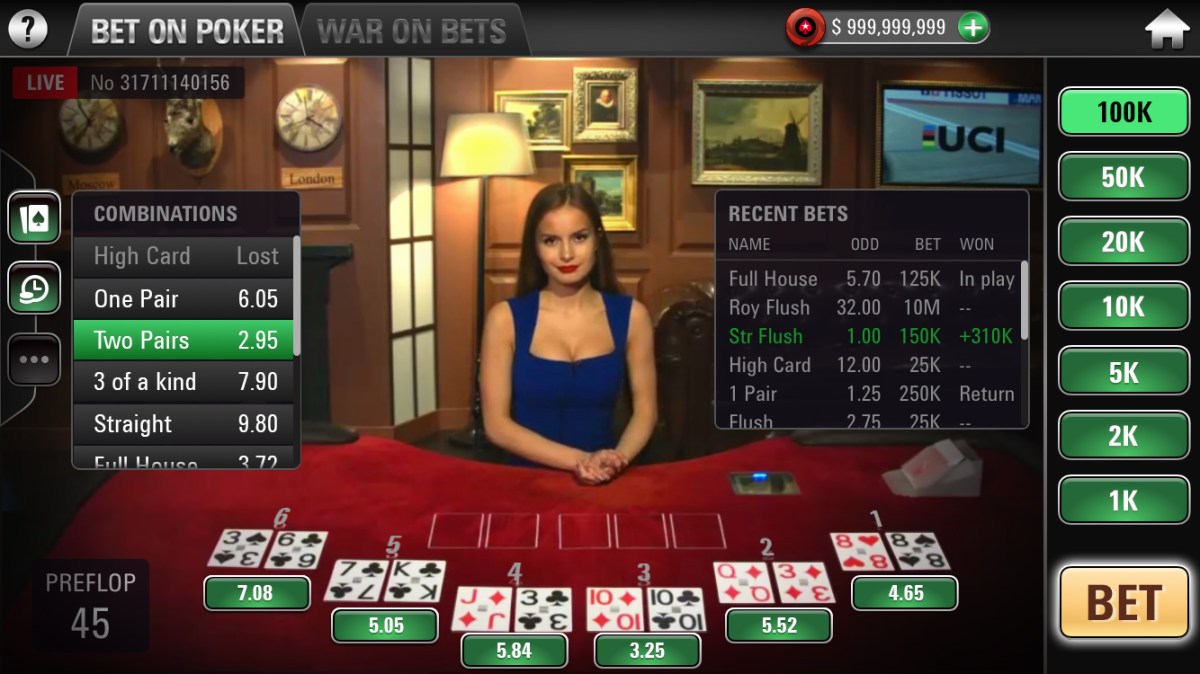
  • Live dealer. Live dealer games are the fastest growing mechanic in the real money gaming space. Companies led by Evolution Gaming, provide games where customers play against a live dealer or host through a video feed. Just as with virtual sports, technology has made this offering much better than only a few years ago, with smoother and higher quality streaming. It is the fastest growing segment of real money gaming and virtually when any B2C company reports its financial results, Live Dealer is the highlight or only bright spot. There are challenges integrating it into social games, bandwidth costs, one-to-one dealer requirements, etc., but as Stars Group showed these issues can be overcome.
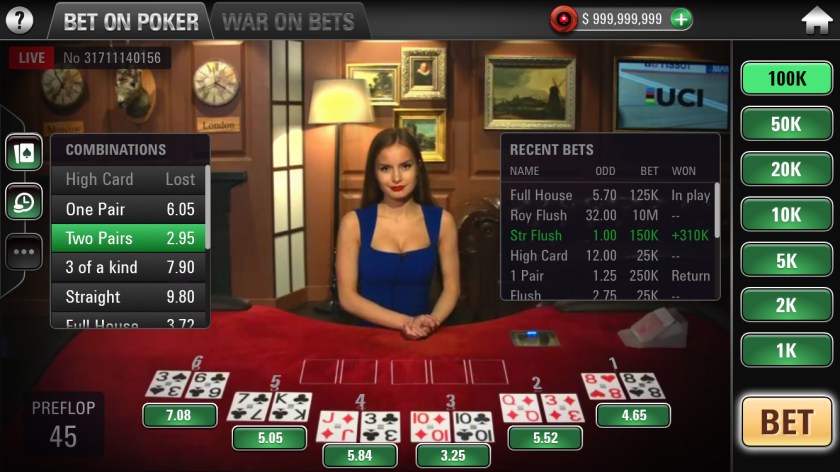
  • PSP_ftue_bop.jpg

New Audience

Real Money gaming shows that the addressable market is not limited to 40+ women. While 73 percent of social casino players are female, 65 percent of real money gamers (and 55 percent of real money casino players) are men. With user growth stagnant in social casino, appealing to a male demographic can expand the market for social casino.

Offer driven user acquisition

While social casino companies are more sophisticated with their overall digital marketing, Real Money operators are better at using promotional offers to bring in players. Promotions, such as a free money welcome bonus, spin to win, triple winnings their first day playing, etc., have a very strong pull. While the cost in Real Money of these promotions is sometimes challenging, in social casino they are less risky as providers are only gifting virtual currency. These offers are complicated by AppStore restrictions but this challenge is not insurmountable and more creative offers will improve social game companies user acquisition efforts.

VIP 3.0

While social casino is more reliant on VIPs than Real Money casinos, more than 60 percent of social casino revenue comes from 0.5 percent of players, Real Money operators are much more sophisticated in working with their VIPs. Only a few social casino operators, such as Zynga, have true VIP management programs, most social casinos have one person (who may also be responsible for social media or support) who runs their VIP “program.” Conversely, the most successful real money casinos have a more robust VIP support initiative:

  • Proactive. While much of VIP management in social casino is better customer support for spenders, VIP management in Real Money gaming consists of proactively reaching out to your top players and understanding them as a process. The VIP team can then anticipate problems or opportunities and provide a better experience to the player.
  • Rake back or loss return. Many real money gaming companies (both land based and online) refund part of player losses to their best players. This practice allows players to take more risks and helps overcome periods of bad luck. While it is a controversial practice, many in the real money space lament the cost is not worth the effort, it is a strong way to increase loyalty of your most active players.
  • First class promotions. Why are most fights in Las Vegas, answer is so the casinos can give their VIPs front row seats. Real Money operators will send their top players to great sporting events, sold out concerts, the top restaurants or even a luxury cruise to show their appreciation. While VIPs will often spend over $200,000 in a social game, these VIPs are often rewarded with a t-shirt (if they are lucky). Treating top VIPs similarly to the real money industry will keep them more engaged with social casino offerings.
  • Hospitality events. Not only do Real Money casinos send their VIPs to great events, they create great events. By creating your own event, you are building something unique that competitors cannot replicate and the player cannot get anywhere else. Thus, they are less likely to churn as they would not want to lose access to these events, while they can always buy fight or concert tickets. It is also a great opportunity for your VIP team to build personal relationships with your VIPs, and the personal bond is often stronger than financial benefits of being a VIP.

By replicating these practices, social casinos can reduce VIP churn and improve their lifetime value to the company.

What Real Money gaming can learn from social casino

Although Real Money casino is a larger business, in many ways it is less sophisticated than social gaming. For many years, Real Money casino operators could succeed by getting a stable product in front of customers. With LTVs upward of $400, they had significant margin of error in user acquisition and product features. Conversely, social casinos continuously had to optimize all facets of their business to continue growing. This optimization has led to the development of many features and tactics that can benefit Real Money gaming.

Progression

Providing progression serves many valuable purposes in games. First, it gives people a reason to play, they want to keep moving forward. Even in Real Money gaming, studies have shown over 65 percent do not play to win money, thus progression will appeal to the majority of these customers.

Progression also prevents churn. Loss aversion is a very strong driver of behaviour, people do not want to lose something they already have. The endowment effect also explains that they will also overvalue it.

In addition to reducing churn, progression increases engagement. Players want to complete as many levels as quickly as possible. If there are outstanding levels, they will want to reach them as they will want to finish everything open.

Progression also is a strong monetization driver. Candy Crush is a great example of a game genre that did not monetize but by adding progression King.com was able to create a billion-dollar franchise. Progression prompts players to want to keep playing even when they are out of chips, so thus depositing more, and to play at higher stakes, increasing their bet size.

In the Real Money casino world, where players will often jump between casino offerings to capitalize on the best promotions, progression creates loyal and valuable customers.

Social features

Social features are another strong behaviour driver that has largely been perfected by free to play games. Social interaction is a core value for customers, driving success across many industries. While many features satisfy base needs, social interaction appeals to a higher need and thus people are willing to pay more for it and less likely to give it up. The success of Big Fish Casino, and more recently Huuuge Games, shows how social features can create a unique and very profitable market position. Outside of the casino space, Clash of Clans is a great example of social features driving billions in revenue.

There are many different types of social features that Real Money casino operators can implement, with some of the most successful including:

  • Guilds or clans, where players join together to overcome challenges or compete with other groups.
  • Group challenges, so players have to team together to win rewards.
  • Chat, to enable players to interact with each other.
  • Customizable and useful player profiles, so players can know more about other players.
  • Social shares to unlock gifts.
  • Personalized videos, so players can share their gameplay with friends.
  • Team competitions, where players form teams to get higher scores (which could be chips won) than other teams.
  • Synchronous slot game play.
  • Social lobby, so players know they are not playing alone.
  • Visibility into where friends and other players are winning.
  • Player review of games and slots, similar to Amazon.
  • Referral program, so your players can also be your evangelists.

Some of these features will work better in certain products than others but a mix of these features will not only create bonds with your players but amongst your players.

UIUX

Social casino developers provide a much cleaner and smoother user interface (UI) and user experience (UX) than real money gaming companies. Players can quickly start playing and there is virtually no learning curve. It is easy to navigate in the product, take advantage of offers and understand every offering. Real Money, conversely, often overwhelms the customer with choice, increasing the cognitive load. This problem is not only in the lobby but in the products, betting options are often very complex and confusing. Overall, social gaming companies create an experience much more consistent with customers expectations in 2019.

In-product VIP

While Real Money gaming companies are great at hosting and managing their VIPs, social game companies are much better at giving them incentives and rewards in product. Virtually all social casinos have an in-game VIP system, where the more VIPs play, the more privileges they earn. This type of automated system provides continuous reinforcement and reminds VIPs why they want to remain in their favourite product.

Events

Within the past year, social casinos have become very adept at creating events that boost engagement. It could be the December Challenge or the Race to the Mountain Top, but in effect it is a collection of challenges and specialized content that is available for a limited time. Often the player has a chance to win an item(s) that is only available by completing the event and will not be available again, creating an incentive both to participate and to visit the game regularly (so they know about the events). These events also break the monotony of playing the same games repeatedly. Finally, they can provide an incentive to try new slots or mechanics.

The most successful social games are now running at least one event daily and this practice can be replicated in the Real Money world. A regular schedule of events increase loyalty, engagement and monetization.

Key takeaways

  1. The strength of both the Real Money Gaming and social casino businesses suggest they both have many lessons to offer.
  2. Social casino companies should focus on adding even more content than they do currently (in part by using third party content they do not have exclusively), create an ecosystem based on cross-sell, try game mechanics from Real Money gaming (sports, virtual sports, live dealer), try to engage male players, create more unique new player offers and replicate the high-touch VIP programs found in real money.
  3. Real Money casinos can improve their profitability by adding progression mechanic, social features, more simple user interface and user experience, in-product VIP programmes and daily events.
Share this:

  • Click to share on Facebook (Opens in new window) Facebook
  • Click to share on LinkedIn (Opens in new window) LinkedIn
Like Loading...
Unknown's avatarAuthor Lloyd MelnickPosted on January 29, 2019January 28, 2019Categories General Social Games Business, Growth, Lloyd's favorite posts, Social Casino, Social Games MarketingTags cross-selling, Live Dealer, real money online gambling, slots, social casino, sports, uiux, vip, VIP hosting, Virtual Sports1 Comment on Convergence of social and real money casino goes both ways

Lessons and insights from social casino and gaming M&A activity in Q1

Lessons and insights from social casino and gaming M&A activity in Q1

Last quarter saw some interesting deals in the gaming space. Several of the deals, and non-deals, suggest trends that are likely to continue in 2019.

Playtika acquires Wooga rather than another social casino

The most interesting deal was Playtika acquiring Wooga for ~$100MM. The thought-provoking element to me was that Playtika decided to invest outside the social casino space. In the past, acquisitions such as House of Fun, Buffalo Studios, etc., were focused on explanding Playtika’s social casino portfolio. Wooga, however, has no presence in the social casino space, instead is a casual, primarily puzzle, game developer. Playtika’s move suggests one of the following:

  1. Given the stagnant user numbers in social casino, there are better growth opportunities in other genres.
  2. Valuations in casino are too high compared with growth potential in the space.
  3. Most likely, social casino companies will continue to expand (and acquire) in casino but also are maturing to want a more robust and diversified portfolio (consistent with Aristocrat’s acquisition in 2017 of Plarium at the same time it purchased Big Fish).

Zynga spent $560+ million for one title, Empires & Puzzles

Zynga’s $560MM acquisition of 80 percent of Small Giant Games (thus valuing the company at $700MM) shows CEO Frank Gibeau’s strategy of focusing on controlling large, long-term franchises. Small Giant’s core product, Empires & Puzzles, is the 13th highest grossing title on mobile. Empires & Puzzles is Small Giant’s only game live, they are not known to have any other big projects in the pipeline (unlike Natural Motion, which had Dawn of Titans in the works when Zynga acquired it), so the acquisition is to add Empires & Puzzles to Zynga’s list of franchises.

This strategy is consistent with what Gibeau learned at EA, that franchises transform a game company from a hit driven business, with wide revenue fluctuations, to a company with sustainable and predictable growth (and thus higher valuation). He is collecting evergreen franchises to try to turn Zynga into the EA of mobile. These franchises include his purchase of Gram Games, which provided the hypercasual franchise Merge Dragons, and Harpin, which gave him Patience – Solitaire. In addition, acquiring rights to Star Wars, Harry Potter and Game of Thrones for gaming creates additional franchise opportunities. Coupled with existing Zynga franchises Zynga Poker, Words with Friends, CSR Racing and to a lesser extent Hit It Rich!, Wizard of Oz Casino Slots and Farmville, Zynga now has a stable revenue base to build on.

Epic raises $1.25BN at a valuation of $5BN-$6BN, showing the breadth and value of its business

Last October, Epic raised $1.25 billion from KKR, Kleiner Perkins, Vulcan Capital and other blue chip investors at a valuation probably well over $5 billion. What is most impressive about Epic is how it has consistently succeeded in different parts of the game industry. While companies frequently are unable to repeat successes in the gaming space or expand beyond their expertise, Epic seems to do it at ease. Fortnite is only the latest in a string of successes that I find incredibly surprising, given the challenges other companies in the game industry experience. I remember Epic when they were still a small North Carolina company, largely an indie developer. Their odds-defying achievements include (and I am probably forgetting some):

  • I first learned about Epic from a CNN story (I think 1998) about someone who created a first person shooter (FPS) in their basement that was soon to be released but getting much buzz. At the time, the FPS market was dominated by id Software (Doom) and all the other FPS were fringe products. They might have a loyal following, like Bungee’s Marathon, but nobody challenged id. I did not expect Epic to launch the top FPS but they did. Unreal turned into the biggest FPS for years, making id an afterthought.
  • With the success of Unreal, Epic decided to license its game engine (creatively branded the Unreal Engine). At the time, the game engine industry was awful. Companies like NDL (Emergent) scraped by to make payroll as no major developers were using third party engines. There was very much a not invented here mentality in the video game industry. Fast forward ten years later and Epic built a game engine company that powers many hit products and is worth hundreds of millions of dollars.
  • Most successful games are followed with…not another successful game. The video game industry is known as being hit driven and even the strongest companies have had difficulty replicating their big successes. While Epic surprised me by successfully creating a huge franchise with Unreal, it did not seem likely that they could ever replicate their success. Then they launched Gears of War in 2006 and ended up with a bigger franchise than Unreal.
  • I have written several times about the challenge of traditional gaming companies competing successfully in the free to play space, most recently Nintendo. Not only is much of what a game company learned in the traditional videogame space worthless in free to play gaming, it actually hinders the ability to create a successful F2P product. Outside of acquisition, I did not foresee a traditional company succeeding in F2P. Then Epic, which had built its business around traditional console game (Unreal, Gears, etc), launched a title you may have heard of, Fortnite, which has now generated billions of dollars. Not only did it succeed in F2P, it helped build a new F2P monetization mechanic. Yet again Epic proved me wrong.

This fundraising deal shows Epic is arguably the strongest company in the gaming sector and one that can expand its footprint into other gaming areas. Although I consider the Google/Apple duopoly over mobile gaming unshakeable, same for Steam on PC, it is hard to bet against Epic. Its ability to expand from Unreal to one of the largest core gaming companies also suggest that Fortnite will not be a one-hit wonder but we should anticipate more Epic titles dominating free to play gaming.

What Q4 means for 2019

The big deals in Q4 suggest several M&A trends I expect to see in 2019:

  1. There will be a pick-up in consolidation among social casino companies, but these companies will also look at growing in other game genres.
  2. The major game companies (all genres and all platforms) will focus acquisition efforts on acquiring franchises, not talent.
  3. Epic will continue to defy the odds

Key takeaways

  • The three most important deals in the gaming space in Q4 2018 were Zynga’s acquisition of Small Giant Games, Playtika’s acquisition of Wooga and a $1.25BN investment in Epic at a valuation of $5BN-$6BN
  • Playtika’s deal shows that social casino companies are looking outside the space to grow
  • Zynga’s deal demonstrates the value of franchises is increasing in mobile gaming

Share this:

  • Click to share on Facebook (Opens in new window) Facebook
  • Click to share on LinkedIn (Opens in new window) LinkedIn
Like Loading...
Unknown's avatarAuthor Lloyd MelnickPosted on January 15, 2019January 11, 2019Categories General Social Games Business, Social CasinoTags epic games, M&A, playtika, wooga, zynga1 Comment on Lessons and insights from social casino and gaming M&A activity in Q1

Social Casino Outlook for 2019

Social Casino Outlook for 2019

As I write virtually every year at this time, I cannot predict the future, nor do I think ANYONE else can. While the Mary Meekers, Elon Musks, Bill Gateses, etc., will often come up with insights of how the economy and world will evolve, if you review their predictions you will find they are wrong as often as they are correct.

December, however, is a useful time to reflect on the key trends from 2018 that are likely to extend into 2019, impacting opportunities for those in the mobile and gaming space.

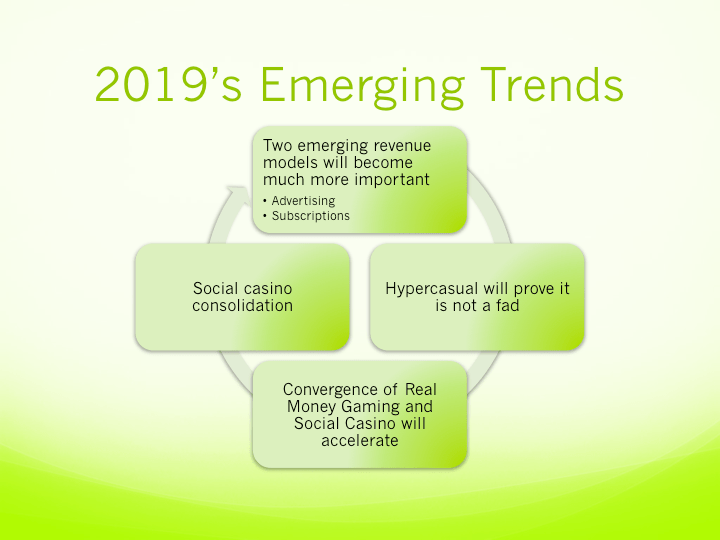
Slide1

Two emerging revenue models will become much more important

While in-app purchases (IAP)will continue to drive revenue for social casino and social games, two other revenue sources will grow in importance.

  1. Advertising revenue.While advertising revenue already been the primary revenue source for many social games, it still represents only a small percentage of total social game revenue and many applications. In 2019, I expect advertising to become more important for all apps, particularly social casino. If done correctly, watch to earn videos do not cannibalize IAP revenue from spenders and creates revenue from the 95+ percent who do not monetize. Not only do ads not cannibalize IAP revenue, it often increases it by improving engagement and retention.

    Additionally, as customer growth in many social gaming verticals stagnates, particularly social casino, it will be increasingly important to generate additional revenue from existing players. Advertising will provide incremental revenue that complements the other product initiatives and allows companies to cast a wider net in their user acquisition activities.

  2. Subscriptions become another revenue option. While advertising will grow as a revenue source for social casino and social games, subscriptions will make an even greater impact. The subscription model has worked very well in Asia, it is a large part Tencent is valued at over $350 billion, but has not made a big difference in the mobile gaming space in the west (US and Europe). It is also the key to Netflix’s success and arguably Amazon’s (see Amazon Prime). Mobile game companies are finally understanding how to incorporate subscriptions in their business models, rather than just throwing them out there as an additional in-app purchase. The strength of subscriptions throughout the economy suggest it can become as important or even more important than IAPs eventually for social games.

Hypercasual will prove it is not a fad

The biggest development in social gaming in 2018 was the rise of hypercasual games, which now make up more than 50 percent of all mobile downloads. They have also dominated the M&A scene, with Zynga buying Gram Games for $250 million, Goldman Sachs investing $200 million in Voodoo as well as multiple smaller deals. Hypercasual games typically have a single mechanic and a single goal, yet reaching a high score can be very difficult. Effectively the core game loop is very straightforward, do one thing, get rewarded (so you can try again) and keep repeating to get a higher score.

In 2019, I expect the hypercasual segment to mature. By mature, I do not see lower growth but a more professional approach. Companies will no longer succeed by throwing a lot of products at the market. Instead, the industry will fragment, with different companies focusing on specific demographics or gameplay mechanics. I also expect you will see higher product values, while a $25k hypercasual game can be a huge success now, competition will raise the bar. UIUX will improve as will technical stability (today’s hypercasual games remind me of Facebook games from 2012, while games crashing are part of the experience). The increase in quality will eventually drive out the small and independent developers (except for the best and the brightest) but will result in better consumer experiences.

Convergence of Real Money Gaming and Social Casino will accelerate

With both Real Money gaming and social casino becoming increasingly competitive, they will lean more heavily on each other to capture best practices and improve their businesses. Social casinos are great at progression and social mechanics and these features will increasingly find their way into real money gaming, where just adding games no longer will be enough for success. On the social side, with the ability to grow the social slots market seemingly coming to an end, social casinos will take more gaming mechanics (sports betting, live dealer, virtual sports) from real money and adapt them to the social space.

Also, real money online gaming companies will get over their phobia that social gaming is cannibalistic and realize what their land based brethren discovered years ago, the two businesses are complimentary and increase the size of the pie. Social gaming provides the trigger for players to want to play roulette or slots and can also prove a great brand building opportunity. Partnerships similar to MGM’s relationship with Play Studios (where MyVegas and Play Studio’s other games share MGM’s rewards program) will extend into the real money space. As the US real money market emerges, real money operators will be increasingly anxious to partner with social casino companies to access their players.

Social casino consolidation

With user growth slowing in the social casino space, the top companies have to look elsewhere to grow their businesses. They have proven quite adept at increasing revenue from existing users, leading to unbroken annual growth for the past ten years that is likely to continue for at least another few years. But growing revenue per user has its limits, and the owners of the top social casino companies are demanding even more growth. While companies have had mixed (i.e. disappointing) results purchasing small players, the major casinos are driving growth by acquiring the other big boys. Late 2017, Aristocrat purchased Big Fish for about $1 billion. DoubleU also acquired DoubleDown Casino for over $800 million. These two deals have created the number 2 and number 3 social casino companies and I expect this trend to accelerate in 2019 as there will be limited other options for rapid growth.

Return to blogging

One prediction I can be 100 percent confident in is that I will be blogging more in 2019. While the real world got in the way of my blogging in 2018, there are many topics I plan to cover in 2019. I also look forward to any ideas from my friends and followers on topics you would like to see me discuss.

Retrospective

It would be intellectually dishonest if I wrote about my expectations for 2019 without reviewing how my picks for 2018 did. So how did I do last year:

  • The convergence of micro-segmentation, AI and machine learning to create extreme personalization. In 2018, the social casino industry continued to experience strong growth despite flat user numbers. The key driver for this growth has been better personalization and segmentation, the successful companies are tailoring promotions and sales for individual users. If anything, I expect this trend to accelerate in 2019 as companies actually understand what they are doing with machine learning and AI.
  • Voice recognition. While it has not had a big impact on the social casino space, voice driven devices continue to gain ground with Google and Apple joining Amazon promoting voice heavily. I expect in 2019 game companies will figure out how to combine the growth of voice with gaming products.
  • Big change in social casino. I will call this one a slight miss as the space has not evolved dramatically. Stars Group did release the first social casino games, PokerStars Play and Jackpot Poker, with Live Dealer but overall the industry did not change much from 2017. I still expect an innovative company will change the market in 2019.
  • Devices and platforms will become less important. I will admit to a miss here, the ecosystem still revolves around Apple and Google.
  • Dual devices. Another slight miss here. Dual devices have become a reality but they have not significantly impacted the game space.
  • Big players will enter free to play, and fail. This was a big miss and indicative of a sea change but one I am very happy about. After years of social casino and mobile gaming overall being the shiny thing and companies make stupid investments to get into the space, the business has rationalized. Companies are now looking at the competitive situation and financials before moving into the space, leading to a much more rational environment.
  • Privacy. BOOM, did I get this one correct. As someone who personally does not worry too much about my online privacy, privacy became the story of 2018. While privacy concerns will not go away in 2019, I think the concerns will ebb as people understand how to control what they share. The days of aggressively compiling and sharing user data, however, are gone and those companies that still act in a rogue way put their whole business at risk.

See you in 2019, have a great year.

Key takeaways

  1. 2019 should see the emergence of two additional revenue streams for social casino and social games, subscriptions and advertising.
  2. Hypercasual will prove to have legs, remaining a dominant genre in gaming
  3. Real money gaming will borrow more from social casino in 2019 while social casino operators will try game mechanics popular in real money.

Share this:

  • Click to share on Facebook (Opens in new window) Facebook
  • Click to share on LinkedIn (Opens in new window) LinkedIn
Like Loading...
Unknown's avatarAuthor Lloyd MelnickPosted on December 31, 2018December 29, 2018Categories General Social Games Business, General Tech Business, Social CasinoTags advertising, hypercasual, Live Dealer, Mergers and Acquisition, Subscription, Virtual Sports1 Comment on Social Casino Outlook for 2019

Lessons from Real Money Gaming talk at Casual Connect

Lessons from Real Money Gaming talk at Casual Connect

Earlier this month, I spoke at Casual Connect about lessons from Real Money gaming that could be applied to the social space. These lessons range from product to CRM to VIP. See the full talk here:

Share this:

  • Click to share on Facebook (Opens in new window) Facebook
  • Click to share on LinkedIn (Opens in new window) LinkedIn
Like Loading...
Unknown's avatarAuthor Lloyd MelnickPosted on June 20, 2018June 19, 2018Categories General Social Games Business, Social CasinoTags Casual Connect, real money online gamblingLeave a comment on Lessons from Real Money Gaming talk at Casual Connect

How to build a Leaderboard that actually works and drives KPIs

Leaderboards are a common feature in games but developers are often surprised because they are ineffectual or quickly lose impact. The problem is not in the underlying value of leaderboards but in how they are often designed. A recent blog post by Omar Ganai and Steven Ledbetter, How to Motivate with Leaderboards, does a great job of presenting the underlying psychology driving leaderboards and best practices.

What makes leaderboards work

The key principle behind leaderboards is that people want to win and winning improves status. What is often neglected, however, is that some players do not want to win, they want to avoid losing. The latter is important as players who want to avoid losing perform worse when competing. Competition is good for motivation and achievement only when it helps users feel competent. You need to design your leaderboards so it does not make your players feel incompetent.

Ganai and Ledbetter point out that self-determination theory shows people seek and engage in undertakings that fulfill three basic needs. Thus, a well designed leaderboard is consistent with these three needs:

  1. Competence. The emotion a player feels when they successfully complete a challenging goal. The opposite feeling is ineffective or helpless.
  2. Relatedness. The feeling a player has when they are understood and liked by other players. The opposite feeling is rejection and disconnection.
  3. Autonomy. The satisfaction a player gets resulting from a personal commitment and choice. The opposite here is coercion and manipulation.

An effective leaderboard will combine competence, relatedness and autonomy while not making the player feel helpless, disconnected or manipulated.

Best practices in designing leaderboards

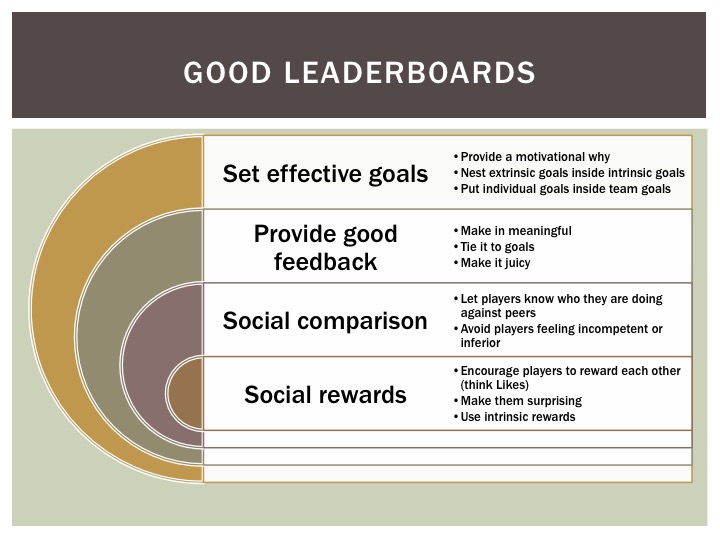
To design a leaderboard that drives behavior and incorporates the three needs above, the authors point to four “ingredients”:

Slide1

  • Goal-setting.Goal-setting involves giving or guiding a user toward a goal, and has become recommended as an effective building block for behavior change. The goal of most leaderboards implicitly is to be number one. You need to go beyond this implicit goal and guide your player toward a goal. Effective goals include having fun, learning and showing autonomy. They also recommend nesting intrinsic goals with the extrinsic goals, like making yourself a better poker player by competing on the leaderboard. Finally, an effective technique nests individual goals inside team goals, so the leaderboard is more about playing with others than being number one.

    There are also some goals you should avoid as they will prove demotivating. These goals include meaningless rewards (get more worthless points by finishing number one), emphasizing outcomes players cannot control and focusing on pride (i.e. you should win because only the smartest win).

  • Feedback. A strong feedback mechanic can promote feelings of mastery and competence. You should provide feedback for players on how they are progressing tied to the above goals they have set. The authors also suggest proving juicy feedback, “juicy feedback is varied, unexpectedly excessive sensual positive feedback on small user actions and achievements.”
  • Social comparison. Social comparison helps players understand how they are doing compared to others. Rankings are inherently a form of social comparison. The trick is doing it right because social comparison can make people feel ineffective and unrelated. People tend to compare themselves with people above them so it is easy for them to then feel incompetent.

    There are some techniques to mitigate the risks in social comparison. First, you can tell players they have achieved a standard, even if they did not finish first. Second, explain why players got the score they did and explain how they can do better. Third, give players a choice of playing more or stopping (putting them in control). Finally, acknowledge losing is not fun. If you keep players focused on improving and playing well, they are likely to stay engaged. Also, if they lose as part of a team, the impact of the loss will not be as great, thus it is critical to emphasize connections and relationships.

  • Social rewards. Just as Facebook uses the Like button, let other players reward a player for their activity. You can achieve this impact by letting them follow the player or just sending a virtual high-five. It also helps to make the rewards surprising, as predictable rewards undermine intrinsic motivation.

What to do

Rather than avoiding leaderboards, build them but build them correctly. If you employ a lazy approach and just rank players 1 to one million, the leaderboard will not work well and impact will diminish over time. If you take the time, however, to set up effective goal setting, provide good feedback, employ social comparison and have strong social rewards, you will have a winning feature and move up the AppStore leaderboard.

Key takeaways

  1. While leaderboards are a central feature in many games, for them to be effective you must build them properly or else they will be ineffective.
  2. A key to good design is keeping players from feeling incompetent or inferior.
  3. The other critical components of powerful leaderboards are clear goals, a strong feedback loop, social comparison and rewards that are social.

Share this:

  • Click to share on Facebook (Opens in new window) Facebook
  • Click to share on LinkedIn (Opens in new window) LinkedIn
Like Loading...
Unknown's avatarAuthor Lloyd MelnickPosted on June 19, 2018June 18, 2018Categories General Social Games Business, General Tech Business, Social CasinoTags Feedback, game design, goals, leaderboards3 Comments on How to build a Leaderboard that actually works and drives KPIs

How to add features that your customers actually want

How to add features that your customers actually want

One of the challenges successful game developers face is what features to add to the product. With a successful game, you are not in panic mode but you also must deal with the reality that in a free-to-play product you need to keep players engaged or you will become the next Trivia Crack. The fundamental issue is adding features that are useful and fun for your existing players, that enhances their enjoyment of your game.

Keys to adding successful features

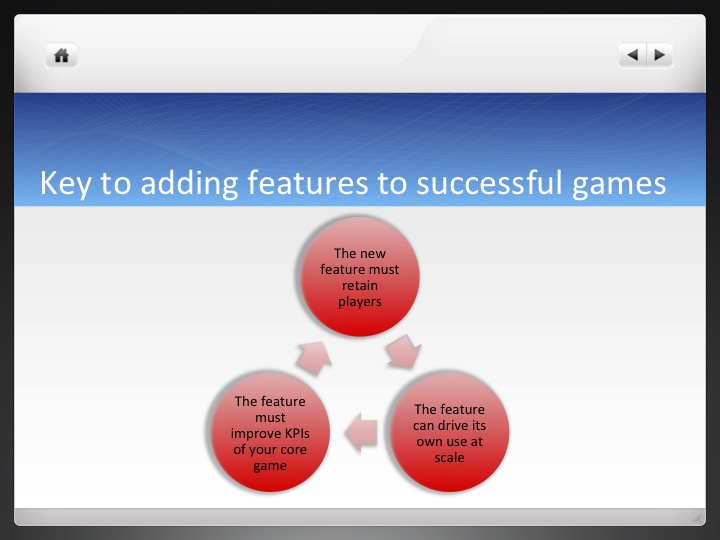
There is an excellent post by Casey Winters that highlights three keys to building features that enhance a successful product:

Slide1

  1. The new feature must retain players. The feature itself retains the player and you do not have to drive players artificially to it from other parts of the game. For example, if you add Blackjack to your social slots application, it works if players engage with Blackjack and then come back to play it regularly. You can use the same retention metrics (D1, D7, D30 and CURR) to assess if a feature is working as you do to look at an app.
  2. The feature can drive its own use at scale, you do not need to create a plan to build adaption. To use the Blackjack example, if you integrate it in your lobby players will try it without forcing you to run specific campaigns.
  3. The feature must improve KPIs of your core product. To use the blackjack example, it needs to improve either your overall retention or monetization.

The last point is critical to success. I used to be at a game company where product managers regularly presented analysis of their features and bragged about the great performance of the feature. Overall, though, the company’s games continued to lose players (DAU) and monetization per player (ARPDAU) was also decreasing. While the features appeared to perform great in a Powerpoint, they actually were costing the company money because they drove lower overall performance.

How to add features that improve LTV

While you may infer from the previous sections that you should only integrate features that appeal to everyone, the opportunity is to segment your players and build features to appeal to target segments. If you limit yourself to only adding features that are accretive to everyone, you have a small pool to pull from.

Given you already have a successful game, by definition your players are already enjoying your product. While there may be opportunities to add features everyone enjoys, you have a bigger set to choose from if you also identify features that may appeal to a subset of your players. This is particularly powerful because this feature can appeal to a segment that is likely to churn and keep them engaged or a segment that does not monetize and prompts them to spend. Conversely, it could only appeal to the ½ of 1 percent that are VIPs but given how much they spend could have a great impact on revenue

If you are building a feature that appeals to a specific segment, then you must be careful not to violate the third key to creating a successful feature, you do not want it to impact negatively overall KPIs. The way to achieve this balance is by positioning or displaying the feature only to the target audience. This can be done as an AB test, where you only surface the feature to specific players. It can be achieved through targeted CRM (in-game banners, push notifications, email, etc.) that is only sent to players in the target group. Surfacing a different UIUX to players who you want to engage with the feature can also accomplish the same goal. The key is maximizing how much the target audience uses the feature and minimizes how much other players see it.

Using the blackjack example yet again, we can illustrate how it could help a social casino game. Overall, slots monetizes much better than blackjack. It is a faster game and many blackjack players will play in a way so they lose very few chips. If you added blackjack to a successful slots game and promoted it across your player base, you probably would get great engagement as a lot of people love blackjack. It would, however, drive some players from your slots to blackjack where they are likely to monetize at a lower rate. If you were looking at how it would impact overall performance, then, you would say blackjack is a failure.

If, however, the blackjack game was not in the main lobby but embedded deeper in the game and you then drove players who were likely to churn (maybe you have a nice machine learning algorithm that can identify these players) to blackjack, it would engage some of these players. They would then come back regularly to play and rather than churn some would monetize. Thus, you would have a successful feature that helps the overall product.

Add features that help your game

Although it sounds obvious, when building your product roadmap you need to dive deeply into each potential feature and identify how it will improve KPIs of a target segment. Effectively, how will it solve a problem for you or your player (user churning, user not spending, etc.). The bigger the problem, the higher the priority.

Key takeaways

  • The key to adding new features to a successful product is ensure the feature itself retains players, can generate its own use and helps the overall KPIs of your game.
  • You must avoid features that seem to perform well when reviewed in a vacuum but actually hurt the KPIs of the game.
  • You can achieve launching a successful feature by targeting your players and then only showing or promoting the feature to players who will benefit from it.

Share this:

  • Click to share on Facebook (Opens in new window) Facebook
  • Click to share on LinkedIn (Opens in new window) LinkedIn
Like Loading...
Unknown's avatarAuthor Lloyd MelnickPosted on May 29, 2018May 27, 2018Categories General Social Games Business, Growth, Social CasinoTags features, monetization, Product design, product management, retentionLeave a comment on How to add features that your customers actually want

How to balance your publishing or development portfolio

How to balance your publishing or development portfolio

Most investors know that to optimize the expected value and risk of their financial portfolio they need the right mix of domestic and international stocks, bonds and cash. Many game companies, however, fail to heed the core principals of diversification when building their portfolios and deciding what projects to green light. Ironically, very successful companies often amplify this mistake by replicating (i.e. cloning) their hit.

Mistake 1: Copying your hit

The most common mistake successful game companies make is re-skinning or cloning their biggest game. The logic behind this decision is that it is quite difficult to create a hit game so copy what you know. Most frequently, however, the clone fails to reach expectations and the company is left relying on the original hit.

The flaw in this strategy, leading to a negative result, is that the new product appeals to users who are already highly engaged with your company. Since the existing product is a success, players are not looking for an alternative. They already love what they have, why give them the same thing in a different wrapper. I recently wrote about how challenging it is to steal VIP customers from a competitor because they already love the product, it is just as difficult to steal them from yourself.

In the social casino space, you often see this mistake by companies that have a hit slots product, just change the feel of the casino, keep the same slots, and then the new product does not perform as well as the original.

Mistake 2: Appealing to the exact same market

If you base your new product on one of your existing products, you will appeal to the same customers. By appealing to the same users, you are not expanding your potential market but can only increase your share of wallet.

Again, using the social casino space as an example, there are different types of slots players. If your existing game is appealing to players who enjoy land based casinos, rather than creating another product for this target market you can build off of your success by creating a product that appeals to recreational online-only players. Thus, you can still monetize the land-based players with your core product, and increase monetization by improving that game, but you open up a new market.

Mistake 3: You are not creating a blue ocean opportunity

The core of the issue in creating a copy of an existing product is you are not creating a blue ocean opportunity, that is moving to a market space where the competition is not relevant. I have written frequently about Blue Ocean strategy, and rather than repeat it the key is that you have a higher ROI by pursuing a blue ocean strategy than competing in a red (bloody competitive) market.

Blue Ocean strategy is incompatible with cloning your existing product because a new product needs to fulfill four criteria to create a blue ocean:

  1. Raise. You need to raise some of the elements of value you are currently competing on.
  2. Eliminate. You need to eliminate some features or aspects that you compete on.
  3. Add. You must add new features or attributes that other products do not have.
  4. Reduce. You have to reduce some of the features that the industry relies on.

By definition, if you are copying an existing product you are not doing any, let alone all, of these changes needed to move into a space where the competition is non-existent.

Mistake 4: No new VIPs

VIPs are the lifeblood of a successful mobile game. Less than one percent of players normally drive over 80 percent of revenue, thus it is critical to have a strong VIP base for a game to be successful. When you re-skin or clone an existing game, it becomes virtually impossible to build a strong new VIP base. Your existing VIPs already love the old product, hence why they are VIPs, so they have no reason to move (and you probably have no benefit in moving them). New customers were already exposed to the same mechanics in the existing product and chose not to become VIPs, thus it is very unlikely the new product will generate a different reaction.

What you should do

The easy part of the game industry is recommending what not to do, the challenge is how do you grow your product base. There are many different ways to run a good green light process, assess market conditions, etc., and that is not the purpose of this post (please see my post on how to create a mobile gaming hit). Instead, I recommend you build out a strong green light process that looks at the market, the competition, your strengths and gaps in the market and build your product strategy from there. If you already have a hit product, rather than start from scratch, see how you can leverage key elements of that product to expand into a different segment of the market or create an entirely new space.

Key takeaways

  • While it is tempting to try to replicate your successful product by re-skinning or cloning it, such a strategy is likely to fail as it will not expand your market.
  • Cloning a product is the inverse of pursuing a Blue Ocean strategy (which requires focusing on four core elements: Eliminate, Raise, Add, Reduce), and Blue Ocean generates a higher long-term ROI that traditional strategy.
  • If you have a hit, rather than start from scratch see how you can leverage key elements of that product to expand into a different segment of the market or create an entirely new space.

Cloning

Share this:

  • Click to share on Facebook (Opens in new window) Facebook
  • Click to share on LinkedIn (Opens in new window) LinkedIn
Like Loading...
Unknown's avatarAuthor Lloyd MelnickPosted on May 1, 2018April 30, 2018Categories General Social Games Business, Social CasinoTags Green Light, green light process, portfolio strategyLeave a comment on How to balance your publishing or development portfolio

Casual Connect Europe session on Lessons from Real Money Casino

Casual Connect Europe session on Lessons from Real Money Casino

I will be speaking next month at Casual Connect Europe on lessons from real money that give your free to play game a competitive advantage. If you are attending the show, please come by my session.

Share this:

  • Click to share on Facebook (Opens in new window) Facebook
  • Click to share on LinkedIn (Opens in new window) LinkedIn
Like Loading...
Unknown's avatarAuthor Lloyd MelnickPosted on April 30, 2018April 29, 2018Categories General Social Games Business, Social CasinoTags Casual Connect, real money online gamblingLeave a comment on Casual Connect Europe session on Lessons from Real Money Casino

Hypercasual, the real next big thing in mobile gaming

There is a lot of buzz now about hypercasual games, and, for once, I agree with the buzz. There is a new big thing in gaming every year – a new console, technology, mechanic, etc. – that people expect to change the industry, investment flocks to it and a few years later it becomes an afterthought and a lot of people have to send out their resumes. I am usually skeptical of these fads, if you look at my posts there is not one about VR, blockchain, 3D, etc., but hypercasual is the exception

Hypercasual, is not a fad because it taps into what is one of the strongest drivers of building a successful product, simplicity. I have written repeatedly about how people gravitate to easy products that minimize cognitive load, and often use the example of Uber’s success to show that simple and straightforward can generate tens of billions of dollars of value. Hypercasual games tap into that formula for success.

A recent article, 100 Million Downloads: How Hypercasual Mobile Games Are Rewriting the Game Design Rulebook by Tom Kinniburgh, does a great job of both quantifying the success of the genre and pointing out key rules to building hypercasual games.

What is hypercasual

The first step to analyzing the hypercasual market is defining what is hypercasual. If you do not define it, you cannot build towards it. As Kinniburgh writes, “the term ‘hypercasual’ has become a collective way to reference games of this nature. Such titles typically have a single mechanic and a single goal, yet reaching a high score can be fiendishly difficult.” Effectively the core game loop is very straightforward, do one thing, get rewarded (so you can try again) and keep repeating to get a higher score.

Slide1

The state of the hypercasual market

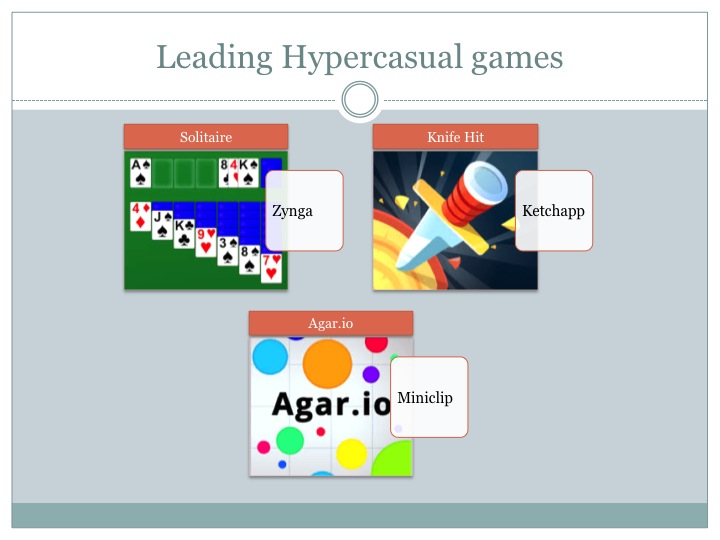
Hypercasual is not the next big thing that developers and investors are flocking to but an already established space in the game ecosystem with hundreds of millions of players. There are already tens, if not hundreds, of hypercasual games with over 100 million downloads. To put that number in perspective, 100 million downloads is more downloads than if everyone in Germany or France or the UK installed the app. These games include Agar.io, Finger Driver, Balls Race, Dunk and most of the other games at the top of the various app stores’ charts. The acquisition of Harpin, a one-person studio that built a solitaire game, for over $42 million also validates the hypercasual market, as companies usually do some due diligence before investing millions of dollars.

How to build a hypercasual game

The core game mechanic is even more important in the hypercasual space. As mentioned above, hypercasual games have a single mechanic that the player keeps repeating to get a superior score. Thus, the single mechanic needs to be fun, easy and compelling or else the player will not want to continue.

This core mechanic must also be easy for the player to understand quickly and provide for ever improving scores. Kinniburgh writes, “Great hypercasual are easy to grasp, but rely on players having a perfect run to succeed, and they measure that perfection with a score.”

By being easy to understand quickly, players recognize that playing more leads to better scores. If it is difficult to comprehend how to play, the score and activity would not be linked in the player’s mind so they would not be driven to keep playing. Also, if continued play did not yield higher scores, then the key incentive to more gameplay would not exist.

This simplicity exists throughout the game. Unlike other game genres, you do not introduce more features (complexity) as the game progresses. According to Kinniburgh, “great games in this genre rely on mechanics that provide everything the player needs to play from the start of the game, either with a single life on offer – such as Flappy Bird – or with multiple lives, like Ballz. In each case, however, the game ends when said lives count reaches zero.”

While the gameplay mechanic needs to stay consistent, the game must also scale so players do not get bored. If they can master the game, then the score is capped. Instead, you need to introduce variety by making higher levels more difficult (less time, bigger opponents, etc) or making the level more complex (a puzzle game with more area blocked). According to Kinniburgh, there are three ways to scale hypercasual games:

  • Changing the underlying environment
  • Changing the speed
  • Adding a PvP element

When designing, use one or a combination of these elements to keep the player engaged.

How do you make money

I, and most others, would not care about hypercasual if there was not a way to translate the popularity of these games into revenue. The most obvious answer is in-game advertising. Throughout the game space, advertising is becoming an increasingly important revenue stream. Players in games already see rewarded video as a benefit; adding watch to earn almost always increases your retention metrics. Machine learning now allows for more targeted advertising, creating a better user experience (you see ads you are actually interested in) and a better value for advertisers (you only pay to show ads to people who are really potential customers). These two forces are further driving ad revenues for game companies.

Hypercasual taps into this trend because of the sheer number of players you attract. With hundreds of millions of players, algorithms have more data on who to target with what, providing better advertiser and user experiences. And, with each player generating some revenue, hundreds of millions of players directly translates to more revenue.

In addition to direct advertising revenue, you can improve company revenue by using hypercasual as an acquisition channel. While the Harpin acquisition may be ROI positive based on advertising revenue, my guess is that the revenue it generates by driving players to Zynga Poker and other games with strong lifetime values actually is more valuable than the direct revenue from Harpin’s games. Using hypercasual as a portfolio play rather than a standalone opportunity further builds value.

Future opportunities for hypercasual

With many trends, by the time you read about it, it is too late to capitalize, but in the case of hypercasual there are still many opportunities. First, the underlying principle of a single, simple mechanic will always lead to a good user experience. My philosophy is simpler is better, and hypercasual is defined by simplicity.

Also, for those in the casino space, hypercasual has barely raised its head. While Harpin and several other hypercasual companies have built great businesses around solitaire or solitaire like apps, that is largely the extent of its penetration of the most exciting gaming vertical (social casino). There are no hypercasual games that target slot players, which represents about 80 percent of the social casino market. Same for table games (roulette, baccarat, etc), which seem to lend themselves perfectly to hypercasual.

The opportunity also is not limited to free to play casino, but the real money space can learn from it. The success of lottery products not only shows willingness to gamble on hypercasual experiences but a strong and continuing desire to do so. Also, the high customer acquisition costs in real money suggests the value of hypercasual as an acquisition tool would dwarf the benefits free to play companies get from these games.

Key takeaways

  1. Hundreds of millions of people play hypercasual games; apps that have a single game mechanic where players keep returning to get a higher score.
  2. Hypercasual games are a great opportunity in the free to play social casino market, as there is still no hypercasual games that target slots players, the biggest segment of that space
  3. Hypercasual is also an untapped opportunity in real money gaming, as lotteries show players willingness to gamble on a hypercasual experience and they provide a way to offset the very high customer acquisition costs.

Share this:

  • Click to share on Facebook (Opens in new window) Facebook
  • Click to share on LinkedIn (Opens in new window) LinkedIn
Like Loading...
Unknown's avatarAuthor Lloyd MelnickPosted on February 27, 2018March 1, 2018Categories General Social Games Business, Social Casino, Social Games MarketingTags harpin, hypercasual, user acquisition2 Comments on Hypercasual, the real next big thing in mobile gaming

The dark cloud over social casino revenue

While projections for the social casino (free to play slots and poker) industry continue to be overwhelmingly positive and the industry has never seen a revenue decline on a sequential basis, there is an ominous KPI that nobody is discussing. While the industry continues to grow, that growth is from better monetization, not bringing new customers into the market. This fact potentially puts a ceiling on potential growth or worse portends to a future decline.

Slide1 Continue reading “The dark cloud over social casino revenue”

Share this:

  • Click to share on Facebook (Opens in new window) Facebook
  • Click to share on LinkedIn (Opens in new window) LinkedIn
Like Loading...
Unknown's avatarAuthor Lloyd MelnickPosted on February 6, 2018February 5, 2018Categories General Social Games Business, Lloyd's favorite posts, Social CasinoTags Growth, monetization, social casino2 Comments on The dark cloud over social casino revenue

Posts pagination

Previous page Page 1 … Page 3 Page 4 Page 5 Page 6 Next page

Get my book on LTV

The definitive book on customer lifetime value, Understanding the Predictable, is now available in both print and Kindle formats on Amazon.

Understanding the Predictable delves into the world of Customer Lifetime Value (LTV), a metric that shows how much each customer is worth to your business. By understanding this metric, you can predict how changes to your product will impact the value of each customer. You will also learn how to apply this simple yet powerful method of predictive analytics to optimize your marketing and user acquisition.

For more information, click here

Follow The Business of Social Games and Casino on WordPress.com

Enter your email address to follow this blog and receive notifications of new posts by email.

Join 791 other subscribers

Most Recent Posts

  • Join me at PDMA Inspire for my talk on new product prioritization
  • Why keep studying?
  • The next three years of this blog
  • Interview with the CEO of Murka on the biggest growth opportunity in gaming, Barak David

Lloyd Melnick

This is Lloyd Melnick’s personal blog.  All views and opinions expressed on this website are mine alone and do not represent those of people, institutions or organizations that I may or may not be associated with in professional or personal capacity.

I am a serial builder of businesses (senior leadership on three exits worth over $700 million), successful in big (Disney, Stars Group/PokerStars, Zynga) and small companies (Merscom, Spooky Cool Labs) with over 20 years experience in the gaming and casino space.  Currently, I am the GM of VGW’s Chumba Casino and on the Board of Directors of Murka Games and Luckbox.

Topic Areas

  • Analytics (114)
  • Bayes' Theorem (8)
  • behavioral economics (8)
  • blue ocean strategy (14)
  • Crowdfunding (4)
  • DBA (2)
  • General Social Games Business (459)
  • General Tech Business (195)
  • Growth (88)
  • International Issues with Social Games (50)
  • Lloyd's favorite posts (101)
  • LTV (54)
  • Machine Learning (10)
  • Metaverse (1)
  • Mobile Platforms (37)
  • Prioritization (1)
  • Social Casino (52)
  • Social Games Marketing (105)
  • thinking fast and slow (5)
  • Uncategorized (33)

Social

  • View CasualGame’s profile on Facebook
  • View @lloydmelnick’s profile on Twitter
  • View lloydmelnick’s profile on LinkedIn

RSS

RSS Feed RSS - Posts

RSS Feed RSS - Comments

Categories

  • Analytics (114)
  • Bayes' Theorem (8)
  • behavioral economics (8)
  • blue ocean strategy (14)
  • Crowdfunding (4)
  • DBA (2)
  • General Social Games Business (459)
  • General Tech Business (195)
  • Growth (88)
  • International Issues with Social Games (50)
  • Lloyd's favorite posts (101)
  • LTV (54)
  • Machine Learning (10)
  • Metaverse (1)
  • Mobile Platforms (37)
  • Prioritization (1)
  • Social Casino (52)
  • Social Games Marketing (105)
  • thinking fast and slow (5)
  • Uncategorized (33)

Archives

  • September 2023
  • December 2021
  • July 2021
  • March 2021
  • February 2021
  • January 2021
  • December 2020
  • November 2020
  • October 2020
  • September 2020
  • August 2020
  • July 2020
  • June 2020
  • May 2020
  • April 2020
  • March 2020
  • February 2020
  • January 2020
  • November 2019
  • October 2019
  • September 2019
  • June 2019
  • May 2019
  • April 2019
  • March 2019
  • February 2019
  • January 2019
  • December 2018
  • June 2018
  • May 2018
  • April 2018
  • March 2018
  • February 2018
  • January 2018
  • December 2017
  • June 2017
  • May 2017
  • April 2017
  • March 2017
  • February 2017
  • January 2017
  • December 2016
  • November 2016
  • October 2016
  • September 2016
  • June 2016
  • May 2016
  • April 2016
  • March 2016
  • February 2016
  • January 2016
  • December 2015
  • November 2015
  • October 2015
  • September 2015
  • July 2015
  • June 2015
  • May 2015
  • April 2015
  • March 2015
  • February 2015
  • January 2015
  • December 2014
  • November 2014
  • October 2014
  • September 2014
  • August 2014
  • July 2014
  • June 2014
  • May 2014
  • April 2014
  • March 2014
  • February 2014
  • January 2014
  • December 2013
  • November 2013
  • October 2013
  • September 2013
  • August 2013
  • July 2013
  • June 2013
  • May 2013
  • April 2013
  • March 2013
  • February 2013
  • January 2013
  • December 2012
  • November 2012
  • October 2012
  • September 2012
  • August 2012
  • July 2012
  • June 2012
  • May 2012
  • April 2012
  • March 2012
  • February 2012
  • January 2012
  • December 2011
  • November 2011
  • October 2011
  • September 2011
  • August 2011
  • July 2011
  • June 2011
  • May 2011
  • December 2010
January 2026
S M T W T F S
 123
45678910
11121314151617
18192021222324
25262728293031
« Sep    

by Lloyd Melnick

All posts by Lloyd Melnick unless specified otherwise
Google+

Enter your email address to subscribe to this blog and receive notifications of new posts by email.

Join 791 other subscribers
Follow Lloyd Melnick on Quora

RSS HBR Blog

  • Regaining Momentum After a Holiday Break
  • When You’ve Outgrown Your Relationship with a Trusted Advisor
  • Research: Conventional Cybersecurity Won’t Protect Your AI
  • Weave Mentorship into the Fabric of Your Organization
  • To Execute a Unified Strategy, Leaders Need to Shadow Each Other
  • What Companies that Excel at Strategic Foresight Do Differently
  • How Bristol Myers Squibb Transformed Working Capital to Fund Its Future - SPONSOR CONTENT FROM EY-PARTHENON
  • When Being a Family Business Becomes a Competitive Advantage
  • How to Handle a Difficult Board Member
  • How to Strengthen Your Focus When Demands Never Let Up

RSS Techcrunch

  • An error has occurred; the feed is probably down. Try again later.

RSS MIT Sloan Management Review Blog

  • Build Better Pay-for-Performance (PFP) Compensation Plans
  • Your People Are Not All Right
  • Five Trends in AI and Data Science for 2026
  • Stop Making Hollow Apologies at Work
  • Calm: The Underrated Capability Every Leader Needs Now
  • The Top Five MIT SMR Videos of 2025
  • Three Steps Toward Fairer Talent Management
  • From Crisis to Coopetition: What Leaders Can Learn From Anesthesiologists
  • AI Coding Tools: The Productivity Trap Most Companies Miss
  • How Procter & Gamble Uses AI to Unlock New Insights From Data
The Business of Social Games and Casino Website Powered by WordPress.com.
  • Subscribe Subscribed
    • The Business of Social Games and Casino
    • Join 726 other subscribers
    • Already have a WordPress.com account? Log in now.
    • The Business of Social Games and Casino
    • Subscribe Subscribed
    • Sign up
    • Log in
    • Report this content
    • View site in Reader
    • Manage subscriptions
    • Collapse this bar
 

Loading Comments...
 

    %d