I recently read a column by Robert Eckert, the former CEO of Mattel who engineered its turnaround, and he highlighted two words that were crucial to his success leading the company. Although not as cool or trendy as some of the other topics I have discussed in this blog, looking at my own successes I realize these two words are as important or more important than many of the strategies I evangelize. Those words are Thank You. Continue reading “Two words crucial to success”
Four old-school business practices that still create value
A recent Harvard Business review post by John Coleman about “old-school” business practices worth bringing back highlighted several traditional office habits that still improve productivity.While I love posting about the cool new trends (growth vs marketing , lifetime value-driven ad spending, etc.) that can have a huge impact on your business, I agree with Coleman that you shouldn’t abandon everything from business pre-2005. The four suggestions from Coleman’s post that I most agree with (he had five but I was not sold on one of them) are:
- Make meetings distraction free. This to me is the most important practice Coleman highlights, and it’s not necessarily “old school.” Meetings are not as productive if half (or even one) attendee is looking at their phone or playing with their laptop. Getting rid of these distractions make meetings more focused and productive. Although those using their devices may be doing something productive, if they have something more important to do they should not be in the meeting in the first place. (This brings to mind another good practice: make sure everyone in a meeting needs to be there.) Continue reading “Four old-school business practices that still create value”
Pivoting is not just about business models
While the focus and glory is on an ability to quickly pivot your business model, a more important skill for entrepreneurs is being able to pivot inside your business. We encourage and fête leaders who change their business model to deal with changing market conditions or adjust their original plan when it meets reality. As important to growing your company and reaching an exit (or more important), but often unseen and unsung is the ability to change the way you do business, your processes, technology, etc. The success of my first company, Merscom, is often attributed to our pivoting from value core games (CD-ROMs sold at stores like Target and Best Buy) to casual downloadable games (e.g., hidden-object games downloaded from sites like Big Fish) and then pivoting to social (i.e., Facebook) games. Equally important—but more difficult—was pivoting from licensing content to creating content, pivoting from using external developers to building an internal team and pivoting from a European-focused marketing strategy to a domestic strategy. It was the latter pivots that paved the way for Merscom’s sale to Playdom and subsequently through Playdom to Disney. While all the attention and board meetings are focused on whether or not to pivot your business model, you should spend as much or more time analyzing how you are doing business and whether it needs to change. Continue reading “Pivoting is not just about business models”
Lessons for the game industry from Louisville’s national championship
The most important lesson from yesterday’s national championship is that to be truly successful, you must always be working to improve. Last year, when Kentucky won the national championship, I wrote a piece on how it highlighted the importance of recruiting great talent. This year the lesson is that great leaders (and I definitely put Pitino in that category) never take a break on working to make their organizations better.
What was particularly illuminating was Rick Pitino’s (the coach of Louisville) comment this morning during a radio interview that he “broke down” tape already from the game. For those who are not sports, or basketball, fans, a coach spends the majority of his time watching tapes of his games so he understands what his team is doing right and wrong and tape of opponents so he knows their strengths and weaknesses. Pitino’s need to break down tape highlights several things: Continue reading “Lessons for the game industry from Louisville’s national championship”
Three rules for becoming a truly great game company
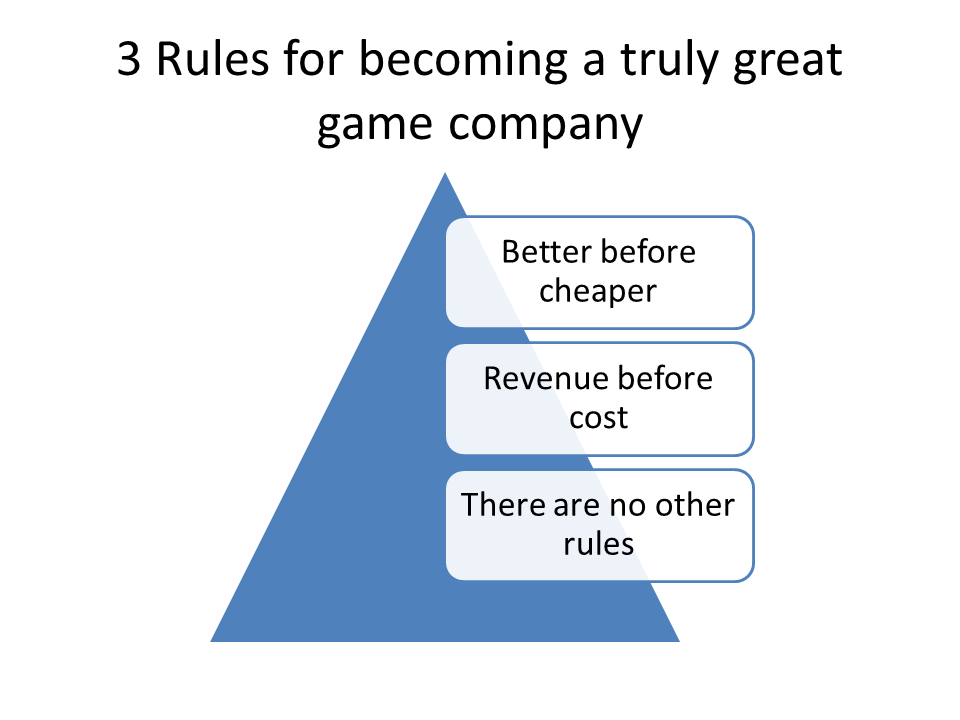
A recent article in the Harvard Business Review, “Three Rules for Making A Company Truly Great,” pointed to three elemental rules that were consistently followed by exceptional companies. There are a lot of hyperbole and clichés about how to create great companies, but the research by Michael Raynor and Mumtaz Ahmed (in the HRB article) shows that three fundamental principles are the keys to success. This finding was based on a statistical study of thousands of companies, so it is much more analytic than what business book happens to be at the top of the charts in a particular week. It is also apparent that these principles apply to social and mobile game companies.
 Continue reading “Three rules for becoming a truly great game company”
The key to measuring the success of your social media marketing
Although most people realize the value of social media marketing (in addition to paid social media performance advertising), few understand the subtleties of understanding how to measure its effectiveness. The secret is to measure engagement.
The relationship era
I was recently at a dinner with Doug Levy, the author of Can’t Buy Me Like, and Doug eloquently made the point that marketing has made a fundamental shift from persuading people to buy to creating trust in your product, and that is what persuades people to buy from you. The most successful marketers are ones who have the greatest expertise in gaining authentic relationships. Among those who have worked with and endorse Doug’s ideas are the CEOs of Whole Foods, Panera Bread and Patagonia, real companies that are highly profitable. Continue reading “The key to measuring the success of your social media marketing”
Reblog of a good post on Player Valuation for Marketing in Free to Play Games
Good post on the value of non-payers.

Aggressive monetization and targeting of high value players is receiving more and more attention from game developers, especially in the mobile channel. This had led to a more analytical approach to game creation. Now before I discuss the industry standard metrics of CAC (Customer Acquisition Cost), ARPU (Average Revenue per User) and LTV (Lifetime Value), I want to touch on something I am concerned is becoming overlooked in the Free to Play Market, the value of non-paying players.
Free to play is just one of many video games business models and the basic premise is that whilst the game itself is free to play or download, certain elements of the game are monetized to create revenue. This can be items, characters, time savers etc. that create the revenue that pays for the development and subsequent profitability of the game.
As the use of Free to Play expands amongst game makers…
View original post 2,030 more words
Why would anyone buy a virtual good?
Many do not understand, or even accept, the motivation for people to spend real money for virtual goods. Some are even more amazed at the success of virtual casinos, where players gamble but can never collect their winnings. They discount it as manipulation or irrational thinking by the consumer. In fact, purchasing virtual goods is a very rational behavior consistent with how people conduct other aspects of their life. Understanding this motivation will help you develop a game that better satisfies your customers’ needs.
Why people shop
Although some people shop because they need something (food, clothing, steak), yet there are many other reasons people shop. In a seminal piece from the Journal of Marketing entitled “Why People Shop?“, Edward Tauber wrote that the obvious answer (“to purchase something”) “can be a most deceptive one and reflects a marketing myopia.” Below are several reasons that Tauber hypothesizes drive shopping behavior, which do not reflect ending up with a physical good. These reasons can also drive monetization in a game: Continue reading “Why would anyone buy a virtual good?”
Lifetime Value Part 8: Incorporating costs and expenses in LTV
An aspect of lifetime value that is often neglected but could mean the difference between the ability to advertise (or not), are the costs associated with your game (or product for those outside the gaming space). As I have discussed in detail in the first seven posts on customer lifetime value (LTV), your lifetime value has to exceed to cost per install of a new user (CPI) to justify advertising. The LTV is a formula incorporating retention, virality and monetization. The other areas, though, that you need to look at are costs that lower the revenue stream from the user. Continue reading “Lifetime Value Part 8: Incorporating costs and expenses in LTV”
Don’t charge for your app, PLEASE (at least if you want to make money)
One of the greatest mistake game companies make is building or launching products that are paid apps, not free-to-play (F2P), which then monetize through micro-transactions. Despite the fact that survey after survey shows F2P games generate more revenue than paid apps, virtually all the investment money goes to F2P products (and VCs are pretty intelligent) and most companies that abandon paid apps for F2P never go back, there are a surprisingly high number of companies still focusing on the paid app model. In particular, many mobile studios whose roots are in the traditional (console) gaming world still prefer the paid app model. As I am often asked to help game companies, it is very frustrating when they forgo my advice and build a paid app. The usual refrain is “But look at Angry Birds.”

A recent analysis by Forbes (“Rovio’s Revenue Crisis and the App Market Evolution”) shows beyond a shadow of a doubt it is just foolish to still be building paid apps, even if you are Rovio. To summarize the key analysis and findings from the Forbes data: Continue reading “Don’t charge for your app, PLEASE (at least if you want to make money)”
 The Business of Social Games and Casino