
Skip to content

The Business of Social Games and Casino

How to succeed in the mobile game space by Lloyd Melnick

Tag: communication

How to become successful CEO

How to become successful CEO

Many people write about how to be a great leader or CEO, but very few of them have actually achieved it. Ben Horowitz is one of the few whose credentials live up to his advice. He cofounded and was CEO of Opsware (formerly Loudcloud), which was acquired by Hewlett-Packard for $1.6 billion in 2007. Before Opsware, he was vice president and general manager of America Online’s (AOL) E-commerce Platform division and also ran several product divisions at Netscape. Even before joining Netscape in July 1995, he held various senior product marketing positions at Lotus Development Corporation (the father of the spreadsheet). Given this great track record, I put significant credence in Horowitz’s book, The Hard Thing About Hard Things: Building a Business When There Are No Easy Answers.

hard thing hard things

Horowitz rightfully focuses on the difficult things that leaders need to do to succeed. CEOs and others who are leading business units (BU) are responsible not only for their fate but the fate of their company or BU, having to make potentially life or death decisions daily (either for the business or for the individuals involved). Based on his experience both running BUs and actively involved in growing others as a VC, Horowitz provides some key principles on how to be a great CEO.

What is The Struggle

The greatest challenge a CEO faces is reality. Horowitz refers to the challenges in leading a business as “The Struggle,” which occurs when dreams of success meet reality. It is also an inescapable element of leading a company, and it consists of the stress and seemingly impossible decisions that come with the territory. The stress and weight of The Struggle will probably affect the CEO’s entire life, from their mental and physical well being to their career choices and social relationships. The CEO is responsible for negotiating the challenges the company faces, and thus it is the leader who will get credit for successes or be let go for failures.

Meeting The Struggle

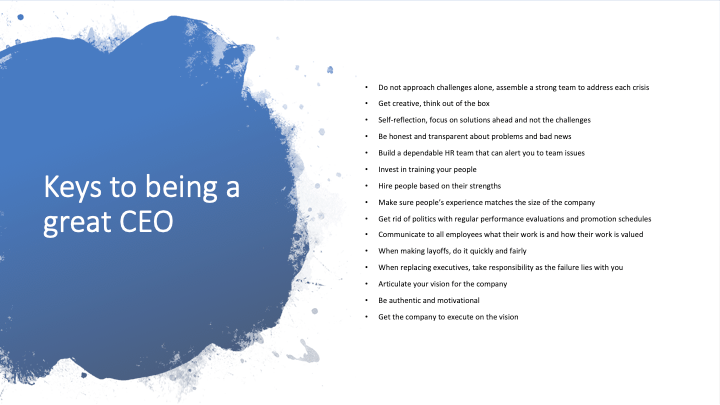
Horowitz suggests several strategies for leaders to manage The Struggle. Among the most important is not trying to face it alone but assembling a strong team to face each crisis. While the burden will fall primarily on the leader, you should not try to bear it alone. Instead, include as many people as possible to face a crisis. When Horowitz’s Opsware faced a crisis caused by the dot-com crash, he got the entire company together in an offsite meeting and told them honestly and directly that unless they overhauled entirely their product they would not survive. As mentioned earlier, he eventually sold Opsware to HP for over $1.5 billion, so it worked.

The second approach to dealing with the Struggle is to get creative. Rather than business as usual, think out of the box for potential solutions. When Horowitz was leading Loudcloud and they were missing their revenue targets, he decided to take the company public to raise the funds he needed.

Horowitz’s third approach to dealing with The Struggle is self-reflection. He points out that dealing with your own psychology is the hardest challenge any CEO faces and it is often lonely. To overcome this challenge, he uses the analogy of a racecar driver. Successful drivers concentrate on the road ahead not on the potential hazards and track walls. Leaders must emulate this approach and focus on the solutions ahead, not the problem.

Intellectual honesty is critical

Another key element for successful leadership is being honest about problems and bad news. He admits that nobody likes to give bad news. He explains, however, that when you are the CEO and your company is dealing with challenges, discussing them openly and directly with your team (not just leadership but entire team) is critical for success.

Horowitz points out that bad news spreads very quickly, whether or not you disclose it. Thus, there is no sense in trying to contain it. Moreover, secrecy can be very damaging because it makes the bad news unexpected when it does surface. Sometimes this secrecy comes from good intent, what Horowitz refers to as the “positivity delusion,” the idea that their employees cannot handle the truth but need to be coddled. The reality is the opposite; employees usually deal with bad news better than the leader, in part because they can blame the leader for the problem.

Instead of keeping quiet, the leader should preemptively head off the bad news by divulging it as soon as possible. This allows the company to focus on a solution and stops gossiping (I would actually say slows gossiping, as gossip never stops). By disclosing problems as soon as you can, a great leader or CEO helps put those problems in the hands of the people who can solve them as quickly as possible.

Take care of your people

Horowitz has learned while building multiple companies that to achieve greatness you need to take care of the people in your company by training them well and creating a good human resource structure. He suggests you ensure you have a dependable HR department as it can give you valuable insights into problems invisible to you.

Second, he shows it is vital to invest in training your people to fit better their roles. He points out that every company has its own procedures and tools and no outsider can pick them up without training. He also stresses the training should be functional, proving employees with the experience and skills they need to succeed in their job and hit their goals.

Hiring based on strengths

In Horowitz’s experience, leaders succeed by hiring people based on their strengths, not their weaknesses. When recruiting, a CEO’s first priority should be hiring people for their strengths, not rejecting based on weaknesses, as the strengths will determine if the person excels at their job.

The second key when hiring executives is to make sure their experience matches the size of the company. In large companies, executives tend to have a lot of incoming work, which makes them have to adjust and review existing projects. In small companies, executives create their own projects and design their own work. These discrepancies can result in mismatches in rhythm, meaning the expected working pace and skill set.

Get rid of politics

Horowitz writes that if you want to build a company where people want to work you have to dispense with politics. By politics, he largely means the maneuvering that some people employ to get an undeserved promotion. The best way to avoid such politics is to only hire people who are ambitious in terms of the entire company, not simply their careers.

Another tool to mitigate politics is the implementation of strict processes that mandate regularly spaced performance evaluations, compensation scales and promotion schedules. These fixed timelines and processes make it more difficult for anyone to get an undeserved promotion.

A final step to eliminate politics is to communicate to all employees what their work is and how their work is valued. Make sure that your hierarchy of titles means something and is understood throughout the organization. One caveat that Horowitz points out is the need to avoid the Law of Crappy People, which states that the most incompetent person who holds a given title determines the value of the title in general. This leads to other title holders feeling undervalued and demotivated.

How to deal with redundancies and layoffs

Horowitz points out that nobody wants to lay people off, but if necessary, it should be done quickly and fairly. When layoffs are needed, it is critical to act fast. Once the decision is made, CEOs should take action, as delaying the inevitable that everyone knows is coming is like letting a wound fester.

It is also important to treat outgoing employees fairly, which is often a challenge as layoffs are frequently the result of deteriorating business conditions. Thus, there is an incentive to support the business rather than the exiting employees. Instead, you need to give the outgoing people decent severance packages and good references. These actions not only help the morale of those who stay but also makes future recruiting easier, not to mention it being the right thing to do.

Finally, the leader needs to be transparent and honest when explaining why they are making the layoffs. Horowitz gives two reasons to take this approach

  1. An admission of failures helps to solidify trust between the remaining employees and the leader
  2. Everyone should understand that the company failed and must now find its way forward and move on.

Own having to replace an Executive

While a company may have to make redundancies when dealing with challenging times, CEOs and other leaders sometimes also must fire members of their leadership team. Horowitz explains that having to let go of a leader is more difficult and serious because there is much more at stake for the company both financially and culturally. Horowitz suggests the best way to approach replacing a leader

  • As the CEO or leader you are responsible for having hired the wrong person and you need to explain this either to the Board or your CEO. Figure out why you made this hiring mistake and how it can be avoided the next time.
  • Prepare thoroughly for the conversation with the executive you are letting go. Include thinking about the kind of language you will use and how you will formulate the severance package. You never want to humiliate the person. You also should not be discussing performance with the outgoing executive, it is not a coaching session but an ending.
  • Treat the outgoing executive fairly and respectfully. This will help morale and performance of the other executives, which will also help ensure smooth operations after the executive has left.

When letting go of an executive, Horowitz stresses that the primary issue is to maintain business continuity (both actual and perceived) despite the departure. The leader has to do what it takes to keep the affected part of the business running normally, including in the short term becoming a temporary replacement for the departed executive.

Set the direction

The key to leading a company or business unit is knowing what to do and getting the entire organization to do it. Horowitz points out that great leaders and CEOs find the right direction for the company to follow. Then they have to articulate that direction and get the rest of the company to follow them. There are thus three critical elements

  1. Articulating the vision.
  2. Being authentic and motivational.
  3. Getting the company to execute on your vision.

Both define the path and execute on it

While some leaders are excellent at defining a direction and others are very effective at execution and performance management, the truly great CEOs and leaders combine the characteristics of both. Some leaders focus on defining a path for their organization to follow rather than implementing it. These leaders have a compelling long-term vision for their company, like Bill Gates did at Microsoft. Sometimes companies led by this type of leader become disorganized and chaotic.

The other type of CEO prefers the execution and performance management aspect of leadership over research and planning. They do not like to make big decisions. With leaders such as these, it can slow down the company as important decisions are delayed or avoided.

Great CEOs and leaders combine characteristics of both. They are like the latter in that when it comes to overall corporate decisions, they like to focus on execution rather than planning the company’s path forward. Where they are different, however, is that when it comes to their own area of responsibility and expertise, they act as planners (the first category). The implication of Horowitz’s view is that no matter which type of leader you are, you should continue to work on skills outside your comfort zone to arrive at the ideal combination.
Slide1

Becoming great

Horowitz points out that becoming a great CEO will initially be uncomfortable. CEOs and leaders grow into the job (unlike the television stereotype of the Homelander-type CEO who comes into the job with superhuman skills) and must develop the right characteristics and abilities for that particular role. You should always strive to be authentic and true to your personality and style.

Horowitz explains another skill to master in becoming a great leader is knowing how to give good feedback. He refers to the shit sandwich where the most unpleasant topic is sandwiched between two positive comments (though even this approach, you do not want to appear rehearsed and insincere).

Most importantly, Horowitz says, great leaders must learn to be comfortable doing inherently uncomfortable things. Just as boxers train themselves for initially unnatural feeling footwork, great CEOs have to make their unnatural job feel natural.

Key takeaways

  • Being a great CEO or leader is very hard. CEOs and others leading business units are responsible not only for their fate but the fate of their company, having to make potentially life or death decisions.
  • To meet The Struggle of leading a company, you need to rely on teamwork, think outside the box for solutions and continuously self-reflect.
  • Great leaders must learn to be comfortable doing inherently uncomfortable things. Great CEOs have to make their unnatural job feel natural.

Share this:

  • Click to share on Facebook (Opens in new window) Facebook
  • Click to share on LinkedIn (Opens in new window) LinkedIn
Like Loading...
Unknown's avatarAuthor Lloyd MelnickPosted on November 11, 2020May 23, 2021Categories General Social Games Business, General Tech Business, Lloyd's favorite postsTags communication, leadership, recruiting2 Comments on How to become successful CEO

Don’t Reply All, for Gods sake

I recently had an epiphany, that the Reply All option to email creates undesirable and sub-optimal behavior, similar to the proliferation of meetings and Powerpoints. Rather than progressing a conversation, Reply All often keeps people from making substantive contributions and prompts people to ignore the key issues. Of course, sometimes there is value to Reply All, you share information with multiple people who need it, but it is something you should use judiciously rather than as a default.

Slide1

Communicate

The key problem with Reply All is that it is often used by someone to make a point or impress other people on the thread, normally higher-ranking executives. Some people see it as an opportunity to present knowledge or an idea not necessarily relevant to the message, to impress some on the thread. This creates a situation where people discount the entire thread and sometimes the original reason for the email is lost, without appropriate action taken on that email.

Rather than Reply All, you should determine who you want to communicate with and only include those on the response. Then, rather than using it to posture, you are proactively moving the conversation forward with relevant parties.

Watch what you say

While most people are polite to their colleagues in person, Reply All often invites boorish behavior. Building on people using it to impress, some people feel the best way to impress is by disparaging a colleague. The thought is that by making your colleagues seem weaker, it elevates them. The reality is that degrading a colleague will often permanently weaken your relationship with that colleague, they are less likely to support your future initiatives or go out of their way to help you and if they reach a leadership position they are likely to remember your behavior. Others on the thread, however, are also unlikely to be impressed, they will actually probably question your character and be less likely to support you in the future.

If there has been a legitimate mistake, reply directly to the person who made the mistake and give them the opportunity to correct it. Your goal should be ensuring the organization has the right information, not that you know more than your colleagues. If they do not agree with you or fail to correct, then respond (but only include relevant stakeholders) but do it in an objective manner that does not throw your colleague under the bus.

Why be the smartest person the thread

The biggest negative often of replying all is that it dissuades others from being part of the conversation. As I wrote several months ago, you should not try to be the smartest person in the room, and the same holds true for email threads. Rather than trying to impress everyone, learn from them so you can come to the best possible solution. Let everyone put forward their best ideas. Ensure a vibrant conversation, listen to others and, if anything, respond primarily to solicit more ideas.

Just think and reply appropriately

The key to communicating effectively is to think first. Determine who you should be speaking with and limit your communication to them. Then ensure you are propagating a message that moves the conversation forward, more likely to a better solution. Most importantly, avoid trying to impress others, especially at the expense of colleagues, and focus on the appropriate message to the right people.

Key takeaways

  • Simply replying all to an email often does not provide the highest value to the business, ensure that you really need to Reply All before doing it.
  • Do not use Reply All as an opportunity to impress, instead use it only to move conversation forward.
  • Never use Reply All to denigrate a colleague, if you must question someone do it directly.

Share this:

  • Click to share on Facebook (Opens in new window) Facebook
  • Click to share on LinkedIn (Opens in new window) LinkedIn
Like Loading...
Unknown's avatarAuthor Lloyd MelnickPosted on March 15, 2017March 12, 2017Categories General Social Games BusinessTags communication, Reply All1 Comment on Don’t Reply All, for Gods sake

How to encourage your team to speak freely

While almost every company professes and often tries to get its employees to speak freely, most are unsuccessful. Employees either feel retribution for speaking openly or believe their efforts will be fruitless. An article in the Harvard Business Review, Can Your Employees Really Speak Freely by James Detert and Ethan Burris, shows the value of getting employees to speak up and how to do it.

Many leaders believe that by professing to have an open door policy, employees will come to them to raise issues or suggest improvements. It could be a project is going to miss its schedule or one of your manager’s is putting in a lackluster effort, Detert and Burris’ research shows your team is more likely to keep quiet than to question initiatives or suggest new ideas. When employees freely express their concerns, companies experience higher retention and better performance.

As Detert and Burris write, “leaders use a variety of tools to get people to speak up, like “climate” surveys and all-staff feedback sessions. Many of these efforts focus on improving communication up and down the hierarchy. But they usually fall short, regardless of good intentions, for two key reasons: a fear of consequences (embarrassment, isolation, low performance ratings, lost promotions, and even firing) and a sense of futility (the belief that saying something won’t make a difference, so why bother?).“

Why your team keeps quiet

There are two key reasons why employees fail to express their concerns, fear and futility. While you may think you are encouraging your team to speak up, you actually may be doing the opposite and leaving them afraid to openly discuss issues.

Part of the problem comes from relying on anonymous feedback. This policy has multiple problems:

  1. Encouraging anonymous feedback implicitly says it is not safe to raise issues publicly. If you were truly an open organization, people would not have to comment anonymously.
  2. Rather than focus on the content of the anonymous comment, the focus often becomes a hunt for who made or could have made the comment.
  3. It can be difficult to address issues while protecting the identify of the people who raised them.

Another element that contributes to the fear factor is sending signals that you are in charge. While you may be encouraging open conversation, forcing someone to sit in a small chair in your large office or set up an appointment can create a power situation. In this atmosphere, people may not be willing to tell you the unvarnished truth.

The other enemy of open conversation is futility, people feel it just will not make a difference to raise issues. This is referred to as the why-bother attitude. One contributor to this attitude is when leaders fail to convey issues to their superiors. If your team members raise concerns but you fail to address them with your superior, they feel they have wasted their time.

Another contributor to this problem is leaders who are unclear about the input they want. They may encourage “all” feedback but you have your own priorities and will only act on input that can help you advance these priorities (it could be improving efficiency, making marketing more user driven, etc.). By telling your team to bring you all issues but then not acting on all issues, and we all need to prioritize, they will feel their input is fruitless.

The most frustrating area to me that leads to people suppressing comments is a lack of resources to address the issues raised. You may spend excessive time getting ideas for new products or software that could improve efficiency, but you then do not have the resources to create the product or license the software. Devoting resources to collecting ideas without making commitments, financial and otherwise, to see some of them to fruition can lead your team to feel their input will have no impact.

Slide1

How to create a more vocal culture

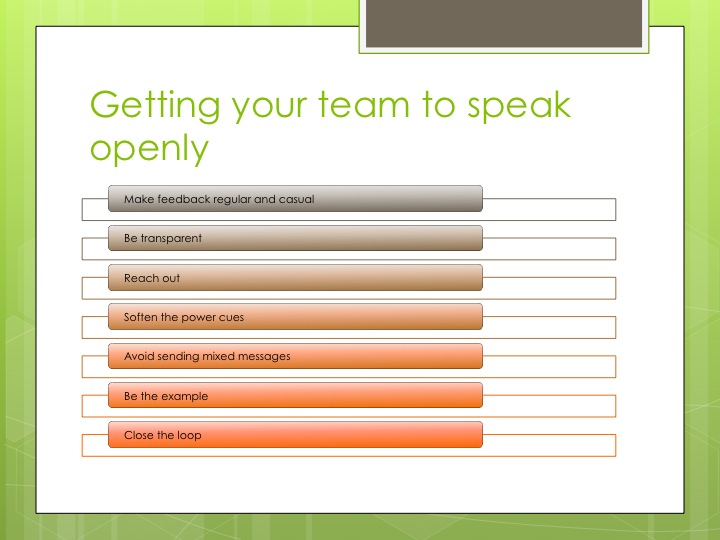
While saying be open and not always closing your door probably will not generate open conversation, there are ways to get strong feedback from your team.

  • Make feedback a regular and casual exchange. Try to schedule regular one-to-one meetings with your team, this will make it less of a special even when they have something to share. The meetings also should not be with only your direct reports, but try to reach out to all the units you oversee, the ideas are not limited to your direct reports. Even when there is nothing to discuss, still hold the meeting and see what comes out. Often, if there is not a set agenda, the true issues will rise to the top.
  • Be transparent. As Detert and Burris write, “transparency about feedback processes can reduce anxiety and increase participation…. Spelling out guidelines and commitements up front made contributing feel less daunting and futile to employees.”
  • Reach out. When you want to understand what your team thinks of something, ask them. Call people in and ask them what are the company’s biggest problems or where they feel costs can be reduced or what is wrong with your product. Soliciting feedback proactively is more effective than just listening to it when someone brings an issue to you. First, it allows you to focus on your biggest problems. Second, since it is an issue you are already trying to address, there is a higher likelihood you will act on the employee’s feedback.
  • Soften the power cues. To get earnest feedback, play down the power relationship. Walk over to your employee to talk to them rather than asking them to your office. Sit with them at a table rather than having them sit across from your desk. Join your employees for lunch or a drink. The key is to interact with your team as peers rather than subordinates.
  • Avoid sending mixed messages. Do not encourage ideas and then cut them apart. Make sure not to focus the employee on process, it does not matter if their Powerpoint is awful, but instead pull the ideas out of the conversation and see which ideas will help the company.
  • Be the example. Employees feel inspired when they see you advocating for them. It is important to help move the ideas along. Unless you feel they will hurt the company, and provide visibility to the team on your efforts in getting their ideas implemented. As Detert and Burris write, “Employees feel inspired when they see you advocating for them. While it’s great when your subordinates can see you speaking up, in many cases that’s not possible, because they aren’t present when you interact with your own boss. But you can tell them what happened and involve them directly in any follow-up steps.”
  • Close the loop.The most critical element in creating a culture where people are truly open with their feedback and suggestions is telling them what you did with their idea and what they can expect as a result. Even in cases where the idea was not implemented, tell them why it was not moved forward so that they both see it was taken seriously and can adjust future suggestions to the reality of the business. Also, where possible, tell the entire team about the feedback you received and how it was acted upon.

While it is much easier to say you have an open door policy than follow through on the seven suggestions above, these suggestions will prompt your team to raise important issues to improve your company. You will find the effort is well worth it both in increased morale and a better business.

Key takeaways

  1. Open feedback and suggestions improve retention and the company’s performance, yet just having an “open door policy is not effective at soliciting feedback.
  2. Most people do not speak openly out of fear that there will be negative consequences or a belief that nothing will happen if they do.
  3. To counteract this reluctance, make feedback regular, be transparent, proactively reach out to employees, soften the power position, set an example by bringing ideas up the corporate chain and provide feedback on what action came from the suggestion or criticism.

Share this:

  • Click to share on Facebook (Opens in new window) Facebook
  • Click to share on LinkedIn (Opens in new window) LinkedIn
Like Loading...
Unknown's avatarAuthor Lloyd MelnickPosted on February 10, 2016February 9, 2016Categories General Social Games Business, General Tech BusinessTags communication, Feedback, leadership, management2 Comments on How to encourage your team to speak freely

Reducing surprises with your project and game development

Last week I wrote about improving your project management, today I want to address a related issue, how to minimize surprises during product development. Most experienced leaders in the tech and game space (and probably any product development) have experienced many projects that fail to meet their goals for time, cost or performance. Rather than accepting these failures as part of the development process, an article in the MIT Sloan Management Review, Reducing Unwelcome Surprises in Project Management by Tyson Browning and Ranga Ramasesh, shows how to reduce these undesirable blows.

Browning and Ramasesh discuss projects often miss schedule and projections because of unknown unknowns, problems people do not even know they do not know (rather than issues you are concerned about from the beginning). What the authors point out is that they are not really unknown unknowns but issues that nobody has bothered to find out. Many of these unknown unknowns can be converted to known unkowns (and thus planned around) through a process of “direct recognition.”

Six project domains

There are six project domains where a project uncertainty resides and where recognition of the uncertainty should occur. “Projects operate as systems. Project and performance result not only from individual project elements but also from how the elements work together.” All projects have five key subsystems that when coupled with the project’s context contain both known and unknown unknowns.

  1. Result subsystem. The desired result of most projects is a product, service, feature or other deliverable. Results have multiple components, all of which must work together to deliver success. Problems in one area can bleed into other areas.
  2. Process subsystem. The labor required to execute and manage a project is another system, made up of activities, tasks and decisions tied to the flow of information, work product and deliverables. Efficient and effective processes depend not only on the specific activity but also on the relationships among the activities. Bad inputs can undermine an otherwise value-adding activity.
  3. Organization subsystem. A third type of system incorporates the people, teams, departments and functions working on a project. This is the system that often breaks down due to poor communication.
  4. Tools subsystem. Team members need tools, facilities and equipment to manage activities and exchange information. Many tools, however, are unable to transfer information due to various incompatibilities and organizational decisions.
  5. Goals subsystem. Almost every project has goals for time, cost and performance/quality. These three areas, however, compete with each other. For example, improving performance by adding features often adds costs.
  6. Context. Every project (hopefully) exists within a larger context. A project may be part of a larger portfolio or a feature for a game. It may also have multiple stakeholders with competing visions and metrics for success.

The first step in reducing unknown unknowns is to consider these six subsystems and their relationships.

The factors driving uncertainty

There are multiple elements of a project’s subsystems and context that make impact the likelihood of surprises. If you review your project looking for unknown unknowns you are more likely to convert them to known unknowns (and thus account for them in your schedule/budget). There are six factors that drive uncertainty and help you identify unknown unknowns.

The first of is complexity. A complex system contains many interacting elements that increase the variety of its possible behaviors and results. A project with more tasks, people or requirements is going to be more complex than a project with fewer. When a project’s elements have a greater variety of tasks, complexity also increases. The higher complexity, the greater the chance of experiencing unknown unknowns.

The second element driving uncertainty is complicatedness. Complicatedness is more subjective than complexity. It is often increased if the product is unprecedented or its structure is unintuitive. The more complicated the project, the more difficult it is for the participants to understand and anticipate.

The third factor impacting uncertainty is dynamism. A project’s volatility adds to its complexity. A project’s external dynamics are particularly likely to affect its goals, for example if regulation changes. Changes in goals then add to the complexity and complicatedness and increase the chances of unknown unknowns.

The fourth factor impacting uncertainty is equivocality. Project work requires sharing a great deal of information. If the information is not crisp and specific, then the people who receive it will be equivocal and will not be empowered to make firm decisions.

Mindlessness is the fifth factor driving uncertainty. These are the perceptive barriers that interfere with the recognition of unknown unknowns. They good be too much reliance on intuition or anchoring on past experience and traditions rather than looking objectively at the situation.

The final factor impacting uncertainty is project pathologies. Project pathologies are structural or behavioral conditions in and around project in their entirety (rather than individuals who exhibit mindlessness) that allow unknown unknowns to remain hidden. Project pathologies include mismatches among the project subsystems and context, unclear expectations among stakeholders and dysfunctional cultures.

Reducing unknown unknowns

Slide1

By addressing the factors that drive uncertainty and understanding projects’ subsystems, Browning and Ramasesh suggest several ways to reduce the chance of unpleasant surprises

  • Decompose the project. Modeling a project’s subsystems builds understanding that exposes unknown unknowns. Decomposition should begin with the natural structure of the overall purpose of the project, identifying the sub-problems relating to key areas and complimenting it with experience and experimentation.
  • Analyze scenarios. Scenario planning includes building several different future outlooks. It tries to understand and build uncertainty into the reasoning. Rather than being predictions, scenarios are coherent and credible futures built on dynamic events and conditions.
  • Use checklists. Organized learning from past projects can inform planning. They can take the form of checklists or prompt lists, though should not be used as a substitute for thinking.
  • Scrutinize plans. Project plans are an estimate for how success will occur, including resources needed and results. All participants and stakeholders should scrutinize closely these estimates. This scrutiny can be as project reviews, audits or even external evaluations.
  • Use long interviews. Thorough interviews with project stakeholders, subject matter experts and other project participants are effective at uncovering waiting problems and issues.
  • Pick up weak signals. Weak signals often come in subtle forms, such as unexplained behaviors, confusing outcomes or a realization that no one in the organization has a complete understanding of the project.
  • Mine data. When vast amounts of data, analyzing this data can pull out implicit, previously unknown information. By reviewing data from multiple projects, data mining could help you identify precursors of potential problems.
  • Communicate frequently and effectively. Regularly and systematically reviewing decision-making and communication processes, including the assumptions that are factored into the processes, and seeking to reduce information disparities, can help to anticipate and uncover unknown unknowns.
  • Balance local autonomy and central control. Using decentralization of control to grant autonomy to the local nodes of a multi-nodal project aids recognition of unknown unknowns. Although decentralization helps project managers compensate for their knowledge gaps, it creates challenges for governance. Local nodes are less willing to report problems. You must balance central authority with local control to ensure unknown unknowns are both discovered and reported.
  • Incentivize discovery. One of the best ways to identify unknown unknowns is timely and honest communication of missteps, anomalies and missing competencies. Offering incentives for candor can show people there are advantages to owning up to errors or mistakes in time for management to take action.
  • Cultivate an alert culture. If project participants and stakeholders understand how unknown unknowns can derail projects, they will strive to illuminate rather than hide potential problems. You can make the culture more alert by emphasizing systems thinking, stress the limits of what can be known about a project a priori, seek to build a wide range of experiential expertise, develop the characteristics of a high-reliability organization and learn from surprising outcomes.

Avoid the unpleasant surprises

With the techniques above, you and your project managers can uncover and recognize knowable unknown unknowns. By providing guidance on where and why these unknown unknowns exist in projects and how to recognize their clues, you can reduce the number and magnitude of unwelcome surprises.

Key takeaways

  1. Unpleasant surprises in product management – particularly software development – occur when issues arise that nobody thought of, referred to as unknown unknowns.
  2. To anticipate unknown unknowns, you need to understand the underlying system for the projects and the key factors (complexity, complicatedness, dynamism, equivocality, mindlessness and project pathologies) that drive the uncertainty.
  3. You can then reduce the number and magnitude of unpleasant surprises by moving many to known unknowns by decomposing the project, analyzing scenarios, using checklists, scrutinized planning and strong communication (among other techniques).
Like Loading...
Unknown's avatarAuthor Lloyd MelnickPosted on May 5, 2015May 3, 2015Categories General Social Games Business, General Tech BusinessTags collaboration, communication, Game development, project management, software development, surprises, uncertainty, unknown unknowns3 Comments on Reducing surprises with your project and game development

Trust as the foundation of leadership

Slide1Although there are many tricks and buzz words thrown around to help people become great leaders, the single most important attribute is trust. A recent article on the Psychology Today website, Why Trust is Foundational to Sound Management, provided the evidence to support my claim. It also provides evidence that although trust is incorporated into many (if not all) companies’ mission statements, it is not showing up in practice. A recent
Gallup workforce survey
asserted approximately 70 percent of employees are disengaged. For those who do not think this is an important statistic, Gallup points out that work units in the top 25 percent of engagement have significantly higher productivity, profitability, and customer ratings while suffering lower turnover and absenteeism.

Achieving trust with your team is one of many things easier said than done. When things are going well for your group or company, it is much easier to act trustworthy. Last year I wrote about how someone reacts to difficult times is the true measure of that person
and the same principle applies to leadership, your team will judge you by how trustworthy you are in trying situations. Continue reading “Trust as the foundation of leadership”

Share this:

  • Click to share on Facebook (Opens in new window) Facebook
  • Click to share on LinkedIn (Opens in new window) LinkedIn
Like Loading...
Unknown's avatarAuthor Lloyd MelnickPosted on November 6, 2013November 15, 2013Categories General Social Games Business, Lloyd's favorite postsTags communication, leadership, trustLeave a comment on Trust as the foundation of leadership

Get my book on LTV

The definitive book on customer lifetime value, Understanding the Predictable, is now available in both print and Kindle formats on Amazon.

Understanding the Predictable delves into the world of Customer Lifetime Value (LTV), a metric that shows how much each customer is worth to your business. By understanding this metric, you can predict how changes to your product will impact the value of each customer. You will also learn how to apply this simple yet powerful method of predictive analytics to optimize your marketing and user acquisition.

For more information, click here

Follow The Business of Social Games and Casino on WordPress.com

Enter your email address to follow this blog and receive notifications of new posts by email.

Join 791 other subscribers

Most Recent Posts

  • Join me at PDMA Inspire for my talk on new product prioritization
  • Why keep studying?
  • The next three years of this blog
  • Interview with the CEO of Murka on the biggest growth opportunity in gaming, Barak David

Lloyd Melnick

This is Lloyd Melnick’s personal blog.  All views and opinions expressed on this website are mine alone and do not represent those of people, institutions or organizations that I may or may not be associated with in professional or personal capacity.

I am a serial builder of businesses (senior leadership on three exits worth over $700 million), successful in big (Disney, Stars Group/PokerStars, Zynga) and small companies (Merscom, Spooky Cool Labs) with over 20 years experience in the gaming and casino space.  Currently, I am the GM of VGW’s Chumba Casino and on the Board of Directors of Murka Games and Luckbox.

Topic Areas

  • Analytics (114)
  • Bayes' Theorem (8)
  • behavioral economics (8)
  • blue ocean strategy (14)
  • Crowdfunding (4)
  • DBA (2)
  • General Social Games Business (459)
  • General Tech Business (195)
  • Growth (88)
  • International Issues with Social Games (50)
  • Lloyd's favorite posts (101)
  • LTV (54)
  • Machine Learning (10)
  • Metaverse (1)
  • Mobile Platforms (37)
  • Prioritization (1)
  • Social Casino (52)
  • Social Games Marketing (105)
  • thinking fast and slow (5)
  • Uncategorized (33)

Social

  • View CasualGame’s profile on Facebook
  • View @lloydmelnick’s profile on Twitter
  • View lloydmelnick’s profile on LinkedIn

RSS

RSS Feed RSS - Posts

RSS Feed RSS - Comments

Categories

  • Analytics (114)
  • Bayes' Theorem (8)
  • behavioral economics (8)
  • blue ocean strategy (14)
  • Crowdfunding (4)
  • DBA (2)
  • General Social Games Business (459)
  • General Tech Business (195)
  • Growth (88)
  • International Issues with Social Games (50)
  • Lloyd's favorite posts (101)
  • LTV (54)
  • Machine Learning (10)
  • Metaverse (1)
  • Mobile Platforms (37)
  • Prioritization (1)
  • Social Casino (52)
  • Social Games Marketing (105)
  • thinking fast and slow (5)
  • Uncategorized (33)

Archives

  • September 2023
  • December 2021
  • July 2021
  • March 2021
  • February 2021
  • January 2021
  • December 2020
  • November 2020
  • October 2020
  • September 2020
  • August 2020
  • July 2020
  • June 2020
  • May 2020
  • April 2020
  • March 2020
  • February 2020
  • January 2020
  • November 2019
  • October 2019
  • September 2019
  • June 2019
  • May 2019
  • April 2019
  • March 2019
  • February 2019
  • January 2019
  • December 2018
  • June 2018
  • May 2018
  • April 2018
  • March 2018
  • February 2018
  • January 2018
  • December 2017
  • June 2017
  • May 2017
  • April 2017
  • March 2017
  • February 2017
  • January 2017
  • December 2016
  • November 2016
  • October 2016
  • September 2016
  • June 2016
  • May 2016
  • April 2016
  • March 2016
  • February 2016
  • January 2016
  • December 2015
  • November 2015
  • October 2015
  • September 2015
  • July 2015
  • June 2015
  • May 2015
  • April 2015
  • March 2015
  • February 2015
  • January 2015
  • December 2014
  • November 2014
  • October 2014
  • September 2014
  • August 2014
  • July 2014
  • June 2014
  • May 2014
  • April 2014
  • March 2014
  • February 2014
  • January 2014
  • December 2013
  • November 2013
  • October 2013
  • September 2013
  • August 2013
  • July 2013
  • June 2013
  • May 2013
  • April 2013
  • March 2013
  • February 2013
  • January 2013
  • December 2012
  • November 2012
  • October 2012
  • September 2012
  • August 2012
  • July 2012
  • June 2012
  • May 2012
  • April 2012
  • March 2012
  • February 2012
  • January 2012
  • December 2011
  • November 2011
  • October 2011
  • September 2011
  • August 2011
  • July 2011
  • June 2011
  • May 2011
  • December 2010
December 2025
S M T W T F S
 123456
78910111213
14151617181920
21222324252627
28293031  
« Sep    

by Lloyd Melnick

All posts by Lloyd Melnick unless specified otherwise
Google+

Enter your email address to subscribe to this blog and receive notifications of new posts by email.

Join 791 other subscribers
Follow Lloyd Melnick on Quora

RSS HBR Blog

  • How One Manufacturer Achieved Net Zero at Zero Cost
  • What Can U.S. Employers Do About Rising Healthcare Costs?
  • When You Have to Execute a Strategy You Disagree With
  • 4 Ways to Build Durable Relationships with Your Most Important Customers
  • What Jargon Says About Your Company Culture
  • Research: When Used Correctly, LLMs Can Unlock More Creative Ideas
  • Your New Role Requires Strategic Thinking…But You’re Stuck in the Weeds
  • For Circular Economy Innovation, Look to the Global South
  • Why Great Leaders Focus on the Details
  • Corporate Disclosure in the Age of AI

RSS Techcrunch

  • An error has occurred; the feed is probably down. Try again later.

RSS MIT Sloan Management Review Blog

  • AI Coding Tools: The Productivity Trap Most Companies Miss
  • How Procter & Gamble Uses AI to Unlock New Insights From Data
  • Rewire Organizational Knowledge With GenAI
  • Hungry for Learning: Wendy’s Will Croushorn
  • Beat Burnout: 10 Essential MIT SMR Reads
  • How Leaders Stay True to Themselves and Their Stakeholders
  • Our Guide to the Winter 2026 Issue
  • Broadening Future Perspectives at the Bank of England
  • A Faster Way to Build Future Scenarios
  • Assess What Is Certain in a Sea of Unknowns
The Business of Social Games and Casino Website Powered by WordPress.com.
  • Subscribe Subscribed
    • The Business of Social Games and Casino
    • Join 726 other subscribers
    • Already have a WordPress.com account? Log in now.
    • The Business of Social Games and Casino
    • Subscribe Subscribed
    • Sign up
    • Log in
    • Report this content
    • View site in Reader
    • Manage subscriptions
    • Collapse this bar
 

Loading Comments...
 

    %d