Skip to content

The Business of Social Games and Casino

How to succeed in the mobile game space by Lloyd Melnick

Tag: social casino

Consolidate your gains (if you have them)

Consolidate your gains (if you have them)

While many companies and business are struggling to survive the Covid19 pandemic, some businesses and industries have been fortunate to see a boost. Mobile gaming, social casino and iGaming as well as many other online businesses (from Zoom to HouseParty to Netflix) have experienced extraordinary results due to more people being stuck at home and many land-based businesses closed. In particular, social casino companies have experienced about a 20 percent uplift in revenue (even higher in the social poker space), while many online real money casinos and poker companies have seen record revenue (including Stars Group, Evolution Gaming
and
Flutter).

If you have been fortunate enough to benefit financially (I think all of us would trade it for a return to normal and an end to the suffering people are experiencing) from the pandemic, now is the time to think about your next steps, in particular, what you need to do to lock in the gains. There are three routes lucky companies can go

    1. Consolidate the gains. Many gaming companies are seeing an unprecedented number of new players and players spending at higher levels. You can take steps that when the world returns to normal you retain these incremental players and help them sustain their new monetization level.
    2. Enjoy it while it lasts. The increase in users and revenue for gaming companies has largely come at little or negative (due to lower marketing expense) incremental expense, thus directly impacting net profit. Companies can use this profit to pay down debt or increase dividends to shareholders (investors, founders, etc.) and other stakeholders (i.e. employees).
    3. Assume it will continue. Some companies might treat the improvement as less of a windfall but more of a new normal internally driven rather than created by the pandemic.

You probably guessed from the title of this post my recommendation is that now is the time to lock in as much of the gains as possible. This pandemic is (hopefully) a once in a lifetime event, companies that can but do not leverage their good fortune will look back in 12-18 months and deeply regret missing the opportunity to move to the next level.

While it could be tempting to pull as much of the incremental profit out of the company, especially in businesses that have struggled, it creates a short-term rush that will leave you in no better position than you were six months ago. Three years from now, five years from now, ten years from now, the utility gained by pulling out the revenue will be forgotten rather than having created a business worth multiple multiples of what it is currently worth.

In the past, I have seen people use extraordinary experiences (the financial crisis, 9/11, etc.,) as an excuse for poor performance while attributing any benefits to the underlying business. Executives may want to take credit for a 20-50 percent uplift, but just as executives at EasyJet and Virgin Australia did not suddenly become stupid overnight, it’s important to realize your product did not suddenly become great and will maintain its momentum post-pandemic.

Locking in the gains

While you can argue the gains are temporary, it is a choice rather than an eventuality. As a believer in online gaming, I am confident that with the appropriate actions you can maintain much of your current success. Brett Nowak, founder and CEO of Liquid & Grit and arguably the pre-eminent expert on the social casino space, recently pointed out that mobile and social gaming is probably the best entertainment value in the world. For $5 or $10 a month (or even zero) you can enjoy a game for tens or hundreds of hours. Compare that to the cost of going to a movie or a concert or sporting event or even buying a book and the utility of your spend is tremendous. What the pandemic has done is exposed millions of people to this incredible entertainment value.

The companies that will benefit long-term are the ones that can turn this short-term boost into a long-term behavior change for the new customers. There are two elements you need to focus on. The first is retaining your new customers, keeping them from abandoning your game when casinos open or they are no longer spending 24 hours at home. The second element is keeping your players’ monetization at the higher levels. By focusing on these two areas, you can set a new, higher, floor for your product and continue growing.
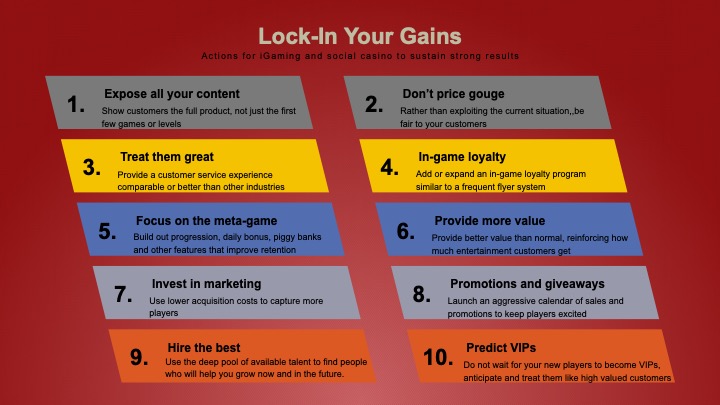
Slide1

Retaining your new customers

The best way to retain the influx of players is by reinforcing to them the great entertainment they are getting so they have less desire to return to the cinema or casino. There are multiple actions you can take to retain these players:

  • Expose them to all that is great. Most entertainment alternatives cannot offer the breadth and depth that a game provides. If the player, however, only sees a small part of your offering, they have no idea what they are missing. Run promotions where you open for a limited time elder-play levels, slot machines that they would not normally have access to or powers and weapons normally available for senior players.
  • Treat them like they expect to be treated. While online gaming provides a great value, often our customer facing teams are less mature than other industries. I have written many times about the importance of creating a WOW experience for your players but with new customers who are used to WOW experiences at their casino or favorite restaurant, it is even more important. Now is the time to double down on giving a great experience, especially to the players likely to become VIPs, who may be used to red carpet VIP treatment at casinos or in other parts of their lives. Match the experience they would get if they go back to their normal haunts.
  • Focus on the meta-game. Social games are great at creating an environment that encourages players to come back regularly. Features like progression, daily bonuses, locking mechanics, piggy banks, etc., create incentives and habits for players to return regularly. These features often promote loss aversion in players or make it a matter of prestige to return, so focusing on building a compelling set of retention features will help prevent churn of your new players.
  • In-game loyalty. Now is the time to improve or add a loyalty system to your game (think airline frequent flyer program). By definition, a good loyalty program increases the loyalty of the customer. Loyalty programs increase the cost the player feels when leaving, making them less likely to churn. Loyalty programs also help form habits that make your game part of their daily activity.
  • Invest in marketing. Now is the best time to invest in marketing to acquire new players, even though many have cut their marketing budgets. Given the damage some industries have faced, overall advertising has decreased, thus cutting the costs most gaming companies face for new users (supply and demand). Instead of acquiring the same number of players you had planned to but at a lower cost, you can use these savings to invest in additional marketing to grow faster than you had projected.
  • Hire the best. While your company may come through the pandemic unscathed or better, unfortunately many others are not. This situation provides a unique opportunity to bring in talent that can take you to the next level that normally would never be available. Even if you do not have an immediate need, consider accelerating your people growth now.

Maintain customers’ monetization

While retaining players is always a challenge, maintaining monetization is much more straightforward. In addition to keeping the new users who have discovered your offering due to being locked in their homes, you want to give them a reason to keep their spend at current levels. The “secret” is giving people value. If you give your customers great entertainment for every dollar they spend, they will learn that your game is a better investment than alternatives. There are several steps you can take to reinforce this understanding

    • Don’t price gouge. Some companies, especially those that consider the pandemic a short-term opportunity, are tempted to use the current situation to extract as much as possible from players. While it could boost short-term profits, it is likely to leave players less satisfied and thus more likely to revert to other options as the lockdowns ease.
    • Provide more value. Rather than squeezing players, now is the time to be more generous (you can afford it with the increased revenue). Ensure that they get more hours of gameplay, more exciting virtual goods, etc., from the purchases they make now. This action will reinforce in their mind the great entertainment value your game is compared with other entertainment products.
    • Conduct great promotions and giveaways. As the pandemic recedes, launch an aggressive calendar of sales promotions as well as giveaways to keep customers engaged at previous levels. Again, be generous as the goal is not to get a short-term boost but to reinforce what a great product you have and then keep these players engaged at current levels for months and years.
    • Predict VIPs. Most iGaming and social game companies have learned the value of VIPs, as it drives profitability in the space. Many of your new customers who eventually would become VIPs, however, have not had time to achieve the criteria that would qualify them for VIP treatment. Loosen your criteria so that you can capture future VIPs and give them exceptional treatment that they will not want to lose. This treatment is particularly critical in the iGaming and social casino space where they will probably have a host waiting for them at their land based casino when it reopens.

It’s up to you

The current Covid19 crisis means it is not business as usual. If your business is one of the few companies actually benefitting, do not make the mistake of missing a once in a lifetime opportunity to go to the next level. Now is the time to do everything you can to retain your new customers and give them a reason to keep monetization at new levels.

Key takeaways

  1. While most of the economy is suffering right now, some online companies, particularly in the iGaming and social gaming space, are benefiting. These lucky games need to lock in these gains rather than miss a once in a lifetime opportunity.
  2. To consolidate gains, companies need to minimize churn from this new cohort of players and provide customers a reason to maintain their new monetization levels.
  3. Some of the most effective ways to retain these new customers include exposing them to the full product, introducing a loyalty program, enhancing meta-features and providing great customer service.
Share this:

  • Click to share on Facebook (Opens in new window) Facebook
  • Click to share on LinkedIn (Opens in new window) LinkedIn
Like Loading...
Unknown's avatarAuthor Lloyd MelnickPosted on May 6, 2020April 25, 2020Categories General Social Games Business, General Tech Business, Growth, Social Casino, Social Games MarketingTags Coronavirus, Covid19, iGaming, real money online gambling, social casino2 Comments on Consolidate your gains (if you have them)

Podcast on outlook for social casino sector

Podcast on outlook for social casino sector

I was fortunate recently to be invited to the Deconstructor of Fun podcast to talk with Joseph Kim and Brett Nowak (Founder/CEO of Liquid & Grit) about the future of the social casino space. For anyone interested in our conversation, listen to the Podcast or view the discussion on YouTube.

Share this:

  • Click to share on Facebook (Opens in new window) Facebook
  • Click to share on LinkedIn (Opens in new window) LinkedIn
Like Loading...
Unknown's avatarAuthor Lloyd MelnickPosted on May 1, 2020May 1, 2020Categories General Social Games Business, Social CasinoTags podcast, social casinoLeave a comment on Podcast on outlook for social casino sector

Are the glory days of social casino over? Probably!

Are the glory days of social casino over? Probably!

While revenue in the social casino space continues to increase (a streak that has not been broken since the first days of Zynga Poker and Slotomania), dark clouds on the horizon have started to dampen the enthusiasm. Most social casino companies would not publicly disclose that they are expecting growth to slow (or reverse) but unspoken indicators are bearish.

Stagnant player growth

The greatest threat to the social casino industry is that the user base is not growing. Over the past couple of years industry revenue has continued to increase but active players has remained virtually stagnant. The revenue growth has been driven by certain companies (particularly Playtika) becoming increasingly adept at growing revenue per customer, especially among their VIPs. At some point, however, social casino operators will hit a ceiling as VIPs cannot and will not spend more.

Actions show that the top companies do not believe in the space

While no social casino operator has publicly warned about the challenges they are facing, their actions speak more loudly. Playtika, the largest social casino company, acquired Seriously last month, after acquiring Wooga last year.

Huuuge Games, the biggest success story in the social casino space in the last three years, launched a publishing arm. Critically, it is focused on hypercasual and traditional social games (such as Traffic Puzzle) rather than social casino. Given how involved Huuuge is with social casino, if it expected tremendous growth it would almost certainly be focusing its efforts to further increase market share in this space.

The public markets are also talking

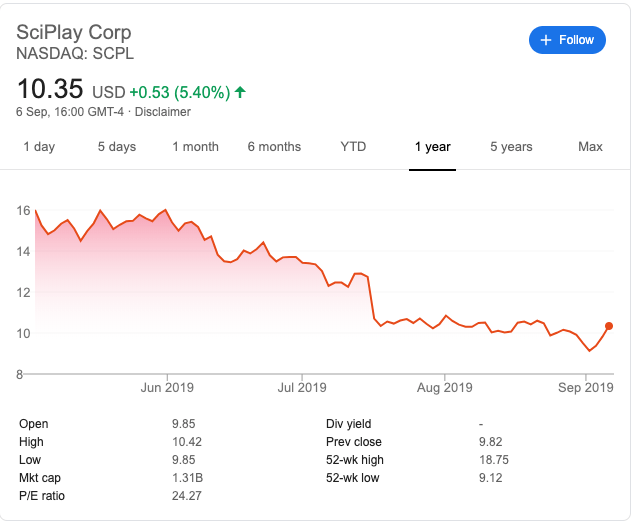
While social casino operators are showing how they look at the industry through their actions, the public markets also show how investors view the opportunities in social casino. The first pure play social casino IPO, SciPlay (the social casino operations of Scientific Gaming), has seen its share price drop from $16 when it went public in May to $10.35, losing over 30 percent of its value.
SciPlay Stock price

From 2015 to 2017, virtually every Zynga’s earnings call highlighted its social casino division. Initially, it focused on the growth of its slots products (primarily Hit It Rich!), which was largely the only bright spot for the company. Not only did it tout the success of its slots products, but the big IP licenses it was signing for future products (such as Willy Wonka). The calls then incorporated Zynga’s success with Poker, which experienced a renaissance. Very noticeably, over the last year, Zynga has downplayed or even ignored the role of social casino in its growth projections. In part, this is due to the success it has experienced with recent acquisitions (and the struggles it has experienced recently in the social casino space), but it also highlights that investors are not very receptive to initiatives in the social casino space.

Again, actions speak louder than words. While investors are not perfect (The Big Short, anyone), they are focused on optimizing return and look across a broad spectrum to find the best opportunities. The lack of appetite for social casino shows that investors no longer think social casino is easy money.

The other looming risk

Another cloud dampening the prospects for social casino is real money gaming. The US is disproportionally important for the social casino industry, it derives a much higher percentage of total revenue (over two thirds) than other areas of the video game industry (which derives over 50 percent of revenue outside the US). While there are too many factors to determine causality, the US is the only major social casino market where real money online casino is largely illegal. Thus, many customers who would normally play in a real money environment can only get their online casino experience through social casino.

Eventually, as real money casino play becomes legal in more US states, it represents an existential risk to the social casino industry. This risk is not an immediate one, legislation has to be approved on a state-by-state basis and I do not expect a significant number of states to approve legislation until 2022-2023 at the earliest (sports betting is a very different phenomenon). Investors and companies, however, do look beyond the next few years to determine their best opportunities and real money gaming is an acute part of that equation.

What social casino companies should do

First, innovate. While it sounds trite, innovation is the key to revitalizing the sector. The industry (and many other parts of the game industry) has been driven by copying what is already working, trying to do it a little better and continued optimization. They are thus relying on fewer players to generate more revenue. Coin Master is a great example of how a company can generate hundreds of millions of dollars in the social casino space by breaking the mold and creating a casino product for new customers. Finding Blue Ocean opportunities using casino mechanics can reverse the dynamics threatening the industry.

Second, embrace Real Money gaming. While Real Money is a risk, it is also potentially salvation. Land based casino companies largely resisted social casino for years (one particularly reactionary one still does) only to find that customers who also play social casino have a higher lifetime value. MGM’s relationship with Play Studios (MyVegas) has driven millions of dollars of value to MGM, displayed by MGM’s increasing its support (actions speak louder than words).

While the relationship between social and real money online has not yet been proven, the size of the opportunity should generate more attention from social casino operators. Real Money online gaming, a $54+ billion industry, dwarfs social casino. If social casino companies can learn how to capture a portion of that revenue (and player base), it can exceed greatly the growth rates of the past.

Key takeaways

    • Despite growing every year since the first social casino products launched, the industry faces significant risks. There are highlighted by recent growth driven by improved monetization of existing players rather than appealing to new customers.
    • Further corroborating this problem is how leading social casino companies are looking outside the space for acquisitions while investors are showing little interest in social casino.
    • To combat these trends, social casino companies need to look for Blue Ocean opportunities (use social casino mechanics to appeal to new customers) and leverage the roll out of real money gaming.


    Share this:

    • Click to share on Facebook (Opens in new window) Facebook
    • Click to share on LinkedIn (Opens in new window) LinkedIn
    Like Loading...
Unknown's avatarAuthor Lloyd MelnickPosted on September 10, 2019September 8, 2019Categories General Social Games Business, Social CasinoTags investment, M&A, playtika, sciplay, social casino1 Comment on Are the glory days of social casino over? Probably!

Yes, Coin Master is Disruptive

Yes, Coin Master is Disruptive

There has been much debate lately, including on my Facebook page, whether Coin Master from Moon Active is truly disrupting the social casino genre or whether it should be classified in a different category. Much of the debate shows how challenging it is to disrupt a segment or an industry. Coin Master is classic disruption, and understanding the debate helps conceive of additional ways to disrupt.

For those not familiar with Coin Master, it is a mobile game currently generating over $250,000/day currently or an annualized run rate based on Q4 2018 of over $280 million (source: Eilers & Krejcik Gaming, LLC). This would make it the second largest social casino game, behind Slotomania but ahead of well known titles like Doubledown, Heart of Vegas, Big Fish Casino, Hit It Rich!, etc.

Given the success of Coin Master, there are many excellent articles about the gameplay mechanics, monetization, etc., and I will not repeat what others have written better than I could. For those who have not played Coin Master, there is a single, (simple) slot machine and not only do you win coins, you also can attack and raid other villages. You then use your coins to build your village.

Coin master

Coin Master uses a slot mechanic as part of the core game loop, hence why it may be categorized as a social casino product. As a social casino product, many think it has successfully disrupted a highly profitable but stagnant space. Conversely, as there are RPG and Invest-Express elements, it is also argued that it should not be considered social casino, thus it is not disruptive. The latter argument, however, misses the point of disruption.

Disruption, the Blue Ocean Way

One way to approach disrupting an industry is to take a Blue Ocean methodology. I have written frequently about Blue Ocean strategy and am a strong advocate of this technique. In Blue Ocean strategy, you create a new market space by serving the non-customers of an industry, making the competition irrelevant. You do this by adding-reducing-eliminating-increasing features.

This approach is exactly what Moon Active did with Coin Master. They built a game that served people who were not currently engaged in social casino. They also did not try to compete directly with Playtika or Aristocrat, with the eight figure marketing budgets those companies have, they disrupted the industry by finding untapped demand.

Moon Active’s strategy perfectly followed the Blue Ocean framework of adding-reducing-eliminating-increasing features

  • Add.  Key elements that Moon Active added include raiding and attacking friends and city-building (invest express).
  • Reduce.  Among the elements that Moon Active reduced were number of slot machines, quality (graphics and depth) of slots and purchase options.
  • Eliminate.  Moon Active also eliminated several features that are seen in virtually all other social casino products. These include locked machines, pay-tables, jackpots, tournaments and a reward system.
  • Increase.  Finally, Moon Active increased certain elements. Among the features increased were the value of progression, interaction with your friends and the importance of card collection.

There are many examples of companies in other industries that disrupted their industry with a Blue Ocean approach. Cirque de Soleil is one of the most popular examples, as the circus business was stagnant until Cirque de Soleil reinvented the industry by creating a new type of product that appealed to different customers. Ringling Brothers did not consider Cirque a competitor and most argued that it was a different, not disrupting the circus industry. Amazon did the same to retail when it started selling books online. Barnes & Noble and Borders did not consider it disruptive, and retailers in other industries certainly did not, as their customers were not looking to buy books (or shoes or electronics) online. When Wikipedia launched, Encyclopedia Britannica did not consider it a competitor. Now you probably would use Wikipedia to remember what Britannica was.

In all of these Blue Ocean cases, many argued the disruptive competitor was not a competitor or in the same category because it was so disruptive. That is the case with Coin Master and those who are arguing it is not disrupting the social casino space are largely proving that it is true disruption.

Coin Master is also an example of Classic Disruption theory

If you prefer red oceans and have not succumbed to Blue Ocean strategy, Coin Master is also a textbook example of classic disruption theory. Clay Christensen is considered the father of understanding innovation and disruption, with his book The Innovator’s Dilemma required reading at every tech (and most non-tech) company. In The Innovator’s Dilemma, incumbent businesses focus on improving their product to better meet customers’ needs but eventually lose their market to disruptors who appeal to less sophisticated customers initially but end up providing a more appealing, broader solution.

The incumbent understands its customers and is continually improving its product to suit better these customers. Christensen stresses, however, that it leaves the incumbent open to disruption. By focusing on existing customers, new entrants can create a product, often inexpensively, that appeals to a different set of customers (there are parallels with Blue Ocean). Institutionally, the incumbents are forced to resist appealing to these customers out of concern of alienating existing players.

An example would be the growth of the personal computer business. The PC initially did not compete with mainframes and mini-computers. Incumbents did not want to build these machines because they knew their customers needed a powerful machine and would not be interested in the “silly” PC. That arrogance allowed small companies (like Dell and Compaq) to build their business. Incumbents did not consider PC companies’ competitors because it did not fit the framework of what a computer does. Eventually their products became so good that the customer of the incumbents shifted and thus the PC disrupted the computer business.

In the Coin Master case, existing social casino companies know players well and are constantly building better slots and apps to meet these customers’ expectations. That is why you are seeing average revenue per user increase linearly, the companies are getting better at delivering value to existing social casino customers. Moon Active, however, created a slot machine with relatively low production value that does not compete for the player who wants an authentic casino slots experience. Coin Master appeals to a broad market while still leveraging a slot mechanic.

Just as with the Blue Ocean analysis, most of the industries Christensen studies that were disrupted in this manner did not consider the product or company creating the disruption a competitor, at least initially. Blackberry did not consider the iPhone a competitor, Blockbuster did not consider Netflix a competitor, GM did not consider Honda a competitor and server hardware companies never thought AWS would impact their business.

Why disruption matters

Rather than being an academic argument, it is important to realize that Moon Active is actually disrupting the social casino space. First, while disruptive products initially do not impact incumbents, in times they do shift the industry and create new winners and losers. While Digital Equipment, Data General, Olivetti, et. al., thrived for years they are now afterthoughts. Second, the disruptor is blazing a path for other companies. Coin Master will go from a Blue Ocean to a Red Ocean product, and there will be other successes in the new Red Ocean. Most importantly, Coin Master shows how to disrupt the social casino space. It is not about changing the type of jackpots or the orientation of the screen, it is about creating a social casino product that makes the competition irrelevant.

Key takeaways

  1. Coin Master has taken the social casino space by storm, generating more than $250,000/day, by disrupting the space and deviating from how other social casino products compete.
  2. Coin Master exemplifies how to disrupt an industry, appealing to non-customers of the industry by adding new features, increasing others while eliminating some elements and reducing the emphasis on other features.
  3. Coin Master is a textbook example of how to disrupt and succeed in the social casino space, by creating a product that makes the competition irrelevant.

Share this:

  • Click to share on Facebook (Opens in new window) Facebook
  • Click to share on LinkedIn (Opens in new window) LinkedIn
Like Loading...
Unknown's avatarAuthor Lloyd MelnickPosted on March 19, 2019March 2, 2021Categories blue ocean strategy, General Social Games Business, General Tech Business, Social CasinoTags blue ocean, blue ocean strategy, Clayton Christensen, Coin Master, disruption, Innovator's Dilemma, social casino3 Comments on Yes, Coin Master is Disruptive

Convergence of social and real money casino goes both ways

Convergence of social and real money casino goes both ways

When I listed my expectations for 2019, the one that generated the most conversation was that the convergence between Real Money Gaming and social casino would accelerate. The underlying driver of this convergence is that both ecosystems are strong and have many learnings to offer. Real Money casino is a $10.6 billion business. Meanwhile, social casino is a $5.4 billion industry that has grown every year since 2012 and is projected to continue growing 7-12 percent per year through 2022.

What social casino can learn from Real Money gaming

Content is king

Real Money casinos focus on adding more content (slots and table games) to increase revenue. While social casino operators also will profess content is king and acknowledge that new games are the strongest driver of KPIs, they do not have the singular focus on adding content that their Real Money counterparts have. Most social casino companies are happy releasing a new slot every second week and launching with 20-30 machines. Conversely, the top Real Money casinos often have over 500 slots and introduce new games much more rapidly.

Given the proven results from launching new content, social casinos should look at much more aggressive content schedules. To achieve this result, social casinos will need to move from their reliance on exclusive, homemade content.

Real Money operators can launch hundreds of games because they license the slots non-exclusively, thus providing access to thousands of slot machines and table games. While exclusivity does provide a unique selling point, many of the homemade social slots are not truly unique. They have common themes and standard math, they are effectively a commodity. Thus the exclusivity is only a perceived advantage, it has no value to the player. Rather than recreating the wheel for every machine, social casinos can still create a unique machine every two weeks (or four weeks or one week) but supplement it with non-exclusive content from the many third-party slot developers.

Cross-sell

While most social casino operators are focused on creating a strong slots app and then optimizing acquisition for that app, Real Money operators have a more robust model. While they still will acquire slots players for their casino products, they have entire verticals that exist largely to acquire players that can be cross-sold into casino. Virtually all the Real Money Bingo products derive the bulk of their revenue from slots. While sports betting is a profitable real money vertical on its own, all of the major sports betting companies rely on slots to drive LTV and allow for more aggressive user acquisition.

In the social space, the siloes are much stronger. Only Kama Games, which uses products like Blackjackist and Roulettist to drive traffic to its poker offering, regularly uses other casino mechanics to acquire players and then cross sell them to its core poker product. Even the social game companies with strong bingo products generally treat bingo as a standalone vertical with its own P&L, just acquiring players for bingo rather than to cross sell into their slots offerings.

Social game companies need to look more at their ecosystem rather than individual products. This will allow them to acquire more players at a higher ROI.

New mechanics

All successful social casino products are based on mechanics proven in the real money space (either land based or online) but not all real money gaming mechanics have made it to social casino. One of the challenges faced by social casino is that the number of players is no longer growing. While revenue continues to increase, it is driven by better monetization of the player base, rather than expanding the player base. One of the most obvious ways to appeal to more players is offering more gameplay options.

There are several real money mechanics that could benefit social casino companies:

  • Sports betting. Sports betting is the largest Real Money gaming vertical, worth well over $22 billion. Social casino companies have tried to replicate Real Money sports betting apps with no success; they have failed for several reasons. The products are normally very complicated, not lending itself to a new sports betting player. Sports betting is also very event driven (you are only interested when there is a match you want to bet on), while social games rely on strong daily retention. Despite these issues, given the overall interest in sports, strength of social fantasy applications and lack of Real Money sports betting in some core markets, a creative game designer can come up with the killer social app for this segment.
  • Virtual sports. Virtual sports is an important but small part of the online real money gaming ecosystem. Technology, however, has made it much more viable and a great option for social casino companies. Virtual sports are similar to slot machines in that winning is based on a random number generator with set odds, they just simulate a real sporting event. Technology, however, has made these simulated games look as good as real sports. The video below from virtual sports provider Inspired Gaming shows these matches look better than what you would see on a gaming console. Unlike actual sports betting, virtual sports are always available to the player so you can create an experience players can return to daily.
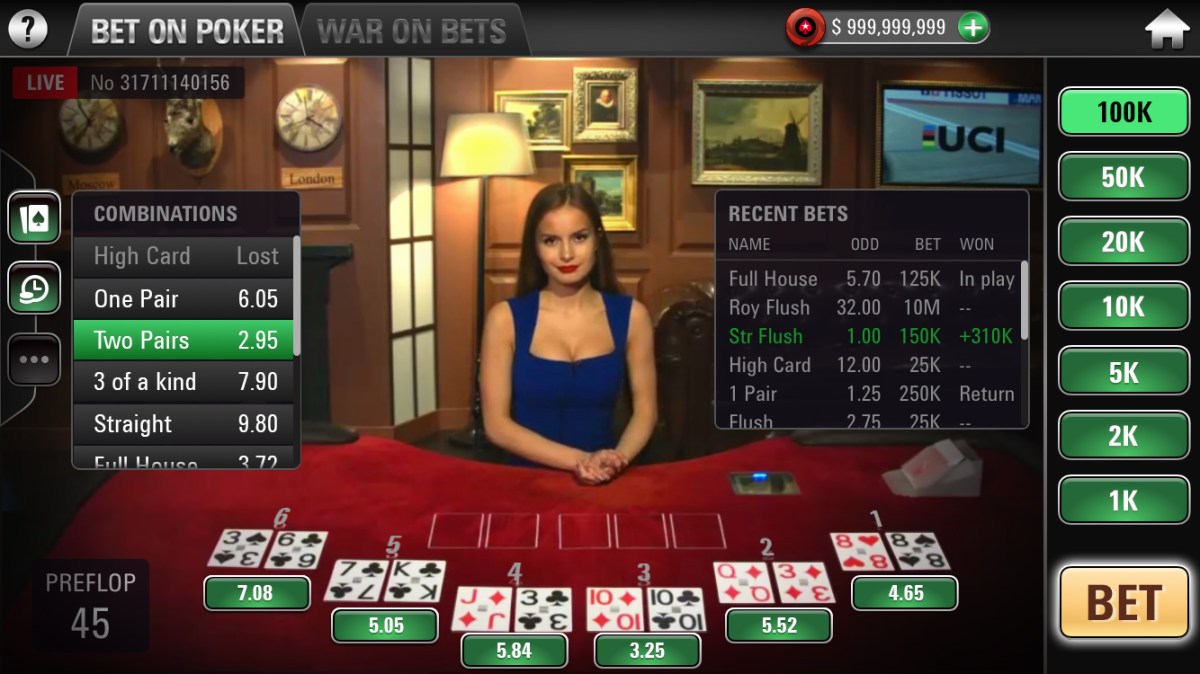
  • Live dealer. Live dealer games are the fastest growing mechanic in the real money gaming space. Companies led by Evolution Gaming, provide games where customers play against a live dealer or host through a video feed. Just as with virtual sports, technology has made this offering much better than only a few years ago, with smoother and higher quality streaming. It is the fastest growing segment of real money gaming and virtually when any B2C company reports its financial results, Live Dealer is the highlight or only bright spot. There are challenges integrating it into social games, bandwidth costs, one-to-one dealer requirements, etc., but as Stars Group showed these issues can be overcome.
  • PSP_ftue_bop.jpg

New Audience

Real Money gaming shows that the addressable market is not limited to 40+ women. While 73 percent of social casino players are female, 65 percent of real money gamers (and 55 percent of real money casino players) are men. With user growth stagnant in social casino, appealing to a male demographic can expand the market for social casino.

Offer driven user acquisition

While social casino companies are more sophisticated with their overall digital marketing, Real Money operators are better at using promotional offers to bring in players. Promotions, such as a free money welcome bonus, spin to win, triple winnings their first day playing, etc., have a very strong pull. While the cost in Real Money of these promotions is sometimes challenging, in social casino they are less risky as providers are only gifting virtual currency. These offers are complicated by AppStore restrictions but this challenge is not insurmountable and more creative offers will improve social game companies user acquisition efforts.

VIP 3.0

While social casino is more reliant on VIPs than Real Money casinos, more than 60 percent of social casino revenue comes from 0.5 percent of players, Real Money operators are much more sophisticated in working with their VIPs. Only a few social casino operators, such as Zynga, have true VIP management programs, most social casinos have one person (who may also be responsible for social media or support) who runs their VIP “program.” Conversely, the most successful real money casinos have a more robust VIP support initiative:

  • Proactive. While much of VIP management in social casino is better customer support for spenders, VIP management in Real Money gaming consists of proactively reaching out to your top players and understanding them as a process. The VIP team can then anticipate problems or opportunities and provide a better experience to the player.
  • Rake back or loss return. Many real money gaming companies (both land based and online) refund part of player losses to their best players. This practice allows players to take more risks and helps overcome periods of bad luck. While it is a controversial practice, many in the real money space lament the cost is not worth the effort, it is a strong way to increase loyalty of your most active players.
  • First class promotions. Why are most fights in Las Vegas, answer is so the casinos can give their VIPs front row seats. Real Money operators will send their top players to great sporting events, sold out concerts, the top restaurants or even a luxury cruise to show their appreciation. While VIPs will often spend over $200,000 in a social game, these VIPs are often rewarded with a t-shirt (if they are lucky). Treating top VIPs similarly to the real money industry will keep them more engaged with social casino offerings.
  • Hospitality events. Not only do Real Money casinos send their VIPs to great events, they create great events. By creating your own event, you are building something unique that competitors cannot replicate and the player cannot get anywhere else. Thus, they are less likely to churn as they would not want to lose access to these events, while they can always buy fight or concert tickets. It is also a great opportunity for your VIP team to build personal relationships with your VIPs, and the personal bond is often stronger than financial benefits of being a VIP.

By replicating these practices, social casinos can reduce VIP churn and improve their lifetime value to the company.

What Real Money gaming can learn from social casino

Although Real Money casino is a larger business, in many ways it is less sophisticated than social gaming. For many years, Real Money casino operators could succeed by getting a stable product in front of customers. With LTVs upward of $400, they had significant margin of error in user acquisition and product features. Conversely, social casinos continuously had to optimize all facets of their business to continue growing. This optimization has led to the development of many features and tactics that can benefit Real Money gaming.

Progression

Providing progression serves many valuable purposes in games. First, it gives people a reason to play, they want to keep moving forward. Even in Real Money gaming, studies have shown over 65 percent do not play to win money, thus progression will appeal to the majority of these customers.

Progression also prevents churn. Loss aversion is a very strong driver of behaviour, people do not want to lose something they already have. The endowment effect also explains that they will also overvalue it.

In addition to reducing churn, progression increases engagement. Players want to complete as many levels as quickly as possible. If there are outstanding levels, they will want to reach them as they will want to finish everything open.

Progression also is a strong monetization driver. Candy Crush is a great example of a game genre that did not monetize but by adding progression King.com was able to create a billion-dollar franchise. Progression prompts players to want to keep playing even when they are out of chips, so thus depositing more, and to play at higher stakes, increasing their bet size.

In the Real Money casino world, where players will often jump between casino offerings to capitalize on the best promotions, progression creates loyal and valuable customers.

Social features

Social features are another strong behaviour driver that has largely been perfected by free to play games. Social interaction is a core value for customers, driving success across many industries. While many features satisfy base needs, social interaction appeals to a higher need and thus people are willing to pay more for it and less likely to give it up. The success of Big Fish Casino, and more recently Huuuge Games, shows how social features can create a unique and very profitable market position. Outside of the casino space, Clash of Clans is a great example of social features driving billions in revenue.

There are many different types of social features that Real Money casino operators can implement, with some of the most successful including:

  • Guilds or clans, where players join together to overcome challenges or compete with other groups.
  • Group challenges, so players have to team together to win rewards.
  • Chat, to enable players to interact with each other.
  • Customizable and useful player profiles, so players can know more about other players.
  • Social shares to unlock gifts.
  • Personalized videos, so players can share their gameplay with friends.
  • Team competitions, where players form teams to get higher scores (which could be chips won) than other teams.
  • Synchronous slot game play.
  • Social lobby, so players know they are not playing alone.
  • Visibility into where friends and other players are winning.
  • Player review of games and slots, similar to Amazon.
  • Referral program, so your players can also be your evangelists.

Some of these features will work better in certain products than others but a mix of these features will not only create bonds with your players but amongst your players.

UIUX

Social casino developers provide a much cleaner and smoother user interface (UI) and user experience (UX) than real money gaming companies. Players can quickly start playing and there is virtually no learning curve. It is easy to navigate in the product, take advantage of offers and understand every offering. Real Money, conversely, often overwhelms the customer with choice, increasing the cognitive load. This problem is not only in the lobby but in the products, betting options are often very complex and confusing. Overall, social gaming companies create an experience much more consistent with customers expectations in 2019.

In-product VIP

While Real Money gaming companies are great at hosting and managing their VIPs, social game companies are much better at giving them incentives and rewards in product. Virtually all social casinos have an in-game VIP system, where the more VIPs play, the more privileges they earn. This type of automated system provides continuous reinforcement and reminds VIPs why they want to remain in their favourite product.

Events

Within the past year, social casinos have become very adept at creating events that boost engagement. It could be the December Challenge or the Race to the Mountain Top, but in effect it is a collection of challenges and specialized content that is available for a limited time. Often the player has a chance to win an item(s) that is only available by completing the event and will not be available again, creating an incentive both to participate and to visit the game regularly (so they know about the events). These events also break the monotony of playing the same games repeatedly. Finally, they can provide an incentive to try new slots or mechanics.

The most successful social games are now running at least one event daily and this practice can be replicated in the Real Money world. A regular schedule of events increase loyalty, engagement and monetization.

Key takeaways

  1. The strength of both the Real Money Gaming and social casino businesses suggest they both have many lessons to offer.
  2. Social casino companies should focus on adding even more content than they do currently (in part by using third party content they do not have exclusively), create an ecosystem based on cross-sell, try game mechanics from Real Money gaming (sports, virtual sports, live dealer), try to engage male players, create more unique new player offers and replicate the high-touch VIP programs found in real money.
  3. Real Money casinos can improve their profitability by adding progression mechanic, social features, more simple user interface and user experience, in-product VIP programmes and daily events.

Share this:

  • Click to share on Facebook (Opens in new window) Facebook
  • Click to share on LinkedIn (Opens in new window) LinkedIn
Like Loading...
Unknown's avatarAuthor Lloyd MelnickPosted on January 29, 2019January 28, 2019Categories General Social Games Business, Growth, Lloyd's favorite posts, Social Casino, Social Games MarketingTags cross-selling, Live Dealer, real money online gambling, slots, social casino, sports, uiux, vip, VIP hosting, Virtual Sports1 Comment on Convergence of social and real money casino goes both ways

The dark cloud over social casino revenue

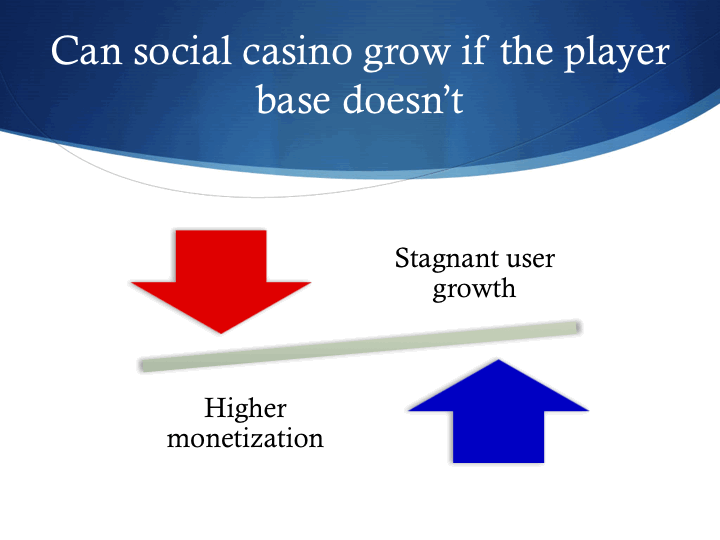
While projections for the social casino (free to play slots and poker) industry continue to be overwhelmingly positive and the industry has never seen a revenue decline on a sequential basis, there is an ominous KPI that nobody is discussing. While the industry continues to grow, that growth is from better monetization, not bringing new customers into the market. This fact potentially puts a ceiling on potential growth or worse portends to a future decline.

Slide1 Continue reading “The dark cloud over social casino revenue”

Share this:

  • Click to share on Facebook (Opens in new window) Facebook
  • Click to share on LinkedIn (Opens in new window) LinkedIn
Like Loading...
Unknown's avatarAuthor Lloyd MelnickPosted on February 6, 2018February 5, 2018Categories General Social Games Business, Lloyd's favorite posts, Social CasinoTags Growth, monetization, social casino2 Comments on The dark cloud over social casino revenue

Why people gamble, and pay real money to play social casino games

When I accepted my first job in the social casino (free to play slot machines) space, I did not understand fully (or believe) why anyone would pay to play a casino game (slots, poker, bingo, etc.) if they could not win money. After all, people gambled to win money, or so I thought. It was, however, difficult to argue with the data that showed social casino consistently the most profitable genre in social and mobile gaming. Moreover, I also did not fully understand why people would spend real money for a virtual good (i.e. a virtual tractor) and assumed the two must be related.

Those questions prompted me to do research before starting my position in the social casino, which led to my blog post Why would anyone buy a virtual good? . The post also included information that people gamble for three reasons – economic, symbolic and pleasure-seeking – and only one of them was tied to making money.

Recently, I came across an article, Segmenting slot machine players: a factor-cluster analysis by Sandy Chen, Stowe Shoemaker and Dina Marie Zemke, that provides even more insight into why people would spend money on a social casino game. While the research was about real money slots players, it shows their motivations are often non-financial; that is they are not playing to make money.

Chen, Shoemaker and Zemke segmented slots players into four clusters based on five sets of factors, and by looking at each cluster it provides a good understanding of the people who play and monetize on social slots products. The five factors are ego-driven, learning, relaxation, excitement and financial rewards. Based on how players ranked the various factors, the authors were able to create four distinct clusters that show different types of players. Below, I recap the four clusters, which you can then use to make your products and marketing better fit for your target customers.

Slide1

The “excitement gambling seekers” cluster

Players who are excitement gambling seekers are playing for the stimulation. Their primary motivation is the strong sensations they experience while playing, the positive memories from winning moments and the thrill of winning or losing. Excitement seekers were the largest cluster of slots players (27.5%) in the research.

The key takeaway about this cluster is they are not playing to win or make money, they are playing for the same reason someone rides a roller coaster, excitement.

The “relaxation gambling seekers” cluster

These customers are playing slots to escape. Their key motivation is to release tension and because the game is fun. They will often credit slots as the best way to relax completely. This cluster is more interested in the experience of playing rather than focusing on winning. This is has more men than women (51.5% to 49.5% respectively). 25.5 percent of slots players make up this cluster.

The key takeaway with this cluster is that they are playing largely for the same reason someone goes to the cinema or reads a book, to relax and escape. As with the excitement cluster, they are not looking for financial rewards.

The “utilitarian gambling seekers” cluster

These are players who play as a means of socialization, communing with friends or as an escape from everyday boredom. It is referred to as utilitarian because the purpose is functional (utilitarian) and players gamble to satisfy experiential motives. About 20 percent of the players sampled fell into this cluster (which was also the oldest group).

These players place little value in some of the features many social casinos focus on. They do not care about themes or progressive jackpots. One of their most important considerations is the minimum bet of the slot machines.

Earlier this month, I wrote about Robert Thaler’s work on behavioural economics, including his theory regarding mental accounting. Mental accounting is a psychological theory of how limited cognition affects spending, saving, and other household behavior. In particular, people group their expenditures into different categories (housing, food, clothes, etc.), with each category corresponding to a separate mental account. Each account has its own budget and its own separate reference point, which results in restricted movement between the accounts. When integrated with the research of Chen, Shoemaker and Zemke, mental accounting explains how people have a set sum to spend on slots and will chose the purchase that allows them to optimize use of those funds.

The “multipurpose gambling seekers” cluster

The multi-purpose cluster, as its name suggests, play for several reasons. Players in this cluster play because slots are fun but also because there is a good chance to win and it is in their budget. These are players who think (fantasize) about what they will do with their winnings and want to make a lot of money. These players normally do not care about themes around games. About 27 percent of slots players are in the multipurpose cluster.

The takeaway with this cluster is that it combines a desire to win money with the entertainment value of playing. These are the players who might seek a real money alternative when it is available but play free to play (social) slots if they are in a location where they do not have access to real money.

How men and women differ

One other interesting insight in this research is the difference between male and female slots players. Many female players were excitement gambling seekers or utilitarian gambling seekers, while male players were relaxation or multipurpose gambling seekers. Thus, if you target different genders, your messaging and promotions should apply to what they are more likely to find important.

Remember these are real money players

The most important takeaway from the above cluster analysis is that it was done with real money land based slots players, not social players. This is critical because even people gambling in the traditional sense are largely not gambling to make money but for excitement, relaxation, etc. Once their motivations are understood, it is obvious why people would spend to play slot machines where the real money opportunity does not exist. As the authors write, “American slot players were mainly motivated by hedonic and experiential motives…gambling is a type of recreation or entertainment in America.” Hence, why social casino is such a strong and growing genre.

Key takeaways

  1. Research shows that there are four types of slots players, with each group having different motivations.
  2. Three of the four groups are driven by non-economic reasons (excitement, relaxation, fun, etc.) to play slots, thus they get the same satisfaction from social casino products that they get from playing real money slots.
  3. Gambling is primarily recreation and entertainment in the US.

Share this:

  • Click to share on Facebook (Opens in new window) Facebook
  • Click to share on LinkedIn (Opens in new window) LinkedIn
Like Loading...
Unknown's avatarAuthor Lloyd MelnickPosted on January 23, 2018January 14, 2018Categories General Social Games Business, Growth, Lloyd's favorite posts, Social CasinoTags excitement, gambling, online gambling, real money online gambling, relaxation, slots, social casino6 Comments on Why people gamble, and pay real money to play social casino games

NOT predictions for 2018

This time of year always makes me chuckle at the arrogance of some but more the desire of others to accept proclamations of what the new year will bring. I am not a big fan of predictions. First, regardless of experts’ success or intelligence, there are too many variables to predict accurately what will happen in 2018. As much as I respect Bill Gates, Warren Buffett, Mary Meeker, etc., they cannot predict the future. If they could, they would even be wealthier (who has not played the mental game of what you would invest in if you could go back in time five years). It’s the same underlying reason why the best and brightest mutual fund managers cannot regularly beat the market indexes they are targeting.

Second, and a little more sinister, most people who claim to predict what will happen in 2018 are little more than fortune tellers you would meet at a State Fair (or social gaming conference). The predictions are generally broad enough that regardless of what happens next year they will be able to pull some “victories” from their predictions. It may be things as simple as bitcoin will have a volatile 2018 to there will be at least one major acquisition in the video gaming space; these are either broad enough that you can always claim victory or predictable by anyone who looks at the past trends. The point is, they are not providing any information that is actionable unless they get lucky. Again, if they were so visionary, they would act on it rather than talk about it.

So with that said, it is time for my predictions. Seriously, rather than predictions, I do feel it is helpful to look at trends that have gained momentum in 2017 and are likely to have a disproportionate impact in 2018.

The convergence of micro-segmentation, AI and machine learning to create extreme personalization

The most important trend that is gaining momentum is personalization. Various related technologies are allowing game and technology companies to optimize experiences for every individual. From Amazon showing you products you are most interested in to Supercell pairing you with a player whose gameplay style best complements yours, everyone will have an experience personal to them in ecommerce, gaming and pretty much anywhere in 2018.

Microsegmentation

Three related technologies are driving this personalization: micro-segmentation, artificial intelligence and machine learning. Micro-segmentation allows companies to create hundreds or thousands of different clusters of customers and then provides the best experience for each of these segments. One segment may be players who have monetized 3-6 months ago and continue to play but not spend and are more open to free offers than sales; micro-segmentation will help create offers to optimize their experience and make them more likely to spend. Another segment might also have spent at some time 3-6 months ago and remain active but these players are more likely to spend if encouraged to play at higher stakes. Micro-segmentation allows companies to create the best path for each player.

Machine learning allows for more and better micro-segmentation, as it automatically creates hundreds, thousands or millions of segments. And artificial intelligence then determines what to offer each micro-segment.

The key takeaway is that customers will get very personal experiences on the successful sites, apps and games in 2018. They will then come to expect experiences and offers tailored to their needs, directing their money to those that deliver.

Voice recognition

I wrote in 2016 about the increasing importance of voice recognitionand this is likely to accelerate in 2018. Providing directions verbally is much more natural and simpler than having to type them. While the technology is still largely a novelty, everyone uses Alexa or Siri but primarily to listen to music or set a timer, in 2018 voice recognition will become more integrated on how you use/consume technology. In particular, I see it becoming a central part of the social/mobile game user interface, it will be much easier to play a game by speaking to it rather than typing or navigating with a mouse.

Big change in social casino

I have been in the social casino space (online free to play slot, poker, etc) for almost five years and have seen it mature and continue to grow revenue but it is still largely the same as it was in 2012. The interface, gameplay mechanics even art have changed very little. Companies have gotten better at monetizing their players but the games have not evolved. Even land-based casinos look more different now than they did five years ago than social casinos do.

While I do not expect an entirely new gaming mechanic to surface, one or two companies will innovate and create a very different product that not only steals existing market share but also brings new customers into the market. There is enough money in social casino that new entrants will try to innovate to build a competitive position and the company(ies) that is able to create a new market space will be the next Playtika.

Devices and platforms will become less important

When I first entered the game space, one of the biggest determinants of success was anticipating what platforms (Playstation, X-box, DS, etc.) would become big, getting on them early and not getting tied to a dying platform. Platforms (iOS, Android, Kindle, etc.), however, are becoming increasingly less important. Tools and underlying technology are allowing the best content to be used regardless of device. This trend should accelerate and companies that spend the bulk of their time trying to optimize for the next big thing will lose out to companies looking to create the next great content.

Privacy

I am one of those people who never really cares about privacy settings, have not read a Terms & Conditions in my life before clicking continue, and never worry about sharing my personal information. I am, however, in the minority. More and more people are concerned about privacy and products that either ignore this fact or try to trick customers and players into sharing information they do not want to share will fail in 2018. Successful products will empower customers to share the information they want to share, which will be different by individual (see first point on personalization). This is also the area where Blockchain can have the greatest impact, even more so than the crypto-currency space.

Dual devices

Not a 2018 trend (or even a 2015 trend) but more of a 2018 fact of life. People virtually never use only one screen. It is not only using your phone or tablet while watching television. It is using your phone while on your tablet. Using your tablet while on your work computer. Watching television while on your phone. Giving Alexa directions while watching television. You get the idea.

Your games and applications need to be sensitive both to people not focusing 100 percent and also provide a good experience as the second device your customer is focused on using. You also need to understand the different use cases and allow people to consume your product in different cases, whether they are also watching TV or working on their computer.

Big players will enter free to play, and fail

Remember how I said the hallmark of a good fortune teller is to include in their predictions something that definitely will happen (ie. there will be a lot of vitriol on Facebook about politics), here is my prediction that will come true in 2018. At least one major multi-billion company not currently in free to play will enter the space either through a new venture or acquisition because it just seems so easy to make money selling virtual goods; and they will fail miserably. It’s happened every year since social gaming took off and will probably happen for the next ten years.

Other trends

I would love to know what trends you are seeing and how they will help shape 2018. Let me know your thoughts on what we will be writing about this time next year.

Key Takeaways

  1. Personalization will dominate 2018. Successful games, sites and retailers will provide a hyper-personal experience to all customers with a combination of machine learning, artificial intelligence and micro-segmentation.
  2. Voice recognition will go from the domain of Alexa and Siri to become a primary and powerful user interface for people playing games, shopping or doing virtually anything.
  3. The social casino space will experience a disruptive product that not only takes significant existing market share but brings new customers to the market.

Share this:

  • Click to share on Facebook (Opens in new window) Facebook
  • Click to share on LinkedIn (Opens in new window) LinkedIn
Like Loading...
Unknown's avatarAuthor Lloyd MelnickPosted on January 2, 2018December 30, 2017Categories General Social Games Business, General Tech Business, Machine Learning, Social CasinoTags alexa, artificial intelligence, Blockchain, Machine learning, micro-segmentation, privacy, social casino, Voice recognitionLeave a comment on NOT predictions for 2018

How to create a valuable product or game

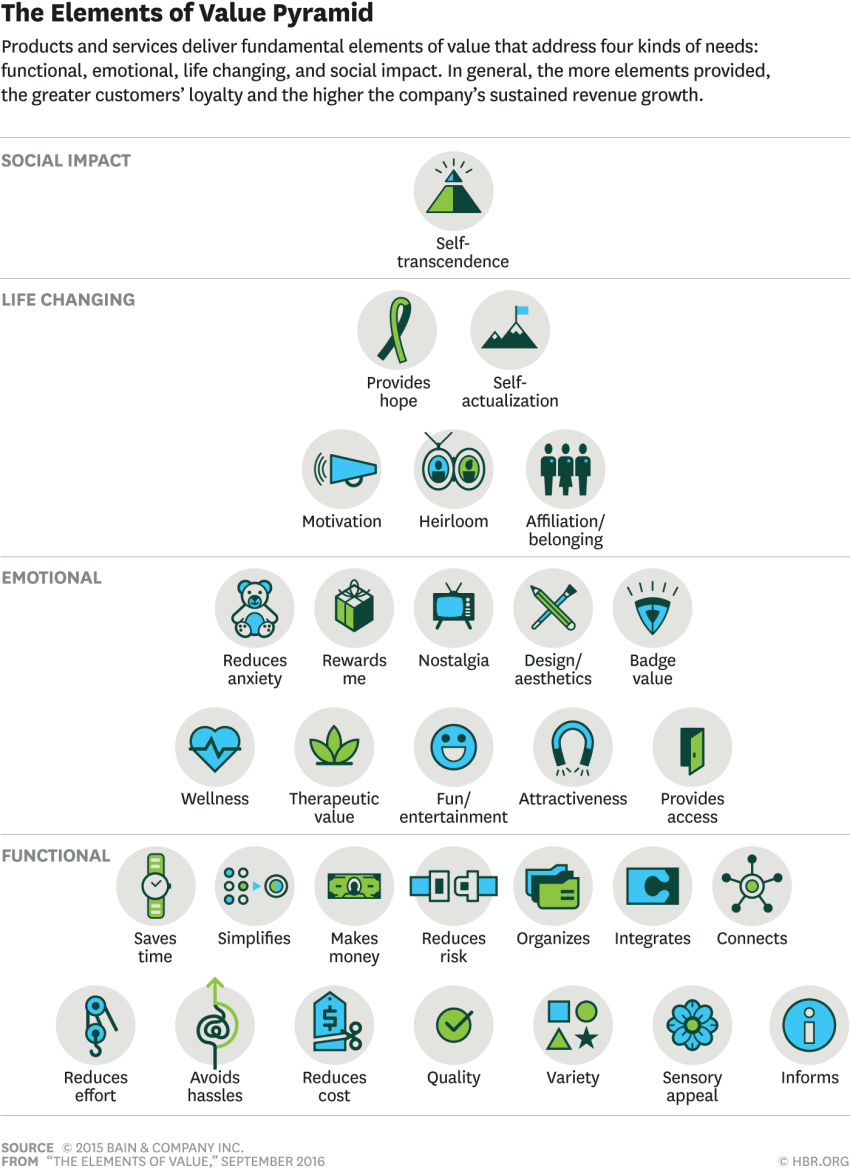
A colleague of mine recently used in a presentation a chart from a Harvard Business Review article and it was so helpful in defining a new product I wanted to share the concepts with everyone. In The Elements of Value by Eric Almquist, John Senior and Nicolas Block of Bain’s Strategy Practice, the authors discuss that while consumers evaluate a product by its perceived value versus cost, most marketers and executives focus on the price side of the equation. They attribute this focus largely to it being easier to manage price, as there are limited variables involved and it is easy to test.

It is more challenging to measure and optimize what customers truly value, whether functional (giving someone more capabilities) or emotional, because it is often a combination of multiple components. While value is always intrinsic to the customer (different people have a different value for the same attributes), the authors have identified universal building blocks of value to improve performance in current markets or enter new markets. Their analysis shows that the right combinations of these attributes leads to higher customer loyalty, greater willingness to try a brand and sustained revenue growth.

In the article, they have identified 30 elements of value (see below), fundamental attributes in their most essential and discrete forms. You can categorize these components in four buckets:

  • Functional
  • Emotional
  • Life-changing
  • Social impact

value-pyramid
From Harvard Business Review, Sept 2016

Some are inwardly focused, like motivation, while others help people deal with other or operate in the world, Not surprisingly, the Value Pyramid is related to Maslow’s Hierarchy of Needs. For those not familiar with Maslow’s work, Maslow’s hierarchy of needs is often portrayed in the shape of a pyramid with the largest, most fundamental levels of needs at the bottom and the need for self-actualization and self-transcendence at the top. The most fundamental and basic four layers of the pyramid contain what Maslow called “deficiency needs” or “d-needs”: esteem, friendship and love, security, and physical needs. If these “deficiency needs” are not met – with the exception of the most fundamental (physiological) need – there may not be a physical indication, but the individual will feel anxious and tense. Maslow’s theory suggests that the most basic level of needs must be met before the individual will strongly desire (or focus motivation upon) the secondary or higher level needs.

According the Almquist, Senior and Bloch, “the elements of value approach extends his insights by focusing on people as consumers—describing their behavior as it relates to products and services….The elements of value pyramid is a heuristic model—practical rather than theoretically perfect—in which the most powerful forms of value live at the top. To be able to deliver on those higher-order elements, a company must provide at least some of the functional elements required by a particular product category.”

Depending on your industry and product, the elements of value will vary. Some industries or geographies will focus more on basic elements, those near the bottom of the pyramid, while others will be focused higher.

Product lifecycle is critical

One area the authors did not explore that I think is critical is product lifecycle. Also, although not a feature of the article, an industry’s stage of development strongly impacts which elements will drive value for a consumer. In an emerging industry, consumers will be much more driven by the functional features. As an industry matures, you no longer will be able to compete on the functional elements but instead will need to move higher up the pyramid. Everyone in the industry will be providing the functional features, so you will have to deliver emotional value. Even there, your competitors will catch up and you will then have to deliver life changing or social impact attributes.

The social slots business is a great example of how the value pyramid has driven success. Five + years ago, companies experienced great success just by providing an online version of slot machines that people formerly only played in casinos. As long as you had a game that worked, priced it correctly (free to play) and made it simple to use, you had a ticket to print money. As the market became more mature, emotional attributes became the factor that generated success. Companies late to the market leap-frogged the Functional leaders by making the products nostalgic (classic slots by DGN or Rocket Games) or better design and more attractive (Hit It Rich by Zynga). As the market gets even more mature and competitive the companies that are experiencing success are those that are introducing life changing elements, primarily affiliation and belonging (such as Huuuge Games).

Using the elements to grow

An area where the elements can help you succeed is by improving on the elements that form your core value, so you can differentiate from the competition and better meet your customers’ needs. The elements can also help you grow your product’s value without overhauling your game or product.

Some companies use the elements to identify where customers see strengths and weaknesses. First, they look at which elements are important in their industry and how they compare with competitors. Then if there are any significant gaps, the priority is eliminating those gaps. Once the gaps are closed, you can then see what elements could create a new gap above your competitors.

Implementation

To leverage the elements model effectively, you should integrate it into several key areas of your business:

  1. New product development. The elements framework should provide ideas for new products and enhancements to existing products.
  2. Pricing. If you are looking to increase your prices, you can soften the blow of the increase by concurrently increasing the value your customer receives from your product. Amazon Prime is a great example, as the service started at $79.99 (I think) with frequent discounts and is now significantly higher but the free shipping is only a side thought, as you get everything from streaming services to special credit cards.
  3. Customer segmentation. Rather than only segmenting customers by demographic or behavioral group, you can use the elements to segment them by where they are deriving value. You can then focus on delivering more of the elements that these segments want or highlighting the elements that may exist but they are not aware of.

While adding value to increase competitive is not the most unique or newest idea, Almquist et. al., have created a framework to focus on creating the most value for your customers and knowing where to focus to increase that value. If you continue to deliver more value than your competitors, you will succeed.

Key takeaways

  • There are 30 core elements that drive the value a consumer derives from a product and the more they are willing to spend on the product
  • The values are hierarchical, similar to Maslow’s hierarchy of needs, and once a consumer gets the base value they will be more engaged by life changing or social impact elements.
  • The value you need to deliver is based on the life stage of the industry. Young industries are focused on functional value while you need to deliver higher level value to compete in a mature industry.

Share this:

  • Click to share on Facebook (Opens in new window) Facebook
  • Click to share on LinkedIn (Opens in new window) LinkedIn
Like Loading...
Unknown's avatarAuthor Lloyd MelnickPosted on March 8, 2017March 4, 2017Categories General Social Games Business, General Tech Business, Growth, Lloyd's favorite posts, Social Casino, Social Games MarketingTags Bain, elements of value, social casino, value1 Comment on How to create a valuable product or game

Blue Ocean Opportunities in the Red Ocean of Social Casino

For those of you who were not at Casual Connect and missed my talk on Blue Ocean opportunities in social casino and why they are the best path forward, below is a copy of my deck. The key takeaways are

  1. Social casino is one of the bloodiest of red oceans, with excellent well-financed companies competing ferociously. The best path to success is to take a Blue Ocean approach.
  2. Blue Ocean is all about turning non-customers into customers, rather than competing for the same customer.
  3. You do this by looking at what you can remove from the existing product offering, what you can add, what you can increase and what you can reduce. This leads to a new offering that appeals to new users.

The full presentation can be seen here:

Like Loading...
Unknown's avatarAuthor Lloyd MelnickPosted on October 26, 2015April 11, 2020Categories blue ocean strategy, General Social Games Business, Growth, Lloyd's favorite postsTags blue ocean, Casual Connect, mobile, slots, social casino, social games, Strategy2 Comments on Blue Ocean Opportunities in the Red Ocean of Social Casino

Posts pagination

Page 1 Page 2 Next page

Get my book on LTV

The definitive book on customer lifetime value, Understanding the Predictable, is now available in both print and Kindle formats on Amazon.

Understanding the Predictable delves into the world of Customer Lifetime Value (LTV), a metric that shows how much each customer is worth to your business. By understanding this metric, you can predict how changes to your product will impact the value of each customer. You will also learn how to apply this simple yet powerful method of predictive analytics to optimize your marketing and user acquisition.

For more information, click here

Follow The Business of Social Games and Casino on WordPress.com

Enter your email address to follow this blog and receive notifications of new posts by email.

Join 791 other subscribers

Most Recent Posts

  • Join me at PDMA Inspire for my talk on new product prioritization
  • Why keep studying?
  • The next three years of this blog
  • Interview with the CEO of Murka on the biggest growth opportunity in gaming, Barak David

Lloyd Melnick

This is Lloyd Melnick’s personal blog.  All views and opinions expressed on this website are mine alone and do not represent those of people, institutions or organizations that I may or may not be associated with in professional or personal capacity.

I am a serial builder of businesses (senior leadership on three exits worth over $700 million), successful in big (Disney, Stars Group/PokerStars, Zynga) and small companies (Merscom, Spooky Cool Labs) with over 20 years experience in the gaming and casino space.  Currently, I am the GM of VGW’s Chumba Casino and on the Board of Directors of Murka Games and Luckbox.

Topic Areas

  • Analytics (114)
  • Bayes' Theorem (8)
  • behavioral economics (8)
  • blue ocean strategy (14)
  • Crowdfunding (4)
  • DBA (2)
  • General Social Games Business (459)
  • General Tech Business (195)
  • Growth (88)
  • International Issues with Social Games (50)
  • Lloyd's favorite posts (101)
  • LTV (54)
  • Machine Learning (10)
  • Metaverse (1)
  • Mobile Platforms (37)
  • Prioritization (1)
  • Social Casino (52)
  • Social Games Marketing (105)
  • thinking fast and slow (5)
  • Uncategorized (33)

Social

  • View CasualGame’s profile on Facebook
  • View @lloydmelnick’s profile on Twitter
  • View lloydmelnick’s profile on LinkedIn

RSS

RSS Feed RSS - Posts

RSS Feed RSS - Comments

Categories

  • Analytics (114)
  • Bayes' Theorem (8)
  • behavioral economics (8)
  • blue ocean strategy (14)
  • Crowdfunding (4)
  • DBA (2)
  • General Social Games Business (459)
  • General Tech Business (195)
  • Growth (88)
  • International Issues with Social Games (50)
  • Lloyd's favorite posts (101)
  • LTV (54)
  • Machine Learning (10)
  • Metaverse (1)
  • Mobile Platforms (37)
  • Prioritization (1)
  • Social Casino (52)
  • Social Games Marketing (105)
  • thinking fast and slow (5)
  • Uncategorized (33)

Archives

  • September 2023
  • December 2021
  • July 2021
  • March 2021
  • February 2021
  • January 2021
  • December 2020
  • November 2020
  • October 2020
  • September 2020
  • August 2020
  • July 2020
  • June 2020
  • May 2020
  • April 2020
  • March 2020
  • February 2020
  • January 2020
  • November 2019
  • October 2019
  • September 2019
  • June 2019
  • May 2019
  • April 2019
  • March 2019
  • February 2019
  • January 2019
  • December 2018
  • June 2018
  • May 2018
  • April 2018
  • March 2018
  • February 2018
  • January 2018
  • December 2017
  • June 2017
  • May 2017
  • April 2017
  • March 2017
  • February 2017
  • January 2017
  • December 2016
  • November 2016
  • October 2016
  • September 2016
  • June 2016
  • May 2016
  • April 2016
  • March 2016
  • February 2016
  • January 2016
  • December 2015
  • November 2015
  • October 2015
  • September 2015
  • July 2015
  • June 2015
  • May 2015
  • April 2015
  • March 2015
  • February 2015
  • January 2015
  • December 2014
  • November 2014
  • October 2014
  • September 2014
  • August 2014
  • July 2014
  • June 2014
  • May 2014
  • April 2014
  • March 2014
  • February 2014
  • January 2014
  • December 2013
  • November 2013
  • October 2013
  • September 2013
  • August 2013
  • July 2013
  • June 2013
  • May 2013
  • April 2013
  • March 2013
  • February 2013
  • January 2013
  • December 2012
  • November 2012
  • October 2012
  • September 2012
  • August 2012
  • July 2012
  • June 2012
  • May 2012
  • April 2012
  • March 2012
  • February 2012
  • January 2012
  • December 2011
  • November 2011
  • October 2011
  • September 2011
  • August 2011
  • July 2011
  • June 2011
  • May 2011
  • December 2010
December 2025
S M T W T F S
 123456
78910111213
14151617181920
21222324252627
28293031  
« Sep    

by Lloyd Melnick

All posts by Lloyd Melnick unless specified otherwise
Google+

Enter your email address to subscribe to this blog and receive notifications of new posts by email.

Join 791 other subscribers
Follow Lloyd Melnick on Quora

RSS HBR Blog

  • The Most Popular HBR Podcast Episodes of 2025
  • How the Best Leaders Develop and Spend “Innovation Capital”
  • The 10 Most Popular HBR Articles of 2025
  • How Work Changed in 2025, According to HBR Readers
  • What Leaders Can Learn from a Formula 1 Turnaround
  • Climate Rising: Extending Apparel Lifespan with ThredUp
  • Bring Your Extended Leadership Team into Strategy Decisions
  • 15 Reasons to Be Optimistic About Globalization
  • How a French Spirits Company Created Employee Buy-In for AI
  • AI Is Changing How We Learn at Work

RSS Techcrunch

  • An error has occurred; the feed is probably down. Try again later.

RSS MIT Sloan Management Review Blog

  • Three Steps Toward Fairer Talent Management
  • From Crisis to Coopetition: What Leaders Can Learn From Anesthesiologists
  • AI Coding Tools: The Productivity Trap Most Companies Miss
  • How Procter & Gamble Uses AI to Unlock New Insights From Data
  • Rewire Organizational Knowledge With GenAI
  • Hungry for Learning: Wendy’s Will Croushorn
  • Beat Burnout: 10 Essential MIT SMR Reads
  • How Leaders Stay True to Themselves and Their Stakeholders
  • Our Guide to the Winter 2026 Issue
  • Broadening Future Perspectives at the Bank of England
The Business of Social Games and Casino Website Powered by WordPress.com.
  • Subscribe Subscribed
    • The Business of Social Games and Casino
    • Join 726 other subscribers
    • Already have a WordPress.com account? Log in now.
    • The Business of Social Games and Casino
    • Subscribe Subscribed
    • Sign up
    • Log in
    • Report this content
    • View site in Reader
    • Manage subscriptions
    • Collapse this bar
 

Loading Comments...
 

    %d