Skip to content

The Business of Social Games and Casino

How to succeed in the mobile game space by Lloyd Melnick

Tag: Strategy

The keys to building a resilient business

The keys to building a resilient business

Last year, the most valuable book I read was General Stanley McChrystal’s Team of Teams and I found his discussion of building an organization to deal with a complex environment particularly useful. The world today is very complex, with events everywhere impacting severely your business, yet most companies are built for a less inter-connected, albeit complicated, world.  McChrystal showed that being complex is different from being complicated. Things that are complicated may have many parts, but those parts are joined, one to the next, in straightforward and simple ways. A complicated machine like an internal combustion engine might be confusing to many people but it can be broken down into a series of neat and tidy deterministic relationships. Conversely, things that are complex, such as insurgencies or the mobile gaming ecosystem, have a diverse range of connected parts that interact regularly. Due to this complexity, you need to build a resilient organization that can adapt to changes in the external environment.

resilience

Given the importance of resiliency, I then read a book referenced in Team of Teams, Resilience Thinking by Brian Walker. While the book is primarily about resilience in the environment, it lays the groundwork for managing resources in a business and navigating a complex environment.

At its core, resilience thinking is based on the concept that things change and to ignore or resist this change is to increase your vulnerability and forego emerging opportunities. If you do not implement a resiliency strategy, you limit your options. Additionally, Walker points out that business is characterized by dynamic change and it is as critical to manage systems to enhance their resilience, as it is to manage the supply of specific products.

Resiliency versus optimization

One of the ways that resilience thinking prompts you to take a different approach is by helping you understand the costs of optimization. I have been trained, especially in the gaming space, that the key to success is perpetual optimization (even used that phrase to help sell a company once). We always look for ways to create the most output with the fewest resources, optimize every event in a game based on ABn tests and reduce any “wasted” effort by employees, customers and other stakeholders. Walker says, “humans are great optimizers. We look at everything around us, whether a cow, a house, or a share portfolio and ask ourselves how we can manage it to get the best return. Our modus operandi is to break the thing we’re managing down into its component parts and understand how each part functions and what inputs will yield the greatest outputs.”

An optimization approach aims to get your business into an optimal state and maintain it. Walker explains, “to achieve this outcome, management builds models that generally assume (among other unrecognized assumptions) that changes will be incremental and linear (cause-and-effect changes)…. Ecological systems are extremely dynamic, their behavior much more like the analogy of a boat at sea. They are constantly confronted with ‘surprise’ events such as storms, pest outbreaks, or droughts. What is optimal for one year is unlikely to be optimal the next.” Resilience thinking shows that optimization is not a best-practice as the business ecosystem is usually configured and reconfigured by extreme events, not average conditions.

Walker uses several examples to show how these extreme events actually drive business. Sometimes a competitive product only has a minor impact and at other times it can destroy your business. In some cases a change in interest rate does not impact growth, other times it causes a crash. Resilience thinking is the capacity of a business to absorb disturbances like these and still retain its basic function and structure. Being efficient, by definition, leads to elimination of redundancies as you only keep those activities that are directly and immediately beneficial. Walker writes, “the more you optimize elements of a complex system of humans and nature for some specific goal, the more you diminish that system’s resilience. A drive for an efficient client optimal state outcome has the effect of making the total system more vulnerable to shocks and disturbances.”

Thresholds versus linearity

The most important takeaway from Walker’s book, and resiliency theory in general, is the importance of thresholds. To understand the need for resilient thinking, the first step is learning about thresholds. In non-business terms, systems can exist in more than one kind of stable state. If a system changes too much it crosses a threshold and begins behaving in a different way, with different feedbacks between its component parts and a different structure. This is not a gradual, linear progression but almost a jump between realities. Think of an airline operating in January 2020 versus their situation in April 2020.

ball and basin

Walker explains how systems, including business systems, shift between thresholds. He uses the analogy of a ball and basin.

System as a Ball in a Basin. The important variables you use to describe a system are known as the system’s “state” variables….

We can envisage the system as a number of basins in two-, or four-, or n-dimensional space…. The ball is the particular combination of the amounts of each of the n variables the system currently has-that is, the current state of the system. The state space of a system is therefore defined by the variables that you are particularly interested in, encompassing the full array of possible states the system can be in.

And it’s not just the state of the system (the position of the ball) in relation to the threshold that’s important. If conditions cause the basin to get smaller, resilience declines, and the potential of the system to cross into a different basin of attraction becomes easier. It takes a progressively smaller disturbance to nudge the system over the threshold. Figures 3 and 4 shows this using the ball in the basin analogy.

If you think of a system as a ball moving around in a basin of attraction, then managing for resilience is about understanding how the ball is moving and what forces shape the basin. The threshold is the lip of the basin leading into an alternate basin where the rules change.

Threshold

I have seen many examples of this ball and basin philosophy in the business world:

  • A mobile game company progressively tightens its economy. Product managers increase monetization by worsening the exchange rate or limiting the amount of free play. Each of these changes has a positive impact when AB tested but after six months or a year, they have to sunset the product.
  • A slots developer has a successful slot machine. They keep making small changes to the math and one year later nobody is playing the machine.
  • A company hires a new COO who cuts costs by reducing the customer service team by 10 percent. Customers only have to wait an extra 45 seconds to get their request dealt with. Initially, KPIs are unchanged but six months later they find they lost 25 percent of their most valuable customers.
  • A new CTO optimizes load time of slot machines in a mobile casino by 0.5 seconds. When surveyed, players did not even see a difference. KPIs, however, improve 30 percent.
  • A product is growing 10-20 percent annually for 5 years. They then make a series of small improvements to the way they work with customers and the flow within the product. Growth goes from low double digits to triple digits but nobody can point to one improvement.

These are all examples where small changes by themselves had negligible impact or even an opposite initial impact, but over time combined they moved the product from one basin to another, causing a tremendous shift in KPIs. Resilience thinking is about looking at the entire ecosystem rather than optimizing one or two events.

This threshold approach shows different ways to approach traditional situations. If the business is stuck in an undesirable “basin”, then it might be impossible or too expensive to manage the threshold or the system’s trajectory. In this situation you may consider transforming the very nature of the system by introducing new state variables (e.g. a subscription model).

You should also consider thresholds when making changes. Walker asks, “how much disturbance and change can a system take before it loses the ability to stay in the same basin?….Along each of these key variables are thresholds; if the system moves beyond a threshold it behaves in a different way, often with undesirable and unforeseen surprises.
Once a threshold has been crossed it is usually difficult (in some cases impossible) to cross back.”

Thresholds also suggest a different way to look at your data and products. You need to understand what thresholds lie along your variables, and knowing how much disturbance it will take to push the system across these thresholds. As Walker says, “to ignore these variables and their thresholds, to simply focus on getting better at business as usual, is to diminish the resilience of the system, increase vulnerability to future shocks and reduce future options…. A system’s resilience can be measured by its distance from these thresholds. The closer you are to a threshold, the less it takes to be pushed….There is a much higher likelihood of crossing a threshold into a new regime if you are unaware of its existence.”

You can’t neglect the environment

One of the driving forces making resiliency increasingly important compared to efficiency is the complexity of the global business ecosystem, particularly in the gaming space. Walker explains, “we all live and operate in social systems that are inextricably linked with the systems in which they are embedded; we exist within social-ecological systems. Whether in Manhattan or Baghdad, people depend on ecosystems somewhere where for their continued existence. Changes in one domain of the system, social or ecological, inevitably have impacts on the other domain. It is not possible to meaningfully understand the dynamics of one of the domains in isolation from the other.”

2020 drove home the impact of the external environment on many businesses. It is a major component of resilience thinking and an important point of difference with traditional science that has modeled the world based on the assumption that change is incremental and predictable.

Resiliency is managing shocks

Resilience is the capacity of a system to absorb disturbance; to undergo change and still retain essentially the same function, structure, and feedbacks. In cases where you have a particularly successful product or business, this resiliency even more important as you do not want to lose what you have achieved (and success is not easy in the gaming space). Walker writes, “it’s the capacity to undergo some change without crossing a threshold to a different system regime, that is a system with a different identity. A resilient social-ecological system in a ‘desirable’ state (such as a productive agricultural region or industrial region) has a greater capacity to continue providing us with the goods and services that support our quality of life while being subjected to a variety of shocks.“

Resilience thinking is about understanding and engaging with a changing world. By understanding how and why the system as a whole is changing, you can build a capacity to work with change, rather than being at its mercy.

An understanding of what is happening above and below your specific business is critically important. You should ask yourself what effect do these changes exert over the scale in which you are operating. It is also important to identify the key slow controlling variables that may move you between thresholds. While I focused previously on a combination of internal factors that could cause your company to change “basins,” it could also be due to a combination of external factors (e.g. a virus and trade war) or a few of each. Look for, and understand the drivers of slowly changing variables in your ecosystem. Also, simplifying or optimizing the system for increased efficiency reduces diversity of possible responses to disturbance and you become more vulnerable to stresses and shocks.

Recovery is key

Given all the variables that impact your business, rather than anticipating each of them, resilience thinking prepares you to recover quickly from shocks. The key to a sustainable business is capacity to recover after a disturbance. While Walker’s book was published in 2006, Covid proved how important it is to be able to recover from existential disturbances.

It is also critical that the ecosystem and the social system are viewed together rather than analyzed independently, and that both went through cycles of adaptation to their changing environments as adaptive cycles happen everywhere.

By adaptive cycles, Walker is referring to two modes, Fore Loops and Back Loops. Walker writes, “a development loop (or ‘fore’ loop), and a release and reorganization loop (or ‘back’ loop) (see figures 9 and 10). The fore loop (sometimes called the front loop or forward loop) is characterized by the accumulation of capital, by stability and conservation, a mode that is essential for system (and therefore human) well-being and …the back loop is characterized by uncertainty, novelty, and experimentation. The back loop is the time of greatest potential for the initiation of either destructive or creative change in the system. It is the time when human actions-intentional and thoughtful, or spontaneous and reckless-can have the biggest impact.”

Resilience is the capacity of the business to absorb change and disturbances and still retain its basic structure and function, maintaining its identity.

How to manage for resiliency

The first key to building a company that can navigate the complex and inter-connected world is looking outward, not simply focusing on doing what you are doing now but better. Realize that the future has a habit of throwing up surprises, a product of the complex nature of social-ecological systems.

Rather than try to simulate the future, explore different potential scenarios. Walker writes, “scenarios are not predictions of what will happen. They are an exploration ration of what might happen….Scenarios help organize information, and they are easy to understand. Scenario planning is also a good way to open discussion among different groups of people who might not otherwise interact….For this reason the scenarios should be considered together, not separately. They should be thought of as a set that provides us with a range of insights on what makes a region vulnerable and what confers resilience.”

Second, you should also put resilience thinking into practice. It represents a different way of looking at the world. It’s about seeing systems, linkages, thresholds, and cycles in both what is directly important to your business and in what that drive them. It is about understanding and embracing change, as opposed to striving for constancy.

Third, keep thresholds top of mind. Understand what are the key slow variables that drive your business’ ecosystem and although a small change might not have a negative impact, know that a series of them could push you into another state. Ask whether these variables are changing and what are the thresholds beyond which the ecosystem will behave differently. Thresholds are defined by changes in feedbacks, so understand which important feedbacks in the system are likely to change under certain conditions.

Finally, understand that resilience comes at a cost. It comes down to a trade-off between foregone extra profits in the short term, and long-term persistence and reduced costs from crisis management. Managing for specified resilience is important, but so too is maintaining the general capacities that allow your company to absorb unforeseen disturbances.

Key takeaways

  1. Resilience thinking is based on the concept that things change (both within and externally to your business) and to ignore or resist this change is to increase your vulnerability and forego emerging opportunities.
  2. The world is not linear, instead we operate in thresholds. Like a basin, small changes keep you in a certain range but then combine to pass over a threshold and move you into a completely different business situation. You need to understand what are the key slow variables that could end up moving you into a much worse (or better) position.
  3. Resilience thinking represents a different way of looking at the world. It’s about seeing systems, linkages, thresholds, and cycles in both what is directly important to your business and in what drives them. It is about understanding and embracing change, as opposed to striving for constancy.

Share this:

  • Click to share on Facebook (Opens in new window) Facebook
  • Click to share on LinkedIn (Opens in new window) LinkedIn
Like Loading...
Unknown's avatarAuthor Lloyd MelnickPosted on January 20, 2021May 23, 2021Categories General Social Games Business, General Tech Business, Lloyd's favorite posts, Social CasinoTags complexity, Resiliency, Strategy1 Comment on The keys to building a resilient business

The Halo Effect and How to Avoid It

The Halo Effect and How to Avoid It

Several months ago, a colleague read and commented on
The Halo Effect by Phil Rosenzweig
, and although I have mixed opinions of the book it contains some great lessons on avoiding biases that lead to misjudging the causes of success or failure. Since reading the book, I have extended these ideas to both understand what activities to replicate and how to communicate better cause and effect.

The Halo Effect drives people to over-simplify why a company or product is succeeding, often misattributing it to leadership or a visible initiative. It can lead to negative consequences by driving incorrect hiring and firing decisions or causing incorrect strategic pivots. The Halo Effect is driven by basic psychology, Rosenzweig points out that “social psychologist Eliot Aronson observed that people are not rational beings so much as rationalizing beings. We want explanations. “

The Halo Effect is attributing a company’s success or failure to its leader or a specific strategy or tactic. People may look at a successful company and believe its acquisition or HR strategy is responsible for the success. This belief then becomes common and other companies replicate the strategy but experience different results. The problem is that the success was probably due to many or alternative factors and just copying one, which may or may not have contributed to the success, does not create the same recipe for success. You may actually be copying part of the strategy or leadership that does not work.

It is the same with individuals. If a company is successful, people are quick to credit the CEO. Articles and books are written about the leader but in reality the company was probably successful because of many factors, both external and internal. Not only then are those who copy the behavior of the CEO disappointed with their results, the successful CEO himself may find failure one year later even if they have not changed.

I have seen this issue many times in sports, both in business and other areas. A manager or coach can be brilliant one year and stupid the next. Yet the manager is the same person, with the same philosophy and strategy. Either the previous success was misattributed or the failure is. I remember when Claudio Renieri shocked everyone as Manager of Leicester City when they won the Premier League in 2016, only to be fired the club in 2017.

Ranieri

The reality is that the success is a combination of factors (including luck) and his strategy was not singly responsible for success or failure. This argument is not simply academic, as it impacts who the club hires and releases. Extended to the business world, it impacts who you put in leadership positions, promote or remove.

There are many factors that contribute to the Halo Effect. Most managers do not usually care to review discussions about data validity and methodology and statistical models and probabilities. They prefer explanations that are definitive and offer clear implications for action. They want to explain successes quickly, simply, and with an appealing logic.

There are multiple reasons that the Halo Effect is so widespread. First, it is impossible to experiment or test real life scenarios to determine actual cause and effect. Second, people love a story and the Halo Effect creates a nice (albeit inaccurate) success story. Third, many, including data analysts, mistakenly equate correlation with causality. Fourth, people often neglect to look at the overall ecosystem and try to simplify a situation to a vacuum. They look for one answer when the reality is much more complex. Finally, people often neglect to account fully for the impact of competition.

You can’t experiment to determine business success

When looking for why a company succeeds, you cannot replicate the methodology an app or game developer would use on why a feature works. There is no way to bring the rigor of experimentation to questions like why a company tripled in revenue or experienced a sales decline. If you want to know the best way to manage an acquisition, you cannot buy 100 companies, manage half of them in one way and half in another way, and compare the results. Without the ability to run a statistically significant experiment, people search for other ways to understand success and failure.

Reinforcing this problem is the confirmation bias, since there is not objective data people pull the data that confirms what they believe is the cause. People do not recognize good leadership unless they have signs about company performance from other things that can be assessed more clearly—namely, financial performance. Roswenszweig writes, “and once they have evidence that a company is performing well, they confidently make attributions about a company’s leadership, as well as its culture, its customer focus, and the quality of its people….But when some researchers took a closer look, they found that …the scores … for a given company turn out to be highly correlated—much more than should be the case given variance within each category. Furthermore, many of the scores were very much driven by the company’s financial performance, just what we would expect given the salient and tangible nature of financial results. “ In effect, they back into confirming their original hypothesis on the cause of a success (or failure).

Pick any group of highly successful companies and look backward, relying either on self-reporting or on articles in the business press, and you will find that they are said to have strong cultures, solid values, and a commitment to excellence. This does not prove these cultures are actually strong, but they are viewed as strong due to the company’s success.

People love stories

Marketers have known for a long time, as have entertainment companies, the power of stories. Rather than explaining the features in a pair of runners that would help in a soccer match, a good marketer will explain how the shoes are developed in conjunction with world-class athletes, who then go to the factory to test them. This type of story is much more compelling (even if false) than an objective review of facts. The same problem contributes to the Halo Effect.

People love to hear how the charismatic leader led the company from a start up to a Unicorn. These stories sell books and magazines (or generate web traffic). The tendency to attribute company success to a specific individual is hard to resist. We love stories because they do not simply report disconnected facts but make connections about cause and effect, often giving credit or blame to individuals. As Rosenzweig writes, “our most compelling stories often place people at the center of events. When times are good, we lavish praise and create heroes. When things go bad, we lay blame and create villains. Facts were assembled and shaped to tell the story of the moment, whether it was about great performance or collapsing performance or about rebirth and recovery. “

The book uses the examples of Cisco and ABB to reinforce the point about the power of stories. Both companies were written about in glowing terms, with many trying to replicate the approaches of John Chambers at Cisco and Percy Barnevik at ABB. As long as Cisco was growing and profitable and setting records for its share price, managers and journalists and professors inferred that it had a wonderful ability to listen to its customers, a cohesive corporate culture, and a brilliant strategy. And when the bubble burst, observers were quick to make the opposite attribution. The same happened with ABB, where Barnevik went from revered business leader to scandal plagued miscreant. The reality was neither Chambers nor Barnevik changed, the story changed to fit the new performance.

Equating correlation with causality

One of the most dangerous manifestations of the Halo Effect is equating correlation with causality. While the correlation may be useful for the purposes of suggesting causal hypotheses, it is not a method of scientific proof. A correlation, by itself, explains nothing. Rosenzweig writes, “by looking only at companies that perform well, we can never hope to show what makes them different from companies that perform less well. I call this the Delusion of Connecting the Winning Dots, because if all we compare are successful companies, we can connect the dots any way we want but will never get an accurate picture. “

Companies that consider themselves data driven and even business intelligence teams, often fall into this correlation trap. They start with a success (or failure), either their own or another company, and then dissect it by looking for correlations between the success and a certain activity. Eventually you will find something, even if the correlation is coincidental. If you are starting with a hypothesis, I guarantee you there will be one relationship that “proves” your hypothesis, no matter what you are claiming (and how accurate you are). A good data scientist can even prove a statistica significance to almost anything, they will find some test that “proves” their claim.

I always laugh at the articles written around the World Cup or Super Bowl about how the region or league of the winner will impact an election or economic growth (i.e. if a California team wins the Republicans will win the next election). Obviously, it is just random luck but there is so much activity occurring at any time there will be some correlational relationship. The sporting event, though, is not driving the activity (there is no causality) and is no more likely to predict an up economy as a coin flip would.

People fall into this trap because they are looking for an easy answer. Rather than understanding all the factors that contribute to a drop in registrations in a region, the analytics team will point to a new product introduction that occurred roughly the same time. For them, it is problem solved. Only when their sales continue to fall or extends to other regions do others begin to see that the problem is much more complex.

Single explanations often do not exist

Another issue driving the Halo Effect is that most results are not driven by one factor. So many things contribute to company performance that it is impossible hard to know exactly how much is due to one particular factor. Even if we try to control for many things outside the company we cannot control for all the many different things that go on inside the company.

All of us can probably think of examples that show this phenomenon. In my case, I was once asked during an exit interview why I quit. Rather than one answer, which the interviewer was expecting, it was a series of experiences over a year. There were several triggers but you could not attribute it to any one variable, as much as the HR person was hoping. Another example is when one of our products out-performed projections. While it would have been easy to explain it as one brilliant decision, and that is what the CEO was looking for, it was a combination of product changes, changes with the competition and a platform shift.

Rosenzweig writes, “the new CEO does something—such as setting new objectives, or bringing about a better market focus, which may help improve the corporate culture, or overhauling the approach to managing human resources, and so on. The improved performance we attribute to the CEO almost certainly overlaps with one or more other explanations for company success. Which brings us to the nub of the problem: Every one of these studies looks at a single explanation for firm performance and leaves the others aside. That would be okay if there were no correlation among them, but common sense tells us that many of these factors are likely to be found in the same company.”

The competitive impact

Related to the impact of multiple variables on performance is the competitive environment. I can be a great leader but if Jeff Bezos and Satya Nadella lead my competitors, my company would probably not perform very well and my leadership would be used as an example of what not to do. Now say I am exactly equally competent but I run an airline. My competitors are not exactly rock stars and we probably out-perform them. Then books and articles get written about how strong my leadership is and what aspects should be copied. In either case, I am doing the same thing but the Halo Effect attributes much of the result to my leadership. Same can be said for HR policies (open office, free lunch, etc) and any other driver of success. If looked at in a vacuum, the Halo Effect creates very misleading results.

As Rosenzweig writes, “the Delusion of Absolute Performance diverts our attention from the fact that success and failure always take place in a competitive environment. It may be comforting to believe that our success is entirely up to us, but as the example of Kmart demonstrated, a company can improve in absolute terms and still fall further behind in relative terms. Success in business means doing things better than rivals, not just doing things well.”

Success is short-lived, especially now

The final point that Rosenzweig makes is that success is short lived. He points out that only 74 companies on the S&P 500 in 1957 were still on the S&P 500 in 1997, forty years later. Of the 74, only 12 outperformed the overall S&P 500 index (they survived but did not thrive). Thus, what makes a company great today probably will not make it great tomorrow, but more realistically it probably is not one thing and as it evolves so will the company.

Next steps

The Halo Effect is a result of our attempts to over-simplify the world. Success and failure are driven by multiple factors and there are no shortcuts to achieving great results. While we can learn from others, we need to remain diligent and make sure not to draw simplistic conclusions. At the end of the day, there is no easy answer and no silver bullet to generate success, it comes from repeatedly make smart, data driven decisions consistent with a coherent strategy.

Key takeaways

  • The Halo Effect is attributing success or failure to an individual or specific action, which is often misleading.
  • The Halo Effect is caused by an inability to do experiments in the real world on the success of a business, people loving stories, mistakenly equating correlation with causality, looking for a single answer to a complex problem and neglected the impact of competition.
  • There is not one simple answer on how to succeed or how to avoid failure, but you must make a series of good decisions based on data.

Share this:

  • Click to share on Facebook (Opens in new window) Facebook
  • Click to share on LinkedIn (Opens in new window) LinkedIn
Like Loading...
Unknown's avatarAuthor Lloyd MelnickPosted on April 30, 2019February 27, 2019Categories Analytics, General Social Games Business, General Tech BusinessTags Halo Effect, leadership, Stories, StrategyLeave a comment on The Halo Effect and How to Avoid It

Think of Non-Customers First If You Want to Grow

Think of Non-Customers First If You Want to Grow

I have been a consistent advocate of Blue Ocean strategy for years and a blog post by the Blue Ocean Team shows how you can grow your business by focusing on non-customers. Rather than fighting with your competitors to split up the existing pie, by thinking about non-customers you have greater growth potential. The blog post shows three types of non-customers and by understanding them you can tailor your product, new products or marketing to meet their needs. Below are the three groups of non-customers and my thoughts on their relevance to the social casino industry.

Non-customers who occasionally purchase or play

The first group of non-customers who represent a potential market are those who sit on the edge of the market, they purchase minimally your industry’s offerings but are always looking and quick to move to an alternative. The Blue Ocean Team uses the Pret A Manger chainas an example, as they appealed to people who reluctantly bought fast food but were looking for an alternative.

The social casino ecosystem includes many of these non-customers. These include gamers who are ready to skip to another genre (hypercasual, match-3, etc) if they see an appealing ad or the 90 plus percent of players who will play but not monetize. There are first-tier noncustomers waiting to be swayed in every industry.

Non-customers who refuse to become customers

The second group of non-customers is people who know an industry exists but have rejected it. As the Blue Ocean Team writes, “they have consciously thought about and considered your offering and then rejected it. It might be because another offering meets their needs better, or it could be that they simply can’t afford your offering. A second-tier noncustomer will compare your offering with another offering, weighing the pros and cons of each….The fact that second-tier noncustomers considered your industry means that you are far closer to possibly capturing them than you realize. So you need to find out why second-tier noncustomers refuse to use the products or services of your industry.”

In the social casino space, there are three types of these non-customers. The first is real money casino players (either land based or online) who have decided to not to play a free to play offering. They could have passed because they are only playing for economic reasons or the games offered are not what they prefer. The second is male casino players who may have rejected social casino because they consider them too “pink.” The third group is people who have tried social slot games but did not like the slot mechanic.

Non-customers who have not considered your industry

This category of non-customers has never considered your industry as an option. These non-customers have not been targeted ever by any company in your industry. This group is important to consider as it represents the largest potential market to penetrate (by definition it is everyone else). Existing companies in your industry assume these peoples needs are satisfied better by other industries.

In the social casino space, these are people who do not know or care that social slots games exist. It can be gamblers, gamers (other genres) or even people who have not played a mobile game.

What non-customers mean for social casino

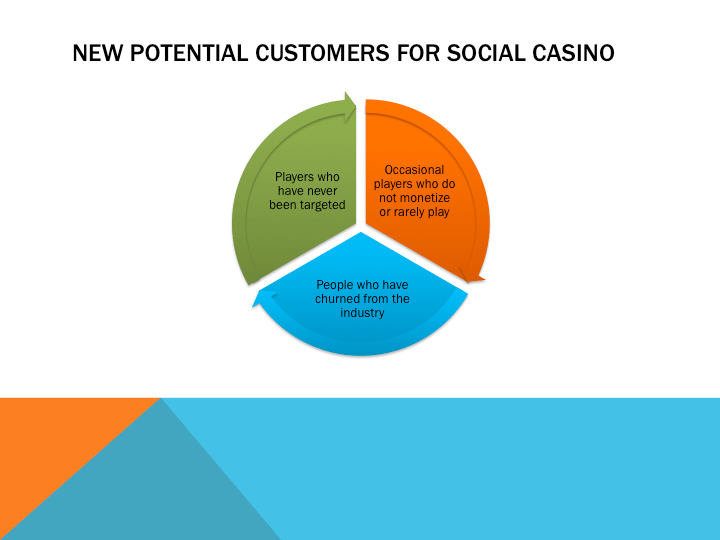
Non-customers are particularly important to social casino as the ecosystem has been growing consistently but through better monetization rather than an increase in customers. If the industry is going to continue growing or if you want to gain market share, appealing to non-customers is the best option. First, you can tailor a product appeal to people who play but do not monetize or play rarely. Second, you can build a product for people who have churned, tried social casino games but left. Finally, you can build a social casino product for people who the industry has never targeted.

While the successful companies will come up with concepts internally and not rely on this blog to provide the answers, the key will be creating social casino products that do not simply replicate the existing games. That means looking at mechanics other than slots. Is also means creating an environment that is not targeting 40+ women. To successfully turn non-customers into customers, the parameters of the products also must shift.

Key takeaways

  1. While many companies look at their competitors and try to grow by building a better product for existing customers, the biggest opportunity exists in appealing to non-customers.
  2. There are three types of non-customers: those who occasionally purchase or play, those who have rejected the current offerings and those who have not considered your industry.
  3. If social casino is going to continue growing or if you want to gain market share, appealing to non-customers is the best option. First, you can tailor a product appeal to people who play but do not monetize or play rarely. Second, you can build a product for people who have churned, tried social casino games but left. Finally, you can build a social casino product for people who the industry has never targeted.

Share this:

  • Click to share on Facebook (Opens in new window) Facebook
  • Click to share on LinkedIn (Opens in new window) LinkedIn
Like Loading...
Unknown's avatarAuthor Lloyd MelnickPosted on February 19, 2019April 11, 2020Categories blue ocean strategy, General Social Games Business, General Tech Business, GrowthTags blue ocean strategy, customers, Growth, Strategy1 Comment on Think of Non-Customers First If You Want to Grow

What poker can teach you about business

Joining PokerStars last year had one unexpected side benefit, learning poker skills that makes me more effective. Shortly after starting at PokerStars, I had two of our resident ex-pro poker players give me a crash course in Poker so I can understand our products better. While I am still far from a good player, several of the principles they taught are equally important to succeeding professionally.

Blog JP photo

Don’t bluff

The first thing I was told was never to bluff. This advice is equally valuable in the workplace. Do not threaten an action if you do not plan to follow through. Once you do and the other party calls your bluff, you no longer have any credibility. Moreover, you can put yourself in a weak position if you are bluffing and the other party has a stronger hand than you believe, then they may raise (challenge you) and you will not be able to respond.

This principle does not only impact negotiating with other companies but also handling your career. I remember several years ago an employee coming in threatening to leave for another offer if we did not give him a significant raise. Unfortunately, their work did not warrant a raise and we wished them luck with the other position. It turned out that they did not actually have another offer and were left unemployed.

Don’t assume another player is bluffing

A corollary to not bluffing is never assume your opponent (or in this case a company you are negotiating with) is bluffing. In most cases, the counter-party actually has a strong position. Thus, determine your best course of action under the assumption that they are in a strong position. That may mean making a deal with them that is sub-optimal for you but still better than no deal, rather than pushing too hard and ending up with nothing because they have strong alternatives. As my Yoda said, “take the word bluff out of your vocabulary.

Be aggressive with a strong hand

While you should avoid acting like you have a strong hand when you do not, be aggressive when you do have a strong hand. That is the time to get the best deal for yourself or your company. You do not get many fantastic hands in life (the equivalent of a royal flush), so when you do you need to make up for all the times you folded because you did not try to bluff or assumed your opponent was not bluffing.

I spoke earlier of a situation of a person with a very weak hand trying to bluff their way to a higher salary only to lose their position; I also saw someone with a very strong hand play it into security for life. In the latter case, a colleague was responsible for a very successful game, one that positioned the company for success. Rather than simply smiling and accepting a nice (guaranteed) bonus check, they threatened to leave unless they got a new contract that guaranteed them financial security and creative control effectively for life. They could do this because the successful game not only made them critical for their company but meant they could go virtually anywhere they pleased. He thus used this strong hand to not only secure his future but that of his children.

Patience

The need to only play strong hands (derived from not bluffing), but play them powerfully, also creates a need for patience. In poker, you have very few strong hands, probably less than one out of five. That means 80 percent of the time you need to fold and sit back and watch everyone else play.

This patience is much easier said than done. Most people, myself included, do not like to wait. You are anxious to play, you feel you are letting yourself or your company down by not acting. Most of the time, though, the optimal strategy is folding until you have a strong hand that you play aggressively. It may not be the most fun but it is the most effective.

Don’t bet your entire bankroll

Another key principle is to never bet your entire bankroll. Even if you feel you have a strong hand, you should not risk more than 25 percent of your bank roll. Rather than a hard number, I have heard you should not bet more than you are comfortable loosing.

Launching a great new product is a good example. You may have a product that has been testing well and you believe in strongly. Rather than bet your entire company on the success of the product, you need to keep resources to support the rest of your business. Elon Musk has shown this with the launch of the Model 3. While Tesla clearly believes this is their breakthrough product, they continue to develop the Model X SUV and improve the Model S. While you may think your new product is the future, a competitive product can undercut it or the market may not react the same as it did during testing.

Information is critical

In poker, good players leverage data to optimize their chances of winning. This data can come from knowing the odds of what hands are likely, watching how other players are playing (see below) or pulling data on opposing players from various data sources. They also do not provide information when not required. They do not show what cards they have if they folded or if the other player folds before showdown. Less is more when disclosing information.

In the business world, success is also driven by information. If you are trying to do a deal with a company and know that they are about to have an important earnings call and word of your deal will help stock price, you can extract better terms than if you treated the negotiation as if it was happening in a void.

Watch and listen

The final, and possibly most important lesson, was to spend most of your time studying your opponents. By understanding your opponent, anticipating patterns in their behavior, translating their body language to future action, you can decide on the best course of action.

An example of the power of observation is a story I was told about a professional poker player who won a tournament purely based on observation. The player never once looked at his cards. Instead, he folded, called and bet based on what he saw of his opponents. Never underestimate the power of observation.

Key takeaways

  • Remove bluffing from your vocabularly. Do not try to bluff your opponent in business and do not assume they are bluffing.
  • When you are in a strong position, push your advantage.
  • Observe everyone you are interacting with and use those observations to put their actions into context.

Share this:

  • Click to share on Facebook (Opens in new window) Facebook
  • Click to share on LinkedIn (Opens in new window) LinkedIn
Like Loading...
Unknown's avatarAuthor Lloyd MelnickPosted on May 11, 2016May 1, 2021Categories General Social Games Business, General Tech Business, Lloyd's favorite postsTags bluffing, PokerStars, StrategyLeave a comment on What poker can teach you about business

When to reinvent your company

There was a great article in the Harvard Business Review, “Knowing When to Reinvent” by Mark Bertolini, David Duncan and Andrew Waldeck, that does a great job of showing the indicators of when you need to reinvent your business. Although Bertolini is CEO of Aetna, the insurance company, the lessons are very relevant for game and technology companies.

Slide1In my twenty plus years in the game industry, I have seen many great companies fail because they waited too long to reinvent their business. You can look at companies that missed the shift from PC to console (the Infogrames and CDVs), the transition from console to free to play (the THQs and SEGAs), or the transition from Facebook to mobile (the Zyngas and PopCaps). Conversely, I have seen many fail when they lose focus and chase the cool shiny object too early (the NeoGeos and Playdoms).

Bertolini, et al., first make the point that “no business survives over the long term without reinventing itself.” While nobody argues this point, knowing when to start a deliberate strategic transformation is extremely challenging. There are several obstacles to such a change:

  • Employees feel threatened;
  • Customers can be confused or alienated;
  • Investors see uncertainty and often punish what they consider higher risk.

Ironically, the better a company is doing, the harder it is to pursue strategic reinvention. Investors (i.e. the stock market) are happy with current performance. Although they may prefer a wait and see attitude, that can often lead to reinventing yourself too late (which happened to Borders and Blockbusters).

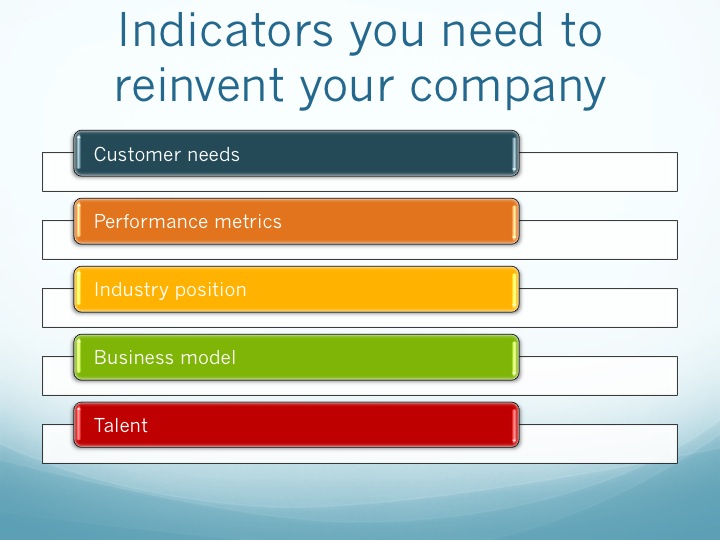
To understand when you should start the process of reinventing your company, the article’s authors define five fault lines that show the underlying business is less stable than it appears. The fault lines focus on business fundamentals:

  1. Is your business serving the right customers and using the appropriate performance metrics?
  2. Is your business positioned properly in its ecosystem and using the best business model?
  3. Does your business’ employees and partners have the needed expertise?

These three areas lead to five fault lines that show if your business needs reinventing. Continue reading “When to reinvent your company”

Share this:

  • Click to share on Facebook (Opens in new window) Facebook
  • Click to share on LinkedIn (Opens in new window) LinkedIn
Like Loading...
Unknown's avatarAuthor Lloyd MelnickPosted on December 16, 2015January 4, 2016Categories General Social Games Business, General Tech BusinessTags Mark Bertolini, Reinvent, Strategy2 Comments on When to reinvent your company

Blue Ocean Opportunities in the Red Ocean of Social Casino

For those of you who were not at Casual Connect and missed my talk on Blue Ocean opportunities in social casino and why they are the best path forward, below is a copy of my deck. The key takeaways are

  1. Social casino is one of the bloodiest of red oceans, with excellent well-financed companies competing ferociously. The best path to success is to take a Blue Ocean approach.
  2. Blue Ocean is all about turning non-customers into customers, rather than competing for the same customer.
  3. You do this by looking at what you can remove from the existing product offering, what you can add, what you can increase and what you can reduce. This leads to a new offering that appeals to new users.

The full presentation can be seen here:

Like Loading...
Unknown's avatarAuthor Lloyd MelnickPosted on October 26, 2015April 11, 2020Categories blue ocean strategy, General Social Games Business, Growth, Lloyd's favorite postsTags blue ocean, Casual Connect, mobile, slots, social casino, social games, Strategy2 Comments on Blue Ocean Opportunities in the Red Ocean of Social Casino

My favorite posts of 2013

Happy New Year!!! Rather than make predictions, which I find as valuable as reading tarot cards, I wanted to look back at some of my favorite posts from last year. Below is a list of the ones I felt were most useful:

  • LTV: The Lifeblood of Your Business My first in a series of posts about lifetime value (LTV), the most important metric any company (from games to bricks and mortar) should focus on.
  • Using probability to build a game portfolio likely to succeed One of my first posts of 2013 but one potentially very important to game companies. It discusses how to structure your portfolio to maximize return while reducing risk.
  • Growth tactics for mobile game and social media companies The key tenets to building a successful growth and user acquisition plan. Continue reading “My favorite posts of 2013”

Share this:

  • Click to share on Facebook (Opens in new window) Facebook
  • Click to share on LinkedIn (Opens in new window) LinkedIn
Like Loading...
Unknown's avatarAuthor Lloyd MelnickPosted on January 2, 2014January 12, 2014Categories Analytics, General Social Games Business, Growth, International Issues with Social Games, Lloyd's favorite posts, LTV, Social CasinoTags analytics, leadership, Lloyd Melnick, Strategy1 Comment on My favorite posts of 2013

How to create a winning strategy

Last month, I wrote about the telltale signs of a doomed strategy. Today I want to write about the foundation of creating a successful strategy that builds sustainable competitive advantage.
Playing to Win
As I’ve mentioned in previous posts, A.G. Lafley and Roger Martin do a great job in Playing to Win of showing the common factors that demonstrate a winning strategy. Continue reading “How to create a winning strategy”

Share this:

  • Click to share on Facebook (Opens in new window) Facebook
  • Click to share on LinkedIn (Opens in new window) LinkedIn
Like Loading...
Unknown's avatarAuthor Lloyd MelnickPosted on December 4, 2013December 11, 2013Categories General Social Games BusinessTags A.G. Lafley, Playing to Win, Roger Martin, StrategyLeave a comment on How to create a winning strategy

Is your strategy unsound?

While it is extremely difficult to create a great strategy that generates sustainable competitive advantage, it is not very hard to craft a flawed strategy. It is more difficult now than ever to build a great business. As A.G. Lafley and Roger Martin write in Playing to Win the new normal is volatile, uncertain, complex and ambiguous. Given this environment, having a sound strategy is critical. I plan on writing next month on the key elements of a sound strategy but more pressing is analyzing your existing strategy to see if it is flawed. In Playing to Win, the authors point out the six most common strategy traps.

  • The do-it-all strategy. Companies fall into this trap when they fail to make choices, instead they consider all initiatives as priorities. While this is sometimes a problem for struggling companies who feel they do not have the luxury to reject any initiatives, it is actually a greater problem for companies that have multiple great opportunities. It is harder to say no to a great opportunity than focus on the least of all evils. But if you do not focus, you are not likely to make the most of any of your opportunities and build sustainable competitive advantage. Lafley and Martin point out that strategy is always a choice, so you should not abdicate this decision.
  • The Don Quixote strategy. With this trap, you attack competitive “walled cities,” taking on your strongest competitors first. Given that your competitors are also smart and trying to build sustainable competitive advantage, your chances for success are minimized if you are focusing on fighting the strongest. Part of strategy is deciding who to compete against.
  • The Waterloo strategy. Much like the do-it-all strategy, this trap entails starting wars on multiple fronts with multiple competitors at the same time. No company can do everything well, and trying to compete on so many fronts will leave you weaker everywhere.
  • The something for everyone strategy. In this trap, you try to capture all consumer or channel or geographic or category segments simultaneously. The problem is, to create real value for your customers, you need to know them intimately and not worry about the others.
  • The dreams-that-never-come-true strategy. With this approach, you create high-level aspirations and mission statements that never get translated into concrete where to compete and how to compete choices, core capabilities or management systems. The authors point out that with this trap aspirations are not strategy.
  • The program-of-the-month strategy. This is another trap I have seen all too often. With this trap, a company chooses generic industry strategies, in which all competitors are chasing the same customers, geographies and segments the same way. It is a classic red ocean approach, and you have little chance of doing better than everyone else (despite how smart you think you are). The more your choices look like those of your competitor, the less likely you are to win. Continue reading “Is your strategy unsound?”

Share this:

  • Click to share on Facebook (Opens in new window) Facebook
  • Click to share on LinkedIn (Opens in new window) LinkedIn
Like Loading...
Unknown's avatarAuthor Lloyd MelnickPosted on November 13, 2013November 20, 2013Categories General Social Games BusinessTags A.G. Lafley and Roger Martin, Do-it-all strategy, don quixote strategy, Playing to Win, Strategy, waterloo strategy1 Comment on Is your strategy unsound?

Innovate your business model, not necessarily your product

While everyone in the tech industry focuses on innovating their product, one great way to create value is by innovating your business model. A recent article in the MIT Sloan Management Review, Creating Value Through Business Model Innovation by Raphael Amit and Christoph Zott, does a great job of showing ways to innovate and create value. The article also points out that innovating the business model and not focusing just on products can be less capital intensive. Finally, it puts you at less risk, because currently in the tech and gaming space you are one innovation away from people not needing your product.

There are three primary reasons you should consider focusing on innovating your business model

  1. It represents an often underutilized source of future value.
  2. Competitors might find it more difficult to imitate or replicate an entire novel activity system than a single novel product or process.
  3. Leaders must be attuned to the possibility of competitors’ efforts at business model innovation because it is so potentially powerful.

One of the best examples of a company dominating an industry by innovating business models is Apple with the iPod. Continue reading “Innovate your business model, not necessarily your product”

Share this:

  • Click to share on Facebook (Opens in new window) Facebook
  • Click to share on LinkedIn (Opens in new window) LinkedIn
Like Loading...
Unknown's avatarAuthor Lloyd MelnickPosted on September 11, 2013October 9, 2013Categories General Social Games BusinessTags blue ocean, business model innovation, StrategyLeave a comment on Innovate your business model, not necessarily your product

Posts pagination

Page 1 Page 2 Next page

Get my book on LTV

The definitive book on customer lifetime value, Understanding the Predictable, is now available in both print and Kindle formats on Amazon.

Understanding the Predictable delves into the world of Customer Lifetime Value (LTV), a metric that shows how much each customer is worth to your business. By understanding this metric, you can predict how changes to your product will impact the value of each customer. You will also learn how to apply this simple yet powerful method of predictive analytics to optimize your marketing and user acquisition.

For more information, click here

Follow The Business of Social Games and Casino on WordPress.com

Enter your email address to follow this blog and receive notifications of new posts by email.

Join 791 other subscribers

Most Recent Posts

  • Join me at PDMA Inspire for my talk on new product prioritization
  • Why keep studying?
  • The next three years of this blog
  • Interview with the CEO of Murka on the biggest growth opportunity in gaming, Barak David

Lloyd Melnick

This is Lloyd Melnick’s personal blog.  All views and opinions expressed on this website are mine alone and do not represent those of people, institutions or organizations that I may or may not be associated with in professional or personal capacity.

I am a serial builder of businesses (senior leadership on three exits worth over $700 million), successful in big (Disney, Stars Group/PokerStars, Zynga) and small companies (Merscom, Spooky Cool Labs) with over 20 years experience in the gaming and casino space.  Currently, I am the GM of VGW’s Chumba Casino and on the Board of Directors of Murka Games and Luckbox.

Topic Areas

  • Analytics (114)
  • Bayes' Theorem (8)
  • behavioral economics (8)
  • blue ocean strategy (14)
  • Crowdfunding (4)
  • DBA (2)
  • General Social Games Business (459)
  • General Tech Business (195)
  • Growth (88)
  • International Issues with Social Games (50)
  • Lloyd's favorite posts (101)
  • LTV (54)
  • Machine Learning (10)
  • Metaverse (1)
  • Mobile Platforms (37)
  • Prioritization (1)
  • Social Casino (52)
  • Social Games Marketing (105)
  • thinking fast and slow (5)
  • Uncategorized (33)

Social

  • View CasualGame’s profile on Facebook
  • View @lloydmelnick’s profile on Twitter
  • View lloydmelnick’s profile on LinkedIn

RSS

RSS Feed RSS - Posts

RSS Feed RSS - Comments

Categories

  • Analytics (114)
  • Bayes' Theorem (8)
  • behavioral economics (8)
  • blue ocean strategy (14)
  • Crowdfunding (4)
  • DBA (2)
  • General Social Games Business (459)
  • General Tech Business (195)
  • Growth (88)
  • International Issues with Social Games (50)
  • Lloyd's favorite posts (101)
  • LTV (54)
  • Machine Learning (10)
  • Metaverse (1)
  • Mobile Platforms (37)
  • Prioritization (1)
  • Social Casino (52)
  • Social Games Marketing (105)
  • thinking fast and slow (5)
  • Uncategorized (33)

Archives

  • September 2023
  • December 2021
  • July 2021
  • March 2021
  • February 2021
  • January 2021
  • December 2020
  • November 2020
  • October 2020
  • September 2020
  • August 2020
  • July 2020
  • June 2020
  • May 2020
  • April 2020
  • March 2020
  • February 2020
  • January 2020
  • November 2019
  • October 2019
  • September 2019
  • June 2019
  • May 2019
  • April 2019
  • March 2019
  • February 2019
  • January 2019
  • December 2018
  • June 2018
  • May 2018
  • April 2018
  • March 2018
  • February 2018
  • January 2018
  • December 2017
  • June 2017
  • May 2017
  • April 2017
  • March 2017
  • February 2017
  • January 2017
  • December 2016
  • November 2016
  • October 2016
  • September 2016
  • June 2016
  • May 2016
  • April 2016
  • March 2016
  • February 2016
  • January 2016
  • December 2015
  • November 2015
  • October 2015
  • September 2015
  • July 2015
  • June 2015
  • May 2015
  • April 2015
  • March 2015
  • February 2015
  • January 2015
  • December 2014
  • November 2014
  • October 2014
  • September 2014
  • August 2014
  • July 2014
  • June 2014
  • May 2014
  • April 2014
  • March 2014
  • February 2014
  • January 2014
  • December 2013
  • November 2013
  • October 2013
  • September 2013
  • August 2013
  • July 2013
  • June 2013
  • May 2013
  • April 2013
  • March 2013
  • February 2013
  • January 2013
  • December 2012
  • November 2012
  • October 2012
  • September 2012
  • August 2012
  • July 2012
  • June 2012
  • May 2012
  • April 2012
  • March 2012
  • February 2012
  • January 2012
  • December 2011
  • November 2011
  • October 2011
  • September 2011
  • August 2011
  • July 2011
  • June 2011
  • May 2011
  • December 2010
December 2025
S M T W T F S
 123456
78910111213
14151617181920
21222324252627
28293031  
« Sep    

by Lloyd Melnick

All posts by Lloyd Melnick unless specified otherwise
Google+

Enter your email address to subscribe to this blog and receive notifications of new posts by email.

Join 791 other subscribers
Follow Lloyd Melnick on Quora

RSS HBR Blog

  • How One Manufacturer Achieved Net Zero at Zero Cost
  • What Can U.S. Employers Do About Rising Healthcare Costs?
  • When You Have to Execute a Strategy You Disagree With
  • 4 Ways to Build Durable Relationships with Your Most Important Customers
  • What Jargon Says About Your Company Culture
  • Research: When Used Correctly, LLMs Can Unlock More Creative Ideas
  • Your New Role Requires Strategic Thinking…But You’re Stuck in the Weeds
  • For Circular Economy Innovation, Look to the Global South
  • Why Great Leaders Focus on the Details
  • Corporate Disclosure in the Age of AI

RSS Techcrunch

  • An error has occurred; the feed is probably down. Try again later.

RSS MIT Sloan Management Review Blog

  • AI Coding Tools: The Productivity Trap Most Companies Miss
  • How Procter & Gamble Uses AI to Unlock New Insights From Data
  • Rewire Organizational Knowledge With GenAI
  • Hungry for Learning: Wendy’s Will Croushorn
  • Beat Burnout: 10 Essential MIT SMR Reads
  • How Leaders Stay True to Themselves and Their Stakeholders
  • Our Guide to the Winter 2026 Issue
  • Broadening Future Perspectives at the Bank of England
  • A Faster Way to Build Future Scenarios
  • Assess What Is Certain in a Sea of Unknowns
The Business of Social Games and Casino Website Powered by WordPress.com.
  • Subscribe Subscribed
    • The Business of Social Games and Casino
    • Join 726 other subscribers
    • Already have a WordPress.com account? Log in now.
    • The Business of Social Games and Casino
    • Subscribe Subscribed
    • Sign up
    • Log in
    • Report this content
    • View site in Reader
    • Manage subscriptions
    • Collapse this bar
 

Loading Comments...
 

    %d