Change is the cornerstone of building a successful a business, but while many people look at the strategic reasons to pivot equally important for triumph is managing the politics and emotions involved. Left unattended, skepticism, fear, and panic can wreak havoc on any pivot. These emotions create resistance, distraction and burnout when you are trying to make a strategic or tactical change. A recent article in the MIT Sloan Management Review by Ellen Auster and Trish Ruebottom highlights a five-step process to address these issues.
Author: Lloyd Melnick
The real takeaway from Hasbro’s acquisition of Backflip
The announcement yesterday that Hasbro acquired 70 percent of Backflip Studios for $112 million is great (and well deserved) for the Backflip team but potentially disastrous for many mid-level social game companies. Backflip has a history of successful—and profitable—games, highlighted by DragonVale, one of the most successful games in iOS history. The game launched in 2011 and still in the top 15 in the top-grossing charts.
The valuation bodes poorly for other social mobile game companies. Given the $112 million purchase price for 70 percent, the Backflip team accepted a valuation of $160 million. There are many, many, less successful mobile game developers who have taken significant amounts of venture capital at valuation two to six times the valuation Hasbro paid for Backflip. How could a company that does not have a franchise as strong as DragonVale argue it is worth more than $160 million? Continue reading “The real takeaway from Hasbro’s acquisition of Backflip”
Shane Battier and analytics
A few weeks ago, I wrote about how doing the things that do not always generate glory are crucial to success, citing the example of the Miami Heat basketball player, Shane Battier. Well, the Heat won the NBA championship last week, largely due to Battier’s performance in Game 7. What was particularly satisfying is that Battier credited his performance to analytics: Shane Battier cites regression to the mean.

Proud to be part of third exit in three years
For those who have not seen the news, Zynga acquired Spooky Cool Labs today.
The job no leader should delegate (or ignore)
Although delegation is a crucial skill in a leader, one thing you should not delegate is developing and finding future leaders. A classic HBR article by Larry Bossidy, retired CEO of AlliedSignal (now Honeywell), recalled that the greatest challenge he faced in turning around AlliedSignal was building the management team so it was competitive. Bossidy wrote that despite the challenges he faced, he devoted 30–40 percent of his time to hiring and developing leaders. He concludes that AlliedSignal’s success was due in large part to the amount of time and emotional commitment he made to leadership development.
Recruitment
The first step is to be directly involved in the recruitment of leaders. This does not mean only those who report to you, but evaluating the direct reports of direct reports and even going further down the line when necessary. This includes interviewing as many of the future leaders that you can, thereby setting a standard internally; if you hire a good person they will hire good people. Continue reading “The job no leader should delegate (or ignore)”
Lifetime Value Part 10: Incorporating qualitative data into your LTV predictions and game development
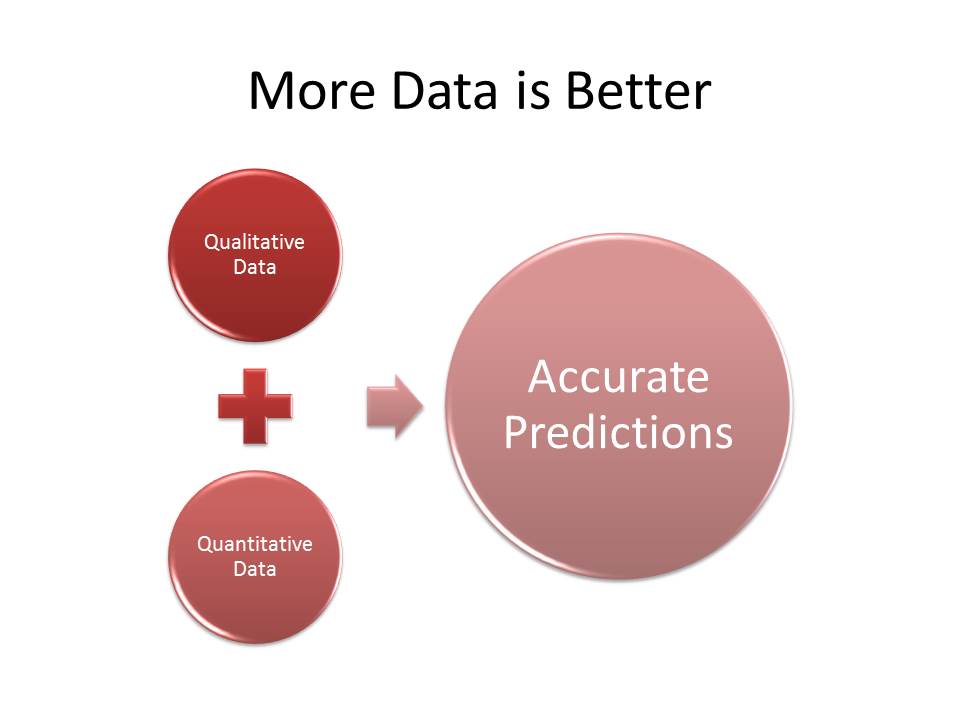
Most of my posts about the reasons and methodology for creating accurate customer lifetime value (LTV) predictions have focused on the numbers and metrics, but a key element to predicting accurately LTV is observational (qualitative) data. It all comes down to more data is better, so predictions with qualitative data are going to be more accurate than those that rely solely on quantitative data. A mistake that is commonly made in the analytics world, and particularly in gaming, is to disregard anything that is not a quantitative value.
Some examples of incorporating effectively qualitative data
The example that had the most impact on me is that Billy Beane and the Oakland A’s, the subject of Moneyball (and multiple blog posts by me), has one of the highest scouting budgets in baseball. Scouts provide data on variables, like mental make-up and desire to win, that are not evident in the historical metrics. So although Beane makes personnel decisions based on metrics, he has also invested large sums in getting qualitative data (scouts watch players and prospects and then report on how they perceive the player’s skills). This approach has proven successful, as Beane’s A’s again surprised people by winning their division last year. What Beane has mastered is finding a way to incorporate the scouting reports with the available quantitative metrics. Continue reading “Lifetime Value Part 10: Incorporating qualitative data into your LTV predictions and game development”
What Mary Meeker’s Internet trends mean for the game industry
Last week, Mary Meeker published her annual Internet Trends presentation (see embedded presentation below) and as I did last year I went through it to see which trends would most influence the social and mobile game ecosystem. Before highlighting the relevant trends she has identified, I went back and examined how prescient her analysis last year was.
Mary Meeker’s 2012 accuracy
Nobody’s predictions will be perfect, and I am not looking to punch holes in Meeker’s analysis. However, it is useful in looking at this year’s predictions to understand her past performance. The big thing that I noticed is that many of the trends she identified last year have not yet had a chance to play out … or even develop. Thus, many of her prediction this year may not have an immediate impact even if they prove eventually to be correct. If you pivot to leverage these trends too quickly, you may have a product before the market develops. Continue reading “What Mary Meeker’s Internet trends mean for the game industry”
Do not mistake the unfamiliar for the improbable
One of the critical mistakes you can make when making analytics-based decisions is mistaking the unfamiliar with the improbable. A few weeks ago, I wrote about how Nate Silver influenced my understanding of how to incorporate uncertainty into your LTV calculation, Silver also did a great job of showing that we must consider contingencies we may not even have thought of. There is a tendency in our planning to confuse the unfamiliar with the improbable. The contingency we have not considered seriously looks strange; what looks strange is thought improbable; what is improbable need not be considered seriously.
Avoid anosognosia
There is a medical condition called “anosognosia,” in which a person who suffers a certain disability seems unaware of the existence of the disability. When a possibility is unfamiliar, we do not even think about it. Instead we develop a sort of mind-blindness to it. The relevant version of this syndrome for professionals in the game industry requires us to do one of the things that goes most against our nature: Admit what we do not know.
In his book, Silver used the attack at Pearl Harbor as a prime example of anosognosia within the US government. He outlined the myriad reasons why the Japanese attack had been such a surprise to our military and intelligence officers. Worse than being unprepared, we had mistaken our ignorance for knowledge and made ourselves more vulnerable as a result. In advance of Pearl Harbor we had a theory that sabotage was the most likely means by which our planes and ships would be attacked. We stacked our planes wingtip to wingtip, and our ships stern to bow, on the theory that it would be easier to monitor one big target than several smaller ones. Meanwhile we theorized that if Japan seemed to be mobilizing for an attack, it would be against Russia or perhaps against the Asian territorial possessions of the United Kingdom since Russia and the UK were already involved in the war. We had not seen the conflict through Japan’s eyes. Continue reading “Do not mistake the unfamiliar for the improbable”

Paul Heydon presentation on the state of the game industry
Great presentation on the evolution of the game industry, the importance of mobile ads and what it means for game developers
The importance of the assist (or why it is good to be Shane Battier)
If you were fortunate enough to see the end of the NBA playoff game Wednesday between Miami and Indiana, you saw one of the greatest plays of all time. It is also one that exemplifies how you can help your company achieve greatness. You may have seen the highlight (Below is a link to the play), but with about two seconds left in overtime, the Miami Heat were down by one point. LeBron James got the ball, blew past the defender and scored a game-winning layup with no time left to give the Heat the win and a 1-0 lead in the series.
What you probably did not realize is that although LeBron made a great play, it would never have happened without Shane Battier, the Miami Heat player who in-bounded the ball. Battier recognized the defense and put the ball in the perfect space for LeBron to get it mid-stride and be able to make the play now shown millions of times throughout the world. Without Battier, the Heat would be down 1-0 in the series with home court advantage belonging to Indiana and people questioning the Heat’s ability to repeat as NBA Champions.
It is not a coincidence that Battier was responsible for such an important play and that the in-bound pass was not made by another player. Continue reading “The importance of the assist (or why it is good to be Shane Battier)”