Skip to content

The Business of Social Games and Casino

How to succeed in the mobile game space by Lloyd Melnick

Category: General Social Games Business

Bayes’ Theorem Part 6: Making the best hiring choices

I have written several blog posts on how Bayes’ Rule can help you make better business decisions and application of this theorem. One of the areas where Bayes’ Rule is most often neglected is in hiring decisions. Often, rational and data driven individuals and organizations abandon the rules of optimal decision-making and rely on intuition.

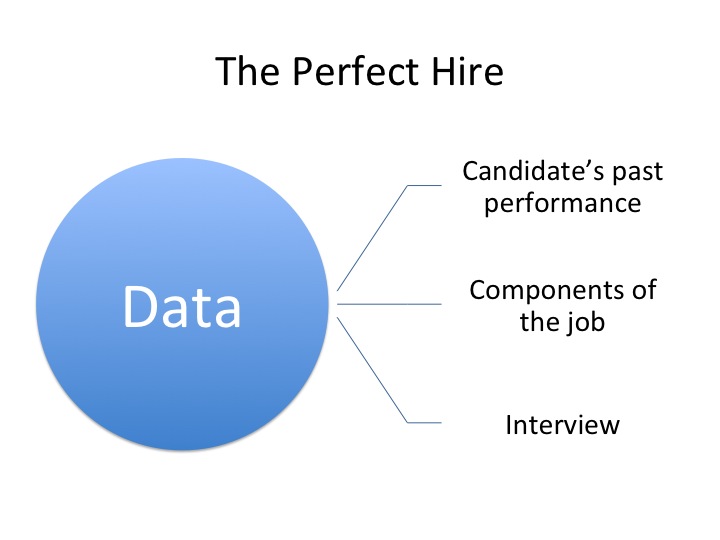
At its core, Bayes’ Rule shows how you can optimize the chance of a correct decision by looking at previous data points that encompass the decision you are trying to make. In the case of hiring, this analysis would be more effective by looking at the metrics and data that shows who succeeds, looking at what makes someone successful in the position you are hiring for and reducing the impact of data that does not lead to good hiring decisions.

What most companies end up doing is using data as a filter but then hiring based on intuition. If you really want to make good decisions, you need to understand your intuition is only one (weak) data point and base the decision on Bayes’ Theorem, using past data to make the optimal decision.
Slide1

What has worked for others

First, look at the position you are hiring for and identify the most successful people (at other companies or at your’s) in the field and “reverse engineer” their background. What experience(s) did they have before they were hired? What is their educational background (school, degree, extra curricular activities, etc.)? Using Bayes’ Rule, if you are hiring for a Director of Social Media and find that 90 percent of the top performing Directors of Social Media went to Texas A&M, then the chances of making a good hire from Texas Tech is already at less than 10 percent. Continue reading “Bayes’ Theorem Part 6: Making the best hiring choices”

Share this:

  • Click to share on Facebook (Opens in new window) Facebook
  • Click to share on LinkedIn (Opens in new window) LinkedIn
Like Loading...
Unknown's avatarAuthor Lloyd MelnickPosted on May 1, 2014May 29, 2014Categories Bayes' Theorem, General Social Games BusinessTags Bayes' Rule, Bayes' Theorem, hiring, recruitingLeave a comment on Bayes’ Theorem Part 6: Making the best hiring choices

The importance of not tolerating low-character employees

One of the most important, yet most difficult, challenges a leader faces is disciplining or jettisoning a strong contributor who has a negative attitude. Although you want as many talented and performing individuals in your company or group as possible, ones with a negative attitude can cause more damage than add value. By negative attitude, I mean an individual who does not feel the company is well run and expresses their lack of confidence in management, and shows visible anger and pessimism about the success of the team or project.

No Jerks Allowed

A recent article on Forbes.com, “The Worst Thing Any Leader Can Do To High Performers” by Robert Sher, quotes Joe Montana, the former star NFL quarterback for the San Francisco 49ers. Montana would say that whenever a fellow player exhibited problem behavior, he would be gone in a few months. What makes this point particularly poignant is that the 49ers had a fantastic string of success, even with high turnover of players. Montana also added that the worst thing a leader can do is “to do nothing.” The article goes on to point out that doing nothing drives peak performers crazy when bad teammates are allowed to stay. Continue reading “The importance of not tolerating low-character employees”

Share this:

  • Click to share on Facebook (Opens in new window) Facebook
  • Click to share on LinkedIn (Opens in new window) LinkedIn
Like Loading...
Unknown's avatarAuthor Lloyd MelnickPosted on April 29, 2014May 29, 2014Categories General Social Games BusinessTags attitude, collaboration, disruptive personalities, leadership, negativeLeave a comment on The importance of not tolerating low-character employees

Lifetime Value Part 12: 10 ways to increase retention and loyalty

I have written several times on how crucial retention is to customer lifetime value and thus the survival of your business. I recently came across an article by Mike Bal in Entrepreneur magazine that does a great job of showing some tactics to improve retention through higher loyalty:10 ways to increase LTV by boosting retention

  • Feature fans in your content. By putting your users in the game or on your fan page, they will become champions of your product. Take good content that they have shared and highlight it, let them know you appreciate their efforts.
  • Give fans something they do not know they want. With your very engaged VIPs or fans, go to their Facebook page or Twitter account, see what they are interested in and give them a gift. For example, if they love guitar, give them a gift card for guitar accessories.
  • Credit customers for feedback you use. Given that we are all constantly improving our products, when one of these improvements is based on customer feedback let the customers know. This could be from survey results, posts on your social media channel or direct communications with the customers.
  • Continue reading “Lifetime Value Part 12: 10 ways to increase retention and loyalty”

Share this:

  • Click to share on Facebook (Opens in new window) Facebook
  • Click to share on LinkedIn (Opens in new window) LinkedIn
Like Loading...
Unknown's avatarAuthor Lloyd MelnickPosted on April 24, 2014May 29, 2014Categories General Social Games Business, LTVTags brand loyalty, lifetime value, LTV, retentionLeave a comment on Lifetime Value Part 12: 10 ways to increase retention and loyalty

Using WhatsApp to grow your game or business

One area where the tech and gaming spaces are very predictable is that they will always evolve; what is a popular platform or channel now is not likely to have the same market share in five years. In 2009, you may have focused on MySpace and told people about it with your Motorola Razr phone. To succeed in this environment, you not only need to build products that take advantage of new platforms, but your entire strategy also needs to leverage this evolution.

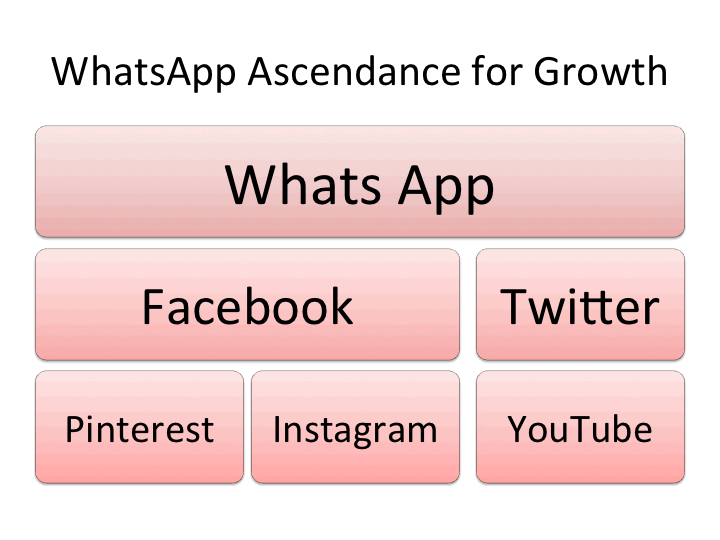
Most marketing and product strategies are currently centered on Facebook, Twitter or Pinterest, but WhatsApp may be the next major platform to outpace them. Facebook obviously thought so, as they spent $19 billion for the company, so it is important to be proactive and leverage the WhatsApp platform to grow and sustain your company. Moreover, many of the techniques applicable to WhatsApp can also be used with its competitors, such as Tencent’s WeChat. WhatsApp can help boost retention and growth.Slide1 Continue reading “Using WhatsApp to grow your game or business”

Share this:

  • Click to share on Facebook (Opens in new window) Facebook
  • Click to share on LinkedIn (Opens in new window) LinkedIn
Like Loading...
Unknown's avatarAuthor Lloyd MelnickPosted on April 22, 2014May 29, 2014Categories General Social Games Business, Growth, Mobile PlatformsTags Facebook, Growth, pinterest, retention, social media, twitter, WeChat, WhatsApp2 Comments on Using WhatsApp to grow your game or business

Three key feedback loops for success with social media games and products

Andrew Chen, one of the thought leaders in growth hacking, recently wrote a blog post that framed the three key feedback loops to make social products habit forming. Given the central role retention plays in lifetime value, and how lifetime value determines whether a product fails or thrives, these loops can be your key to success. If they are all working, the users in your ecosystem create valuable content for the network, creating habitual usage. When the feedback loops are not properly structured, your entire product can break down.
Vital social feedback loops
Chen comments that the industry mantra, “the 1/9/90 principle,” only talks about the distribution of users, not their motivations. This principle states that for a community or social network, 90 percent of users are lurkers, 9 percent contribute and only 1 percent contribute most of the content (more than 50 percent). While this rule shows the different types of users, Chen suggests you think of why these feedback loops are able to create positive emotions and develop habits. If you look at each feedback loop individually, you can then understand how to innovate by adding a twist in content creation, consumption or how people are networked. Continue reading “Three key feedback loops for success with social media games and products”

Share this:

  • Click to share on Facebook (Opens in new window) Facebook
  • Click to share on LinkedIn (Opens in new window) LinkedIn
Like Loading...
Unknown's avatarAuthor Lloyd MelnickPosted on April 10, 2014April 22, 2014Categories General Social Games Business, GrowthTags 1/9/90, Andrew Chen, Social feedback loop1 Comment on Three key feedback loops for success with social media games and products

Optimizing customer service is not about keeping everyone happy

Customer service is a function that is usually neglected in the tech or game space. A recent article in the MIT Sloan Management Review, “The High Price of Customer Satisfaction,” shows companies can also err by focusing on creating too much customer delight. The article points out that customer satisfaction is the most widely used metric to measure and manage customer loyalty because companies assume highly satisfied customers are good for business. The article points out that the reality is not as simple as the belief that high customer satisfaction optimizes profitability. In the article, the authors look across industries and find the correlation between companies’ customer-satisfaction levels for a given year and the company’s performance (as measured by stock price) only explains 1 percent of the variation in a company’s market return. Another study by Bloomberg’s Business Week actually shows a negative relationship. Although you can poke holes in these studies, overall the relationship between customer spending and customer satisfaction is very weak. Because of this and similar research, many consultants and authors have argued that achieving customer satisfaction is a waste of money. The authors, however, conducted extensive research and uncovered three critical issues that keep customer satisfaction from generating higher revenue. By understanding these three issues, any tech or game company (which I think will find them very familiar) can create a better customer service strategy.

Avoid money losing delighters

Strong customer service (CS) scores are normally considered universally good for business but the data is not as clear-cut. There is a downside to devoting resources continually to raise customer satisfaction levels. As companies cannot usually quantify the costs associated with raising customer satisfaction levels, you cannot determine the value of an increase. Often, the return on investment for improving customer satisfaction is trivial or negative. Although higher satisfaction scores can increase revenue, the costs of getting the higher scores frequently outweigh the benefits. Pricing is a great example of this phenomenon.

One key factor that drives customer satisfaction is low prices, as satisfaction and price are almost inversely related. Thus, lowering price tends to be one of the easiest ways to improve satisfaction levels (in the game industry, which could be the same as giving away premium currency). The problem is that most companies and products, low prices are often bad for business and there is not much room to drop prices and remain profitable. The authors used examples of a large financial services institution and Groupon to illustrate this point. With the financial institution, the majority of customers were highly satisfied. Unfortunately, over two-thirds of these highly satisfied customers were also unprofitable for the company. The customers’ high satisfaction was driven primarily by their belief that they were getting great deals, which they were. Each time the company underpriced its offer, these customers bought in large quantities. The problem was exacerbated as the more they spent, the more additional services they expected. With Groupon, there is a usually negative relationship between customer satisfaction and merchant profitability. Four of the six top performing categories of Groupon offers in terms of satisfaction were money losers for the merchants. These four categories, as they were so popular, generate half of Groupon’s volume.

These examples show that customer satisfaction and profitability are often not aligned. There are other ways to improve customer satisfaction, a better customer experience or more innovative products. However, not all alternatives will be profitable. Moreover, not all customers can be profitably satisfied; some will not pay the necessary price for the level of service being offered. Others demand a level of service that more than offsets any revenue they provide. The point of this issue: you must understand the profit impact of efforts to improve customer satisfaction.

Smaller often equals happier

While conventional wisdom suggests that higher satisfaction would lead to higher market share, the author’s research shows that high satisfaction is a negative predictor of market share. They use some very obvious examples to make their point. McDonalds has lower customer satisfaction scores than Wendy’s but much higher sales. Target, Sears and JC Penney all consistently outperform Wal-Mart on customer satisfaction but there sales and profits fall way behind. The primary reason for this seeming contradiction is that the broader a company’s market appeal relative to the offerings of competitors, the lower the level of satisfaction. Gaining market share normally comes from attracting customers whose needs are not completely aligned with the company’s core target market. Thus, smaller niche companies can better serve their customers while companies with large market share must serve a more diverse set of customers. This data suggests you should not necessarily benchmark against the companies in your space with the highest customer satisfaction levels, they are probably niche players that by design are tailored to their individual audience. It also shows that you a focus on improving your score may not improve your profitability.

The importance of being number one

Improving customers’ share of spending with your brand often represents a far greater opportunity than efforts to improve customer retention. Many companies assume that higher customer satisfaction scores will result in a greater share of customer’s wallet. The research, however, shows virtually no correlation between satisfaction and wallet share. They hypothesize this occurs because customers now have divided loyalty (they are not committed to a single brand), more customers partially defect than completely defect from a business or brand. This is particularly true in the free to play game space, where players will partially defect to another game or app. The weak relationship between satisfaction and wallet share leaves many companies unable to identify what they can do to capture a greater share of customer spending. They tend to believe that customers who consider themselves completely satisfied are more likely to give the bulk of their spending in the category to their brand. The goal then becomes to get that number up. Unfortunately, company’s satisfaction or NPS (Net Promoter Score) is a poor indicator of the relative preference that customers have toward the brands they use. Customers normally divide their spending among multiple competing games or brands. Since not all are equal in satisfying customers, those that better satisfy will get a greater share of customers’ spending. The measure that really impacts revenue is the relative rank that your brand’s satisfaction level represents compared to your competitors. Satisfaction is relative to competitive alternatives.

How to succeed with customer satisfaction

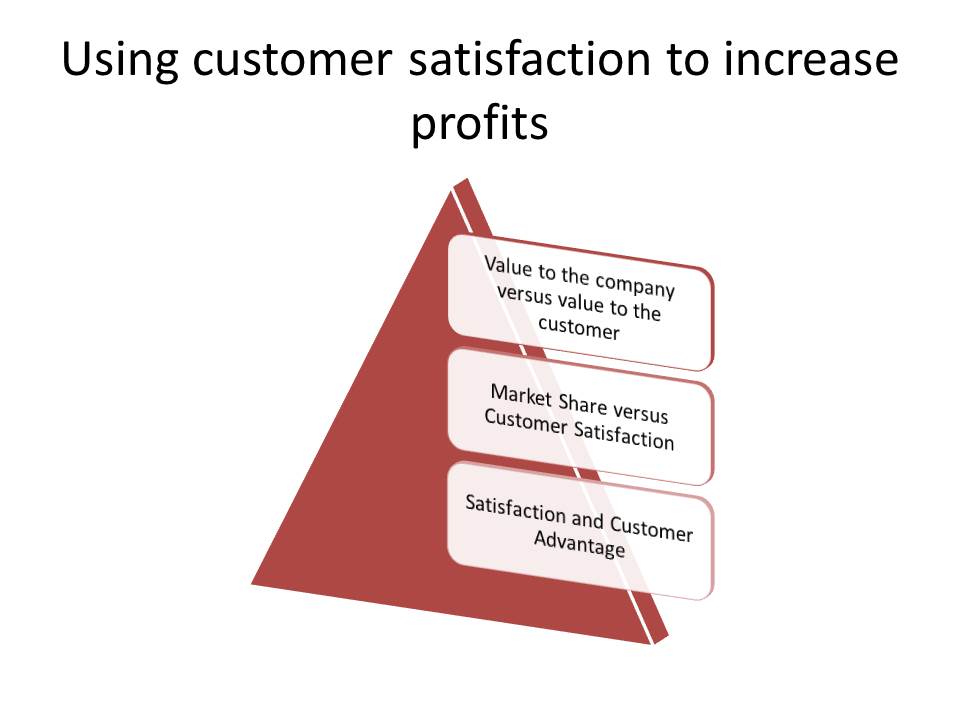
Using customer satisfaction to increase profits While focusing simply on high customer satisfaction is not a profitable strategy, using it appropriately has huge benefits. Continue reading “Optimizing customer service is not about keeping everyone happy”
Share this:

  • Click to share on Facebook (Opens in new window) Facebook
  • Click to share on LinkedIn (Opens in new window) LinkedIn
Like Loading...
Unknown's avatarAuthor Lloyd MelnickPosted on April 8, 2014April 14, 2014Categories General Social Games Business, Growth, Lloyd's favorite postsTags Customer satisfaction, customer service, NPS1 Comment on Optimizing customer service is not about keeping everyone happy

Understanding the innovator’s dilemma

Earlier this year, I wrote how using analytics to gain deep customer insight could inhibit innovation, based on Clayton Christensen’s Innovator’s Dilemma. I wanted to dive deeper into the Innovator’s Dilemma, as it is important to all tech companies, from those trying to grow to those trying to disrupt established industries. I will also tie everything together by showing how the free-to-play model disrupted the electronic game industry, destroying companies like Acclaim and Midway and creating billion-dollar companies like King.com and Kabam.

What is the innovator’s dilemma

At its core, the innovator’s dilemma is the apparent contradiction between knowing your customers intimately and optimizing your product for them, versus the fact that innovation will be driven by a different group of customers. Additionally, if you are a successful company the problem is magnified, as the new market may initially be much smaller than your current market and thus not warrant your attention. Finally, as Christensen writes, “blindly following the maxim that good managers should keep close to their customers can sometimes be a fatal mistake.”

Christensen cites many examples in the book, but one of the strongest is how the disc drive industry evolved. Some great companies, IBM, Control Data, Seagate, made all the right textbook moves by innovating based on what their customers wanted and then found themselves outflanked by other companies. In fact, the established 14-inch drive manufacturers were held captive by customers. Mainframe computer manufacturers did not need or want an 8-inch drive. They explicitly did not want it: They wanted drives with increased capacity at a lower cost per megabyte. So the drive manufacturers created products that their customers were demanding, missed the market for PC drives and then the manufacturers of PC drives went upstream and took their core market. This is a cycle that has been repeated in the drive industry buy also in multiple high-tech and low-tech industries. Continue reading “Understanding the innovator’s dilemma”

Share this:

  • Click to share on Facebook (Opens in new window) Facebook
  • Click to share on LinkedIn (Opens in new window) LinkedIn
Like Loading...
Unknown's avatarAuthor Lloyd MelnickPosted on March 25, 2014June 4, 2014Categories General Social Games Business, Growth, Lloyd's favorite postsTags Clayton Christensen, customer intimacy, disruption, disruptive technology, innovation, Innovator's Dilemma6 Comments on Understanding the innovator’s dilemma

How to get the most knowledge out of an acquisition

There was a great article, “Acquisitions That Make Your Company Smarter” by Nima Amiryany and Jeanne W Ross, in the MIT Sloan Management Review that showed why many companies fail to integrate successfully the knowledge and processes from companies they acquire, even if the acquisition was to acquire the knowledge. It is a phenomenon that I have seen repeatedly, where large game companies will acquire smaller companies to give them international expertise, experience leveraging IP, knowledge of a new platform, etc., yet fail to integrate that information and best practices into the parent organizations. It ends up lessening the value of the acquisition and often disheartening the experts who were acquired and see areas they can improve the parent’s business.

Some examples

Slide1Acquisitions focused on incorporating knowledge are fundamentally different than other acquisitions. The expertise of the acquired company represents a crucial part of its collective knowledge that gives it a competitive advantage. The acquiring company is interested in something that a group of people have created that involves their vision, ways of working together and approach to carrying out certain activities. The acquiring company is primarily interested in the skills and processes, not the products, of the target company.

One of the best examples of such an acquisition was Disney’s acquisition of Pixar in 2006. By purchasing Pixar, Disney brought in knowledge of cutting-edge animation that it did not have. Thus, the success in the deal should not be measured just by the profit from Pixar’s pictures but also from the incremental profit Disney captured with all of its animated films.

Another example is Pfizer’s purchase of Icagen (now Neusentis) in 2011. This deal gave Pfizer expertise in pain research that it previously did not have.

Continue reading “How to get the most knowledge out of an acquisition”

Share this:

  • Click to share on Facebook (Opens in new window) Facebook
  • Click to share on LinkedIn (Opens in new window) LinkedIn
Like Loading...
Unknown's avatarAuthor Lloyd MelnickPosted on March 20, 2014March 25, 2014Categories General Social Games BusinessTags knowledge transfer, Mergers and Acquisition, PixarLeave a comment on How to get the most knowledge out of an acquisition

Analytics: Your company’s reconnaissance unit

At this time of year, most of you are expecting me to write a post tying business with sports, but I want to surprise you with a parallel between business and the military. Many of the issues the military faces and the value it derives from reconnaissance (recon) is very similar to those game and other tech companies derive from data. In the military, recon is used to gather intelligence on the enemy. In business, analytics is used to gather intelligence on your customers. By exploring these similarities, you can better use analytics to achieve victory.

How deep to probe

One of the first question military planners face is how far to send its units. The deeper you send your assets, the more information you will gain. As they go deeper, however, the cost increasing as they are more likely to get killed or captured. You face the same decision, how many assets should you devote to getting intelligence on your customer.

To succeed in business, you first need to determine what information you need from analytics to drive your business (the military equivalent of winning a battle). Then, you need to devote sufficient resources to generate this analysis.

What assets to use

Military commanders have multiple ways to reconnoiter the enemy. They can use troops, special forces (e.g., Rangers, SAS), ships, aircraft, drones, etc. These assets are not mutually exclusive and a leader will combine them to generate the information they need.

Continue reading “Analytics: Your company’s reconnaissance unit”

Share this:

  • Click to share on Facebook (Opens in new window) Facebook
  • Click to share on LinkedIn (Opens in new window) LinkedIn
Like Loading...
Unknown's avatarAuthor Lloyd MelnickPosted on March 18, 2014March 25, 2014Categories Analytics, General Social Games BusinessTags analytics, reconnaisance, social gamesLeave a comment on Analytics: Your company’s reconnaissance unit

Focus over diversification to accelerate growth

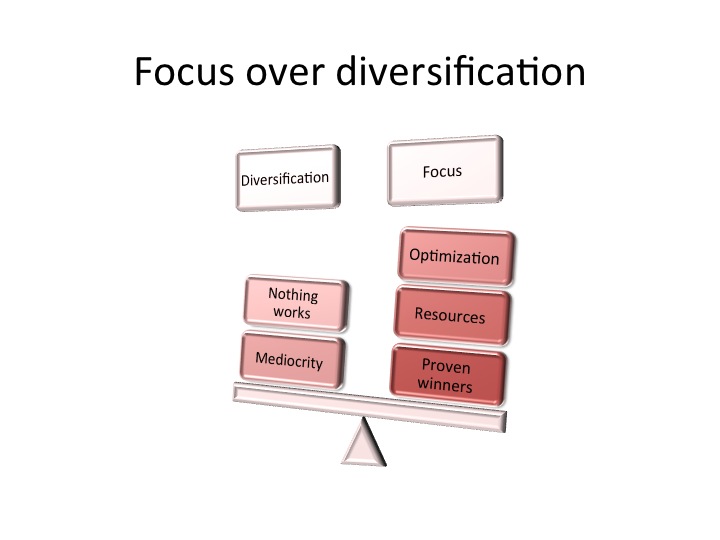
I came across a great blog post by Brian Balfour, “What Blackjack Strategy Teaches us About Growth,” target=”_blank” that does a great job of illustrating the power of focusing your growth efforts rather than chasing diversification. Balfour, a co-founder of Viximo and former Entrepreneur in Residence at Trinity Ventures, draws parallels between the crux of good strategy in Blackjack, doubling down (double down on an 11, and sometimes on a 9 or 10 depending on what the dealer shows), and how it should be applied to your growth strategy.

Slide1

In blackjack, you follow this rule rather than saving your resources for another hand and diversifying your risk. He explains the logic behind this strategy: With a 9, 10 or 11 you have data for that hand that it is “working.” Thus, you have a higher probability of optimizing your winnings by focusing more of your money on a hand that is working than diversifying on other hands that you do not have data on yet.

Application of Blackjack to growth

Balfour points out that many companies work hard to get a growth strategy or tactic to work. Once they get one working, the first instinct is to then find another channel to add to the mix. He argues to fight this instinct and learn from Blackjack: Double down before you diversify.

First, it is important to understand the driver for growth. Growth is a function of (probability of success, impact and resources required). This formula means growth occurs by balancing the probability of success for an AB test, the impact it has if successful and the resources required to implement. You then focus on opportunities that have high probability of success, high impact and low resources required.

Continue reading “Focus over diversification to accelerate growth”

Share this:

  • Click to share on Facebook (Opens in new window) Facebook
  • Click to share on LinkedIn (Opens in new window) LinkedIn
Like Loading...
Unknown's avatarAuthor Lloyd MelnickPosted on March 13, 2014March 25, 2014Categories General Social Games Business, Growth, Social Games MarketingTags Brian Balfour, Diversification, focus, Growth, Peter ThielLeave a comment on Focus over diversification to accelerate growth

Posts pagination

Previous page Page 1 … Page 27 Page 28 Page 29 … Page 46 Next page

Get my book on LTV

The definitive book on customer lifetime value, Understanding the Predictable, is now available in both print and Kindle formats on Amazon.

Understanding the Predictable delves into the world of Customer Lifetime Value (LTV), a metric that shows how much each customer is worth to your business. By understanding this metric, you can predict how changes to your product will impact the value of each customer. You will also learn how to apply this simple yet powerful method of predictive analytics to optimize your marketing and user acquisition.

For more information, click here

Follow The Business of Social Games and Casino on WordPress.com

Enter your email address to follow this blog and receive notifications of new posts by email.

Join 791 other subscribers

Most Recent Posts

  • Join me at PDMA Inspire for my talk on new product prioritization
  • Why keep studying?
  • The next three years of this blog
  • Interview with the CEO of Murka on the biggest growth opportunity in gaming, Barak David

Lloyd Melnick

This is Lloyd Melnick’s personal blog.  All views and opinions expressed on this website are mine alone and do not represent those of people, institutions or organizations that I may or may not be associated with in professional or personal capacity.

I am a serial builder of businesses (senior leadership on three exits worth over $700 million), successful in big (Disney, Stars Group/PokerStars, Zynga) and small companies (Merscom, Spooky Cool Labs) with over 20 years experience in the gaming and casino space.  Currently, I am the GM of VGW’s Chumba Casino and on the Board of Directors of Murka Games and Luckbox.

Topic Areas

  • Analytics (114)
  • Bayes' Theorem (8)
  • behavioral economics (8)
  • blue ocean strategy (14)
  • Crowdfunding (4)
  • DBA (2)
  • General Social Games Business (459)
  • General Tech Business (195)
  • Growth (88)
  • International Issues with Social Games (50)
  • Lloyd's favorite posts (101)
  • LTV (54)
  • Machine Learning (10)
  • Metaverse (1)
  • Mobile Platforms (37)
  • Prioritization (1)
  • Social Casino (52)
  • Social Games Marketing (105)
  • thinking fast and slow (5)
  • Uncategorized (33)

Social

  • View CasualGame’s profile on Facebook
  • View @lloydmelnick’s profile on Twitter
  • View lloydmelnick’s profile on LinkedIn

RSS

RSS Feed RSS - Posts

RSS Feed RSS - Comments

Categories

  • Analytics (114)
  • Bayes' Theorem (8)
  • behavioral economics (8)
  • blue ocean strategy (14)
  • Crowdfunding (4)
  • DBA (2)
  • General Social Games Business (459)
  • General Tech Business (195)
  • Growth (88)
  • International Issues with Social Games (50)
  • Lloyd's favorite posts (101)
  • LTV (54)
  • Machine Learning (10)
  • Metaverse (1)
  • Mobile Platforms (37)
  • Prioritization (1)
  • Social Casino (52)
  • Social Games Marketing (105)
  • thinking fast and slow (5)
  • Uncategorized (33)

Archives

  • September 2023
  • December 2021
  • July 2021
  • March 2021
  • February 2021
  • January 2021
  • December 2020
  • November 2020
  • October 2020
  • September 2020
  • August 2020
  • July 2020
  • June 2020
  • May 2020
  • April 2020
  • March 2020
  • February 2020
  • January 2020
  • November 2019
  • October 2019
  • September 2019
  • June 2019
  • May 2019
  • April 2019
  • March 2019
  • February 2019
  • January 2019
  • December 2018
  • June 2018
  • May 2018
  • April 2018
  • March 2018
  • February 2018
  • January 2018
  • December 2017
  • June 2017
  • May 2017
  • April 2017
  • March 2017
  • February 2017
  • January 2017
  • December 2016
  • November 2016
  • October 2016
  • September 2016
  • June 2016
  • May 2016
  • April 2016
  • March 2016
  • February 2016
  • January 2016
  • December 2015
  • November 2015
  • October 2015
  • September 2015
  • July 2015
  • June 2015
  • May 2015
  • April 2015
  • March 2015
  • February 2015
  • January 2015
  • December 2014
  • November 2014
  • October 2014
  • September 2014
  • August 2014
  • July 2014
  • June 2014
  • May 2014
  • April 2014
  • March 2014
  • February 2014
  • January 2014
  • December 2013
  • November 2013
  • October 2013
  • September 2013
  • August 2013
  • July 2013
  • June 2013
  • May 2013
  • April 2013
  • March 2013
  • February 2013
  • January 2013
  • December 2012
  • November 2012
  • October 2012
  • September 2012
  • August 2012
  • July 2012
  • June 2012
  • May 2012
  • April 2012
  • March 2012
  • February 2012
  • January 2012
  • December 2011
  • November 2011
  • October 2011
  • September 2011
  • August 2011
  • July 2011
  • June 2011
  • May 2011
  • December 2010
January 2026
S M T W T F S
 123
45678910
11121314151617
18192021222324
25262728293031
« Sep    

by Lloyd Melnick

All posts by Lloyd Melnick unless specified otherwise
Google+

Enter your email address to subscribe to this blog and receive notifications of new posts by email.

Join 791 other subscribers
Follow Lloyd Melnick on Quora

RSS HBR Blog

  • New Research on Copycat Products, Your Pitch-Day Dress Code, When Hand Gestures Help Persuasion, and More
  • Leaders, Bring Your Best Self into the New Year
  • What Actually Works to Change Someone’s Mind
  • Our Favorite Management Tips of 2025
  • How to Manage—and Motivate—Gen Z
  • The Most-Watched HBR Videos of 2025
  • The HBR Charts that Help Explain 2025
  • The Most Popular HBR Podcast Episodes of 2025
  • How the Best Leaders Develop and Spend “Innovation Capital”
  • The 10 Most Popular HBR Articles of 2025

RSS Techcrunch

  • An error has occurred; the feed is probably down. Try again later.

RSS MIT Sloan Management Review Blog

  • Calm: The Underrated Capability Every Leader Needs Now
  • The Top Five MIT SMR Videos of 2025
  • Three Steps Toward Fairer Talent Management
  • From Crisis to Coopetition: What Leaders Can Learn From Anesthesiologists
  • AI Coding Tools: The Productivity Trap Most Companies Miss
  • How Procter & Gamble Uses AI to Unlock New Insights From Data
  • Rewire Organizational Knowledge With GenAI
  • Hungry for Learning: Wendy’s Will Croushorn
  • Beat Burnout: 10 Essential MIT SMR Reads
  • How Leaders Stay True to Themselves and Their Stakeholders
The Business of Social Games and Casino Website Powered by WordPress.com.
  • Subscribe Subscribed
    • The Business of Social Games and Casino
    • Join 726 other subscribers
    • Already have a WordPress.com account? Log in now.
    • The Business of Social Games and Casino
    • Subscribe Subscribed
    • Sign up
    • Log in
    • Report this content
    • View site in Reader
    • Manage subscriptions
    • Collapse this bar
 

Loading Comments...
 

    %d