Skip to content

The Business of Social Games and Casino

How to succeed in the mobile game space by Lloyd Melnick

Category: General Social Games Business

Why Activision and EA have dropped over 40 percent

Why Activision and EA have dropped over 40 percent

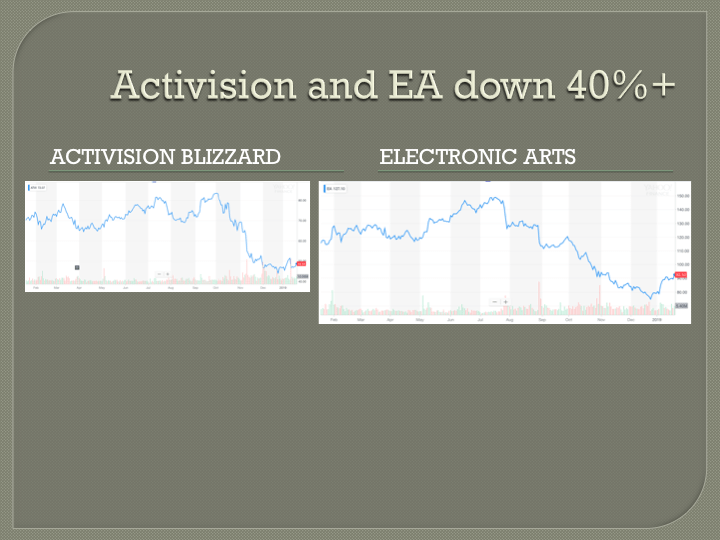
Both Electronic Arts and Activision have plummeted more than 40 percent from their 2018 heights and the underlying causes provide important lessons for other game companies. An article in Barrons, Electronic Arts and Activision Are Struggling to Survive a Fortnite World, highlights the key causes.
slide1

Look at the competition holistically

Many companies are focused on the competition but they fail to define the competition properly. While your direct competition can have the biggest short term impact by increasing marketing or adding a new feature, your entire business can be disrupted by a company that you did not realize is a competitor.

Netflix views Hulu and Amazon Prime as their primary competitors, and then the broadcast and cable networks. It was, however, Fortnite from Epic that had the biggest impact on Netflix last quarter as consumers shifted their entertainment focus from television to the massively popular game. The failure of Netflix to anticipate this competition from a non-traditional competitor has left them unable to respond promptly, adding more scripted content does not negate the appeal of a game like Fortnite.

As the article shows, it was not just Netflix who misread the competition, as it was a key driver for EA and Activision’s decline. These companies were focused on each other (as well as the other console games coming to market) and did not anticipate a free to play gaming changing the ecosystem so dramatically.

Outside of gaming, we have seen this phenomenon repeatedly, from the classic horse buggy companies that went bankrupt as they did not realize the impact of automobiles to the decline of retailers who were slow to respond to online shopping. Blockbuster focused on Hollywood Video and mom and pop video stores before realizing that Netflix was the real threat, realizing too late. In the 1990s, GM and Ford and Chrysler were so focused on competing with each other they all faced bankruptcy when Asian manufacturers gutted their market with a new breed of high mileage vehicles. Dell and Compaq were so fixated on providing better PCs at a more competitive price that they are now afterthoughts to Apple and Samsung.

The game and iGaming space is littered with similar examples. The THQs and Acclaims did not consider free to play a competitor until it was too late. Many land-based sportsbooks did not consider online a threat until they saw their businesses disintegrate. When Sega was looking at building the next Dreamcast, they focused on Nintendo and Sony, not Microsoft.

The lesson is the true threat to your business is not the competitors you recognize as competitors, but companies who provide an offering that your customers can use to replace yours, even if it is a very different product. By not realizing who your potential competitors are, you will not be positioned to retain your customers when they shift.

Franchises are not forever

The article points out how underperforming franchises have also negatively impacted Activision and EA. Destiny was one of Activision’s cornerstone franchises and as soon as Destiny 2 showed the franchise was in decline, the stock fell 12 percent.

Destiny is not the only example of a declining franchise pulling down its stock. When Zynga went public in 2011, Farmville and Zynga Poker helped drive a share price to over $12. As both “franchises” slipped, Zynga has struggled to remain relevant, with a share price about 65 percent lower than at its peak.

These examples show that franchises do not continue indefinitely on their own. You need to work at maintaining and growing them by keeping up with current customer needs, as well as anticipating shifts in the market place.

It also shows a growth strategy focused on acquiring franchises runs the risk of overpaying and failing. Almost by definition, you are buying at a peak because it is only a franchise when it is doing very well (then it is defined is a declining product). If the acquirer cannot grow the franchise, their large investment (and franchises do not come cheap) can crumble.

You need a pipeline of new products

The third lesson from the fall of EA and Activision is the need for a robust product pipeline. Given the risks of franchises declining, you need to have new products ready to replace them. As an analyst wrote in the Barron’s article, “the main issue [for Activision Blizzard] is an underperforming pipeline of games.” In EA’s case, the poor performance of its Battlefield franchise has left it with little to drive growth. Both EA and Activision have built their business by refreshing franchises, so when those fail, they have nothing to fall back on.

While the need for a pipeline of new products (for any industry) seems obvious, it requires a commitment, and not just money. This commitment often feels unnecessary when franchises are driving growth and revenue. Even if a company is willing to invest in new products, if they do not have a commitment from on top, it will still fail as their best people (marketing, tech, design, etc.) will be working on the existing franchise products. In a competitive industry (and every industry these days), your B team is not going to beat other companies who are focused on winning with new products.

What Activision and EA teach us

Rather than feeling sorry for Activision Blizzard and Electronic Arts (they are still valued at over $25+ billion each), you can learn from them to avoid the dramatic declines they have faced recently. Most importantly, when looking at the ecosystem and your customers, realize that customers are not simply deciding between you and your closest competitor, they are looking at the best use of their time. For a game company, that means not worrying about competing games (primarily), but Netflix, music, movies and other form of entertainment. You may create a better product than your competitor to find there is a much smaller market for both of you.

As you are anticipating your customers’ needs, you also need to anticipate they will be different, so you cannot rely on today’s franchises. You need a stream of new products that anticipate their new expectations.

Key takeaways

  • Activision and Electronic Arts shares have fallen more than 40 percent in the past twelve months, driven by a combination of misjudging the competition, relying on franchises and having a weak product pipeline.
  • When surveying and reacting to the competition, you must look beyond the direct competition and understand who else could take your customers.
  • While franchises are important revenue sources, you need to nurture them and have alternatives as they eventually will degrade.

Share this:

  • Click to share on Facebook (Opens in new window) Facebook
  • Click to share on LinkedIn (Opens in new window) LinkedIn
Like Loading...
Unknown's avatarAuthor Lloyd MelnickPosted on January 19, 2019January 19, 2019Categories General Social Games BusinessTags Activision, competition, Electronic Arts, franchises, Green Light, new product development1 Comment on Why Activision and EA have dropped over 40 percent

Lessons and insights from social casino and gaming M&A activity in Q1

Lessons and insights from social casino and gaming M&A activity in Q1

Last quarter saw some interesting deals in the gaming space. Several of the deals, and non-deals, suggest trends that are likely to continue in 2019.

Playtika acquires Wooga rather than another social casino

The most interesting deal was Playtika acquiring Wooga for ~$100MM. The thought-provoking element to me was that Playtika decided to invest outside the social casino space. In the past, acquisitions such as House of Fun, Buffalo Studios, etc., were focused on explanding Playtika’s social casino portfolio. Wooga, however, has no presence in the social casino space, instead is a casual, primarily puzzle, game developer. Playtika’s move suggests one of the following:

  1. Given the stagnant user numbers in social casino, there are better growth opportunities in other genres.
  2. Valuations in casino are too high compared with growth potential in the space.
  3. Most likely, social casino companies will continue to expand (and acquire) in casino but also are maturing to want a more robust and diversified portfolio (consistent with Aristocrat’s acquisition in 2017 of Plarium at the same time it purchased Big Fish).

Zynga spent $560+ million for one title, Empires & Puzzles

Zynga’s $560MM acquisition of 80 percent of Small Giant Games (thus valuing the company at $700MM) shows CEO Frank Gibeau’s strategy of focusing on controlling large, long-term franchises. Small Giant’s core product, Empires & Puzzles, is the 13th highest grossing title on mobile. Empires & Puzzles is Small Giant’s only game live, they are not known to have any other big projects in the pipeline (unlike Natural Motion, which had Dawn of Titans in the works when Zynga acquired it), so the acquisition is to add Empires & Puzzles to Zynga’s list of franchises.

This strategy is consistent with what Gibeau learned at EA, that franchises transform a game company from a hit driven business, with wide revenue fluctuations, to a company with sustainable and predictable growth (and thus higher valuation). He is collecting evergreen franchises to try to turn Zynga into the EA of mobile. These franchises include his purchase of Gram Games, which provided the hypercasual franchise Merge Dragons, and Harpin, which gave him Patience – Solitaire. In addition, acquiring rights to Star Wars, Harry Potter and Game of Thrones for gaming creates additional franchise opportunities. Coupled with existing Zynga franchises Zynga Poker, Words with Friends, CSR Racing and to a lesser extent Hit It Rich!, Wizard of Oz Casino Slots and Farmville, Zynga now has a stable revenue base to build on.

Epic raises $1.25BN at a valuation of $5BN-$6BN, showing the breadth and value of its business

Last October, Epic raised $1.25 billion from KKR, Kleiner Perkins, Vulcan Capital and other blue chip investors at a valuation probably well over $5 billion. What is most impressive about Epic is how it has consistently succeeded in different parts of the game industry. While companies frequently are unable to repeat successes in the gaming space or expand beyond their expertise, Epic seems to do it at ease. Fortnite is only the latest in a string of successes that I find incredibly surprising, given the challenges other companies in the game industry experience. I remember Epic when they were still a small North Carolina company, largely an indie developer. Their odds-defying achievements include (and I am probably forgetting some):

  • I first learned about Epic from a CNN story (I think 1998) about someone who created a first person shooter (FPS) in their basement that was soon to be released but getting much buzz. At the time, the FPS market was dominated by id Software (Doom) and all the other FPS were fringe products. They might have a loyal following, like Bungee’s Marathon, but nobody challenged id. I did not expect Epic to launch the top FPS but they did. Unreal turned into the biggest FPS for years, making id an afterthought.
  • With the success of Unreal, Epic decided to license its game engine (creatively branded the Unreal Engine). At the time, the game engine industry was awful. Companies like NDL (Emergent) scraped by to make payroll as no major developers were using third party engines. There was very much a not invented here mentality in the video game industry. Fast forward ten years later and Epic built a game engine company that powers many hit products and is worth hundreds of millions of dollars.
  • Most successful games are followed with…not another successful game. The video game industry is known as being hit driven and even the strongest companies have had difficulty replicating their big successes. While Epic surprised me by successfully creating a huge franchise with Unreal, it did not seem likely that they could ever replicate their success. Then they launched Gears of War in 2006 and ended up with a bigger franchise than Unreal.
  • I have written several times about the challenge of traditional gaming companies competing successfully in the free to play space, most recently Nintendo. Not only is much of what a game company learned in the traditional videogame space worthless in free to play gaming, it actually hinders the ability to create a successful F2P product. Outside of acquisition, I did not foresee a traditional company succeeding in F2P. Then Epic, which had built its business around traditional console game (Unreal, Gears, etc), launched a title you may have heard of, Fortnite, which has now generated billions of dollars. Not only did it succeed in F2P, it helped build a new F2P monetization mechanic. Yet again Epic proved me wrong.

This fundraising deal shows Epic is arguably the strongest company in the gaming sector and one that can expand its footprint into other gaming areas. Although I consider the Google/Apple duopoly over mobile gaming unshakeable, same for Steam on PC, it is hard to bet against Epic. Its ability to expand from Unreal to one of the largest core gaming companies also suggest that Fortnite will not be a one-hit wonder but we should anticipate more Epic titles dominating free to play gaming.

What Q4 means for 2019

The big deals in Q4 suggest several M&A trends I expect to see in 2019:

  1. There will be a pick-up in consolidation among social casino companies, but these companies will also look at growing in other game genres.
  2. The major game companies (all genres and all platforms) will focus acquisition efforts on acquiring franchises, not talent.
  3. Epic will continue to defy the odds

Key takeaways

  • The three most important deals in the gaming space in Q4 2018 were Zynga’s acquisition of Small Giant Games, Playtika’s acquisition of Wooga and a $1.25BN investment in Epic at a valuation of $5BN-$6BN
  • Playtika’s deal shows that social casino companies are looking outside the space to grow
  • Zynga’s deal demonstrates the value of franchises is increasing in mobile gaming

Share this:

  • Click to share on Facebook (Opens in new window) Facebook
  • Click to share on LinkedIn (Opens in new window) LinkedIn
Like Loading...
Unknown's avatarAuthor Lloyd MelnickPosted on January 15, 2019January 11, 2019Categories General Social Games Business, Social CasinoTags epic games, M&A, playtika, wooga, zynga1 Comment on Lessons and insights from social casino and gaming M&A activity in Q1

What’s next for hypercasual

What’s next for hypercasual

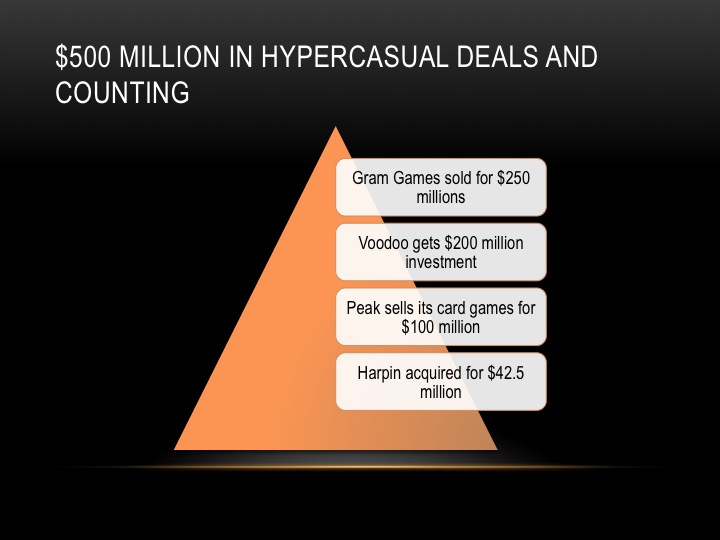
Last year, hypercasual games were the biggest story in mobile gaming. These games captured more than half of all downloads and saw several exits at high multiples. Five of the top 10 free games in the Google Play and Apple AppStores are hyper-casual while Ubisoft acquired Ketchapp for $100-$200 million, Zynga acquired Gram Games for $250 million and Goldman Sachs invested $200 million into Voodoo.

The space, however, is very reminiscent of the early days of social casino where any developer, small or large, could launch a slots product and then sit back and count the money. From Playtika (Slotomania was not great in the early days) to High 5 to Plumbee to GSN, anyone with a decent social casino app would enjoy high returns. As in any competitive industry, over the last few years the companies that could not create great products lost market share or failed whereas the good companies grew. While the social gaming market has grown every year for the past ten years, there have been winners and losers.

The hypercasual sector is likely develop similarly to social casino. Currently, virtually any developer (even one person) can build and launch (with the help of the many publishers) a profitable hypercasual game, with some earning hundreds of thousands of dollars monthly. You also see new companies flocking to the space daily: traditional developers who see it as easy money, established gaming companies looking for a new revenue stream and small independents.

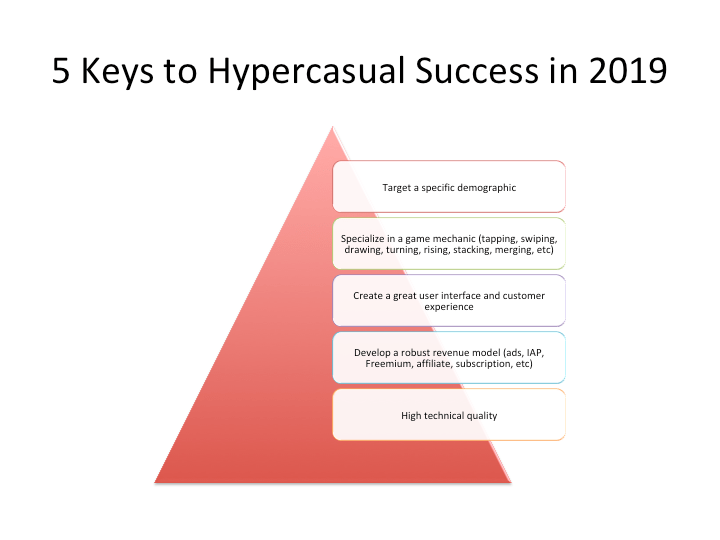
With the influx of so much supply, the next few years will become much more challenging for companies in the hypercasual space. There will still be huge successes, but there will be equally large failures, especially among players who are not committed or do not understand fully the space. Those that succeed will likely follow the five principles below:
Slide1.jpg

Targeted demographic

”Know your customer” was probably the three words that a caveman etched in stone when writing the first business book. Developers of hypercasual games, however, claim their customers are “everybody” and there is no way to have an intimate customer knowledge if everyone is your customer. Most hypercasual games are thus developed for the lowest common denominator, so anyone can enjoy them.

This strategy works in the early days of a market, where there is so much demand a fun product will see a huge market. Think of Bejeweled in the early Match-3 days or Farmville when invest express games first hit Facebook. Those games were the biggest the category would ever see because there were so few options and thus everyone did play them. It’s the same with hypercasual, you still have a limited number of games.

As markets mature, the next phase is games that appeal to a specific demographic. Games for men 15-25, games for women 45+, games for students, games for artists, etc. Once you have a choice of a game optimized for your demographic, you are much less likely to be interested in mass entertainment. Thus, the next phase of the hypercasual market will see different developers focusing on different customer segments.

Focused on one game mechanic

Currently, as the hypercasual market is not very critical, developers are more interesting in create a suite of games quickly. They will replicate popular games and finish a game in a few months (or weeks), then move onto another entirely different game.

As the market matures, customers will be more discerning and will pick the best game in the category they like. The game industry is traditionally winner take all (or at least winner take most), so the likelihood the twentieth best stacking game will find a sizable audience are slim to none. Just as a slots developer is not going to create the best bingo game, a hypercasual developer is not going to create the best games for each hypercasual mechanic (tapping, swiping, drawing, turning, rising, stacking, merging, etc).

In the future, to succeed in hypercasual, you will need to master a game mechanic and create unique experiences. Rather than creating one game in each-sub-genre, create a great rising/falling game then iterate and keep making it better. To succeed, you will need to add unique features or elements to the genre and take it to the next level (pardon the pun).

Better UIUX

The current crop of hypercasual games often have poor user interfaces and mediocre customer experiences. While they are easy to learn, they are often difficult to understand and thoroughly enjoy. Most, even the successful ones, feel thrown together and the player has to figure it out as they go along. It is not a refined experience. They are the equivalent of cars that do not have handles on the doors or put the mirror control next to the back seat. As the industry evolves, customers will expect a smooth, intuitive interface and user experience.

Additionally, advertising now greatly diminishes the customer experience; with more product options players will be less accepting of so many intrusive ads. The only way to create a great UIUX is to devote the time to user testing and polishing and focus on the customer experience from installation through their lifetime, and this polish will be required to succeed in the future.

More robust revenue model

Now, most hypercasual games primarily generate revenue from ads. They do not have robust monetization models because they do not need it, revenue from ads is sufficient to cover user acquisition costs in successful hypercasual games.

Gram Games has expanded into IAP (in-app purchases) while several have a Freemium model that allows players to remove ads for a price. As the space gets more competitive, so will user acquisition. Simple supply and demand shows that UA costs will increase significantly while organic users will decrease as people will have more options. This phenomenon occurred in the social casino space and almost certainly will be replicated in hypercasual.

To mitigate higher acquisition costs, developers will have to increase LTV. Rather than simply relying on ads, successful developers will personalize monetization for each customer, with some happy to generate ad or affiliate revenue, others paying for IAP and some preferring a Freemium or subscription model.

High quality and tested

In the early days of any business, simply being first to market covers a lot of sins. Think of US automakers through the 1970s or the first Facebook games (which seemed to be in maintenance mode as much as they were live). As these and other industries matured, people placed a premium on reliable products. I have been amazed at how often the current generation of hypercasual games crash and how little time the developers have apparently devoted to QA. Success in 2019 (and beyond) will depend on making games that are reliable and bug-free.

How to win

To succeed in hypercasual in 2019 and beyond, you need to create a game that is best of breed for your target customer. Understand your customer and grow the segment, rather than trying to be everything to everyone. Most importantly, make sure the product is fun and polished.

Key takeaways

  1. In 2018, the hypercasual market was like the early days of the social casino market, put out a decent product and count the money. As companies flock to the hypercasual market, success will be much more challenging in 2019 and beyond.
  2. To succeed, rather than every developer putting out a plethora of different hypercasual games, the successful ones will target a demographic and specialize in a game mechanic that allows them to create a superior experience.
  3. Successful hypercasual developers will also polish products so that they have a professional UIUX and they work flawlessly.

Share this:

  • Click to share on Facebook (Opens in new window) Facebook
  • Click to share on LinkedIn (Opens in new window) LinkedIn
Like Loading...
Unknown's avatarAuthor Lloyd MelnickPosted on January 8, 2019January 9, 2019Categories General Social Games BusinessTags hypercasual6 Comments on What’s next for hypercasual

Social Casino Outlook for 2019

Social Casino Outlook for 2019

As I write virtually every year at this time, I cannot predict the future, nor do I think ANYONE else can. While the Mary Meekers, Elon Musks, Bill Gateses, etc., will often come up with insights of how the economy and world will evolve, if you review their predictions you will find they are wrong as often as they are correct.

December, however, is a useful time to reflect on the key trends from 2018 that are likely to extend into 2019, impacting opportunities for those in the mobile and gaming space.

Slide1

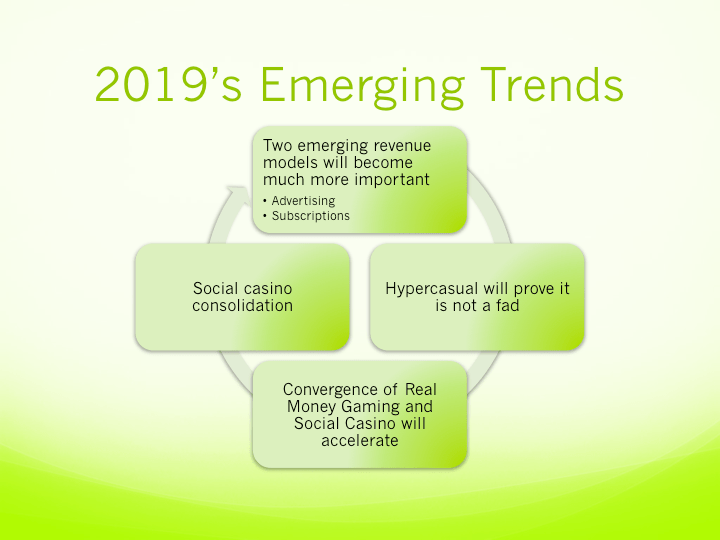
Two emerging revenue models will become much more important

While in-app purchases (IAP)will continue to drive revenue for social casino and social games, two other revenue sources will grow in importance.

  1. Advertising revenue.While advertising revenue already been the primary revenue source for many social games, it still represents only a small percentage of total social game revenue and many applications. In 2019, I expect advertising to become more important for all apps, particularly social casino. If done correctly, watch to earn videos do not cannibalize IAP revenue from spenders and creates revenue from the 95+ percent who do not monetize. Not only do ads not cannibalize IAP revenue, it often increases it by improving engagement and retention.

    Additionally, as customer growth in many social gaming verticals stagnates, particularly social casino, it will be increasingly important to generate additional revenue from existing players. Advertising will provide incremental revenue that complements the other product initiatives and allows companies to cast a wider net in their user acquisition activities.

  2. Subscriptions become another revenue option. While advertising will grow as a revenue source for social casino and social games, subscriptions will make an even greater impact. The subscription model has worked very well in Asia, it is a large part Tencent is valued at over $350 billion, but has not made a big difference in the mobile gaming space in the west (US and Europe). It is also the key to Netflix’s success and arguably Amazon’s (see Amazon Prime). Mobile game companies are finally understanding how to incorporate subscriptions in their business models, rather than just throwing them out there as an additional in-app purchase. The strength of subscriptions throughout the economy suggest it can become as important or even more important than IAPs eventually for social games.

Hypercasual will prove it is not a fad

The biggest development in social gaming in 2018 was the rise of hypercasual games, which now make up more than 50 percent of all mobile downloads. They have also dominated the M&A scene, with Zynga buying Gram Games for $250 million, Goldman Sachs investing $200 million in Voodoo as well as multiple smaller deals. Hypercasual games typically have a single mechanic and a single goal, yet reaching a high score can be very difficult. Effectively the core game loop is very straightforward, do one thing, get rewarded (so you can try again) and keep repeating to get a higher score.

In 2019, I expect the hypercasual segment to mature. By mature, I do not see lower growth but a more professional approach. Companies will no longer succeed by throwing a lot of products at the market. Instead, the industry will fragment, with different companies focusing on specific demographics or gameplay mechanics. I also expect you will see higher product values, while a $25k hypercasual game can be a huge success now, competition will raise the bar. UIUX will improve as will technical stability (today’s hypercasual games remind me of Facebook games from 2012, while games crashing are part of the experience). The increase in quality will eventually drive out the small and independent developers (except for the best and the brightest) but will result in better consumer experiences.

Convergence of Real Money Gaming and Social Casino will accelerate

With both Real Money gaming and social casino becoming increasingly competitive, they will lean more heavily on each other to capture best practices and improve their businesses. Social casinos are great at progression and social mechanics and these features will increasingly find their way into real money gaming, where just adding games no longer will be enough for success. On the social side, with the ability to grow the social slots market seemingly coming to an end, social casinos will take more gaming mechanics (sports betting, live dealer, virtual sports) from real money and adapt them to the social space.

Also, real money online gaming companies will get over their phobia that social gaming is cannibalistic and realize what their land based brethren discovered years ago, the two businesses are complimentary and increase the size of the pie. Social gaming provides the trigger for players to want to play roulette or slots and can also prove a great brand building opportunity. Partnerships similar to MGM’s relationship with Play Studios (where MyVegas and Play Studio’s other games share MGM’s rewards program) will extend into the real money space. As the US real money market emerges, real money operators will be increasingly anxious to partner with social casino companies to access their players.

Social casino consolidation

With user growth slowing in the social casino space, the top companies have to look elsewhere to grow their businesses. They have proven quite adept at increasing revenue from existing users, leading to unbroken annual growth for the past ten years that is likely to continue for at least another few years. But growing revenue per user has its limits, and the owners of the top social casino companies are demanding even more growth. While companies have had mixed (i.e. disappointing) results purchasing small players, the major casinos are driving growth by acquiring the other big boys. Late 2017, Aristocrat purchased Big Fish for about $1 billion. DoubleU also acquired DoubleDown Casino for over $800 million. These two deals have created the number 2 and number 3 social casino companies and I expect this trend to accelerate in 2019 as there will be limited other options for rapid growth.

Return to blogging

One prediction I can be 100 percent confident in is that I will be blogging more in 2019. While the real world got in the way of my blogging in 2018, there are many topics I plan to cover in 2019. I also look forward to any ideas from my friends and followers on topics you would like to see me discuss.

Retrospective

It would be intellectually dishonest if I wrote about my expectations for 2019 without reviewing how my picks for 2018 did. So how did I do last year:

  • The convergence of micro-segmentation, AI and machine learning to create extreme personalization. In 2018, the social casino industry continued to experience strong growth despite flat user numbers. The key driver for this growth has been better personalization and segmentation, the successful companies are tailoring promotions and sales for individual users. If anything, I expect this trend to accelerate in 2019 as companies actually understand what they are doing with machine learning and AI.
  • Voice recognition. While it has not had a big impact on the social casino space, voice driven devices continue to gain ground with Google and Apple joining Amazon promoting voice heavily. I expect in 2019 game companies will figure out how to combine the growth of voice with gaming products.
  • Big change in social casino. I will call this one a slight miss as the space has not evolved dramatically. Stars Group did release the first social casino games, PokerStars Play and Jackpot Poker, with Live Dealer but overall the industry did not change much from 2017. I still expect an innovative company will change the market in 2019.
  • Devices and platforms will become less important. I will admit to a miss here, the ecosystem still revolves around Apple and Google.
  • Dual devices. Another slight miss here. Dual devices have become a reality but they have not significantly impacted the game space.
  • Big players will enter free to play, and fail. This was a big miss and indicative of a sea change but one I am very happy about. After years of social casino and mobile gaming overall being the shiny thing and companies make stupid investments to get into the space, the business has rationalized. Companies are now looking at the competitive situation and financials before moving into the space, leading to a much more rational environment.
  • Privacy. BOOM, did I get this one correct. As someone who personally does not worry too much about my online privacy, privacy became the story of 2018. While privacy concerns will not go away in 2019, I think the concerns will ebb as people understand how to control what they share. The days of aggressively compiling and sharing user data, however, are gone and those companies that still act in a rogue way put their whole business at risk.

See you in 2019, have a great year.

Key takeaways

  1. 2019 should see the emergence of two additional revenue streams for social casino and social games, subscriptions and advertising.
  2. Hypercasual will prove to have legs, remaining a dominant genre in gaming
  3. Real money gaming will borrow more from social casino in 2019 while social casino operators will try game mechanics popular in real money.

Share this:

  • Click to share on Facebook (Opens in new window) Facebook
  • Click to share on LinkedIn (Opens in new window) LinkedIn
Like Loading...
Unknown's avatarAuthor Lloyd MelnickPosted on December 31, 2018December 29, 2018Categories General Social Games Business, General Tech Business, Social CasinoTags advertising, hypercasual, Live Dealer, Mergers and Acquisition, Subscription, Virtual Sports1 Comment on Social Casino Outlook for 2019

Lessons from Real Money Gaming talk at Casual Connect

Lessons from Real Money Gaming talk at Casual Connect

Earlier this month, I spoke at Casual Connect about lessons from Real Money gaming that could be applied to the social space. These lessons range from product to CRM to VIP. See the full talk here:

Share this:

  • Click to share on Facebook (Opens in new window) Facebook
  • Click to share on LinkedIn (Opens in new window) LinkedIn
Like Loading...
Unknown's avatarAuthor Lloyd MelnickPosted on June 20, 2018June 19, 2018Categories General Social Games Business, Social CasinoTags Casual Connect, real money online gamblingLeave a comment on Lessons from Real Money Gaming talk at Casual Connect

How to build a Leaderboard that actually works and drives KPIs

Leaderboards are a common feature in games but developers are often surprised because they are ineffectual or quickly lose impact. The problem is not in the underlying value of leaderboards but in how they are often designed. A recent blog post by Omar Ganai and Steven Ledbetter, How to Motivate with Leaderboards, does a great job of presenting the underlying psychology driving leaderboards and best practices.

What makes leaderboards work

The key principle behind leaderboards is that people want to win and winning improves status. What is often neglected, however, is that some players do not want to win, they want to avoid losing. The latter is important as players who want to avoid losing perform worse when competing. Competition is good for motivation and achievement only when it helps users feel competent. You need to design your leaderboards so it does not make your players feel incompetent.

Ganai and Ledbetter point out that self-determination theory shows people seek and engage in undertakings that fulfill three basic needs. Thus, a well designed leaderboard is consistent with these three needs:

  1. Competence. The emotion a player feels when they successfully complete a challenging goal. The opposite feeling is ineffective or helpless.
  2. Relatedness. The feeling a player has when they are understood and liked by other players. The opposite feeling is rejection and disconnection.
  3. Autonomy. The satisfaction a player gets resulting from a personal commitment and choice. The opposite here is coercion and manipulation.

An effective leaderboard will combine competence, relatedness and autonomy while not making the player feel helpless, disconnected or manipulated.

Best practices in designing leaderboards

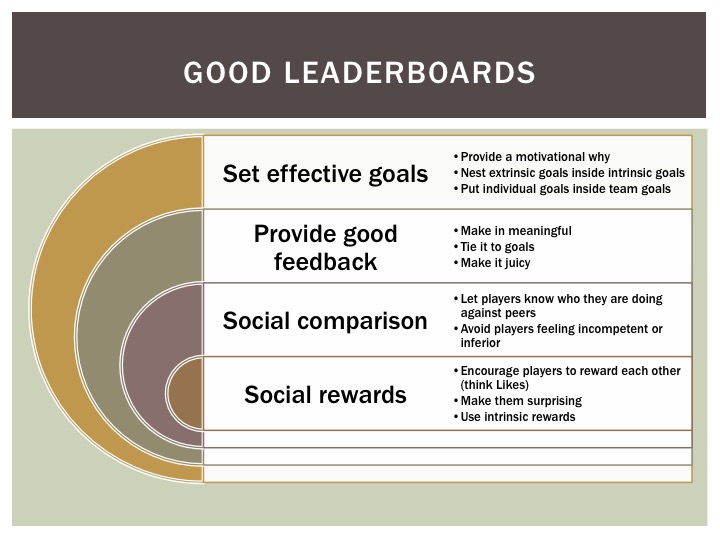
To design a leaderboard that drives behavior and incorporates the three needs above, the authors point to four “ingredients”:

Slide1

  • Goal-setting.Goal-setting involves giving or guiding a user toward a goal, and has become recommended as an effective building block for behavior change. The goal of most leaderboards implicitly is to be number one. You need to go beyond this implicit goal and guide your player toward a goal. Effective goals include having fun, learning and showing autonomy. They also recommend nesting intrinsic goals with the extrinsic goals, like making yourself a better poker player by competing on the leaderboard. Finally, an effective technique nests individual goals inside team goals, so the leaderboard is more about playing with others than being number one.

    There are also some goals you should avoid as they will prove demotivating. These goals include meaningless rewards (get more worthless points by finishing number one), emphasizing outcomes players cannot control and focusing on pride (i.e. you should win because only the smartest win).

  • Feedback. A strong feedback mechanic can promote feelings of mastery and competence. You should provide feedback for players on how they are progressing tied to the above goals they have set. The authors also suggest proving juicy feedback, “juicy feedback is varied, unexpectedly excessive sensual positive feedback on small user actions and achievements.”
  • Social comparison. Social comparison helps players understand how they are doing compared to others. Rankings are inherently a form of social comparison. The trick is doing it right because social comparison can make people feel ineffective and unrelated. People tend to compare themselves with people above them so it is easy for them to then feel incompetent.

    There are some techniques to mitigate the risks in social comparison. First, you can tell players they have achieved a standard, even if they did not finish first. Second, explain why players got the score they did and explain how they can do better. Third, give players a choice of playing more or stopping (putting them in control). Finally, acknowledge losing is not fun. If you keep players focused on improving and playing well, they are likely to stay engaged. Also, if they lose as part of a team, the impact of the loss will not be as great, thus it is critical to emphasize connections and relationships.

  • Social rewards. Just as Facebook uses the Like button, let other players reward a player for their activity. You can achieve this impact by letting them follow the player or just sending a virtual high-five. It also helps to make the rewards surprising, as predictable rewards undermine intrinsic motivation.

What to do

Rather than avoiding leaderboards, build them but build them correctly. If you employ a lazy approach and just rank players 1 to one million, the leaderboard will not work well and impact will diminish over time. If you take the time, however, to set up effective goal setting, provide good feedback, employ social comparison and have strong social rewards, you will have a winning feature and move up the AppStore leaderboard.

Key takeaways

  1. While leaderboards are a central feature in many games, for them to be effective you must build them properly or else they will be ineffective.
  2. A key to good design is keeping players from feeling incompetent or inferior.
  3. The other critical components of powerful leaderboards are clear goals, a strong feedback loop, social comparison and rewards that are social.

Share this:

  • Click to share on Facebook (Opens in new window) Facebook
  • Click to share on LinkedIn (Opens in new window) LinkedIn
Like Loading...
Unknown's avatarAuthor Lloyd MelnickPosted on June 19, 2018June 18, 2018Categories General Social Games Business, General Tech Business, Social CasinoTags Feedback, game design, goals, leaderboards3 Comments on How to build a Leaderboard that actually works and drives KPIs

Key takeaways for game companies from Mary Meeker’s 2018 Internet Trends

Key takeaways for game companies from Mary Meeker’s 2018 Internet Trends

Mary Meeker recently released her 2018 Internet Trends (entire presentation below) and several of these trends are particularly important for gaming companies (both real money and social). For those of you not familiar with Meeker, she was formerly one of the top tech analysts on Wall Street and is now a leading VC (Venture Capitalist) with Kleiner Perkins. Her annual Internet Trends report has become required reading and although I hate predictions (they are about as accurate as your local weather man) she does a good job of identifying underlying developments that change the way business operates.

The trends that are most important to companies are:

  • Smartphone shipments are flat, the base is not growing, while growth in the number of Internet users has fallen to less than 5%. This fact means for game companies growth will come from increasing the amount of time existing people spend in games and, in particular, your games. It also means you need to monetize these existing users better.
  • Easy to use products are becoming pervasive, and Meeker points to Messaging (Telegram), Commerce (Square Cash) and Media (Spotify). This development is consistent with the growth of hypercasual in the game space.
  • Messaging (WhatsApp, WeChat, FB Messenger, etc.) is growing at an incredible rate. This trend suggests CRM, acquisition, support and games on messaging platforms will become incredibly important.
  • Voice technology is lifting off, suggesting voice will be an increasingly important element of games.
  • Personalization plus collective data is creating better consumer experiences. Game companies need to continue making experiences more personal for players without crossing over concerns about privacy. This can be done by keeping data cumulative, rather than personal.
  • Social media discovery is driving purchases. Discovery of products is expanding from Google and Amazon to Facebook and Instagram, which should reinforce their importance for game marketing.
  • In performance based marketing channels, competition for top placement has reduced ROIs and increased the importance of improving LTV.
  • Shopping and entertainment is converging, with one example people using YouTube before making a purchase. Game companies need to leverage this by making their games purchase ready on entertainment shopping destinations.
  • New retail, a phrase pioneered by Jack Ma, puts the right product in front of the right customers at the right time. This translates to how we should present in-app purchases in games, right package to the right player at the right time.
  • Data is an increasingly important driver of customer satisfaction. You should look to leverage this data so the player experience is tied to their interests.

All of these trends should be considered as your green light and grow your games. Rather than building for today, you should build for when you launch the product and years in the future when players will still be playing. I am sure there are other trends you may find useful and recommend you review the full presentation.

The Complete Mary Meeker Internet Trends 2018 presentation:

INTERNET-TRENDS-REPORT-2018

Share this:

  • Click to share on Facebook (Opens in new window) Facebook
  • Click to share on LinkedIn (Opens in new window) LinkedIn
Like Loading...
Unknown's avatarAuthor Lloyd MelnickPosted on June 12, 2018June 5, 2018Categories General Social Games Business, General Tech BusinessTags Internet trends, Mary Meeker, messaging, personalization, Voice recognitionLeave a comment on Key takeaways for game companies from Mary Meeker’s 2018 Internet Trends

Is Hypercasual worth the $450 million that Zynga and Goldman Sachs just spent

In February, I wrote that the next big casual gaming phenomenon would be hypercasual, but even I did not expect the genre to take off as quickly as it did. Last week, Goldman Sachs invested about $200 million in French hypercasual game company Voodoo. The next day, Zynga announced it acquired hypercasual game company Gram Games for $250+ million. These deals follow Zynga’s acquisitions of Harpin and Peak Games’ card business for $142 million. With about $600 million in deal, money talks, and money is saying hypercasual is for real.

Slide1

What are hypercasual games?

Hypercasual games have a single mechanic and a single goal, so they are very easy to learn. Mastering them, however, is almost impossible, as the games get more challenging as you try to reach a high score. Effectively the core game loop is very straightforward, do one thing, get rewarded (so you can try again) and keep repeating to get a higher score.

Are hypercasual games here to stay?

As I said in February, unlike fads, hypercasual taps into the key to product success, simplicity. Most successful products are not crammed with features that generate a lot of checkmarks on a competitive analysis. Instead, products with very few options generate tremendous value. Uber is valued at tens of billions and when you open the app you are asked where you want to go, and then you are given 3 or 4 options to get there. You are not picking the color of the car that collects you, the height of the driver, what route they will take, etc., which is all handled by Uber. Apple is another great example. The iPhone and iPad have virtually no extraneous features or options.

The science behind simplicity is neuroscience, particularly related to cognitive load. Cognitive load is how much info people are processing at any one time. A simple user experience minimizes cognitive load, thus not creating too much strain and making enjoyment more likely.

Many people often do not realize it is much harder to make a simple product, just as it is harder to create a five slide presentation than a 50 slide one. Keeping a product simple means you must decide what features to exclude, so you need to understand your customer and what you are trying to achieve. Given the market’s feedback to Gram and Voodoo last week, the effort is worthwhile.

Do opportunities remain in hypercasual?

Often when there is a spate of deals it means the end of bubble, or at least the end for small developers, but that is not the case with hypercasual. First, hypercasual is not really a genre, but more of a game making philosophy. It is about creating games with a straightforward and simple mechanic. There is no reason to believe this philosophy cannot be extended to every genre, from simple car racing games to hypercasual social casino titles. The opportunities for hypercasual are as bright now as the opportunities for free to play were after Farmville and Who Has the Biggest Brain.

What should you do

<pThe key is to learn from hypercasual rather than try to imitate what is already in the market. If you have a successful game, see how you can simplify it. What can you do to reduce players’ cognitive load. If you are looking for new product opportunities, identify what player segments currently do not have good hypercasual options and build products for these players. This can be an extension of your current customers or can create games for customers where the competition is irrelevant. By focusing on simple yet repeatable fun, there is a great opportunity in the game industry.

Key takeaways

  • Hypercasual it the hottest sector in the gaming space, with two deals valued at $450+ million announced last week.
  • Hypercasual games have a single mechanic and a single goal, making them easy to learn and play but hard to master
  • The key is simplicity, and the opportunity is to make your own games simpler or create products for an existing or new market that leverages simple mechanics.

Share this:

  • Click to share on Facebook (Opens in new window) Facebook
  • Click to share on LinkedIn (Opens in new window) LinkedIn
Like Loading...
Unknown's avatarAuthor Lloyd MelnickPosted on June 5, 2018June 4, 2018Categories General Social Games BusinessTags gram games, hypercasual, voodoo, zynga2 Comments on Is Hypercasual worth the $450 million that Zynga and Goldman Sachs just spent

How to add features that your customers actually want

How to add features that your customers actually want

One of the challenges successful game developers face is what features to add to the product. With a successful game, you are not in panic mode but you also must deal with the reality that in a free-to-play product you need to keep players engaged or you will become the next Trivia Crack. The fundamental issue is adding features that are useful and fun for your existing players, that enhances their enjoyment of your game.

Keys to adding successful features

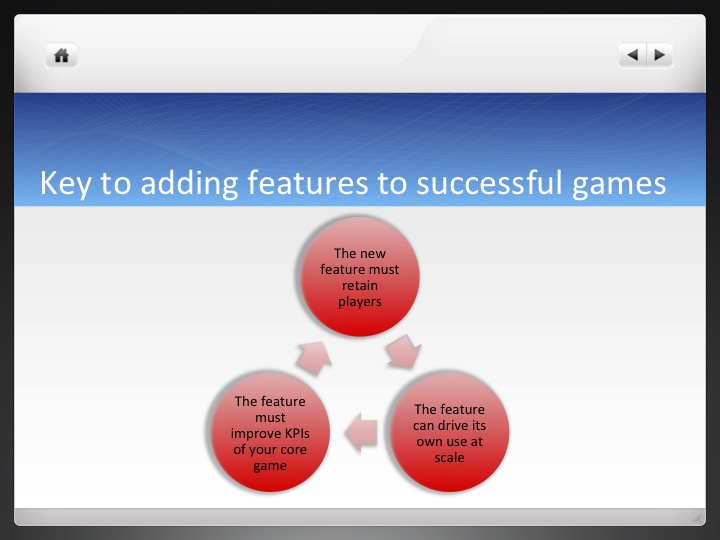
There is an excellent post by Casey Winters that highlights three keys to building features that enhance a successful product:

Slide1

  1. The new feature must retain players. The feature itself retains the player and you do not have to drive players artificially to it from other parts of the game. For example, if you add Blackjack to your social slots application, it works if players engage with Blackjack and then come back to play it regularly. You can use the same retention metrics (D1, D7, D30 and CURR) to assess if a feature is working as you do to look at an app.
  2. The feature can drive its own use at scale, you do not need to create a plan to build adaption. To use the Blackjack example, if you integrate it in your lobby players will try it without forcing you to run specific campaigns.
  3. The feature must improve KPIs of your core product. To use the blackjack example, it needs to improve either your overall retention or monetization.

The last point is critical to success. I used to be at a game company where product managers regularly presented analysis of their features and bragged about the great performance of the feature. Overall, though, the company’s games continued to lose players (DAU) and monetization per player (ARPDAU) was also decreasing. While the features appeared to perform great in a Powerpoint, they actually were costing the company money because they drove lower overall performance.

How to add features that improve LTV

While you may infer from the previous sections that you should only integrate features that appeal to everyone, the opportunity is to segment your players and build features to appeal to target segments. If you limit yourself to only adding features that are accretive to everyone, you have a small pool to pull from.

Given you already have a successful game, by definition your players are already enjoying your product. While there may be opportunities to add features everyone enjoys, you have a bigger set to choose from if you also identify features that may appeal to a subset of your players. This is particularly powerful because this feature can appeal to a segment that is likely to churn and keep them engaged or a segment that does not monetize and prompts them to spend. Conversely, it could only appeal to the ½ of 1 percent that are VIPs but given how much they spend could have a great impact on revenue

If you are building a feature that appeals to a specific segment, then you must be careful not to violate the third key to creating a successful feature, you do not want it to impact negatively overall KPIs. The way to achieve this balance is by positioning or displaying the feature only to the target audience. This can be done as an AB test, where you only surface the feature to specific players. It can be achieved through targeted CRM (in-game banners, push notifications, email, etc.) that is only sent to players in the target group. Surfacing a different UIUX to players who you want to engage with the feature can also accomplish the same goal. The key is maximizing how much the target audience uses the feature and minimizes how much other players see it.

Using the blackjack example yet again, we can illustrate how it could help a social casino game. Overall, slots monetizes much better than blackjack. It is a faster game and many blackjack players will play in a way so they lose very few chips. If you added blackjack to a successful slots game and promoted it across your player base, you probably would get great engagement as a lot of people love blackjack. It would, however, drive some players from your slots to blackjack where they are likely to monetize at a lower rate. If you were looking at how it would impact overall performance, then, you would say blackjack is a failure.

If, however, the blackjack game was not in the main lobby but embedded deeper in the game and you then drove players who were likely to churn (maybe you have a nice machine learning algorithm that can identify these players) to blackjack, it would engage some of these players. They would then come back regularly to play and rather than churn some would monetize. Thus, you would have a successful feature that helps the overall product.

Add features that help your game

Although it sounds obvious, when building your product roadmap you need to dive deeply into each potential feature and identify how it will improve KPIs of a target segment. Effectively, how will it solve a problem for you or your player (user churning, user not spending, etc.). The bigger the problem, the higher the priority.

Key takeaways

  • The key to adding new features to a successful product is ensure the feature itself retains players, can generate its own use and helps the overall KPIs of your game.
  • You must avoid features that seem to perform well when reviewed in a vacuum but actually hurt the KPIs of the game.
  • You can achieve launching a successful feature by targeting your players and then only showing or promoting the feature to players who will benefit from it.

Share this:

  • Click to share on Facebook (Opens in new window) Facebook
  • Click to share on LinkedIn (Opens in new window) LinkedIn
Like Loading...
Unknown's avatarAuthor Lloyd MelnickPosted on May 29, 2018May 27, 2018Categories General Social Games Business, Growth, Social CasinoTags features, monetization, Product design, product management, retentionLeave a comment on How to add features that your customers actually want

How to use nano-marketing to grow your game or app

One of the constant challenges developers face is user acquisition, as costs seem to increase much faster than revenue per user. This issue is not limited to game developers as more companies see digital and performance marketing as their premium-marketing channel, the competition for eyeballs drives up costs. It is a constant challenge for everyone in growth or marketing to understand the newest techniques for finding the best and most effective channels. No longer can any executive run television ads and then hide behind ambiguous results. The issue is magnified when trying to reach millennials, who spend most of their time (free time or not) in the digital world.

A recent article in the MIT Sloan Management Review, The Right Way to Market to Millennials by Jay Sinha and Thomas Fung, does a great job of presenting the idea of nano-marketing, one of the most promising new growth mechanics. Nano-marketing is using micro-influencers to market your product or build your brand. This approach is evolving into one of the most effective forms of advertising.

Who and what are micro-influencers

While we are all familiar with the personalities who have huge social media followings, the Kim Kardashians or Gwyneth Paltrows, the people with smaller followings are proving most effective. Micro-influencers have between 1,000 and 100,000 followers. Although their following is relatively small (Kim Kardashian has over 100 million followers), they have a category specific following and much more engaged audience. Micro-influencers also build more personal relationships with their fans, as they can engage with them one-on-one. They are also frequently considered experts in their fields (something you may not say about a Kardashian).

People also often consider micro-influencers more credible. When LeBron James tweets his support of a shoe, most people assume he is getting paid for that tweet. Conversely, a micro-influencer who promotes your game will believe he is a fan and give him the benefit of the doubt. Even if people assume the micro-influencer was paid, they also assume that the personality has a true affinity for the product.

Not only can micro-influencers drive sales, but they can contribute to your brand building. Sinha and Fung discuss how Coca-Cola leverages micro-influencers to develop compelling brand narratives. They also discuss how start-ups, such as sock retailer Stance Inc., have used micro-influencers to grow into major brands.

How to leverage micro-influencers

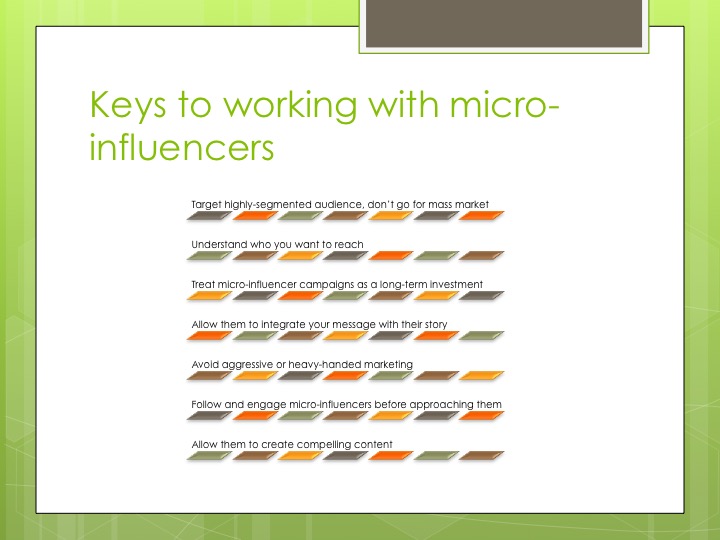
Working with micro-influencers is different than working with celebrities or other marketing channels, it also requires a personal approach. There are several keys to building a successful micro-influencer program, with may of them highlighted by Sinha and Fung as well as a VentureBeat post on how micro-influencers are essential. The elements of a successful program include:

Slide1

  1. Use micro-influencers to target highly segmented audiences. This channel is not the right option to reach millions at once. Instead, micro-influencers are a great way to amplify a feature that largely appeals to a niche or helps you recruit a specialized segment.
  2. Understand who you want to reach. There are millions of micro-influencers, you need to understand exactly who you want to target and the goal(s) of your campaign. Once you have a clear understanding of your target, you can then find the micro-influencers who reach that audience.
  3. Look at micro-influencer work as a long-term investment. Build a long-term relationship with the most appropriate micro-influencers, so they can continuously weave your brand into their stories.
  4. Effective micro-influencers integrate their personal narratives with the brands they endorse. Rather than trying to foist a message on the micro-influencers, use their story-telling ability to create a compelling message.
  5. Avoid heavy-handed or aggressive push-marketing and instead have the micro-influencer give their audience a gentle nudge.
  6. Before approaching micro-influencers, follow and engage with them. As VentureBeat writes, “this helps you better understand their personality and interests so you can determine their fit with your brand. It also helps you approach them with a more personal request, which is more likely to get a positive response.”
  7. Allow the micro-influencer to create compelling content rather than directing them. As Sinha and Fung write, “young, creative micro-influencers are good at producing innovative content that features the brands in an interesting way. They know their audience would want to be educated about new offerings, while being entertained at the same time.”

By following these steps, you can build an effective micro-influencer program that will support your marketing initiatives.

Key takeaways

  • Marketing continues to evolve quickly, with it increasingly difficult and important to find effective advertising channels. Nano marketing is one of the most promising of these channels.
  • Nano marketing entails working with micro-influencers, people with between 1,000 and 100,000 followers, to promote your brand or products.
  • Micro-influencers are particularly effective because consumers consider them more genuine and they have much greater focus than celebrities who have huge followings.

Share this:

  • Click to share on Facebook (Opens in new window) Facebook
  • Click to share on LinkedIn (Opens in new window) LinkedIn
Like Loading...
Unknown's avatarAuthor Lloyd MelnickPosted on May 22, 2018May 14, 2018Categories General Social Games Business, General Tech Business, Growth, Social Games MarketingTags influencers, Millenials, Nano Marketing, You TubeLeave a comment on How to use nano-marketing to grow your game or app

Posts pagination

Previous page Page 1 … Page 8 Page 9 Page 10 … Page 46 Next page

Get my book on LTV

The definitive book on customer lifetime value, Understanding the Predictable, is now available in both print and Kindle formats on Amazon.

Understanding the Predictable delves into the world of Customer Lifetime Value (LTV), a metric that shows how much each customer is worth to your business. By understanding this metric, you can predict how changes to your product will impact the value of each customer. You will also learn how to apply this simple yet powerful method of predictive analytics to optimize your marketing and user acquisition.

For more information, click here

Follow The Business of Social Games and Casino on WordPress.com

Enter your email address to follow this blog and receive notifications of new posts by email.

Join 791 other subscribers

Most Recent Posts

  • Join me at PDMA Inspire for my talk on new product prioritization
  • Why keep studying?
  • The next three years of this blog
  • Interview with the CEO of Murka on the biggest growth opportunity in gaming, Barak David

Lloyd Melnick

This is Lloyd Melnick’s personal blog.  All views and opinions expressed on this website are mine alone and do not represent those of people, institutions or organizations that I may or may not be associated with in professional or personal capacity.

I am a serial builder of businesses (senior leadership on three exits worth over $700 million), successful in big (Disney, Stars Group/PokerStars, Zynga) and small companies (Merscom, Spooky Cool Labs) with over 20 years experience in the gaming and casino space.  Currently, I am the GM of VGW’s Chumba Casino and on the Board of Directors of Murka Games and Luckbox.

Topic Areas

  • Analytics (114)
  • Bayes' Theorem (8)
  • behavioral economics (8)
  • blue ocean strategy (14)
  • Crowdfunding (4)
  • DBA (2)
  • General Social Games Business (459)
  • General Tech Business (195)
  • Growth (88)
  • International Issues with Social Games (50)
  • Lloyd's favorite posts (101)
  • LTV (54)
  • Machine Learning (10)
  • Metaverse (1)
  • Mobile Platforms (37)
  • Prioritization (1)
  • Social Casino (52)
  • Social Games Marketing (105)
  • thinking fast and slow (5)
  • Uncategorized (33)

Social

  • View CasualGame’s profile on Facebook
  • View @lloydmelnick’s profile on Twitter
  • View lloydmelnick’s profile on LinkedIn

RSS

RSS Feed RSS - Posts

RSS Feed RSS - Comments

Categories

  • Analytics (114)
  • Bayes' Theorem (8)
  • behavioral economics (8)
  • blue ocean strategy (14)
  • Crowdfunding (4)
  • DBA (2)
  • General Social Games Business (459)
  • General Tech Business (195)
  • Growth (88)
  • International Issues with Social Games (50)
  • Lloyd's favorite posts (101)
  • LTV (54)
  • Machine Learning (10)
  • Metaverse (1)
  • Mobile Platforms (37)
  • Prioritization (1)
  • Social Casino (52)
  • Social Games Marketing (105)
  • thinking fast and slow (5)
  • Uncategorized (33)

Archives

  • September 2023
  • December 2021
  • July 2021
  • March 2021
  • February 2021
  • January 2021
  • December 2020
  • November 2020
  • October 2020
  • September 2020
  • August 2020
  • July 2020
  • June 2020
  • May 2020
  • April 2020
  • March 2020
  • February 2020
  • January 2020
  • November 2019
  • October 2019
  • September 2019
  • June 2019
  • May 2019
  • April 2019
  • March 2019
  • February 2019
  • January 2019
  • December 2018
  • June 2018
  • May 2018
  • April 2018
  • March 2018
  • February 2018
  • January 2018
  • December 2017
  • June 2017
  • May 2017
  • April 2017
  • March 2017
  • February 2017
  • January 2017
  • December 2016
  • November 2016
  • October 2016
  • September 2016
  • June 2016
  • May 2016
  • April 2016
  • March 2016
  • February 2016
  • January 2016
  • December 2015
  • November 2015
  • October 2015
  • September 2015
  • July 2015
  • June 2015
  • May 2015
  • April 2015
  • March 2015
  • February 2015
  • January 2015
  • December 2014
  • November 2014
  • October 2014
  • September 2014
  • August 2014
  • July 2014
  • June 2014
  • May 2014
  • April 2014
  • March 2014
  • February 2014
  • January 2014
  • December 2013
  • November 2013
  • October 2013
  • September 2013
  • August 2013
  • July 2013
  • June 2013
  • May 2013
  • April 2013
  • March 2013
  • February 2013
  • January 2013
  • December 2012
  • November 2012
  • October 2012
  • September 2012
  • August 2012
  • July 2012
  • June 2012
  • May 2012
  • April 2012
  • March 2012
  • February 2012
  • January 2012
  • December 2011
  • November 2011
  • October 2011
  • September 2011
  • August 2011
  • July 2011
  • June 2011
  • May 2011
  • December 2010
January 2026
S M T W T F S
 123
45678910
11121314151617
18192021222324
25262728293031
« Sep    

by Lloyd Melnick

All posts by Lloyd Melnick unless specified otherwise
Google+

Enter your email address to subscribe to this blog and receive notifications of new posts by email.

Join 791 other subscribers
Follow Lloyd Melnick on Quora

RSS HBR Blog

  • What Actually Works to Change Someone’s Mind
  • Our Favorite Management Tips of 2025
  • How to Manage—and Motivate—Gen Z
  • The Most-Watched HBR Videos of 2025
  • The HBR Charts that Help Explain 2025
  • The Most Popular HBR Podcast Episodes of 2025
  • How the Best Leaders Develop and Spend “Innovation Capital”
  • The 10 Most Popular HBR Articles of 2025
  • How Work Changed in 2025, According to HBR Readers
  • What Leaders Can Learn from a Formula 1 Turnaround

RSS Techcrunch

  • An error has occurred; the feed is probably down. Try again later.

RSS MIT Sloan Management Review Blog

  • Calm: The Underrated Capability Every Leader Needs Now
  • The Top Five MIT SMR Videos of 2025
  • Three Steps Toward Fairer Talent Management
  • From Crisis to Coopetition: What Leaders Can Learn From Anesthesiologists
  • AI Coding Tools: The Productivity Trap Most Companies Miss
  • How Procter & Gamble Uses AI to Unlock New Insights From Data
  • Rewire Organizational Knowledge With GenAI
  • Hungry for Learning: Wendy’s Will Croushorn
  • Beat Burnout: 10 Essential MIT SMR Reads
  • How Leaders Stay True to Themselves and Their Stakeholders
The Business of Social Games and Casino Website Powered by WordPress.com.
  • Subscribe Subscribed
    • The Business of Social Games and Casino
    • Join 726 other subscribers
    • Already have a WordPress.com account? Log in now.
    • The Business of Social Games and Casino
    • Subscribe Subscribed
    • Sign up
    • Log in
    • Report this content
    • View site in Reader
    • Manage subscriptions
    • Collapse this bar
 

Loading Comments...
 

    %d