Skip to content

The Business of Social Games and Casino

How to succeed in the mobile game space by Lloyd Melnick

Category: Lloyd’s favorite posts

My favorite posts

Trust as the foundation of leadership

Slide1Although there are many tricks and buzz words thrown around to help people become great leaders, the single most important attribute is trust. A recent article on the Psychology Today website, Why Trust is Foundational to Sound Management, provided the evidence to support my claim. It also provides evidence that although trust is incorporated into many (if not all) companies’ mission statements, it is not showing up in practice. A recent
Gallup workforce survey
asserted approximately 70 percent of employees are disengaged. For those who do not think this is an important statistic, Gallup points out that work units in the top 25 percent of engagement have significantly higher productivity, profitability, and customer ratings while suffering lower turnover and absenteeism.

Achieving trust with your team is one of many things easier said than done. When things are going well for your group or company, it is much easier to act trustworthy. Last year I wrote about how someone reacts to difficult times is the true measure of that person
and the same principle applies to leadership, your team will judge you by how trustworthy you are in trying situations. Continue reading “Trust as the foundation of leadership”

Share this:

  • Click to share on Facebook (Opens in new window) Facebook
  • Click to share on LinkedIn (Opens in new window) LinkedIn
Like Loading...
Unknown's avatarAuthor Lloyd MelnickPosted on November 6, 2013November 15, 2013Categories General Social Games Business, Lloyd's favorite postsTags communication, leadership, trustLeave a comment on Trust as the foundation of leadership

The thrill of the deal

A few weeks ago I gave some suggestions on how to build a company for exit, but today I wanted to write a more personal entry about the emotions tied to being part of an exit. My post today is not meant to apply to everyone; as I wrote previously some will find creating a long-term profitable business very satisfying. But for me—and many of you that I know—there is no better feeling in business than the day you are part of big M&A transaction.

Image from SBNation

It is like winning the World Cup or Super Bowl or NCAA Championship (though obviously I have never been part of any of these): A combination of pure joy, relief, camaraderie and satisfaction. Continue reading “The thrill of the deal”

Share this:

  • Click to share on Facebook (Opens in new window) Facebook
  • Click to share on LinkedIn (Opens in new window) LinkedIn
Like Loading...
Unknown's avatarAuthor Lloyd MelnickPosted on August 20, 2013September 4, 2013Categories General Social Games Business, Lloyd's favorite postsTags Deals, M&A, Victory2 Comments on The thrill of the deal

How to build a company you can sell

After being part of three big exits (total value over $600 million) in three years, I am frequently asked, “What must an entrepreneur do to successfully build and sell a company?” I have one piece of advice I give—not necessarily what you would hear from an uber-VC—that I think is the key to creating and selling a business. It comes down to building a company another company needs.

Victory

Think about your customer

Just as it is crucial to understand the consumer need when creating a product, you must also understand why your company would be attractive as an acquisition target. In a competitive marketplace, you need unique selling points to gain market share. As I have previously written, your best chance of success is pursuing a blue ocean strategy;  rather than competing with everyone else (in a red ocean) you create a unique offering. In other words, rather than create another hamburger store, sell fast food hot dogs and sausages. The same can be said for building a business that will have an exit. Continue reading “How to build a company you can sell”

Share this:

  • Click to share on Facebook (Opens in new window) Facebook
  • Click to share on LinkedIn (Opens in new window) LinkedIn
Like Loading...
Unknown's avatarAuthor Lloyd MelnickPosted on August 6, 2013August 19, 2013Categories General Social Games Business, Lloyd's favorite postsTags Acquisition, customer, Exit, M&A2 Comments on How to build a company you can sell

What leaders actually do

A paper I read recently (“What Leaders Really Do” by John Kotter) made a great case that a leader’s value is not solving problems or organizing people but leading your company through change. I have been in senior executive positions for a while now and am sometimes left speechless when someone asks me what I actually do. The paper helped crystalize where I, and you, make the biggest impact on the company. Given all the changes game companies go through (I remember the days before cell phones and when MySpace was the primary social network), the ability to understand and adapt your company to these changes is the most valuable skill you can provide; just look at all the game companies that have failed to adapt to a changing environment, from THQ to 38 Studios to Midway to Oberon to Atari.

Leadership is not management

Leadership One important issue to keep in mind with leadership is that it is not management. They are two distinctive and complementary systems of action. Both are necessary for success in the game industry (and woefully lacking at many companies). In the article, Kotter points out that many companies are overly managed and underled. The real challenge is to combine strong leadership and strong management (not necessarily with the same person or people) and use each to balance each other. Continue reading “What leaders actually do”

Share this:

  • Click to share on Facebook (Opens in new window) Facebook
  • Click to share on LinkedIn (Opens in new window) LinkedIn
Like Loading...
Unknown's avatarAuthor Lloyd MelnickPosted on May 21, 2013May 24, 2013Categories General Social Games Business, Lloyd's favorite postsTags John Kotter, leadership, management, vision6 Comments on What leaders actually do

Lifetime Value Part 9: Uncertainty and LTV

The key to using customer lifetime value (LTV) effectively is the understanding that it is a prediction, not a value. In my previous eight posts on LTV, I stressed the importance of LTV to the success of your game and company and the key components in determining LTV. After reading Nate Silver’s The Signal and the Noise, I realized that it is crucial to understand that LTV is a prediction and suffers the same risk as other predictions (e.g., elections, weather, sports scores).

The Uncertainty Principle

Many people mistakenly believe (and I may have inadvertently implied this in a previous post), that LTV is an exact function of virality, monetization and retention. It implies you put those variables into a formula and get out a number that shows precisely how much a player is worth. That would be the case if you did it with historical information after five years and then calculated how much that player had been worth to you. However, you are calculating how much the player will be worth, which is inherently different because you are predicting their future value.

The uncertainty principle, a key tenet of quantum mechanics (as popularized by Stephen Hawking), postulates that perfect predictions are impossible if the universe itself is random. Since you cannot have a perfect prediction, your LTV cannot be a distinctly quantified value. You are predicting future events (how much the player will monetize, how viral they will be and how long they will stay in your game) based on the available data. Your LTV model is a simplification of the world the player is in; you are looking at several variables but you cannot look at everything (e.g., chance of war, plague, everyone switching to Blackberry devices). In effect, your LTV calculation is very similar to a sportscaster’s estimate of how many home runs Albert Pujols will hit or a weatherman’s prediction on the likelihood of a hurricane to hit Cape Hatteras. Continue reading “Lifetime Value Part 9: Uncertainty and LTV”

Share this:

  • Click to share on Facebook (Opens in new window) Facebook
  • Click to share on LinkedIn (Opens in new window) LinkedIn
Like Loading...
Unknown's avatarAuthor Lloyd MelnickPosted on April 23, 2013June 4, 2014Categories Analytics, General Social Games Business, Lloyd's favorite posts, LTVTags analytics, Chaos Theory, lifetime value, LTV, mobile games, Nate Silver, Qualitative Information, Quantum Mechanics, social games, Uncertainty Principle11 Comments on Lifetime Value Part 9: Uncertainty and LTV

Why would anyone buy a virtual good?

Many do not understand, or even accept, the motivation for people to spend real money for virtual goods. Some are even more amazed at the success of virtual casinos, where players gamble but can never collect their winnings. They discount it as manipulation or irrational thinking by the consumer. In fact, purchasing virtual goods is a very rational behavior consistent with how people conduct other aspects of their life. Understanding this motivation will help you develop a game that better satisfies your customers’ needs.

Why people shop

Although some people shop because they need something (food, clothing, steak), yet there are many other reasons people shop. In a seminal piece from the Journal of Marketing entitled “Why People Shop?“, Edward Tauber wrote that the obvious answer (“to purchase something”) “can be a most deceptive one and reflects a marketing myopia.” Below are several reasons that Tauber hypothesizes drive shopping behavior, which do not reflect ending up with a physical good. These reasons can also drive monetization in a game: Continue reading “Why would anyone buy a virtual good?”

Share this:

  • Click to share on Facebook (Opens in new window) Facebook
  • Click to share on LinkedIn (Opens in new window) LinkedIn
Like Loading...
Unknown's avatarAuthor Lloyd MelnickPosted on March 20, 2013April 9, 2013Categories General Social Games Business, Lloyd's favorite postsTags gambling, monetization, shopping, virtual goods7 Comments on Why would anyone buy a virtual good?

Don’t charge for your app, PLEASE (at least if you want to make money)

One of the greatest mistake game companies make is building or launching products that are paid apps, not free-to-play (F2P), which then monetize through micro-transactions. Despite the fact that survey after survey shows F2P games generate more revenue than paid apps, virtually all the investment money goes to F2P products (and VCs are pretty intelligent) and most companies that abandon paid apps for F2P never go back, there are a surprisingly high number of companies still focusing on the paid app model. In particular, many mobile studios whose roots are in the traditional (console) gaming world still prefer the paid app model. As I am often asked to help game companies, it is very frustrating when they forgo my advice and build a paid app. The usual refrain is “But look at Angry Birds.”

F2P vs Paid download

A recent analysis by Forbes (“Rovio’s Revenue Crisis and the App Market Evolution”) shows beyond a shadow of a doubt it is just foolish to still be building paid apps, even if you are Rovio. To summarize the key analysis and findings from the Forbes data: Continue reading “Don’t charge for your app, PLEASE (at least if you want to make money)”

Share this:

  • Click to share on Facebook (Opens in new window) Facebook
  • Click to share on LinkedIn (Opens in new window) LinkedIn
Like Loading...
Unknown's avatarAuthor Lloyd MelnickPosted on March 11, 2013April 11, 2013Categories General Social Games Business, Lloyd's favorite postsTags F2P, monetization, paid app, rovioLeave a comment on Don’t charge for your app, PLEASE (at least if you want to make money)

Using probability to build a game portfolio likely to succeed

One of the biggest challenges for a social or mobile game company is managing the challenges of an industry that is hit-driven. Understanding the laws of probability is a good step in overcoming this hurdle. Since the beginning of time, game companies have been struggling with the hit-driven nature of our industry. Although new markets and technologies (e.g., casual, social, and mobile games) held out the promise of not being as hit-driven, they all ended up having a few titles drive the majority of revenue. The number I use is that 25 percent of games will break even or make a profit after launch (without accounting for development expense); this means that there’s a 75 percent failure rate. (I have heard estimates that as many as 90 percent of game projects fail and I would not argue strongly against that number, but for the sake of analysis I will use a success rate of 25 percent.)

Chance of dice rolls

The argument for taking a portfolio approach

Basic probability theory shows the importance of having multiple independent game projects to improve your company’s chance of success (more on independence later). By using probability, the benefits of taking a portfolio approach become clear. Continue reading “Using probability to build a game portfolio likely to succeed”

Share this:

  • Click to share on Facebook (Opens in new window) Facebook
  • Click to share on LinkedIn (Opens in new window) LinkedIn
Like Loading...
Unknown's avatarAuthor Lloyd MelnickPosted on January 31, 2013February 19, 2013Categories General Social Games Business, Lloyd's favorite postsTags portfolio strategy, probability, social games12 Comments on Using probability to build a game portfolio likely to succeed

Lifetime Value Part 4: The role of retention in LTV and how to impact it

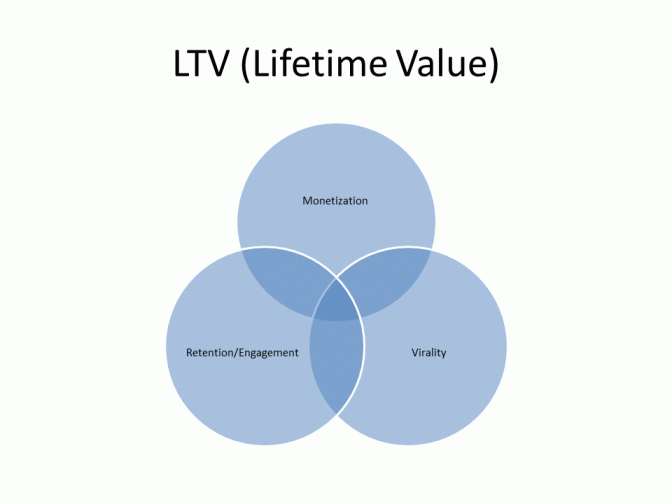
Retention is one of three components that you use to determine LTV (lifetime value of a customer) and in many ways most important to the success of a product (and the most difficult to improve significantly after launch). Three weeks ago, I wrote about the central importance of lifetime value (LTV) to the success of your game and your company. This week I want to discuss retention, its importance and how you can improve it.

LTV Venn Diagram

How to define retention

Retention is how often players play your game and thus, also, how long they remain active players. As with all the LTV metrics, different companies use different measures of retention to determine lifetime value.

There are several components of retention for you to track and roll into your LTV formula. Continue reading “Lifetime Value Part 4: The role of retention in LTV and how to impact it”

Share this:

  • Click to share on Facebook (Opens in new window) Facebook
  • Click to share on LinkedIn (Opens in new window) LinkedIn
Like Loading...
Unknown's avatarAuthor Lloyd MelnickPosted on January 29, 2013February 4, 2013Categories Analytics, General Social Games Business, Lloyd's favorite posts, LTVTags lifetime value, LTV, retention, social games6 Comments on Lifetime Value Part 4: The role of retention in LTV and how to impact it

Physical virtual goods

The use of virtual goods in a physical form is one of the most interesting (and profitable) monetization techniques that I have seen. By “physical virtual goods” (my term), I mean taking a virtual good that is normally sold through an in-app purchase and making it into a physical retail item that is used to unlock the virtual good inside the game (with no functionality for the physical product).

The Skylanders example

Activision’s Skylanders are the perfect example of this monetization strategy. Activison has two video games, Skylanders Giants and Skylanders Spyro’s Adventure, that sell at retail, just as you would purchase Call of Duty or Super Mario Bros. However, instead of selling downloadable content or offering upgrades through in-app purchases (depending on the platform), players must purchase Skylanders characters at retail, place them on a game-specific portal (a device that plugs into the game console) or enter a code that comes with the character (again, depending on the platform) to unlock the character in the game. Continue reading “Physical virtual goods”

Share this:

  • Click to share on Facebook (Opens in new window) Facebook
  • Click to share on LinkedIn (Opens in new window) LinkedIn
Like Loading...
Unknown's avatarAuthor Lloyd MelnickPosted on January 10, 2013January 22, 2013Categories General Social Games Business, Lloyd's favorite postsTags Activision, monetization, physical virtual goods, Skylanders3 Comments on Physical virtual goods

Posts pagination

Previous page Page 1 … Page 7 Page 8 Page 9 … Page 11 Next page

Get my book on LTV

The definitive book on customer lifetime value, Understanding the Predictable, is now available in both print and Kindle formats on Amazon.

Understanding the Predictable delves into the world of Customer Lifetime Value (LTV), a metric that shows how much each customer is worth to your business. By understanding this metric, you can predict how changes to your product will impact the value of each customer. You will also learn how to apply this simple yet powerful method of predictive analytics to optimize your marketing and user acquisition.

For more information, click here

Follow The Business of Social Games and Casino on WordPress.com

Enter your email address to follow this blog and receive notifications of new posts by email.

Join 791 other subscribers

Most Recent Posts

  • Join me at PDMA Inspire for my talk on new product prioritization
  • Why keep studying?
  • The next three years of this blog
  • Interview with the CEO of Murka on the biggest growth opportunity in gaming, Barak David

Lloyd Melnick

This is Lloyd Melnick’s personal blog.  All views and opinions expressed on this website are mine alone and do not represent those of people, institutions or organizations that I may or may not be associated with in professional or personal capacity.

I am a serial builder of businesses (senior leadership on three exits worth over $700 million), successful in big (Disney, Stars Group/PokerStars, Zynga) and small companies (Merscom, Spooky Cool Labs) with over 20 years experience in the gaming and casino space.  Currently, I am the GM of VGW’s Chumba Casino and on the Board of Directors of Murka Games and Luckbox.

Topic Areas

  • Analytics (114)
  • Bayes' Theorem (8)
  • behavioral economics (8)
  • blue ocean strategy (14)
  • Crowdfunding (4)
  • DBA (2)
  • General Social Games Business (459)
  • General Tech Business (195)
  • Growth (88)
  • International Issues with Social Games (50)
  • Lloyd's favorite posts (101)
  • LTV (54)
  • Machine Learning (10)
  • Metaverse (1)
  • Mobile Platforms (37)
  • Prioritization (1)
  • Social Casino (52)
  • Social Games Marketing (105)
  • thinking fast and slow (5)
  • Uncategorized (33)

Social

  • View CasualGame’s profile on Facebook
  • View @lloydmelnick’s profile on Twitter
  • View lloydmelnick’s profile on LinkedIn

RSS

RSS Feed RSS - Posts

RSS Feed RSS - Comments

Categories

  • Analytics (114)
  • Bayes' Theorem (8)
  • behavioral economics (8)
  • blue ocean strategy (14)
  • Crowdfunding (4)
  • DBA (2)
  • General Social Games Business (459)
  • General Tech Business (195)
  • Growth (88)
  • International Issues with Social Games (50)
  • Lloyd's favorite posts (101)
  • LTV (54)
  • Machine Learning (10)
  • Metaverse (1)
  • Mobile Platforms (37)
  • Prioritization (1)
  • Social Casino (52)
  • Social Games Marketing (105)
  • thinking fast and slow (5)
  • Uncategorized (33)

Archives

  • September 2023
  • December 2021
  • July 2021
  • March 2021
  • February 2021
  • January 2021
  • December 2020
  • November 2020
  • October 2020
  • September 2020
  • August 2020
  • July 2020
  • June 2020
  • May 2020
  • April 2020
  • March 2020
  • February 2020
  • January 2020
  • November 2019
  • October 2019
  • September 2019
  • June 2019
  • May 2019
  • April 2019
  • March 2019
  • February 2019
  • January 2019
  • December 2018
  • June 2018
  • May 2018
  • April 2018
  • March 2018
  • February 2018
  • January 2018
  • December 2017
  • June 2017
  • May 2017
  • April 2017
  • March 2017
  • February 2017
  • January 2017
  • December 2016
  • November 2016
  • October 2016
  • September 2016
  • June 2016
  • May 2016
  • April 2016
  • March 2016
  • February 2016
  • January 2016
  • December 2015
  • November 2015
  • October 2015
  • September 2015
  • July 2015
  • June 2015
  • May 2015
  • April 2015
  • March 2015
  • February 2015
  • January 2015
  • December 2014
  • November 2014
  • October 2014
  • September 2014
  • August 2014
  • July 2014
  • June 2014
  • May 2014
  • April 2014
  • March 2014
  • February 2014
  • January 2014
  • December 2013
  • November 2013
  • October 2013
  • September 2013
  • August 2013
  • July 2013
  • June 2013
  • May 2013
  • April 2013
  • March 2013
  • February 2013
  • January 2013
  • December 2012
  • November 2012
  • October 2012
  • September 2012
  • August 2012
  • July 2012
  • June 2012
  • May 2012
  • April 2012
  • March 2012
  • February 2012
  • January 2012
  • December 2011
  • November 2011
  • October 2011
  • September 2011
  • August 2011
  • July 2011
  • June 2011
  • May 2011
  • December 2010
December 2025
S M T W T F S
 123456
78910111213
14151617181920
21222324252627
28293031  
« Sep    

by Lloyd Melnick

All posts by Lloyd Melnick unless specified otherwise
Google+

Enter your email address to subscribe to this blog and receive notifications of new posts by email.

Join 791 other subscribers
Follow Lloyd Melnick on Quora

RSS HBR Blog

  • The Power of Affirmation at Work
  • How One Manufacturer Achieved Net Zero at Zero Cost
  • What Can U.S. Employers Do About Rising Healthcare Costs?
  • When You Have to Execute a Strategy You Disagree With
  • 4 Ways to Build Durable Relationships with Your Most Important Customers
  • What Jargon Says About Your Company Culture
  • Research: When Used Correctly, LLMs Can Unlock More Creative Ideas
  • Your New Role Requires Strategic Thinking…But You’re Stuck in the Weeds
  • For Circular Economy Innovation, Look to the Global South
  • Why Great Leaders Focus on the Details

RSS Techcrunch

  • An error has occurred; the feed is probably down. Try again later.

RSS MIT Sloan Management Review Blog

  • AI Coding Tools: The Productivity Trap Most Companies Miss
  • How Procter & Gamble Uses AI to Unlock New Insights From Data
  • Rewire Organizational Knowledge With GenAI
  • Hungry for Learning: Wendy’s Will Croushorn
  • Beat Burnout: 10 Essential MIT SMR Reads
  • How Leaders Stay True to Themselves and Their Stakeholders
  • Our Guide to the Winter 2026 Issue
  • Broadening Future Perspectives at the Bank of England
  • A Faster Way to Build Future Scenarios
  • Assess What Is Certain in a Sea of Unknowns
The Business of Social Games and Casino Website Powered by WordPress.com.
  • Subscribe Subscribed
    • The Business of Social Games and Casino
    • Join 726 other subscribers
    • Already have a WordPress.com account? Log in now.
    • The Business of Social Games and Casino
    • Subscribe Subscribed
    • Sign up
    • Log in
    • Report this content
    • View site in Reader
    • Manage subscriptions
    • Collapse this bar
 

Loading Comments...
 

    %d