While apps and games have traditionally grown by having the acquisition team focus on the funnel, a recent blog post, Growth Loops are the New Funnels by growth guru Brian Balfour, shows a better strategy is to build growth loops. Rather than asking your marketing or user acquisition team to optimize user acquisition channels, growth loops has product and acquisition working holistically to build a product that will scale.
The traditional thinking
The strategy most game and app developers is create a great product, then optimize the acquisition funnel. After creating the product, they focus on optimizing the funnel below (testing different channels and strategies) to scale. This is a very KPI driven exercise, with each level of the funnel optimized through experiments and testing. The funnel consists of five categories, in this order:
Acquisition. Helping as many users as possible discover the game. This can be discovered by visitors in the app store, downloads, app install, etc.
Activation. Once acquiring a user, how many start playing the game (or using the app). This category can be measured by first spin (in a casino game), players who Facebook Connect, new accounts, completed tutorial, etc.
Retention. Retention is the next, and arguably most important, category in the funnel. In games, this is often measured by how many players come by the next day (D1), return in a week (D7) or are active a month after installing (D30). Other good retention metrics are CURR (current rate of returning users) or engagement metrics (how much time spent in app).
Referral. How many of your active players are helping bring new players. This category can be measured by actual referrals or K-score (number between 0-100 that indicates the strength of engagement between your product and your contacts, accounts, opportunities and leads).
Revenue. The final layer of the funnel is revenue, how well you monetize the players. This metric is measured by ARPDAU (average revenue per daily active user), conversion rate (how many players spend), frequency of purchases, total lifetime spend, etc.
Successful companies would optimize the above funnel, testing different channels, creative, etc., at each step of the funnel, then optimizing spend to improve these KPIs.
The new approach
Rather than focusing on the five categories in the growth funnel, Balfour suggests a holistic approach to growth. As Balfour points out, while the growth funnel has helped many companies scale, it is over eleven years old and the industry has since evolved. Funnels lead to silos, where the product team has its own domain, growth has its empire while monetization owns its business. This strategy can lead to failure as the product is not built to optimize the channels where it will be distributed (e.g. the AppStores).
The key is building a product or game where growth is part of the core product loop, not a separate task done by a growth or acquisition or marketing team. As Balfour writes, “The fastest growing products are better represented as a system of loops, not funnels. Loops are closed systems where the inputs through some process generates more of an output that can be reinvested in the input. There are growth loops that serve different value creation including new users, returning users, defensibility, or efficiency.”
The key to a successful growth loop is the customer or player reinvesting the value of the loop to drive the initial elements of the loop Pinterest does this by investing in creating content that shows up high in search engines, users then find the content and either return to Pinterest or sign up for it, Pinterest then serves related content with the user saves, thus creating more searchable content (the beginning of the loop). SurveyMonkey has a growth loop where a user signs up, creates a survey, sends the survey out, when the recipients finish the survey the are served an opportunity to sign up with SurveyMonkey, and those sign-ups restart the loop.
Just as with your financial investments, a critical element of the power of growth loops is that they compound growth. Rather than the linear approach of the growth funnel, a growth loop continuously adds to create more output and revenue. The more output that is reinvested by the user or player, the larger the output created from the next cycle. This compounding is critical as rather than creating a multitude of growth loops, you want to measure and focus on the ones that have the greatest impact.
As growth loops are holistic systems, they are also more defensible than growth funnel. In a funnel, any element of the funnel can be attacked. Growth loops, however, integrate product, channel and monetization model specific to your game and thus harder for other companies to copy.
Why loops are better
Balfour explains that growth loops change your entire business, largely for the better. The key benefits include:
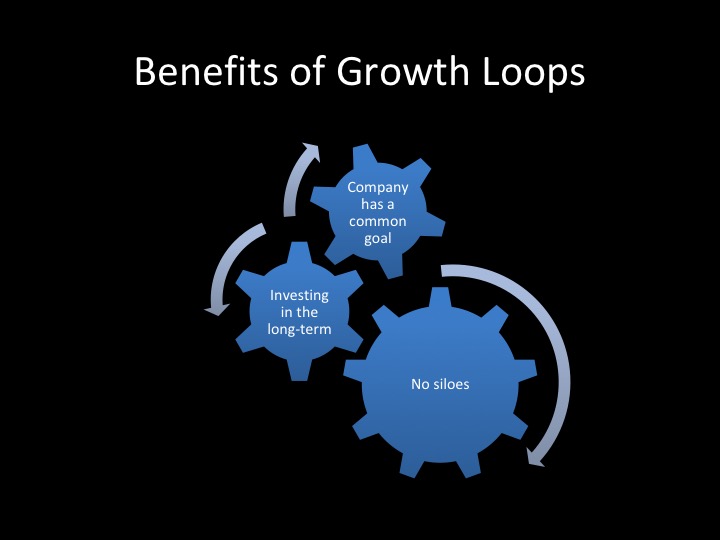
You get away from siloes (product, marketing, etc) and work together. Growth loops force companies to build a system.
You invest resources in systems that are more sustainable long-term, that continue to grow on their own.
You organize your personnel and teams towards a common goal, aligning and optimizing the growth loops.
Next steps
When building your company and designing your games or products, think holistically. Understand how you will create growth loops that will feed themselves and build a long-term dominant product. With games, ensure that there are loops in the game that drive the acquisition phase.
Key takeaways
Growth loops represent the evolution from a traditional acquisition funnel to a loop that continually creates value. Loops are closed systems where the inputs through some process generates more of an output that can be reinvested in the input.
Rather than creating siloes, growth loops help marketing, product, monetization, analytics work holistically.
A key value derived from growth loops is they have a compounding effect, they continually add value to the initial investment and thus perpetually grow the underlying product.
I have written many times about customer lifetime value (LTV)and how it is the critical determinant of a company’s success (any company, from mobile games to retailers). A user’s lifetime value has to exceed the cost of acquiring the customer, otherwise companies cannot grow and will eventually die.
Last year, I discussed that out of the three key components of LTV – monetization, virality and retention – retention was the one most critical for success. While people sometimes focus on monetization, its impact on the long-term value of a customer is limited. Think of a retail store. Would they rather have a customer who comes in, makes a $100 purchase but never returns or somebody who comes in every week and makes a purchase ranging from $10 to $25? Obviously, they would prefer the latter. Successful businesses, games, apps, have great retention, thus creating high LTVs and allowing for more marketing spend.
While the mathematical case for focusing on retention is incontrovertible, many companies have not perfected how to measure retention effectively. Most social game companies, among the most sophisticated users of analytics, rely on measuring retention by D1/D7/D30 retention (how many players who installed on Day 0 are play after one day, seven days and thirty days, respectively). While this method is an acceptable (and sometimes powerful) way of tracking how new users are performing, even D30 retention only reflects behavior of customers acquired in the last month. It does not show how well the game or company is retaining its existing customer base.
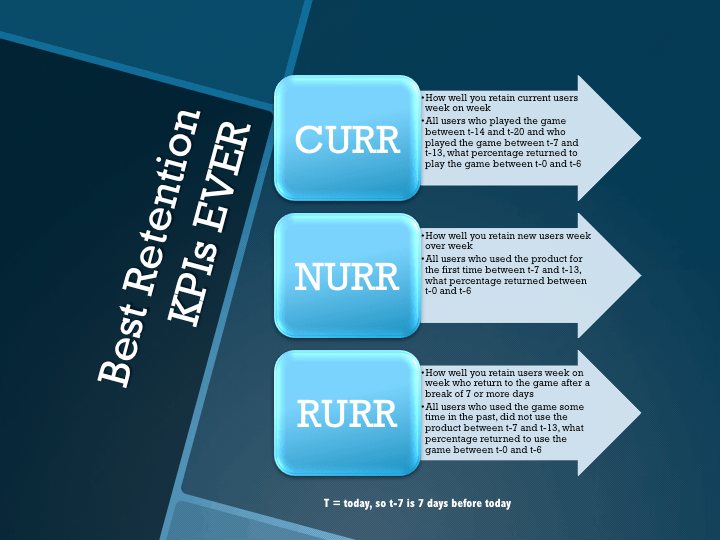
When I was at Zynga, I came across a metric that perfectly captures how well you are performing with your existing customers, CURR (current user return rate). CURR is complemented by NURR (new user return rate) and RURR (returning user return rate). Since leaving Zynga, not only have I taken these KPIs with me, I have used them as a key focus for optimizing products. A post by Nathan Williams, SaaS Retention Metrics: Lessons from Free-to-Play Games, reminded me how important these KPIs are and how to best use them.
CURR
CURR (current user return rate) is the most important KPI to track (or at least a tie with NPS). It shows how loyal your existing customers are; you should consider CURR the inverse of churn. If your CURR increases, it means you have improved your product’s appeal to existing players or customers, if CURR declines you have made your game worse. CURR is also an excellent way of looking at how your game is performing among different segments, VIPs versus payers versus never-spenders.
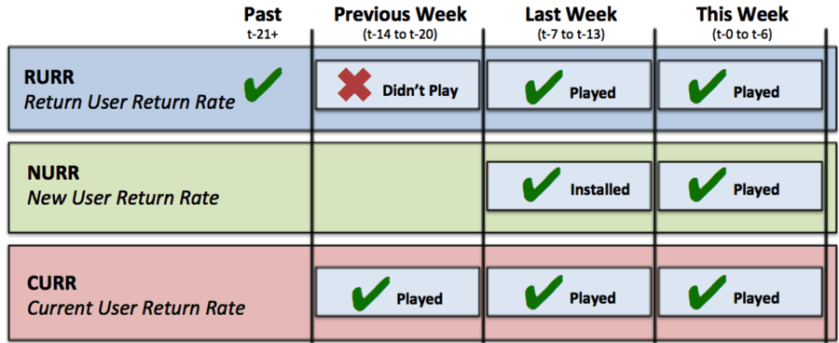
To calculate CURR, you start with all the users who played the game between t-14 (14 days before today, today minus 14) and t-20 and who used the product between t-7 and t-13, what percentage returned to play between t-0 and t-6. The benchmark for a good, but not great, game is 80 percent.
NURR
NURR (new user return rate) is a great metric for understanding how appealing your game is to players you have just acquired. A low NURR shows you have a bad initial experience (or a bad traffic source), turning off many users. It is virtually impossible to acquire players profitably with a low NURR.
To calculate NURR, take all the players who used the game for the first time between t-7 and t-13 and look at what percentage returned to the game between t-0 and t-6. You can benchmark NURR at about 30 percent, though it is dependent on the type of game and platform. There is much higher variance in NURR than CURR among successful games (a game on desktop could succeed with a much lower NURR than a game on Google Play).
RURR
RURR (return user return rate) shows how many people who had churned and returned to your game stay active. It is a great way of measuring how well your game can capitalize on CRM and paid reactivation campaigns. If the number is low, you are doing a great job of bringing players back but the product is still not compelling to these players.
You can calculate RURR by taking all the players who were active at some point but did not use the product between t-14 and t-20, and did use the product between t-7 and t-13, what percentage returned to play the game between t-0 and t-6. There is also significant variance in this benchmark but I usually target 40 percent for social casino games.
Use *URR to track product performance
Once you start monitoring CURR/RURR/NURR, you should use them to understand what is working and where there are issues. If you see a significant change in CURR, it is almost certainly caused by recent product changes. Low NURR indicates either you have broken your FTUE or you have added weak sources of traffic. A low RURR indicates your CRM or reactivation team is doing a good job but you need to add product features to keep the players you are brining back.
Key takeaways
Retention is the key driver of customer lifetime value (LTV), and CURR/NURR/RURR are the most accurate metrics to track retention.
CURR (current user return rate) is your most valuable metric, the percent of your current players who are staying active. It shows whether changes in your product are appealing to or deterring your player base.
NURR (new user return rate) shows if your initial user experience is strong while RURR (return user return rate) shows if your game is appealing to players who have churned but decide to try it again.
When I listed my expectations for 2019, the one that generated the most conversation was that the convergence between Real Money Gaming and social casino would accelerate. The underlying driver of this convergence is that both ecosystems are strong and have many learnings to offer. Real Money casino is a $10.6 billion business. Meanwhile, social casino is a $5.4 billion industry that has grown every year since 2012 and is projected to continue growing 7-12 percent per year through 2022.
What social casino can learn from Real Money gaming
Content is king
Real Money casinos focus on adding more content (slots and table games) to increase revenue. While social casino operators also will profess content is king and acknowledge that new games are the strongest driver of KPIs, they do not have the singular focus on adding content that their Real Money counterparts have. Most social casino companies are happy releasing a new slot every second week and launching with 20-30 machines. Conversely, the top Real Money casinos often have over 500 slots and introduce new games much more rapidly.
Given the proven results from launching new content, social casinos should look at much more aggressive content schedules. To achieve this result, social casinos will need to move from their reliance on exclusive, homemade content.
Real Money operators can launch hundreds of games because they license the slots non-exclusively, thus providing access to thousands of slot machines and table games. While exclusivity does provide a unique selling point, many of the homemade social slots are not truly unique. They have common themes and standard math, they are effectively a commodity. Thus the exclusivity is only a perceived advantage, it has no value to the player. Rather than recreating the wheel for every machine, social casinos can still create a unique machine every two weeks (or four weeks or one week) but supplement it with non-exclusive content from the many third-party slot developers.
Cross-sell
While most social casino operators are focused on creating a strong slots app and then optimizing acquisition for that app, Real Money operators have a more robust model. While they still will acquire slots players for their casino products, they have entire verticals that exist largely to acquire players that can be cross-sold into casino. Virtually all the Real Money Bingo products derive the bulk of their revenue from slots. While sports betting is a profitable real money vertical on its own, all of the major sports betting companies rely on slots to drive LTV and allow for more aggressive user acquisition.
In the social space, the siloes are much stronger. Only Kama Games, which uses products like Blackjackist and Roulettist to drive traffic to its poker offering, regularly uses other casino mechanics to acquire players and then cross sell them to its core poker product. Even the social game companies with strong bingo products generally treat bingo as a standalone vertical with its own P&L, just acquiring players for bingo rather than to cross sell into their slots offerings.
Social game companies need to look more at their ecosystem rather than individual products. This will allow them to acquire more players at a higher ROI.
New mechanics
All successful social casino products are based on mechanics proven in the real money space (either land based or online) but not all real money gaming mechanics have made it to social casino. One of the challenges faced by social casino is that the number of players is no longer growing. While revenue continues to increase, it is driven by better monetization of the player base, rather than expanding the player base. One of the most obvious ways to appeal to more players is offering more gameplay options.
There are several real money mechanics that could benefit social casino companies:
Sports betting. Sports betting is the largest Real Money gaming vertical, worth well over $22 billion. Social casino companies have tried to replicate Real Money sports betting apps with no success; they have failed for several reasons. The products are normally very complicated, not lending itself to a new sports betting player. Sports betting is also very event driven (you are only interested when there is a match you want to bet on), while social games rely on strong daily retention. Despite these issues, given the overall interest in sports, strength of social fantasy applications and lack of Real Money sports betting in some core markets, a creative game designer can come up with the killer social app for this segment.
Virtual sports. Virtual sports is an important but small part of the online real money gaming ecosystem. Technology, however, has made it much more viable and a great option for social casino companies. Virtual sports are similar to slot machines in that winning is based on a random number generator with set odds, they just simulate a real sporting event. Technology, however, has made these simulated games look as good as real sports. The video below from virtual sports provider Inspired Gaming shows these matches look better than what you would see on a gaming console. Unlike actual sports betting, virtual sports are always available to the player so you can create an experience players can return to daily.
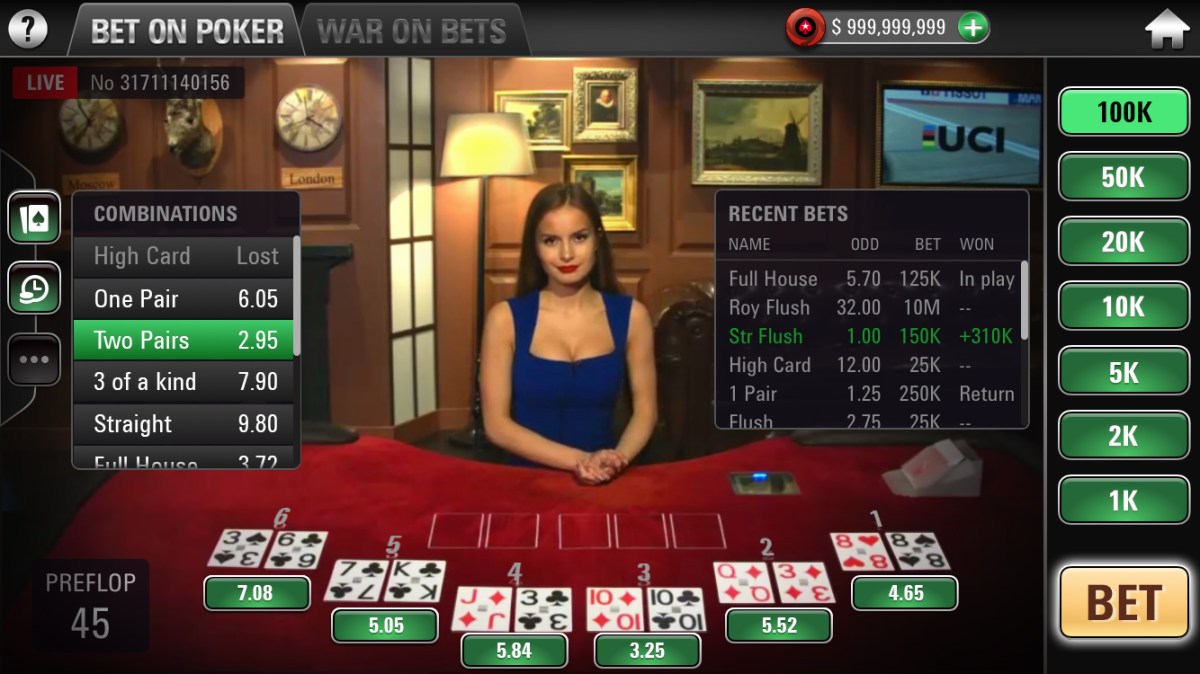
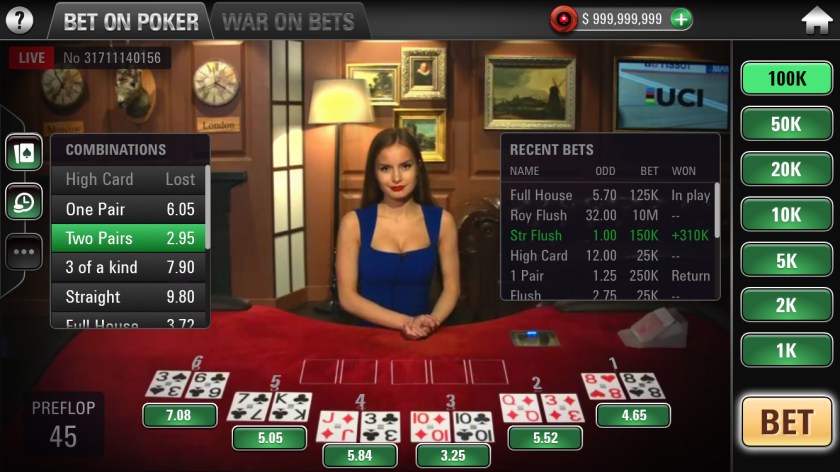
Live dealer. Live dealer games are the fastest growing mechanic in the real money gaming space. Companies led by Evolution Gaming, provide games where customers play against a live dealer or host through a video feed. Just as with virtual sports, technology has made this offering much better than only a few years ago, with smoother and higher quality streaming. It is the fastest growing segment of real money gaming and virtually when any B2C company reports its financial results, Live Dealer is the highlight or only bright spot. There are challenges integrating it into social games, bandwidth costs, one-to-one dealer requirements, etc., but as Stars Group showed these issues can be overcome.
New Audience
Real Money gaming shows that the addressable market is not limited to 40+ women. While 73 percent of social casino players are female, 65 percent of real money gamers (and 55 percent of real money casino players) are men. With user growth stagnant in social casino, appealing to a male demographic can expand the market for social casino.
Offer driven user acquisition
While social casino companies are more sophisticated with their overall digital marketing, Real Money operators are better at using promotional offers to bring in players. Promotions, such as a free money welcome bonus, spin to win, triple winnings their first day playing, etc., have a very strong pull. While the cost in Real Money of these promotions is sometimes challenging, in social casino they are less risky as providers are only gifting virtual currency. These offers are complicated by AppStore restrictions but this challenge is not insurmountable and more creative offers will improve social game companies user acquisition efforts.
VIP 3.0
While social casino is more reliant on VIPs than Real Money casinos, more than 60 percent of social casino revenue comes from 0.5 percent of players, Real Money operators are much more sophisticated in working with their VIPs. Only a few social casino operators, such as Zynga, have true VIP management programs, most social casinos have one person (who may also be responsible for social media or support) who runs their VIP “program.” Conversely, the most successful real money casinos have a more robust VIP support initiative:
Proactive. While much of VIP management in social casino is better customer support for spenders, VIP management in Real Money gaming consists of proactively reaching out to your top players and understanding them as a process. The VIP team can then anticipate problems or opportunities and provide a better experience to the player.
Rake back or loss return. Many real money gaming companies (both land based and online) refund part of player losses to their best players. This practice allows players to take more risks and helps overcome periods of bad luck. While it is a controversial practice, many in the real money space lament the cost is not worth the effort, it is a strong way to increase loyalty of your most active players.
First class promotions. Why are most fights in Las Vegas, answer is so the casinos can give their VIPs front row seats. Real Money operators will send their top players to great sporting events, sold out concerts, the top restaurants or even a luxury cruise to show their appreciation. While VIPs will often spend over $200,000 in a social game, these VIPs are often rewarded with a t-shirt (if they are lucky). Treating top VIPs similarly to the real money industry will keep them more engaged with social casino offerings.
Hospitality events. Not only do Real Money casinos send their VIPs to great events, they create great events. By creating your own event, you are building something unique that competitors cannot replicate and the player cannot get anywhere else. Thus, they are less likely to churn as they would not want to lose access to these events, while they can always buy fight or concert tickets. It is also a great opportunity for your VIP team to build personal relationships with your VIPs, and the personal bond is often stronger than financial benefits of being a VIP.
By replicating these practices, social casinos can reduce VIP churn and improve their lifetime value to the company.
What Real Money gaming can learn from social casino
Although Real Money casino is a larger business, in many ways it is less sophisticated than social gaming. For many years, Real Money casino operators could succeed by getting a stable product in front of customers. With LTVs upward of $400, they had significant margin of error in user acquisition and product features. Conversely, social casinos continuously had to optimize all facets of their business to continue growing. This optimization has led to the development of many features and tactics that can benefit Real Money gaming.
Progression
Providing progression serves many valuable purposes in games. First, it gives people a reason to play, they want to keep moving forward. Even in Real Money gaming, studies have shown over 65 percent do not play to win money, thus progression will appeal to the majority of these customers.
Progression also prevents churn. Loss aversion is a very strong driver of behaviour, people do not want to lose something they already have. The endowment effect also explains that they will also overvalue it.
In addition to reducing churn, progression increases engagement. Players want to complete as many levels as quickly as possible. If there are outstanding levels, they will want to reach them as they will want to finish everything open.
Progression also is a strong monetization driver. Candy Crush is a great example of a game genre that did not monetize but by adding progression King.com was able to create a billion-dollar franchise. Progression prompts players to want to keep playing even when they are out of chips, so thus depositing more, and to play at higher stakes, increasing their bet size.
In the Real Money casino world, where players will often jump between casino offerings to capitalize on the best promotions, progression creates loyal and valuable customers.
Social features
Social features are another strong behaviour driver that has largely been perfected by free to play games. Social interaction is a core value for customers, driving success across many industries. While many features satisfy base needs, social interaction appeals to a higher need and thus people are willing to pay more for it and less likely to give it up. The success of Big Fish Casino, and more recently Huuuge Games, shows how social features can create a unique and very profitable market position. Outside of the casino space, Clash of Clans is a great example of social features driving billions in revenue.
There are many different types of social features that Real Money casino operators can implement, with some of the most successful including:
Guilds or clans, where players join together to overcome challenges or compete with other groups.
Group challenges, so players have to team together to win rewards.
Chat, to enable players to interact with each other.
Customizable and useful player profiles, so players can know more about other players.
Social shares to unlock gifts.
Personalized videos, so players can share their gameplay with friends.
Team competitions, where players form teams to get higher scores (which could be chips won) than other teams.
Synchronous slot game play.
Social lobby, so players know they are not playing alone.
Visibility into where friends and other players are winning.
Player review of games and slots, similar to Amazon.
Referral program, so your players can also be your evangelists.
Some of these features will work better in certain products than others but a mix of these features will not only create bonds with your players but amongst your players.
UIUX
Social casino developers provide a much cleaner and smoother user interface (UI) and user experience (UX) than real money gaming companies. Players can quickly start playing and there is virtually no learning curve. It is easy to navigate in the product, take advantage of offers and understand every offering. Real Money, conversely, often overwhelms the customer with choice, increasing the cognitive load. This problem is not only in the lobby but in the products, betting options are often very complex and confusing. Overall, social gaming companies create an experience much more consistent with customers expectations in 2019.
In-product VIP
While Real Money gaming companies are great at hosting and managing their VIPs, social game companies are much better at giving them incentives and rewards in product. Virtually all social casinos have an in-game VIP system, where the more VIPs play, the more privileges they earn. This type of automated system provides continuous reinforcement and reminds VIPs why they want to remain in their favourite product.
Events
Within the past year, social casinos have become very adept at creating events that boost engagement. It could be the December Challenge or the Race to the Mountain Top, but in effect it is a collection of challenges and specialized content that is available for a limited time. Often the player has a chance to win an item(s) that is only available by completing the event and will not be available again, creating an incentive both to participate and to visit the game regularly (so they know about the events). These events also break the monotony of playing the same games repeatedly. Finally, they can provide an incentive to try new slots or mechanics.
The most successful social games are now running at least one event daily and this practice can be replicated in the Real Money world. A regular schedule of events increase loyalty, engagement and monetization.
Key takeaways
The strength of both the Real Money Gaming and social casino businesses suggest they both have many lessons to offer.
Social casino companies should focus on adding even more content than they do currently (in part by using third party content they do not have exclusively), create an ecosystem based on cross-sell, try game mechanics from Real Money gaming (sports, virtual sports, live dealer), try to engage male players, create more unique new player offers and replicate the high-touch VIP programs found in real money.
Real Money casinos can improve their profitability by adding progression mechanic, social features, more simple user interface and user experience, in-product VIP programmes and daily events.
One of the challenges successful game developers face is what features to add to the product. With a successful game, you are not in panic mode but you also must deal with the reality that in a free-to-play product you need to keep players engaged or you will become the next Trivia Crack. The fundamental issue is adding features that are useful and fun for your existing players, that enhances their enjoyment of your game.
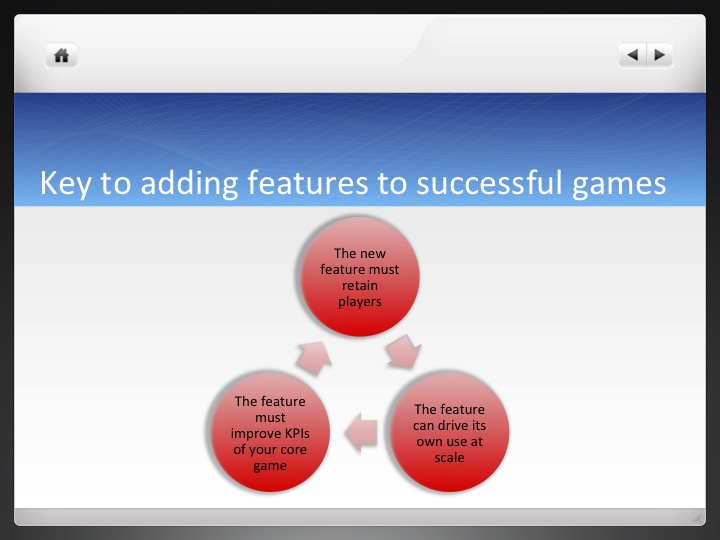
The new feature must retain players. The feature itself retains the player and you do not have to drive players artificially to it from other parts of the game. For example, if you add Blackjack to your social slots application, it works if players engage with Blackjack and then come back to play it regularly. You can use the same retention metrics (D1, D7, D30 and CURR) to assess if a feature is working as you do to look at an app.
The feature can drive its own use at scale, you do not need to create a plan to build adaption. To use the Blackjack example, if you integrate it in your lobby players will try it without forcing you to run specific campaigns.
The feature must improve KPIs of your core product. To use the blackjack example, it needs to improve either your overall retention or monetization.
The last point is critical to success. I used to be at a game company where product managers regularly presented analysis of their features and bragged about the great performance of the feature. Overall, though, the company’s games continued to lose players (DAU) and monetization per player (ARPDAU) was also decreasing. While the features appeared to perform great in a Powerpoint, they actually were costing the company money because they drove lower overall performance.
How to add features that improve LTV
While you may infer from the previous sections that you should only integrate features that appeal to everyone, the opportunity is to segment your players and build features to appeal to target segments. If you limit yourself to only adding features that are accretive to everyone, you have a small pool to pull from.
Given you already have a successful game, by definition your players are already enjoying your product. While there may be opportunities to add features everyone enjoys, you have a bigger set to choose from if you also identify features that may appeal to a subset of your players. This is particularly powerful because this feature can appeal to a segment that is likely to churn and keep them engaged or a segment that does not monetize and prompts them to spend. Conversely, it could only appeal to the ½ of 1 percent that are VIPs but given how much they spend could have a great impact on revenue
If you are building a feature that appeals to a specific segment, then you must be careful not to violate the third key to creating a successful feature, you do not want it to impact negatively overall KPIs. The way to achieve this balance is by positioning or displaying the feature only to the target audience. This can be done as an AB test, where you only surface the feature to specific players. It can be achieved through targeted CRM (in-game banners, push notifications, email, etc.) that is only sent to players in the target group. Surfacing a different UIUX to players who you want to engage with the feature can also accomplish the same goal. The key is maximizing how much the target audience uses the feature and minimizes how much other players see it.
Using the blackjack example yet again, we can illustrate how it could help a social casino game. Overall, slots monetizes much better than blackjack. It is a faster game and many blackjack players will play in a way so they lose very few chips. If you added blackjack to a successful slots game and promoted it across your player base, you probably would get great engagement as a lot of people love blackjack. It would, however, drive some players from your slots to blackjack where they are likely to monetize at a lower rate. If you were looking at how it would impact overall performance, then, you would say blackjack is a failure.
If, however, the blackjack game was not in the main lobby but embedded deeper in the game and you then drove players who were likely to churn (maybe you have a nice machine learning algorithm that can identify these players) to blackjack, it would engage some of these players. They would then come back regularly to play and rather than churn some would monetize. Thus, you would have a successful feature that helps the overall product.
Add features that help your game
Although it sounds obvious, when building your product roadmap you need to dive deeply into each potential feature and identify how it will improve KPIs of a target segment. Effectively, how will it solve a problem for you or your player (user churning, user not spending, etc.). The bigger the problem, the higher the priority.
Key takeaways
The key to adding new features to a successful product is ensure the feature itself retains players, can generate its own use and helps the overall KPIs of your game.
You must avoid features that seem to perform well when reviewed in a vacuum but actually hurt the KPIs of the game.
You can achieve launching a successful feature by targeting your players and then only showing or promoting the feature to players who will benefit from it.
One of the constant challenges developers face is user acquisition, as costs seem to increase much faster than revenue per user. This issue is not limited to game developers as more companies see digital and performance marketing as their premium-marketing channel, the competition for eyeballs drives up costs. It is a constant challenge for everyone in growth or marketing to understand the newest techniques for finding the best and most effective channels. No longer can any executive run television ads and then hide behind ambiguous results. The issue is magnified when trying to reach millennials, who spend most of their time (free time or not) in the digital world.
A recent article in the MIT Sloan Management Review, The Right Way to Market to Millennials by Jay Sinha and Thomas Fung, does a great job of presenting the idea of nano-marketing, one of the most promising new growth mechanics. Nano-marketing is using micro-influencers to market your product or build your brand. This approach is evolving into one of the most effective forms of advertising.
Who and what are micro-influencers
While we are all familiar with the personalities who have huge social media followings, the Kim Kardashians or Gwyneth Paltrows, the people with smaller followings are proving most effective. Micro-influencers have between 1,000 and 100,000 followers. Although their following is relatively small (Kim Kardashian has over 100 million followers), they have a category specific following and much more engaged audience. Micro-influencers also build more personal relationships with their fans, as they can engage with them one-on-one. They are also frequently considered experts in their fields (something you may not say about a Kardashian).
People also often consider micro-influencers more credible. When LeBron James tweets his support of a shoe, most people assume he is getting paid for that tweet. Conversely, a micro-influencer who promotes your game will believe he is a fan and give him the benefit of the doubt. Even if people assume the micro-influencer was paid, they also assume that the personality has a true affinity for the product.
Not only can micro-influencers drive sales, but they can contribute to your brand building. Sinha and Fung discuss how Coca-Cola leverages micro-influencers to develop compelling brand narratives. They also discuss how start-ups, such as sock retailer Stance Inc., have used micro-influencers to grow into major brands.
How to leverage micro-influencers
Working with micro-influencers is different than working with celebrities or other marketing channels, it also requires a personal approach. There are several keys to building a successful micro-influencer program, with may of them highlighted by Sinha and Fung as well as a VentureBeat post on how micro-influencers are essential. The elements of a successful program include:
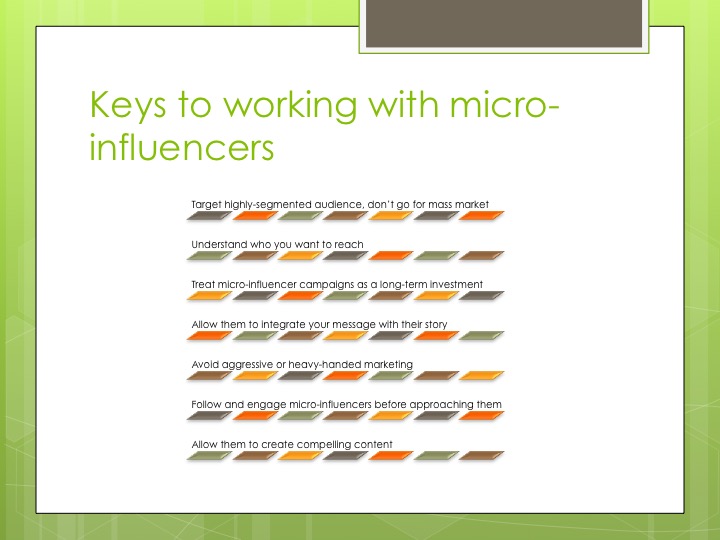
Use micro-influencers to target highly segmented audiences. This channel is not the right option to reach millions at once. Instead, micro-influencers are a great way to amplify a feature that largely appeals to a niche or helps you recruit a specialized segment.
Understand who you want to reach. There are millions of micro-influencers, you need to understand exactly who you want to target and the goal(s) of your campaign. Once you have a clear understanding of your target, you can then find the micro-influencers who reach that audience.
Look at micro-influencer work as a long-term investment. Build a long-term relationship with the most appropriate micro-influencers, so they can continuously weave your brand into their stories.
Effective micro-influencers integrate their personal narratives with the brands they endorse. Rather than trying to foist a message on the micro-influencers, use their story-telling ability to create a compelling message.
Avoid heavy-handed or aggressive push-marketing and instead have the micro-influencer give their audience a gentle nudge.
Before approaching micro-influencers, follow and engage with them. As VentureBeat writes, “this helps you better understand their personality and interests so you can determine their fit with your brand. It also helps you approach them with a more personal request, which is more likely to get a positive response.”
Allow the micro-influencer to create compelling content rather than directing them. As Sinha and Fung write, “young, creative micro-influencers are good at producing innovative content that features the brands in an interesting way. They know their audience would want to be educated about new offerings, while being entertained at the same time.”
By following these steps, you can build an effective micro-influencer program that will support your marketing initiatives.
Key takeaways
Marketing continues to evolve quickly, with it increasingly difficult and important to find effective advertising channels. Nano marketing is one of the most promising of these channels.
Nano marketing entails working with micro-influencers, people with between 1,000 and 100,000 followers, to promote your brand or products.
Micro-influencers are particularly effective because consumers consider them more genuine and they have much greater focus than celebrities who have huge followings.
Someone I respect recently posted an article from a news source that I also respect, but the article actually highlighted how data can mislead, either intentionally or not. An article on the Guardian.com, Amazon Prime Video’s growth outpaces Netflix in UK, tells the story of how Prime Video is growing at a faster rate than Netflix. The sub-title stresses that, “cross-promotion to Amazon shoppers and new on-demand series rank it top in 2017.”
The article goes on to point out several reasons why Amazon is top in 2017:
New series of the Grand Tour and Transparent are fueling growth
Hefty cross promotion of Prime Video to regular Amazon shoppers is also contributing
Prime Video increased its subscribers to 4.3 million in 2017, representing 41% year-on-year growth
Netflix only grew 25% in the same period.
If you stopped reading the article there, and who reads an article until the end these days, you would think Amazon is doing a great job in the video market and Netflix should be very worried. If you worked at Amazon and get a similar report from your analytics team, you might high-five the head of Amazon Prime in the UK. If you were at Netflix and got a similar report from your analytics team, you might panic a little and divert resources to the UK.
The problem is that although the data is accurate it is misleading. The key figure is that Netflix added 1.6 million new subscribers in 2017, while Amazon added 1.3 million new subscribers for Prime Video in the UK. Thus Netflix actually extended its lead over Amazon by 300,000 customers in 2017. Netflix is in 8.2 million UK households (at the end of 2017), versus 3 million for Amazon.
How different would the story have been if the headline was Netflix extends lead by another 300,000. How different would the reception be at Amazon and Netflix respective headquarters if their analytics team presented data in this way.
The mistake
The mistake in this case (and I will be generous and assume the Guardian was not click-baiting) is comparing growth rates (or any other rates) while neglecting the size of the relative base. It would be the same in football if you looked at Messi’s goal scoring versus a second year player. The latter may be scoring twice as many goals as he did as a rookie while Messi may have been flat or added a few. Thus the young player is growing his goal scoring 100% while Messi is adding only a few percent to his lifetime numbers. That does not mean that the second year player is either having as good a season as Messi or closing the gap.
The same happens in the mobile game world. Your slot game may be growing 100% month on month while Slotomania is growing 10% (not real numbers), but because their base is so high they are adding millions in revenue while you are still not profitable.
The key is only comparing trends when you are comparing apples to apples. Trends mean something if you are looking at two products or companies of comparable size in the same stage of their lifecycle. Looking at two auto companies who launched an SUV the same year in the same market makes sense, comparing growth rates of two automakers, one who is new and has no dealer network with one that has been around 100 years is worthless.
The answer
You need to look deeper into the numbers. Look at the absolute numbers. Look at the pricing. Look at the target market. Look at percent usage (in the Amazon case, how engaged are Prime users who may have bought it just to get free shipping versus Netflix users). The key to using data effectively is look deeply at the data and understand what is driving the results. You also need to make sure your analytics team does the same. It is very easy to make conclusions based on obvious trends. Avoid superficial analysis and, more importantly, superficial conclusions.
Key takeaways
A recent article implied Amazon Prime Video was doing better than Netflix in the UK as it grew 41% versus 25% by Netflix.
The article is misleading as Netflix actually added 300,000 more customers than Amazon. This obfuscation shows how data can mislead if you focus on trends but are not comparing comparable companies or products.
The key to using data effectively is look deeply at the data and understand what is driving the results.
I, and many others, have written multiple times on how important VIPs are for free-to-play games but one area that is opaque is how do you get VIPs. In most free-to-play games, VIPs (which I define as a player who spends over $2,000 lifetime but is genre and game dependent) represent less than 0.5 percent of all players but generate 60-80 percent of revenue. It is thus critical for a game’s success to find and nurture VIPs.
Given the importance of VIPs, many think the road to success is stealing VIPs from competitors. This technique works in land based casinos, to a degree, and some other industries, but should not form the foundation of your efforts. If you are focused on winning competitors’ VIPs, you are likely to fail in the long term. You will be disappointed in the number of VIPs you can steal and will find that overall your game is deficient. Instead, you need to focus on creating VIPs, as that will ensure long-term success.
Why you should not rely on stealing VIPs
There are many techniques to woo competitors’ VIPs in social games but they yield surprisingly disappointing results. You can recruit competitors’ VIP hosts, troll VIP forums, target players based on their level in competitors’ games, etc. Surprisingly, however, this strategy fails to have a higher ROI than traditional user acquisition, where you cast a wide net.
VIPs love the game they are already playing
The first reason that it is very challenging to win over VIPs is that, by definition, they love the game they are currently spending in. They are VIPs because they are highly engaged and thus willing to spend liberally. If they were not happy with your competitor’s game, they would not be spending large sums of money there. A typical new product has to be 9 times better than an existing product to win over a customer. A VIP is going to be even more committed to the existing product, so your game will need to be 10X or 20X better to prompt the VIP switch. It also has to be better in areas the VIP cares about because their needs are already served with their current game.
All games are different
Unlike with some businesses, all mobile and social games are different. While players and developers often lament the copycat nature of the industry, there are no identical products in the market. It may just be a different theme or user interface, but there is a difference between games. In social slots games, everyone has different slot machines. In match-3 games, there are different themes and animations even in games that are largely the same.
Some other industries, where VIP “stealing” is easier, do not have this differentiation. In land-based casinos, most high-end casinos have the same slot machines. With department stores, most stores targeting the affluent will carry Gucci. Thus, a VIP at an MGM casino is likely to go to the casino for a game they can play at Caesars or a customer at Nordstrom can find the same product at Nieman Marcus. Conversely, it you love the slots in Hit It Rich!, you cannot play them in Heart of Vegas.
Your spender is not my spender
One thing that has surprised me in the mobile game space is that a spender in one game probably will not spend in another. I have been part of or around multiple initiatives in major mobile gaming companies to move spenders and VIPs to other products. Sometimes we have tried because the games were being phased out or we thought they would continue spending in the existing game and start spending the new game. All of these efforts have failed. They have not failed due to cannibalization but almost always there has been no correlation between spend in one game and spend in other games.
This surprising result is probably due to the reasons a person monetizes in a particular game. As discussed above, someone will spend in a game because they really love that game. They are not spending to spend, they are spending to enjoy. Thus, they are no more likely to fall in love with the new game than any other (non-spending) player.
How you should build your VIP base
If winning over VIPs will not drive your VIP revenue, you need to create your own VIPs. Having a strong VIP base is critical to a successful game, and like most things that drive success; it requires hard work. These efforts range from developing products focused on fostering VIPs, treating your VIPs right and acquiring players most likely to become VIPs.
Building products to create VIPs
People become VIPs because they love your game, so you have to create a product with something for them to love. If your game is a weak copy of the market leader, why should they spend in an inferior lookalike (unless you are competing on price, which does not work in mobile gaming). Instead, you need to give players something unique so the 0.5 percent who could become VIPs has something to fall in love with. Give players unique content that they cannot find anywhere else, if you are in social casino, that means slot machines that are unlike your competitors.
Also, give them features that reward a huge commitment. Love is mutual, and if you are asking for their commitment you must reciprocate. Rather than having some superficial features that get boring after a few hours or days of gameplay, make very deep features that only a few players may ever get through but gives those few VIPs an incredibly deep and fulfilling experience.
Create an in-game VIP program that shows VIPs they are important and advancing. Airlines were the first to roll out frequent flyer programs; you need to have a program focused on rewarding your top players. A few months ago, I wrote about how to create a top in-product VIP program and the key is creating compelling differentiated benefits and experiences.
Treating your VIPs right
The second critical element in building a strong VIP base is to have an effective VIP host program. VIPs are very valuable (hence the V in VIP) and you need to treat them properly. Many game companies have treated a player who never spends exactly the same as someone who spends thousands. The cost, however, of losing someone who is a great customer is huge so the ROI on investing in keeping this player is also very high. A good VIP host program will proactively deal with its top customers, ensuring they are happy and anticipating problems before they arise.
Spend to reactivate
If someone loved your game at one point, there are likely still elements of the product they love. Rather than focusing on bringing in new players, also focus on bringing back your VIPs. If you have good VIP hosts, one of their priorities should be to bring back players. Spending part of your user acquisition budget to reacquire churned VIPs is likely to generate higher returns than hunting for new ones. Adding features or content that your VIPs wanted, and then letting those who left know what you now have, is often a better investment than creating generic new features.
Acquiring players who will become VIPs
Finally, although you are not likely to grow your VIP base through acquiring competitors’ VIPs, you can still increase the likelihood that your user acquisition will find future VIPs. You need first to recognize what it is about your game that VIPs love. I have found it very helpful to understand what is your North Star metric, the metric that indicates if a player will become a VIP (i.e. makes three purchases in their first seven days). You can then optimize your paid user acquisition on players that achieve this North Star metric, even moving to a CPA model where you only pay (though pay much more) for players who perform this action(s). You can also run lookalike campaigns that target players who look like your VIPs. Unlike targeting players who look like VIPs of competitors, your VIPs love something in your game and if you find similar players, there is a high likelihood they will also love it.
It’s not easy but it is worth it
There is no silver bullet in building your VIP base but it is critical for your success. Regardless of your available funds, you cannot just go out and buy your competitor’s VIPs. Instead, you need to focus your business on creating a VIP receptive product. From the product development to your marketing, you need to create a holistic experience that appeals to the customers who will drive your business.
Key takeaways
VIPs, less than 0.5% of all of your players, will drive 60-80 percent of revenue for a typical social game, so it is critical you have a strong VIP base.
It is virtually impossible to build VIP base by wooing your competitor’s VIPs as they already love the competitive product and thus will probably not like yours better.
You should focus on building a game that gives people something unique, something they can love, so they will become VIPs.
My team was recently working on a new product and one of the issues that came up was what color scheme would generate the best results. Rather than rely on our (great) designers and team’s overall understanding of the market, we looked into the literature of consumer behavior and the research on what behavior different colors generated. Reinforcing the value of spending time on your color choices is research that shows 90 percent of snap judgments on products can be based on color. While there is no magic formula (unfortunately make everything dark blue or yellow is not a silver bullet), you can apply consumer behavior to leverage your color choices.
Color and branding
The first area we looked to leverage color was in our branding, ensuring our logo and app icon generated a strong positive response from players. A good article on Entrepreneur, The Psychology of Color, explained that you initially need to ensure your choice of colors is considered appropriate for your product. What would be effective in a bar is very different than the colors you should use for a funeral home. Customers decide a brand’s personality largely by its color scheme. The colors also make the brand more or less recognizable (IBM is defined as Big Blue), and people prefer recognizable brands.
Color choices also can create a unique visual identity. This helps to differentiate the brand and make it more memorable.
The key to choosing the right colors for your brand are using ones that convey the personality you want people to associate with your brand. If it is excitement, colors like red and yellow generate that response. If it is trust, you are best going with a lighter shade of blue. Colors also mean different things in different contexts (green can be environmentally friendly or related to money).
Color and gender
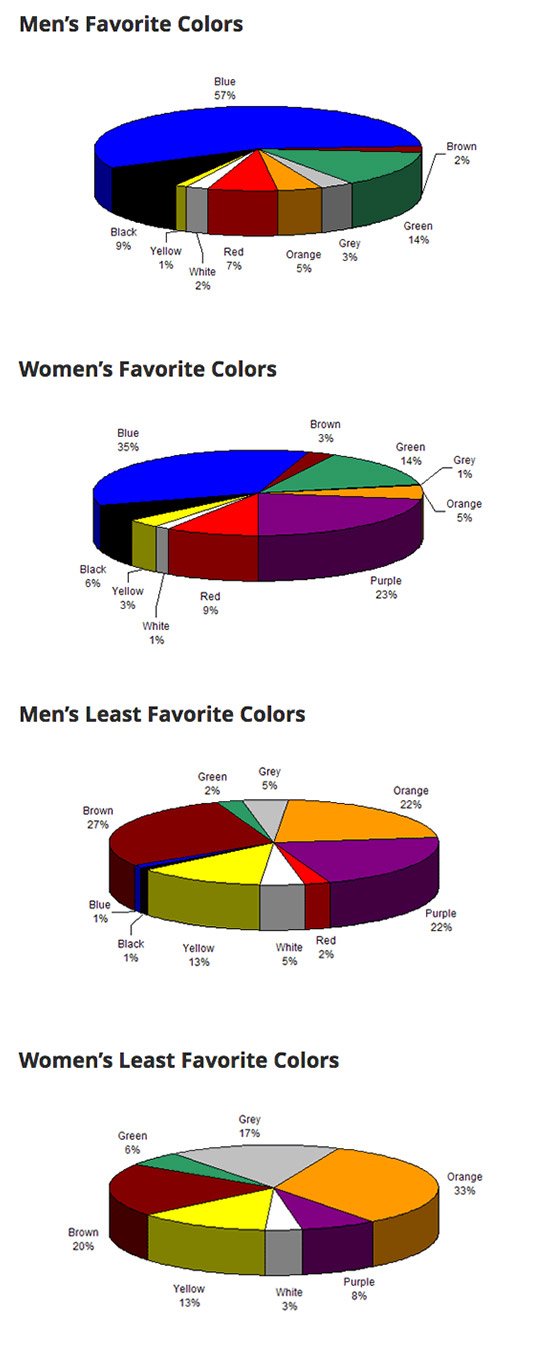
You also need to tailor your color scheme to the gender of your target customer. Blue is popular with both genders while purple is the most polarizing (loved by women and disliked by men). In general, men prefer bold colors while women prefer softer colors. Men are also more amenable to shades of colors as their favorites (colors with black added) while women prefer tints of colors (colors with white added).
Color and conversions
The true impact of color on conversion (making sales) is that you should use color to make an item or monetization opportunity jump out. A red “Buy Now “ button is likely to work great on a predominantly green and blue page but not work as well as a green button on a page with a lot of red. The key is using color to highlight what you want users to consider purchasing. You should use color to leverage the isolate effect.
Think about color
The key to this article is that color is important on multiple levels to your business and should not be an afterthought. The right color choices will create the brand identity you are looking for, appeal to your target market and make customers more likely to purchase.
Key takeaways
Color is a very strong determinant of consumer behavior and you should spend time to make color choices with your brand, logo and product that drive the behavior you are seeking.
Color scheme needs to be consistent with your brand, creating the brand personality you are trying to build.
The key to driving conversions is using color to isolate the elements that will drive purchases, less important than the actual color choices is using colors that do not appear elsewhere on the page or app.
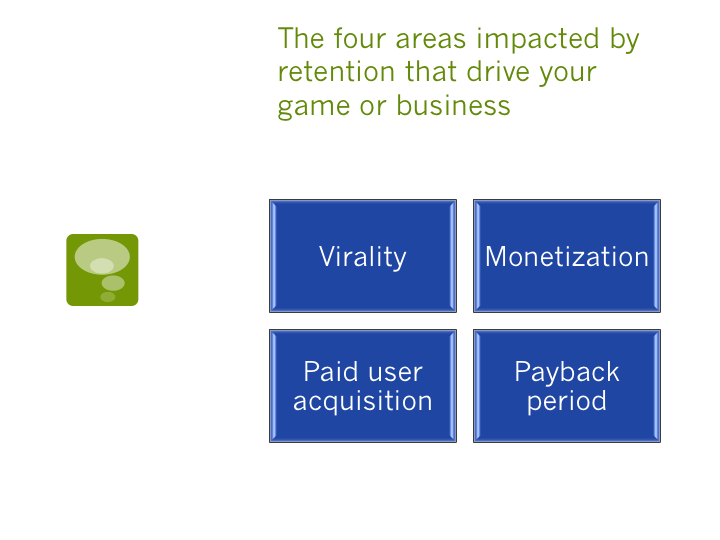
As you improve retention of existing users, you also acquire more new customers. A number of organic acquisition channels, such as virality and user-generated content (UGC), work when existing users take an action that introduces new users to your game or product (via inviting friends, sharing, word-of mouth, creating new content, etc.). A larger base of active users leads to better acquisition metrics. Players remaining in your game or product can invite new people to the product, so the more you retain, the more players who can send invites.
Monetization
Monetization is the second area impacted by retention. I get very frustrated when people, usually Product Managers, act as if there is a trade-off between retention and monetization. The reality is that retention drives monetization rather than damaging it. First, retention allows players to spend more frequently. If you retain a customer for three months rather than one month, they have 3X the opportunity to spend. Moreover, if your model is more robust than simply discreet purchases (either in-app purchases for a game or sales for a retailer), you also generate a longer stream of advertising or subscription revenue the longer the user is engaged with your product.
User acquisition becomes a competitive advantage
Paid user acquisition is one of the critical elements to growing a game or app, you need to have a positive return on ad spend to justify scaling your product. More importantly, since a bidding model drives user acquisition in the app space, with acquisition muscle you can push competitors out of acquisition channels, dominating a market and growing faster. As described earlier, your users are generating more revenue (they are in the product longer so spending more often and driving ad and subscription revenue), you can afford to outspend your competitors.
Payback period
Retention accelerates your payback period, allowing you to avoid raising additional funds or providing more free cash flow to funnel into acquisition. Payback period is the amount of time to pay for your full loaded user acquisition costs. As Balfour writes, “if you have a longer payback period, you either need to raise more money to fuel acquisition or wait longer to reinvest in acquisition. If you have a shorter payback period you will be able to reinvest the cash earned sooner in acquisition. Since improving retention drives monetization – meaning you make more money over a designated period of time – it also shortens your payback period.”
Build with retention top of mind
With retention driving so much value, you need both to create products that will retain customers or players and then the live services need to focus on improving retention. While it is sexy to try to boost ARPDAU, you will create the most value by strengthening your retention.
Key takeaways
Retention is the most important area to focus on, as it drives four areas critical to growth: virality, monetization, paid acquisition and payback period.
Retention generates more users because there is more virality, word of mouth, user generated content and an ability to spend more to acquire.
Retention drives revenue because players have more opportunities to make purchases and generate additional advertising and subscription revenue.
In 2018, if you are not delivering a personalized customer journey in your game or product you will fail. Personalization, for marketing, for customer experience, for CRM, for almost everything, is the current buzzword but it is still rare that companies have a comprehensive plan to create a personal experience. David Norton, former CMO at Harrah’s Casino group and architect of its Total Rewards program, discusses several ways companies can personalize effectively in his book The High Roller Experience.
Personalization is critical not only to a great customer experience but also to optimizing efficiency. As Norton writes, “personalizing the marketing communication approach will dramatically improve the efficiency of marketing spend both by eliminating activities that will not be fruitful and by improving response through more appropriate offers.” As your competitors are already optimizing, if you are not you will not be able to spend as many marketing dollars as they can, putting you at a fatal disadvantage.
How to create a personalized experience
Realistically, you are not going to have one-to-one personalization on day one, so you need practical planning to create a personal experience. A great way to start is replicate what Harrah’s did as a way to improve its marketing effectiveness, using a basic life cycle approach: new business, non-loyal, loyal, and defector. If you initially communicate differently with these segments, you will see an increase in overall ROI.
You also need to leverage the data you have on customers beyond the typical events. At Harrah’s, they looked at implied preferences based on all the information they had about their customers normal behavior, such as what customers did on their visits to our properties, including games played, offers redeemed, and nongaming activities, and then stored the preferences at a customer level for easy use in campaigns. They noted whether the customers preferred slot or table games, if they participated in gaming tournaments, if they most often came midweek or on the weekend, how often they redeemed offers when they came, what type of entertainment they preferred, which channel of communication they preferred, and a host of other factors. They used these implied preferences as inclusion and exclusion rules in campaigns. By excluding customers from programs that they had no chance to respond to based on their past behavior, they significantly improved response rates and cost savings. Most importantly, as Norton wrote, “we made our customers happier.”
Find the segments with high ROI
As alluded to above, you do not need to create hundreds of micro-segments initially but you do need to determine which segments you should invest in. Non-loyal customers represent a particularly attractive segment to target, as this is where you have the biggest opportunity to win market share. At Harrah’s, they targeted this segment by giving them increased value for more frequent visits, generating a significant increase in revenue from this group than they had predicted. In gaming, this creates opportunities, especially in the social and real money casino spaces, where players normally play three to five competitive apps.
Another segment rich with opportunity is defectors. Harrah’s found a way to identify those customers who had broken their typical visitation pattern as opposed to the standard inactive program practice of waiting 6 or 12 months to reach out to them, at which time they would have been long gone. This practice created lower churn and more value from this segment.
Treat VIPs extra special
I have written multiple times about VIP, and you need to ensure your personalization extends to giving VIPs a very special experience. This includes making sure you not only identify VIPs who make a large purchase in one product (or in Caesars case one property) but the ones who have the highest lifetime value. For an online company, the key is looking at number of transactions and adding across products to get the best picture of who your true VIPs are. You then need to treat VIPs in one product as VIPs in all your products. One of the biggest failures of personalization is when a VIP in one product or one retail location then goes to another and is treated as a standard customer.
Personalize all touch points
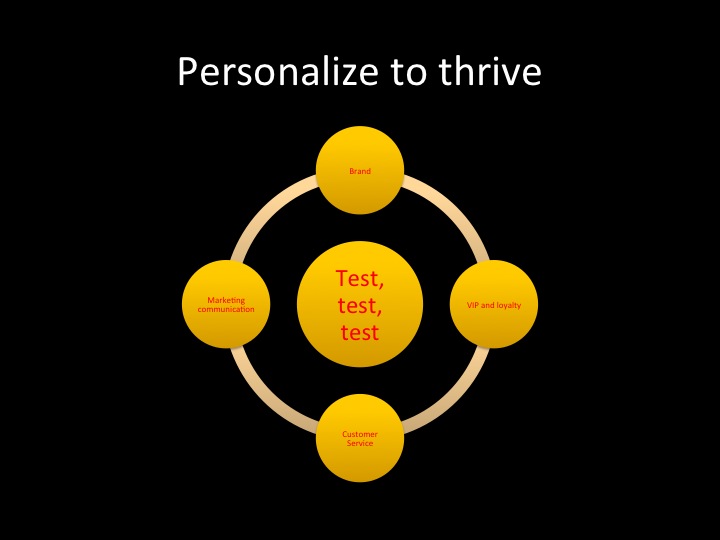
It is not just personalizing communications that is critical but you also need to personalize all the core functions. According to Norton, personalization needs to extend to brand, loyalty and customer service. As Norton writes, “if a company can execute against all three of these well, it is going to outperform its competitors….Customers increasingly want a seamless experience across touchpoints with a brand, and contact channels are often one of the greatest frustration points.”
Do not forget customer service (CS)
Given that you need to personalize all touch points, the one that companies most often miss is customer service. The service profit chain is not a theory but a powerful motivator and value creator.
It is absolutely essential, however, to think about the holistic customer service experience and understand the interplay among various channels. The call center and other contact channels are a valuable commodity. When personalized, CS can drive revenue and brand advocacy and provide valuable customer data. Norton writes, “I have always viewed customer care as a critical marketing channel that can build customer relationships, be a source of relevant information about the customer, and of course turn demand into revenue.“ Many of the product improvements that have led to the most revenue growth in my past two positions originated from feedback from our customer facing team members and VIP hosts.
CS is also an area for innovation, as you can improve your offering through technology. Customers may embrace technology before your company might, so CS can be a great vehicle to try new tools and channels.
To truly leverage customer service as a tool to improve personalization and the customer journey, you need to measure it at a granular level. This helps drive service improvement efficiently.
Testing is the key
You need to constantly test to ensure you are personalizing optimally. As Norton writes, “constantly testing and learning and holding out control groups is the best way to optimize marketing spend. This allows companies to find the most appropriate message and to spend .”
The first step is to automate the test process. If it takes months to evaluate what happened, the results become useless as the competitive landscape has changed.
It is also critical to have a control group for each campaign and program. While this policy seems automatic, there is often pressure to release what you believe is the optimal campaign or communications to everyone, as you do not want to leave money on the table. Holding out customers, however, from a specific marketing program is much more informative in determining which marketing activities drive the most incremental profitability, changing the customer’s behavior to spend more with you than with a competitor. This is also a better strategy than a universal control group, which does not show you the relative performance of different marketing programs.
As mentioned above, customer service is critical to personalization and measuring customer service with a significant level of granularity provides tremendous insight about the customer experience and helps identify areas for improvement. As Norton writes, “being able to correlate improved service to increased revenue, and developing a well-constructed incentive plan, leads to great outcomes for both a company and its customers— especially when there is innovation around challenged service touchpoints that drive overall customer satisfaction with the brand.”
Personalize, personalize, personalize
The key to success in the current business environment is personalization, your customers expect it, and if you do not deliver they will go to a competitor. And you need to deliver not only in communication but also in customer service and VIP. Then you need to optimize to ensure you are delivering a truly effective personal experience. This is not a secret to gaining competitive advantage, it is the cost of doing business.
Key takeaways
Personalization improves the efficiency of marketing spend by eliminating activities that will not be fruitful and by improving response through more appropriate offers
Think holistically about the customer journey. Ensure all parts of it are personalized, from the initial communication through the product to customer service and support.
Testing and control groups are the best ways to optimize your marketing and ensure your personalization efforts are creating value.


 The Business of Social Games and Casino