Skip to content

The Business of Social Games and Casino

How to succeed in the mobile game space by Lloyd Melnick

Category: Lloyd’s favorite posts

My favorite posts

Don’t give up, there are still great opportunities in mobile (aka make mobile great again)

Key takeaways

  1. The mobile market is far from dead. The misperception that the opportunity has passed is driven by the selective memory of a better past than existed and the current focus on copying existing successful products.
  2. The opportunity on mobile is still great, with projections of 5 billion smartphone users by 2019 and over 1 billion people on Facebook.
  3. Rather than complain or try to create yet another slot or mid-core game, challenge yourself to think outside the box. Focus on creating uncontested market space and making the competition irrelevant.

Don’t give up, there are still great opportunities in mobile (aka make mobile great again)

I doubt a day goes by without someone whining and winging about how tough the games and mobile market is today and although it is difficult, there are still great opportunities.

Why many think the mobile market sucks

There are a few reasons people feel the market is so challenging. First, there is always a selective memory of how great things used to be. I was there when the mobile market was perceived as a gold rush. And for the first few iOS games, they did great. It was, however, always challenging. I remember at Playdom all of our failed efforts (and various heads of mobile) to penetrate this market. Playdom was not alone, as many companies (EA/Playfish, Zynga, Kabam, CrowdStar and innumerable others) lost tons of money (and users) in the mobile space. I call this the “Make Mobile Great Again” phenomenon, similar to the Americans who have a very nostalgic view of the country 20 or 30 years ago.

The second reason for the perception of the difficulty of mobile is the red ocean mentality of most of the complainers. I have written before about blue ocean versus red ocean strategy, with the latter a strategy to beat established competitors in a known market rather than expanding the market to appeal to non-users. Mobile now is incredibly difficult if you are pursuing a red ocean strategy. Players have invested months or years in existing products (Clash of Clans, Game of War, Slotomania, etc.) and getting them to switch does not mean putting out a product a little bit better but creating a game that is 9 times better ( see my blog post from 2014 on why a new product needs to be 9X better to get users to switch ).

Then add to the challenge of creating something 9X better that the competition is really good these days. Even the game companies out of favor have experienced and deep teams of game designers, product managers and engineers. They also have millions of dollars they are investing in their new games (in some cases sitting on billions in the bank) to make them better, get new users and reactivate lapsed players. They are not waiting for you to launch a new game and take away their chart position (and revenue).

The bottom line is the market is very challenging if you are just trying to compete with games already on the market (but it always sucked to compete in a red ocean). That does not mean, however, that the mobile market itself is no longer a great opportunity.

The next great platform is still mobile

A recent blog post from Greylock Partners by Josh Elman, a leading Silicon Valley VC, makes the point that The Next Great Platform is the One That We Already Have.  In the world of venture capital, they also hear all the time that there are no longer opportunities in mobile (in their case, it is often that Facebook, Snapchat, Instagram, Twitter, etc. have consumed the entire market) and that they need to look at the next big thing (VR, AR, drones, IOT, insert hot new trend here).

Elman, like me, is not ready to give up on mobile. He pointed out that in 2002-2004, everyone was complaining that all of the opportunities on the Internet were over: Yahoo and AOL were the dominant portals, Google controlled search and Amazon owned eCommerce. Post 2004, however, we saw Friendster then LinkedIn, MySpace, YouTube and a small company named Facebook. So maybe the Internet was not exactly devoid of opportunity.

What is particularly interesting is that these companies (many of whom enjoy huge valuations), did not even need a technological inflection point to enter the market. Instead, they grasped the opportunity from user-generated content followed by a social and psychological shift. Even the new technologies were largely improvements on existing tech.

The opportunity now is tremendous. Billions and billions of people use Smartphones (5 billion by 2019). More than one billion people are active on Facebook and over 100 million use Instagram monthly, according to Facebook. And for those still not convinced there is still an opportunity, the chart below shows all the new apps (albeit not gaming) that rose to the top of the charts just this year.

hits-of-2016

Where the mobile opportunities are

If you are expecting me now to list some great opportunities, you have not read the rest of this post very carefully. The opportunities in mobile are not doing what everyone else is doing but understanding where you can create apps and games to reach people in a new way.

As Elman writes, “What happened in the Web 2.0 era was that some companies succeeded in creating totally new experiences, engaging consumers, and enabling them to connect with other people in a way that had never happened before online. Now that we’re in a fully mobile world, I think there is a lot of room to create new experiences and connect people. “

Rather than complain or try to create yet another slot or mid-core game, challenge yourself to think outside the box. Focus on creating uncontested market space and making the competition irrelevant. Then you can leverage the still great mobile platform.


Share this:

  • Click to share on Facebook (Opens in new window) Facebook
  • Click to share on LinkedIn (Opens in new window) LinkedIn
Like Loading...
Unknown's avatarAuthor Lloyd MelnickPosted on September 28, 2016April 11, 2020Categories blue ocean strategy, General Social Games Business, General Tech Business, Lloyd's favorite posts, Mobile PlatformsTags Facebook, mobile, mobile games, Venture Capital2 Comments on Don’t give up, there are still great opportunities in mobile (aka make mobile great again)

Jacoby Brissett shows in one night what I’ve been trying to explain for years

Last night, the New England Patriots beat the Houston Texans 27-0 with Jacoby Brissett at quarterback. What is surprising to some is that Brissett is an unknown third-team rookier quarterback only playing because the star starting quarterback, Tom Brady, is suspended for four games and his back-up Jimmy Garoppolo was injured last week. What the victory so poignantly shows is that companies and teams succeed by building a good system and not letting inevitable hardships derail them.

brissett

Over two years ago, I wrote about the Next Man Up philosophy, how rather than dwelling on adversity just keep moving (not surprisingly, it was also about the Patriots). The core is that successful companies and teams focus on their goal and do not let short-term issues serve as a reason to fail.

No excuses

At its core, this philosophy is about staying focused on what you need to do to succeed, not why you might fail. It would have been easy for Patriots Coach Bill Belichick during the week to say they would “try their best” but without their top quarterbacks it will be difficult. Instead, Belichick’s message was his job is to beat the Texans, it has always been to beat the Texans and that is what he will prepare the team to do.

Companies and individuals often look for reasons why a project will not succeed or already has failed. I remember at E3 after 9/11, hearing from multiple game development companies that they ran into problems or their games did not succeed because of 9/11. The truth was they would not have succeeded regardless and most of these companies failed to ever succeed.

There will always be reasons that can rationalize why you are not successful: someone left the team, competitors are not pricing fairly, regulations have changed, blah blah blah. The reality is things never go as they are planned, there will always be unforeseen obstacles and hurdles. Good companies, good coaches and good leaders, however, do not care about the excuses and focus on the goal and how they will succeed given the circumstances. They do not make excuses when they fail, they learn from them (and avoid them).

Not rah-rah

What is also interesting in the Patriots success last night (and pretty much the last ten years) is that it was not at all driven by a great motivational speech. As well as not making excuses, Belichick did not extoll his team to play at 110% or do it for Brady. Instead, it was business as usual. We have a job to do, the variables have changed as they always do, but we will go out and do it. That is exactly what the Patriots did last night.

The press, and many people, love the charismatic, macho, inspirational leader. Rex Ryan (former New York Jet and current Buffalo Bill American Football coach) had a rabid following because he was so enthusiastic and his players loved him. Elon Musk has more fans than any businessman I have ever seen. Yet it is the Bill Belichek’s, Jeff Bezos’ and Bill Gates’ that deliver results year in and year out, and neither of them could be deemed charismatic. In fact, they are often successful because the team and the company are at the forefront, rather than their individual star.

It’s above the individual

Related to the coach not being the center of attention, the Patriots show that success is about not elevating any individual above the team or company. While the Patriots have had many great players, they have fostered a team first mentality. Even Tom Brady, New England’s injured starting quarterback who some consider the greatest quarterback of all time, celebrated on Facebook the Patriots win last night even though it theoretically could have impacted his greatness by showing the Patriots win with or without him.

This strategy also makes it easier to deal with an employee who leaves or a player that gets injured. Again, to use the Patriots example, they have now won all three games that Tom Brady has missed due to his suspension. By contrast, when the Indianapolis Colts (a traditional Super Bowl contender at that time) in 2011 lost quarterback Peyton Manning to an injury for the season, they ended up winning only two out of 16 games. In the business world, there is also almost always turnover. If you tie your success to one individual, you are much less flexible in your ability to deal with future situations.

It’s about the process

What it comes down to is building a good process to achieve your ultimate goal, whether that is hitting revenue targets or winning football matches. If you have a system that can weather external shocks you will achieve this goal rather than spending your team in a bar rationalizing why you failed and your competitors succeeded.

Key Takeaways

  1. New England’s 27-0 victory over Houston Thursday night with a third string rookie quarterback exemplifies the concept of how a good system will help any team or company succeed regardless of the circumstances.
  2. Good companies and teams succeed by not making excuses (either before or after the fact) but simply focusing on succeeding knowing that circumstances will sometimes be against them.
  3. They also succeed by ensuring they build a system not centered on an individual but one that allows for success regardless of changes to the team.

Share this:

  • Click to share on Facebook (Opens in new window) Facebook
  • Click to share on LinkedIn (Opens in new window) LinkedIn
Like Loading...
Unknown's avatarAuthor Lloyd MelnickPosted on September 23, 2016Categories General Social Games Business, General Tech Business, Lloyd's favorite postsTags leadership, Next Man Up, process1 Comment on Jacoby Brissett shows in one night what I’ve been trying to explain for years

Optimizing failure

I am a big fan of failure. I not only encourage my team and people around me to fail, I consider it a problem if they do not. It means we are not trying enough new things.

Even if we have a 90 percent chance of success with everything you try, if you try 30 or 40 initiatives 3-4 will fail. I argue that only trying things with a 90 percent chance of working is too conservative; you need to look at the expected return and try any that have a positive expected value, even if they have less than a 50 percent chance (if the upside is high enough). The key is if you are not taking risks, you are not doing enough to increase value.

A great article in the Harvard Business Review, “Increase Your Return on Failure” by Julian Birkinshaw and Martine Haas, adds an important layer to the thesis of pursuing failures. Birkinshaw and Haas provide a framework to learn from your failures, so that even the initiatives that do not work create value.

The authors point out that while most companies acknowledge and support the need to fail occasionally, management processes actually work against this goal. Most budgeting, resource allocation and risk control systems are built on predictability and optimizing efficiency, giving bonuses and promotions to those executives “in control.” Thus, even if you are encouraged to fail, you are incentivized to do everything possible to avoid it. The solution is to extract value from failure so you an increase your return on it, boosting benefits while controlling costs. There are three steps to raise your return from failure.

Learn from every failure

The first step to generating additional value from failure is getting people to reflect on projects and initiatives that had disappointing results. While it sounds obvious, it often does not occur. Most people find reviewing failures quite painful and would prefer to invest their time in looking forward.

A failure provides the chance to revisit your core beliefs and adjust them where needed. The authors recommend asking the following questions to understand the benefits and costs of the failed initiative or project:

  1. What have we learned about our customers’ needs and preferences and our current markets? Should we change any of our assumptions?
  2. What insights have we gained into future trends? How shold we adjust our forecasts?
  3. What have we discovered about the way we work together? How effective are our organizational processes, structure and culture?
  4. How did we grow our skills individually and as a team? Did the project increase trust and goodwill? Were any developmental needs highlighted?
  5. What were the direct costs – for materials, labor, art and production or software development?
  6. What were the external costs? Did we hurt our reputation in the market or with customers, or weaken our competitive position?
  7. What were the internal costs? Did the project damage team morale or consume too much attention? Was there any organizational fallout?
  8. What are the key insights and takeaways for the business?

These questions will help you think of everything that you and your company have learned, how it might help you move forward and all the positive side effects from the experience.

Share the lessons

The big benefit from failures is spreading the lessons across the company. You can amplify the paybacks from failures by passing between business areas the information, ideas and opportunities for improvement gained from the above analysis.

Shared learnings also increases the proclivity to pursue future initiatives. By reflecting on the positives, you build trust and goodwill and clear the path for others to take action on risky initiatives.

Review your pattern of failure

The final step to gaining value from failure is “to take a bird’s-eye view of the organization and ask whether your overall approach to failure is working.” Do you have a process to learn from every failure? Are these lessons shared? Are you using these lessons to improve both your strategy and execution?

This analysis will help you see if you are failing too much (and unnecessarily), not enough (and thus not taking enough risks) or at the appropriate level. If you are failing too often, you probably need to make the green light process for initiatives more rigorous. If not enough, you need to generate and evaluate more initiatives.

The benefit

Failure is critical to generating the most possible value. By rigorously learning from failures, you increase their return and the ability to pursue future initiatives.

Slide1.jpg

Key takeaways

  • You need to encourage failure. Without failure, you are not pursuing enough initiatives to grow.
  • To get the most from failures, and subsequently prompt people to launch initiatives that can fail, you must study failures carefully and learn about the market, customers and organization.
  • You also need to circulate this information through your organization.

Share this:

  • Click to share on Facebook (Opens in new window) Facebook
  • Click to share on LinkedIn (Opens in new window) LinkedIn
Like Loading...
Unknown's avatarAuthor Lloyd MelnickPosted on June 29, 2016May 1, 2021Categories General Social Games Business, General Tech Business, Lloyd's favorite postsTags failure, learnings, lessonsLeave a comment on Optimizing failure

What poker can teach you about business

Joining PokerStars last year had one unexpected side benefit, learning poker skills that makes me more effective. Shortly after starting at PokerStars, I had two of our resident ex-pro poker players give me a crash course in Poker so I can understand our products better. While I am still far from a good player, several of the principles they taught are equally important to succeeding professionally.

Blog JP photo

Don’t bluff

The first thing I was told was never to bluff. This advice is equally valuable in the workplace. Do not threaten an action if you do not plan to follow through. Once you do and the other party calls your bluff, you no longer have any credibility. Moreover, you can put yourself in a weak position if you are bluffing and the other party has a stronger hand than you believe, then they may raise (challenge you) and you will not be able to respond.

This principle does not only impact negotiating with other companies but also handling your career. I remember several years ago an employee coming in threatening to leave for another offer if we did not give him a significant raise. Unfortunately, their work did not warrant a raise and we wished them luck with the other position. It turned out that they did not actually have another offer and were left unemployed.

Don’t assume another player is bluffing

A corollary to not bluffing is never assume your opponent (or in this case a company you are negotiating with) is bluffing. In most cases, the counter-party actually has a strong position. Thus, determine your best course of action under the assumption that they are in a strong position. That may mean making a deal with them that is sub-optimal for you but still better than no deal, rather than pushing too hard and ending up with nothing because they have strong alternatives. As my Yoda said, “take the word bluff out of your vocabulary.

Be aggressive with a strong hand

While you should avoid acting like you have a strong hand when you do not, be aggressive when you do have a strong hand. That is the time to get the best deal for yourself or your company. You do not get many fantastic hands in life (the equivalent of a royal flush), so when you do you need to make up for all the times you folded because you did not try to bluff or assumed your opponent was not bluffing.

I spoke earlier of a situation of a person with a very weak hand trying to bluff their way to a higher salary only to lose their position; I also saw someone with a very strong hand play it into security for life. In the latter case, a colleague was responsible for a very successful game, one that positioned the company for success. Rather than simply smiling and accepting a nice (guaranteed) bonus check, they threatened to leave unless they got a new contract that guaranteed them financial security and creative control effectively for life. They could do this because the successful game not only made them critical for their company but meant they could go virtually anywhere they pleased. He thus used this strong hand to not only secure his future but that of his children.

Patience

The need to only play strong hands (derived from not bluffing), but play them powerfully, also creates a need for patience. In poker, you have very few strong hands, probably less than one out of five. That means 80 percent of the time you need to fold and sit back and watch everyone else play.

This patience is much easier said than done. Most people, myself included, do not like to wait. You are anxious to play, you feel you are letting yourself or your company down by not acting. Most of the time, though, the optimal strategy is folding until you have a strong hand that you play aggressively. It may not be the most fun but it is the most effective.

Don’t bet your entire bankroll

Another key principle is to never bet your entire bankroll. Even if you feel you have a strong hand, you should not risk more than 25 percent of your bank roll. Rather than a hard number, I have heard you should not bet more than you are comfortable loosing.

Launching a great new product is a good example. You may have a product that has been testing well and you believe in strongly. Rather than bet your entire company on the success of the product, you need to keep resources to support the rest of your business. Elon Musk has shown this with the launch of the Model 3. While Tesla clearly believes this is their breakthrough product, they continue to develop the Model X SUV and improve the Model S. While you may think your new product is the future, a competitive product can undercut it or the market may not react the same as it did during testing.

Information is critical

In poker, good players leverage data to optimize their chances of winning. This data can come from knowing the odds of what hands are likely, watching how other players are playing (see below) or pulling data on opposing players from various data sources. They also do not provide information when not required. They do not show what cards they have if they folded or if the other player folds before showdown. Less is more when disclosing information.

In the business world, success is also driven by information. If you are trying to do a deal with a company and know that they are about to have an important earnings call and word of your deal will help stock price, you can extract better terms than if you treated the negotiation as if it was happening in a void.

Watch and listen

The final, and possibly most important lesson, was to spend most of your time studying your opponents. By understanding your opponent, anticipating patterns in their behavior, translating their body language to future action, you can decide on the best course of action.

An example of the power of observation is a story I was told about a professional poker player who won a tournament purely based on observation. The player never once looked at his cards. Instead, he folded, called and bet based on what he saw of his opponents. Never underestimate the power of observation.

Key takeaways

  • Remove bluffing from your vocabularly. Do not try to bluff your opponent in business and do not assume they are bluffing.
  • When you are in a strong position, push your advantage.
  • Observe everyone you are interacting with and use those observations to put their actions into context.

Share this:

  • Click to share on Facebook (Opens in new window) Facebook
  • Click to share on LinkedIn (Opens in new window) LinkedIn
Like Loading...
Unknown's avatarAuthor Lloyd MelnickPosted on May 11, 2016May 1, 2021Categories General Social Games Business, General Tech Business, Lloyd's favorite postsTags bluffing, PokerStars, StrategyLeave a comment on What poker can teach you about business

The big opportunity in gaming (and tech) that nobody is talking about

While everyone in the game industry always seems to be chasing the next big thing, what looks like the next big thing is actually being neglected by most game companies. Game companies are quick to chase what they think will be hot, be it a new platform, a new genre or these days VR (virtual reality) and AR (augmented reality).

The problem with this strategy is that it rarely creates a competitive advantage, as not only are you creating games for this technology but your competitors are too. Rather than creating a new marketplace, you are shifting the battlefield.

VR (and to a degree AR) is a great example of this situation. Everywhere I look, I see people talking about how it will change gaming and trying to pick the winning hardware, with the foregone conclusion that it will change the face of gaming. Additionally, virtually everyone has now started VR or AR projects, either full scale development or tests.

I am still undecided whether VR will redefine gaming or have an equivalent impact as 3D did on television but am surprised that people are neglecting an evolving technology that is more likely to be adopted by the mainstream and have a greater impact on games, voice recognition.

The Voice Recognition landscape

Many strong, and forward looking, companies are making major pushes into voice recognition. In the VR world, the battle between Facebook (Oculus Rift), Sony (Playstation VR), Samsung (Gear VR), Microsoft (HoloLens) and HTC (Vive) has generated excitement and helped push the technology forward.

The battle is no less pronounced in the area of voice recognition. Apple was the first company with a major initiative, when it added Siri to its devices. Apple acquired Siri Inc in 2010 and released its first devices with Siri in 2012. Since then it has been a staple of all new products.

Microsoft was the second major technology company to make voice recognition a key part of its mobile product strategy, with its Cortana intelligent personal assistant. Cortana was first shown in 2014 and is now integrating not only in Microsoft’s mobile products but has been added to Windows 10 as well as new products for both Android and iOS.

The latest entrant in the field is Alexa, Amazon’s voice recognition personal assistant. Alexa is available on the Amazon Echo speaker and voice command device, originally offered to some Amazon customers in June 2015. Amazon has now expanded the Alexa offering to the Tap wireless speaker and Echo Dot.

The first big thing

Amazon Echo

A Forrester analyst recently said, “The Echo is a sleeper hit.” While Siri and Cortana benefitted Apple and Microsoft, the success of Alexa points to the opportunity for all tech companies, particularly game companies, with voice recognition. According to an article in the New York Times, The Echo from Amazon Brims with Groundbreaking Promise, Alexa is on a path to become Amazon’s next $1 billion business. Understating this demand is the fact that while the Echo sells for $180 on Amazon, because of supply shortages the same product sells for $200-$300 on eBay.

The article points out that the Echo is evolving from a device with fixed functionality (like the original iPhone where people initially used it as a phone) to a platform with unlimited functionality. “But the Echo has a way of sneaking into your routines. When Alexa reorders popcorn for you, or calls an Uber car for you, when your children start asking Alexa to add Popsicles to the grocery list, you start to want pretty much everything else in life to be Alexa-enabled, too.”

Amazon has also started to turn the Echo into the center of a new ecosystem, again like Apple did with the iPhone. Many developers are using the technology to create voice-controlled apps for the device, or skills, as Amazon calls them. There are now more than 300 skills for the Echo, from the trivial — there is one to make Alexa produce rude body sounds on command — to the pretty handy. Other tech companies, like Nest, are also making their products compatible with the Echo. Alexa can control Internet-connected lights, home thermostats and a variety of other devices.

The parallels between the opportunities with Smartphones and now with Alexa are impossible to ignore. From demand exceeding supply to developers creating a myriad of applications that even Amazon does not anticipate, it is hard to argue against voice recognition having the same impact as Apple’s iPhone.

Why voice recognition will become ubiquitious

Not only does the data (the sales and third party applications) point to Alexa’s success, but the dynamics of the opportunity also show why it is a much more powerful force than the current hot technologies.

First, voice is already how almost everyone prefers to communicate. It’s what people learn from the day they are born. It is already how people give commands and they react in emergencies (if you are in the passenger seat of a car and see another car about to hit your vehicle, you do not email the driver, you scream). Rather than asking people to change the way they behave, voice recognition amplifies this power.

Second, the equipment is also natural. Very few people wear a headset from birth (except maybe in some science fictions stories). Most people even find those little cardboard 3D glasses you use at cinemas annoying as they are not what users are used to. Echo, and now Tap, masquerade as speakers that just sit in a room and then you talk naturally. The key here is that you do not do anything differently than your instincts tell you to behave.

Third, this is closer to a mature technology than some of the hot ones (i.e. VR). As mentioned above, Siri launched four years ago and in those years the technology continues to be refined. It is now much more natural, you can talk to Echo as you would talk to your mate. It is also much quicker, rather than waiting seconds (which again is unnatural as you usually do not have to wait ten seconds for a friend to respond), new voice recognition can process and act as quickly as a human.

Overall, the beauty of voice recognition is what keeps it from being the sexy new thing. It feels natural, just an extension of what people are already doing (communicating to each other by voice). You cannot create viral YouTube videos of somebody talking in their living room to a speaker like you can by creating a 3D universe. My philosophy, though, is that the strongest opportunities are usually the least sexy. Rather than invest in a MySpace or Ouya, I always prefer to invest in a Waste Management type company, where people have a clear need that is being solved.

What it means for games

Neglecting the emergence of voice recognition for a game company would be akin to neglecting the emergence of mobile as a gaming platform after Apple launched the iPhone, and we see how that turned out for many one-time great Facebook game companies. Rather than control your experience with a keyboard, game controller or even gesture controls, the next generation of gamers is likely to want to control their experience with voice. Why click on a slot machine when you can just say spin. Why go onto a monetization page and purchase a currency package when you can simply say “buy 1 million chips”. The gaming experience will become more natural and fluid. Most importantly, customers will start abandoning products and games that are not voice controlled for ones that are.

Key takeaways

  • The biggest paradigm shift that will hit the game industry is voice recognition, not VR, AR or any new platform.
  • Voice recognition is already exploding, with Amazon’s Echo its surprise hit with some predicting it is Amazon’s next billion dollar product.
  • Games that leverage voice recognition early will be the big winners while companies that miss this shift will join those that missed the shift to mobile.

Share this:

  • Click to share on Facebook (Opens in new window) Facebook
  • Click to share on LinkedIn (Opens in new window) LinkedIn
Like Loading...
Unknown's avatarAuthor Lloyd MelnickPosted on March 16, 2016March 21, 2016Categories General Social Games Business, General Tech Business, Growth, Lloyd's favorite postsTags amazon, Amazon Echo, Echo, innovation, new technology, VR5 Comments on The big opportunity in gaming (and tech) that nobody is talking about

It all comes down to the eye of the tiger

I was recently speaking with a former colleague who is a leader of one of the most successful businesses I have been part of, a mini-corn (a near unicorn, $500 million – $1 billion valuation), and I realized that there is one overriding driver of large scale success, and it is determination. Anyone who reads my blog (and by definition that means you) realizes I am a huge advocate of analytics based decision making, blue ocean strategy, open management, customer driven products, etc. These are all great and will help you grow and optimize your business but the truly huge companies get there because of the sheer determination and take no prisoner attitude of their leaders.

I was fortunate enough to be part of a team like this and people often ask what was the secret to its success. They often assume it is great technology, design genius or some black box, even internally most of us did not see it (myself included), but the key driver of greatness was the sheer determination of the top leadership. The leadership’s entire focus was on growth, always grow, never stop, never slow down, never let anything or anyone get in the way.

Not a popularity contest

This attitude would often make people uncomfortable but they would never stop pushing. This often meant taking risks that other companies would not take or risks that others in the company did not want to take. It often meant hurting feelings, not just of competitors but those internally who lost resources or prestige to the steamroller.

Steamroller

What stands out is that this leadership team that ended up generating huge success never cared if they were liked internally or externally. All they cared about was getting the most resources and making the decisions that drove their business higher, and only drove their business higher.

Never enough

It also meant never being satisfied, and this last principle is what helped me see the overall determination. Even when this leadership team had seen more success than anyone else I have ever met, they still have as much hunger as the first day I met them. It is still all about growth, not just winning but owning the space and then it will be about further distancing themselves from number two. It’s probably very much the same as why Bill Belichick does not stop when the Patriots are up by 10 in the fourth quarter, but will still continue passing and competing until they win by 31. Continue reading “It all comes down to the eye of the tiger”

Share this:

  • Click to share on Facebook (Opens in new window) Facebook
  • Click to share on LinkedIn (Opens in new window) LinkedIn
Like Loading...
Unknown's avatarAuthor Lloyd MelnickPosted on December 2, 2015January 4, 2016Categories General Social Games Business, General Tech Business, Growth, Lloyd's favorite postsTags Growth, leadership, mini-corn, Uber, UnicornLeave a comment on It all comes down to the eye of the tiger

Don’t forget to recruit your own team

The value of a good team cannot be overstated, it is more important than strategy, technology and even cash available. I have written before on some of the principals for recruiting a great team and how you should never stop recruiting. It is ironic how much effort companies put to recruiting the best but do not put the same effort into their existing team members until it is too late.

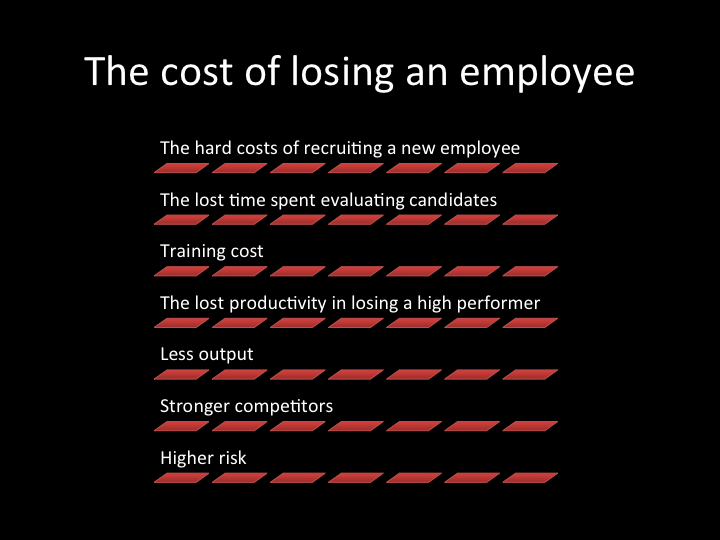
While most companies acknowledge the importance of recruiting, they often neglect the complementary principle that you need to put as much effort in keeping your existing team satisfied. Just as increasing user acquisition costs intensifies the value of retaining existing players, the increasing difficulty in finding great employees intensifies the need to minimize employee churn. There are multiple costs of replacing a good employee

Losing an employee is more costly than you realize
  • The hard costs of recruiting a new employee. This can be payments to a recruiter, referral fees to employees, travel costs to attend recruiting, travel costs to bring candidates in for interviews, etc.
  • The lost time spent evaluating candidates. The time you and your team spend reviewing resumes/CVs, interviewing candidates and discussing options. These days, almost all candidates go through multiple rounds of interviews before being offered a position. Each of those interviews takes 30 minutes or more of someone’s time, if you value that time based on the interviewer’s salary, you quickly get into the thousands of dollars (even more for a senior candidate who meets with leadership).
  • Training costs. These are both direct and indirect. You may have to send the new employee to various external training courses to prepare him for the job. More likely you will need to spend you time or your colleagues will training the new person on how the company works, practical issues (i.e. where the bathroom is), systems, interactions with other teams and what they need to perform their tasks optimally. Again, there is a cost for every minute that you and colleagues spend getting a new hire up to speed. When you break out salaries by how much the person earns per hour, this training cost often runs into the thousands of dollars.
  • The lost productivity in losing a high performer. You should never consider replacing an employee as an upgrade. If there are better people on the market, you need to recruit them proactively and replace weak team members. Assuming you adhere to this principle, if someone leaves voluntary, it means their replacement is not likely to be as good as the existing team member. The cost can range from minimal to huge in having somebody not as good performing a role on your team.
  • Less output. If you employ somebody, they should be providing a valuable service (or else you should proactively have eliminated the position). When you lose somebody, that task either does not get done until a replacement is in place or you must take other people off of their tasks (which again are worthwhile or you should not having them doing it). In either case, the overall output of your organization decreases.
  • Stronger competitors. When a good employee leaves, by definition they go somewhere else. That somewhere else is often a competitor, so not only are you losing their services but a competitor is likely improving. If Messi were to leave Barcelona for Real Madrid, the loss to Barcelona would be magnified by the improvement of their arch competitor.
  • Higher risk. Regardless of how rigorous your recruitment process, there is always risk that you make a bad hire. Many people interview above their actual competence, while others may just not be a good fit for your organization and processes. Thus, you have the risk that not only will the new hire be slightly weaker, they may prove incapable of doing the job and themselves have to be replaced. Then you have both an extended period of the job not getting done (or people being pulled off other tasks) and a repeat of the costs above.

Continue reading “Don’t forget to recruit your own team”

Like Loading...
Unknown's avatarAuthor Lloyd MelnickPosted on November 4, 2015May 1, 2021Categories General Social Games Business, General Tech Business, Lloyd's favorite postsTags employee retention, HR, productivity, recruiting, retention, training1 Comment on Don’t forget to recruit your own team

Blue Ocean Opportunities in the Red Ocean of Social Casino

For those of you who were not at Casual Connect and missed my talk on Blue Ocean opportunities in social casino and why they are the best path forward, below is a copy of my deck. The key takeaways are

  1. Social casino is one of the bloodiest of red oceans, with excellent well-financed companies competing ferociously. The best path to success is to take a Blue Ocean approach.
  2. Blue Ocean is all about turning non-customers into customers, rather than competing for the same customer.
  3. You do this by looking at what you can remove from the existing product offering, what you can add, what you can increase and what you can reduce. This leads to a new offering that appeals to new users.

The full presentation can be seen here:

Like Loading...
Unknown's avatarAuthor Lloyd MelnickPosted on October 26, 2015April 11, 2020Categories blue ocean strategy, General Social Games Business, Growth, Lloyd's favorite postsTags blue ocean, Casual Connect, mobile, slots, social casino, social games, Strategy2 Comments on Blue Ocean Opportunities in the Red Ocean of Social Casino

Why your business model should not rely solely on in-app purchases

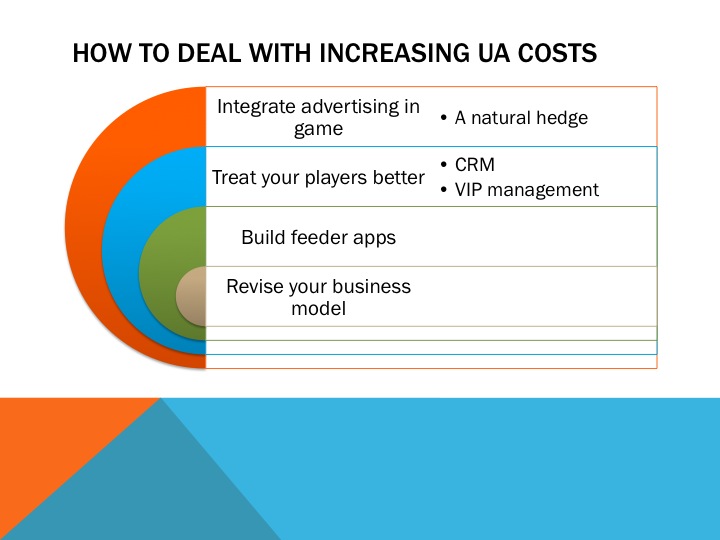
I have seen many disparate data points recently that when looked at holistically show how the free to play business model needs to evolve from relying on in-app purchases. While previously a strong in-game economy that generated significant revenue from in-app purchases was sufficient to create large profits for successful games, changes in the economics of the industry suggest in-app purchases will not be enough to support even successful games. The obvious answer is the advertising model, but even this model needs evolution to keep up with the times.

The data points

There are multiple data points that suggest CPIs (cost-per-installs) for performance marketing are not only increasing, but are likely to increase at the rate where they will surpass the lifetime value of acquired users for most games.

More apps, more spend

Slide1Most of the major game publishers are planning to grow through the launch of multiple new apps, particularly in the social casino space (where user acquisition costs are already high). While speaking colleagues recently, I learned that two of the major social slot companies have three new SKUs each planned for 2016, with planned spend of over $250,000 per day for each company already budgeted. They also expect their major competitors to each launch 1-2 new SKUs next year (and all in the first half of next year).

CPIs are simply a matter of supply and demand, and given that the advertising inventory is not increasing, it is inevitable that the cost of installs will increase. Even if the new apps are not targeted in your space, there is a limited number of people who will download a game and these companies will start to target your potential customers also because they will dry up their demographic.

Companies scapegoating user acquisition teams and agencies

The second data point is how many companies, including some of the biggest in the space, are replacing the leadership of their UA (user acquisition) teams and firing UA agencies they have worked with for several years. Many people I know have recently been approached for senior UA positions, and many of these people do not have significant UA experience. What is occurring is publishers are seeing a lower return on their advertising investment, or a negative return, and believe the problem is their UA team or advertising agency. Continue reading “Why your business model should not rely solely on in-app purchases”

Like Loading...
Unknown's avatarAuthor Lloyd MelnickPosted on October 14, 2015January 4, 2016Categories General Social Games Business, Growth, Lloyd's favorite posts, LTV, Social Games MarketingTags advertising, in-app purchases, LTV, UA, user acquisition2 Comments on Why your business model should not rely solely on in-app purchases

More discounts, less fees

Slide1Having traveled a lot recently, I noticed a phenomenon that presents opportunities to all companies. When companies or industries introduce new charges or fees, customers rebel. Examples include baggage and change fees by airlines and overdraft fees by banks. Customers react by switching if they have options (some industries have such fees across the industry), decreasing loyalty or just consuming less of the product. It is not a surprise that airlines are beset with bankruptcies and banks are much less profitable than in the past (hence the need for bailouts).

While most of those industries argue the fees are essential for profitability, there is another option. Rather than frame the charge as a fee, increase the overall price and provide incentives for the user to get a discount. Rather than charge a fee for maid service, some hotels now give customers a credit or loyalty points for waiving the maid service. Rather than being upset that they are being charged for maid service, the customer is happy that they just received a $5 credit for not having their bed made. I am sure this $5 is included in the cost of the room but the customer leaves with a better impression of the hotel than if they had been charged a fee.

There is an argument that people will select the lowest cost provider regardless, and if the fee is built into the price the customer will go elsewhere, but Southwest Airlines proves this argument does not have much validity. Southwest is one of the few US airlines not to charge for baggage (and thus probably adds the cost to the ticket price), yet Southwest is the only airline to be profitable since 1971. Customers are savvy and those companies that are condescending towards them pay the price in the long-run.

What this means to you

If you do not run an airline or hotel, you may think that there is no way to apply this understanding but that is not the case. It applies to virtually any business, particularly e-commerce. Rather than charging for overnight shipping, offer free shipping but give customers a discount if they accept standard delivery. If you have a free-to-play game, rather than charging users extra if they are not VIPs, give a discount if they join your loyalty program. The key is turn your pricing into something that enhances the customer experience.

Like Loading...
Unknown's avatarAuthor Lloyd MelnickPosted on September 30, 2015January 4, 2016Categories General Social Games Business, General Tech Business, Lloyd's favorite posts, Social Games MarketingTags discounts, fees, monetization, pricingLeave a comment on More discounts, less fees

Posts pagination

Previous page Page 1 … Page 3 Page 4 Page 5 … Page 11 Next page

Get my book on LTV

The definitive book on customer lifetime value, Understanding the Predictable, is now available in both print and Kindle formats on Amazon.

Understanding the Predictable delves into the world of Customer Lifetime Value (LTV), a metric that shows how much each customer is worth to your business. By understanding this metric, you can predict how changes to your product will impact the value of each customer. You will also learn how to apply this simple yet powerful method of predictive analytics to optimize your marketing and user acquisition.

For more information, click here

Follow The Business of Social Games and Casino on WordPress.com

Enter your email address to follow this blog and receive notifications of new posts by email.

Join 791 other subscribers

Most Recent Posts

  • Join me at PDMA Inspire for my talk on new product prioritization
  • Why keep studying?
  • The next three years of this blog
  • Interview with the CEO of Murka on the biggest growth opportunity in gaming, Barak David

Lloyd Melnick

This is Lloyd Melnick’s personal blog.  All views and opinions expressed on this website are mine alone and do not represent those of people, institutions or organizations that I may or may not be associated with in professional or personal capacity.

I am a serial builder of businesses (senior leadership on three exits worth over $700 million), successful in big (Disney, Stars Group/PokerStars, Zynga) and small companies (Merscom, Spooky Cool Labs) with over 20 years experience in the gaming and casino space.  Currently, I am the GM of VGW’s Chumba Casino and on the Board of Directors of Murka Games and Luckbox.

Topic Areas

  • Analytics (114)
  • Bayes' Theorem (8)
  • behavioral economics (8)
  • blue ocean strategy (14)
  • Crowdfunding (4)
  • DBA (2)
  • General Social Games Business (459)
  • General Tech Business (195)
  • Growth (88)
  • International Issues with Social Games (50)
  • Lloyd's favorite posts (101)
  • LTV (54)
  • Machine Learning (10)
  • Metaverse (1)
  • Mobile Platforms (37)
  • Prioritization (1)
  • Social Casino (52)
  • Social Games Marketing (105)
  • thinking fast and slow (5)
  • Uncategorized (33)

Social

  • View CasualGame’s profile on Facebook
  • View @lloydmelnick’s profile on Twitter
  • View lloydmelnick’s profile on LinkedIn

RSS

RSS Feed RSS - Posts

RSS Feed RSS - Comments

Categories

  • Analytics (114)
  • Bayes' Theorem (8)
  • behavioral economics (8)
  • blue ocean strategy (14)
  • Crowdfunding (4)
  • DBA (2)
  • General Social Games Business (459)
  • General Tech Business (195)
  • Growth (88)
  • International Issues with Social Games (50)
  • Lloyd's favorite posts (101)
  • LTV (54)
  • Machine Learning (10)
  • Metaverse (1)
  • Mobile Platforms (37)
  • Prioritization (1)
  • Social Casino (52)
  • Social Games Marketing (105)
  • thinking fast and slow (5)
  • Uncategorized (33)

Archives

  • September 2023
  • December 2021
  • July 2021
  • March 2021
  • February 2021
  • January 2021
  • December 2020
  • November 2020
  • October 2020
  • September 2020
  • August 2020
  • July 2020
  • June 2020
  • May 2020
  • April 2020
  • March 2020
  • February 2020
  • January 2020
  • November 2019
  • October 2019
  • September 2019
  • June 2019
  • May 2019
  • April 2019
  • March 2019
  • February 2019
  • January 2019
  • December 2018
  • June 2018
  • May 2018
  • April 2018
  • March 2018
  • February 2018
  • January 2018
  • December 2017
  • June 2017
  • May 2017
  • April 2017
  • March 2017
  • February 2017
  • January 2017
  • December 2016
  • November 2016
  • October 2016
  • September 2016
  • June 2016
  • May 2016
  • April 2016
  • March 2016
  • February 2016
  • January 2016
  • December 2015
  • November 2015
  • October 2015
  • September 2015
  • July 2015
  • June 2015
  • May 2015
  • April 2015
  • March 2015
  • February 2015
  • January 2015
  • December 2014
  • November 2014
  • October 2014
  • September 2014
  • August 2014
  • July 2014
  • June 2014
  • May 2014
  • April 2014
  • March 2014
  • February 2014
  • January 2014
  • December 2013
  • November 2013
  • October 2013
  • September 2013
  • August 2013
  • July 2013
  • June 2013
  • May 2013
  • April 2013
  • March 2013
  • February 2013
  • January 2013
  • December 2012
  • November 2012
  • October 2012
  • September 2012
  • August 2012
  • July 2012
  • June 2012
  • May 2012
  • April 2012
  • March 2012
  • February 2012
  • January 2012
  • December 2011
  • November 2011
  • October 2011
  • September 2011
  • August 2011
  • July 2011
  • June 2011
  • May 2011
  • December 2010
December 2025
S M T W T F S
 123456
78910111213
14151617181920
21222324252627
28293031  
« Sep    

by Lloyd Melnick

All posts by Lloyd Melnick unless specified otherwise
Google+

Enter your email address to subscribe to this blog and receive notifications of new posts by email.

Join 791 other subscribers
Follow Lloyd Melnick on Quora

RSS HBR Blog

  • How One Manufacturer Achieved Net Zero at Zero Cost
  • What Can U.S. Employers Do About Rising Healthcare Costs?
  • When You Have to Execute a Strategy You Disagree With
  • 4 Ways to Build Durable Relationships with Your Most Important Customers
  • What Jargon Says About Your Company Culture
  • Research: When Used Correctly, LLMs Can Unlock More Creative Ideas
  • Your New Role Requires Strategic Thinking…But You’re Stuck in the Weeds
  • For Circular Economy Innovation, Look to the Global South
  • Why Great Leaders Focus on the Details
  • Corporate Disclosure in the Age of AI

RSS Techcrunch

  • An error has occurred; the feed is probably down. Try again later.

RSS MIT Sloan Management Review Blog

  • AI Coding Tools: The Productivity Trap Most Companies Miss
  • How Procter & Gamble Uses AI to Unlock New Insights From Data
  • Rewire Organizational Knowledge With GenAI
  • Hungry for Learning: Wendy’s Will Croushorn
  • Beat Burnout: 10 Essential MIT SMR Reads
  • How Leaders Stay True to Themselves and Their Stakeholders
  • Our Guide to the Winter 2026 Issue
  • Broadening Future Perspectives at the Bank of England
  • A Faster Way to Build Future Scenarios
  • Assess What Is Certain in a Sea of Unknowns
The Business of Social Games and Casino Website Powered by WordPress.com.
  • Subscribe Subscribed
    • The Business of Social Games and Casino
    • Join 726 other subscribers
    • Already have a WordPress.com account? Log in now.
    • The Business of Social Games and Casino
    • Subscribe Subscribed
    • Sign up
    • Log in
    • Report this content
    • View site in Reader
    • Manage subscriptions
    • Collapse this bar
 

Loading Comments...
 

    %d