I am very proud to announce I will be speaking at MIT’s CDOIQ (Chief Data Officer and Information Quality) Symposium in July about how data affects your LTV projections, and ways to improve the quality of your metrics. It’s going to be a great conference and I would love to meet up with anyone who will be there.
Tag: LTV
Lifetime Value presentation to Yetizen
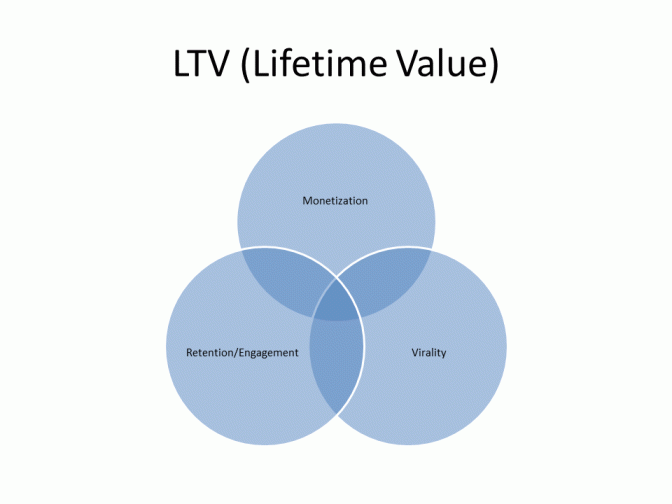
Below is a presentation that I gave yesterday on lifetime value (LTV) to the portfolio companies of YetiZen. It covers the importance of LTV, key variables (monetization, virality and retention) and how to affect them, importance outside gaming, cohort analysis and the predictive nature of LTV. Other than the final section on uncertainty, which echoes my blog post on Tuesday, the presentation is largely consistent with the one posted earlier that I gave at Groundwork Labs a few months ago. Here is the one from last night:
Lifetime Value Part 9: Uncertainty and LTV
The key to using customer lifetime value (LTV) effectively is the understanding that it is a prediction, not a value. In my previous eight posts on LTV, I stressed the importance of LTV to the success of your game and company and the key components in determining LTV. After reading Nate Silver’s The Signal and the Noise
The Uncertainty Principle
Many people mistakenly believe (and I may have inadvertently implied this in a previous post), that LTV is an exact function of virality, monetization and retention. It implies you put those variables into a formula and get out a number that shows precisely how much a player is worth. That would be the case if you did it with historical information after five years and then calculated how much that player had been worth to you. However, you are calculating how much the player will be worth, which is inherently different because you are predicting their future value.

The uncertainty principle, a key tenet of quantum mechanics (as popularized by Stephen Hawking), postulates that perfect predictions are impossible if the universe itself is random. Since you cannot have a perfect prediction, your LTV cannot be a distinctly quantified value. You are predicting future events (how much the player will monetize, how viral they will be and how long they will stay in your game) based on the available data. Your LTV model is a simplification of the world the player is in; you are looking at several variables but you cannot look at everything (e.g., chance of war, plague, everyone switching to Blackberry devices). In effect, your LTV calculation is very similar to a sportscaster’s estimate of how many home runs Albert Pujols will hit or a weatherman’s prediction on the likelihood of a hurricane to hit Cape Hatteras. Continue reading “Lifetime Value Part 9: Uncertainty and LTV”
Lifetime Value Part 8: Incorporating costs and expenses in LTV
An aspect of lifetime value that is often neglected but could mean the difference between the ability to advertise (or not), are the costs associated with your game (or product for those outside the gaming space). As I have discussed in detail in the first seven posts on customer lifetime value (LTV), your lifetime value has to exceed to cost per install of a new user (CPI) to justify advertising. The LTV is a formula incorporating retention, virality and monetization. The other areas, though, that you need to look at are costs that lower the revenue stream from the user. Continue reading “Lifetime Value Part 8: Incorporating costs and expenses in LTV”
Using analytics to optimize all of your advertising spend
A recent article in the Harvard Business Review on Advertising Analytics 2.0 shows how advanced analytic tools and concepts can improve the return from your growth efforts. The article, written by Wes Nichols of MarketShare, shows how ad channels increasingly interact with each other and you can be much more effective by understanding these interactions. What you do in performance marketing, search ads, web, YouTube, TV and PR are not independent of each other. For example, a TV advertisement may increase Google searches that are then directed to your web game by purchasing ad words.
Advanced analytics allow you to understand these interdependencies and allocate accordingly. For example, one company found 85 percent of its budget went to TV ads and six percent to YouTube ads but the YouTube ads were nearly twice as effective at driving search. They then changed their allocation of ad dollars. This adjustment increased sales nine percent without incurring any additional advertising expense.
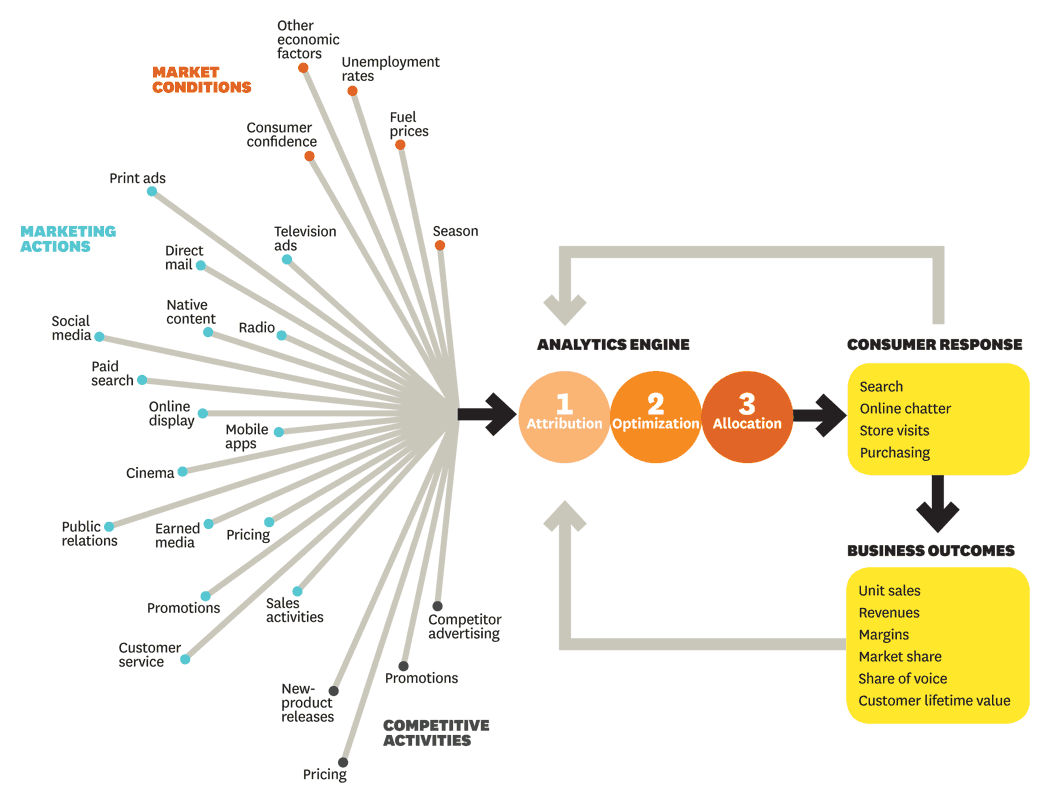 One of the keys to using analytics more effectively is understanding what data to collect. Many in the game industry think that tracking clicks on cost-per-click (CPC) campaigns, adding some consumer surveys, focus groups and last-click attribution is enough to optimize their marketing. It is not. Continue reading “Using analytics to optimize all of your advertising spend”
Lifetime Value Part 7: The importance of segments and cohorts to LTV
In previous posts, I discussed the importance of customer lifetime value (LTV), its key elements (monetization, retention and virality) and how to calculate LTV; but it is important to also understand that there is not a monolithic LTV for your game (or product). You may remember that the practical value of LTV is to use it as a metric to determine whether or not an ad spend has a positive return. If the LTV is higher than the cost per install (CPI), it is profitable to advertise (and vice versa).

The key to success, though, is understanding the LTV of the customer you will be acquiring as opposed to the general LTV for the game. Some low cost user acquisition channels may bring in players who are effectively worthless (they leave your game right after they click on the ad) even in a game that has a high overall LTV, so understanding the lifetime value of these users would save you from wasting your money. Conversely, there may be a very expensive advertising channel that brings in great players who all monetize well and have a much higher lifetime value than their CPI.
There are four factors that you should use to calculate separate LTVs (and in different combinations): Continue reading “Lifetime Value Part 7: The importance of segments and cohorts to LTV”
Lifetime Value Part 6: Guest Post on Calculating LTV
Mark Robinson, the Co-Founder and COO of GamesAnalytics , was generous enough to write the first guest post on my blog, getting into the mechanics of determining Lifetime Value (LTV). This post does a great job of putting many of the ideas I have discussed in my LTV series into practice. Here are Mark’s thoughts on calculating LTV.

The games industry is quickly learning how to design engaging player experiences and make money from free to play (F2P) games. The transformation from console to online has placed analytics at the heart of game design and management. There are two types of analytics. Game Performance metrics let us interpret the health of our games. Player Behavioural metrics tell us what to do about it to make things better. Continue reading “Lifetime Value Part 6: Guest Post on Calculating LTV”
Lifetime Value Part 5: Moneyball and LTV
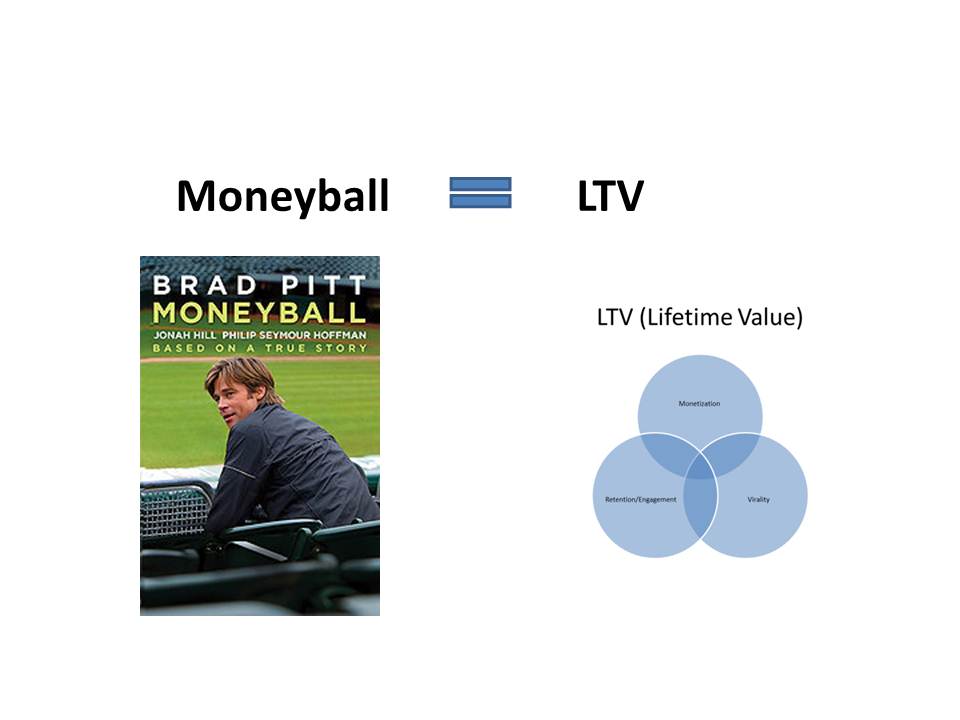
I have written several times about Moneyball and many times about customer lifetime value (LTV), so I wanted to bring the two together. Moneyball was the Michael Lewis book turned into a successful film about Billy Beane and how he made the Oakland A’s competitive by relying on analytics over intuition (for more detail, please see Lessons from Moneyball for the Social Game Industry and Moneyball Strikes Again). The same principles that help the Oakland A’s compete effectively could help social game companies compete, even against better financed firms. The same phenomenon holds with LTV, in which many of the metrics people focus on do not have maximum impact on long-term success.
Runs = LTV
LTV serves the same role in your business as runs do in baseball. Beane and his analysts realized that the success of a baseball team comes down to scoring more runs than your opponent. They thus reverse-engineered the game and its players into what contributed to scoring runs and what contributed to preventing runs. They then used their resources that maximized the delta between runs scored by the A’s and runs that they allowed. Continue reading “Lifetime Value Part 5: Moneyball and LTV”
Talk on LTV and Monetization
I will be speaking today at 11 at Groundwork Labs, the Durham-based technology accelerator, on why companies in any industry need to focus on LTV, the primary levers and its impact on success. Anyone interested and in the area is free to come by. Much of the discussion has been covered previously in this blog, but feel free to check out the presentation on Slideshare:
Lifetime Value Part 4: The role of retention in LTV and how to impact it
Retention is one of three components that you use to determine LTV (lifetime value of a customer) and in many ways most important to the success of a product (and the most difficult to improve significantly after launch). Three weeks ago, I wrote about the central importance of lifetime value (LTV) to the success of your game and your company. This week I want to discuss retention, its importance and how you can improve it.
How to define retention
Retention is how often players play your game and thus, also, how long they remain active players. As with all the LTV metrics, different companies use different measures of retention to determine lifetime value.
There are several components of retention for you to track and roll into your LTV formula. Continue reading “Lifetime Value Part 4: The role of retention in LTV and how to impact it”
 The Business of Social Games and Casino