Skip to content

The Business of Social Games and Casino

How to succeed in the mobile game space by Lloyd Melnick

Category: General Social Games Business

Jay Powell’s blog post on the perils of working with some publishers

Last year I blogged about developers needing to choose a publisher carefully. This post shows that devs still need to be careful.

JP's avatarJay Powell

Gamezebo recently posted an open letter from several studios about the horrific relationship they have endured with Mamba Games.  I’m not going to post the entirety of it here but basically the publisher sold their rights where they were not legally allowed to do so and has failed to pay or even report the sales back to several studios.  This is a breach of contract in the worst way and unfortunately many developers just throw up their hands and say “What can we do about it? We can’t afford to sue them”.  Many times they’re right but I like the way they have chosen to handle the situation.

View original post 367 more words
Share this:

  • Click to share on Facebook (Opens in new window) Facebook
  • Click to share on LinkedIn (Opens in new window) LinkedIn
Like Loading...
Unknown's avatarAuthor Lloyd MelnickPosted on February 18, 2013February 18, 2013Categories General Social Games BusinessLeave a comment on Jay Powell’s blog post on the perils of working with some publishers

Physical virtual goods prove their value to game publishers

Activision’s earnings announcement yesterday shows how attractive successfully conquering the physical virtual goods market is. On November 27, I blogged that Activision would be the big winner Q4 2012 on the strength of the Skylanders franchise and its reliance on a new business model, selling physical versions of virtual goods. I elaborated on that post earlier this month, commenting that the emergence of the Physical Virtual Goods monetization model was one of the most exciting developments in the gaming space in years .

Image from 5minutesformom.com

Today, Activision’s stock rose 14 percent because earnings tripled from the fourth quarter last year (in a period in which overall video games sales slumped). Net income increased 257.58 percent to $354 million in the quarter versus a net gain of $99 million in the year-earlier quarter. Revenue rose 25.66 percent to $1.77 billion from the year-earlier quarter (unfortunately, some of that is due to my family).

This report affirms my belief that physical virtual goods are an incredible opportunity. While I do not advocate trying to copy exactly what Activision has done (I believe in blue oceans, not fast following), there are many elements in this space (e.g., product type, demographic) that represent incredible opportunities for game companies.

Share this:

  • Click to share on Facebook (Opens in new window) Facebook
  • Click to share on LinkedIn (Opens in new window) LinkedIn
Like Loading...
Unknown's avatarAuthor Lloyd MelnickPosted on February 8, 2013February 19, 2013Categories General Social Games BusinessTags Activision, monetization, physical virtual goods, SkylandersLeave a comment on Physical virtual goods prove their value to game publishers

Lifetime Value Part 5: Moneyball and LTV

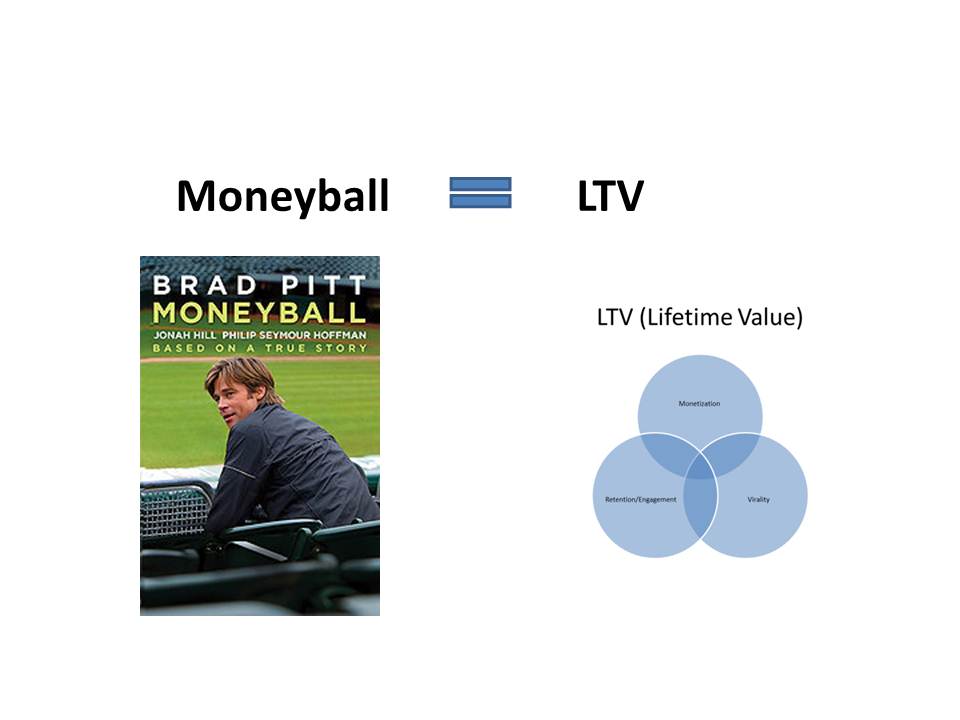
Moneyball = LTV

I have written several times about Moneyball and many times about customer lifetime value (LTV), so I wanted to bring the two together. Moneyball was the Michael Lewis book turned into a successful film about Billy Beane and how he made the Oakland A’s competitive by relying on analytics over intuition (for more detail, please see Lessons from Moneyball for the Social Game Industry and Moneyball Strikes Again). The same principles that help the Oakland A’s compete effectively could help social game companies compete, even against better financed firms. The same phenomenon holds with LTV, in which many of the metrics people focus on do not have maximum impact on long-term success.

Runs = LTV

LTV serves the same role in your business as runs do in baseball. Beane and his analysts realized that the success of a baseball team comes down to scoring more runs than your opponent. They thus reverse-engineered the game and its players into what contributed to scoring runs and what contributed to preventing runs. They then used their resources that maximized the delta between runs scored by the A’s and runs that they allowed. Continue reading “Lifetime Value Part 5: Moneyball and LTV”

Share this:

  • Click to share on Facebook (Opens in new window) Facebook
  • Click to share on LinkedIn (Opens in new window) LinkedIn
Like Loading...
Unknown's avatarAuthor Lloyd MelnickPosted on February 6, 2013February 19, 2013Categories Analytics, General Social Games Business, LTVTags analytics, LTV, Moneyball, retention, social gamesLeave a comment on Lifetime Value Part 5: Moneyball and LTV

Talk on LTV and Monetization

I will be speaking today at 11 at Groundwork Labs, the Durham-based technology accelerator, on why companies in any industry need to focus on LTV, the primary levers and its impact on success. Anyone interested and in the area is free to come by. Much of the discussion has been covered previously in this blog, but feel free to check out the presentation on Slideshare:

Groundworks presentation on monetization and ltv from Lloyd Melnick

Share this:

  • Click to share on Facebook (Opens in new window) Facebook
  • Click to share on LinkedIn (Opens in new window) LinkedIn
Like Loading...
Unknown's avatarAuthor Lloyd MelnickPosted on February 1, 2013January 31, 2013Categories Analytics, General Social Games Business, LTVTags groundwork labs, LTV, monetization, presentationLeave a comment on Talk on LTV and Monetization

Using probability to build a game portfolio likely to succeed

One of the biggest challenges for a social or mobile game company is managing the challenges of an industry that is hit-driven. Understanding the laws of probability is a good step in overcoming this hurdle. Since the beginning of time, game companies have been struggling with the hit-driven nature of our industry. Although new markets and technologies (e.g., casual, social, and mobile games) held out the promise of not being as hit-driven, they all ended up having a few titles drive the majority of revenue. The number I use is that 25 percent of games will break even or make a profit after launch (without accounting for development expense); this means that there’s a 75 percent failure rate. (I have heard estimates that as many as 90 percent of game projects fail and I would not argue strongly against that number, but for the sake of analysis I will use a success rate of 25 percent.)

Chance of dice rolls

The argument for taking a portfolio approach

Basic probability theory shows the importance of having multiple independent game projects to improve your company’s chance of success (more on independence later). By using probability, the benefits of taking a portfolio approach become clear. Continue reading “Using probability to build a game portfolio likely to succeed”

Share this:

  • Click to share on Facebook (Opens in new window) Facebook
  • Click to share on LinkedIn (Opens in new window) LinkedIn
Like Loading...
Unknown's avatarAuthor Lloyd MelnickPosted on January 31, 2013February 19, 2013Categories General Social Games Business, Lloyd's favorite postsTags portfolio strategy, probability, social games12 Comments on Using probability to build a game portfolio likely to succeed

Lifetime Value Part 4: The role of retention in LTV and how to impact it

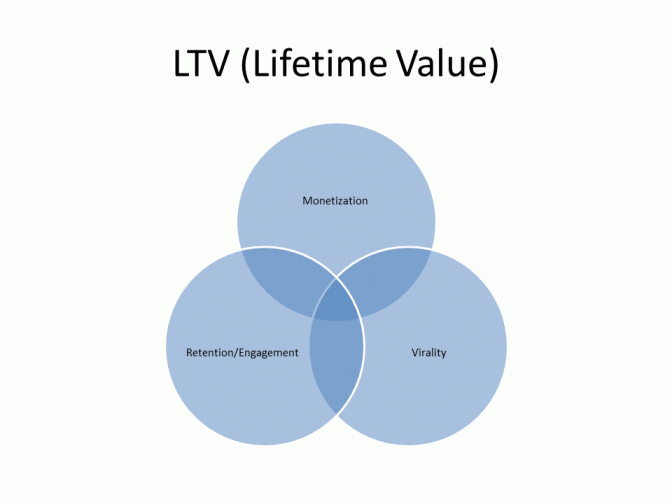
Retention is one of three components that you use to determine LTV (lifetime value of a customer) and in many ways most important to the success of a product (and the most difficult to improve significantly after launch). Three weeks ago, I wrote about the central importance of lifetime value (LTV) to the success of your game and your company. This week I want to discuss retention, its importance and how you can improve it.

LTV Venn Diagram

How to define retention

Retention is how often players play your game and thus, also, how long they remain active players. As with all the LTV metrics, different companies use different measures of retention to determine lifetime value.

There are several components of retention for you to track and roll into your LTV formula. Continue reading “Lifetime Value Part 4: The role of retention in LTV and how to impact it”

Share this:

  • Click to share on Facebook (Opens in new window) Facebook
  • Click to share on LinkedIn (Opens in new window) LinkedIn
Like Loading...
Unknown's avatarAuthor Lloyd MelnickPosted on January 29, 2013February 4, 2013Categories Analytics, General Social Games Business, Lloyd's favorite posts, LTVTags lifetime value, LTV, retention, social games6 Comments on Lifetime Value Part 4: The role of retention in LTV and how to impact it

Accounting issues tied to crowd-funding

This is a great post on GamesBrief about accounting issues tied to crowd-funding (as a site note, I highly recommend you follow GamesBrief). I have written before about how crowd-funding is increasingly important, especially in the games space. Although the post is focused primarily on the UK (and accounting is different in every country), it highlights some universal issues everyone should be aware of regarding crowd-funding.
kickstarter-logo

Share this:

  • Click to share on Facebook (Opens in new window) Facebook
  • Click to share on LinkedIn (Opens in new window) LinkedIn
Like Loading...
Unknown's avatarAuthor Lloyd MelnickPosted on January 28, 2013February 4, 2013Categories Crowdfunding, General Social Games BusinessTags crowd-funding, Equity crowd-fundingLeave a comment on Accounting issues tied to crowd-funding

Facebook’s importance, or lack thereof, for social gaming

I have been reluctant to join the bandwagon of people declaring Facebook dead, either overall or as a social gaming platform, but I have gotten to the point where I have lost confidence in Facebook. It has been fashionable since Facebook’s IPO to say the platform was in trouble because of the shift to mobile. In the game space, the anti-Facebook crowd got started even earlier, suggesting the only wise course for social game companies was to develop for mobile platforms instead of Facebook. I was reluctant to join this chorus, given the incredible user numbers Facebook has and the revenue that some games were still generating on Facebook (which dwarfed comparable mobile games). However, I have been rethinking my position.

Facebook logo Continue reading “Facebook’s importance, or lack thereof, for social gaming”

Share this:

  • Click to share on Facebook (Opens in new window) Facebook
  • Click to share on LinkedIn (Opens in new window) LinkedIn
Like Loading...
Unknown's avatarAuthor Lloyd MelnickPosted on January 24, 2013February 4, 2013Categories General Social Games Business, Mobile PlatformsTags Facebook, mobile gaming, social gaming, zynga1 Comment on Facebook’s importance, or lack thereof, for social gaming

Lifetime Value Part 3: Monetization’s role in LTV and how to impact it

Monetization is one of three components that you use to determine LTV (lifetime value of a customer) and is the one that is the easiest to improve. Two weeks ago, I wrote about the central importance of lifetime value to the success of your game and your company. This week I want to discuss monetization, its importance and how you can improve it.

How to define monetization

Monetization at its core is how much money an average player spends in your game. As with the other two components of LTV, there are different facets of monetization that you can use to create a more accurate calculation. With all monetization measurements, you need to incorporate all revenue, including revenue that does not come from in-app purchases (e.g., advertising revenue, subscription revenue) to get a true picture of monetization and LTV.

moneyThe primary metric for monetization is ARPDAU (average revenue per daily active user) but there are several other metrics that together can help you get a more robust LTV calculation. Continue reading “Lifetime Value Part 3: Monetization’s role in LTV and how to impact it”

Share this:

  • Click to share on Facebook (Opens in new window) Facebook
  • Click to share on LinkedIn (Opens in new window) LinkedIn
Like Loading...
Unknown's avatarAuthor Lloyd MelnickPosted on January 22, 2013February 19, 2013Categories Analytics, General Social Games Business, LTVTags LTV, monetization, social gaming4 Comments on Lifetime Value Part 3: Monetization’s role in LTV and how to impact it

Great financial tool for tracking against plan and re-forecasting

This is a tool that was recommended to me and I plan to start using immediately. Recommend for anyone who seriously wants to manage their business and cash flow. Thanks to Kirk Owen for recommending it to me.

brianascher's avatarVC Waves

Today I faced a choice.  Should I go out and enjoy the beautiful weather and waves and go for a surf or should I blog about my favorite financial reporting tool?  Seems like a pathetic question for a surfer to ask, or maybe this financial reporting tool is really that great.  I’ll settle for an answer of “both”.

The tool in question is the Waterfall Chart.  It’s a way to compare actual results across time periods (months or quarters usually) against your original Plan of Record, as well as forecasts you made along the way as more information became available.  It packs a ton of information into a concise format, and provides management and Board members quick answers to the following important questions:

1.      How are we doing against plan?  Against what we thought last time we reforecast?

2.      Where are we most likely to end up at the end…

View original post 655 more words

Share this:

  • Click to share on Facebook (Opens in new window) Facebook
  • Click to share on LinkedIn (Opens in new window) LinkedIn
Like Loading...
Unknown's avatarAuthor Lloyd MelnickPosted on January 20, 2013January 20, 2013Categories General Social Games BusinessLeave a comment on Great financial tool for tracking against plan and re-forecasting

Posts pagination

Previous page Page 1 … Page 35 Page 36 Page 37 … Page 46 Next page

Get my book on LTV

The definitive book on customer lifetime value, Understanding the Predictable, is now available in both print and Kindle formats on Amazon.

Understanding the Predictable delves into the world of Customer Lifetime Value (LTV), a metric that shows how much each customer is worth to your business. By understanding this metric, you can predict how changes to your product will impact the value of each customer. You will also learn how to apply this simple yet powerful method of predictive analytics to optimize your marketing and user acquisition.

For more information, click here

Follow The Business of Social Games and Casino on WordPress.com

Enter your email address to follow this blog and receive notifications of new posts by email.

Join 791 other subscribers

Most Recent Posts

  • Join me at PDMA Inspire for my talk on new product prioritization
  • Why keep studying?
  • The next three years of this blog
  • Interview with the CEO of Murka on the biggest growth opportunity in gaming, Barak David

Lloyd Melnick

This is Lloyd Melnick’s personal blog.  All views and opinions expressed on this website are mine alone and do not represent those of people, institutions or organizations that I may or may not be associated with in professional or personal capacity.

I am a serial builder of businesses (senior leadership on three exits worth over $700 million), successful in big (Disney, Stars Group/PokerStars, Zynga) and small companies (Merscom, Spooky Cool Labs) with over 20 years experience in the gaming and casino space.  Currently, I am the GM of VGW’s Chumba Casino and on the Board of Directors of Murka Games and Luckbox.

Topic Areas

  • Analytics (114)
  • Bayes' Theorem (8)
  • behavioral economics (8)
  • blue ocean strategy (14)
  • Crowdfunding (4)
  • DBA (2)
  • General Social Games Business (459)
  • General Tech Business (195)
  • Growth (88)
  • International Issues with Social Games (50)
  • Lloyd's favorite posts (101)
  • LTV (54)
  • Machine Learning (10)
  • Metaverse (1)
  • Mobile Platforms (37)
  • Prioritization (1)
  • Social Casino (52)
  • Social Games Marketing (105)
  • thinking fast and slow (5)
  • Uncategorized (33)

Social

  • View CasualGame’s profile on Facebook
  • View @lloydmelnick’s profile on Twitter
  • View lloydmelnick’s profile on LinkedIn

RSS

RSS Feed RSS - Posts

RSS Feed RSS - Comments

Categories

  • Analytics (114)
  • Bayes' Theorem (8)
  • behavioral economics (8)
  • blue ocean strategy (14)
  • Crowdfunding (4)
  • DBA (2)
  • General Social Games Business (459)
  • General Tech Business (195)
  • Growth (88)
  • International Issues with Social Games (50)
  • Lloyd's favorite posts (101)
  • LTV (54)
  • Machine Learning (10)
  • Metaverse (1)
  • Mobile Platforms (37)
  • Prioritization (1)
  • Social Casino (52)
  • Social Games Marketing (105)
  • thinking fast and slow (5)
  • Uncategorized (33)

Archives

  • September 2023
  • December 2021
  • July 2021
  • March 2021
  • February 2021
  • January 2021
  • December 2020
  • November 2020
  • October 2020
  • September 2020
  • August 2020
  • July 2020
  • June 2020
  • May 2020
  • April 2020
  • March 2020
  • February 2020
  • January 2020
  • November 2019
  • October 2019
  • September 2019
  • June 2019
  • May 2019
  • April 2019
  • March 2019
  • February 2019
  • January 2019
  • December 2018
  • June 2018
  • May 2018
  • April 2018
  • March 2018
  • February 2018
  • January 2018
  • December 2017
  • June 2017
  • May 2017
  • April 2017
  • March 2017
  • February 2017
  • January 2017
  • December 2016
  • November 2016
  • October 2016
  • September 2016
  • June 2016
  • May 2016
  • April 2016
  • March 2016
  • February 2016
  • January 2016
  • December 2015
  • November 2015
  • October 2015
  • September 2015
  • July 2015
  • June 2015
  • May 2015
  • April 2015
  • March 2015
  • February 2015
  • January 2015
  • December 2014
  • November 2014
  • October 2014
  • September 2014
  • August 2014
  • July 2014
  • June 2014
  • May 2014
  • April 2014
  • March 2014
  • February 2014
  • January 2014
  • December 2013
  • November 2013
  • October 2013
  • September 2013
  • August 2013
  • July 2013
  • June 2013
  • May 2013
  • April 2013
  • March 2013
  • February 2013
  • January 2013
  • December 2012
  • November 2012
  • October 2012
  • September 2012
  • August 2012
  • July 2012
  • June 2012
  • May 2012
  • April 2012
  • March 2012
  • February 2012
  • January 2012
  • December 2011
  • November 2011
  • October 2011
  • September 2011
  • August 2011
  • July 2011
  • June 2011
  • May 2011
  • December 2010
January 2026
S M T W T F S
 123
45678910
11121314151617
18192021222324
25262728293031
« Sep    

by Lloyd Melnick

All posts by Lloyd Melnick unless specified otherwise
Google+

Enter your email address to subscribe to this blog and receive notifications of new posts by email.

Join 791 other subscribers
Follow Lloyd Melnick on Quora

RSS HBR Blog

  • How Bristol Myers Squibb Transformed Working Capital to Fund Its Future - SPONSOR CONTENT FROM EY-PARTHENON
  • How to Handle a Difficult Board Member
  • When Being a Family Business Becomes a Competitive Advantage
  • How to Strengthen Your Focus When Demands Never Let Up
  • The Risks of Prioritizing Short-Term Revenue Over Customer Fit
  • When There’s Nowhere to Promote a Star Employee
  • Why AI Boosts Creativity for Some Employees but Not Others
  • Where McKinsey—and Consulting—Go From Here
  • How Equitable Confronted Its Inertia After 160 Years in Business
  • Our Favorite Management Tips on Creating Meaning and Happiness at Work

RSS Techcrunch

  • An error has occurred; the feed is probably down. Try again later.

RSS MIT Sloan Management Review Blog

  • Your People Are Not All Right
  • Five Trends in AI and Data Science for 2026
  • Stop Making Hollow Apologies at Work
  • Calm: The Underrated Capability Every Leader Needs Now
  • The Top Five MIT SMR Videos of 2025
  • Three Steps Toward Fairer Talent Management
  • From Crisis to Coopetition: What Leaders Can Learn From Anesthesiologists
  • AI Coding Tools: The Productivity Trap Most Companies Miss
  • How Procter & Gamble Uses AI to Unlock New Insights From Data
  • Rewire Organizational Knowledge With GenAI
The Business of Social Games and Casino Website Powered by WordPress.com.
  • Subscribe Subscribed
    • The Business of Social Games and Casino
    • Join 726 other subscribers
    • Already have a WordPress.com account? Log in now.
    • The Business of Social Games and Casino
    • Subscribe Subscribed
    • Sign up
    • Log in
    • Report this content
    • View site in Reader
    • Manage subscriptions
    • Collapse this bar
 

Loading Comments...
 

    %d